

6.7E: Exercises for Section 6.7
- Page ID
- 69815

In exercises 1 - 3, find the derivative \(\dfrac{dy}{dx}\).
1) \(y=\ln(2x)\)
- Answer
- \(\dfrac{dy}{dx} = \dfrac{1}{x}\)
2) \(y=\ln(2x+1)\)
3) \(y=\dfrac{1}{\ln x}\)
- Answer
- \(\dfrac{dy}{dx} = −\dfrac{1}{x(\ln x)^2}\)
In exercises 4 - 5, find the indefinite integral.
4) \(\displaystyle ∫\frac{dt}{3t}\)
5) \(\displaystyle ∫\frac{dx}{1+x}\)
- Answer
- \(\displaystyle ∫\frac{dx}{1+x} = \ln|x+1|+C\)
In exercises 6 - 15, find the derivative \(\dfrac{dy}{dx}\). (You can use a calculator to plot the function and the derivative to confirm that it is correct.)
6) [T] \(y=\dfrac{\ln x}{x}\)
7) [T] \(y=x\ln x\)
- Answer
- \(\dfrac{dy}{dx} = \ln(x)+1\)
8) [T] \(y=\log_{10}x\)
9) [T] \(y=\ln(\sin x)\)
- Answer
- \(\dfrac{dy}{dx} = \cot x\)
10) [T] \(y=\ln(\ln x)\)
11) [T] \(y=7\ln(4x)\)
- Answer
- \(\dfrac{dy}{dx} = \frac{7}{x}\)
12) [T] \(y=\ln\big((4x)^7\big)\)
13) [T] \(y=\ln(\tan x)\)
- Answer
- \(\dfrac{dy}{dx} = \csc x\sec x\)
14) [T] \(y=\ln(\tan 3x)\)
15) [T] \(y=\ln(\cos^2x)\)
- Answer
- \(\dfrac{dy}{dx} = −2\tan x\)
In exercises 16 - 25, find the definite or indefinite integral.
16) \(\displaystyle ∫^1_0\frac{dx}{3+x}\)
17) \(\displaystyle ∫^1_0\frac{dt}{3+2t}\)
- Answer
- \(\displaystyle ∫^1_0\frac{dt}{3+2t} = \tfrac{1}{2}\ln\left(\tfrac{5}{3}\right)\)
18) \(\displaystyle ∫^2_0\frac{x}{x^2+1}\, dx\)
19) \(\displaystyle ∫^2_0\frac{x^3}{x^2+1}\,dx\)
- Answer
- \(\displaystyle ∫^2_0\frac{x^3}{x^2+1}\,dx = 2−\tfrac{1}{2}\ln(5)\)
20) \(\displaystyle ∫^e_2\frac{dx}{x\ln x}\)
21) \(\displaystyle ∫^e_2\frac{dx}{(x\ln x)^2}\)
- Answer
- \(\displaystyle ∫^e_2\frac{dx}{(x\ln x)^2} = \frac{1}{\ln(2)}−1\)
22) \(\displaystyle ∫\frac{\cos x}{\sin x}\, dx\)
23) \(\displaystyle ∫^{π/4}_0\tan x\,dx\)
- Answer
- \(\displaystyle ∫^{π/4}_0\tan x\,dx = \tfrac{1}{2}\ln(2)\)
24) \(\displaystyle ∫\cot(3x)\,dx\)
25) \(\displaystyle ∫\frac{(\ln x)^2}{x}\, dx\)
- Answer
- \(\displaystyle ∫\frac{(\ln x)^2}{x}\, dx = \tfrac{1}{3}(\ln x)^3\)
In exercises 26 - 35, compute \(\dfrac{dy}{dx}\) by differentiating \(\ln y\).
26) \(y=\sqrt{x^2+1}\)
27) \(y=\sqrt{x^2+1}\sqrt{x^2−1}\)
- Answer
- \(\dfrac{dy}{dx} = \dfrac{2x^3}{\sqrt{x^2+1}\sqrt{x^2−1}}\)
28) \(y=e^{\sin x}\)
29) \(y=x^{−1/x}\)
- Answer
- \(\dfrac{dy}{dx} = x^{−2−(1/x)}(\ln x−1)\)
30) \(y=e^{ex}\)
31) \(y=x^e\)
- Answer
- \(\dfrac{dy}{dx} = ex^{e−1}\)
32) \(y=x^{(ex)}\)
33) \(y=\sqrt{x}\sqrt[3]{x}\sqrt[6]{x}\)
- Answer
- \(\dfrac{dy}{dx} = 1\)
34) \(y=x^{−1/\ln x}\)
35) \(y=e^{−\ln x}\)
- Answer
- \(\dfrac{dy}{dx} = −\dfrac{1}{x^2}\)
In exercises 36 - 40, evaluate by any method.
36) \(\displaystyle ∫^{10}_5\dfrac{dt}{t}−∫^{10x}_{5x}\dfrac{dt}{t}\)
37) \(\displaystyle ∫^{e^π}_1\dfrac{dx}{x}+∫^{−1}_{−2}\dfrac{dx}{x}\)
- Answer
- \(π−\ln(2)\)
38) \(\dfrac{d}{dx}\left[\displaystyle ∫^1_x\dfrac{dt}{t}\right]\)
39) \(\dfrac{d}{dx}\left[\displaystyle ∫^{x^2}_x\dfrac{dt}{t}\right]\)
- Answer
- \(\dfrac{1}{x}\)
40) \(\dfrac{d}{dx}\Big[\ln(\sec x+\tan x)\Big]\)
In exercises 41 - 44, use the function \(\ln x\). If you are unable to find intersection points analytically, use a calculator.
41) Find the area of the region enclosed by \(x=1\) and \(y=5\) above \(y=\ln x\).
- Answer
- \((e^5−6)\text{ units}^2\)
42) [T] Find the arc length of \(\ln x\) from \(x=1\) to \(x=2\).
43) Find the area between \(\ln x\) and the \(x\)-axis from \(x=1\) to \(x=2\).
- Answer
- \(\ln(4)−1) \text{ units}^2\)
44) Find the volume of the shape created when rotating this curve from \(x=1\) to \(x=2\) around the \(x\)-axis, as pictured here.
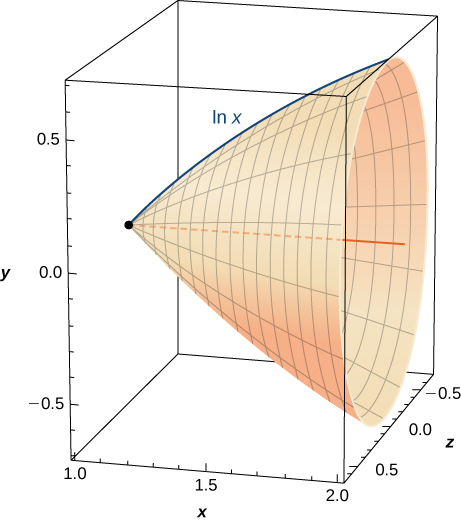
45) [T] Find the surface area of the shape created when rotating the curve in the previous exercise from \(x=1\) to \(x=2\) around the \(x\)-axis.
- Answer
- \(2.8656 \text{ units}^2\)
If you are unable to find intersection points analytically in the following exercises, use a calculator.
46) Find the area of the hyperbolic quarter-circle enclosed by \(x=2\) and \(y=2\) above \(y=1/x.\)
47) [T] Find the arc length of \(y=1/x\) from \(x=1\) to \(x=4\).
- Answer
- \(s = 3.1502\) units
48) Find the area under \(y=1/x\) and above the \(x\)-axis from \(x=1\) to \(x=4\).
In exercises 49 - 53, verify the derivatives and antiderivatives.
49) \(\dfrac{d}{dx}\Big[\ln(x+\sqrt{x^2+1})\Big]=\dfrac{1}{\sqrt{1+x^2}}\)
50) \(\dfrac{d}{dx}\Big[\ln\left(\frac{x−a}{x+a}\right)\Big]=\dfrac{2a}{(x^2−a^2)}\)
51) \(\dfrac{d}{dx}\Big[\ln\left(\frac{1+\sqrt{1−x^2}}{x}\right)\Big]=−\dfrac{1}{x\sqrt{1−x^2}}\)
52) \(\dfrac{d}{dx}\Big[\ln(x+\sqrt{x^2−a^2})\Big]=\dfrac{1}{\sqrt{x^2−a^2}}\)
53) \(\displaystyle ∫\frac{dx}{x\ln(x)\ln(\ln x)}=\ln|\ln(\ln x)|+C\)
Contributors
Gilbert Strang (MIT) and Edwin “Jed” Herman (Harvey Mudd) with many contributing authors. This content by OpenStax is licensed with a CC-BY-SA-NC 4.0 license. Download for free at http://cnx.org.