

2.3: Comparing, Expanded and Written Form, and Rounding of Decimals
- Page ID
- 218254

\( \newcommand{\vecs}[1]{\overset { \scriptstyle \rightharpoonup} {\mathbf{#1}} } \)
\( \newcommand{\vecd}[1]{\overset{-\!-\!\rightharpoonup}{\vphantom{a}\smash {#1}}} \)
\( \newcommand{\dsum}{\displaystyle\sum\limits} \)
\( \newcommand{\dint}{\displaystyle\int\limits} \)
\( \newcommand{\dlim}{\displaystyle\lim\limits} \)
\( \newcommand{\id}{\mathrm{id}}\) \( \newcommand{\Span}{\mathrm{span}}\)
( \newcommand{\kernel}{\mathrm{null}\,}\) \( \newcommand{\range}{\mathrm{range}\,}\)
\( \newcommand{\RealPart}{\mathrm{Re}}\) \( \newcommand{\ImaginaryPart}{\mathrm{Im}}\)
\( \newcommand{\Argument}{\mathrm{Arg}}\) \( \newcommand{\norm}[1]{\| #1 \|}\)
\( \newcommand{\inner}[2]{\langle #1, #2 \rangle}\)
\( \newcommand{\Span}{\mathrm{span}}\)
\( \newcommand{\id}{\mathrm{id}}\)
\( \newcommand{\Span}{\mathrm{span}}\)
\( \newcommand{\kernel}{\mathrm{null}\,}\)
\( \newcommand{\range}{\mathrm{range}\,}\)
\( \newcommand{\RealPart}{\mathrm{Re}}\)
\( \newcommand{\ImaginaryPart}{\mathrm{Im}}\)
\( \newcommand{\Argument}{\mathrm{Arg}}\)
\( \newcommand{\norm}[1]{\| #1 \|}\)
\( \newcommand{\inner}[2]{\langle #1, #2 \rangle}\)
\( \newcommand{\Span}{\mathrm{span}}\) \( \newcommand{\AA}{\unicode[.8,0]{x212B}}\)
\( \newcommand{\vectorA}[1]{\vec{#1}} % arrow\)
\( \newcommand{\vectorAt}[1]{\vec{\text{#1}}} % arrow\)
\( \newcommand{\vectorB}[1]{\overset { \scriptstyle \rightharpoonup} {\mathbf{#1}} } \)
\( \newcommand{\vectorC}[1]{\textbf{#1}} \)
\( \newcommand{\vectorD}[1]{\overrightarrow{#1}} \)
\( \newcommand{\vectorDt}[1]{\overrightarrow{\text{#1}}} \)
\( \newcommand{\vectE}[1]{\overset{-\!-\!\rightharpoonup}{\vphantom{a}\smash{\mathbf {#1}}}} \)
\( \newcommand{\vecs}[1]{\overset { \scriptstyle \rightharpoonup} {\mathbf{#1}} } \)
\(\newcommand{\longvect}{\overrightarrow}\)
\( \newcommand{\vecd}[1]{\overset{-\!-\!\rightharpoonup}{\vphantom{a}\smash {#1}}} \)
\(\newcommand{\ket}[1]{\left| #1 \right>}\)
\(\newcommand{\bra}[1]{\left< #1 \right|}\)
\(\newcommand{\braket}[2]{\left< #1 \vphantom{#2} \right| \left. #2 \vphantom{#1} \right>}\)
\(\newcommand{\braopket}[3]{\left< #1 \vphantom{#2}\vphantom{#3} \right| #2 \vphantom{#1}\vphantom{#3} \left| #3 \vphantom{#1}\vphantom{#2} \right>}\)
\(\newcommand{\qmvec}[1]{\mathbf{\vec{#1}}}\)
\(\newcommand{\op}[1]{\hat{\mathbf{#1}}}\)
\(\newcommand{\expect}[1]{\langle #1 \rangle}\)
\(\newcommand{\dfn}[1]{\emph{\textbf{#1}}}\)
- understand the meaning of digits occurring to the right of the ones position
- be familiar with the meaning of decimal fractions
- be able to read and write a decimal fraction
Digits to the Right of the Ones Position
We began our study of arithmetic by noting that our number system is called a positional number system with base ten. We also noted that each position has a particular value. We observed that each position has ten times the value of the position to its right.
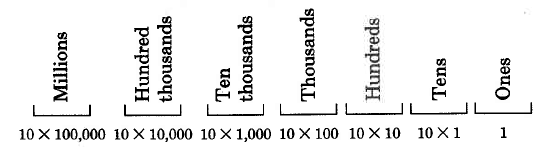
This means that each position has \(\dfrac{1}{10}\) the value of the position to its left.
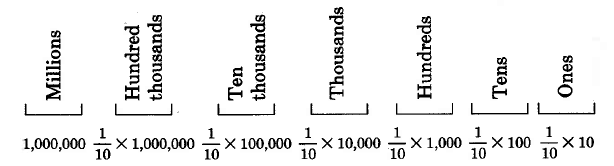
Thus, a digit written to the right of the units position must have a value of \(\dfrac{1}{10}\) of 1. Recalling that the word "of" translates to multiplication \((\cdot)\), we can see that the value of the first position to the right of the units digit is \(\dfrac{1}{10}\) of 1, or
\(\dfrac{1}{10} \cdot 1 = \dfrac{1}{10}\)
The value of the second position to the right of the units digit is \(\dfrac{1}{10}\) of \(\dfrac{1}{10}\), or
\(\dfrac{1}{10} \cdot \dfrac{1}{10} = \dfrac{1}{10^2} = \dfrac{1}{100}\)
The value of the third position to the right of the units digit is \(\dfrac{1}{10}\) of \(\dfrac{1}{100}\), or
\(\dfrac{1}{10} \cdot \dfrac{1}{100} = \dfrac{1}{10^3} = \dfrac{1}{1000}\)
This pattern continues.
We can now see that if we were to write digits in positions to the right of the units positions, those positions have values that are fractions. Not only do the positions have fractional values, but the fractional values are all powers of 10 \((10, 10^2, 10^3, ...)\).
Decimal Fractions
Decimal Point, Decimal
If we are to write numbers with digits appearing to the right of the units digit, we must have a way of denoting where the whole number part ends and the fractional part begins. Mathematicians denote the separation point of the units digit and the tenths digit by writing a decimal point. The word decimal comes from the Latin prefix "deci" which means ten, and we use it because we use a base ten number system. Numbers written in this form are called decimal fractions, or more simply, decimals.
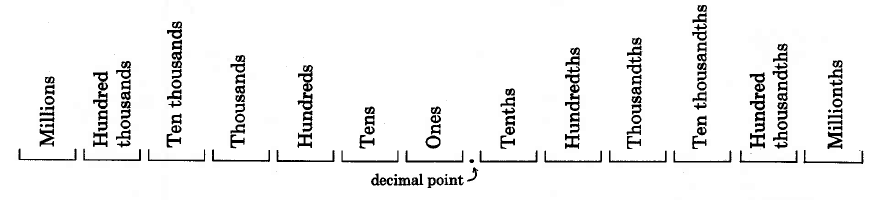
Notice that decimal numbers have the suffix "th."
Decimal Fraction
A decimal fraction is a fraction in which the denominator is a power of 10.
The following numbers are examples of decimals.
42.6
The 6 is in the tenths position.
\(42.6 = 42 \dfrac{6}{10}\)
9.8014
The 8 is in the tenths position.
The 0 is in the hundredths position.
The 1 is in the thousandths position.
The 4 is in the ten thousandths position.
\(9.8014 = 9 \dfrac{8014}{10,000}\)
0.93
The 9 is in the tenths position.
The 3 is in the hundredths position.
\(0.93 = \dfrac{93}{100}\)
Quite often a zero is inserted in front of a decimal point (in the units position) of a decimal fraction that has a value less than one. This zero helps keep us from overlooking the decimal point.
0.7
The 7 is in the tenths position.
\(0.7 = \dfrac{7}{10}\)
We can insert zeros to the right of the right-most digit in a decimal fraction without changing the value of the number.
\(\dfrac{7}{10} = 0.7 = 0.70 = \dfrac{70}{100} = \dfrac{7}{10}\)
Reading Decimal Fractions
Reading a Decimal Fraction
To read a decimal fraction,
- Read the whole number part as usual. (If the whole number is less than 1, omit steps 1 and 2.)
- Read the decimal point as the word "and."
- Read the number to the right of the decimal point as if it were a whole number.
- Say the name of the position of the last digit.
Read the following numbers.
6.8
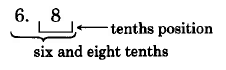
Some people read this as "six point eight." This phrasing gets the message across, but technically, "six and eight tenths" is the correct phrasing.
14.116

0.0019

81
Eighty-one
In this problem, the indication is that any whole number is a decimal fraction. Whole numbers are often called decimal numbers.
\(81 = 81.0\)
Practice Set A
Read the following decimal fractions.
12.9
- Answer
-
twelve and nine tenths
Practice Set A
4.86
- Answer
-
four and eighty-six hundredths
Practice Set A
7.00002
- Answer
-
seven and two hundred thousandths
Practice Set A
0.030405
- Answer
-
thirty thousand four hundred five millionths
Writing Decimal Fractions
Writing a Decimal Fraction
To write a decimal fraction,
Write the whole number part.
Write a decimal point for the word "and."
Write the decimal part of the number so that the right-most digit appears in the position indicated in the word name. If necessary, insert zeros to the right of the decimal point in order that the right-most digit appears in the correct position.
Write each number.
Thirty-one and twelve hundredths.
Solution
The decimal position indicated is the hundredths position.
31.12
Two and three hundred-thousandths.
Solution
The decimal position indicated is the hundred thousandths. We'll need to insert enough zeros to the immediate right of the decimal point in order to locate the 3 in the correct position.
2.00003
Six thousand twenty-seven and one hundred four millionths.
Solution
The decimal position indicated is the millionths position. We'll need to insert enough zeros to the immediate right of the decimal point in order to locate the 4 in the correct position.
6,027.000104
Seventeen hundredths.
Solution
The decimal position indicated is the hundredths position.
0.17
Practice Set B
Write each decimal fraction.
Three hundred six and forty-nine hundredths.
- Answer
-
306.49
Practice Set B
Nine and four thousandths.
- Answer
-
9.004
Practice Set B
Sixty-one millionths.
- Answer
-
0.000061
Exercises
For the following three problems, give the decimal name of the position of the given number in each decimal fraction.
Exercise \(\PageIndex{1}\)
1. 3.941
9 is in the position.
4 is in the position.
1 is in the position.
- Answer
-
Tenths; hundredths, thousandths
Exercise \(\PageIndex{2}\)
17.1085
1 is in the position.
0 is in the position.
8 is in the position.
5 is in the position.
Exercise \(\PageIndex{3}\)
652.3561927
9 is in the position.
7 is in the position.
- Answer
-
Hundred thousandths; ten millionths
For the following 7 problems, read each decimal fraction by writing it.
Exercise \(\PageIndex{4}\)
9.2
Exercise \(\PageIndex{5}\)
8.1
- Answer
-
eight and one tenth
Exercise \(\PageIndex{6}\)
10.15
Exercise \(\PageIndex{7}\)
55.06
- Answer
-
fifty-five and six hundredths
Exercise \(\PageIndex{8}\)
0.78
Exercise \(\PageIndex{9}\)
1.904
- Answer
-
one and nine hundred four thousandths
Exercise \(\PageIndex{10}\)
10.00011
For the following 10 problems, write each decimal fraction.
Exercise \(\PageIndex{11}\)
Three and twenty one-hundredths.
- Answer
-
3.20
Exercise \(\PageIndex{12}\)
Fourteen and sixty seven-hundredths.
Exercise \(\PageIndex{13}\)
One and eight tenths.
- Answer
-
1.8
Exercise \(\PageIndex{14}\)
Sixty-one and five tenths.
Exercise \(\PageIndex{15}\)
Five hundred eleven and four thousandths.
- Answer
-
511.004
Exercise \(\PageIndex{16}\)
Thirty-three and twelve ten-thousandths.
Exercise \(\PageIndex{17}\)
Nine hundred forty-seven thousandths.
- Answer
-
0.947
Exercise \(\PageIndex{18}\)
Two millionths.
Exercise \(\PageIndex{19}\)
Seventy-one hundred-thousandths.
- Answer
-
0.00071
Exercise \(\PageIndex{20}\)
One and ten ten-millionths.
Rounding Decimal Numbers
- be able to round a decimal number to a specified position
We first considered the concept of rounding numbers in [link] where our concern with rounding was related to whole numbers only. With a few minor changes, we can apply the same rules of rounding to decimals.
To round a decimal to a particular position:
- Mark the position of the round-off digit (with an arrow or check).
- Note whether the digit to the immediate right of the marked digit is
- less than 5. If so, leave the round-off digit unchanged.
- 5 or greater. If so, add 1 to the round-off digit.
- If the round-off digit is
- to the right of the decimal point, eliminate all the digits to its right.
- to the left of the decimal point, replace all the digits between it and the decimal point with zeros and eliminate the decimal point and all the decimal digits.
Round each decimal to the specified position. (The numbers in parentheses indicate which step is being used.)
Round 32.116 to the nearest hundredth.
Solution
1: 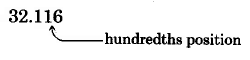
2b: The digit immediately to the right is 6, and \(6 > 5\), so we add 1 to the round-off digit:
\(1 + 1 = 2\)
3a: The round-off digit is to the right of the decimal point, so we eliminate all digits to its right.
32.12
The number 32.116 rounded to the nearest hundredth is 32.12.
Round 633.14216 to the nearest hundred.
Solution
1: 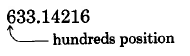
2a: The digit immediately to the right is 3, and \(3 < 5\) so we leave the round-off digit unchanged.
3b: The round-off digit is to the left of 0, so we replace all the digits between it and the decimal point with zeros and eliminate the decimal point and all the decimal digits.
600
The number 633.14216 rounded to the nearest hundred is 600.
1,729.63 rounded to the nearest ten is 1,730.
1.0144 rounded to the nearest tenth is 1.0.
60.98 rounded to the nearest one is 61.
Sometimes we hear a phrase such as "round to three decimal places." This phrase means that the round-off digit is the third decimal digit (the digit in the thousandths position).
67.129 rounded to the second decimal place is 67.13.
67.129558 rounded to 3 decimal places is 67.130.
Practice Set A
Round each decimal to the specified position.
4.816 to the nearest hundredth.
- Answer
-
4.82
Practice Set A
0.35928 to the nearest ten thousandths.
- Answer
-
0.3593
Practice Set A
82.1 to the nearest one.
- Answer
-
82
Practice Set A
753.98 to the nearest hundred.
- Answer
-
800
Practice Set A
Round 43.99446 to three decimal places.
- Answer
-
43.994
Practice Set A
Round 105.019997 to four decimal places.
- Answer
-
105.0200
Practice Set A
Round 99.9999 to two decimal places.
- Answer
-
100.00