

2.4: Basic Multi-Digit Multiplication and Division
- Page ID
- 218255
\( \newcommand{\vecs}[1]{\overset { \scriptstyle \rightharpoonup} {\mathbf{#1}} } \)
\( \newcommand{\vecd}[1]{\overset{-\!-\!\rightharpoonup}{\vphantom{a}\smash {#1}}} \)
\( \newcommand{\dsum}{\displaystyle\sum\limits} \)
\( \newcommand{\dint}{\displaystyle\int\limits} \)
\( \newcommand{\dlim}{\displaystyle\lim\limits} \)
\( \newcommand{\id}{\mathrm{id}}\) \( \newcommand{\Span}{\mathrm{span}}\)
( \newcommand{\kernel}{\mathrm{null}\,}\) \( \newcommand{\range}{\mathrm{range}\,}\)
\( \newcommand{\RealPart}{\mathrm{Re}}\) \( \newcommand{\ImaginaryPart}{\mathrm{Im}}\)
\( \newcommand{\Argument}{\mathrm{Arg}}\) \( \newcommand{\norm}[1]{\| #1 \|}\)
\( \newcommand{\inner}[2]{\langle #1, #2 \rangle}\)
\( \newcommand{\Span}{\mathrm{span}}\)
\( \newcommand{\id}{\mathrm{id}}\)
\( \newcommand{\Span}{\mathrm{span}}\)
\( \newcommand{\kernel}{\mathrm{null}\,}\)
\( \newcommand{\range}{\mathrm{range}\,}\)
\( \newcommand{\RealPart}{\mathrm{Re}}\)
\( \newcommand{\ImaginaryPart}{\mathrm{Im}}\)
\( \newcommand{\Argument}{\mathrm{Arg}}\)
\( \newcommand{\norm}[1]{\| #1 \|}\)
\( \newcommand{\inner}[2]{\langle #1, #2 \rangle}\)
\( \newcommand{\Span}{\mathrm{span}}\) \( \newcommand{\AA}{\unicode[.8,0]{x212B}}\)
\( \newcommand{\vectorA}[1]{\vec{#1}} % arrow\)
\( \newcommand{\vectorAt}[1]{\vec{\text{#1}}} % arrow\)
\( \newcommand{\vectorB}[1]{\overset { \scriptstyle \rightharpoonup} {\mathbf{#1}} } \)
\( \newcommand{\vectorC}[1]{\textbf{#1}} \)
\( \newcommand{\vectorD}[1]{\overrightarrow{#1}} \)
\( \newcommand{\vectorDt}[1]{\overrightarrow{\text{#1}}} \)
\( \newcommand{\vectE}[1]{\overset{-\!-\!\rightharpoonup}{\vphantom{a}\smash{\mathbf {#1}}}} \)
\( \newcommand{\vecs}[1]{\overset { \scriptstyle \rightharpoonup} {\mathbf{#1}} } \)
\(\newcommand{\longvect}{\overrightarrow}\)
\( \newcommand{\vecd}[1]{\overset{-\!-\!\rightharpoonup}{\vphantom{a}\smash {#1}}} \)
\(\newcommand{\ket}[1]{\left| #1 \right>}\)
\(\newcommand{\bra}[1]{\left< #1 \right|}\)
\(\newcommand{\braket}[2]{\left< #1 \vphantom{#2} \right| \left. #2 \vphantom{#1} \right>}\)
\(\newcommand{\braopket}[3]{\left< #1 \vphantom{#2}\vphantom{#3} \right| #2 \vphantom{#1}\vphantom{#3} \left| #3 \vphantom{#1}\vphantom{#2} \right>}\)
\(\newcommand{\qmvec}[1]{\mathbf{\vec{#1}}}\)
\(\newcommand{\op}[1]{\hat{\mathbf{#1}}}\)
\(\newcommand{\expect}[1]{\langle #1 \rangle}\)
\(\newcommand{\dfn}[1]{\emph{\textbf{#1}}}\)
We begin this section by discussing multiplication of whole numbers. The first order of business is to introduce the various symbols used to indicate multiplication of two whole numbers.
| Symbol | Example | |
|---|---|---|
| × | times symbol | 3 × 4 |
| · | dot | 3 · 4 |
| ( ) | parentheses | (3)(4) or 3(4) of (3)4 |
In the expression \(3 · 4\), the whole numbers 3 and 4 are called the factors and \(3 · 4\) is called the product.
The key to understanding multiplication is held in the following statement.
Multiplication is equivalent to repeated addition.
Suppose, for example, that we would like to evaluate the product \(3 ·4\). Because multiplication is equivalent to repeated addition, \(3 · 4\) is equivalent to adding three fours. That is,
\[ 3 \cdot 4=\underbrace{4+4+4}_{\text { three fours }} \nonumber\]
Thus, \(3 · 4 = 12\). You can visualize the product \(3 · 4\) as the sum of three fours on a number line, as shown in Figure 1.6.

Like addition, the order of the factors does not matter.
\[ 4 \cdot 3=\underbrace{3+3+3+3}_{\text { four threes }} \nonumber\]
Thus, \(4 · 3 = 12\). Consider the visualization of \(4 · 3\) in Figure 1.7.

The evidence in Figure 1.6 and Figure 1.7 show us that multiplication is commutative. That is,
\[3 · 4=4 · 3 \nonumber\]
If a and b are any whole numbers, then
\[a · b = b · a. \nonumber\]
The Multiplicative Identity
In Figure 1.8(a), note that five ones equals 5; that is, \(5 · 1 = 5\). On the other hand, in Figure 1.8(b), we see that one five equals five; that is, 1 · 5 = 5.
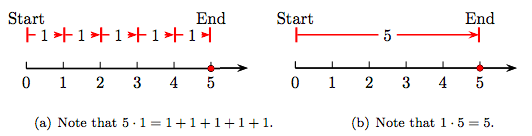
Because multiplying a whole number by 1 equals that identical number, the whole number 1 is called the multiplicative identity.
If \(a\) is any whole number, then
a · 1 = a and 1 · a = a.
Multiplication by Zero
Because \(3 · 4 = 4 + 4 + 4\), we can say that the product \(3 · 4\) represents “3 sets of 4,” as depicted in Figure 1.9, where three groups of four boxes are each enveloped in an oval.
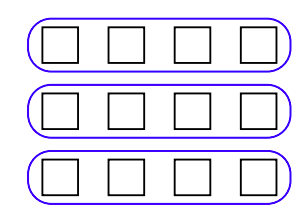
Therefore, \(0 · 4\) would mean zero sets of four. Of course, zero sets of four is zero.
If a represents any whole number, then
\(a · 0 = 0\) and \(0 · a = 0\).
The Associative Property of Multiplication
Like addition, multiplication of whole numbers is associative. Indeed,
\[\begin{align*} 2 · (3 · 4) &= 2 · 12 \\[4pt] &= 24 \end{align*}\]
and
\[\begin{align*} (2 · 3) · 4 &=6 · 4 \\[4pt] &= 24. \end{align*}\]
If a, b, and c are any whole numbers, then
\[a · (b · c)=(a · b) · c. \nonumber\]
Multiplying Larger Whole Numbers
Much like addition and subtraction of large whole numbers, we will also need to multiply large whole numbers. Again, we hope the algorithm is familiar from previous coursework.
Simplify: \(35 · 127\).
Solution
Align the numbers vertically. The order of multiplication does not matter, but we’ll put the larger of the two numbers on top of the smaller number. The first step is to multiply 5 times 127. Again, we proceed from right to left. So, 5 times 7 is 35. We write the 5, then carry the 3 to the tens column. Next, 5 times 2 is 10. Add the carry digit 3 to get 13. Write the 3 and carry the 1 to the hundreds column. Finally, 5 times 1 is 5. Add the carry digit to get 6.
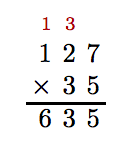
The next step is to multiply 3 times 127. However, because 3 is in the tens place, its value is 30, so we actually multiply 30 times 127. This is the same as multiplying 127 by 3 and placing a 0 at the end of the result.
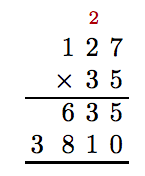
After adding the 0, 3 times 7 is 21. We write the 1 and carry the 2 above the 2 in the tens column. Then, 3 times 2 is 6. Add the carry digit 2 to get 8. Finally, 3 times 1 is 1.
All that is left to do is to add the results.
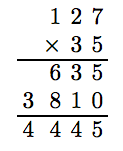
Thus, 35 · 127 = 4, 445.
Alternate Format
It does not hurt to omit the trailing zero in the second step of the multiplication, where we multiply 3 times 127. The result would look like this:
In this format, the zero is understood, so it is not necessary to have it physically present. The idea is that with each multiplication by a new digit, we indent the product one space from the right.
Simplify: 56 · 335
- Answer
-
18,760
Division of Whole Numbers
We now turn to the topic of division of whole numbers. We first introduce the various symbols used to indicate division of whole numbers.
| Symbol | Example | |
|---|---|---|
| ÷ | division symbol | 12 ÷ 4 |
| - | fraction bar | \(\frac{12}{4}\) |
| \(\longdiv{-}\) | division bar | \(4 \longdiv{12}\) |
Note that each of the following say the same thing; that is, “12 divided by 4 is 3.”
\(12 \div 4=3 \quad \text { or } \quad \frac{12}{4}=3 \quad \text { or } \quad 4 \sqrt{12}\)
In the statement
\(\frac{3}{4 ) 12}\)
the whole number 12 is called the dividend, the whole number 4 is called the divisor, and the whole number 3 is called the quotient. Note that this division bar notation is equivalent to
\(12 \div 4=3 \quad \text { and } \quad \frac{12}{4}=3.\)
The expression a/b means “a divided by b,” but this construct is also called a fraction.
The expression
\( \frac{a}{b}\)
is called a fraction. The number \(a\) on top is called the numerator of the fraction; the number \(b\) on the bottom is called the denominator of the fraction.
The key to understanding division of whole numbers is contained in the following statement.
Division is equivalent to repeated subtraction.
Suppose for example, that we would like to divide the whole number 12 by the whole number 4. This is equivalent to asking the question “how many fours can we subtract from 12?” This can be visualized in a number line diagram, such as the one in Figure 1.10.

In Figure 1.10, note that we if we subtract three fours from twelve, the result is zero. In symbols,
\( 12-\underbrace{4-4-4}_{\text { three fours }}=0.\)
Equivalently, we can also ask “How many groups of four are there in 12,” and arrange our work as shown in Figure 1.11, where we can see that in an array of twelve objects, we can circle three groups of four ; i.e., 12 ÷ 4 = 3.
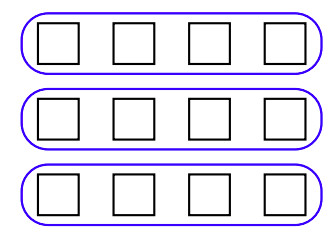
In Figure 1.10 and Figure 1.11, note that the division (repeated subtraction) leaves no remainder. This is not always the case.
Divide 7 by 3.
Solution
In Figure 1.12, we can see that we can subtract two threes from seven, leaving a remainder of one.
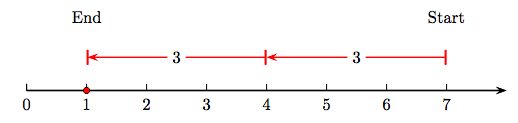
Alternatively, in an array of seven objects, we can circle two groups of three, leaving a remainder of one.
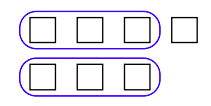
Both Figure 1.12 and Figure1.13 show that there are two groups of three in seven, with one left over. We say “Seven divided by three is two, with a remainder of one.
Use both the number line approach and the array of boxes approach to divide 12 by 5.
Division is not Commutative
When dividing whole numbers, the order matters. For example
12 ÷ 4 = 3,
but 4 ÷ 12 is not even a whole number. Thus, if a and b are whole numbers, then a ÷ b does not have to be the same as b ÷ a.
Division is not Associative
When you divide three numbers, the order in which they are grouped will usually affect the answer. For example,
(48 ÷ 8) ÷ 2=6 ÷ 2
= 3,
but
48 ÷ (8 ÷ 2) = 48 ÷ 4
= 12.
Thus, if a, b, and c are whole numbers, (a ÷ b) ÷ c does not have to be the same as a ÷ (b ÷ c).
Division by Zero is Undefined
Suppose that we are asked to divide six by zero; that is, we are asked to calculate 6 ÷ 0. In Figure 1.14, we have an array of six objects.
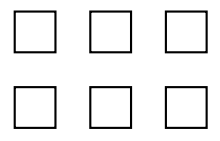
Now, to divide six by zero, we must answer the question “How many groups of zero can we circle in Figure 1.14?” Some thought will provide the answer: This is a meaningless request! It makes absolutely no sense to ask how many groups of zero can be circled in the array of six objects in Figure 1.14.
Division by zero is undefined. Each of the expressions
\(6 \div 0 \quad \text { and } \quad \frac{6}{0} \quad \text { and } \quad 0 ) \overline{6}\)
is undefined.
On the other hand, it make sense to ask “What is zero divided by six?” If we create an array of zero objects, then ask how many groups of six we can circle, the answer is “zero groups of six.” That is, zero divided by six is zero.
\( 0 \div 6=0 \quad \text { and } \quad \frac{0}{6}=0 \quad \text { and } \quad 6 \frac{0}{0}\)
Exercises
In Exercises 1-4 use number line diagrams as shown in Figure 1.6 to depict the multiplication.
1. 2 · 4.
2. 3 · 4.
3. 4 · 2.
4. 4 · 3.
In Exercises 5-16, state the property of multiplication depicted by the given identity.
5. 9 · 8=8 · 9
6. 5 · 8=8 · 5
7. 8 · (5 · 6) = (8 · 5) · 6
8. 4 · (6 · 5) = (4 · 6) · 5
9. 6 · 2=2 · 6
10. 8 · 7=7 · 8
11. 3 · (5 · 9) = (3 · 5) · 9
12. 8 · (6 · 4) = (8 · 6) · 4
13. 21 · 1 = 21
14. 39 · 1 = 39
15. 13 · 1 = 13
16. 44 · 1 = 44
In Exercises 17-28, multiply the given numbers.
17. 78 · 3
18. 58 · 7
19. 907 · 6
20. 434 · 80
21. 128 · 30
22. 454 · 90
23. 799 · 60
24. 907 · 20
25. 14 · 70
26. 94 · 90
27. 34 · 90
28. 87 · 20
In Exercises 29-40, multiply the given numbers.
29. 237 · 54
30. 893 · 94
31. 691 · 12
32. 823 · 77
33. 955 · 89
34. 714 · 41
35. 266 · 61
36. 366 · 31
37. 365 · 73
38. 291 · 47
39. 955 · 57
40. 199 · 33
41. Count the number of objects in the array.

42. Count the number of objects in the array.

43. Count the number of objects in the array.

44. Count the number of objects in the array.

In Exercises 45-48, find the area of the rectangle having the given length and width.
45. L = 50 in, W = 25 in
46. L = 48 in, W = 24 in
47. L = 47 in, W = 13 in
48. L = 19 in, W = 10 in
In Exercises 49-52, find the perimeter of the rectangle having the given length and width.
49. L = 25 in, W = 16 in
50. L = 34 in, W = 18 in
51. L = 30 in, W = 28 in
52. L = 41 in, W = 25 in
53. A set of beads costs 50 cents per dozen. What is the cost (in dollars) of 19 dozen sets of beads?
54. A set of beads costs 60 cents per dozen. What is the cost (in dollars) of 7 dozen sets of beads?
55. If a math tutor worked for 47 hours and was paid $15 each hour, how much money would she have made?
56. If a math tutor worked for 46 hours and was paid $11 each hour, how much money would he have made?
57. There are 12 eggs in one dozen, and 12 dozen in one gross. How many eggs are in a shipment of 24 gross?
58. There are 12 eggs in one dozen, and 12 dozen in one gross. How many eggs are in a shipment of 11 gross?
59. If bricks weigh 4 kilograms each, what is the weight (in kilograms) of 5000 bricks?
60. If bricks weigh 4 pounds each, what is the weight (in pounds) of 2000 bricks?
In Exercises 61-68, which of the following four expressions differs from the remaining three?
61. \(\frac{30}{5}\), 30 ÷ 5, \(5 \longdiv { 3 0 }\), 5 ÷ 30
62. \(\frac{12}{2}\), 12 ÷ 2, \(2 \longiv{12}\), 2 ÷ 12
63. \(\frac{8}{2}\), 8 ÷ 2, \(2 \longdiv{8}\), \(8 \longdiv{2}\)
64. \(\frac{8}{4}\), 8 ÷ 4, \(4 \longdiv { 8 }\), \(8 \longdiv { 4 }\)
65. \(2 \longdiv { 14 }\), \(14 \longdiv { 2 }\), \(\frac{14}{2}\), 14 ÷ 2
66. \(9 \longdiv { 54 }\), \(54 \longdiv { 9 }\), \(\frac{54}{9}\), 54 ÷ 9
67. \(3 \longdiv { 24 }\), 3 ÷ 24, \(\frac{24}{3}\), 24 ÷ 3
68. \(3 \longdiv { 15 }\), 3 ÷ 15, \(\frac{15}{3}\), 15 ÷ 3
In Exercises 69-82, simplify the given expression. If the answer doesn’t exist or is undefined, write “undefined”.
69. 0 ÷ 11
70. 0 ÷ 5
71. 17 ÷ 0
72. 24 ÷ 0
73. 10 · 0
74. 20 · 0
75. \(\frac{7}{0}\)
76. \(\frac{23}{0}\)
77. \(16 \longdiv { 0 }\)
78. \(25 \longdiv { 0 }\)
79. \(\frac{0}{24}\)
80. \(\frac{0}{22}\)
81. \(0 \longdiv { 0 }\)
82. 0 ÷ 0
In Exercises 83-94, divide the given numbers.
83. \(\frac{2816}{44}\)
84. \(\frac{1998}{37}\)
85. \(\frac{2241}{83}\)
86. \(\frac{2716}{97}\)
87. \(\frac{3212}{73}\)
88. \(\frac{1326}{17}\)
89. \(\frac{8722}{98}\)
90. \(\frac{1547}{91}\)
91. \(\frac{1440}{96}\)
92. \(\frac{2079}{27}\)
93. \(\frac{8075}{85}\)
94. \(\frac{1587}{23}\)
In Exercises 95-106, divide the given numbers.
95. \(\frac{17756}{92}\)
96. \(\frac{46904}{82}\)
97. \(\frac{11951}{19}\)
98. \(\frac{22304}{41}\)
99. \(\frac{18048}{32}\)
100. \(\frac{59986}{89}\)
101. \(\frac{29047}{31}\)
102. \(\frac{33264}{86}\)
103. \(\frac{22578}{53}\)
104. \(\frac{18952}{46}\)
105. \(\frac{12894}{14}\)
106. \(\frac{18830}{35}\)
107. A concrete sidewalk is laid in square blocks that measure 6 feet on each side. How many blocks will there be in a walk that is 132 feet long?
108. A concrete sidewalk is laid in square blocks that measure 5 feet on each side. How many blocks will there be in a walk that is 180 feet long?
109. One boat to the island can take 5 people. How many trips will the boat have to take in order to ferry 38 people to the island? (Hint: Round up your answer.)
110. One boat to the island can take 4 people. How many trips will the boat have to take in order to ferry 46 people to the island? (Hint: Round up your answer.)
111. If street lights are placed at most 145 feet apart, how many street lights will be needed for a street that is 4 miles long, assuming that there are lights at each end of the street? (Note: 1 mile = 5280 feet.)
112. If street lights are placed at most 70 feet apart, how many street lights will be needed for a street that is 3 miles long, assuming that there are lights at each end of the street? (Note: 1 mile = 5280 feet.)
113. A concrete sidewalk is laid in square blocks that measure 4 feet on each side. How many blocks will there be in a walk that is 292 feet long?
114. A concrete sidewalk is laid in square blocks that measure 5 feet on each side. How many blocks will there be in a walk that is 445 feet long?
115. One boat to the island can take 3 people. How many trips will the boat have to take in order to ferry 32 people to the island? (Hint: Round up your answer.)
116. One boat to the island can take 4 people. How many trips will the boat have to take in order to ferry 37 people to the island? (Hint: Round up your answer.)
117. If street lights are placed at most 105 feet apart, how many street lights will be needed for a street that is 2 miles long, assuming that there are lights at each end of the street? (Note: 1 mile = 5280 feet.)
118. If street lights are placed at most 105 feet apart, how many street lights will be needed for a street that is 3 miles long, assuming that there are lights at each end of the street? (Note: 1 mile = 5280 feet.)
119. Writing articles. Eli writes an average of 4 articles a day, five days a week, to support product sales. How many articles does Eli write in one week?
120. Machine gun. A 0.50-caliber antiaircraft machine gun can fire 800 rounds each minute. How many rounds could fire in three minutes? Associated Press Times-Standard 4/15/09
121. Laps. The swimming pool at CalCourts is 25 yards long. If one lap is up and back again, how many yards has Wendell swam doing 27 laps?
122. Refrigerator wattage. A conventional refrigerator will run about 12 hours each day can use 150 Watts of power each hour. How many Watts of power will a refrigerator use over the day?
123. Horse hay. A full-grown horse should eat a minimum of 12 pounds of hay each day and may eat much more depending on their weight. How many pounds minimum would a horse eat over a year?
124. College costs. After a $662 hike in fees, Califormia residents who want to attend the University of California as an undergraduate should expect to pay $8,700 in for the upcoming academic year 2009- 2010. If the cost were to remain the same for the next several years, how much should a student expect to pay for a four-year degree program at a UC school?
125. Non-resident costs. Nonresident undergraduates who want to attend a University of California college should expect to pay about $22,000 for the upcoming academic year. Assuming costs remain the same, what can a four-year degree cost?
126. Student tax. The mayer of Providence, Rhode Island wants to tax its 25,000 Brown University students $150 each to contribute to tax receipts saying students should pay for the resources they use just like the town residents. How many dollars would the mayer generate?
127. New iceberg. A new iceberg, shaved off a glacier after a collision with another iceberg, measures about 48 miles long and 28 miles wide. What’s the approximate area of the new iceberg? Associated PressTimes-Standard 02/27/10 2 Huge icebergs set loose off Antarctica’s coast.
128. Solar panels. One of the solar panels on the International Space Station is 34 meters long and 11 meters wide. If there are eight of these, what’s the total area for solar collection?
129. Sidewalk. A concrete sidewalk is to be 80 foot long and 4 foot wide. How much will it cost to lay the sidewalk at $8 per square foot?
130. Hay bales. An average bale of hay weighs about 60 pounds. If a horse eats 12 pounds of hay a day, how many days will one bale feed a horse?
131. Sunspots. Sunspots, where the sun’s magnetic field is much higher, usually occur in pairs. If the total count of sunspots is 72, how many pairs of sunspots are there?
Answers
1. \(2 \cdot 4=\underbrace{4+4}_{2 \text { times }}=8\)
3. \(4 \cdot 2=\underbrace{2+2+2+2}_{4 \text { times }}=8\)
5. Commutative property of multiplication
7. Associative property of multiplication
9. Commutative property of multiplication
11. Associative property of multiplication
13. Multiplicative identity property
15. Multiplicative identity property
17. 234
19. 5442
21. 3840
23. 47940
25. 980
27. 3060
29. 12798
31. 8292
33. 84995
35. 16226
37. 26645
39. 54435
41. 64
43. 56
45. 1250 in2
47. 611 in2
49. 82 in
51. 116 in
53. 9.50
55. 705
57. 3456
59. 20000
61. 5 ÷ 30
63. \(8 \sqrt{2}\)
65. \(14 \sqrt{2}\)
67. 3 ÷ 24
69. 0
71. Undefined
73. 0
75. Undefined
77. 0
79. 0
81. Undefined
83. 64
85. 27
87. 44
89. 89
91. 15
93. 95
95. 193
97. 629
99. 564
101. 937
103. 426
105. 921
107. 22
109. 8
111. 147
113. 73
115. 11
117. 102
119. 20 articles
121. 1350 yards
123. 4380 pounds of hay
125. $88,000
127. 1344 mi2
129. $2,560
131. 36
- be able to divide a whole number by a single or multiple digit divisor
- be able to interpret a calculator statement that a division results in a remainder
Division with a Single Digit Divisor
Our experience with multiplication of whole numbers allows us to perform such divisions as \(75 \div 5\). We perform the division by performing the corresponding multiplication, \(5 \times Q = 75\). Each division we considered in [link] had a one-digit quotient. Now we will consider divisions in which the quotient may consist of two or more digits. For example, \(75 \div 5\).
Let's examine the division \(75 \div 5\). We are asked to determine how many 5's are contained in 75. We'll approach the problem in the following way.
- Make an educated guess based on experience with multiplication.
- Find how close the estimate is by multiplying the estimate by 5.
- If the product obtained in step 2 is less than 75, find out how much less by subtracting it from 75.
- If the product obtained in step 2 is greater than 75, decrease the estimate until the product is less than 75. Decreasing the estimate makes sense because we do not wish to exceed 75.
We can suggest from this discussion that the process of division consists of
The Four Steps in Division
- an educated guess
- a multiplication
- a subtraction
- bringing down the next digit (if necessary)
The educated guess can be made by determining how many times the divisor is contained in the dividend by using only one or two digits of the dividend.
Find \(75 \div 5\).
Solution
\(5\overline{)75}\) Rewrite the problem using a division bracket.
\(\begin{array} {r} {10} \\ {5\overline{)75}} \end{array}\)
Make an educated guess by noting that one 5 is contained in 75 at most 10 times.
Since 7 is the tens digit, we estimate that 5 goes into 75 at most 10 times.
\(\begin{array} {r} {10} \\ {5\overline{)75}} \\ {\underline{-50}} \\ {25} \end{array}\)
Now determine how close the estimate is.
10 fives is \(10 \times 5 = 50\). Subtract 50 from 75.
Estimate the number of 5's in 25.
There are exactly 5 fives in 25.

Check:
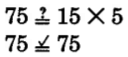
Thus, \(75 \div 5 = 15\).
The notation in this division can be shortened by writing.
\(\begin{array} {r} {15} \\ {5\overline{)75}} \\ {-5 \downarrow} \\ {\overline{\ \ 25}} \\ {-25} \\ {\overline{\ \ \ \ 0}} \end{array}\)
\(\begin{cases} \text{Divide:} & \text{5 goes into 7 at most 1 time.} \\ \text{Multiply:} & 1 \times 5 = 5. \text{Write 5 below 7.} \\ \text{Subtract:} & 7 - 5 = 2. \text{Bring down the 5.} \end{cases}\) \(\begin{cases} {\text{Divide:}} & {\text{5 goes into 25 exactly 5 times}} \\ {\text{Multiply:}} & {5 \times 5 = 25. \text{Write 25 below 25.}} \\ {\text{Subtract:}} & {25 - 25 = 0} \end{cases}\)
Find \(4,944 \div 8\).
Solution
\(8\overline{)4944}\)
Rewrite the problem using a division bracket.
\(\begin{array} {r} {600} \\ {8\overline{)4944}} \\ {\underline{-4800}} \\ {144} \end{array}\)
8 goes into 49 at most 6 times, and 9 is in the hundreds column. We'll guess 600.
Then, \(8 \times 600 = 4800\).
\(\begin{array} {r} {10} \\ {600} \\ {8\overline{)4944}} \\ {\underline{-4800}} \\ {144} \\ {\underline{-\ \ 80}} \\ {64} \end{array}\)
8 goes into 14 at most 1 time, and 4 is in the tens column. We'll guess 10.
\(\begin{array} {r} {8} \\ {10} \\ {600} \\ {8\overline{)4944}} \\ {\underline{-4800}} \\ {144} \\ {\underline{-\ \ 80}} \\ {64} \\ {\underline{-64}} \\ {0} \end{array}\)
8 goes into 64 exactly 8 times.
600 eights + 10 eights + 8 eights = 618 eights.
Check:

Thus, \(4,944 \div 8 = 618\).
As in the first problem, the notation in this division can be shortened by eliminating the subtraction signs and the zeros in each educated guess.
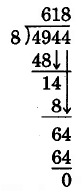
\(\begin{cases} \text{Divide:} & \text{8 goes into 49 at most 6 times.} \\ \text{Multiply:} & 6 \times 8 = 48. \text{Write 48 below 49.} \\ \text{Subtract:} & 49 - 48 = 1. \text{Bring down the 4.} \end{cases}\) \(\begin{cases} \text{Divide:} & \text{8 goes into 14 at most 1 time.} \\ \text{Multiply:} & 1 \times 8 = 8. \text{Write 8 below 14.} \\ \text{Subtract:} & 14 - 8 = 6. \text{Bring down the 4.} \end{cases}\)
\(\begin{cases} \text{Divide:} & \text{8 goes into 64 exactly 8 times.} \\ \text{Multiply:} & 8 \times 8 = 64. \text{Write 64 below 64.} \\ \text{Subtract:} & 64 - 64 = 0. \end{cases}\)
Not all divisions end in zero. We will examine such divisions in a subsequent subsection.
Practice Set A
Perform the following divisions.
\(126 \div 7\)
- Answer
-
18
Practice Set A
\(324 \div 4\)
- Answer
-
81
Practice Set A
\(2,559 \div 3\)
- Answer
-
853
Practice Set A
\(5,645 \div 5\)
- Answer
-
1,129
Practice Set A
\(757,125 \div 9\)
- Answer
-
84,125
Division with a Multiple Digit Divisor
The process of division also works when the divisor consists of two or more digits. We now make educated guesses using the first digit of the divisor and one or two digits of the dividend.
Find \(2,232 \div 36\).
Solution
\(36 \overline{)2232}\)
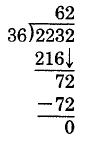
Use the first digit of the divisor and the first two digits of the dividend to make the educated guess.
3 goes into 22 at most 7 times.
Try 7: \(7 \times 36 = 252\) which is greater than 223. Reduce the estimate.
Try 6: \(6 \times 36 = 216\) which is less than 223.
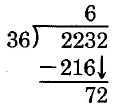
\(\begin{array} {ll} {\text{Multiply: }} & {6 \times 36 = 216. \text{Write 216 below 223.}} \\ {\text{Subtract: }} & {223 - 216 = 7. \text{Bring down the 2.}} \end{array}\)
Divide 3 into 7 to estimate the number of times 36 goes into 72. The 3 goes into 7 at most 2 times.
Try 2: \(2 \times 36 = 72\).
Check:
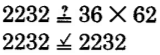
Thus \(2,232 \div 36 = 62\).
Find \(2,417,228 \div 802\).
Solution
\(802 \overline{)2417228}\)
First, the educated guess: \(24 \div 8 = 3\). Then \(3 \times 802 = 2406\), which is less than 2417. Use 3 as the guess. Since \(3 \times 802 = 2406\), and 2406 has four digits, place the 3 above the fourth digit of the dividend.
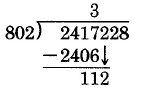
Subtract: 2417 - 2406 = 11.
Bring down the 2.
The divisor 802 goes into 112 at most 0 times. Use 0.
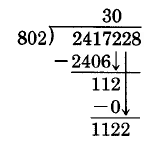
\(\begin{array} {ll} {\text{Multiply:}} & {0 \times 802 = 0.} \\ {\text{Subtract:}} & {112 - 0 = 112.} \\ {\text{Bring down the 2.}} & {} \end{array}\)
The 8 goes into 11 at most 1 time, and \(1 \times 802 = 802\), which is less than 1122. Try 1.
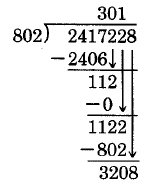
Subtract 1122 - 802 = 320
Bring down the 8.
8 goes into 32 at most 4 times.
\(4 \times 802 = 3208\).
Use 4.
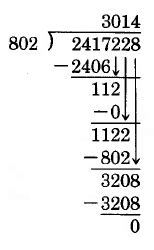
Check:

Thus, \(2,417,228 \div 802 = 3,014\).
Practice Set B
Perform the following divisions.
\(1,376 \div 32\)
- Answer
-
43
Practice Set B
\(6,160 \div 55\)
- Answer
-
112
Practice Set B
\(18,605 \div 61\)
- Answer
-
305
Practice Set B
\(144,768 \div 48\)
- Answer
-
3,016
Division with a Remainder
We might wonder how many times 4 is contained in 10. Repeated subtraction yields
\(\begin{array} {r} {10} \\ {\underline{-\ \ 4}} \\ {6} \\ {\underline{-4}} \\ {2} \end{array}\)
Since the remainder is less than 4, we stop the subtraction. Thus, 4 goes into 10 two times with 2 remaining. We can write this as a division as follows.
\(\begin{array} {r} {2} \\ {4 \overline{)10}} \\ {\underline{-\ \ 8}} \\ {2} \end{array}\)
\(\begin{array} {ll} {\text{Divide:}} & {\text{4 goes into 10 at most 2 times.}} \\ {\text{Multiply:}} & {2 \times 4 = 8. \text{Write 8 below 0.}} \\ {\text{Subtract:}} & {10 - 8 = 2.} \end{array}\)
\(\begin{array} {r} {\text{2R2}} \\ {4\overline{)\ \ \ 10}} \\ {\underline{-8}} \\ {2} \end{array}\) or \(10 \div 4 = \begin{matrix} \underbrace{\text{2R2}} \\ {\text{2 with remainder 2}} \end{matrix}\)
Find \(85 \div 3\).
Solution
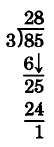
\(\begin{cases} \text{Divide:} & \text{3 goes into 8 at most 2 times.} \\ \text{Multiply:} & 2 \times 3 = 6. \text{ Write 6 below 8.} \\ \text{Subtract:} & 8 - 6 = 2. \text{ Bring down the 5.} \end{cases}\) \(\begin{cases} \text{Divide:} & \text{3 goes into 25 at most 8 times.} \\ \text{Multiply:} & 3 \times 8 = 24. \text{ Write 24 below 25.} \\ \text{Subtract:} & 25 - 24 = 1 \end{cases}\)
Find \(726 \div 23\).
Solution

Check: Multiply 31 by 23, then add 13.

Thus, \(726 \div 23 = 31R13\).
Practice Set C
Perform the following divisions.
\(75 \div 4\)
- Answer
-
18 R3
Practice Set C
\(346 \div 8\)
- Answer
-
43 R2
Practice Set C
\(489 \div 21\)
- Answer
-
23 R6
Practice Set C
\(5,016 \div 82\)
- Answer
-
61 R14
Practice Set C
\(41,196 \div 67\)
- Answer
-
614 R58
Calculators
The calculator can be useful for finding quotients with single and multiple digit divisors. If, however, the division should result in a remainder, the calculator is unable to provide us with the particular value of the remainder. Also, some calculators (most nonscientific) are unable to perform divisions in which one of the numbers has more than eight digits.
Use a calculator to perform each division.
\(328 \div 8\).
Solution
| Type | 328 |
| Press | \(\div\) |
| Type | 8 |
| Press | = |
The display now reads 41.
\(53,136 \div 82\).
Solution
| Type | 53136 |
| Press | \(\div\) |
| Type | 82 |
| Press | = |
The display now reads 648.
\(730,019,001 \div 326\)
Solution
We first try to enter 730,019,001 but find that we can only enter 73001900. If our calculator has only an eight-digit display (as most nonscientific calculators do), we will be unable to use the calculator to perform this division.
\(3727 \div 49\).
Solution
| Type | 3727 |
| Press | \(\div\) |
| Type | 49 |
| Press | = |
The display now reads 76.061224.
This number is an example of a decimal number (see [link]). When a decimal number results in a calculator division, we can conclude that the division produces a remainder.
Practice Set D
Use a calculator to perform each division.
\(3,330 \div 74\)
- Answer
-
45
Practice Set D
\(63,365 \div 115\)
- Answer
-
551
Practice Set D
\(21,996,385,287 \div 53\)
- Answer
-
Since the dividend has more than eight digits, this division cannot be performed on most nonscientific calculators. On others, the answer is 415,026,137.4
Practice Set D
\(4,558 \div 67\)
- Answer
-
This division results in 68.02985075, a decimal number, and therefore, we cannot, at this time, find the value of the remainder. Later, we will discuss decimal numbers.
Exercises
For the following problems, perform the divisions.
The first 38 problems can be checked with a calculator by multiplying the divisor and quotient then adding the remainder.
Exercise \(\PageIndex{1}\)
\(52 \div 4\)
- Answer
-
13
Exercise \(\PageIndex{2}\)
\(776 \div 8\)
Exercise \(\PageIndex{3}\)
\(603 \div 9\)
- Answer
-
67
Exercise \(\PageIndex{4}\)
\(240 \div 8\)
Exercise \(\PageIndex{5}\)
\(208 \div 4\)
- Answer
-
52
Exercise \(\PageIndex{6}\)
\(576 \div 6\)
Exercise \(\PageIndex{7}\)
\(21 \div 7\)
- Answer
-
3
Exercise \(\PageIndex{8}\)
\(0 \div 0\)
Exercise \(\PageIndex{9}\)
\(140 \div 2\)
- Answer
-
70
Exercise \(\PageIndex{10}\)
\(528 \div 8\)
Exercise \(\PageIndex{11}\)
\(244 \div 4\)
- Answer
-
61
Exercise \(\PageIndex{12}\)
\(0 \div 7\)
Exercise \(\PageIndex{13}\)
\(177 \div 3\)
- Answer
-
59
Exercise \(\PageIndex{14}\)
\(96 \div 8\)
Exercise \(\PageIndex{15}\)
\(67 \div 1\)
- Answer
-
67
Exercise \(\PageIndex{16}\)
\(896 \div 56\)
Exercise \(\PageIndex{17}\)
\(1,044 \div 12\)
- Answer
-
87
Exercise \(\PageIndex{18}\)
\(988 \div 19\)
Exercise \(\PageIndex{19}\)
\(5,238 \div 97\)
- Answer
-
54
Exercise \(\PageIndex{20}\)
\(2530 \div 55\)
Exercise \(\PageIndex{21}\)
\(4,264 \div 82\)
- Answer
-
52
Exercise \(\PageIndex{22}\)
\(637 \div 13\)
Exercise \(\PageIndex{23}\)
\(3,420 \div 90\)
- Answer
-
38
Exercise \(\PageIndex{24}\)
\(5,655 \div 87\)
Exercise \(\PageIndex{25}\)
\(2,115 \div 47\)
- Answer
-
45
Exercise \(\PageIndex{26}\)
\(9,328 \div 22\)
Exercise \(\PageIndex{27}\)
\(55,167 \div 71\)
- Answer
-
777
Exercise \(\PageIndex{28}\)
\(68,356 \div 92\)
Exercise \(\PageIndex{29}\)
\(27,702 \div 81\)
- Answer
-
342
Exercise \(\PageIndex{30}\)
\(6,510 \div 31\)
Exercise \(\PageIndex{31}\)
\(60,536 \div 94\)
- Answer
-
644
Exercise \(\PageIndex{32}\)
\(31,844 \div 38\)
Exercise \(\PageIndex{33}\)
\(23,985 \div 45\)
- Answer
-
533
Exercise \(\PageIndex{34}\)
\(60,606 \div 74\)
Exercise \(\PageIndex{35}\)
\(2,975,400 \div 285\)
- Answer
-
10,440
Exercise \(\PageIndex{36}\)
\(1,389,660 \div 795\)
Exercise \(\PageIndex{37}\)
\(7,162,060 \div 879\)
- Answer
-
8,147 remainder 847
Exercise \(\PageIndex{38}\)
\(7,561,060 \div 909\)
Exercise \(\PageIndex{39}\)
\(38 \div 9\)
- Answer
-
4 remainder 2
Exercise \(\PageIndex{40}\)
\(97 \div 4\)
Exercise \(\PageIndex{41}\)
\(199 \div 3\)
- Answer
-
66 remainder 1
Exercise \(\PageIndex{42}\)
\(573 \div 6\)
Exercise \(\PageIndex{43}\)
\(10,701 \div 13\)
- Answer
-
823 remainder 2
Exercise \(\PageIndex{44}\)
\(13,521 \div 53\)
Exercise \(\PageIndex{45}\)
\(3,628 \div 90\)
- Answer
-
40 remainder 28
Exercise \(\PageIndex{46}\)
\(10,592 \div 43\)
Exercise \(\PageIndex{47}\)
\(19,965 \div 30\)
- Answer
-
665 remainder 15
Exercise \(\PageIndex{48}\)
\(8,320 \div 21\)
Exercise \(\PageIndex{49}\)
\(61,282 \div 64\)
- Answer
-
957 remainder 34
Exercise \(\PageIndex{50}\)
\(1,030 \div 28\)
Exercise \(\PageIndex{51}\)
\(7,319 \div 11\)
- Answer
-
665 remainder 4
Exercise \(\PageIndex{52}\)
\(3,628 \div 90\)
Exercise \(\PageIndex{53}\)
\(35,279 \div 77\)
- Answer
-
458 remainder 13
Exercise \(\PageIndex{54}\)
\(52,196 \div 68\)
Exercise \(\PageIndex{55}\)
\(67,751 \div 68\)
- Answer
-
996 remainder 23
For the following 5 problems, use a calculator to find the quotients.
Exercise \(\PageIndex{56}\)
\(4,346 \div 53\)
Exercise \(\PageIndex{57}\)
\(3,234 \div 77\)
- Answer
-
42
Exercise \(\PageIndex{58}\)
\(6,771 \div 37\)
Exercise \(\PageIndex{59}\)
\(4,272,320 \div 520\)
- Answer
-
8,216
Exercise \(\PageIndex{60}\)
\(7,558,110 \div 651\)
Exercise \(\PageIndex{61}\)
A mathematics instructor at a high school is paid $17,775 for 9 months. How much money does this instructor make each month?
- Answer
-
$1,975 per month
Exercise \(\PageIndex{62}\)
A couple pays $4,380 a year for a one-bedroom apartment. How much does this couple pay each month for this apartment?
Exercise \(\PageIndex{63}\)
Thirty-six people invest a total of $17,460 in a particular stock. If they each invested the same amount, how much did each person invest?
- Answer
-
$485 each person invested
Exercise \(\PageIndex{64}\)
Each of the 28 students in a mathematics class buys a textbook. If the bookstore sells $644 worth of books, what is the price of each book?
Exercise \(\PageIndex{65}\)
A certain brand of refrigerator has an automatic ice cube maker that makes 336 ice cubes in one day. If the ice machine makes ice cubes at a constant rate, how many ice cubes does it make each hour?
- Answer
-
14 cubes per hour
Exercise \(\PageIndex{66}\)
A beer manufacturer bottles 52,380 ounces of beer each hour. If each bottle contains the same number of ounces of beer, and the manufacturer fills 4,365 bottles per hour, how many ounces of beer does each bottle contain?
Exercise \(\PageIndex{67}\)
A computer program consists of 68,112 bits. 68,112 bits equals 8,514 bytes. How many bits in one byte?
- Answer
-
8 bits in each byte
Exercise \(\PageIndex{68}\)
A 26-story building in San Francisco has a total of 416 offices. If each floor has the same number of offices, how many floors does this building have?
Exercise \(\PageIndex{69}\)
A college has 67 classrooms and a total of 2,546 desks. How many desks are in each classroom if each classroom has the same number of desks?
- Answer
-
38
Exercises for Review
Exercise \(\PageIndex{70}\)
What is the value of 4 in the number 124,621?
Exercise \(\PageIndex{71}\)
Round 604,092 to the nearest hundred thousand.
- Answer
-
600,000
Exercise \(\PageIndex{72}\)
What whole number is the additive identity?
Exercise \(\PageIndex{73}\)
Find the product. \(6,256 \times 100\).
- Answer
-
625,600
Exercise \(\PageIndex{74}\)
Find the quotient. \(0 \div 11\)