

2.6: Multiplying and Dividing Fractions
- Page ID
- 218257

\( \newcommand{\vecs}[1]{\overset { \scriptstyle \rightharpoonup} {\mathbf{#1}} } \)
\( \newcommand{\vecd}[1]{\overset{-\!-\!\rightharpoonup}{\vphantom{a}\smash {#1}}} \)
\( \newcommand{\dsum}{\displaystyle\sum\limits} \)
\( \newcommand{\dint}{\displaystyle\int\limits} \)
\( \newcommand{\dlim}{\displaystyle\lim\limits} \)
\( \newcommand{\id}{\mathrm{id}}\) \( \newcommand{\Span}{\mathrm{span}}\)
( \newcommand{\kernel}{\mathrm{null}\,}\) \( \newcommand{\range}{\mathrm{range}\,}\)
\( \newcommand{\RealPart}{\mathrm{Re}}\) \( \newcommand{\ImaginaryPart}{\mathrm{Im}}\)
\( \newcommand{\Argument}{\mathrm{Arg}}\) \( \newcommand{\norm}[1]{\| #1 \|}\)
\( \newcommand{\inner}[2]{\langle #1, #2 \rangle}\)
\( \newcommand{\Span}{\mathrm{span}}\)
\( \newcommand{\id}{\mathrm{id}}\)
\( \newcommand{\Span}{\mathrm{span}}\)
\( \newcommand{\kernel}{\mathrm{null}\,}\)
\( \newcommand{\range}{\mathrm{range}\,}\)
\( \newcommand{\RealPart}{\mathrm{Re}}\)
\( \newcommand{\ImaginaryPart}{\mathrm{Im}}\)
\( \newcommand{\Argument}{\mathrm{Arg}}\)
\( \newcommand{\norm}[1]{\| #1 \|}\)
\( \newcommand{\inner}[2]{\langle #1, #2 \rangle}\)
\( \newcommand{\Span}{\mathrm{span}}\) \( \newcommand{\AA}{\unicode[.8,0]{x212B}}\)
\( \newcommand{\vectorA}[1]{\vec{#1}} % arrow\)
\( \newcommand{\vectorAt}[1]{\vec{\text{#1}}} % arrow\)
\( \newcommand{\vectorB}[1]{\overset { \scriptstyle \rightharpoonup} {\mathbf{#1}} } \)
\( \newcommand{\vectorC}[1]{\textbf{#1}} \)
\( \newcommand{\vectorD}[1]{\overrightarrow{#1}} \)
\( \newcommand{\vectorDt}[1]{\overrightarrow{\text{#1}}} \)
\( \newcommand{\vectE}[1]{\overset{-\!-\!\rightharpoonup}{\vphantom{a}\smash{\mathbf {#1}}}} \)
\( \newcommand{\vecs}[1]{\overset { \scriptstyle \rightharpoonup} {\mathbf{#1}} } \)
\(\newcommand{\longvect}{\overrightarrow}\)
\( \newcommand{\vecd}[1]{\overset{-\!-\!\rightharpoonup}{\vphantom{a}\smash {#1}}} \)
\(\newcommand{\ket}[1]{\left| #1 \right>}\)
\(\newcommand{\bra}[1]{\left< #1 \right|}\)
\(\newcommand{\braket}[2]{\left< #1 \vphantom{#2} \right| \left. #2 \vphantom{#1} \right>}\)
\(\newcommand{\braopket}[3]{\left< #1 \vphantom{#2}\vphantom{#3} \right| #2 \vphantom{#1}\vphantom{#3} \left| #3 \vphantom{#1}\vphantom{#2} \right>}\)
\(\newcommand{\qmvec}[1]{\mathbf{\vec{#1}}}\)
\(\newcommand{\op}[1]{\hat{\mathbf{#1}}}\)
\(\newcommand{\expect}[1]{\langle #1 \rangle}\)
\(\newcommand{\dfn}[1]{\emph{\textbf{#1}}}\)
- understand the concept of multiplication of fractions
- be able to multiply one fraction by another
- be able to multiply mixed numbers
- be able to find powers and roots of various fractions
Fractions of Fractions
We know that a fraction represents a part of a whole quantity. For example, two fifths of one unit can be represented by
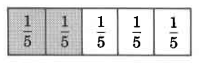
\(\dfrac{2}{5}\) of the whole is shaded.
A natural question is, what is a fractional part of a fractional quantity, or, what is a fraction of a fraction? For example, what \(\dfrac{2}{3}\) of \(\dfrac{1}{2}\)?
We can suggest an answer to this question by using a picture to examine \(\dfrac{2}{3}\) of \(\dfrac{1}{2}\).
First, let's represent \(\dfrac{1}{2}\).
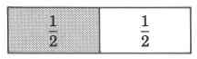
\(\dfrac{1}{2}\) of the whole is shaded.
Then divide each of the\(\dfrac{1}{2}\) parts into 3 equal parts.

Each part is \(\dfrac{1}{6}\) of the whole.
Now we'll take \(\dfrac{2}{3}\) of the \(\dfrac{1}{2}\) unit.
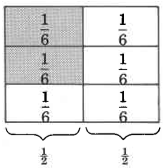
\(\dfrac{2}{3}\) of \(\dfrac{1}{2}\) is \(\dfrac{2}{6}\), which reduces to \(\dfrac{1}{3}\).
Multiplication of Fractions
Now we ask, what arithmetic operation \((+, - , \times , \div)\) will produce \(\dfrac{2}{6}\) from \(\dfrac{2}{3}\) of \(\dfrac{1}{2}\)?
Notice that, if in the fractions \(\dfrac{2}{3}\) and \(\dfrac{1}{2}\), we multiply the numerators together and the denominators together, we get precisely \(\dfrac{2}{6}\).
\(\dfrac{2 \cdot 1}{3 \cdot 2} = \dfrac{2}{6}\)
This reduces to \(\dfrac{1}{3}\) as before.
Using this observation, we can suggest the following:
The word "of" translates to the arithmetic operation "times."
To multiply two or more fractions, multiply the numerators together and then multiply the denominators together. Reduce if necessary.
\(\dfrac{\text{numerator 1}}{\text{denominator 1}} \cdot \dfrac{\text{numerator 2}}{\text{denominator 2}} = \dfrac{\text{numerator 1}}{\text{denominator 1}} \cdot \dfrac{\text{numerator 2}}{\text{denominator 2}}\)
Perform the following multiplications.
\(\dfrac{3}{4} \cdot \dfrac{1}{6} = \dfrac{3 \cdot 1}{4 \cdot 6} = \dfrac{3}{24}\) Now, reduce,
\(= \dfrac{\begin{array} {c} {^1} \\ {\cancel{3}} \end{array}}{\begin{array} {c} {\cancel{24}} \\ {^{8}} \end{array}} = \dfrac{1}{8}\)
Thus
\(\dfrac{3}{4} \cdot \dfrac{1}{6} = \dfrac{1}{8}\)
This means that \(\dfrac{3}{4}\) of \(\dfrac{1}{6}\) is \(\dfrac{1}{8}\), that is, \(\dfrac{3}{4}\) of \(\dfrac{1}{6}\) of a unit is \(\dfrac{1}{8}\) of the original unit.
\(\dfrac{3}{8} \cdot 4\). Write 4 as a fraction by writing \(\dfrac{4}{1}\)
\(\dfrac{3}{8} \cdot \dfrac{4}{1} = \dfrac{3 \cdot 4}{8 \cdot 1} = \dfrac{12}{8} = \dfrac{\begin{array} {c} {^3} \\ {\cancel{12}} \end{array}}{\begin{array} {c} {\cancel{8}} \\ {^2} \end{array}} = \dfrac{3}{2}\)
\(\dfrac{3}{8} \cdot 4 = \dfrac{3}{2}\)
This means that \(\dfrac{3}{8}\) of 4 whole units is \(\dfrac{3}{2}\) of one whole unit.
\(\dfrac{2}{5} \cdot \dfrac{5}{8} \cdot \dfrac{1}{4} = \dfrac{2 \cdot 5 \cdot 1}{5 \cdot 8 \cdot 4} = \dfrac{\begin{array} {c} {^1} \\ {\cancel{10}} \end{array}}{\begin{array} {c} {\cancel{160}} \\ {^{16}} \end{array}} = \dfrac{1}{16}\)
This means that \(\dfrac{2}{5}\) of \(\dfrac{5}{8}\) of \(\dfrac{1}{4}\) of a whole unit is \(\dfrac{1}{16}\) of the original unit.
Practice Set A
Perform the following multiplications.
\(\dfrac{2}{5} \cdot \dfrac{1}{6}\)
- Answer
-
\(\dfrac{1}{15}\)
Practice Set A
\(\dfrac{1}{4} \cdot \dfrac{8}{9}\)
- Answer
-
\(\dfrac{2}{9}\)
Practice Set A
\(\dfrac{4}{9} \cdot \dfrac{15}{16}\)
- Answer
-
\(\dfrac{5}{12}\)
Practice Set A
\((\dfrac{2}{3}) (\dfrac{2}{3})\)
- Answer
-
\(\dfrac{4}{9}\)
Practice Set A
\((\dfrac{7}{4}) (\dfrac{8}{5})\)
- Answer
-
\(\dfrac{14}{5}\)
Practice Set A
\(\dfrac{5}{6} \cdot \dfrac{7}{8}\)
- Answer
-
\(\dfrac{35}{48}\)
Practice Set A
\(\dfrac{2}{3} \cdot 5\)
- Answer
-
\(\dfrac{10}{3}\)
Practice Set A
\((\dfrac{3}{10}) (10)\)
- Answer
-
\(\dfrac{15}{2}\)
Practice Set A
\(\dfrac{3}{4} \cdot \dfrac{8}{9} \cdot \dfrac{5}{12}\)
- Answer
-
\(\dfrac{5}{18}\)
Multiplying Fractions by Dividing Out Common Factors
We have seen that to multiply two fractions together, we multiply numerators together, then denominators together, then reduce to lowest terms, if necessary. The reduction can be tedious if the numbers in the fractions are large. For example,
\(\dfrac{9}{16} \cdot \dfrac{10}{21} = \dfrac{9 \cdot 10}{16 \cdot 21} = \dfrac{90}{336} = \dfrac{45}{168} = \dfrac{15}{28}\)
We avoid the process of reducing if we divide out common factors before we multiply.
\(\dfrac{9}{16} \cdot \dfrac{10}{21} = \dfrac{\begin{array} {c} {^3} \\ {\cancel{9}} \end{array}}{\begin{array} {c} {\cancel{16}} \\ {^8} \end{array}} \cdot \dfrac{\begin{array} {c} {^5} \\ {\cancel{10}} \end{array}}{\begin{array} {c} {\cancel{21}} \\ {^7} \end{array}} = \dfrac{3 \cdot 5}{8 \cdot 7} = \dfrac{15}{56}\)
Divide 3 into 9 and 21, and divide 2 into 10 and 16. The product is a fraction that is reduced to lowest terms.
To multiply fractions by dividing out common factors, divide out factors that are common to both a numerator and a denominator. The factor being divided out can appear in any numerator and any denominator.
Perform the following multiplications.
\(\dfrac{4}{5} \cdot \dfrac{5}{6}\)
\(\dfrac{\begin{array} {c} {^2} \\ {\cancel{4}} \end{array}}{\begin{array} {c} {\cancel{5}} \\ {^1} \end{array}} \cdot \dfrac{\begin{array} {c} {^1} \\ {\cancel{5}} \end{array}}{\begin{array} {c} {\cancel{6}} \\ {^1} \end{array}} = \dfrac{2 \cdot 1}{1 \cdot 3} = \dfrac{2}{3}\)
Divide 4 and 6 by 2
Divide 5 and 5 by 5
\(\dfrac{8}{12} \cdot \dfrac{8}{10}\)
\(\dfrac{\begin{array} {c} {^4} \\ {\cancel{8}} \end{array}}{\begin{array} {c} {\cancel{12}} \\ {^3} \end{array}} \cdot \dfrac{\begin{array} {c} {^2} \\ {\cancel{8}} \end{array}}{\begin{array} {c} {\cancel{10}} \\ {^5} \end{array}} = \dfrac{4 \cdot 2}{3 \cdot 5} = \dfrac{8}{15}\)
Divide 8 and 10 by 2.
Divide 8 and 12 by 4.
\(8 \cdot \dfrac{5}{12} = \dfrac{\begin{array} {c} {^2} \\ {\cancel{8}} \end{array}}{1} \cdot \dfrac{5}{\begin{array} {c} {\cancel{12}} \\ {^3} \end{array}} = \dfrac{2 \cdot 5}{1 \cdot 3} = \dfrac{10}{3}\)
\(\dfrac{35}{18} \cdot \dfrac{63}{105}\)
\(\dfrac{\begin{array} {c} {^{^1}} \\ {^{\cancel{7}}} \\ {\cancel{35}} \end{array}}{\begin{array} {c} {\cancel{18}} \\ {^2} \end{array}} \dfrac{\begin{array} {c} {^7} \\ {\cancel{63}} \end{array}}{\begin{array} {c} {\cancel{105}} \\ {^{\cancel{21}}} \\ {^{^3}} \end{array}} = \dfrac{1 \cdot 7}{2 \cdot 3} = \dfrac{7}{6}\)
\(\dfrac{13}{9} \cdot \dfrac{6}{39} \cdot \dfrac{1}{12}\)
\(\dfrac{\begin{array} {c} {^1} \\ {\cancel{13}} \end{array}}{9} \cdot \dfrac{\begin{array} {c} {^{^1}} \\ {^{\cancel{2}}} \\ {\cancel{6}} \end{array}}{\begin{array} {c} {\cancel{39}} \\ {^{\cancel{3}}} \\ {^{^1}} \end{array}} \cdot \dfrac{1}{\begin{array} {c} {\cancel{12}} \\ {^6} \end{array}} = \dfrac{1 \cdot 1 \cdot 1}{9 \cdot 1 \cdot 6} = \dfrac{1}{54}\)
Practice Set B
Perform the following multiplications.
\(\dfrac{2}{3} \cdot \dfrac{7}{8}\)
- Answer
-
\(\dfrac{7}{12}\)
Practice Set B
\(\dfrac{25}{12} \cdot \dfrac{10}{45}\)
- Answer
-
\(\dfrac{25}{54}\)
Practice Set B
\(\dfrac{40}{48} \cdot \dfrac{72}{90}\)
- Answer
-
\(\dfrac{2}{3}\)
Practice Set B
\(7 \cdot \dfrac{2}{49}\)
- Answer
-
\(\dfrac{2}{7}\)
Practice Set B
\(12 \cdot \dfrac{3}{8}\)
- Answer
-
\(\dfrac{9}{2}\)
Practice Set B
\((\dfrac{13}{7}) (\dfrac{14}{26})\)
- Answer
-
1
Practice Set B
\(\dfrac{16}{10} \cdot \dfrac{22}{6} \cdot \dfrac{21}{44}\)
- Answer
-
\(\dfrac{14}{5}\)
Multiplication of Mixed Numbers
Multiplying Mixed Numbers
To perform a multiplication in which there are mixed numbers, it is convenient to first convert each mixed number to an improper fraction, then multiply.
Perform the following multiplications. Convert improper fractions to mixed numbers.
\(1 \dfrac{1}{8} \cdot 4 \dfrac{2}{3}\)
Convert each mixed number to an improper fraction.
\(1 \dfrac{1}{8} = \dfrac{8 \cdot 1 + 1}{8} = \dfrac{9}{8}\)
\(4 \dfrac{2}{3} = \dfrac{4 \cdot 3 + 2}{3} = \dfrac{14}{3}\)
\(\dfrac{\begin{array} {c} {^3} \\ {\cancel{9}} \end{array}}{\begin{array} {c} {\cancel{8}} \\ {^4} \end{array}} \cdot \dfrac{\begin{array} {c} {^7} \\ {\cancel{14}} \end{array}}{\begin{array} {c} {\cancel{3}} \\ {^1} \end{array}} = \dfrac{3 \cdot 7}{4 \cdot 1} = \dfrac{21}{4} = 5 \dfrac{1}{4}\)
\(16 \cdot 8 \dfrac{1}{5}\)
Convert \(8 \dfrac{1}{5}\) to an improper fraction.
\(8 \dfrac{1}{5} = \dfrac{5 \cdot 8 + 1}{5} = \dfrac{41}{5}\)
\(\dfrac{16}{1} \cdot \dfrac{41}{5}\).
There are no common factors to divide out.
\(\dfrac{16}{1} \cdot \dfrac{41}{5} = \dfrac{16 \cdot 41}{1 \cdot 5} = \dfrac{656}{5} = 131 \dfrac{1}{5}\)
\(9 \dfrac{1}{6} \cdot 12 \dfrac{3}{5}\)
Convert to improper fractions.
\(9 \dfrac{1}{6} = \dfrac{6 \cdot 9 + 1}{6} = \dfrac{55}{6}\)
\(12 \dfrac{3}{5} = \dfrac{5 \cdot 12 + 3}{5} = \dfrac{63}{5}\)
\(\dfrac{\begin{array} {c} {^{11}} \\ {\cancel{55}} \end{array}}{\begin{array} {c} {\cancel{6}} \\ {^2} \end{array}} \cdot \dfrac{\begin{array} {c} {^{21}} \\ {\cancel{63}} \end{array}}{\begin{array} {c} {\cancel{5}} \\ {^1} \end{array}} = \dfrac{11 \cdot 21}{2 \cdot 1} = \dfrac{231}{2} = 115 \dfrac{1}{2}\)
\(\begin{array} {rcl} {\dfrac{11}{8} \cdot 4 \dfrac{1}{2} \cdot 3 \dfrac{1}{8}} & = & {\dfrac{11}{8} \cdot \dfrac{\begin{array} {c} {^3} \\ {\cancel{9}} \end{array}}{\begin{array} {c} {\cancel{2}} \\ {^1} \end{array}} \cdot \dfrac{\begin{array} {c} {^5} \\ {\cancel{10}} \end{array}}{\begin{array} {c} {\cancel{3}} \\ {^1} \end{array}}} \\ {} & = & {\dfrac{11 \cdot 3 \cdot 5}{8 \cdot 1 \cdot 1} = \dfrac{165}{8} = 20 \dfrac{5}{8}} \end{array}\)
Practice Set C
Perform the following multiplications. Convert improper fractions to mixed numbers.
\(2 \dfrac{2}{3} \cdot 2 \dfrac{1}{4}\)
- Answer
-
6
Practice Set C
\(6 \dfrac{2}{3} \cdot 3 \dfrac{3}{10}\)
- Answer
-
22
Practice Set C
\(7 \dfrac{1}{8} \cdot 12\)
- Answer
-
\(85\dfrac{1}{2}\)
Practice Set C
\(2 \dfrac{2}{5} \cdot 3 \dfrac{3}{4} \cdot 3 \dfrac{1}{3}\)
- Answer
-
30
Exercises
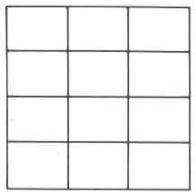
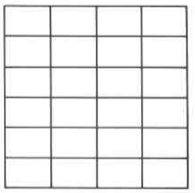
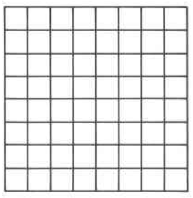
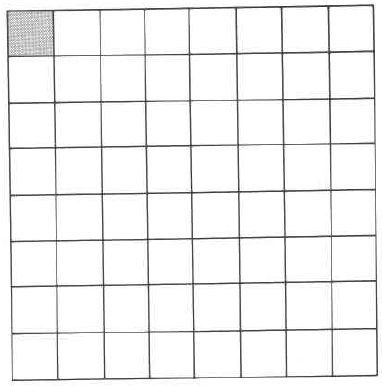
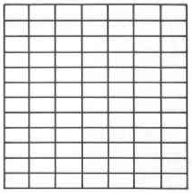
For the following six problems, use the diagrams to find each of the following parts. Use multiplication to verify your result.
Exercise \(\PageIndex{1}\)
\(\dfrac{3}{4}\) of \(\dfrac{1}{3}\)
- Answer
-
\(\dfrac{1}{4}\)

Exercise \(\PageIndex{2}\)
\(\dfrac{2}{3}\) of \(\dfrac{3}{5}\)

Exercise \(\PageIndex{3}\)
\(\dfrac{2}{7}\) of \(\dfrac{7}{8}\)

- Answer
-
\(\dfrac{1}{4}\)

Exercise \(\PageIndex{4}\)
\(\dfrac{5}{6}\) of \(\dfrac{3}{4}\)
Exercise \(\PageIndex{5}\)
\(\dfrac{1}{8}\) of \(\dfrac{1}{8}\)
- Answer
-
\(\dfrac{1}{64}\)
Exercise \(\PageIndex{6}\)
\(\dfrac{7}{12}\) of \(\dfrac{6}{7}\)
For the following problems, find each part without using a diagram.
Exercise \(\PageIndex{7}\)
\(\dfrac{1}{2}\) of \(\dfrac{4}{5}\)
- Answer
-
\(\dfrac{2}{5}\)
Exercise \(\PageIndex{8}\)
\(\dfrac{3}{5}\) of \(\dfrac{5}{12}\)
Exercise \(\PageIndex{9}\)
\(\dfrac{1}{4}\) of \(\dfrac{8}{9}\)
- Answer
-
\(\dfrac{2}{9}\)
Exercise \(\PageIndex{10}\)
\(\dfrac{3}{16}\) of \(\dfrac{12}{15}\)
Exercise \(\PageIndex{11}\)
\(\dfrac{2}{9}\) of \(\dfrac{6}{5}\)
- Answer
-
\(\dfrac{4}{15}\)
Exercise \(\PageIndex{12}\)
\(\dfrac{1}{8}\) of \(\dfrac{3}{8}\)
Exercise \(\PageIndex{13}\)
\(\dfrac{2}{3}\) of \(\dfrac{9}{10}\)
- Answer
-
\(\dfrac{3}{5}\)
Exercise \(\PageIndex{14}\)
\(\dfrac{18}{19}\) of \(\dfrac{38}{54}\)
Exercise \(\PageIndex{15}\)
\(\dfrac{5}{6}\) of \(2 \dfrac{2}{5}\)
- Answer
-
2
Exercise \(\PageIndex{16}\)
\(\dfrac{3}{4}\) of \(3 \dfrac{3}{5}\)
Exercise \(\PageIndex{17}\)
\(\dfrac{3}{2}\) of \(2 \dfrac{2}{9}\)
- Answer
-
\(\dfrac{10}{3}\) or \(3 \dfrac{1}{3}\)
Exercise \(\PageIndex{18}\)
\(\dfrac{15}{4}\) of \(4 \dfrac{4}{5}\)
Exercise \(\PageIndex{19}\)
\(5 \dfrac{1}{3}\) of \(9 \dfrac{3}{4}\)
- Answer
-
52
Exercise \(\PageIndex{20}\)
\(1 \dfrac{13}{15}\) of \(8 \dfrac{3}{4}\)
Exercise \(\PageIndex{21}\)
\(\dfrac{8}{9}\) of \(\dfrac{3}{4}\) of \(\dfrac{2}{3}\)
- Answer
-
\(\dfrac{4}{9}\)
Exercise \(\PageIndex{22}\)
\(\dfrac{1}{6}\) of \(\dfrac{12}{13}\) of \(\dfrac{26}{36}\)
Exercise \(\PageIndex{23}\)
\(\dfrac{1}{2}\) of \(\dfrac{1}{3}\) of \(\dfrac{1}{4}\)
- Answer
-
\(\dfrac{1}{24}\)
Exercise \(\PageIndex{24}\)
\(1 \dfrac{3}{7}\) of \(5 \dfrac{1}{5}\) of \(8 \dfrac{1}{3}\)
Exercise \(\PageIndex{25}\)
\(2 \dfrac{4}{5}\) of \(5 \dfrac{5}{6}\) of \(7 \dfrac{5}{7}\)
- Answer
-
126
For the following problems, find the products. Be sure to reduce.
Exercise \(\PageIndex{26}\)
\(\dfrac{1}{3} \cdot \dfrac{2}{3}\)
Exercise \(\PageIndex{27}\)
\(\dfrac{1}{2} \cdot \dfrac{1}{2}\)
- Answer
-
\(\dfrac{1}{4}\)
Exercise \(\PageIndex{28}\)
\(\dfrac{3}{4} \cdot \dfrac{3}{8}\)
Exercise \(\PageIndex{29}\)
\(\dfrac{2}{5} \cdot \dfrac{5}{6}\)
- Answer
-
\(\dfrac{1}{3}\)
Exercise \(\PageIndex{30}\)
\(\dfrac{3}{8} \cdot \dfrac{8}{9}\)
Exercise \(\PageIndex{31}\)
\(\dfrac{5}{6} \cdot \dfrac{14}{15}\)
- Answer
-
\(\dfrac{7}{9}\)
Exercise \(\PageIndex{32}\)
\(\dfrac{4}{7} \cdot \dfrac{7}{4}\)
Exercise \(\PageIndex{33}\)
\(\dfrac{3}{11} \cdot \dfrac{11}{3}\)
- Answer
-
1
Exercise \(\PageIndex{34}\)
\(\dfrac{9}{16} \cdot \dfrac{20}{27}\)
Exercise \(\PageIndex{35}\)
\(\dfrac{35}{36} \cdot \dfrac{48}{55}\)
- Answer
-
\(\dfrac{28}{33}\)
Exercise \(\PageIndex{36}\)
\(\dfrac{21}{25} \cdot \dfrac{15}{14}\)
Exercise \(\PageIndex{37}\)
\(\dfrac{76}{99} \cdot \dfrac{66}{38}\)
- Answer
-
\(\dfrac{4}{3}\)
Exercise \(\PageIndex{38}\)
\(\dfrac{3}{7} \cdot \dfrac{14}{18} \cdot \dfrac{6}{2}\)
Exercise \(\PageIndex{39}\)
\(\dfrac{4}{15} \cdot \dfrac{10}{3} \cdot \dfrac{27}{2}\)
- Answer
-
12
Exercise \(\PageIndex{40}\)
\(\dfrac{14}{15} \cdot \dfrac{21}{28} \cdot \dfrac{45}{7}\)
Exercise \(\PageIndex{41}\)
\(\dfrac{8}{3} \cdot \dfrac{15}{4} \cdot \dfrac{16}{21}\)
- Answer
-
\(7\dfrac{13}{21}\) or \(\dfrac{160}{21}\)
Exercise \(\PageIndex{42}\)
\(\dfrac{18}{14} \cdot \dfrac{21}{35} \cdot \dfrac{36}{7}\)
Exercise \(\PageIndex{43}\)
\(\dfrac{3}{5} \cdot 20\)
- Answer
-
12
Exercise \(\PageIndex{44}\)
\(\dfrac{8}{9} \cdot 18\)
Exercise \(\PageIndex{45}\)
\(\dfrac{6}{11} \cdot 33\)
- Answer
-
18
Exercise \(\PageIndex{46}\)
\(\dfrac{18}{19} \cdot 38\)
Exercise \(\PageIndex{47}\)
\(\dfrac{5}{6} \cdot 10\)
- Answer
-
\(\dfrac{25}{3}\) or \(8\dfrac{1}{3}\)
Exercise \(\PageIndex{48}\)
\(\dfrac{1}{9} \cdot 3\)
Exercise \(\PageIndex{49}\)
\(5 \cdot \dfrac{3}{8}\)
- Answer
-
\(\dfrac{15}{8} =1 \dfrac{7}{8}\)
Exercise \(\PageIndex{50}\)
\(16 \cdot \dfrac{1}{4}\)
Exercise \(\PageIndex{51}\)
\(\dfrac{2}{3} \cdot 12 \cdot \dfrac{3}{4}\)
- Answer
-
6
Exercise \(\PageIndex{52}\)
\(\dfrac{3}{8} \cdot 24 \cdot \dfrac{2}{3}\)
Exercise \(\PageIndex{53}\)
\(\dfrac{5}{18} \cdot 10 \cdot \dfrac{2}{5}\)
- Answer
-
\(\dfrac{10}{9} = 1 \dfrac{1}{9}\)
Exercise \(\PageIndex{54}\)
\(\dfrac{16}{15} \cdot 50 \cdot \dfrac{3}{10}\)
Exercise \(\PageIndex{55}\)
\(5 \dfrac{1}{3} \cdot \dfrac{27}{32}\)
- Answer
-
\(\dfrac{9}{2} = 4 \drac{1}{2}\)
Exercise \(\PageIndex{56}\)
\(2 \dfrac{6}{7} \cdot 5 \dfrac{3}{5}\)
Exercise \(\PageIndex{57}\)
\(6 \dfrac{1}{4} \cdot 2 \dfrac{4}{15}\)
- Answer
-
\(\dfrac{85}{6} = 14 \drac{1}{6}\)
Exercise \(\PageIndex{58}\)
\(9\dfrac{1}{3} \cdot \dfrac{9}{16} \cdot 1 \dfrac{1}{3}\)
Exercise \(\PageIndex{59}\)
\(3 \dfrac{5}{9} \cdot 1 \dfrac{13}{14} \cdot 10 \dfrac{1}{2}\)
- Answer
-
72
Exercise \(\PageIndex{60}\)
\(20 \dfrac{1}{4} \cdot 8 \dfrac{2}{3} \cdot 16 \dfrac{4}{5}\)
Exercise \(\PageIndex{61}\)
\((\dfrac{2}{3})^2\)
- Answer
-
\(\dfrac{4}{9}\)
Exercise \(\PageIndex{62}\)
\((\dfrac{3}{8})^2\)
Exercise \(\PageIndex{63}\)
\((\dfrac{2}{11})^2\)
- Answer
-
\(\dfrac{4}{121}\)
Exercise \(\PageIndex{64}\)
\((\dfrac{8}{9})^2\)
Exercise \(\PageIndex{65}\)
\((\dfrac{1}{2})^2\)
- Answer
-
\(\dfrac{1}{4}\)
Exercise \(\PageIndex{66}\)
\((\dfrac{3}{5})^2 \cdot \dfrac{20}{3}\)
Exercise \(\PageIndex{67}\)
\((\dfrac{1}{4})^2 \cdot \dfrac{16}{15}\)
- Answer
-
\(\dfrac{1}{15}\)
Exercise \(\PageIndex{68}\)
\((\dfrac{1}{2})^2 \cdot \dfrac{8}{9}\)
Exercise \(\PageIndex{69}\)
\((\dfrac{1}{2})^2 \cdot (\dfrac{2}{5})^2\)
- Answer
-
\(\dfrac{1}{25}\)
Exercise \(\PageIndex{70}\)
\((\dfrac{3}{7})^2 \cdot (\dfrac{1}{9})^2\)
Lesson
Let's use blocks and diagrams to understand more about division with fractions.
Exercise \(\PageIndex{1}\): Reasoning with Fraction Strips
Write a fraction or whole number as an answer for each question. If you get stuck, use the fraction strips. Be prepared to share your reasoning.
- How many \(\frac{1}{2}\)s are in \(2\)?
- How many \(\frac{1}{5}\)s are in \(3\)?
- How many \(\frac{1}{8}\)s are in \(1\frac{1}{4}\)?
- \(1\div\frac{2}{6}=?\)
- \(2\div\frac{2}{9}=?\)
- \(4\div\frac{2}{10}=?\)

Exercise \(\PageIndex{2}\): More Reasoning with Pattern Blocks
Use the pattern blocks in the applet to answer the questions. (If you need help aligning the pieces, you can turn on the grid.)
- If the trapezoid represents 1 whole, what do each of these other shapes represent? Be prepared to explain or show your reasoning.
- 1 triangle
- 1 rhombus
- 1 hexagon
- Use pattern blocks to represent each multiplication equation. Use the trapezoid to represent 1 whole.
- \(3\cdot\frac{1}{3}=1\)
- \(3\cdot\frac{2}{3}=2\)
- Diego and Jada were asked “How many rhombuses are in a trapezoid?”
- Diego says, “\(1\frac{1}{3}\). If I put 1 rhombus on a trapezoid, the leftover shape is a triangle, which is \(\frac{1}{3}\) of the trapezoid.”
- Jada says, “I think it’s \(1\frac{1}{2}\). Since we want to find out ‘how many rhombuses,’ we should compare the leftover triangle to a rhombus. A triangle is \(\frac{1}{2}\) of a rhombus.”
Do you agree with either of them? Explain or show your reasoning.
- Select all the equations that can be used to answer the question: “How many rhombuses are in a trapezoid?”
- \(\frac{2}{3}\div ?=1\)
- \(?\cdot\frac{2}{3}=1\)
- \(1\div\frac{2}{3}=?\)
- \(1\cdot\frac{2}{3}=?\)
- \(?\div\frac{2}{3}=1\)
Exercise \(\PageIndex{3}\): Drawing Diagrams to Show Equal-sized Groups
For each situation, draw a diagram for the relationship of the quantities to help you answer the question. Then write a multiplication equation or a division equation for the relationship. Be prepared to share your reasoning.
- The distance around a park is \(\frac{3}{2}\) miles. Noah rode his bicycle around the park for a total of 3 miles. How many times around the park did he ride?
- You need \(\frac{3}{4}\) yard of ribbon for one gift box. You have 3 yards of ribbon. How many gift boxes do you have ribbon for?
- The water hose fills a bucket at \(\frac{1}{3}\) gallon per minute. How many minutes does it take to fill a 2-gallon bucket?
Are you ready for more?
How many heaping teaspoons are in a heaping tablespoon? How would the answer depend on the shape of the spoons?
Summary
Suppose one batch of cookies requires \(\frac{2}{3}\) cup flour. How many batches can be made with 4 cups of flour?
We can think of the question as being: “How many \(\frac{2}{3}\) are in 4?” and represent it using multiplication and division equations.
\(?\cdot\frac{2}{3}=4\)
\(4\div\frac{2}{3}=?\)
Let’s use pattern blocks to visualize the situation and say that a hexagon is 1 whole.

Since 3 rhombuses make a hexagon, 1 rhombus represents \(\frac{1}{3}\) and 2 rhombuses represent \(\frac{2}{3}\). We can see that 6 pairs of rhombuses make 4 hexagons, so there are 6 groups of \(\frac{2}{3}\) in 4.
Other kinds of diagrams can also help us reason about equal-sized groups involving fractions. This example shows how we might reason about the same question from above: “How many \(\frac{2}{3}\)-cups are in 4 cups?”

We can see each “cup” partitioned into thirds, and that there are 6 groups of \(\frac{2}{3}\)-cup in 4 cups. In both diagrams, we see that the unknown value (or the “?” in the equations) is 6. So we can now write:
\(6\cdot\frac{2}{3}=4\)
\(4\div\frac{2}{3}=6\)
Practice
Exercise \(\PageIndex{4}\)
Use the tape diagram to find the value of \(\frac{1}{2}\div\frac{1}{3}\). Show your reasoning.

Exercise \(\PageIndex{5}\)
What is the value of \(\frac{1}{2}\div\frac{1}{3}\)? Use pattern blocks to represent and find this value. The yellow hexagon represents 1 whole. Explain or show your reasoning.

Exercise \(\PageIndex{6}\)
Use a standard inch ruler to answer each question. Then, write a multiplication equation and a division equation that answer the question.
- How many \(\frac{1}{2}\)s are in \(7\)?
- How many \(\frac{3}{8}\)s are in \(6\)?
- How many \(\frac{5}{16}\)s are in \(1\frac{7}{8}\)?

Exercise \(\PageIndex{7}\)
Use the tape diagram to answer the question: How many \(\frac{2}{5}\)s are in \(1\frac{1}{2}\)? Show your reasoning.

Exercise \(\PageIndex{8}\)
Write a multiplication equation and a division equation to represent each sentence or diagram.
- There are \(12\) fourths in \(3\).

- How many \(\frac{2}{3}\)s are in \(6\)?

(From Unit 4.2.1)
Exercise \(\PageIndex{9}\)
At a farmer’s market, two vendors sell fresh milk. One vendor sells 2 liters for $3.80, and another vendor sells 1.5 liters for $2.70. Which is the better deal? Explain your reasoning.
(From Unit 3.3.1)
Exercise \(\PageIndex{10}\)
A recipe uses 5 cups of flour for every 2 cups of sugar.
- How much sugar is used for 1 cup of flour?
- How much flour is used for 1 cup of sugar?
- How much flour is used with 7 cups of sugar?
- How much sugar is used with 6 cups of flour?
(From Unit 3.3.2)