

2.7: Adding, Subtracting and Multiplying Decimals
- Page ID
- 218258
\( \newcommand{\vecs}[1]{\overset { \scriptstyle \rightharpoonup} {\mathbf{#1}} } \)
\( \newcommand{\vecd}[1]{\overset{-\!-\!\rightharpoonup}{\vphantom{a}\smash {#1}}} \)
\( \newcommand{\dsum}{\displaystyle\sum\limits} \)
\( \newcommand{\dint}{\displaystyle\int\limits} \)
\( \newcommand{\dlim}{\displaystyle\lim\limits} \)
\( \newcommand{\id}{\mathrm{id}}\) \( \newcommand{\Span}{\mathrm{span}}\)
( \newcommand{\kernel}{\mathrm{null}\,}\) \( \newcommand{\range}{\mathrm{range}\,}\)
\( \newcommand{\RealPart}{\mathrm{Re}}\) \( \newcommand{\ImaginaryPart}{\mathrm{Im}}\)
\( \newcommand{\Argument}{\mathrm{Arg}}\) \( \newcommand{\norm}[1]{\| #1 \|}\)
\( \newcommand{\inner}[2]{\langle #1, #2 \rangle}\)
\( \newcommand{\Span}{\mathrm{span}}\)
\( \newcommand{\id}{\mathrm{id}}\)
\( \newcommand{\Span}{\mathrm{span}}\)
\( \newcommand{\kernel}{\mathrm{null}\,}\)
\( \newcommand{\range}{\mathrm{range}\,}\)
\( \newcommand{\RealPart}{\mathrm{Re}}\)
\( \newcommand{\ImaginaryPart}{\mathrm{Im}}\)
\( \newcommand{\Argument}{\mathrm{Arg}}\)
\( \newcommand{\norm}[1]{\| #1 \|}\)
\( \newcommand{\inner}[2]{\langle #1, #2 \rangle}\)
\( \newcommand{\Span}{\mathrm{span}}\) \( \newcommand{\AA}{\unicode[.8,0]{x212B}}\)
\( \newcommand{\vectorA}[1]{\vec{#1}} % arrow\)
\( \newcommand{\vectorAt}[1]{\vec{\text{#1}}} % arrow\)
\( \newcommand{\vectorB}[1]{\overset { \scriptstyle \rightharpoonup} {\mathbf{#1}} } \)
\( \newcommand{\vectorC}[1]{\textbf{#1}} \)
\( \newcommand{\vectorD}[1]{\overrightarrow{#1}} \)
\( \newcommand{\vectorDt}[1]{\overrightarrow{\text{#1}}} \)
\( \newcommand{\vectE}[1]{\overset{-\!-\!\rightharpoonup}{\vphantom{a}\smash{\mathbf {#1}}}} \)
\( \newcommand{\vecs}[1]{\overset { \scriptstyle \rightharpoonup} {\mathbf{#1}} } \)
\(\newcommand{\longvect}{\overrightarrow}\)
\( \newcommand{\vecd}[1]{\overset{-\!-\!\rightharpoonup}{\vphantom{a}\smash {#1}}} \)
\(\newcommand{\ket}[1]{\left| #1 \right>}\)
\(\newcommand{\bra}[1]{\left< #1 \right|}\)
\(\newcommand{\braket}[2]{\left< #1 \vphantom{#2} \right| \left. #2 \vphantom{#1} \right>}\)
\(\newcommand{\braopket}[3]{\left< #1 \vphantom{#2}\vphantom{#3} \right| #2 \vphantom{#1}\vphantom{#3} \left| #3 \vphantom{#1}\vphantom{#2} \right>}\)
\(\newcommand{\qmvec}[1]{\mathbf{\vec{#1}}}\)
\(\newcommand{\op}[1]{\hat{\mathbf{#1}}}\)
\(\newcommand{\expect}[1]{\langle #1 \rangle}\)
\(\newcommand{\dfn}[1]{\emph{\textbf{#1}}}\)
Adding Decimals
Addition of decimal numbers is quite similar to addition of whole numbers. For example, suppose that we are asked to add 2.34 and 5.25. We could change these decimal numbers to mixed fractions and add.
\[ \begin{aligned} 2.34 + 5.25 & = 2 \frac{34}{100} + 5 \frac{25}{100} \\ & = 7 \frac{59}{100} \end{aligned}\nonumber \]
However, we can also line the decimal numbers on their decimal points and add vertically, as follows.
\[ \begin{array}{r} 2.34 \\ + 5.25 \\ \hline 7.59 \end{array}\nonumber \]
Note that this alignment procedure produces the same result, “seven and fifty nine hundredths.” This motivates the following procedure for adding decimal numbers.
To add decimal numbers, proceed as follows:
- Place the numbers to be added in vertical format, aligning the decimal points.
- Add the numbers as if they were whole numbers.
- Place the decimal point in the answer in the same column as the decimal points above it.
Add 3.125 and 4.814.
Solution
Place the numbers in vertical format, aligning on their decimal points. Add, then place the decimal point in the answer in the same column as the decimal points that appear above the answer.
\[ \begin{array}{r} 3.125 \\ +4.814 \\ \hline 7.939 \end{array}\nonumber \]
Thus, 3.125 + 4.814 = 7.939.
Add: 2.864 + 3.029
- Answer
-
5.893
Jane has $4.35 in her purse. Jim has $5.62 in his wallet. If they sum their money, what is the total?
Solution
Arrange the numbers in vertical format, aligning decimal points, then add.
\[ \begin{array}{r} \$ 4.35 \\ + \$ 5.62 \\ \hline \$ 9.97 \end{array}\nonumber \]
Alice has $8.63 in her purse and Joanna has $2.29. If they combine sum their money, what is the total?
- Answer
-
$10.91
Before looking at another example, let’s recall an important observation.
Adding zeros to the end of the fractional part of a decimal number does not change its value. Similarly, deleting trailing zeros from the end of a decimal number does not change its value.
For example, we could add two zeros to the end of the fractional part of 7.25 to obtain 7.2500. The numbers 7.25 and 7.2500 are identical as the following argument shows:
\[ \begin{aligned} 7.2500 & = 7 \frac{2500}{10000} \\ & = 7 \frac{25}{100} \\ & = 7.25 \end{aligned}\nonumber \]
Add 7.5 and 12.23.
Solution
Arrange the numbers in vertical format, aligning their decimal points in a column. Note that we add a trailing zero to improve columnar alignment.
\[ \begin{array}{r} 7.50 \\ +12.23 \\ \hline 19.73 \end{array}\nonumber \]
Hence, 7.5 + 12.23 = 19.73.
Add: 9.7 + 15.86
- Answer
-
25.56
Find the sum: 12.2+8.352 + 22.44.
Solution
Arrange the numbers in vertical format, aligning their decimal points in a column. Note that we add trailing zeros to improve the columnar alignment.
\[ \begin{array}{r} 12.200 \\ 8.352 \\ + 22.440 \\ \hline 42.992 \end{array}\nonumber \]
Hence, 12.2+8.352 + 22.44 = 42.992.
Add: 12.9+4.286 + 33.97
- Answer
-
51.156
Subtracting Decimals
Subtraction of decimal numbers proceeds in much the same way as addition of decimal numbers.
To subtract decimal numbers, proceed as follows:
- Place the numbers to be subtracted in vertical format, aligning the decimal points.
- Subtract the numbers as if they were whole numbers.
- Place the decimal point in the answer in the same column as the decimal points above it.
Subtract 12.23 from 33.57.
Solution
Arrange the numbers in vertical format, aligning their decimal points in a column, then subtract. Note that we subtract 12.23 from 33.57.
\[ \begin{array}{r} 33.57 \\ -12.23 \\ \hline 21.34 \end{array}\nonumber \]
Hence, 33.57 − 12.23 = 21.34.
Subtract: 58.76 − 38.95
- Answer
-
19.81
As with addition, we add trailing zeros to the fractional part of the decimal numbers to help columnar alignment.
Find the difference: 13.3 − 8.572.
Solution
Arrange the numbers in vertical format, aligning their decimal points in a column. Note that we add trailing zeros to the fractional part of 13.3 to improve columnar alignment.
\[ \begin{array}{r} 13.300 \\ -8.572 \\ \hline 4.728 \end{array}\nonumber \]
Hence, 13.3 − 8.572 = 4.728.
Subtract: 15.2 − 8.756
- Answer
-
6.444
Exercises
In Exercises 1-12, add the decimals.
1. \(31.9 + 84.7\)
2. \(9.39 + 7.7\)
3. \(4 + 97.18\)
4. \(2.645 + 2.444\)
5. \(4 + 87.502\)
6. \(23.69 + 97.8\)
7. \(95.57 + 7.88\)
8. \(18.7+7\)
9. \(52.671 + 5.97\)
10. \(9.696 + 28.2\)
11. \(4.76 + 2.1\)
12. \(1.5 + 46.4\)
In Exercises 13-24, subtract the decimals.
13. \(9 − 2.261\)
14. \(98.14 − 7.27\)
15. \(80.9 − 6\)
16. \(9.126 − 6\)
17. \(55.672 − 3.3\)
18. \(4.717 − 1.637\)
19. \(60.575 − 6\)
20. \(8.91 − 2.68\)
21. \(39.8 − 4.5\)
22. \(8.210 − 3.7\)
23. \(8.1 − 2.12\)
24. \(7.675 − 1.1\)
25. Big Banks. Market capitalization of nation’s four largest banks (as of April 23, 2009)
| JPMorgan Chase & Co | $124.8 billion |
| Wells Fargo & Co | $85.3 billion |
| Goldman Sachs Group Inc. | $61.8 billion |
| Bank of America | $56.4 billion |
What is the total value of the nation’s four largest banks? Associated Press Times-Standard 4/22/09
26. Telescope Mirror. The newly launched Herschel Telescope has a mirror 11.5 feet in diameter while Hubble’s mirror is 7.9 feet in diameter. How much larger is Herschel’s mirror in diameter than Hubble’s?
27. Average Temperature. The average temperatures in Sacramento, California in July are a high daytime temperature of 93.8 degrees Fahrenheit and a low nighttime temperature of 60.9 degrees Fahrenheit. What is the change in temperature from day to night? Hint: See Section 2.3 for the formula for comparing temperatures.
28. Average Temperature. The average temperatures in Redding, California in July are a high daytime temperature of 98.2 degrees Fahrenheit and a low nighttime temperature of 64.9 degrees Fahrenheit. What is the change in temperature from day to night? Hint: See Section 2.3 for the formula for comparing temperatures.
29. Net Worth. Net worth is defined as assets minus liabilities. Assets are everything of value that can be converted to cash while liabilities are the total of debts. General Growth Properties, the owners of the Bayshore Mall, have $29.6 billion in assets and $27 billion in liabilities, and have gone bankrupt. What was General Growth Properties net worth before bankruptcy? Times-Standard 4/17/2009
30. Grape crush. The California Department of Food and Agriculture’s preliminary grape crush report shows that the state produced 3.69 million tons of wine grapes in 2009. That’s just shy of the record 2005 crush of 3.76 million tons. By how many tons short of the record was the crush of 2009? Associated Press-Times-Standard Calif. winegrapes harvest jumped 23% in ’09.
31. Turnover. The Labor Department’s Job Openings and Labor Turnover Survey claims that employers hired about 4.08 million people in January 2010 while 4.12 million people were fired or otherwise left their jobs. How many more people lost jobs than were hired? Convert your answer to a whole number. Associated Press-Times-Standard 03/10/10 Job openings up sharply in January to 2.7M.
Answers
1. 116.6
3. 101.18
5. 91.502
7. 103.45
9. 58.641
11. 6.86
13. 6.739
15. 74.9
17. 52.372
19. 54.575
21. 35.3
23. 5.98
25. $328.3 billion
26. −32.9 degrees Fahrenheit
28. $2.6 billion
28. 40, 000
By the end of this section, you will be able to:
- Name and write decimals
- Round decimals
- Add and subtract decimals
- Multiply and divide decimals
- Convert decimals, fractions, and percents
A more thorough introduction to the topics covered in this section can be found in the Prealgebrachapter, Decimals.
Name and Write Decimals
Decimals are another way of writing fractions whose denominators are powers of 10.
\[\begin{array} {ll} {0.1 = \frac { 1 } { 10 }} &{0.1 \text { is "one tenth" }} \\ {0.01 = \frac { 1 } { 100 }} &{0.01 \text { is "one hundredth }} \\ {0.001 = \frac { 1 } { 1,000 }} &{0.001 \text { is "one thousandth }} \\ {0.0001 = \frac { 1 } { 10,000 }} &{0.0001 \text { is "one ten-thousandth" }} \end{array}\]
Notice that “ten thousand” is a number larger than one, but “one ten-thousandth” is a number smaller than one. The “th” at the end of the name tells you that the number is smaller than one.
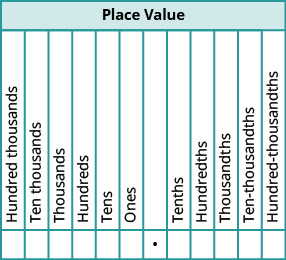
When we name a whole number, the name corresponds to the place value based on the powers of ten. We read 10,000 as “ten thousand” and 10,000,000 as “ten million.” Likewise, the names of the decimal places correspond to their fraction values. Figure \(\PageIndex{1}\) shows the names of the place values to the left and right of the decimal point.
Name the decimal \(4.3\).
- Answer
-




Name the decimal \(6.7\).
- Answer
-
six and seven tenths
Name the decimal \(5.8\).
- Answer
-
five and eight tenths
We summarize the steps needed to name a decimal below.
- Name the number to the left of the decimal point.
- Write “and” for the decimal point.
- Name the “number” part to the right of the decimal point as if it were a whole number.
- Name the decimal place of the last digit.
Name the decimal: \(−15.571\).
- Answer
-
\(−15.571\) Name the number to the left of the decimal point. negative fifteen __________________________________ Write “and” for the decimal point. negative fifteen and ______________________________ Name the number to the right of the decimal point. negative fifteen and five hundred seventy-one __________ The \(1\) is in the thousandths place. negative fifteen and five hundred seventy-one thousandths
Name the decimal: \(−13.461\).
- Answer
-
negative thirteen and four hundred sixty-one thousandths
Name the decimal: \(−2.053\).
- Answer
-
negative two and fifty-three thousandths
When we write a check we write both the numerals and the name of the number. Let’s see how to write the decimal from the name.
Write “fourteen and twenty-four thousandths” as a decimal.
- Answer
-




Write as a decimal: thirteen and sixty-eight thousandths.
- Answer
-
13.068
Write as a decimal: five and ninety-four thousandths.
- Answer
-
5.094
We summarize the steps to writing a decimal.
- Look for the word “and”—it locates the decimal point.
- Place a decimal point under the word “and.” Translate the words before “and” into the whole number and place it to the left of the decimal point.
- If there is no “and,” write a “0” with a decimal point to its right.
- Mark the number of decimal places needed to the right of the decimal point by noting the place value indicated by the last word.
- Translate the words after “and” into the number to the right of the decimal point. Write the number in the spaces—putting the final digit in the last place.
- Fill in zeros for place holders as needed.
Round Decimals
Rounding decimals is very much like rounding whole numbers. We will round decimals with a method based on the one we used to round whole numbers.
Round 18.379 to the nearest hundredth.
- Answer
-



Round to the nearest hundredth: 1.047.
- Answer
-
1.05
Round to the nearest hundredth: 9.173.
- Answer
-
9.17
We summarize the steps for rounding a decimal here.
- Locate the given place value and mark it with an arrow.
- Underline the digit to the right of the place value.
- Is this digit greater than or equal to 5?
- Yes—add 1 to the digit in the given place value.
- No—do not change the digit in the given place value.
- Rewrite the number, deleting all digits to the right of the rounding digit.
Round 18.379 to the nearest
- tenth
- whole number.
- Answer
-
Round 18.379
1. to the nearest tenth
Locate the tenths place with an arrow. 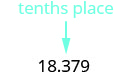
Underline the digit to the right of the given place value. 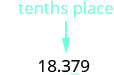
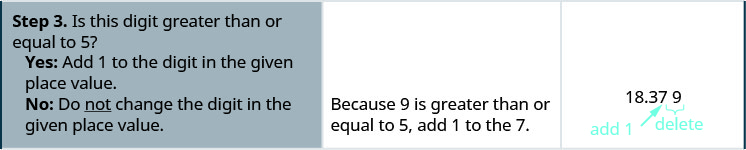
Because 7 is greater than or equal to 5, add 1 to the 3. 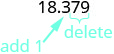
Rewrite the number, deleting all digits to the right of the rounding digit. 
Notice that the deleted digits were NOT replaced with zeros. So, 18.379 rounded to the nearest tenth is 18.4.
2. to the nearest whole numberLocate the ones place with an arrow. 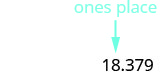
Underline the digit to the right of the given place value. 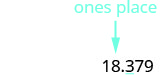
Since 3 is not greater than or equal to 5, do not add 1 to the 8. 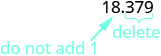
Rewrite the number, deleting all digits to the right of the rounding digit. 
So, 18.379 rounded to the nearest whole number is 18.
Round 6.582 to the nearest
- hundredth
- tenth
- whole number.
- Answer
-
- 6.58
- 6.6
- 7
Round 15.2175 to the nearest
- thousandth
- hundredth
- tenth.
- Answer
-
- 15.218
- 15.22
- 15.2
Add and Subtract Decimals
To add or subtract decimals, we line up the decimal points. By lining up the decimal points this way, we can add or subtract the corresponding place values. We then add or subtract the numbers as if they were whole numbers and then place the decimal point in the sum.
- Write the numbers so the decimal points line up vertically.
- Use zeros as place holders, as needed.
- Add or subtract the numbers as if they were whole numbers. Then place the decimal point in the answer under the decimal points in the given numbers.
Add: \(23.5+41.38\).
- Answer
-
\[\text{Write the numbers so that the decimal points line up vertically.} \quad \begin{array} {r} { 23.50 } \\ { + 41.38 } \\ \hline \end{array}\]
\[\text{Put 0 as a placeholder after the 5 in 23.5. Remember, } \frac{5}{10} = \frac{50}{100}, \text{ so } 0.5 = 0.50 \quad \begin{array} {r} { 23.50 } \\ { + 41.38 } \\ \hline \end{array}\]
\[\text{Add the numbers as if they were whole numbers . Then place the decimal point in the sum.} \quad \begin{array} {r} { 23.50 } \\ { + 41.38 } \\ \hline 64.88 \end{array}\]
Add: \(4.8+11.69\).
- Answer
-
\(16.49\)
Add: \(5.123+18.47\).
- Answer
-
\(23.593\)
Subtract: \(20−14.65\).
- Answer
-
\[\begin{array} {ll} {\text{Write the numbers so that the decimal points line up vertically.}} &{ \begin{align} {20 - 14.65} \\ {20.} \\ {-14.65} \\ \hline \end{align}} \\ {\text{Remember, 20 is a whole number, so place the decimal point after the 0.}} &{} \end{array}\]
\[\begin{array} {ll} {\text{Put zeros to the right as placeholders.}} &{ \begin{align} {20.00} \\ {-14.65} \\ \hline \end{align}} \end{array}\]
\[\begin{array} {ll} {\text{Write the numbers so that the decimal points line up vertically.}} &{ \begin{align} {\tiny{9} \quad \tiny{9}\qquad} \\ {\small{1} \not{\small{10}} \not{\small10}\not{\small10}}\\ {\not{2}\not{0.}\not{0}\not{0}} \\ {-14.65} \\ \hline \\{5.35} \end{align}} \end{array}\]
Subtract: \(10−9.58\).
- Answer
-
0.42
Subtract: \(50−37.42\).
- Answer
-
12.58
Multiply Decimals
Multiplying decimals is very much like multiplying whole numbers—we just have to determine where to place the decimal point. The procedure for multiplying decimals will make sense if we first convert them to fractions and then multiply.
So let’s see what we would get as the product of decimals by converting them to fractions first. We will do two examples side-by-side. Look for a pattern!
 |
|
Convert to fractions. |
 |
| Multiply. |  |
| Convert to decimals. |  |
Notice, in the first example, we multiplied two numbers that each had one digit after the decimal point and the product had two decimal places. In the second example, we multiplied a number with one decimal place by a number with two decimal places and the product had three decimal places.
We multiply the numbers just as we do whole numbers, temporarily ignoring the decimal point. We then count the number of decimal points in the factors and that sum tells us the number of decimal places in the product.
The rules for multiplying positive and negative numbers apply to decimals, too, of course!
When multiplying two numbers,
- if their signs are the same the product is positive.
- if their signs are different the product is negative.
When we multiply signed decimals, first we determine the sign of the product and then multiply as if the numbers were both positive. Finally, we write the product with the appropriate sign.
- Determine the sign of the product.
- Write in vertical format, lining up the numbers on the right. Multiply the numbers as if they were whole numbers, temporarily ignoring the decimal points.
- Place the decimal point. The number of decimal places in the product is the sum of the number of decimal places in the factors.
- Write the product with the appropriate sign.
Multiply: \((−3.9)(4.075)\).
- Answer
-
\((−3.9)(4.075)\) The signs are different. The product will be negative. Write in vertical format, lining up the numbers on the right. 
Multiply. 
Add the number of decimal places in the factors \((1 + 3)\).
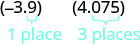
Place the decimal point 4 places from the right.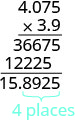
The signs are different, so the product is negative. \((−3.9)(4.075) = −15.8925\)
Multiply: \(−4.5(6.107)\).
- Answer
-
\(−27.4815\)
Multiply: −10.79(8.12).
- Answer
-
\(−87.6148\)
In many of your other classes, especially in the sciences, you will multiply decimals by powers of 10 (10, 100, 1000, etc.). If you multiply a few products on paper, you may notice a pattern relating the number of zeros in the power of 10 to number of decimal places we move the decimal point to the right to get the product.
- Move the decimal point to the right the same number of places as the number of zeros in the power of 10.
- Add zeros at the end of the number as needed.
Multiply 5.63
- by 10
- by 100
- by 1,000.
- Answer
-
By looking at the number of zeros in the multiple of ten, we see the number of places we need to move the decimal to the right.
ⓐ
\(5.63(10)\) There is 1 zero in 10, so move the decimal point 1 place to the right. 
ⓑ
\(5.63(100)\) There are 2 zeros in 100, so move the decimal point 2 places to the right. 
ⓒ
There are 3 zeros in 1,000, so move the decimal point 3 places to the right. 
A zero must be added at the end. 
Multiply 2.58
- by 10
- by 100
- by 1,000.
- Answer
-
- 25.8
- 258
- 2,580
Multiply 14.2
- by 10
- by 100
- by 1,000.
- Answer
-
- 142
- 1,420
- 14,200
Convert Decimals, Fractions, and Percents
We convert decimals into fractions by identifying the place value of the last (farthest right) digit. In the decimal 0.03 the 3 is in the hundredths place, so 100 is the denominator of the fraction equivalent to 0.03.
\[00.03 = \frac { 3 } { 100 }\]
Notice, when the number to the left of the decimal is zero, we get a fraction whose numerator is less than its denominator. Fractions like this are called proper fractions.
The steps to take to convert a decimal to a fraction are summarized in the procedure box.
- Determine the place value of the final digit.
- Write the fraction.
- numerator—the “numbers” to the right of the decimal point
- denominator—the place value corresponding to the final digit
Write 0.374 as a fraction.
- Answer
-
0.374 Determine the place value of the final digit. 
Write the fraction for 0.374:
- The numerator is 374.
- The denominator is 1,000.
\(\dfrac{374}{1000}\) Simplify the fraction. \(\dfrac{2\cdot 187}{2\cdot 500}\) Divide out the common factors. \(\dfrac{187}{500}\)
so, \(0.374=\dfrac{187}{500}\)Did you notice that the number of zeros in the denominator of \(\dfrac{374}{1000}\) is the same as the number of decimal places in 0.374?
Write 0.234 as a fraction.
- Answer
-
\(\dfrac{117}{500}\)
Write 0.024 as a fraction.
- Answer
-
\(\dfrac{3}{125}\)
We’ve learned to convert decimals to fractions. Now we will do the reverse—convert fractions to decimals. Remember that the fraction bar means division. So \(\dfrac{4}{5}\) can be written \(4\div 5\) or \(5)\overline{4}\). This leads to the following method for converting a fraction to a decimal.
To convert a fraction to a decimal, divide the numerator of the fraction by the denominator of the fraction.
Write \(-\dfrac{5}{8}\) as a decimal.
- Answer
-
Since a fraction bar means division, we begin by writing \(\dfrac{5}{8}\) as \(8)\overline{5}\). Now divide.
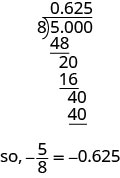
Write \(-\dfrac{7}{8}\) as a decimal.
- Answer
-
−0.875
Write \(-\dfrac{3}{8}\) as a decimal.
- Answer
-
−0.375
When we divide, we will not always get a zero remainder. Sometimes the quotient ends up with a decimal that repeats. A repeating decimal is a decimal in which the last digit or group of digits repeats endlessly. A bar is placed over the repeating block of digits to indicate it repeats.
A repeating decimal is a decimal in which the last digit or group of digits repeats endlessly.
A bar is placed over the repeating block of digits to indicate it repeats.
Write \(\dfrac{43}{22}\) as a decimal.
- Answer
-
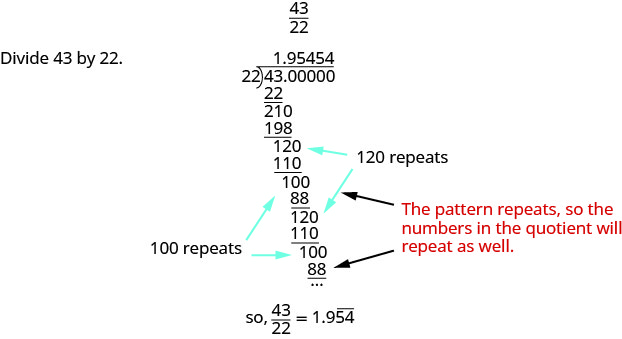
Write \(\dfrac{27}{11}\) as a decimal.
- Answer
-
\(2.\overline{45}\)
Write \(\dfrac{51}{22}\) as a decimal.
- Answer
-
\(2.3\overline{18}\)
Sometimes we may have to simplify expressions with fractions and decimals together.
Simplify: \(\dfrac{7}{8}+6.4\).
- Answer
-
First we must change one number so both numbers are in the same form. We can change the fraction to a decimal, or change the decimal to a fraction. Usually it is easier to change the fraction to a decimal.
\(\dfrac{7}{8}+6.4\) Change \(\dfrac{7}{8}\) to a decimal. 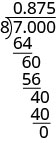
Add. \(0.875+6.4\) \(7.275\) So, \(\dfrac{7}{8}+6.4 = 7.275\)
Simplify: \(\dfrac{3}{8}+4.9\).
- Answer
-
\(5.275\)
Simplify: \(5.7 + \dfrac{13}{20}\).
- Answer
-
\(6.35\)
A percent is a ratio whose denominator is 100. Percent means per hundred. We use the percent symbol, %, to show percent.
A percent is a ratio whose denominator is 100.
Since a percent is a ratio, it can easily be expressed as a fraction. Percent means per 100, so the denominator of the fraction is 100. We then change the fraction to a decimal by dividing the numerator by the denominator.
\[\begin{array} {llll} {} &{\text{6%}} &{\text{78%}} &{\text{135%}} \\ {\text { Write as a ratio with denominator } 100. } &{\dfrac{6}{100}} &{\dfrac{78}{100}} &{\dfrac{135}{100}} \\ { \text { Change the fraction to a decimal by dividing}} &{0.06} &{0.78} &{1.35}\\ {\text{the numerator by the denominator.}} &{} &{} &{} \end{array}\]
Do you see the pattern? To convert a percent number to a decimal number, we move the decimal point two places to the left.
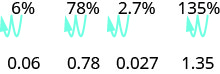
Convert each percent to a decimal:
- 62%
- 135%
- 35.7%.
- Answer
-
1. 
Move the decimal point two places to the left. 0.62 2. 
Move the decimal point two places to the left. 1.35 3. 
Move the decimal point two places to the left. 0.057
Convert each percent to a decimal:
- 9%
- 87%
- 3.9%.
- Answer
-
- 0.09
- 0.87
- 0.039
Convert each percent to a decimal:
- 3%
- 91%
- 8.3%.
- Answer
-
- 0.03
- 0.91
- 0.083
Converting a decimal to a percent makes sense if we remember the definition of percent and keep place value in mind.
To convert a decimal to a percent, remember that percent means per hundred. If we change the decimal to a fraction whose denominator is 100, it is easy to change that fraction to a percent.
\[\begin{array} {llll} {} &{0.83} &{1.05} &{0.075} \\ {\text {Write as a fraction }} &{\frac{83}{100}} &{\small{1}\frac{5}{100}} &{\frac{75}{1000}} \\ { \text {The denominator is 100.}} &{} &{\frac{105}{100}} &{\frac{7.5}{100}}\\ {\text{Write the ratio as a percent.}} &{\text{83%}} &{\text{105%}} &{\text{7.5%}} \end{array}\]
Recognize the pattern? To convert a decimal to a percent, we move the decimal point two places to the right and then add the percent sign.
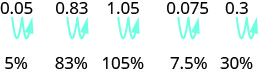
Convert each decimal to a percent:
- 0.51
- 1.25
- 0.093.
- Answer
-
1. 
Move the decimal point two places to the right. \(51%\) 2. 
Move the decimal point two places to the right. \(125%\) 3. 
Move the decimal point two places to the right. \(9.3%\)
Convert each decimal to a percent:
- 0.17
- 1.75
- 0.0825
- Answer
-
- 17%
- 175%
- 8.25%
Convert each decimal to a percent:
- 0.41
- 2.25
- 0.0925.
- Answer
-
- 41%
- 225%
- 9.25%
Key Concepts
- Name a Decimal
- Name the number to the left of the decimal point.
- Write ”and” for the decimal point.
- Name the “number” part to the right of the decimal point as if it were a whole number.
- Name the decimal place of the last digit.
- Write a Decimal
- Look for the word ‘and’—it locates the decimal point. Place a decimal point under the word ‘and.’ Translate the words before ‘and’ into the whole number and place it to the left of the decimal point. If there is no “and,” write a “0” with a decimal point to its right.
- Mark the number of decimal places needed to the right of the decimal point by noting the place value indicated by the last word.
- Translate the words after ‘and’ into the number to the right of the decimal point. Write the number in the spaces—putting the final digit in the last place.
- Fill in zeros for place holders as needed.
- Round a Decimal
- Locate the given place value and mark it with an arrow.
- Underline the digit to the right of the place value.
- Is this digit greater than or equal to 5? Yes—add 1 to the digit in the given place value. No—do not change the digit in the given place value.
- Rewrite the number, deleting all digits to the right of the rounding digit.
- Add or Subtract Decimals
- Write the numbers so the decimal points line up vertically.
- Use zeros as place holders, as needed.
- Add or subtract the numbers as if they were whole numbers. Then place the decimal in the answer under the decimal points in the given numbers.
- Multiply Decimals
- Determine the sign of the product.
- Write in vertical format, lining up the numbers on the right. Multiply the numbers as if they were whole numbers, temporarily ignoring the decimal points.
- Place the decimal point. The number of decimal places in the product is the sum of the decimal places in the factors.
- Write the product with the appropriate sign.
- Multiply a Decimal by a Power of Ten
- Move the decimal point to the right the same number of places as the number of zeros in the power of 10.
- Add zeros at the end of the number as needed.
- Divide Decimals
- Determine the sign of the quotient.
- Make the divisor a whole number by “moving” the decimal point all the way to the right. “Move” the decimal point in the dividend the same number of places - adding zeros as needed.
- Divide. Place the decimal point in the quotient above the decimal point in the dividend.
- Write the quotient with the appropriate sign.
- Convert a Decimal to a Proper Fraction
- Determine the place value of the final digit.
- Write the fraction: numerator—the ‘numbers’ to the right of the decimal point; denominator—the place value corresponding to the final digit.
- Convert a Fraction to a Decimal Divide the numerator of the fraction by the denominator.