

3.5: Applied Maximum and Minimum Problems
- Page ID
- 212026

\( \newcommand{\vecs}[1]{\overset { \scriptstyle \rightharpoonup} {\mathbf{#1}} } \)
\( \newcommand{\vecd}[1]{\overset{-\!-\!\rightharpoonup}{\vphantom{a}\smash {#1}}} \)
\( \newcommand{\dsum}{\displaystyle\sum\limits} \)
\( \newcommand{\dint}{\displaystyle\int\limits} \)
\( \newcommand{\dlim}{\displaystyle\lim\limits} \)
\( \newcommand{\id}{\mathrm{id}}\) \( \newcommand{\Span}{\mathrm{span}}\)
( \newcommand{\kernel}{\mathrm{null}\,}\) \( \newcommand{\range}{\mathrm{range}\,}\)
\( \newcommand{\RealPart}{\mathrm{Re}}\) \( \newcommand{\ImaginaryPart}{\mathrm{Im}}\)
\( \newcommand{\Argument}{\mathrm{Arg}}\) \( \newcommand{\norm}[1]{\| #1 \|}\)
\( \newcommand{\inner}[2]{\langle #1, #2 \rangle}\)
\( \newcommand{\Span}{\mathrm{span}}\)
\( \newcommand{\id}{\mathrm{id}}\)
\( \newcommand{\Span}{\mathrm{span}}\)
\( \newcommand{\kernel}{\mathrm{null}\,}\)
\( \newcommand{\range}{\mathrm{range}\,}\)
\( \newcommand{\RealPart}{\mathrm{Re}}\)
\( \newcommand{\ImaginaryPart}{\mathrm{Im}}\)
\( \newcommand{\Argument}{\mathrm{Arg}}\)
\( \newcommand{\norm}[1]{\| #1 \|}\)
\( \newcommand{\inner}[2]{\langle #1, #2 \rangle}\)
\( \newcommand{\Span}{\mathrm{span}}\) \( \newcommand{\AA}{\unicode[.8,0]{x212B}}\)
\( \newcommand{\vectorA}[1]{\vec{#1}} % arrow\)
\( \newcommand{\vectorAt}[1]{\vec{\text{#1}}} % arrow\)
\( \newcommand{\vectorB}[1]{\overset { \scriptstyle \rightharpoonup} {\mathbf{#1}} } \)
\( \newcommand{\vectorC}[1]{\textbf{#1}} \)
\( \newcommand{\vectorD}[1]{\overrightarrow{#1}} \)
\( \newcommand{\vectorDt}[1]{\overrightarrow{\text{#1}}} \)
\( \newcommand{\vectE}[1]{\overset{-\!-\!\rightharpoonup}{\vphantom{a}\smash{\mathbf {#1}}}} \)
\( \newcommand{\vecs}[1]{\overset { \scriptstyle \rightharpoonup} {\mathbf{#1}} } \)
\(\newcommand{\longvect}{\overrightarrow}\)
\( \newcommand{\vecd}[1]{\overset{-\!-\!\rightharpoonup}{\vphantom{a}\smash {#1}}} \)
\(\newcommand{\ket}[1]{\left| #1 \right>}\)
\(\newcommand{\bra}[1]{\left< #1 \right|}\)
\(\newcommand{\braket}[2]{\left< #1 \vphantom{#2} \right| \left. #2 \vphantom{#1} \right>}\)
\(\newcommand{\braopket}[3]{\left< #1 \vphantom{#2}\vphantom{#3} \right| #2 \vphantom{#1}\vphantom{#3} \left| #3 \vphantom{#1}\vphantom{#2} \right>}\)
\(\newcommand{\qmvec}[1]{\mathbf{\vec{#1}}}\)
\(\newcommand{\op}[1]{\hat{\mathbf{#1}}}\)
\(\newcommand{\expect}[1]{\langle #1 \rangle}\)
\(\newcommand{\dfn}[1]{\emph{\textbf{#1}}}\)
We have used derivatives to find maximums and minimums of functions given by formulas, but it is very unlikely that someone will simply hand you a function and ask you to find its extreme value(s). Typically, someone will describe a problem and ask your help to maximize or minimize a quantity: “What is the largest volume of a package that the post office will accept?”; “What is the quickest way to get from here to there?”; or “What is the least expensive way to accomplish some task?” These problems often involve restrictions — or constraints — and sometimes neither the problem nor the constraints are clearly stated.
Before we can use calculus or other mathematical techniques to solve these “max/min” problems, we need to understand the situation at hand and translate the problem into mathematical form. After solving the problem using calculus (or other mathematical techniques) we need to check that our mathematical solution really solves the original problem. Often, the most challenging part of this procedure is understanding the problem and translating it into mathematical form.
In this section we examine some problems that require understanding, translation, solution and checking. Most will not be as complicated as those a working scientist, engineer or economist needs to solve, but they represent a step toward developing the required skills.
The company you own has a large supply of 8-inch by 15-inch rectangular pieces of tin, and you decide to use them to make boxes by cutting a square from each corner and folding up the sides:

For example, if you cut a 1-inch square from each corner, the resulting 6-inch by 13-inch by 1-inch box has a volume of 78 cubic inches. The amount of money you can charge for a box depends on how much the box holds, so you want to make boxes with the largest possible volume. What size square should you cut from each corner?
Solution
To help understand the problem, first drawing a diagram can be very helpful. Then we need to translate it into a mathematical problem:
- identify the variables
- label the variable and constant parts of the diagram
- write the quantity to be maximized as a function of the variables
If we label the side of the square to be removed as \(x\) inches, then the box is \(x\) inches high, \(8 - 2x\) inches wide and \(15 - 2x\) inches long, so the volume is: \begin{align*} (\mbox{length})(\mbox{width})(\mbox{height}) &= (15 - 2x)(8 - 2x)\cdot x\\ &= 4x^3 - 46x^2 + 120x \mbox{ cubic inches} \end{align*} Now we have a mathematical problem, to maximize the function \(V(x) = 4x^3- 46x^2 + 120x\), so we use existing calculus techniques, computing \(V'(x) = 12x^2- 92x + 120\) to find the critical points.
The maximum volume must occur at the critical point \(x = \frac53\) or at one of the endpoints (\(x = 0\) and \(x = 4\)): \(V(0) = 0\), \(V(\frac53) = \frac{2450}{27} \approx 90.74\) cubic inches, and \(V(4) = 0\), so the maximum volume of the box occurs when we remove a \(\frac53\)-inch by \(\frac53\)-inch square from each corner, resulting in a box \(\frac53\) inches high, \(8 - 2(\frac53) = \frac{14}{3}\) inches wide and \(15 - 2(\frac53) = \frac{35}{3}\) inches long.
- Set \(V'(x) = 0\) and solve by factoring or using the quadratic formula:\[V'(x) = 12x^2- 92x + 120 = 4(3x - 5)(x - 6) = 0 \Rightarrow x = \frac53 \mbox{ or } x = 6\nonumber\]so \(x = \frac53\) and \(x = 6\) are critical points of \(V\).
- \(V'(x)\) is a polynomial so it is defined everywhere and there are no critical points resulting from an undefined derivative.
- What are the endpoints for \(x\) in this problem? A square cannot have a negative length, so \(x \geq 0\). We cannot remove more than half of the width, so \(8 - 2x \geq 0 \Rightarrow x \leq 4\). Together, these two inequalities say that \(0 \leq x \leq 4\), so the endpoints are \(x = 0\) and \(x = 4\). (Note that the value \(x = 6\) is not in this interval, so \(x = 6\) cannot maximize the volume and we do not consider it further.)
If you start with 7-inch by 15-inch pieces of tin, what size square should you remove from each corner so the box will have as large a volume as possible? [Hint: \(12x^2 - 88x + 105 = (2x - 3)(6x - 35)\)]
- Answer
-
\(V(x) = x(15 - 2x)(7 - 2x) = 4x^3 - 44x^2 + 105x\) so:\[V'(x) = 12x^2 - 88x + 105 = (2x - 3)(6x - 35)\nonumber\]which is defined for all \(x\): the only critical numbers are the endpoints \(x = 0\) and \(x = \frac72\) and the places where \(V'(x) = 0\): \(x = \frac32\) and \(x = \frac{35}{6}\) (but \(\frac{35}{6}\) is not in the interval \([0, \frac72]\) so it is not practical). The maximum volume must occur when \(x = 0\), \(x = \frac32\) or \(x = \frac72\):
\begin{align*}
V(0) &= 0\cdot (15 - 2\cdot 0)\cdot(7 - 2\cdot 0) = 0\\
V\left(\frac32\right) &= \frac32 \cdot \left(15 - 2\cdot \frac32\right)\cdot\left(7 - 2\cdot\frac32\right) = \frac32( 12 )( 4 ) = 72\\
V\left(\frac72\right) &= \frac72\left(15 - 2\cdot\frac72\right)\cdot\left(7 - 2\cdot\frac72\right) = \frac72( 8 )( 0 ) = 0\end{align*}
The maximum-volume box will result from cutting a 1.5-by-1.5 inch square from each corner. A graph of \(V(x)\) appears below:![A graph of the red curve V(x) = x(15 - 2x)(7 - 2x) on a [0,4]X[[0,75] grid, with the peak labeled 'max (1.5,72).'](https://math.libretexts.org/@api/deki/files/140499/fig305_31.png?revision=1&size=bestfit&width=253&height=247)
We were fortunate in the previous Example and Practice problem because the functions we created to describe the volume were functions of only one variable. In other situations, the function we get will have more than one variable, and we will need to use additional information to rewrite our function as a function of a single variable. Typically, the constraints will contain the additional information we need.
We want to fence a rectangular area in our backyard for a garden. One side of the garden is along the edge of the yard, which is already fenced, so we only need to build a new fence along the other three sides of the rectangle. If a neighbor gives us 80 feet of fencing left over from a home-improvement project, what dimensions should the garden have in order to enclose the largest possible area using all of the available material?
Solution
As a first step toward understanding the problem, we draw a diagram or picture of the situation:

Next, we identify the variables: in this case, the length (call it \(x\)) and width (call it \(y\)) of the garden. The figure below shows a labeled diagram:

which we can use to write a formula for the function that we want to maximize:\[A = \mbox{area of the rectangle} = (\mbox{length})(\mbox{width}) = x\cdot y\nonumber\]
Unfortunately, our function \(A\) involves two variables, \(x\) and \(y\), so we need to find a relationship between them (an equation containing both \(x\) and \(y\)) that we can solve for either \(x\) or \(y\). The constraint says that we have 80 feet of fencing available, so \(x + 2y = 80 \Rightarrow y = 40 - \frac{x}{2}\). Then:\[A = x\cdot y = x\left(40 - \frac{x}{2}\right) = 40x - \frac{x^2}{2}\nonumber\]which is a function of a single variable (\(x\)). We want to maximize \(A\).
\(A'(x) = 40 - x\) so the only way \(A'(x) = 0\) is to have \(x = 40\), and \(A(x)\) is differentiable for all \(x\) so the only critical number (other than the endpoints) is \(x = 40\). Finally, \(0 \leq x \leq 80\) (why?) so we also need to check \(x = 0\) and \(x = 80\): the maximum area must occur at \(x = 0\), \(x= 40\) or \(x=80\).
\begin{align*}A(0) &= 40(0) - \frac{0^2}{2} = 0 \mbox{ square feet}\\
A(40) &= 40(40) - \frac{40^2}{2} = 800 \mbox{ square feet}\\
A(80) &= 40(80) - \frac{80^2}{2} = 0 \mbox{ square feet}\end{align*}
so the largest rectangular garden has an area of 800 square feet, with dimensions \(x = 40\) feet by \(y = 40 - \frac{40}{2} = 20\) feet
Suppose you decide to create the rectangular garden in a corner of your yard. Then two sides of the garden are bounded by the existing fence, so you only need to use the available 80 feet of fencing to enclose the other two sides. What are the dimensions of the new garden of largest area? What are the dimensions if you have \(F\) feet of new fencing available?
- Answer
-
- We have 80 feet of fencing:

Our assignment is to maximize the area of the garden: \(A = x\cdot y\) (two variables). Fortunately, we have the constraint that \(x + y = 80\), so \(y = 80 - x\) and our assignment reduces to maximizing a function of one variable:\[A = x\cdot y = x\cdot (80 - x) = 80x - x^2 \Rightarrow A'(x) = 80 - 2x\nonumber\]so \(A'(x) = 0 \Rightarrow x = 40\). Because \(A''(x) = -2 <0\), the graph of \(A\) is concave down, hence \(A\) has a maximum at \(x = 40\). The maximum area is \(A(40) = 40\cdot 40 = 1600\) ft\(^2\) when \(x = 40\) feet and \(y = 40\) feet. The maximum-area garden is a square. - This is similar to part (a) except we have \(F\) feet of fencing instead of \(80\) feet: \(x + y = F \Rightarrow y = F - x\) and we want to maximize \(A = xy = x(F - x) = Fx - x^2\). Differentiating, \(A'(x) = F - 2x\) so \(A'(x) = 0 \Rightarrow x = \frac{F}{2} \Rightarrow y = \frac{F}{2}\). The maximum area is \(A\left(\frac{F}{2}\right) = \frac{F^2}{4}\) square feet when the garden is a square with half of the new fence used on each of the two new sides.
- We have 80 feet of fencing:
You need to reach home as quickly as possible, but you are in a rowboat on a lake 4 miles from shore and your home is 2 miles up the shore:

If you can row at 3 miles per hour and walk at 5 miles per hour, toward which point on the shore should you row? What if your home is 7 miles up the coast?
Solution
The figure above shows a labeled diagram with the variable \(x\) representing the distance along the shore from point \(A\), the nearest point on the shore to your boat, to point \(P\), the point you row toward. The total time — rowing and walking — is: \begin{align*}T &= \mbox{total time}\\ &= (\mbox{rowing time from boat to }P) + (\mbox{walking time from }P\mbox{ to }B)\\ &= \frac{\mbox{distance from boat to }P}{\mbox{rate rowing boat}} + \frac{\mbox{distance from }P\mbox{ to }B}{\mbox{rate walking along shore}}\\ &= \frac{\sqrt{x^2 + 4^2}}{3} + \frac{2 - x}{5} = \frac{\sqrt{x^2 + 16}}{3} + \frac{2 - x}{5}\end{align*} It is not reasonable to row to a point below \(A\) and then walk home, so \(x \geq 0\). Similarly, we can conclude that \(x \leq 2\), so our interval is \(0 \leq x \leq 2\) and the endpoints are \(x = 0\) and \(x = 2\).
To find the other critical numbers of \(T\) between \(x = 0\) and \(x = 2\), we need the derivative of \(T\):\[T'(x) = \frac13 \cdot \frac12 \left(x^2 + 16\right)^{-\frac12}(2x) - \frac15 = \frac{x}{3 \sqrt{x^2 + 16}} - \frac15\nonumber\]This derivative is defined for all values of \(x\) (and in particular for all values in the interval \(0\leq x \leq 2\)). To find where \(T'(x) = 0\) we solve:
\begin{align*}\frac{x}{3 \sqrt{x^2 + 16}} - \frac15 = 0 \ &\Rightarrow \ 5x = 3\sqrt{x^2+16} \\ &\Rightarrow \ 25x^2 = 9x^2 + 144 \\ &\Rightarrow 16x^2 = 144 \ \Rightarrow x^2 = 9 \ \Rightarrow x = \pm 3\end{align*}
Neither of these numbers, however, is in our interval \(0 \leq x \leq 2\), so neither of them gives a minimum time. The only critical numbers for \(T\) on this interval are the endpoints, \(x = 0\) and \(x = 2\):
\begin{align*}T(0) &= \frac{\sqrt{0 + 16}}{3} + \frac{2 - 0}{5} = \frac43 +\frac25 \approx 1.73 \mbox{ hours}\\
T(2) &= \frac{\sqrt{2^2 + 16}}{3} + \frac{2 - 2}{5} = \frac{\sqrt{20}}{3} \approx 1.49 \mbox{ hours}\end{align*}
The quickest route has \(P\) 2 miles down the coast: you should row directly toward home.
If your home is 7 miles down the coast, then the interval for \(x\) is \(0 \leq x \leq 7\), which has endpoints \(x = 0\) and \(x = 7\). Our function for the travel time is now:\[T(x) = \frac{\sqrt{x^2 + 16}}{3} + \frac{7 - x}{5} \ \Rightarrow \ T'(x) = \frac{x}{3 \sqrt{x^2 + 16}} - \frac15\nonumber\]so the only point in our interval where \(T'(x) = 0\) is at \(x = 3\) and the derivative is defined for all values in this interval. So the only critical numbers for \(T\) are \(x = 0\), \(x = 3\) and \(x = 7\):
\begin{align*}T(0) &= \frac{\sqrt{0 + 16}}{3} + \frac{7 - 0}{5} = \frac43 +\frac75 &\approx 2.73 \mbox{ hours}\\
T(3) &= \frac{\sqrt{3^2 + 16}}{3} + \frac{7 - 3}{5} = \frac{\sqrt{65}}{3} + \frac45 &\approx 2.47 \mbox{ hours}\\
T(7) &= \frac{\sqrt{7^2 + 16}}{3} + \frac{7 - 7}{5} = \frac{5}{3} &\approx 2.68 \mbox{ hours}\end{align*}
The quickest way home is to aim for a point \(P\) that is 3 miles down the shore, row directly to \(P\), and then walk along the shore to home.
One challenge of max/min problems is that they may require geometry, trigonometry or other mathematical facts and relationships.
Find the height and radius of the least expensive closed cylinder that has a volume of 1,000 cubic inches. Assume that the materials needed to construct the cylinder are free, but that it costs 80¢ per inch to weld the top and bottom onto the cylinder and to weld the seam up the side of the cylinder:

Solution
If we let \(r\) be the radius of the cylinder and \(h\) be its height, then the volume is \(\displaystyle V = \pi r^2 h = 1000\). The quantity we want to minimize is cost, and \begin{align*}C &= (\mbox{top seam cost}) + (\mbox{bottom seam cost}) + (\mbox{side seam cost})\\ &= \left(\mbox{total seam length}\right)\left(80\, \frac{\mbox{¢}}{\mbox{inch}}\right)\\ &= \left(2\pi r + 2\pi r + h\right)(80) = 320\pi r + 80 h\end{align*} Unfortunately, \(C\) is a function of two variables, \(r\) and \(h\), but we can use the information in the constraint (\(V = \pi r^2 h = 1000\)) to solve for \(h\) and then substitute this expression for \(h\) into the formula for \(C\):\[1000 = \pi r^2 h \ \Rightarrow \ h = \frac{1000}{\pi r^2} \ \Rightarrow C = 320\pi r + 80 h = 320\pi r + 80\left(\frac{1000}{\pi r^2}\right)\nonumber\]which is a function of a single variable. Differentiating:\[C'(r) = 320\pi - \frac{160000}{\pi r^3}\nonumber\]which is defined except when \(r = 0\) (a value that does not make sense in the original problem) and there are no restrictions on \(r\) (other than \(r>0\)) so there are no endpoints to check. Thus \(C\) will be at a minimum when \(C'(r) = 0\):\[320\pi - \frac{160000}{\pi r^3} = 0 \ \Rightarrow \ r^3 = \frac{500}{\pi^2} \ \Rightarrow \ r = \sqrt[3]{\frac{500}{\pi^2}}\nonumber\]so \(r \approx 3.7\) inches and \(\displaystyle h = \frac{1000}{\pi r^2} = \frac{1000}{\pi \left(\sqrt[3]{\frac{500}{\pi^2}}\right)^2} \approx 23.3\) inches.
Find the height and radius of the least expensive closed cylinder that has a volume of 1,000 cubic inches, assuming that the only cost for this cylinder is the price of the materials: the material for the top and bottom costs 5¢~per square inch, while the material for the sides costs 3¢~per square inch:

- Answer
-
The cost \(C\) is given by:
\begin{align*}
C &= 5(\mbox{area of top}) + 3(\mbox{area of sides}) + 5(\mbox{area of bottom})\\
&= 5(\pi r^2) + 3(2\pi rh) + 5(\pi r^2)\end{align*}
so our assignment is to minimize \(C = 10\pi r^2 + 6\pi rh\), a function of two variables (\(r\) and \(h\)). Fortunately, we also have the constraint that volume \(= 1000\) in\(^3 = \pi r^2 h \Rightarrow h = \frac{1000}{\pi r^2}\). So:\[C = 10\pi r^2 + 6\pi r\left(\frac{1000}{\pi r^2}\right) = 10\pi r^2 + \frac{6000}{r} \Rightarrow C'(r) = 20\pi r - \frac{6000}{r^2}\nonumber\]which exists for \(r \neq 0\) (\(r = 0\) is not in the domain of \(C(r)\)).\[C'(r) = 0 \Rightarrow 20\pi r - \frac{6000}{r^2} = 0 \Rightarrow 20\pi r^3 = 6000 \Rightarrow r = \sqrt[3]{\frac{6000}{20\pi}} \approx 4.57 \mbox{ inches}\nonumber\]When \(r = 4.57\), \(h = \frac{1000}{\pi (4.57)^2} \approx 15.24\) inches. Examining the second derivative, \(C''(r) = 20\pi + \frac{12000}{r^3} > 0\) for all \(r > 0\) so \(C\) is concave up and we have found the minimum cost.
Find the dimensions of the least expensive rectangular box that is three times as long as it is wide and which holds 100 cubic centimeters of water. The material for the bottom costs 7¢~per cm\(^2\), the sides cost 5¢~per cm\(^2\) and the top costs 2¢~per cm\(^2\).
Solution
Label the box so that \(w =\) width, \(l =\) length and \(h =\) height. Then our cost function \(C\) is: \begin{align*}C &= (\mbox{bottom cost}) + (\mbox{cost of front and back}) + (\mbox{cost of ends}) + (\mbox{top cost})\\ &= (\mbox{bottom area})(7¢) + (\mbox{front and back area})(5¢) + (\mbox{ends area})(5¢) + (\mbox{top area})(2¢)\\ &= (wl)(7) + (2lh)(5) + (2wh)(5) + (wl)(2)\\ &= 7wl + 10lh + 10wh + 2wl\\ &= 9wl + 10lh + 10wh\end{align*} Unfortunately, \(C\) is a function of three variables (\(w\), \(l\) and \(h\)) but we can use the information from the constraints to eliminate some of the variables: the box is “three times as long as it is wide” so \(l = 3w\) and \[C = 9wl + 10lh + 10wh = 9w(3w) + 10(3w)h + 10wh = 27w^2 + 40wh\nonumber\]We also know the volume \(V\) is 100 in\(^3\) and \(V = lwh = 3w^2h\) (because \(l = 3w\)), so \(\displaystyle h = \frac{100}{3w^2}\). Then:\[C = 27w^2 + 40wh = 27w^2 + 40w\left(\frac{100}{3w^2}\right) = 27w^2 + \frac{4000}{3w}\nonumber\]which is a function of a single variable. Differentiating:\[C'(w) = 54w - \frac{4000}{3w^2}\nonumber\]which is defined everywhere except \(w=0\) (yielding a box of volume \(0\)) and there is no constraint interval, so \(C\) is minimized when \(\displaystyle C'(w) = 0 \Rightarrow w = \sqrt[3]{\frac{4000}{162}} \approx 2.91\) inches \(\Rightarrow l = 3w \approx 8.73\) inches \(\Rightarrow h = \frac{100}{3w^2} \approx 3.94\) inches. The minimum cost is approximately $6.87.
Problems described in words are usually more difficult to solve because we first need to understand and “translate” a real-life problem into a mathematical problem. Unfortunately, those skills only seem to come with practice. With practice, however, you will start to recognize patterns for understanding, translating and solving these problems, and you will develop the skills you need. So read carefully, draw pictures, think hard — and do the best you can.
Problems
-
- You have 200 feet of fencing to enclose a rectangular vegetable garden. What should the dimensions of your garden be in order to enclose the largest area?
- Show that if you have \(P\) feet of fencing available, the garden of greatest area is a square.
- What are the dimensions of the largest rectangular garden you can enclose with \(P\) feet of fencing if one edge of the garden borders a straight river and does not need to be fenced?
- Just thinking — calculus will not help: What do you think is the shape of the largest garden that can be enclosed with \(P\) feet of fencing if we do not require the garden to be rectangular? What if one edge of the garden borders a (straight) river?
-
- You have 200 feet of fencing available to construct a rectangular pen with a fence divider down the middle:

What dimensions of the pen enclose the largest total area? - If you need two dividers, what dimensions of the pen enclose the largest area?
- What are the dimensions in parts (a) and (b) if one edge of the pen borders on a river and does not require any fencing?
- You have 200 feet of fencing available to construct a rectangular pen with a fence divider down the middle:
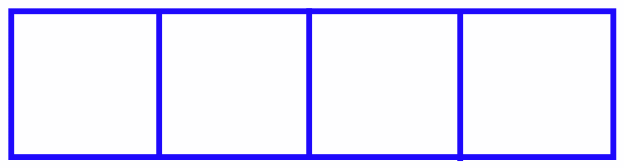
- You have 120 feet of fencing to construct a pen with four equal-sized stalls.
- If the pen is rectangular and shaped like the one shown below, what are the dimensions of the pen of largest area and what is that area?
- The square pen below uses 120 feet of fencing but encloses a larger area (400 ft\(^2\)) than the best design in part (a):
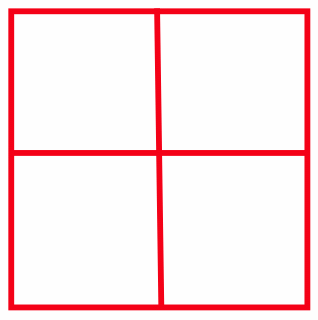
Design a pen that uses only 120 feet of fencing and has four equal-sized stalls but encloses more than 400 ft\(^2\). (Hint: Don’t use rectangles and squares.)
- If the pen is rectangular and shaped like the one shown below, what are the dimensions of the pen of largest area and what is that area?
-
- You need to form a 10-inch by 15-inch piece of tin into a box (with no top) by cutting a square from each corner and folding up the sides. How much should you cut so the resulting box has the greatest volume?

- If the piece of tin is \(A\) inches by \(B\) inches, how much should you cut from each corner so the resulting box has the greatest volume?
- You need to form a 10-inch by 15-inch piece of tin into a box (with no top) by cutting a square from each corner and folding up the sides. How much should you cut so the resulting box has the greatest volume?
- Find the dimensions of a box with largest volume formed from a 10-inch by 10-inch piece of cardboard cut and folded as shown below:

-
- You must construct a square-bottomed box with no top that will hold 100 cubic inches of water. If the bottom and sides are made from the same material, what are the dimensions of the box that uses the least material? (Assume that no material is wasted.)
- Suppose the box in part (a) uses different materials for the bottom and the sides. If the bottom material costs 5¢~per square inch and the side material costs 3¢~per square inch, what are the dimensions of the least expensive box that will hold 100 cubic inches of water?
-
- Determine the dimensions of the least expensive cylindrical can that will hold 100 cubic inches if the materials cost 2¢, 5¢ and 3¢ per square inch, respectively, for the top, bottom and sides.
- How do the dimensions of the least expensive can change if the bottom material costs more than 5¢~per square inch?
- You have 100 feet of fencing to build a pen in the shape of a circular sector, the “pie slice” shown below:

The area of such a sector is \(\displaystyle \frac{rs}{2}\).- What value of \(r\) maximizes the enclosed area?
- What central angle maximizes the area?
- You are a lifeguard standing at the edge of the water when you notice a swimmer in trouble:

40 m out in the water from a point 60 m down the beach. Assuming you can run at a speed of 8 meters per second and swim at a rate of 2 meters per second, how far along the shore should you run before diving into the water in order to reach the swimmer as quickly as possible? - You have been asked to determine the least expensive route for a telephone cable that connects Andersonville with Beantown, as shown in the figure below:

- If it costs $5000 per mile to lay the cable on land and $8000 per mile to lay the cable across the river (with the cost of the cable included), find the least expensive route.
- What is the least expensive route if the cable costs $7000 per mile in addition to the cost to lay it?
- You have been asked to determine where a water works should be built along a river between Chesterville and Denton, as shown below:

to minimize the total cost of the pipe to the towns.- Assume that the same size (and cost) pipe is used to each town. (This part can be done quickly without using calculus.)
- Assume instead that the pipe to Chesterville costs $3000 per mile and to Denton it costs $7000 per mile.
- Light from a bulb at \(A\) is reflected off a flat mirror to your eye at point \(B\), as shown below:

If the time (and length of the path) from \(A\) to the mirror and then to your eye is a minimum, show that the angle of incidence equals the angle of reflection. (Hint: This is similar to the previous problem.) - U.S. postal regulations state that the sum of the length and girth (distance around) of a package must be no more than 108 inches, as shown below:

- Find the dimensions of the acceptable box with a square end that has the largest volume.
- Find the dimensions of the acceptable box that has the largest volume if its end is a rectangle twice as long as it is wide.
- Find the dimensions of the acceptable box with a circular end that has the largest volume.
- Just thinking — you don't need calculus for this problem: A spider and a fly are located on opposite corners of a cube:

What is the shortest path along the surface of the cube from the spider to the fly? - Two sides of a triangle are 7 and 10 inches long. What is the length of the third side so the area of the triangle will be greatest? (This problem can be done without using calculus. How? If you do use calculus, consider the angle \(\theta\) between the two sides.)
- Find the shortest distance from the point \((2,0)\) to the curve:
- \(y = 3x - 1\)
- \(y = x^2\)
- \(x^2 + y^2 = 1\)
- \(y = \sin(x)\)
- Find the dimensions of the rectangle with the largest area if the base must be on the \(x\)-axis and its other two corners are on the graph of:
- \(y = 16 - x^2\), \(-4 \leq x \leq 4\)
- \(x^2 + y^2 = 1\)
- \(\left|x\right| + \left|y\right| = 1\)
- \(y = \cos(x)\), \(-\frac{\pi}{2} \leq x \leq \frac{\pi}{2}\)
- The strength of a wooden beam is proportional to the product of its width and the square of its height, as shown below:

What are the dimensions of the strongest beam that can be cut from a log with diameter:- 12 inches?
- \(d\) inches?
- You have a long piece of 12-inch-wide metal that you plan to fold along the center line to form a V-shaped gutter, as shown below:

What angle \(\theta\) will yield a gutter that holds the most water (that is, has the largest cross-sectional area)? - You have a long piece of 8-inch-wide metal that you plan to make into a gutter by bending up 3 inches on each side:

What angle \(\theta\) will yield a gutter that holds the most water? - You have a 6-inch-diameter paper disk that you want to form into a drinking cup by removing a pie-shaped wedge (sector) and then forming the remaining paper into a cone:

Find the height and top radius of the cone so that the volume of the cup is as large as possible. -
- What value of \(b\) minimizes the sum of the squares of the vertical distances from \(y=2x+b\) to the points \(( 1, 1)\), \(( 1, 2)\) and \(( 2, 2)\)?

- What slope \(m\) minimizes the sum of the squares of the vertical distances from the line \(y=mx\) to the points \(( 1, 1)\), \(( 1, 2)\) and \(( 2, 2)\)?
- What slope \(m\) minimizes the sum of the squares of the vertical distances from the line \(y = mx\) to the points \(( 2, 1)\), \(( 4, 3)\), \(( -2, -2)\) and \(( -4, -2)\)?
- What value of \(b\) minimizes the sum of the squares of the vertical distances from \(y=2x+b\) to the points \(( 1, 1)\), \(( 1, 2)\) and \(( 2, 2)\)?
- You own a small airplane that holds a maximum of 20 passengers. It costs you $100 per flight from St. Thomas to St. Croix for gas and wages plus an additional $6 per passenger for the extra gas required by the extra weight. The charge per passenger is $30 each if 10 people charter your plane (10 is the minimum number you will fly), and this charge is reduced by $1 per passenger for each passenger over 10 who travels (that is, if 11 fly they each pay $29, if 12 fly they each pay $28, etc.). What number of passengers on a flight will maximize your profit?
- Prove: If \(f\) and \(g\) are differentiable functions and if the vertical distance between \(f\) and \(g\) is greatest at \(x = c\), then \(f'(c) = g'(c)\) and the tangent lines to \(f\) and \(g\) are parallel when \(x = c\).

- Profit \(=\) revenue \(-\) expenses. Assuming revenue and expenses are differentiable functions, show that when profit is maximized, then marginal revenue \(\displaystyle \left(\frac{dR}{dx}\right)\) equals marginal expense \(\displaystyle \left(\frac{dE}{dx}\right)\).
- Dean Simonton claims the “productivity levels” of people in various fields can be described as a function of their “career age” \(t\) by \(p(t) = e^{-at}- e^{-bt}\) where \(a\) and \(b\) are constants depending on the field, and career age is approximately 20 less than the actual age of the individual.
- Based on this model, at what ages do mathematicians (\(a=0.03\), \(b=0.05\)), geologists (\(a=0.02\), \(b=0.04\)) and historians (\(a=0.02\), \(b=0.03\)) reach their maximum productivity?
- Simonton says, “With a little calculus we can show that the curve (\(p(t)\)) maximizes at \(\displaystyle t =\frac{1}{b - a} \ln\left(\frac{b}{a}\right)\).” Use calculus to show that Simonton is correct.
- After the table was wiped and the potato chips dried off, the question remained: “Just how far could a can of cola be tipped before it fell over?”
- For a full can or an empty can the answer was easy: the center of gravity (CG) of the can is at the middle of the can, half as high as the height of the can, and we can tilt the can until the CG is directly above the bottom rim (see figure below left). Find \(\theta\) if the height of the can is 12 cm and the diameter is 5 cm.

- For a partly filled can, more thinking was needed. Some ideas you will see in Chapter 5 tell us that the CG of a can holding \(x\) cm of cola is \(\displaystyle C(x) = \frac{360 + 9.6x^2}{60 + 19.2x}\) cm above the bottom of the can. Find the height \(x\) of cola that will make the CG as low as possible.
- Assuming that the cola is frozen solid (so the top of the cola stays parallel to the bottom of the can), how far can we tilt a can containing \(x\) cm of cola? (See figure above right.)
- If the can contained \(x\) cm of liquid cola, could we tilt it farther or less far than the frozen cola before it would fall over?
- For a full can or an empty can the answer was easy: the center of gravity (CG) of the can is at the middle of the can, half as high as the height of the can, and we can tilt the can until the CG is directly above the bottom rim (see figure below left). Find \(\theta\) if the height of the can is 12 cm and the diameter is 5 cm.
- Just thinking — calculus will not help with this one.
- Four towns are located at the corners of a square. What is the shortest length of road we can construct so that it is possible to travel along the road from any town to any other town?

- What is the shortest connecting path for five towns located on the corners of a pentagon?
- (The problem of finding the shortest path connecting several points in the plane is called the “Steiner problem.” It is important for designing computer chips and telephone networks to be as efficient as possible.)
- Four towns are located at the corners of a square. What is the shortest length of road we can construct so that it is possible to travel along the road from any town to any other town?
Generalized Max/Min Problems
The previous max/min problems were mostly numerical problems: the amount of fencing in Problem 2 was 200 feet, the lengths of the piece of tin in Problem 4 were 10 and 15, and the parabola in Problem 17(a) was \(y = 16 - x^2\). In working those problems, you might have noticed some patterns among the numbers in the problem and the numbers in your answers, and you might have wondered if the pattern was a coincidence or if there really was a general pattern at work. Rather than trying several numerical examples to see if the “pattern” holds, mathematicians, engineers, scientists and others sometimes resort to generalizing the problem. We free the problem from the particular numbers by replacing the numbers with letters, and then we solve the generalized problem. In this way, relationships between the values in the problem and those in the solution can become more obvious. Solutions to these generalized problems are also useful if you want to program a computer to quickly provide numerical answers.
-
- Find the dimensions of the rectangle with the greatest area that can be built so the base of the rectangle is on the \(x\)-axis between \(0\) and \(1\) (\(0\leq x \leq 1\)) and one corner of the rectangle is on the curve \(y = x^2\):

What is the area of this rectangle? - Generalize the problem in part (a) for the parabola \(y = Cx^2\) with \(C > 0\) and \(0\leq x \leq 1\).
- Generalize for the parabola \(y = Cx^2\) with \(C > 0\) and \(0\leq x \leq B\).
- Find the dimensions of the rectangle with the greatest area that can be built so the base of the rectangle is on the \(x\)-axis between \(0\) and \(1\) (\(0\leq x \leq 1\)) and one corner of the rectangle is on the curve \(y = x^2\):
-
- Find the dimensions of the rectangle with the greatest area that can be built so the base of the rectangle is on the \(x\)-axis between \(0\) and \(1\) and one corner of the rectangle is on the curve \(y = x^3\). What is the area of this rectangle?
- Generalize the problem in part (a) for the curve \(y = Cx^3\) with \(C > 0\) and \(0\leq x \leq 1\).
- Generalize for the curve \(y = Cx^3\) with \(C > 0\) and \(0\leq x \leq B\).
- Generalize for the curve \(y = Cx^n\) with \(C > 0\), \(n\) a positive integer, and \(0\leq x\ \leq B\).
-
- The base of a right triangle is 50 and the height is 20. Find the dimensions and area of the rectangle with the greatest area that can be enclosed in the triangle if the base of the rectangle must lie on the base of the triangle.

- The base of a right triangle is \(B\) and the height is \(H\). Find the dimensions and area of the rectangle with the greatest area that can be enclosed in the triangle if the base of the rectangle must lie on the base of the triangle.
- State your general conclusion from part (b) in words.
- The base of a right triangle is 50 and the height is 20. Find the dimensions and area of the rectangle with the greatest area that can be enclosed in the triangle if the base of the rectangle must lie on the base of the triangle.
-
- You have \(T\) dollars to buy fencing material to enclose a rectangular plot of land. The fence for the top and bottom costs $5 per foot and for the sides it costs $3 per foot. Find the dimensions of the plot with the largest area. For this largest plot, how much money was used for the top and bottom, and for the sides?

- You have \(T\) dollars to buy fencing material to enclose a rectangular plot of land. The fence for the top and bottom costs $A per foot and for the sides it costs $B per foot. Find the dimensions of the plot with the largest area. For this largest plot, how much money was used for the top and bottom (together), and for the sides (together)?
- You have \(T\) dollars to buy fencing material to enclose a rectangular plot of land. The fence costs $A per foot for the top, $B/foot for the bottom, $C/ft for the left side and $D/ft for the right side. Find the dimensions of the plot with the largest area. For this largest plot, how much money was used for the top and bottom (together), and for the sides (together)?
- You have \(T\) dollars to buy fencing material to enclose a rectangular plot of land. The fence for the top and bottom costs $5 per foot and for the sides it costs $3 per foot. Find the dimensions of the plot with the largest area. For this largest plot, how much money was used for the top and bottom, and for the sides?
- Determine the dimensions of the least expensive cylindrical can that will hold \(V\) cubic inches if the top material costs $A per square inch, the bottom material costs $B per square inch, and the side material costs $C per square inch.
- Find the location of \(C\) in the figure below so that the sum of the distances from \(A\) to \(C\) and from \(C\) to \(B\) is a minimum.
