

5.4: More Work
- Page ID
- 212047

\( \newcommand{\vecs}[1]{\overset { \scriptstyle \rightharpoonup} {\mathbf{#1}} } \)
\( \newcommand{\vecd}[1]{\overset{-\!-\!\rightharpoonup}{\vphantom{a}\smash {#1}}} \)
\( \newcommand{\dsum}{\displaystyle\sum\limits} \)
\( \newcommand{\dint}{\displaystyle\int\limits} \)
\( \newcommand{\dlim}{\displaystyle\lim\limits} \)
\( \newcommand{\id}{\mathrm{id}}\) \( \newcommand{\Span}{\mathrm{span}}\)
( \newcommand{\kernel}{\mathrm{null}\,}\) \( \newcommand{\range}{\mathrm{range}\,}\)
\( \newcommand{\RealPart}{\mathrm{Re}}\) \( \newcommand{\ImaginaryPart}{\mathrm{Im}}\)
\( \newcommand{\Argument}{\mathrm{Arg}}\) \( \newcommand{\norm}[1]{\| #1 \|}\)
\( \newcommand{\inner}[2]{\langle #1, #2 \rangle}\)
\( \newcommand{\Span}{\mathrm{span}}\)
\( \newcommand{\id}{\mathrm{id}}\)
\( \newcommand{\Span}{\mathrm{span}}\)
\( \newcommand{\kernel}{\mathrm{null}\,}\)
\( \newcommand{\range}{\mathrm{range}\,}\)
\( \newcommand{\RealPart}{\mathrm{Re}}\)
\( \newcommand{\ImaginaryPart}{\mathrm{Im}}\)
\( \newcommand{\Argument}{\mathrm{Arg}}\)
\( \newcommand{\norm}[1]{\| #1 \|}\)
\( \newcommand{\inner}[2]{\langle #1, #2 \rangle}\)
\( \newcommand{\Span}{\mathrm{span}}\) \( \newcommand{\AA}{\unicode[.8,0]{x212B}}\)
\( \newcommand{\vectorA}[1]{\vec{#1}} % arrow\)
\( \newcommand{\vectorAt}[1]{\vec{\text{#1}}} % arrow\)
\( \newcommand{\vectorB}[1]{\overset { \scriptstyle \rightharpoonup} {\mathbf{#1}} } \)
\( \newcommand{\vectorC}[1]{\textbf{#1}} \)
\( \newcommand{\vectorD}[1]{\overrightarrow{#1}} \)
\( \newcommand{\vectorDt}[1]{\overrightarrow{\text{#1}}} \)
\( \newcommand{\vectE}[1]{\overset{-\!-\!\rightharpoonup}{\vphantom{a}\smash{\mathbf {#1}}}} \)
\( \newcommand{\vecs}[1]{\overset { \scriptstyle \rightharpoonup} {\mathbf{#1}} } \)
\(\newcommand{\longvect}{\overrightarrow}\)
\( \newcommand{\vecd}[1]{\overset{-\!-\!\rightharpoonup}{\vphantom{a}\smash {#1}}} \)
\(\newcommand{\ket}[1]{\left| #1 \right>}\)
\(\newcommand{\bra}[1]{\left< #1 \right|}\)
\(\newcommand{\braket}[2]{\left< #1 \vphantom{#2} \right| \left. #2 \vphantom{#1} \right>}\)
\(\newcommand{\braopket}[3]{\left< #1 \vphantom{#2}\vphantom{#3} \right| #2 \vphantom{#1}\vphantom{#3} \left| #3 \vphantom{#1}\vphantom{#2} \right>}\)
\(\newcommand{\qmvec}[1]{\mathbf{\vec{#1}}}\)
\(\newcommand{\op}[1]{\hat{\mathbf{#1}}}\)
\(\newcommand{\expect}[1]{\langle #1 \rangle}\)
\(\newcommand{\dfn}[1]{\emph{\textbf{#1}}}\)
In Section 4.7 we investigated the problem of calculating the work done in lifting an object using a cable. This section continues that investigation and extends the process to handle situations in which the applied force or the distance — or both — may vary. The method we used before turns up again here. The first step is to divide the problem into small “slices” so that the force and distance vary only slightly on each slice. Then we calculate the work done for each slice, approximate the total work by adding together the work for each slice (to get a Riemann sum) and, finally, take a limit of that Riemann sum to get a definite integral representing the total work.
There are so many possible variations in work problems that it is vital you understand the process.
Recall that the work done on an object by a constant force is defined to be the magnitude of the force applied to the object multiplied by the distance over which the force is applied:\[\mbox{work} = \left(\mbox{force}\right)\cdot\left(\mbox{distance}\right)\nonumber\]
A 10-pound object is lifted 40 feet from the ground to the top of a building using a cable that weighs \(\frac12\) pound per foot:

How much work is done?
(A similar example appeared in Section 4.7, but it provides a good illustration of the process of dividing a problem into pieces and analyzing each piece.)
Solution
The work done on the object is simply:\[W = F\cdot d = \left(10\mbox{ lbs}\right)\cdot\left(40\mbox{ ft}\right) = 400\mbox{ ft-lbs}\nonumber\]For the rope, we can partition it into \(n\) small pieces, each with length \(\Delta x\):

Each small piece of rope weighs:\[\left(\frac12\, \frac{\mbox{lb}}{\mbox{ft}}\right)\left(\Delta x\mbox{ ft}\right) = \frac12 \Delta x\mbox{ lb}\nonumber\]and the \(k\)-th slice of rope is lifted a distance of (approximately) \(40 - x_k\) feet, so the work done on the \(k\)-th slice of rope is (approximately):\[W_k = F_k \cdot d_k = \left( \frac12 \Delta x\mbox{ lb}\right)\cdot\Big(\left(40-x_k\right)\mbox{ ft}\Big) = \frac12\left(40-x_k\right)\Delta x \mbox{ ft-lbs}\nonumber\]and the total work done to lift the rope is therefore:\[\sum_{k=1}^n \, \frac12\left(40-x_k\right)\Delta x \ \longrightarrow \ \int_0^{40} \frac12\left(40-x\right)\, dx\nonumber\]Evaluating this integral yields:\[\frac12\left[40x-\frac12 x^2\right]_0^{40} = \frac12\left[1600-800\right] = 400\mbox{ ft-lbs}\nonumber\]so the total work done to lift the object is \(400+400=800\) ft-lbs.
How much work is done lifting a 130-pound injured person to the top of a 30-foot cliff using a stretcher that weighs 10 pounds and a cable weighing 2 pounds per foot?
- Answer
-
The work done lifting the person and the stretcher is:\[\left( 130 \ \mbox{lb} + 10 \ \mbox{lb}\right)\cdot\left(30 \ \mbox{ft}\right) = 4200 \ \mbox{ft-lbs}\nonumber\]The work done lifting a small piece of cable with length \(\Delta x\) ft at an initial height of \(x\) feet above the ground is:\[\left(2 \ \frac{\mbox{lb}}{\mbox{ft}}\right)\left(\Delta x \ \mbox{ft}\right)\Big((30-x)\ \mbox{ft}\Big) = (60-2x)\Delta x \ \mbox{ft-lbs}\nonumber\]so the work done lifting the cable is:\[\sum_{k=1}^n \, (60-2x)\Delta x \ \longrightarrow \ \int_0^{30} (60-2x)\ dx = 900 \ \mbox{ft-lbs}\nonumber\]and the total work is \(4200+900 = 5100\) ft-lbs.
Work in the Metric System
All of the work problems we have considered so far measured force in pounds and distance in feet, so that work was measured in “foot-pounds.” Virtually all countries other than the United States — along with U.S. scientists and engineers — use the metric system, so you need to know how to solve work problems using metric units.
In the metric system, we often measure distance in meters (m) and force in newton} (N). According to Newton’s second law of motion:\[\mbox{force} = \left(\mbox{mass}\right)\cdot\left(\mbox{acceleration}\right)\nonumber\]or, more succinctly, \(F=ma\). The force in many work problems is the weight of an object, so the acceleration in question is the acceleration due to gravity, denoted by \(g\). Near sea level on Earth, \(g \approx 9.80665\, \frac{\mbox{m}}{\mbox{sec}^2}\), although the value \(9.81\) is commonly used in computations. An object with a mass of \(10\mbox{ kg}\) would thus have a weight of:\[mg = \left(10\mbox{ kg}\right)\cdot\left(9.81\,\frac{\mbox{m}}{\mbox{sec}^2}\right) = 98.1\,\frac{\mbox{kg}\cdot\mbox{m}}{\mbox{sec}^2} = 98.1\,\mbox{N}\nonumber\]
Sir Isaac Newton (1643–1727) not only invented calculus, he formulated the laws of motion and universal gravitation in physics (among many other accomplishments).
An object with a mass of 10 kg is lifted 40 m from the ground to the top of a building using a 40-meter cable with a mass of 20 kg. How much work is done?
Solution
The work done on the object is:\[W = F\cdot d = mg\cdot d = \left(10\mbox{ kg}\right)\left(9.81\,\frac{\mbox{m}}{\mbox{sec}^2}\right) \cdot\left(40\mbox{ m}\right) = 3924\mbox{ N-m}\nonumber\]or 3,924 joules (a joule, abbreviated “J,” is 1 N-m). The cable has total mass 20 kg and is 40 m long, so it has a linear density of:\[\frac{20\mbox{ kg}}{40\mbox{ m}} = \frac12\,\frac{\mbox{kg}}{\mbox{m}}\nonumber\]We can partition the cable into \(n\) small pieces, each with length \(\Delta x\), so each small piece of cable has a mass of:\[\left(\frac12\, \frac{\mbox{kg}}{\mbox{m}}\right)\left(\Delta x\mbox{ m}\right) = \frac12 \Delta x\mbox{ kg}\nonumber\]and thus has a weight of:\[F = mg = \left( \frac12 \Delta x\mbox{ kg}\right)\left(9.81\,\frac{\mbox{m}}{\mbox{sec}^2}\right) = 4.905\Delta x \,\frac{\mbox{kg}\cdot\mbox{m}}{\mbox{sec}^2} = 4.905\Delta x \mbox{ N}\nonumber\]The \(k\)-th slice of cable is lifted a distance of approximately \(40 - x_k\) m, so the work done on the \(k\)-th slice of cable is:\[W_k = F_k \cdot d_k = \left( 4.905 \Delta x\mbox{ N}\right)\cdot\Big(\left(40-x_k\right)\mbox{ m}\Big) = 4.905\left(40-x_k\right)\Delta x \mbox{ N-m}\nonumber\]and the total work done lifting the cable is therefore:\[\sum_{k=1}^n \, 4.905\left(40-x_k\right)\Delta x \ \longrightarrow \ \int_0^{40} 4.905\left(40-x\right)\, dx = 3924\mbox{ J}\nonumber\]so the total work done to lift the object is \(3924+3924=7848\) J.
(Much of this process should look familiar. Compare the solution of Example 2 to that of Example 1 above.)
This metric unit for work, the joule, is named after another English physicist, James Prescott Joule (1818–1889).
How much work is done lifting an injured person of mass 50 kg to the top of a 30-meter cliff using a stretcher of mass 5 kg and a 30-meter cable of mass 10 kg?
- Answer
-
The work done lifting the person and the stretcher is:\[\left( 50 \ \mbox{kg} + 5 \ \mbox{kg}\right)\cdot \left(9.81 \ \frac{\mbox{m}}{\mbox{sec}^2}\right)\cdot\left(30 \ \mbox{m}\right) = \left(55 \ \mbox{N}\right)\left(30 \ \mbox{m}\right) = 16186.5 \ \mbox{J}\nonumber\]The work done lifting a small piece of cable with length \(\Delta x\) m at an initial height of \(x\) m above the ground is:\[\left(\frac13 \ \frac{\mbox{kg}}{\mbox{m}}\right)\left(9.81 \ \frac{\mbox{m}}{\mbox{sec}^2}\right)\left(\Delta x \ \mbox{m}\right)\Big((30-x)\ \mbox{m}\Big) = 3.27(30-x)\Delta x \ \mbox{J}\nonumber\]so the work done lifting the cable is:\[\sum_{k=1}^n \, 3.27(30-x)\Delta x \ \longrightarrow \ 3.27\int_0^{30} (30-x)\ dx = 1471.5 \ \mbox{J}\nonumber\]and the total work is \( 16186.5+1471.5 = 17658\) J.
Lifting Liquids
A cola glass:

has dimensions given in the table below:
| height | radius |
|---|---|
| 4 | 1.4 |
| 3 | 1.6 |
| 2 | 1.5 |
| 1 | 1.0 |
| 0 | 1.1 |
Approximately how much work do you do when you drink a cola glass full of water by sucking it through a straw to a point 3 inches above the top edge of the glass?
Solution
The table partitions the water into 1-inch “slices”:

The work needed to move each slice is approximately the weight of the slice times the distance the slice is moved. We can use the radius at the bottom of each slice to approximate the volume — and then the weight — of the slice, and a point halfway up each slice to calculate the distance the slice is moved. For the top slice:\[\mbox{weight} = \left(\mbox{volume}\right)\left(\mbox{density}\right) \approx \pi\left(1.6\,\mbox{in}\right)^2\left(1\,\mbox{in}\right)\left(0.5787\,\frac{\mbox{oz}}{\mbox{in}^3}\right) \approx 4.7\,\mbox{oz}\nonumber\](water’s density is \(\displaystyle 62.5 \frac{\mbox{lb}}{\mbox{ft}^3} = 0.5787 \frac{\mbox{oz}}{\mbox{in}^3}\) and the distance this slice travels is roughly 3.5 inches, so:\[W = F\cdot d \approx \left(4.7\mbox{ oz}\right)\left(3.5\mbox{ in}\right) \approx 16.4\mbox{ oz-in}\nonumber\]For the next slice:\[\mbox{weight} = \left(\mbox{volume}\right)\left(\mbox{density}\right) \approx \pi\left(1.5\,\mbox{in}\right)^2\left(1\,\mbox{in}\right)\left(0.5787\,\frac{\mbox{oz}}{\mbox{in}^3}\right) \approx 4.1\,\mbox{oz}\nonumber\]and the distance this slice travels is roughly 4.5 inches, so:\[W = F\cdot d \approx \left(4.1\mbox{ oz}\right)\left(4.5\mbox{ in}\right) \approx 18.4\mbox{ oz-in}\nonumber\]The work for the last two slices is \(\left(1.8\,\mbox{oz}\right)\left(5.5\,\mbox{in}\right) = 9.9\) oz-in and \(\left(2.2\,\mbox{oz}\right)\left(6.5\,\mbox{in}\right) = 14.3\) oz-in. The total work is then sum of the work needed to raise each slice of water:\[\left(16.4\,\mbox{oz-in}\right) + \left(18.4\,\mbox{oz-in}\right) + \left(9.9\,\mbox{oz-in}\right) + \left(14.3\,\mbox{oz-in}\right) = 59.0\,\mbox{oz-in}\nonumber\]or about \(0.31\) ft-lbs.
You might wonder why the displacement is not computed by taking the distance from the bottom of the straw up to the top of the straw, but when computing work we need to use the net displacement.
Approximate the total work needed to raise the water in Example 3 by using the top radius of each slice to approximate its weight and the midpoint of each slice to approximate the distance the slice is raised.
- Answer
-
The total work done is approximately\[\left[\pi(1.4)^2(3.5) + \pi(1.6)^2(4.5) + \pi(1.5)^2(5.5) + \pi(1.0)^2(6.5)\right](0.5787)\nonumber\]or \(67.73 \ \mbox{oz-in} \approx 0.35 \ \mbox{ft-lbs}\).
If we knew the radius of the cola glass at every height, then we could improve our approximation by taking thinner and thinner slices. In fact, we could have formed a Riemann sum, taken the limit of the Riemann sum as the thickness of the slices approached \(0\), and obtained a definite integral. In the next Example we do know the radius of the container at every height.
Find the work needed to raise the water in the cone shown below:

to the top of the straw.
(In this example, both the force and the distance vary, and each depends on the height of the “slice” above the bottom of the cone.)
Solution
We can partition the cone to get \(n\) “slices” of water. The work done raising the \(k\)-th slice is the product of the distance the slice is raised and the force needed to move the slice (the weight of the slice). For any \(c_k\) in the subinterval \(\left[y_{k-1}, y_k\right]\), the slice is raised a distance of approximately \(\left(10 - c_k\right)\) cm. (If you want, you can choose \(c_k = y_k\) like you did in Practice 3.)
Each slice is approximately a right circular cylinder, so its volume is:\[\pi\left(\mbox{radius}\right)^2 \Delta y\nonumber\]At a height \(y\) above the bottom of the cone, the radius of the cylinder is \(\displaystyle x = \frac{y}{3}\) so at a height \(c_k\) the radius is \(\displaystyle \frac13 c_k\). To see this, use similar triangles in the right-hand figure above:\[\frac{x}{y} = \frac26 \ \Rightarrow x = \frac{y}{3}\nonumber\]
The mass of each slice is therefore: \begin{align*}\left(\mbox{volume}\right)\left(\mbox{density}\right) &\approx \pi\left(\mbox{radius}\right)^2\left(\Delta y\right)\left(1\,\frac{\mbox{g}}{\mbox{cm}^3}\right)\\ &= \pi \left(\frac13 c_k\mbox{ cm}\right)^2 \left(\Delta y\mbox{ cm}\right)\left(1\,\frac{\mbox{g}}{\mbox{cm}^3}\right)\\ &= \frac{\pi}{9}\left(c_k\right)^2\Delta y\mbox{ g}\end{align*}
In the metric system, a gram (abbreviated “g”) is defined as the mass of one cubic centimeter of water, so the density of water is:\[1\,\frac{\mbox{g}}{\mbox{cm}^3} = 1,000\,\frac{\mbox{kg}}{\mbox{m}^3}\nonumber\]
So the force required to raise the \(k\)-th slice is:\[F_k = m_k\cdot g \approx \left[\frac{\pi}{9}\left(c_k\right)^2\Delta y\mbox{ g}\right]\cdot\left[981\,\frac{\mbox{cm}}{\mbox{sec}^2}\right] = 109\pi\left(c_k\right)^2\Delta y\ \frac{\mbox{g-cm}}{\mbox{sec}^2}\nonumber\]and the work required to lift the \(k\)-th slice is: \begin{align*} W_k &= F_k\cdot d_k \approx \left[109\pi\left(c_k\right)^2\Delta y\mbox{ dyn}\right]\cdot\left[\left(10-c_k\right)\mbox{ cm}\right]\\ &= 109\pi\left(c_k\right)^2\left(10-c_k\right)\Delta y\mbox{ dyn-cm}\end{align*}
In the g–cm–sec version of the metric system, the standard unit of force is a dyne (abbreviated “dyn”), which is \(\displaystyle 1\,\frac{\mbox{g-cm}}{\mbox{sec}^2}\):\[1\mbox{ N} = 100,000\mbox{ dyn}\nonumber\]
We can then add the work done on all \(n\) slices to get a Riemann sum:\[W \approx \sum_{k=1}^n \, 109\pi\left(c_k\right)^2\left(10-c_k\right)\Delta y \ \longrightarrow \ \int_{y=0}^{y=6} 109\pi y^2(10-y)\, dy\nonumber\] Evaluating this integral is relatively straightforward: \begin{align*}W &= 109\pi\int_0^6 \left(10y^2-y^3\right)\, dy = 109\pi\left[\frac{10}{3}y^3-\frac14 y^4\right]_0^6\\ &= 109\pi\left[720 - 324\right] = 43164\pi\mbox{ erg} \end{align*} or about \(135,604\mbox{ erg} = 0.0135604\mbox{ J}\).
We integrate from \(y=0\) to \(y=6\) because the bottom slice of water is at a height of \(0\) cm and the top slice of water is at a height of \(6\) cm. In the g–cm–sec version of the metric system, the standard unit of work is called an erg, which is: \(\displaystyle 1\mbox{ dyn-cm}\):\[1\mbox{ J} = 10,000,000\mbox{ erg}\nonumber\]
How much work is done drinking just the top 3 cm of the water in Example 4?
- Answer
-
We can use the same integral as in the solution to Example 4, but instead integrate from \(y=3\) to \(y=6\):
\begin{align*}W &= 109\pi\int_3^6 \left(10y^2-y^3\right)\, dy = 109\pi\left[\frac{10}{3}y^3-\frac14 y^4\right]_3^6\\
&= 109\pi\left[\left(720 - 324\right)-\left(90-\frac{81}{4}\right)\right] = 35561.25\pi\mbox{ erg}
\end{align*}
or about \(111,719\mbox{ erg} = 0.0111719\mbox{ J}\).
The trough shown below:

is filled with a liquid weighing 70 pounds per cubic foot. How much work is done pumping the liquid over the wall next to the trough?
Solution
As before, we can partition the height of the trough to get \(n\) “slices” of liquid:

To form a Riemann sum for the total work, we need the weight of a typical slice and the distance that slice is raised. The weight of the \(k\)-th slice is:\[\left(\mbox{volume}\right)\cdot \left(\mbox{density}\right) \approx \left(\mbox{length}\right)\left(\mbox{width}\right)\left(\mbox{height}\right)\cdot \left(70\,\frac{\mbox{lb}}{\mbox{ft}^3}\right)\nonumber\]The length of each slice is 5 feet, and the height of each slice is \(\Delta y\) feet, but the width of each slice (\(w_k\)) varies and depends on how far the slice is above the bottom of the trough (\(c_k\)). Using similar triangles on the edge of the trough, we can observe that:\[\frac{w_k}{c_k} = \frac24 \ \Rightarrow \ w_k = \frac{c_k}{2}\nonumber\] so the weight of the \(k\)-th slice is therefore:\[\left(5\mbox{ ft}\right)\left(\frac{c_k}{2}\mbox{ ft}\right)\left(\Delta y \mbox{ ft}\right)\cdot \left(70\,\frac{\mbox{lb}}{\mbox{ft}^3}\right) = 175c_k \Delta y \mbox{ lb}\nonumber\]The \(k\)-th slice is raised from a height of \(c_k\) feet to a height of \(6\) feet, through a distance of \(6-c_k\) feet, so the work done on the \(k\)-th slice is:\[W_k = F_k\cdot d_k \approx \Big[175c_k \Delta y \mbox{ lb}\Big]\cdot\Big[\left(6-c_k\right)\,\mbox{ft}\Big] = 175c_k\left(6-c_k\right)\Delta y \mbox{ lb-ft}\nonumber\]Adding up the work done on all \(n\) slices yields a Riemann sum that converges to a definite integral:\[\sum_{k=1}^n \, 175c_k\left(6-c_k\right)\Delta y \ \longrightarrow \ \int_0^4 175y(6-y)\, dy \nonumber\]Evaluating the integral is straightforward:\[175\int_0^4 \left(6y-y^2\right)\, dy = 175\left[3y^2-\frac13 y^3\right]_0^4 = \frac{14000}{3}\nonumber\] or about \(4,667\) ft-lbs.
(We integrate from \(y=0\) to \(y=4\) because the bottom slice of liquid is at a height of \(0\) feet and the top slice of liquid is at a height of \(4\) feet.)
You can generally handle “raise the liquid” problems by partitioning the height of the container and then focusing on a typical slice. If you can calculate the weight of a typical slice and the distance it is raised, the rest of the steps are straightforward: form a Riemann sum, let it converge to a definite integral, and evaluate the integral to get the total work.
How much work is done pumping half of the liquid over the wall in Example 5?
- Answer
-
The total amount of liquid in the trough is \(\frac12 \cdot 4 \cdot 2 \cdot 5 = 20 \ \mbox{ft}^3\), so we need to lift the top \(10 \ \mbox{ft}^3\) of liquid out of the trough. To find the height separating the bottom \(10 \ \mbox{ft}^3\) of liquid from the rest, we can recall that (from our similar-triangles computation), the width at height \(h\) is \(w = \frac{h}{2}\), so the volume of liquid between height \(y = 0\) and height \(y = h\) is:\[10 = \frac12\cdot h \cdot \frac{h}{2} \cdot 5 \ \Rightarrow \ h^2 = 8 \ \Rightarrow \ h = 2\sqrt{2}\nonumber\]The work to lift the top \(10 \ \mbox{ft}^3\) of liquid is thus:
\begin{align*}175\int_{2\sqrt{2}}^4 \left(6y-y^2\right)\, dy &= 175\left[3y^2-\frac13 y^3\right]_{2\sqrt{2}}^4 \\
&= 175\left[\left(48-\frac{64}{3}\right)-\left(24-\frac{16\sqrt{2}}{3}\right)\right]\end{align*}
or about \(1,786.6\) ft-lbs.
Work Moving an Object Along a Straight Path
If you push a box along a flat surface, as in the figure below:

that is smooth in some places and rough in others, at some places you only need to push the box lightly and in other places you have to push hard. If \(f(x)\) is the amount of force needed at location \(x\), and you want to push the box along a straight path from \(x=a\) to \(x=b\), then we can partition the interval \(\left[a, b\right]\) into \(n\) pieces, \(\left[a, x_1\right]\), \(\left[x_1, x_2\right]\), … , \(\left[x_{n-1}, b\right]\).
(The force \(f(x)\) discussed here is the minimum force required to counteract the kinetic friction between the box and the surface at any point. You will learn more about friction in physics and engineering classes.)
The work required to move the box through the \(k\)-th subinterval, from \(x_{k-1}\) to \(x_k\), is approximately:\[\left(\mbox{force}\right)\cdot\left(\mbox{distance}\right) \approx f\left(c_k\right)\cdot\left(x_k - x_{k-1}\right) = f\left(c_k\right)\cdot \Delta x_k\nonumber\]for any \(c_k\) in the subinterval \(\left[x_{k-1}, x_k\right]\). The total work is the sum of the work along these \(n\) pieces, which is a Riemann sum that converges to a definite integral:\[\sum_{k=1}^n \, f\left(c_k\right)\cdot \Delta x_k \ \longrightarrow \ \int_a^b f(x)\, dx\nonumber\]This has a simple geometric interpretation. If \(f(x)\) is the force applied at position \(x\), then the work done to move the object from position \(x = a\) to position \(x = b\) is the area under the graph of \(f\) between \(x = a\) and \(x = b\):

This formula applies in more general situations, as demonstrated in the next Example.
If a force of \(7x\) pounds is required to keep a spring stretched \(x\) inches past its natural length, how much work will be done stretching the spring from its natural length (\(x = 0\)) to five inches beyond its natural length (\(x = 5\))?
Solution
According to the formula we just developed:\[\mbox{work} = \int_a^b f(x) \, dx = \int_0^5 7x \, dx = \left[\frac72 x^2\right]_0^5 = \frac{175}{2} = 87.5\, \mbox{in-lbs}\nonumber\]or about 7.29 ft-lbs. See the figure below for a graphical interpretation:

How much work is done to stretch the spring in Example 6 from 5 inches past its natural length to 10 inches past its natural length?
- Answer
-
We can use the same integral as in the solution to Example 6, but instead integrate from \(x=5\) to \(x=10\):\[\int_5^{10} 7x \, dx = \left[\frac72 x^2\right]_5^{10} = 350 - \frac{175}{2} = 262.5\, \mbox{in-lbs} = 21.875 \ \mbox{ft-lbs}\nonumber\]
The preceding spring example is an application of a physical principle discovered by English physicist Robert Hooke (1635–1703), a contemporary of Newton.
The force \(f(x)\) needed to keep a spring stretched (or compressed) \(x\) units beyond its natural length is proportional to the distance \(x\): \(f(x) = kx\) for some constant \(k\).
We call the “\(k\)” in Hooke’s Law a “spring constant.” It varies from spring to spring (depending on the materials and dimensions of the spring — and even on the temperature of the spring), but remains constant for each spring as long as the spring is not overextended or overcompressed.

(In fact, Hooke’s Law holds for most solid objects, at least for limited forces: “Nor is it observable in these bodies only, but in all other springy bodies whatsoever, whether metal, wood, stones, baked earth, hair, horns, silk, bones, sinews, glass and the like.” — Robert Hooke, De Potentia Restitutiva, or Of Spring)
Most bathroom scales use compressed springs — and Hooke’s Law — to measure a person’s weight.
A spring has a natural length of 43 cm when hung from a ceiling. A mass of 40 grams stretches it to a length of 75 cm. How much work is done stretching the spring from a length of 63 cm to a length of 93 cm?
Solution
First we need to use the given information to find the value of \(k\), the spring constant. A mass of \(40\) g produces a stretch of \(75-43=32\) cm. Substituting \(x = 32\) cm and \(\displaystyle f(x) = 40\,\mbox{g}\cdot 981 \frac{\mbox{cm}}{\mbox{sec}^2}\) into Hooke’s Law \(f(x) = kx\), we have:\[40(981) = k(32) \ \Rightarrow \ k = \frac{4905}{4}\nonumber\]The length of 63 cm represents a stretch of 20 cm beyond the spring's natural length, while the length of 93 cm represents a 50-cm stretch. The work done is therefore:\[\int_{20}^{50}\frac{4905}{4} x \, dx = \left[\frac{4905}{8} x^2\right]_{20}^{50} = 613.125\left[50^2-20^2\right] = 1287562.5\ \mbox{ergs}\nonumber\]or about \(0.129\) joules.
A spring has a natural length of 3 inches when hung from a ceiling, and a force of 2 pounds stretches it to a length of 8 inches. How much work is done stretching the spring from a length of 5 inches to a length of 10 inches?
- Answer
-
According to Hooke’s Law, \(\displaystyle 2\ \mbox{lb} = k\cdot\left(8 \ \mbox{in} - 3 \ \mbox{in} \right) \ \Rightarrow \ k = \frac25\), so stretching the spring from \(5-3 = 2\) in to \(10-3=7\) in beyond its natural length requires:\[\int_2^7 \frac25 x \ dx = \left[\frac15 x^2\right]_2^7 = 9 \ \mbox{in-lb} = \frac34 \ \mbox{ft-lb}\nonumber\]
Lifting a Payload
Calculating the work required to lift a payload from the surface of a moon (or any body with no atmosphere) can be accomplished using a similar computation. Newton’s Law of Universal Gravitation says that the gravitational force between two bodies of mass \(M\) and \(m\) is:\[F = \frac{GMm}{x^2}\nonumber\]where \(G \approx 6.673×10^{-11}\ \mbox{N}\left(\frac{\mbox{m}}{\mbox{kg}}\right)^2\) is the gravitational constant and \(x\) is the distance between (the centers of) the two bodies.
If the moon has a radius of \(R\) m and mass \(M\):

the payload has mass \(m\) and \(x\) measures the distance (in meters) from payload to the center of the moon (so \(x \geq R\)), then the total amount of work done lifting the payload from the surface of the moon (an altitude of \(0\), where \(x = R\)) to an altitude of \(R\) (where \(x = R+R= 2R\)) is:\[\int_R^{2R} \frac{GMm}{x^2} \, dx = GMm\left[\frac{-1}{x}\right]_R^{2R} = GMm\left[\frac{-1}{2R}+\frac{1}{R}\right] = \frac{GMm}{2R}\nonumber\]
How much work is required to lift the payload from an altitude of \(R\) m above the surface (\(x = 2R\)) to an altitude of \(2R\) m?
- Answer
-
The work required to lift the payload from \(x = 2R\) to \(x = 3R\) is:\[\int_{2R}^{3R} \frac{GMm}{x^2} \, dx = GMm\left[\frac{-1}{x}\right]_{2R}^{3R} = GMm\left[\frac{-1}{3R}+\frac{1}{2R}\right] = \frac{GMm}{6R}\nonumber\]
The appropriate areas under the force graph:
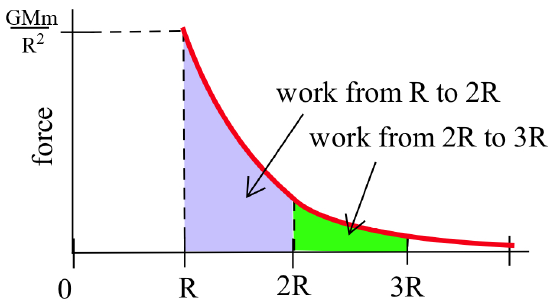
illustrate why the work to lift the payload from \(x = R\) to \(x = 2R\) is much larger than the work to lift it from \(x = 2R\) to \(x = 3R\). In fact, the work to lift the payload from \(x = 2R\) to x = \(100R\) is \(0.49GMmR^{-1}\), which is less than the \(0.5GMmR^{-1}\) needed to lift it from \(x = R\) to \(x = 2R\).
The real-world problem of lifting a payload turns out to be much more challenging, because the rocket doing the lifting must also lift itself (more work) and the mass of the rocket keeps changing as it burns up fuel. Lifting a payload from a moon (or planet) with an atmosphere is even more difficult: the atmosphere produces friction, and the frictional force depends on the density of the atmosphere (which varies with height), the speed of the rocket and the shape of the rocket. Life can get complicated.
Power
In physics, power is defined as the rate of work done per unit of time. One traditional measurement of power, horsepower (abbreviated “hp”), originated with James Watt’s determination in 1782 that a horse could turn a mill wheel of radius 12 feet 144 times in an hour while exerting a force of 180 pounds. Such a horse would travel:
\[144 \ \frac{\mbox{rev}}{\mbox{hr}} \cdot 2\pi(12) \ \frac{\mbox{ft}}{\mbox{rev}} \cdot \frac{1}{60} \ \frac{\mbox{hr}}{\mbox{min}} = \frac{288\pi}{5} \ \frac{\mbox{ft}}{\mbox{min}}\nonumber\]and so it would produce work at a rate of:\[\left(180 \ \mbox{lb}\right)\left( \frac{288\pi}{5} \ \frac{\mbox{ft}}{\mbox{min}}\right) = 10368\pi \, \frac{\mbox{ft-lb}}{\mbox{min}} \approx 32572 \, \frac{\mbox{ft-lb}}{\mbox{min}}\nonumber\]which Watt subsequently rounded to:\[33000 \, \frac{\mbox{ft-lb}}{\mbox{min}} = 550 \, \frac{\mbox{ft-lb}}{\mbox{sec}} = 1 \, \mbox{horsepower}\nonumber\](Scottish engineer James Watt (1736–1819) devised horsepower to compare the output of steam engines with the power of draft horses.)
The metric unit of power, called a watt (abbreviated “W”) in Watt'’s honor, is equivalent to 1 joule per second: \(1\,\mbox{hp} \approx 746\,\mbox{W}\).
How long will it take for a 1-horsepower electric pump to pump all of the liquid in the trough from Example 5 over the wall?
Solution
Power (\(P\)) is the rate at which work (\(W\)) is done, so:\[P = \frac{W}{t} \ \Rightarrow \ t = \frac{W}{P} = \frac{\frac{14000}{3}\,\mbox{ft-lbs}}{1\,\mbox{hp}} = \frac{\frac{14000}{3}\,\mbox{ft-lbs}}{550\,\frac{\mbox{ft-lbs}}{\mbox{sec}}} = \frac{280}{33}\,\mbox{sec}\nonumber\]or about 8.5 seconds.
Problems
- A tank 4 feet long, 3 feet wide and 7 feet tall is filled with water:

How much work is required to pump the water out over the top edge of the tank? - A tank 4 feet long, 3 feet wide and 6 feet tall is filled with a oil with a density of 60 pounds per cubic foot.
- How much work is needed to pump all of the oil over the top edge of the tank?
- How much work is needed to pump the top 3 feet of oil over the top edge of the tank?
- A tank 5 m long, 2 m wide and 4 m tall is filled with an oil of density 900 kg/m\(^3\).
- How much work is needed to pump all of the oil over the top edge of the tank?
- How much work is needed to pump the top 10 m\(^3\) of oil over the top edge of the tank?
- How long does it take for a 200-watt pump to empty the tank?
- A cylindrical aquarium with radius 2 feet and height 5 feet:

is filled with salt water (which has a density of 64 pounds per cubic foot).- How much work is done pumping all of the water over the top edge of the aquarium?
- How long does it take for a \(\frac12\)-horsepower pump to empty the tank? A \(\frac14\)-horsepower pump? Which pump does more work?
- If the aquarium is only filled to a height of 4 feet with sea water, how much work is required to empty it?
- A cylindrical barrel with a radius of 1 m and a height of 6 m is filled with water.
- How much work is done pumping all of the water over the top edge of the barrel?
- How much work is done pumping the top 1 m of water to a point 2 m above the top edge of the barrel?
- How long will it take a \(\frac12\)-horsepower pump to remove half of the water from the barrel?
- The conical container shown below:

is filled with oats that weigh 25 pounds per ft\(^3\).- How much work is done lifting all of the grain over the top edge of the cone?
- How much work is required to lift the top 2 feet of grain over the top edge of the cone?
- If you and a friend share the work equally in emptying the conical container in the previous Problem, what depth of grain should the first person leave for the second person to empty?
- A trough is filled with pig slop weighing 80 pounds per ft\(^3\):

How much work is done lifting all the slop over the top of the trough? - In the preceding problem, how much work is done lifting the top 14 ft\(^3\) of slop over the top edge of the trough?
- The parabolic container shown below (with a height of 4 m) is filled with water:

- How much work is done pumping all of the water over the top edge of the tank?
- How much work is done pumping all of the water to a point 3 m above the top of the tank?
- The parabolic container shown below (with a height of 2 m) is filled with water:

- How much work is done pumping all of the water over the top edge of the tank?
- How much work is done pumping all of the water to a point 3 m above the top of the tank?
- A spherical tank with radius 4 m is full of water. How much work is done lifting all of the water to the top of the tank?
- The spherical tank shown below is filled with water to a depth of 2 m:

How much work is done lifting all of that water to the top of the tank? - A student said, “I’ve got a shortcut for these tank problems, but it doesn’t always work. I figure the weight of the liquid and multiply that by the distance I have to move the ‘middle point’ in the water. It worked for the first five problems and then it didn't.”

- Does this “shortcut” really give the right answer for the first five problems?
- How do the containers in the first five problems differ from the others?
- For which of the containers shown below will the “shortcut” work?
- All of the containers shown below have the same height and hold the same volume of water:

- Which requires the most work to empty? Justify your response with a detailed explanation.
- Which requires the least work to empty?
- All of the containers shown below have the same total height and at each height \(x\) above the ground they all have the same cross-sectional area:

- Which requires the most work to empty? Justify your response with a detailed explanation.
- Which requires the least work to empty?
- The figure below shows the force required to move a box along a rough surface:

How much work is done pushing the box:- from \(x = 0\) to \(x = 5\) feet?
- from \(x = 3\) to \(x = 5\) feet?
- How much work is done pushing the box in the figure from the previous Problem:
- from \(x = 3\) to \(x = 7\) feet?
- from \(x = 0\) to \(x = 7\) feet?
- A spring requires a force of \(6x\) ounces to keep it stretched \(x\) inches past its natural length. How much work is done stretching the spring:
- from its natural length (\(x = 0\)) to 3 inches beyond its natural length?
- from its natural length to 6 inches beyond its natural length?
- A spring requires a force of \(5x\) dyn to keep it compressed \(x\) cm from its natural length. How much work is done compressing the spring:
- 7 cm from its natural length?
- 10 cm from its natural length?
- The figure below shows the force required to keep a spring that does not obey Hooke’s Law stretched beyond its natural length of 23 cm:

About how much work is done stretching it:- from a length of 23 cm to a length 33 cm?
- from a length of 28 cm to a length 33 cm?
- Approximately how much work is done stretching the defective spring in the previous Problem:
- from a length of 23 cm to a length 26 cm?
- from a length of 30 cm to a length 35 cm?
- A 3-kg object attached to a spring hung from the ceiling stretches the spring 15 cm. How much work is done stretching the spring 4 more cm?
- A 2-lb fish stretches a spring 3 in. How much work is done stretching the spring 3 more inches?
- A payload of mass 100 kg sits on the surface of the asteroid Ceres, a dwarf planet that is the largest object in the asteroid belt between Mars and Jupiter. Ceres has diameter 950 km and mass \(896\times 10^{18}\) kg. How much work is required to lift the payload from the asteroid’s surface to an altitude of:
- 10 km?
- 100 km?
- 500 km?
- Calculate the amount of work required to lift you from the surface of the Earth’s moon to an altitude of 100 km above the moon’s surface. (The moon’s radius is approximately 1,737.5 km and its mass is about \(7.35\times 10^{22}\) kg.)
- Calculate the amount of work required to lift you from the surface of the Earth’s moon (see previous Problem) to an altitude of:
- 200 km.
- 400 km.
- 10,000 km.
- An object located at the origin repels you with a force inversely proportional to your distance from the object (so that \(\displaystyle f(x) = \frac{k}{x}\) where \(x\) is your distance from the object, measured in feet). When you are 10 feet away from the origin, the repelling force is 0.1 pound. How much work must you do to move:
- from \(x = 20\) to \(x = 10\)?
- from \(x = 10\) to \(x = 1\)?
- from \(x = 1\) to \(x = 0.1\)?
- An object located at the origin repels you with a force inversely proportional to the square of your distance from the object (so that \(\displaystyle f(x) = \frac{k}{x^2}\) where \(x\) is your distance from the object, measured in meters). When you are 10 m away from the origin, the repelling force is 0.1 N. How much work must you do to move:
- from \(x = 20\) to \(x = 10\)?
- from \(x = 10\) to \(x = 1\)?
- from \(x = 1\) to \(x = 0.1\)?
- A student said “I’ve got a ‘work along a line’ shortcut that always seems to work. I figure the average force and then multiply by the total distance. Will it always work?”
- Will it? Justify your answer. (Hint: What is the formula for “average force”? )
- Is this a shortcut?
Work Along a Curved Path
If the location of a moving object is defined parametrically as \(x = x(t)\) and \(y = y(t)\) for \(a \leq t \leq b\) (where \(t\) often represents time), and the force required to overcome friction at time \(t\) is given as \(f(t)\), we can represent the work done moving along the (possibly curved) path as a definite integral. Partitioning \([a, b]\) into \(n\) subintervals of the form \(\left[t_{k-1}, t_k\right]\), we can choose any \(c_k\) in \(\left[t_{k-1}, t_k\right]\) and approximate the force required on \(\left[t_{k-1}, t_k\right]\) by \(f\left(c_k\right)\) so that the work done between \(t = t_{k-1}\) and \(t = t_k\) is approximately:\[f(c_k) \cdot \sqrt{\left[\Delta x_k\right]^2+\left[\Delta y_k\right]^2} = f(c_k) \cdot \sqrt{\left[\frac{\Delta x_k}{\Delta t_k}\right]^2+\left[\frac{\Delta y_k}{\Delta t_k}\right]^2} \cdot \Delta t_k\nonumber\]The total work done between times \(t = a\) and \(t = b\) is then:\[\sum_{k=1}^n \, f(c_k) \cdot \sqrt{\left[\frac{\Delta x_k}{\Delta t_k}\right]^2+\left[\frac{\Delta y_k}{\Delta t_k}\right]^2} \cdot \Delta t_k \ \longrightarrow \ \int_a^b f(t)\sqrt{\left[x'(t)\right]^2+\left[y'(t)\right]^2} \, dt\nonumber\]
In Problems 31–35, find the work done as an object is moved along the given parametric path (with distance measured in meters), where \(f(t)\) (in newtons) is the force required at time \(t\) (in seconds). If necessary, approximate the value of the integral using technology.
- \(f(t) = t\), \(x(t) = \cos(t)\), \(y(t) = \sin(t)\), \(0 \leq t \leq 2\pi\)
- \(f(t) = t\), \(x(t) = t\), \(y(t) = t^2\), \(0 \leq t \leq 1\)
- \(f(t) = t\), \(x(t) = t^2\), \(y(t) = t\), \(0 \leq t \leq 1\)
- \(f(t) = \sin(t)\), \(x(t) = 2t\), \(y(t) = 3t\), \(0 \leq t \leq \pi\):

- \(f(t) = t\), \(x(t) = \cos(t)\), \(y(t) = \sin(t)\), \(0 \leq t \leq 2\pi\):

(Can you find a geometric way to calculate the shaded area?)