

4.3: Volume and Surface Area
- Page ID
- 207650
\( \newcommand{\vecs}[1]{\overset { \scriptstyle \rightharpoonup} {\mathbf{#1}} } \)
\( \newcommand{\vecd}[1]{\overset{-\!-\!\rightharpoonup}{\vphantom{a}\smash {#1}}} \)
\( \newcommand{\dsum}{\displaystyle\sum\limits} \)
\( \newcommand{\dint}{\displaystyle\int\limits} \)
\( \newcommand{\dlim}{\displaystyle\lim\limits} \)
\( \newcommand{\id}{\mathrm{id}}\) \( \newcommand{\Span}{\mathrm{span}}\)
( \newcommand{\kernel}{\mathrm{null}\,}\) \( \newcommand{\range}{\mathrm{range}\,}\)
\( \newcommand{\RealPart}{\mathrm{Re}}\) \( \newcommand{\ImaginaryPart}{\mathrm{Im}}\)
\( \newcommand{\Argument}{\mathrm{Arg}}\) \( \newcommand{\norm}[1]{\| #1 \|}\)
\( \newcommand{\inner}[2]{\langle #1, #2 \rangle}\)
\( \newcommand{\Span}{\mathrm{span}}\)
\( \newcommand{\id}{\mathrm{id}}\)
\( \newcommand{\Span}{\mathrm{span}}\)
\( \newcommand{\kernel}{\mathrm{null}\,}\)
\( \newcommand{\range}{\mathrm{range}\,}\)
\( \newcommand{\RealPart}{\mathrm{Re}}\)
\( \newcommand{\ImaginaryPart}{\mathrm{Im}}\)
\( \newcommand{\Argument}{\mathrm{Arg}}\)
\( \newcommand{\norm}[1]{\| #1 \|}\)
\( \newcommand{\inner}[2]{\langle #1, #2 \rangle}\)
\( \newcommand{\Span}{\mathrm{span}}\) \( \newcommand{\AA}{\unicode[.8,0]{x212B}}\)
\( \newcommand{\vectorA}[1]{\vec{#1}} % arrow\)
\( \newcommand{\vectorAt}[1]{\vec{\text{#1}}} % arrow\)
\( \newcommand{\vectorB}[1]{\overset { \scriptstyle \rightharpoonup} {\mathbf{#1}} } \)
\( \newcommand{\vectorC}[1]{\textbf{#1}} \)
\( \newcommand{\vectorD}[1]{\overrightarrow{#1}} \)
\( \newcommand{\vectorDt}[1]{\overrightarrow{\text{#1}}} \)
\( \newcommand{\vectE}[1]{\overset{-\!-\!\rightharpoonup}{\vphantom{a}\smash{\mathbf {#1}}}} \)
\( \newcommand{\vecs}[1]{\overset { \scriptstyle \rightharpoonup} {\mathbf{#1}} } \)
\(\newcommand{\longvect}{\overrightarrow}\)
\( \newcommand{\vecd}[1]{\overset{-\!-\!\rightharpoonup}{\vphantom{a}\smash {#1}}} \)
\(\newcommand{\ket}[1]{\left| #1 \right>}\)
\(\newcommand{\bra}[1]{\left< #1 \right|}\)
\(\newcommand{\braket}[2]{\left< #1 \vphantom{#2} \right| \left. #2 \vphantom{#1} \right>}\)
\(\newcommand{\braopket}[3]{\left< #1 \vphantom{#2}\vphantom{#3} \right| #2 \vphantom{#1}\vphantom{#3} \left| #3 \vphantom{#1}\vphantom{#2} \right>}\)
\(\newcommand{\qmvec}[1]{\mathbf{\vec{#1}}}\)
\(\newcommand{\op}[1]{\hat{\mathbf{#1}}}\)
\(\newcommand{\expect}[1]{\langle #1 \rangle}\)
\(\newcommand{\dfn}[1]{\emph{\textbf{#1}}}\)
Volume and surface area are two measurements that are part of our daily lives. We use volume every day, even though we do not focus on it. When you purchase groceries, volume is the key to pricing. Judging how much paint to buy or how many square feet of siding to purchase is based on surface area. The list goes on. An example is a three-dimensional rendering of a floor plan. These types of drawings make building layouts far easier to understand for the client. It allows the viewer a realistic idea of the product at completion; you can see the natural space, the volume of the rooms. This section gives you practical information you will use consistently. You may not remember every formula, but you will remember the concepts, and you will know where to go should you want to calculate volume or surface area in the future.
We will concentrate on a few particular types of three-dimensional objects: right prisms and right cylinders. The adjective “right” refers to objects such that the sides form a right angle with the base. We will look at right rectangular prisms, right triangular prisms, right hexagonal prisms, right octagonal prisms, and right cylinders. Although the principles learned here apply to all right prisms.
Living in a two-dimensional world would be pretty boring. Thankfully, all of the physical objects that you see and use every day—computers, phones, cars, shoes—exist in three dimensions. They all have length, width, and height. (Even very thin objects like a piece of paper are three-dimensional. The thickness of a piece of paper may be a fraction of a millimeter, but it does exist.)
In the world of geometry, it is common to see three-dimensional figures. In mathematics, a flat side of a three-dimensional figure is called a face. Polyhedrons are shapes that have four or more faces, each one being a polygon. These include cubes, prisms, and pyramids. Sometimes you may even see single figures that are composites of two of these figures. Let’s take a look at some common polyhedra.
Three-Dimensional Objects
In geometry, three-dimensional objects are called geometric solids. Surface area refers to the flat surfaces that surround the solid and is measured in square units. Volume refers to the space inside the solid and is measured in cubic units. Imagine that you have a square flat surface with width and length. Adding the third dimension adds depth or height, depending on your viewpoint, and now you have a box. One way to visualize this concept is in three-dimensional Cartesian space. The \(x\)-axis and the \(y\)-axis are, as you would expect, two dimensions and suitable for plotting two-dimensional graphs and shapes. Adding the \(z\)-axis, which shoots through the origin perpendicular to the \(x y\)-plane, and we have a third dimension.
Here is another view taking the two-dimensional square to a third dimension. See Figure .
To study objects in three dimensions, we need to consider the formulas for surface area and volume. For example, suppose you have a box with a hinged lid that you want to use for keeping photos, and you want to cover the box with decorative paper. You would need to find the surface area to calculate the amount of paper needed. Suppose you need to know how much water will fill your swimming pool. In that case, you would need to calculate the volume of the pool. These are just a couple of examples of why these concepts should be understood, and familiarity with the formulas will allow you to make use of these ideas as related to right prisms and right cylinders.
Identifying Solids
The first set of solids contains rectangular bases. Take a look at the table below, which displays each figure in both solid and transparent forms.
| Name | Definition | Solid Form | Transparent Form |
| Cube | A six-sided polyhedron that has congruent squares as faces. | 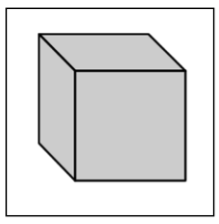 |
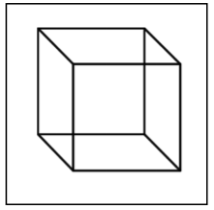 |
| Rectangular prism or Rectangular Solid | A polyhedron that has three pairs of congruent, rectangular, parallel faces. | 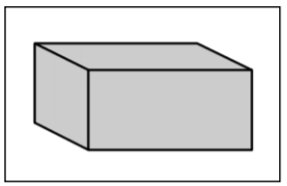 |
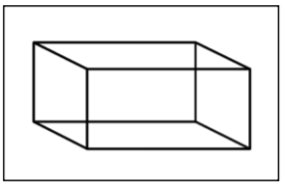 |
| Pyramid (Base of the pyramid could be any shape such as triangle, square, rectangle, pentagon, etc) | A polyhedron with a polygonal base and a collection of triangular faces that meet at a point. |  |
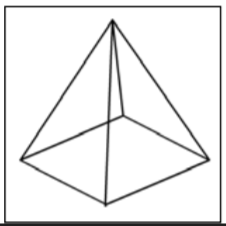 |
Notice the different names that are used for these figures. A cube is different than a square, although they are sometimes confused with each other—a cube has three dimensions, while a square only has two. Likewise, you would describe a shoebox as a rectangular prism (not simply a rectangle), and the ancient pyramids of Egypt as…well, as pyramids (not triangles).
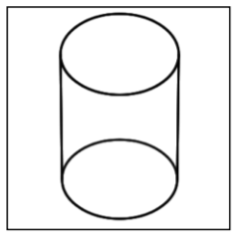
In this next set of solids, each figure has a circular base.
| Name | Definition | Solid Form | Transparent Form |
| Cylinder | A solid figure with a pair of circular, parallel bases and a round, smooth face between them. | 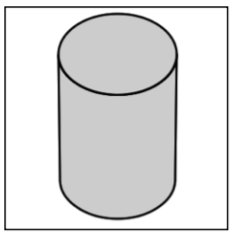 |
 |
| Cone | A solid figure with a single circular base and a round, smooth face that tapers to a single point. | 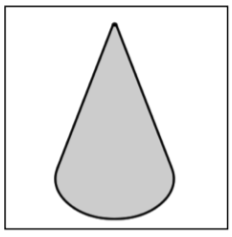 |
 |
Take a moment to compare a pyramid and a cone. Notice that a pyramid has a rectangular base and flat, triangular faces; a cone has a circular base and a smooth, rounded body.
Finally, let’s examine a shape that is unique: The sphere.
| Name | Definition | Solid Form | Transparent Form |
| Sphere | A solid, round figure where every point on the surface is the same distance from the center. | 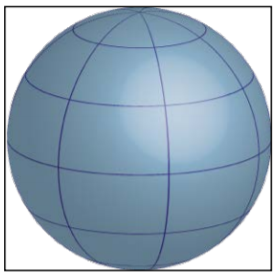 |
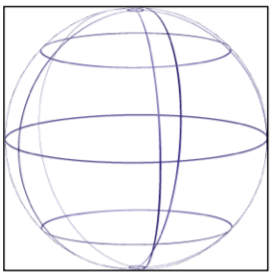 |
There are many spherical objects all around you—soccer balls, tennis balls, and baseballs being three common items. While they may not be perfectly spherical, they are generally referred to as spheres.
Volume
Recall that perimeter measures one dimension (length), and area measures two dimensions (length and width). To measure the amount of space a three-dimensional figure takes up, you use another measurement called volume.
To visualize what “volume” measures, look back at the transparent image of the rectangular prism mentioned earlier (or just think of an empty shoebox). Imagine stacking identical cubes inside that box so that there are no gaps between any of the cubes. Imagine filling up the entire box in this manner. If you counted the number of cubes that fit inside that rectangular prism, you would have its volume.
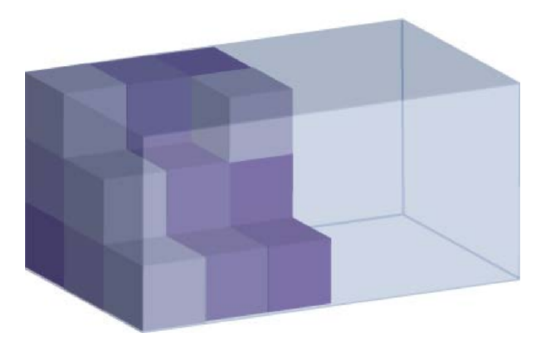
Volume is measured in cubic units.
The shoebox illustrated above may be measured in cubic inches (usually represented as \(\text{in}^3\) or \(\text{inches}^3\)), while the Great Pyramid of Egypt would be more appropriately measured in cubic meters (\(\text{m}^3\) or \(\text{meters}^3\)).
To find the volume of a geometric solid, you could create a transparent version of the solid, create a bunch of \(1\times1\times1\) cubes, and then stack them carefully inside. However, that would take a long time! A much easier way to find the volume is to become familiar with some geometric formulas and to use those instead.
Let’s go through the geometric solids once more and list the volume formula for each.
As you look through the list below, you may notice that some of the volume formulas look similar to their area formulas. To find the volume of a rectangular prism, you find the area of the base and then multiply that by the height.
Surface Area
Surface area is the total area of all the outer surfaces of a three-dimensional object. It tells you how much material is needed to completely cover the shape. It’s measured in square units (e.g., cm², m², in²).
There are two important kinds of surface area: the lateral surface area (LSA) and the total surface area (TSA). To visualize the difference between LSA and TSA, consider the following geometric shape.
- Cylinder (like a can of food)
- LSA: This is just the area around the side of the can—like the paper label. It does not include the top or bottom lids
- TSA: This is the area of the entire can—the sides, plus the top lid and the bottom lid
- Rectangular Prism or solid (like a cardboard box):
- LSA: The area of the four outer walls only (excluding the top and bottom flaps).
- TSA: The area of all \(6\) sides (the \(4\) walls plus the top and bottom).
- Cone (like a party hat):
- LSA: The area of the sloping side.
- TSA: The area of the sloping side plus the circular base at the bottom.
| Name | Transparent Form | Volume and Surface Area Formula |
| Cube | 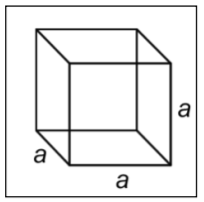 |
\(V =a \cdot a \cdot a = a^3\) \(a\) = the length of one side \(SA =6 a^2\) |
| Rectangular prism | 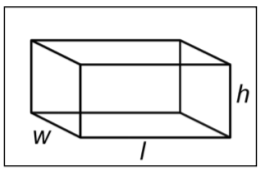 |
\(V = l \cdot w \cdot h\) \(l\) = length \(w\) = width \(h\) = height \(SA =2(lw+lh+wh)\) |
| Pyramid | 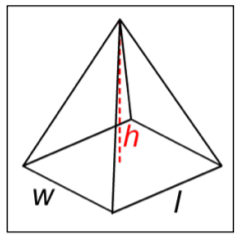 |
\(V = \dfrac{l \cdot w \cdot h}{3}= \dfrac{B \cdot h}{3}\) \(l\) = length \(w\) = width \(h\) = height \(B=l\times w\) = area of the base |
Remember that all cubes are rectangular prisms, so the formula for finding the volume of a cube is the area of the base of the cube times the height.
Now let’s look at solids that have a circular base.
| Name | Transparent Form | Volume and Surface Area Formula |
| Cylinder | 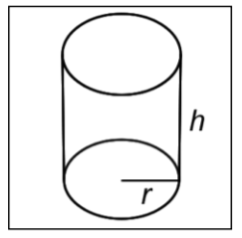 |
\(V = \pi \cdot r^2 \cdot h\) \(r\) = radius \(h\) = height \(SA =2\pi r h\): Lateral surface area of a cylinder (just the curved outside) \(SA =2\pi r h+2\pi r^2\): Total surface area including top and bottom circular parts |
| Cone |  |
\(V = \dfrac{\pi \cdot r^2 \cdot h}{3}\) \(r\) = radius \(h\) = height \(l\) = Slant length Where \(l=\sqrt{r^2+h^2}\) \(SA = \pi rl\): Lateral surface area (just the curved outside) \(SA =\pi r^2+\pi rl\): Total surface area including curved outside and bottom circular parts |
Compare the formula for the volume of a cone (\(V = \dfrac{\pi \cdot r^2 \cdot h}{3}\)) with the formula for the volume of a pyramid (\(V = \dfrac{l \cdot w \cdot h}{3}\)). The numerator of the cone formula is the volume formula for a cylinder, and the numerator of the pyramid formula is the volume formula for a rectangular prism. Then divide each by \(3\) to find the volume of the cone and the pyramid. Looking for patterns and similarities in the formulas can help you remember which formula refers to a given solid.
Finally, the formula for a sphere is provided below. Notice that the radius is cubed, not squared, and that the quantity \(\pi r^3\) is multiplied by \(\dfrac{4}{3}\).
| Name | Wireframe Form | Volume Formula |
| Sphere | 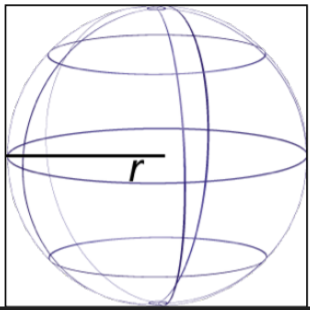 |
\(V = \dfrac{4}{3} \pi r^3\) \(r\) = radius \(V = 4 \pi r^2\) Note: For the hemisphere, you have to divide by \(2\) in the above formula. |
You know how to identify the solids, and you also know the volume formulas for these solids. To calculate the actual volume of a given shape, all you need to do is substitute the solid’s dimensions into the formula and calculate.
Note: If you keep \(\pi\) in your answer, it is called an exact answer. If you replace \(\pi\) with \(3.14\), the answer is an approximate answer.
Example \(\PageIndex{3}\): Calculating Surface Area and Volume of a Rectangular Prism
Find the surface area and volume of the rectangular prism that has a width of 10 cm, a length of 5 cm, and a height of 3 cm (Figure \(\PageIndex{3}\)).
- Answer
-
The surface area is
\[S A=2(10)(5)+2(5)(3)+2(10)(3) = 190 \mathrm{~cm}^2\nonumber\]
Example \(\PageIndex{4}\): Volume of Pyramid
Find the volume of the shape shown below.

- Answer
-
Identify the shape. It has a rectangular base and rises to a point, so it is a pyramid.
Identify the proper formula to use. \(l\) = length, \(w\) = width, and \(h\) = height
\(V = \dfrac{l \cdot w \cdot h}{3}\)
Use the image to identify the dimensions. \(4\) = length \(3\) = width \(8\) = height. Then substitute \(l=4\), \(w=3\), and \(h=8\) into the formula.
\(V = \dfrac{4 \cdot 3 \cdot 8}{3}= \dfrac{96}{3}=32\)
The volume of the pyramid is \(32 \text{~in}^3\)
Example \(\PageIndex{5}\): Box and Ball
Callie is sending her nephew a soccer ball for his birthday. She packs the ball in a cubic box with side length \(24\) in. The diameter of the soccer ball is \(22\) in. She needs to determine how much space needs to be filled with packing material. What is the volume of the box and the ball? What is the remaining volume of the box that needs to be filled with packing material? Use \(3.14\) for \(\pi\), and round the answer to the nearest hundredth.

- Answer
-
Volume of the ball
\[\begin{aligned}
\text{Volume of a ball}&= \dfrac{4}{3} \pi r^3\\
&=\dfrac{4}{3} \pi \cdot 22^3\\
&=5575.45\pi\;\mathrm{in}^3
\end{aligned}\nonumber \]Volume of the box
\[\begin{aligned}
\text{Volume of a box}&=a^3\\
&=24^3\\
&=13,824\pi \;\mathrm{in}^3
\end{aligned}\nonumber \]\(\text{Volume of the remaining for packaging material}= 13,824 -5,575.45 =8,251.55\;\mathrm{~in}^3\)
Example \(\PageIndex{6}\): Volume of Cylinder
Brianna bought a can of soup. She measured its dimensions and recorded them as shown in the image above. How much soup can the can hold? One cubic inch is approximately equal to \(0.554\) fluid ounces. How many fluid ounces of soup does the can hold?

- Answer
-
Calculate the volume, using \(\pi=3.14\) as an approximation for \(\pi\).
\[\begin{aligned}
V &= \pi \times r^2 \times h\\
&=3.14\times 1.1^2 \times 4.2\\
&=15.96\;\text{in}^3\\
\end{aligned} \nonumber \]Now convert \(15.96\;\text{in}^3\) to fluid ounce using \(0.554\;\text{fluid ounces}=1\;\text{in}^3\)
\[\begin{aligned}
15.96\text{~in}^3 & = {\dfrac{\text{15.96 } \cancel{\text{in}^3}}{1} \times \dfrac{\text{0.554 } {\text{fluid ounces}}}{\text{1 } \cancel{\text{in }^3}}} \\
&= {\dfrac{(15.96\times0.554) \text{ fluid ounces}}{1}} \\
& = {\text{8.84 fluid ounces}}
\end{aligned} \nonumber \]
Now you try to find the volume for another solid, called a cone.
Example \(\PageIndex{7}\): Can of Dog Food
Your co-worker has designed a can of dog food that has a height of \(10.1\) cm and a diameter of \(8.6\) cm. Your job is to determine the area of the paper label that will cover the lateral area of the can. Because the ends of the paper label will overlap, assume that you will need the amount of paper to be \(10\%\) more than the lateral surface area of the can. What is the area of one paper label? Round to the nearest square centimeter.

- Answer
-
\[\begin{aligned}
\text{Lateral surface area of the can}&=2\pi rh\\
&= 2 \cdot 3.14\cdot 4.3\cdot 10.1\\
&=272.74 \;\mathrm{cm}^2
\end{aligned}\nonumber \]Since we need \(10\%\) more than the lateral surface area. We need \(0.10\cdot 272.74=27.2\) more than \(272.74\).
The area of the paper needed is \[272.74+27.27=300.01=300 \;\mathrm{cm}^2\nonumber\]
Composite Solids
Composite geometric solids are made from two or more geometric solids. You can find the volume of these solids as well, as long as you are able to figure out the individual solids that make up the composite shape.
Look at the image of a capsule below. Each end is a half-sphere. You can find the volume of the solid by taking it apart. What solids can you break this shape into?
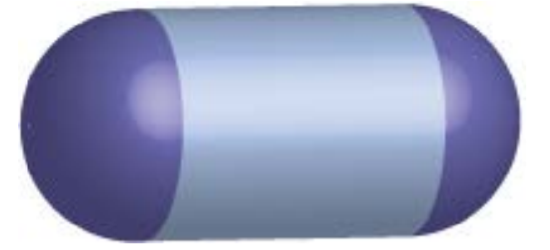
You can break it into a cylinder and two half-spheres.
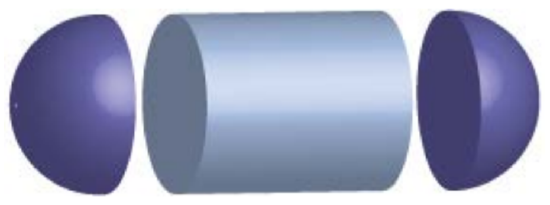
Two half-spheres form a whole one, so if you know the volume formulas for a cylinder and a sphere, you can find the volume of this capsule.
Example \(\PageIndex{8}\): Composite Solid
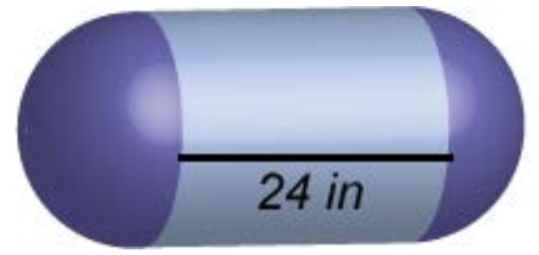
If the radius of the spherical ends is \(6\) inches, find the volume of the solid below. Use \(3.14\) for \(\pi\). Round your final answer to the nearest whole number.
- Answer
-
Identify the composite solids. This capsule can be thought of as a cylinder with a half-sphere on each end.
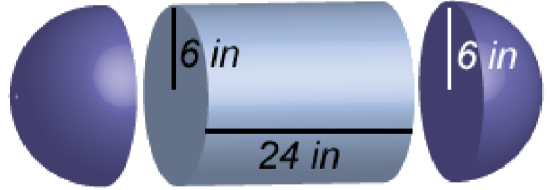
Identify the proper formulas to use.
\(\text{Volume of a cylinder: } \pi \cdot r^2 \cdot h\)
\(\text{Volume of a sphere: } \dfrac{4}{3} \pi r^3\)
The height of a cylinder refers to the section between the two circular bases. This dimension is given as \(24\) inches, so \(h=24\). The radius of the sphere is \(6\) inches. You can use \(r=6\) in both formulas. Substitute the dimensions into the formulas.
For Cylinder
\[\begin{aligned}
\text{Volume of a cylinder }&= \pi \cdot 6^2 \cdot 24\\
&= \pi \cdot 36 \cdot 24\\
&=864\pi
\end{aligned} \nonumber \]For Sphere (Two Hemisphere)
\[\begin{aligned}
\text{Volume of a sphere}&= \dfrac{4}{3} \pi \cdot 6^3\\
&= \dfrac{4}{3} \pi \cdot 216\\\\
&=288\pi
\end{aligned} \nonumber \]The total exact volume is
\[\text{Volume of capsule}=864\pi+ 288\pi =1152\pi \nonumber\]
The total approximate volume is
\[\text{Volume of capsule}= 1152\times 3.14 ≈ 3617.28 \nonumber\]
Example \(\PageIndex{8}\): Composite Solid
This figure is comprised of a hemisphere, cylinder, and cone. The lengths shown are each the vertical parts of each figure. Find the total surface area and the volume of the figure. Write your answer in term of \(\pi\). Note that dimensions are given in inches.

- Answer
-
\[\begin{aligned}
\text{Volume of a cylinder}&= \pi r^2 h\\
&= \pi \cdot 6^2 \cdot 17\\
&=612\pi\;\mathrm{in}^3
\end{aligned}\nonumber \]\[\begin{aligned}
\text{Volume of a hemisphere}&= \dfrac{4}{3} \pi r^3\div 2\\
&=\dfrac{4}{3} \pi \cdot 6^3\div 2\\
&=144\pi\;\mathrm{in}^3
\end{aligned}\nonumber \]\[\begin{aligned}
\text{Volume of a Cone}&=\dfrac{1}{3} \pi r^2\cdot h\\
&= \dfrac{1}{3} \pi 6^2\cdot 8\\
&=96\pi \;\mathrm{in}^3
\end{aligned}\nonumber \]So \(\text{Volume of Figure: } 144\pi+612\pi+96\pi=852\pi\)
\[\begin{aligned}
\text{Surface area of cylinder}&= 2\pi r h\\&= 2\pi \cdot 6 \cdot 17\\&=204\pi\;\mathrm{in}^2
\end{aligned}\nonumber \]\[\begin{aligned}
\text{Surface area of a hemisphere} &=4 \pi r^2\div 2\\&=4 \pi \cdot 6^2\div 2\\&
=72\pi\;\mathrm{in}^2
\end{aligned}\nonumber \]\[\begin{aligned}
\text{Surface area of a Cone}&= \pi r\sqrt{r^2+h^2}\\
&= \pi\cdot 6\cdot \sqrt{6^2+8^2}\\
&= \pi\cdot 6\cdot \sqrt{100}\\
&=60\pi\;\mathrm{in}^2
\end{aligned}\nonumber \]So \(\text{Total Surface area of the Figure: } 204\pi+72\pi+60\pi=336\pi\)