

1.2: What is Mathematics?
- Page ID
- 170061
\( \newcommand{\vecs}[1]{\overset { \scriptstyle \rightharpoonup} {\mathbf{#1}} } \)
\( \newcommand{\vecd}[1]{\overset{-\!-\!\rightharpoonup}{\vphantom{a}\smash {#1}}} \)
\( \newcommand{\dsum}{\displaystyle\sum\limits} \)
\( \newcommand{\dint}{\displaystyle\int\limits} \)
\( \newcommand{\dlim}{\displaystyle\lim\limits} \)
\( \newcommand{\id}{\mathrm{id}}\) \( \newcommand{\Span}{\mathrm{span}}\)
( \newcommand{\kernel}{\mathrm{null}\,}\) \( \newcommand{\range}{\mathrm{range}\,}\)
\( \newcommand{\RealPart}{\mathrm{Re}}\) \( \newcommand{\ImaginaryPart}{\mathrm{Im}}\)
\( \newcommand{\Argument}{\mathrm{Arg}}\) \( \newcommand{\norm}[1]{\| #1 \|}\)
\( \newcommand{\inner}[2]{\langle #1, #2 \rangle}\)
\( \newcommand{\Span}{\mathrm{span}}\)
\( \newcommand{\id}{\mathrm{id}}\)
\( \newcommand{\Span}{\mathrm{span}}\)
\( \newcommand{\kernel}{\mathrm{null}\,}\)
\( \newcommand{\range}{\mathrm{range}\,}\)
\( \newcommand{\RealPart}{\mathrm{Re}}\)
\( \newcommand{\ImaginaryPart}{\mathrm{Im}}\)
\( \newcommand{\Argument}{\mathrm{Arg}}\)
\( \newcommand{\norm}[1]{\| #1 \|}\)
\( \newcommand{\inner}[2]{\langle #1, #2 \rangle}\)
\( \newcommand{\Span}{\mathrm{span}}\) \( \newcommand{\AA}{\unicode[.8,0]{x212B}}\)
\( \newcommand{\vectorA}[1]{\vec{#1}} % arrow\)
\( \newcommand{\vectorAt}[1]{\vec{\text{#1}}} % arrow\)
\( \newcommand{\vectorB}[1]{\overset { \scriptstyle \rightharpoonup} {\mathbf{#1}} } \)
\( \newcommand{\vectorC}[1]{\textbf{#1}} \)
\( \newcommand{\vectorD}[1]{\overrightarrow{#1}} \)
\( \newcommand{\vectorDt}[1]{\overrightarrow{\text{#1}}} \)
\( \newcommand{\vectE}[1]{\overset{-\!-\!\rightharpoonup}{\vphantom{a}\smash{\mathbf {#1}}}} \)
\( \newcommand{\vecs}[1]{\overset { \scriptstyle \rightharpoonup} {\mathbf{#1}} } \)
\(\newcommand{\longvect}{\overrightarrow}\)
\( \newcommand{\vecd}[1]{\overset{-\!-\!\rightharpoonup}{\vphantom{a}\smash {#1}}} \)
\(\newcommand{\ket}[1]{\left| #1 \right>}\)
\(\newcommand{\bra}[1]{\left< #1 \right|}\)
\(\newcommand{\braket}[2]{\left< #1 \vphantom{#2} \right| \left. #2 \vphantom{#1} \right>}\)
\(\newcommand{\braopket}[3]{\left< #1 \vphantom{#2}\vphantom{#3} \right| #2 \vphantom{#1}\vphantom{#3} \left| #3 \vphantom{#1}\vphantom{#2} \right>}\)
\(\newcommand{\qmvec}[1]{\mathbf{\vec{#1}}}\)
\(\newcommand{\op}[1]{\hat{\mathbf{#1}}}\)
\(\newcommand{\expect}[1]{\langle #1 \rangle}\)
\(\newcommand{\dfn}[1]{\emph{\textbf{#1}}}\)
What is Mathematics?
A common question students often ask in one form or another about mathematics is, “When will I ever use this?” or “Why do we need to study math anyway?” To better answer this question for your students, it's important to reflect on your own answer to the question: What is mathematics? Below is a word cloud created from responses given by middle school students to that very question.(1) What do you see in the responses?

Think about (or even write) what you think mathematics is. Then you will partner up with those near to you share your ideas.
As future elementary school teachers, your understanding of mathematics goes beyond solving equations or memorizing formulas; it involves recognizing mathematics as a way of thinking, reasoning, and problem-solving that is deeply connected to the world around us. By exploring the nature of mathematics, you can help your students see its relevance in everyday life and cultivate their curiosity and confidence in the subject. Below are some responses from mathematicians.
- Keith Devlin characterizes mathematics as "the science of patterns," emphasizing its role in identifying and analyzing patterns—whether real or abstract, visual or mental, from the natural world or human cognition.
- In A Mathematician's Lament, Paul Lockhart describes mathematics as "an art of human expression," akin to painting or music. He emphasizes that mathematics is a creative and imaginative pursuit, involving the invention of new ideas and the exploration of abstract concepts for their intrinsic beauty.
- William Thurston, a Fields Medal-winning mathematician, said, "Mathematics is not about numbers, equations, computations, or algorithms: it is about understanding."
- Einstein had insightful views on mathematics. He stated, "Pure mathematics is, in its way, the poetry of logical ideas." For Einstein, mathematics was a form of art that combined logic and creativity.
- Francis Su advocates for mathematics as a means to achieve human flourishing. In his book Mathematics for Human Flourishing, he presents an inclusive vision of mathematics, exploring its beauty and its capacity to develop virtues such as persistence, creativity, and critical thinking. Su's perspective underscores the humanistic aspects of mathematics, suggesting it contributes to personal growth and well-being.
🧠Let's Listen to Learn❤️
As a future elementary teacher, which of these descriptions of mathematics most aligns with how you hope your students will experience math in your classroom?
- What about the description resonates with your personal experience or beliefs about math?
- How might this perspective influence the way you teach or design learning experiences for your students?
- How could you help your students see mathematics in this way?
Understanding mathematics as a multifaceted discipline with deep connections to creativity, logic, and human flourishing opens the door to various perspectives. Each viewpoint—from Lockhart’s emphasis on artistic expression to Su’s focus on personal growth—offers valuable insights into how mathematics shapes our lives. However, for this course, we will center our exploration on Keith Devlin’s definition of mathematics as "the science of patterns." This approach provides a foundational lens to understand mathematical ideas and their application, aligning with the idea that patterns, whether in nature, art, or abstract reasoning, are at the heart of mathematical thought. While the other interpretations are interconnected and essential, focusing on patterns allows us to frame our curriculum in a way that is both accessible and powerful for future educators.
Complete the table following the same rule or pattern from the first rows.
| Input | Output |
| 15 | 5 |
| 18 | 8 |
| 21 | 11 |
| 22 | ? |
| ? | 13 |
- Solution
-
The pattern follows an sequence where both input and output increase by 3, but at 22, the increase is only by 1 instead of 3. Using this rule, the missing values are 22→12 and 23→13. How did you think about it?
Wonder, Play, Grow
Now you try it on your own using the interactive below. Keep playing until you feel comfortable.
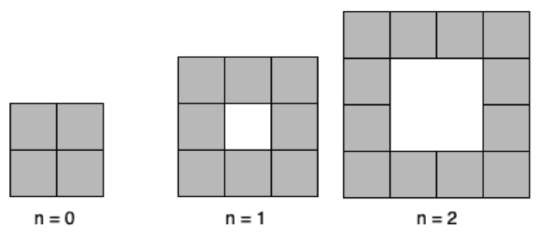
Find the number of tiles around square pools of size n=3, 4, 8, and 10.
- Solution
-
For n=0 the pool is a 2×2, so the total number of shaded tiles is 4. For n=1 the pool is a 3×3 grid with the center tile removed, so the number of shaded tiles is 8. For n=2 the pool is a 4×4 grid with a 2×2 center removed, so the number of shaded tiles is 12.
Pool of size 3 → 16 shaded tiles Pool of size 4 → 20 shaded tiles Pool of size 8 → 36 shaded tiles Pool of size 10 → 44 shaded tiles.
Can you come up with a pattern to find the number of tiles for any size pool of length n?
If you want to further Wonder, Play, Grow with Pool Tile Problem, then use this Growing Patterns LINK for an interactive experience.