

1.5: Problem Solving Strategies Part 2
- Page ID
- 157775

\( \newcommand{\vecs}[1]{\overset { \scriptstyle \rightharpoonup} {\mathbf{#1}} } \)
\( \newcommand{\vecd}[1]{\overset{-\!-\!\rightharpoonup}{\vphantom{a}\smash {#1}}} \)
\( \newcommand{\dsum}{\displaystyle\sum\limits} \)
\( \newcommand{\dint}{\displaystyle\int\limits} \)
\( \newcommand{\dlim}{\displaystyle\lim\limits} \)
\( \newcommand{\id}{\mathrm{id}}\) \( \newcommand{\Span}{\mathrm{span}}\)
( \newcommand{\kernel}{\mathrm{null}\,}\) \( \newcommand{\range}{\mathrm{range}\,}\)
\( \newcommand{\RealPart}{\mathrm{Re}}\) \( \newcommand{\ImaginaryPart}{\mathrm{Im}}\)
\( \newcommand{\Argument}{\mathrm{Arg}}\) \( \newcommand{\norm}[1]{\| #1 \|}\)
\( \newcommand{\inner}[2]{\langle #1, #2 \rangle}\)
\( \newcommand{\Span}{\mathrm{span}}\)
\( \newcommand{\id}{\mathrm{id}}\)
\( \newcommand{\Span}{\mathrm{span}}\)
\( \newcommand{\kernel}{\mathrm{null}\,}\)
\( \newcommand{\range}{\mathrm{range}\,}\)
\( \newcommand{\RealPart}{\mathrm{Re}}\)
\( \newcommand{\ImaginaryPart}{\mathrm{Im}}\)
\( \newcommand{\Argument}{\mathrm{Arg}}\)
\( \newcommand{\norm}[1]{\| #1 \|}\)
\( \newcommand{\inner}[2]{\langle #1, #2 \rangle}\)
\( \newcommand{\Span}{\mathrm{span}}\) \( \newcommand{\AA}{\unicode[.8,0]{x212B}}\)
\( \newcommand{\vectorA}[1]{\vec{#1}} % arrow\)
\( \newcommand{\vectorAt}[1]{\vec{\text{#1}}} % arrow\)
\( \newcommand{\vectorB}[1]{\overset { \scriptstyle \rightharpoonup} {\mathbf{#1}} } \)
\( \newcommand{\vectorC}[1]{\textbf{#1}} \)
\( \newcommand{\vectorD}[1]{\overrightarrow{#1}} \)
\( \newcommand{\vectorDt}[1]{\overrightarrow{\text{#1}}} \)
\( \newcommand{\vectE}[1]{\overset{-\!-\!\rightharpoonup}{\vphantom{a}\smash{\mathbf {#1}}}} \)
\( \newcommand{\vecs}[1]{\overset { \scriptstyle \rightharpoonup} {\mathbf{#1}} } \)
\(\newcommand{\longvect}{\overrightarrow}\)
\( \newcommand{\vecd}[1]{\overset{-\!-\!\rightharpoonup}{\vphantom{a}\smash {#1}}} \)
\(\newcommand{\ket}[1]{\left| #1 \right>}\)
\(\newcommand{\bra}[1]{\left< #1 \right|}\)
\(\newcommand{\braket}[2]{\left< #1 \vphantom{#2} \right| \left. #2 \vphantom{#1} \right>}\)
\(\newcommand{\braopket}[3]{\left< #1 \vphantom{#2}\vphantom{#3} \right| #2 \vphantom{#1}\vphantom{#3} \left| #3 \vphantom{#1}\vphantom{#2} \right>}\)
\(\newcommand{\qmvec}[1]{\mathbf{\vec{#1}}}\)
\(\newcommand{\op}[1]{\hat{\mathbf{#1}}}\)
\(\newcommand{\expect}[1]{\langle #1 \rangle}\)
\(\newcommand{\dfn}[1]{\emph{\textbf{#1}}}\)
Problem Solving Strategy 4 (Look for a Pattern)
The "look for a pattern" strategy is a helpful way to solve problems, especially in math. It involves finding repeating sequences, relationships, or changes that can lead to a solution. Here’s how and when to use this strategy (Musser et al., 2013):
The "Look for a Pattern" Strategy Works Best When:
- Working with lists of data: Trends or recurring relationships can be identified.
- Dealing with number sequences: Adding, subtracting, or multiplying patterns reveal the next numbers or explain the sequence.
- Solving complex problems: Examining examples or special cases helps uncover a general pattern.
- Making predictions or generalizations: Patterns lead to creating rules or formulas.
- Organizing information in tables: Rows or columns often reveal clear patterns.
- Exploring shapes or growth: Numerical or geometric patterns, such as growing figures, can be identified.
- Using recursive patterns: Rules that build on previous steps (e.g., “add 2 each time”) emerge.
- Simplifying computations: Patterns can make complex calculations easier.
- Finding patterns within patterns: Multi-layered patterns can provide additional insight
An example of a numerical pattern-finding activity is the following: _____4, 7, _____, 13, _____, _____
What are the missing numbers and how can we describe the pattern?
- Answer
-
First blank: 1 Second blank: 10 Third blank: 16
This is an arithmetic sequence with a common difference of +3+3+3. In other words, each term is found by adding 3 to the previous term.
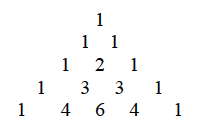
Complete row 6 and row 7 for the following pattern:
- Answer
-
This is is Pascal’s Triangle, a famous triangular array of numbers. Each number is found by adding the two numbers directly above it in the previous row.
Row 6: 1 5 10 10 5 1, Row 7: 1 6 15 20 15 6 1
NOTE: Make sure to explore the link to all the wonderful patterns that can be found in Pascal's Triangle
www.mathsisfun.com/pascals-triangle.html
Problem Solving Strategy 5 (Make a Organized List or Table)
The "make a list" strategy is a problem-solving technique where you systematically list possible solutions, outcomes, or important information to better understand and solve a problem. It helps ensure that all possibilities are considered and none are overlooked. (Feikes et al., 2018; Finan, 2006)
When to Use the "Make a List" Strategy:
- Counting Possibilities: Helps track all possible arrangements or outcomes.
- Finding Patterns: Reveals relationships in numbers generated by a rule or formula.
- Limited Answers: Useful when the number of possible solutions is small.
- Organizing Information: Simplifies complex data and ensures nothing is missed.
- Breaking Down Problems: Helps manage complex problems by listing special cases.
- Visualizing Arrangements: Useful for arranging objects or seating plans.
- Working with Probabilities: Identifies sample spaces and relationships between sets.
- Handling Multiple Variables: Organizes different factors to find all possible combinations.
Before reviewing the next example, consider how you would implement the "Make a List or Table" strategy for the following. Discuss with your peers how you may go about answering the following:
You're at your favorite restaurant, and you're putting together the perfect meal. You can choose 3 types of sandwiches, 2 kinds of sides, and 2 different drinks.
How many different meal combinations can you create if each meal consists of one sandwich, one side, and one drink?
You're at your favorite restaurant, and you're putting together the perfect meal. You can choose 3 types of sandwiches, 2 kinds of sides, and 2 different drinks.
How many different meal combinations can you create if each meal consists of one sandwich, one side, and one drink?
- Answer
-
3 sandwiches: (S1, S2, S3) 2 sides: (D1, D2) 2 drinks: (Dr1, Dr2)
We list all possible sandwiches in one column, each paired with all possible sides and drinks.
By listing all possible combinations, we see that there are 12 different meal combinations.Sandwich Side Drink S1 D1 Dr1 S1 D1 Dr2 S1 D2 Dr1 S1 D2 Dr2 S2 D1 Dr1 S2 D1 Dr2 S2 D2 Dr1 S2 D2 Dr2 S3 D1 Dr1 S3 D1 Dr2 S3 D2 Dr1 S3 D2 Dr2
Problem Solving Strategy 6 (Solve a Simpler Problem).
The "solve a simpler problem" strategy helps break down complex problems into smaller, more manageable parts. By working with an easier version of the problem, you can identify patterns, understand relationships, and develop a strategy to solve the original problem.(Finan, 2006)
When to Use This Strategy:
- Complicated computations → Using smaller numbers makes it easier to see patterns.
- Very large or very small numbers → Simplifying helps uncover relationships that apply to the original problem.
- Direct solution is too complex → Breaking the problem into smaller steps makes it more approachable.
- Gaining a better understanding → A simpler version can clarify the problem’s structure.
- Multiple variables → Reducing variables simplifies problem-solving.
- Working backward → If the final result is clear but the start is not, solving a simpler case first can help.
A band wants to decide the order of 5 songs in their concert set list. How many ways can they arrange them? Before looking at the answer, consider your plan of action.
- Answer
-
Imagine the band only had 1 songs instead of 5. How many ways could they arrange them? 1 Way
Imagine the band only had 2 songs instead of 5. How many ways could they arrange them? 2 Ways
Imagine the band only had 3 songs instead of 5. How many ways could they arrange them? 6 Ways
Imagine the band only had 4 songs instead of 5. How many ways could they arrange them? 24 Ways
Final Answer:
Solving a simpler problem allows you to find a pattern. 1x1=1, 1x2=2, 1x2x3=6, 1x2x3x4=24, ... what is the pattern for each smaller problem?
There are 120 different ways to arrange the 5 songs in the concert set list. (1x2x3x4x5=120)
Analyze each problem scenario and decide which problem solving strategy you would first attempt to use to solve each problem. Do this individually first before discussing this with your peers.
|
Scenario 1 Without a calculator, find each sum. 1+ 3 = 1+ 3 + 5 = 1 + 3 + 5 + 7 = 1 + 3 + 5 + 7 + 9 = . . . 1 + 3 + 5 + 7 + 9 + …+ 19=? |
Scenario 2 If you double the sides of a rectangle, what happens to the area?
|
Scenario 3 Find the sum \(\frac{1}{2}+\frac{1}{2^2}+\frac{1}{2^3}+...+\frac{1}{2^{10}} \). |

Understanding Number Sequences and Inductive Reasoning
A number sequence is a list of numbers arranged in a specific order, where each number in the sequence is called a term. For example, the counting numbers 1, 2, 3, 4, ... form a sequence. The three dots (...), called an ellipsis, mean the pattern continues forever.
Key Idea:
Sequences play a crucial role in early mathematics education, as they help young learners develop number sense, recognize patterns, and lay the foundation for algebraic thinking.
Inductive reasoning is a way of making predictions based on patterns. Instead of checking every number in a sequence, we look at a small part of it and use that to guess what happens later.
For example, look at this sequence:
5, 10, 15, 20, 25, ...
If we continue for a few more terms:
5, 10, 15, 20, 25, 30, 35, 40, 45, 50, …
We notice that every even term ends in 0 or 5. Using this pattern, we can predict that the 100th term will also end in 0, without listing all 100 numbers.
Key Idea:
Inductive reasoning helps us find patterns and make predictions without checking every single number! It is a fundamental aspect of early mathematics learning. It enables children to explore, predict, and discover mathematical relationships, setting the stage for more formal mathematical reasoning in later grades. Encouraging students to explain their reasoning, compare solutions, and refine their conjectures fosters deeper mathematical understanding.
Connections to Mathematical Thinking
Inductive and deductive reasoning are two key approaches to logical thinking in mathematics. Inductive reasoning moves from specific observations to general conclusions by identifying patterns, making predictions, and forming conjectures. However, its conclusions are not always certain. For example, noticing a repeating pattern in a number sequence and assuming it continues is an example of inductive reasoning. In contrast, deductive reasoning starts with general principles and applies them to specific cases to reach definite conclusions. It is used to construct logical arguments, prove theorems, and validate mathematical statements. While elementary students primarily use inductive reasoning to explore patterns, deductive reasoning becomes more important as they advance in their mathematical thinking. Both types of reasoning work together—induction helps discover patterns, while deduction helps prove them. (Burton, 1984; Feikes et al., 2018)