

1.6.1: Written Retrieval and Problem Solving Practice
- Page ID
- 180675
\( \newcommand{\vecs}[1]{\overset { \scriptstyle \rightharpoonup} {\mathbf{#1}} } \)
\( \newcommand{\vecd}[1]{\overset{-\!-\!\rightharpoonup}{\vphantom{a}\smash {#1}}} \)
\( \newcommand{\dsum}{\displaystyle\sum\limits} \)
\( \newcommand{\dint}{\displaystyle\int\limits} \)
\( \newcommand{\dlim}{\displaystyle\lim\limits} \)
\( \newcommand{\id}{\mathrm{id}}\) \( \newcommand{\Span}{\mathrm{span}}\)
( \newcommand{\kernel}{\mathrm{null}\,}\) \( \newcommand{\range}{\mathrm{range}\,}\)
\( \newcommand{\RealPart}{\mathrm{Re}}\) \( \newcommand{\ImaginaryPart}{\mathrm{Im}}\)
\( \newcommand{\Argument}{\mathrm{Arg}}\) \( \newcommand{\norm}[1]{\| #1 \|}\)
\( \newcommand{\inner}[2]{\langle #1, #2 \rangle}\)
\( \newcommand{\Span}{\mathrm{span}}\)
\( \newcommand{\id}{\mathrm{id}}\)
\( \newcommand{\Span}{\mathrm{span}}\)
\( \newcommand{\kernel}{\mathrm{null}\,}\)
\( \newcommand{\range}{\mathrm{range}\,}\)
\( \newcommand{\RealPart}{\mathrm{Re}}\)
\( \newcommand{\ImaginaryPart}{\mathrm{Im}}\)
\( \newcommand{\Argument}{\mathrm{Arg}}\)
\( \newcommand{\norm}[1]{\| #1 \|}\)
\( \newcommand{\inner}[2]{\langle #1, #2 \rangle}\)
\( \newcommand{\Span}{\mathrm{span}}\) \( \newcommand{\AA}{\unicode[.8,0]{x212B}}\)
\( \newcommand{\vectorA}[1]{\vec{#1}} % arrow\)
\( \newcommand{\vectorAt}[1]{\vec{\text{#1}}} % arrow\)
\( \newcommand{\vectorB}[1]{\overset { \scriptstyle \rightharpoonup} {\mathbf{#1}} } \)
\( \newcommand{\vectorC}[1]{\textbf{#1}} \)
\( \newcommand{\vectorD}[1]{\overrightarrow{#1}} \)
\( \newcommand{\vectorDt}[1]{\overrightarrow{\text{#1}}} \)
\( \newcommand{\vectE}[1]{\overset{-\!-\!\rightharpoonup}{\vphantom{a}\smash{\mathbf {#1}}}} \)
\( \newcommand{\vecs}[1]{\overset { \scriptstyle \rightharpoonup} {\mathbf{#1}} } \)
\(\newcommand{\longvect}{\overrightarrow}\)
\( \newcommand{\vecd}[1]{\overset{-\!-\!\rightharpoonup}{\vphantom{a}\smash {#1}}} \)
\(\newcommand{\ket}[1]{\left| #1 \right>}\)
\(\newcommand{\bra}[1]{\left< #1 \right|}\)
\(\newcommand{\braket}[2]{\left< #1 \vphantom{#2} \right| \left. #2 \vphantom{#1} \right>}\)
\(\newcommand{\braopket}[3]{\left< #1 \vphantom{#2}\vphantom{#3} \right| #2 \vphantom{#1}\vphantom{#3} \left| #3 \vphantom{#1}\vphantom{#2} \right>}\)
\(\newcommand{\qmvec}[1]{\mathbf{\vec{#1}}}\)
\(\newcommand{\op}[1]{\hat{\mathbf{#1}}}\)
\(\newcommand{\expect}[1]{\langle #1 \rangle}\)
\(\newcommand{\dfn}[1]{\emph{\textbf{#1}}}\)
Student Learning Objectives
SLO 1.1 Students will apply and evaluate multiple problem-solving strategies, including Polya's 4-step process, mathematical thinking, and algebraic reasoning to mathematical problems and real-world scenarios.
SLO 1.2 Students will analyze, translate, solve, and interpret mathematical problems and real-world scenarios.
The mild assignment 🌶️ is a shorter and less challenging assignment. The medium assignment🌶️🌶️ is right in the middle in terms of length and level of difficulty. Finally, the spicy assignment 🌶️🌶️🌶️ is a longer assignment that is the most challenging.
(Spicy 🌶️🌶️🌶️ Problems are OPTIONAL, but go for it when you have the time to challenge yourself)
🌶️🌶️
Sylvia and Morgan were asked to add two whole numbers Instead, Sylvia subtracted the two numbers and got 10, and Morgan multiplied them and got 651. What was the correct sum?
- Answer
-
31 and 21
🌶️🌶️
Show that 13 can be expressed as the sum of two consecutive numbers. Then decide whether every odd number can be expressed as the sum of two consecutive counting numbers.
- Answer
-
6+7=13,
Let’s generalize:
Let n and n+1 be any two consecutive counting numbers.
n+(n+1)=2n+1
Their sum is:This is always an odd number, since it's one more than an even number.
🌶️🌶️
Using the numbers 9, 8, 7, 6, 5, and 4 once each, find the following:
a) The largest possible sum for TWO 3-digit numbers.
b) the smallest (positive) difference for TWO 3-digit numbers.
- Answer
-
a) Strategy: Assign the three largest digits to the hundreds place. Try to form the two largest possible 3-digit numbers. 1641 is the largest.
b) To minimize the difference, the two numbers should be as close as possible, but not equal, and digits must be distinct. 87 is the smallest.
🌶️🌶️
A textbook is opened and the product on the page numbers of the two facing pages is 3,080. What are the numbers of the pages?
- Answer
-
55 and 56
🌶️🌶️
Using the symbols +, - , x , \( \div \) once each, fill in the following three blanks to make a true equation (Parentheses allowed).
a) 6 __ 6 __ 6 __ 6 __ = 13
b) 5 __ 5 __ 5 __ 5 __ = 55
- Answer
-
a) 6 + (6/6) + 6 is an option. b) 5 x (5 + 5) + 5 is an option.
🌶️🌶️
Find the perimeters and complete the table.

| # of triangles | 1 | 2 | 3 | 4 | 5 | 6 | 10 | n | |
| perimeter | 40 |
- Answer
-
Perimeter: 3, 4, 5, 6, 7, 12, n+2
38 triangles has perimeter is 40
🌶️🌶️
Find the missing term in each pattern.
a) 10, 17, ____, 37, 50, 65
b) 1, \(\frac{3}{2}\), ___, \(\frac{7}{8}\), \(\frac{9}{16}\)
c) 243, 324, 405, ___, 567
- Answer
-
a) 26 b) 5/4 c) 486
🌶️🌶️
Rectangular numbers are whole numbers that are represented by certain rectangular arrays of dots. The first four rectangular numbers are shown.

a) Make a sketch of the 6th rectangular number.
b) How many dots will be in the 10th rectangular number?
c) Come up with a description or formula for the number of dots in the nth rectangular number.
- Answer
-
a) 6 rows × 7 columns of dots (total 42)
b) 10th rectangular number = 110 dots
c) n x (n+1)
🌶️🌶
The triangular numbers are the whole numbers that are represented by certain triangular arrays of dots. The first four triangular numbers are shown.
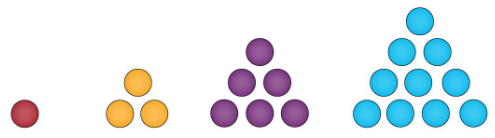
a) Make a sketch to represent the 6th triangular number.
b) How many dots will be in the 10th triangular number?
c) Is there a triangular number that has 91 dots in its shape? If so, which one?
d) Come up with a description or formula for the number of dots in the nth rectangular number
- Answer
-
It is worth your time to learn about how triangular numbers hold a special beauty in mathematics and nature, revealing deep connections between number patterns, geometry, and real-world structures.
a) We build the triangle by stacking rows:
Row 1: 1 dot
Row 2: 2 dots
Row 3: 3 dots
Row 4: 4 dots
Row 5: 5 dots
Row 6: 6 dots
b) 55 Dots - (10 x 11) / 2 c) YES, 13th Triangular Number, (13 x 14)/2 = 91 d) n(n+1)/2
🌶️🌶
Gabby extended the pattern 2, 4, 8 to be 2, 4, 8, 16, 32, . . . . Caitlin extended the same pattern to be 2, 4, 8, 14, 22, . . . . They asked you who was correct. How should you respond?
- Answer
-
Gabby extended the pattern as 2, 4, 8, 16, 32, ...
This follows a sequence where each term is multiplied by 2.
Caitlin extended the pattern as 2, 4, 8, 14, 22, ...
This follows a sequence where each term increases by 2 more each time. Up by 2, then up by 4, then up by 6, ....
Since both sequences follow a logical rule (inductive reasoning), neither Gabby nor Caitlin is incorrect—they just interpreted the pattern differently.
🌶️🌶️🌶️
The Fibonacci sequence was defined to be the sequence 1,1,2,3,5,8,13,21, ..., where each successive number is the sum of the preceding two. Observe the following pattern:
1 + 1 = 3 − 1
1 + 1 + 2 = 5 - 1
1 + 1 + 2 + 3 = 8 - 1
1 + 1 + 2 + 3 + 5 = 13 - 1
Write out six more terms of the Fibonacci sequence, and use the sequence to predict the answer to:
1 + 1 + 2 + 3 + 5 + ... + 144without actually computing the sum. Then use your calculator to check your result.
- Answer
-
1, 1, 2, 3, 5, 8, 13, 21, 34, 55, 89, 144, ....
(377 - 1) = 376 = 1+1+2+3+5+8+13+21+34+55+89+144
🌶️🌶️🌶️
How many palindromes are there between 10 and 1000? (A palindrome is a number like 525 that reads the same backward or forward.)
- Answer
-
99, 9 two digit and 90 three digit.