

2.1: The Language of Sets
- Page ID
- 181431
\( \newcommand{\vecs}[1]{\overset { \scriptstyle \rightharpoonup} {\mathbf{#1}} } \)
\( \newcommand{\vecd}[1]{\overset{-\!-\!\rightharpoonup}{\vphantom{a}\smash {#1}}} \)
\( \newcommand{\dsum}{\displaystyle\sum\limits} \)
\( \newcommand{\dint}{\displaystyle\int\limits} \)
\( \newcommand{\dlim}{\displaystyle\lim\limits} \)
\( \newcommand{\id}{\mathrm{id}}\) \( \newcommand{\Span}{\mathrm{span}}\)
( \newcommand{\kernel}{\mathrm{null}\,}\) \( \newcommand{\range}{\mathrm{range}\,}\)
\( \newcommand{\RealPart}{\mathrm{Re}}\) \( \newcommand{\ImaginaryPart}{\mathrm{Im}}\)
\( \newcommand{\Argument}{\mathrm{Arg}}\) \( \newcommand{\norm}[1]{\| #1 \|}\)
\( \newcommand{\inner}[2]{\langle #1, #2 \rangle}\)
\( \newcommand{\Span}{\mathrm{span}}\)
\( \newcommand{\id}{\mathrm{id}}\)
\( \newcommand{\Span}{\mathrm{span}}\)
\( \newcommand{\kernel}{\mathrm{null}\,}\)
\( \newcommand{\range}{\mathrm{range}\,}\)
\( \newcommand{\RealPart}{\mathrm{Re}}\)
\( \newcommand{\ImaginaryPart}{\mathrm{Im}}\)
\( \newcommand{\Argument}{\mathrm{Arg}}\)
\( \newcommand{\norm}[1]{\| #1 \|}\)
\( \newcommand{\inner}[2]{\langle #1, #2 \rangle}\)
\( \newcommand{\Span}{\mathrm{span}}\) \( \newcommand{\AA}{\unicode[.8,0]{x212B}}\)
\( \newcommand{\vectorA}[1]{\vec{#1}} % arrow\)
\( \newcommand{\vectorAt}[1]{\vec{\text{#1}}} % arrow\)
\( \newcommand{\vectorB}[1]{\overset { \scriptstyle \rightharpoonup} {\mathbf{#1}} } \)
\( \newcommand{\vectorC}[1]{\textbf{#1}} \)
\( \newcommand{\vectorD}[1]{\overrightarrow{#1}} \)
\( \newcommand{\vectorDt}[1]{\overrightarrow{\text{#1}}} \)
\( \newcommand{\vectE}[1]{\overset{-\!-\!\rightharpoonup}{\vphantom{a}\smash{\mathbf {#1}}}} \)
\( \newcommand{\vecs}[1]{\overset { \scriptstyle \rightharpoonup} {\mathbf{#1}} } \)
\(\newcommand{\longvect}{\overrightarrow}\)
\( \newcommand{\vecd}[1]{\overset{-\!-\!\rightharpoonup}{\vphantom{a}\smash {#1}}} \)
\(\newcommand{\ket}[1]{\left| #1 \right>}\)
\(\newcommand{\bra}[1]{\left< #1 \right|}\)
\(\newcommand{\braket}[2]{\left< #1 \vphantom{#2} \right| \left. #2 \vphantom{#1} \right>}\)
\(\newcommand{\braopket}[3]{\left< #1 \vphantom{#2}\vphantom{#3} \right| #2 \vphantom{#1}\vphantom{#3} \left| #3 \vphantom{#1}\vphantom{#2} \right>}\)
\(\newcommand{\qmvec}[1]{\mathbf{\vec{#1}}}\)
\(\newcommand{\op}[1]{\hat{\mathbf{#1}}}\)
\(\newcommand{\expect}[1]{\langle #1 \rangle}\)
\(\newcommand{\dfn}[1]{\emph{\textbf{#1}}}\)
As a future elementary school teacher, understanding set theory is essential to developing mathematical thinking and reasoning. Set theory provides a structured way to categorize and organize objects, making it a powerful tool for defining numbers and mathematical operations. The fundamental ideas of grouping, comparing, and relating collections of objects naturally align with how young children develop number sense (Finnan, 2006; Feike, Schwingendorf, and Gregg, 2018). By studying set theory, you gain insights into the logical foundations of arithmetic, helping you guide students through their early stages of mathematical understanding. Additionally, set notation offers a universal mathematical language that enhances problem-solving and communication across disciplines, equipping you with the tools to teach mathematics in a more structured and meaningful way (Feike et al., 2018).
One of the most accessible and visual applications of set theory is the use of Venn diagrams, which help illustrate relationships between different sets and make abstract concepts more tangible for learners. Understanding how to represent unions, intersections, and complements of sets graphically will enhance your ability to teach students how to classify, compare, and organize information—an essential skill not only in math but across subjects. Mastering these concepts will strengthen your ability to teach foundational math skills, foster deep mathematical thinking, and build problem-solving confidence in your students. Whether you’re explaining counting, arithmetic operations, or logical reasoning, set theory will become an invaluable part of your instructional toolkit, helping you create engaging and effective learning experiences (Feike, Schwingendorf, and Gregg, 2018).
Before we jump into the formal language of Sets, let's take a glimpse of what some of these ideas look like for children. Use this video of UCLA Math Educator Dr. Megan Franke (Supporting the Mathematical Brilliance of Young People) sharing how early learners bring brilliant ideas into the classroom and how this looks when they start doing mathematics. View the video from 2:39 to 7:15, then answer Dr. Franke's question, "what do you notice that is brilliant?"
Make sure to hear what others found brilliant before moving on. We will begin to see how what we saw in the video emerges in this chapter.
Sets
A collection of objects is called a set and the objects are called elements or members of the set. Sets can be defined in three common ways: (1) a verbal description, (2) a listing of the elements separated by commas, with braces (“{” and “}”) used to enclose the list of elements, and (3) set-builder notation. For example, consider the set of all primary colors. This set can be defined in multiple ways: (1) “the set of primary colors”, (2) Listing: {Red, Blue, Yellow}, (2) Set-builder notation: C= {x | x is a primary color}.
Sets are usually denoted by capital letters such as A, B, C and so on. The symbols “∈” and “∉” are used to indicate that an object is or is not an element of a set, respectively. For example, if C represents the set of all primary colors, then Red ∈ C and Purple ∉ C. The set without elements is called the empty set (or null set) and is denoted by { } or the symbol ∅.
🧠Let's Listen to Learn❤️
Two sets A and B are equal, written A = B, if and only if they have precisely the same elements.
A 1-1 correspondence between two sets A and B is a pairing of the elements of A with the elements of B so that each element of A corresponds to exactly one element of B, and vice versa. If there is a 1-1 correspondence between sets A and B, we write A ~ B and say that A and B are equivalent or matching sets.
The Birthday Party (Analogy)
Imagine you are organizing a birthday party with ten (10) children attending. You prepare ten party bags. If every child gets exactly one bag and no bags are left over, you have a one-to-one correspondence between children and hats. This means the number of children and the number of hats are the same.
Question: What scenario would cause us to have the sets (party bags and children) NOT be equivalent?
- Think about the concept of one-to-one correspondence—when each element in one set is paired with exactly one element in another set, with no extras or missing pieces.
- Consider examples from your daily life where this idea appears. (Hint: Think about matching, pairing, or distributing things evenly.)
- Jot down at least two examples from real life that illustrate one-to-one correspondence.
In groups of 3-4 students, share your examples with each other.
- How do your examples fit the definition of one-to-one correspondence?
- How does understanding this concept help in everyday life or in teaching math?
A set A is a subset of a set B if and only if every element of set A is an element of set B. We write \(A\subseteq B\).
To show that one set is not a subset of another set, there would have to be an element in the first set that is not in the second set.
NOTE: If \(A\subseteq B\) and B has an element that is not in A, we write \(A\subset B\) and say that A is a proper subset of B (Figure 2.1.1). For example, {a, b}⊂{a, b, c}, since {a, b}⊆{a, b, c} and c is in the second set but not in the first.
🧠Let's Listen to Learn❤️

There is one thing about sets that confuses a lot of people. By definition, we say that a set is a collection of objects. But in reality, a set can have no elements in it. A set containing no elements is called the empty set or null set. Look at the definition of a subset very carefully. Is the null set is a subset of every set? I hope this was your conclusion: The null set is a subset of every set. [ANALOGY] Imagine a strict school rule posted on an empty classroom door: "Every student in this room wearing a neon-green cape must hop on one foot." Now, suppose you open the door and look inside—the room is completely empty. There are zero students. Can you find even one student wearing a neon-green cape who is refusing to hop? Of course not, because there are no students at all! Because you cannot find a single counterexample, the rule has not been broken. In logic, this is called being vacuously true—a condition is automatically satisfied simply because there are no items available to violate it.
Venn Diagrams
Relationships between sets can be visualized using Venn diagrams. Sets are represented by circles included in a rectangle that represents the universal set, i.e., the set of all elements being considered in a particular discussion. Figure 2.1.1 displays sets A and B inside a universal set U. Set A is comprised of everything inside circle A, and set B is comprised of everything inside circle B, including set A. We will come back in future sections to discuss and use Venn diagrams to provide a clear, intuitive way for students to classify and compare groups of objects or numbers. By comparing different sets, students can grasp the idea of greater than, less than, and equal to.
Let A be the set of all counting numbers less than 8. This set is described by words (verbal description). The list of its elements provides another description A = {1, 2, 3, 4, 5, 6, 7}. Convert this set into Set-builder notation.
- Answer
-
A = {a is a counting number | a < 8}
Here, “a is a counting number” specifies that the set consists of numbers of a certain type and a < 8 specifies that we want to consider the numbers possessing this particular property.
A = {a, b, c, d, e} and B={a, c, f, e, b, g, d}. Is it true that \(A\subseteq B\) ? Is it true that \(A\subset B\) ?
- Answer
-
Both are true because all elements of A are in B (making A⊆B true), and B has extra elements not in A (making A⊂B true as a proper subset). Make sure to understand the distinction between the two. Remember, math is a language. In this section we will see the language of sets come to life.
Are these statements TRUE for ANY set A?
a) \(A\subset A\) b) \(\oslash \subset A\)
- Answer
-
a) is False. a) Every element of A belongs to A, A cannot be a proper subset of itself and b) is True. The argument behind this statement is a little bit twisted. The empty set contains no elements. The definition of a subset requires that every element of the first set belongs to the second set.
Because the empty set has no elements, there is never an element you can point to that violates this rule. You can never find an element inside the empty set that isn't inside set A. Therefore, by default and logical necessity, the empty set is a subset of every set in existence, ∅ ⊆ A.
Sets of Numbers
We work with different sets of numbers that play an important role in mathematics.
• Counting numbers are {1, 2, 3, 4, 5, 6, ....}
• Whole numbers include zero and counting numbers {0, 1, 2, 3, 4, 5, 6, ...}
• Even counting numbers include counting numbers that are multiples of two {2, 4, 6, 8, 10, ...}
• Odd counting numbers include counting numbers that are not multiples of two {1, 3, 5, 7, 9, ...}
Finite / Infinite Sets
Sets can be classified into two main types: finite and infinite. A set is considered finite if it contains no elements (an empty set) or if its elements can be counted in a way that eventually reaches an end. In contrast, an infinite set continues indefinitely without ever stopping. More precisely, a set is finite if (1) it is empty or (2) its elements can be placed in a one-to-one correspondence with the set {1, 2, 3, ..., n}, where n is some whole number. If a set does not meet these conditions, meaning it cannot be matched with a finite list of counting numbers, then it is classified as infinite.
Determine whether the following sets are finite or infinite.
a) {100, 200, 300} b) {a, b, c, d, ... y, z} c) {5, 10, 15, 20, 25, ...}
- Answer
-
a) finite since it can be matched with the set {1, 2, 3} b) finite since it can be matched with the set {1, 2, 3, ..., 26} c) infinite set
Something else to consider when working with sets is how many elements are in a given set. If we count the number of elements in a set, we call that number the cardinality or cardinal number of that set. To denote the cardinality of set C={a, b, c}, we write \(n\)(C) = 3. Think of the n as the number of objects in the set. When you are asked about the cardinality of a set, the answer is a number. We say that two sets are equivalent if they each have the same number of elements which is to say they have the same cardinality. We use the symbol, ~, to denote equivalence. For instance, if set P and H each contain four elements, we can write P ~ H. REMEMBER: Two sets are equal if they have the exact same elements.
Wonder, Play, Grow
Where would you place the following numbers in the Venn diagram? 20, 21, 23, 24

Discuss with your peers where you would place the numbers, why. Be prepared to share your reasoning.
- Answer
-
The left circle contains numbers divisible by 3 (3, 9, 6, 12). The right circle contains numbers even numbers (2, 4, 6, 8, 10, 12).
20: Even number → Goes in the right circle. 21: Divisible by 3 → Goes in the left circle. 23: Neither even nor divisible by 3 → Stays outside the circles.
Operations of Sets
One of the most important ways we organize mathematical ideas is through sets. By studying set operations, we can see how math provides a precise way to describe relationships between groups of objects. This is one way that mathematics serves as a universal language—it allows us to clearly communicate ideas about numbers, patterns, and logical relationships. Let’s explore some simple set operations and how they help us understand and organize information.
The union of two sets A and B, written \(A\cup B\), is the set that consists of all elements belonging either to A or to B (or to both). Informally, \(A\cup B\) is formed by putting all the elements of A and B together.
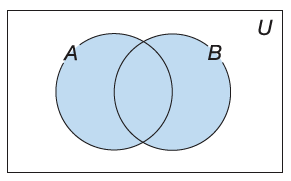
The intersection of sets A and B, written \(A\cap B\), is the set of all elements common to sets A and B. Thus the intersection of A and B is the set of elements shared by A and B.

NOTE: Two sets are disjoint if their intersection is empty
The complement of a set A, written \(\overline{A}\), is the set of all elements in the universe, U, that are not in A.

NOTE: The complement of a set A, can be written Ac or \(\bar{A}\) or A'
For example, if U={1, 2, 3, 4, 5} and H = {3, 4}, then \(\bar{H}\) = {1, 2, 5).
The set difference (or relative complement) of set B from set A, written A − B, is the set of all elements in A that are not in B.
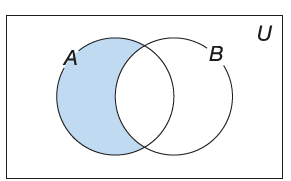
So if F= {1, 2, 3 ,4} and G = {1, 3, 5, 7}, then to find F – G, list the elements of F and cross off any that are in G: {1,2,3,4}. The answer is: {2, 4)
🧠Let's Listen to Learn❤️
Try the following problems in which the universe is the first 9 counting numbers. If U represents the universe, we have U = {1, 2, 3, 4, 5, 6, 7, 8, 9} Three subsets of U are defined as follows: A = {1, 2, 3, 4, 5} B = {2, 4, 6, 8} C = {3, 5, 7}
| a. A \(\cap\) B = _____ | |
| b. B \(\cap\) C = _____ | c. A \(\cup\) B = ____ |
| d. A \(\cup\) C = _____ | e. B \(\cup\) C = ____ |
| f. Ac = _____ | g. Bc = ____ |
| h. Cc = _____ | i. A – B = _____ |
| j. B – A = ____ | k. A – C = _____ |
| l. C – A = ____ | m. B – C = _____ |
| n. C – B = _____ |
Did you notice that the order matters for difference, but not for union or intersection?
- Answer
-
a. {2, 4}
b. ∅
c. {1, 2, 3, 4, 5, 6, 8}
d. {1., 2, 3, 4, 5, 7}
e. {2, 3, 4, 5, 6, 7, 8}
f {6, 7, 8, 9}
g. {1, 3, 5, 7, 9}
h. {1, 2, 4, 6, 8, 9}
i. {1, 3, 5}
j. {6, 8}
k. {1, 2, 4}
l. {7}
m. {2, 4, 6, 8}
n. {3, 5, 7}
Wonder, Play, Grow
Work with at least one peer to try these “more involved” problems. These will take more than one step to do. You might need scratch paper. U = {1, 2, 3, 4, 5, 6, 7, 8, 9}. The subsets are: A= {1, 2, 3, 4, 5} B = {2, 4, 6, 8} C = {3, 5, 7}
| a. (A \(\cup\) C) – B = ____ | b. (A – C)c = ____ |
| c. (A \(\cap\) B) \(\cup\) C = ____ | d. (A \(\cup\) C) \(\cap\) B = ____ |
| e. (A \(\cup\) C)c = ____ | f. Ac \(\cap\) Bc = ____ |
- Answer
-
a. {1, 3, 5, 7}
b. {3, 5, 6, 7, 8, 9}
c. {2, 3, 4, 5}
d. {2, 4, 6, 8}
e. {6, 8, 9}
f. { 7, 9}
There is one more operation we will define on sets. So far, you’ve worked with union, intersection, difference and complement. Now we will learn what it means to take the Cartesian product of two sets, A and B. If you are finding the Cartesian product, the answer is a set that contains ordered pairs. The order matters! The first element must come from the set written to the left of the \(\times\) and the second element must come from the set written to the right of the \(\times\).
The Cartesian product of set A with set B, which is written A \(\times\) B and is read as ‘A cross B” is the set of all possible ordered pairs (a,b), where a \(\in\) A and b \(\in\) B.
NOTE: Using set builder notation, we can write 𝐴×𝐵={(a,b) | a∈𝐴 and b∈𝐵}.
More Info: Cartesian Products IRL
If A = {x, y, z} and B = {a, b}, find A \(\times\) B and B \(\times\) A.
- Answer
-
A \(\times\) B = {(x, a), (x, b), (y, a), (y, b), (z, a), (z, b)}
B \(\times\) A = {(a, x), (b, x), (a, y), (b, y), (a, z), (b, z)}
Notice there were 3 elements in one set and two in the other. The Cartesian product has six elements in it, six ordered pairs.
Wonder, Play, Grow
If a set B contains 5 elements (in other words, n(B) = 5) and a set C contains 7 elements (or n(C) = 7), then how many elements (where each element is an ordered pair) are in the Cartesian product for each of the following?
| a. n(B \(\times\) C) = ____ | b. n(B \(\times\) B) = ____ | c. n(C \(\times\) C) = ____ |
- Answer
-
a) 35 b) 25 c) 49