

2.2: Whole Numbers and Numeration Systems
- Page ID
- 181433
\( \newcommand{\vecs}[1]{\overset { \scriptstyle \rightharpoonup} {\mathbf{#1}} } \)
\( \newcommand{\vecd}[1]{\overset{-\!-\!\rightharpoonup}{\vphantom{a}\smash {#1}}} \)
\( \newcommand{\dsum}{\displaystyle\sum\limits} \)
\( \newcommand{\dint}{\displaystyle\int\limits} \)
\( \newcommand{\dlim}{\displaystyle\lim\limits} \)
\( \newcommand{\id}{\mathrm{id}}\) \( \newcommand{\Span}{\mathrm{span}}\)
( \newcommand{\kernel}{\mathrm{null}\,}\) \( \newcommand{\range}{\mathrm{range}\,}\)
\( \newcommand{\RealPart}{\mathrm{Re}}\) \( \newcommand{\ImaginaryPart}{\mathrm{Im}}\)
\( \newcommand{\Argument}{\mathrm{Arg}}\) \( \newcommand{\norm}[1]{\| #1 \|}\)
\( \newcommand{\inner}[2]{\langle #1, #2 \rangle}\)
\( \newcommand{\Span}{\mathrm{span}}\)
\( \newcommand{\id}{\mathrm{id}}\)
\( \newcommand{\Span}{\mathrm{span}}\)
\( \newcommand{\kernel}{\mathrm{null}\,}\)
\( \newcommand{\range}{\mathrm{range}\,}\)
\( \newcommand{\RealPart}{\mathrm{Re}}\)
\( \newcommand{\ImaginaryPart}{\mathrm{Im}}\)
\( \newcommand{\Argument}{\mathrm{Arg}}\)
\( \newcommand{\norm}[1]{\| #1 \|}\)
\( \newcommand{\inner}[2]{\langle #1, #2 \rangle}\)
\( \newcommand{\Span}{\mathrm{span}}\) \( \newcommand{\AA}{\unicode[.8,0]{x212B}}\)
\( \newcommand{\vectorA}[1]{\vec{#1}} % arrow\)
\( \newcommand{\vectorAt}[1]{\vec{\text{#1}}} % arrow\)
\( \newcommand{\vectorB}[1]{\overset { \scriptstyle \rightharpoonup} {\mathbf{#1}} } \)
\( \newcommand{\vectorC}[1]{\textbf{#1}} \)
\( \newcommand{\vectorD}[1]{\overrightarrow{#1}} \)
\( \newcommand{\vectorDt}[1]{\overrightarrow{\text{#1}}} \)
\( \newcommand{\vectE}[1]{\overset{-\!-\!\rightharpoonup}{\vphantom{a}\smash{\mathbf {#1}}}} \)
\( \newcommand{\vecs}[1]{\overset { \scriptstyle \rightharpoonup} {\mathbf{#1}} } \)
\(\newcommand{\longvect}{\overrightarrow}\)
\( \newcommand{\vecd}[1]{\overset{-\!-\!\rightharpoonup}{\vphantom{a}\smash {#1}}} \)
\(\newcommand{\ket}[1]{\left| #1 \right>}\)
\(\newcommand{\bra}[1]{\left< #1 \right|}\)
\(\newcommand{\braket}[2]{\left< #1 \vphantom{#2} \right| \left. #2 \vphantom{#1} \right>}\)
\(\newcommand{\braopket}[3]{\left< #1 \vphantom{#2}\vphantom{#3} \right| #2 \vphantom{#1}\vphantom{#3} \left| #3 \vphantom{#1}\vphantom{#2} \right>}\)
\(\newcommand{\qmvec}[1]{\mathbf{\vec{#1}}}\)
\(\newcommand{\op}[1]{\hat{\mathbf{#1}}}\)
\(\newcommand{\expect}[1]{\langle #1 \rangle}\)
\(\newcommand{\dfn}[1]{\emph{\textbf{#1}}}\)
From Sets to Whole Numbers
Mathematics begins with understanding how we group and organize objects—this is where set theory comes in. As we recall, a set is simply a collection of objects, and this basic idea helps us define numbers and operations in a logical way. When young children count, they naturally group objects into sets (Feike, Schwingendorf, and Gregg, 2018). For example, when they see two apples and three bananas, they are subconsciously working with sets. Mathematicians formalize this idea by defining numbers as the sizes of sets—what we call cardinal numbers.
A key concept in counting is one-to-one correspondence, where each object in one set is paired with exactly one object in another set. This forms the basis for understanding numbers and operations like addition and subtraction. When we combine two sets, we are performing addition; when we take objects away, we are performing subtraction. Our numeration systems, such as the Hindu-Arabic system, build on these foundational ideas to represent numbers efficiently (NCTM, 2020). Understanding the connection between sets and whole numbers gives us a strong framework for learning mathematical operations and problem-solving (Feike, Schwingendorf, and Gregg, 2018).
What do you remember about learning about numbers or how to count? Have you ever helped to teach a young child how to count? If so, what was it like? How long do you think it takes for someone to learn how to count for the first time?
Task 1:
- Now take a look at the video below from 25:52-27:32 (youtube: courtesy of UCLA Professor Dr. Megan Franke) to see how this 4-year old counts the bears.
- Pause at 27:32.
Task 2
- What does she know? Discuss with your peers before playing the video to hear what the audience thinks.
- Play the video 27:32-29:31
- How does what the audience and Dr. Franke discuss compare to what you noticed?
- What are you wondering about now?
With all of this brilliant thinking in mind, lets learn about numbers.
One difficulty with the concept of numbers as we use them today is that they are concepts and not necessarily used only for counting objects. The number four, for instance, is used in many ways –four years old, room 4, four feet high, 4 children, four hours, four minutes after eight, mail station 4, 4 fingers, a grade of 4 on a quiz, count to 4, four times bigger than something, 4th place, four wishes, fourth in line, call 444-4444, code 44, etc.
So, what is a number?
Well, a number is an abstract idea that represents a quantity. You can't see or touch a number. The symbols that we see and touch that are used to represent numbers are actually numerals. A numeral is made up of one or more symbols. In the Hindu-Arabic system we use, the numerals are made up of one or more of these ten symbols –0,1,2,3,4,5,6,7,8 and 9. For instance, in the Hindu-Arabic system, the number three is represented by writing the numeral three which we write like this: 3 and the number two million is represented by writing the numeral two million which we write like this: 2,000,000. Notice, it took one symbol to write the number for three and seven symbols to write the number for two million (we don't count the commas as symbols because they aren't essential to writing the numeral). Although it took seven symbols to write the numeral two million, note that there are only two different symbols used to write that numeral –a two (2) and a zero (0).
There are three common uses of numbers. Describing how many elements (quantity) are in a finite set is the most common use of the counting numbers. When used this way, the number is referred to as a cardinal number. If a 1-1 correspondence between two sets exists, what does that imply about the cardinality of the two sets? Another way numbers are used concerns order. For instance, someone might be the fifth place winner or you might be eighth in line. When used in this way, numbers are called ordinal numbers. There are also numbers used for identification such as your phone number, zip code, social security number or credit card number. These are called identification numbers and it is the actual order of the symbols that is important –not the value of the number.
🧠Let's Listen to Learn❤️
More Information: How we use Numbers
Ordering Whole Numbers
The relationship between sets, one-to-one correspondence, and ordering whole numbers is essential for understanding fundamental mathematics. Sets serve as collections of objects, and their size, referred to as a cardinal number, helps define numerical values. The concept of one-to-one correspondence establishes equivalence between sets by pairing each element of one set with exactly one element of another. This principle is crucial in understanding whole numbers, as it allows for meaningful comparisons between different quantities. Additionally, ordering whole numbers emerges from counting and comparing sets—if one set corresponds to a proper subset of another, it represents a smaller number. For instance, recognizing that a set of two elements is a subset of a set of five elements illustrates why 2 is less than 5. Ultimately, set theory provides the foundation for defining numbers, one-to-one correspondence enables comparisons, and these comparisons lead to the logical ordering of whole numbers.
Let a = n(A) and b = n(B). Then a < b (read "a is less than b") or b > a (read "b is greater than a") if A is equivalent to a proper subset of B.
Recall: n(A) is the cardinality of set A, the number of elements in set A
There are several ways to compare whole numbers. Three common methods include:
- Counting Chant: Whole numbers can be ordered by reciting the counting sequence ("one, two, three..."). For example, 2 is less than 5 because "two" comes before "five" when counting.
- One-to-One Correspondence: Comparing numbers by matching objects in sets. For example, 2 is less than 5 because a set with two elements corresponds to a proper subset of a set with five elements.
- Whole-Number Line: Numbers are arranged in order on a number line, starting from 0 on the left and increasing by one as you move to the right. (Musser, 2011)
Determine the greater of the two numbers 3 and 4 in three different ways.
- Answer
-
1) "one", "two", "three", "four" - Chant Counting - "four" comes after "three" or "three" comes before "four", 3 < 4.
2) Create two sets:
Set A has 3 objects (e.g., 🟦🟦🟦)
Set B has 4 objects (e.g., 🟥🟥🟥🟥)
Using one-to-one correspondence, we determine that 4 is greater than 3, because after matching each object from Set A with Set B, one object is left unmatched in Set B.
3) One a number line, three is the left of four, so 3 < 4.

Numeration Systems
Today, most but not all civilizations around the world use the Hindu-Arabic system of counting and numerals 1,2,3,4,5,6,7,8,9,10,11,12,... There are many advantages to this number system. While you might think this common, widely used system of counting the obvious choice, you might consider both the advantages and disadvantages of Hindu-Arabic as we learn about other numeration systems.
Consider the STROKE system where there was only one symbol, a simple vertical stroke, to express a number. A vertical stroke like this, |, expressed one. To express the number seven, you would write seven strokes: ||||||| .
a. Show how you would write the numeral eleven in STROKE:
b. Describe in words how to write the numerals five hundred twelve ; and two million in STROKE. Don't attempt to write the actual strokes!! We only have a semester!
c. Name some advantages and disadvantages of the STROKE system, compared with the Hindu-Arabic system.
Wonder, Play, Grow
The tally system improved the STROKE system by introducing the concept of grouping. You are probably familiar with this system where the fifth stroke was placed across the previous four so it would be easier to read since you can count by fives. STROKE is a single symbol system, but Tally can be thought of as a two symbol system, although the second symbol is really just made up of five strokes. Note the difference in writing the numeral twenty-eight in the two systems.
|
STROKE system: ||||||||||||||||||||||||||||||| |
Tally system: \(\cancel{||||}\cancel{||||}\cancel{||||}\cancel{||||}\cancel{||||}|||\) |
a. Write the numeral for 17 in STROKE.
b. Write the numeral for 17 in Tally.
c. If you think of a single stroke (|) as one symbol and the 5-stroke tally (\(\cancel{||||}\)) as a separate symbol, then it takes eight symbols to express the numeral for 28. In STROKE, it took 28 symbols to write the same number. How many symbols does it take to express the numeral for 172 in TALLY?
Egyptian Numeral System
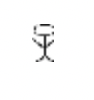
The Old Egyptian Numeral System which was developed around 3400 B.C., employs an additive system of counting, where the symbols of the numeral do not have to be in any special order or even on a line going from left to right. The seven symbols in this ancient system are listed below, along with their Hindu-Arabic equivalents.
 |
 |
 |
 |
 |
 |
 |
| Staff | Heel bone | Scroll | Lotus flower | Pointing finger | Polliwog | Astonished man |
| One | Ten | Hundred | Thousand | Ten thousand | Hundred thousand | Million |
| 1 | 10 | 100 | 1,000 | 10,000 | 100,000 | 1,000,000 |
Here are three different ways to write the numeral sixty five in the Old Egyptian system:
| \(\cap\cap\cap\cap\cap\cap\)||||| | or | \(\cap\cap\||\cap|\cap\cap|\cap\) |
or as shown below with all the symbols enclosed in a visual set

You simply add up the values of each of the symbols to get the answer.
In an additive number system, the value of a written number is the sum of the face values of the symbols that make up the number. The only symbol necessary for an additive number system is a symbol for 1, however many additive number systems contain other symbols.
Remember: The order in which the symbols are written is irrelevant in an additive system.
In addition to being able to write the symbols of the numeral in any order, you may also use a different combination of symbols used to represent the same number. Here are two different ways to write the number for one hundred twenty three:

Express each Egyptian numeral below as a Hindu-Arabic numeral. Show work.
a) 
b) 
c) 
- Answer
-
a) 10 + 10 + 1000 + 100000 + 100000 + 100000 = 301020
b) 10000 + 10 + 10 + 100000 = 110020
c) 4(1000000) + 2(100) + 7 + 10000 + 3(100) = 4010507
Roman Numerals
Even though Roman Numerals are rare in today’s society, they are still used and expected to be understood. They are taught in grades three through five, depending on the district. They can be seen in clocks, the Super Bowl, Film Credits for the copyright date like MCMLXII, preface of textbooks and others like Star Wars Episode VI and WWII.
| Value | Symbol |
|---|---|
|
1 |
I |
|
5 |
V |
|
10 |
X |
|
50 |
L |
|
100 |
C |
|
500 |
D |
|
1000 |
M |
|
1 |
2 |
3 |
4 |
5 |
6 |
7 |
8 |
9 |
|
|
ONES |
I |
II |
III |
IV |
V |
VI |
VII |
VIII |
IX |
|
TENS |
X |
XX |
XXX |
XL |
L |
LX |
LXX |
LXXX |
XC |
|
HUNDREDS |
C |
CC |
CCC |
CD |
D |
DC |
DCC |
DCCC |
CM |
|
THOUSANDS |
M |
MM |
MMM |
\(\overline{\mathrm{IV}}\) |
\(\overline{\mathrm{V}}\) |
\(\overline{\mathrm{VI}}\) |
\(\overline{\mathrm{VII}}\) |
\(\overline{\mathrm{VIII}}\) |
\(\overline{\mathrm{IX}}\) |
|
TEN THOUSANDS |
\(\bar{X}\) |
\(\overline{X X}\) |
\(\overline{X X X}\) |
\(\overline{X L}\) |
\(\bar{L}\) |
\(\overline{L X}\) |
\(\overline{L X X}\) |
\(\overline{L X X X}\) |
\(\overline{X C}\) |
|
HUNDRED THOUSANDS |
\(\bar{C}\) |
\(\overline{C C}\) |
\(\overline{C C C}\) |
\(\overline{C D}\) |
\(\bar{D}\) |
\(\overline{D C}\) |
\(\overline{D C C}\) |
\(\overline{D C C C}\) |
\(\overline{C M}\) |
The Roman numeral system is an ancient numeration system that represents numbers using combinations of letters from the Latin alphabet (I, V, X, L, C, D, M). This system is primarily additive, meaning values are determined by summing the symbols (e.g., VII = 5 + 2 = 7). However, it also incorporates a subtractive principle, where a smaller numeral placed before a larger one indicates subtraction (e.g., IV = 5 - 1 = 4 and IX = 10 - 1 = 9). Additionally, Roman numerals rely on grouping, as repeated symbols represent multiples of a value (e.g., XXX = 10 + 10 + 10 = 30). Unlike place-value systems, Roman numerals do not use zero, and their structure makes arithmetic operations more complex compared to modern numeration systems.
For all numbers except 4 and 9, we ADD the Roman Numerals together, in order from left to right, greatest value to lowest value.
\[\begin{aligned}
11 &=10+1=X I \\
8 &=5+1+1+1=V I I I \\
123 &=100+10+10+1+1+1=C X X I I I \\
3816 &=1000+1000+1000+500+100+100+100+10+5+1=M M M D C C C X V I \\
7002 &=5000+1000+1000+1+1=\overline{V I I }I I
\end{aligned} \nonumber \]
For any number that includes a 4 or a 9, we subtract. When we are looking at a Roman Number expression and we see a Roman character OUT OF ORDER, which is the clue to SUBTRACT!
\[\begin{array}{l}
9=10-1=I X \\
4=5-1=I V \\
1400=1000+(500-100)=M C D \\
29452=10000+10000+10000-1000+(500-100)+50+1+1=\overline{I X X X} C D L I I
\end{array} \nonumber \]
Practice converting Roman Numerals into Hindu-Arabic numeral until you feel comfortable with the process.
Interactive Author:chris cambré - https://www.geogebra.org/m/ttsxcbzn#material/aJ5q37BsWonder, Play Grow
Write each Hindu-Arabic numeral as a Roman numeral using the least amount of symbols:
| a. 32: | b. 561: |
| c. 708: | d. 2053: |
Write each Roman numeral as a Hindu-Arabic numeral and show work:
| a. MMDCLXXXVII: ____ | b. MCCXXXII:_____ |
The Roman numeration system developed and incorporated changes over time. One limitation of a simple additive system is that you eventually run out of symbols for very large numbers. The Romans devised a clever way to take care of this problem. If a bar was placed over a symbol or set of symbols, it indicated that number was to be multiplied by a thousand. More than one bar could be used on any given symbol or set of numerals. For example, two bars indicated the number was to be multiplied by 1000 1000 (or one million). Simply put, symbols with one bar over them are in the thousands, those with two bars over them are in the millions, those with three bars over them are in the billions and so on. Thus, the Roman numeration system is multiplicative as well as additive.
For each of the numeration systems we've learned about so far, state how many different symbols a person has to memorize to understand the system. For Roman, do not consider symbols with bars over them as different symbols.
| a. Hindu-Arabic: _____ | b. STROKE: ____ | c. Tally: ____ | d. Egyptian: ____ | e. Roman: ____ |
Let's write the numeral 67 in the different systems and note how many total symbols (not necessarily different symbols) it takes to express the number 67 in each system.
| Hindu-Arabic: | We write: 67 | 2 symbols |
| STROKE: |
We write 67 strokes, shown below |||||||||||||||||||||||||||||||||||||||||||||||||||| |
67 symbols |
| Tally: |
WE write 13 tally groups and 2 strokes, shown below \(\cancel{||||}\cancel{||||}\cancel{||||}\cancel{||||}\cancel{||||}\cancel{||||}\cancel{||||}\cancel{||||}\cancel{||||}\cancel{||||}\cancel{||||}\cancel{||||}\cancel{||||} ||\) |
15 symbols |
| Egyptian: | We write: | 13 symbols |
| Roman: | We write: LXVII | 5 symbols |
- Answer
-
a) 10 different symbols b) 1 symbol c) 2 symbols d) 7 different symbols e) 7 different symbols
Mayan Numerals
Mayan Numerals were developed by the Mayan priests of southern Mexico and Central America around 300B.C. It is believed to be the earliest positional numeration system incorporating a zero and using it for a placeholder. The Mayan numbers are based on three symbols:a dot, a bar, and a symbol for zero, or completion, usually a shell. It has a vertical place-value system.
A positional number system is a method of representing numbers in which the position of each numeral (symbol) affects its value.
Some Mayan Numerals are shown below. Try to figure out the pattern and then fill in the missing numerals.

- Answer
-

From what you have seen of this system so far, it might look like a simple additive system. One might guess that the numeral for 20 would be four line segments and that the numeral for 103 would be twenty line segments and three dots. At first glance, it is very similar to the tally system. However, the Mayans used a vertical positional system. The bottom level represented how many units (or ones), the second level up represented how many 20's, the third level up represented how many 360's (20 18), the fourth level up represented how many 7200's (20 18 20), the fifth level up represented how many 144,000's (20 18 20 20), etc. Except between the second and third level, each place value increased by a multiple of 20. It is almost a Base Twenty system except for that strange third level. Why the third level is 18 times the second level is explained later. Looking at the chart to the left, which shows the first four place values, may help you understand the system.
| 7200's |
| 360's |
| 20's |
| 1's |
To try and make sense of all of this, we will look at some Mayan numerals that have more than one position now. The numerals from one to nineteen only utilize the bottom level so it isn't apparent that the Mayan system is positional until you count past nineteen.
| To the right is a two-level Mayan numeral. There is a 16 in the bottom level, representing 16 ones, or 16 (\(16 \times 1\)), plus there is a 7 in the second level up, representing 7 groups of twenty, or 140 (\(7 \times 20\)). We add the values of each level, 16 + 140, so the numeral you see represents 156. |  |
|
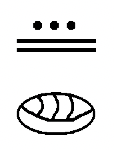
You have seen two basic symbols in this system so far –a dot ( ), which represents the number one and a line segment ( ), which represents the number five. As previously mentioned, there needs to be a symbol for zero to incorporate the use of place value. For that, the Mayans used a shell that looked something like this: To the right is a two level Mayan numeral with a zero in the bottom level, representing zero ones, or 0, plus a 13 in the second level up representing 13 groups of twenty, or 260 (\(13 \times 20\)). So after adding the values together (0 + 260), the numeral you see represents the number 260. |
 |
🧠Let's Listen to Learn❤️
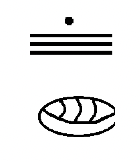
State the Hindu-Arabic equivalent of each Mayan numeral. Show how you obtained your answers. Note that proper space should be left between each place value. Otherwise, someone might incorrectly conclude the number shown for a. represents 14, which would be the answer if there was no space.
| a. ____ | b. ____ | c. ____ |
 |
 |
 |
- Answer
-
a) 10(1) + 4(20) = 90 b) 0 + 16(20) = 320 c) 2(1) + 8(20) = 162
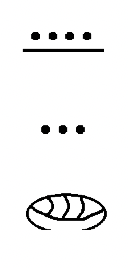
Now, we'll go on to some three and four level Mayan numeral. Remember that the place value for the third level up is 360 and the place value for the fourth level up is 7200. See if you can figure these out on your own first.
| a. ____ | b. ____ | c. ____ | d. ____ | e. ____ |
 |
 |
 |
 |
 |
- Answer
-
a) 14(1) + 0 + 11(360) = 3974 b) 6(1) + 7(20) + 5(360) = 1946 c) 0 + 3(20) + 9(360) = 3300
d) 14(1) + 2(20) + 10(360) + 4(7200) = 32454 e) 19(1) + 5(20) + 0 + 1(7200) = 7319
Wonder, Play, Grow
It's a little trickier to start with a Hindu-Arabic numeral and convert it to Mayan, but with a little patience and practice, you'll be doing it quickly and accurately! Before showing a method for doing this, try the following exercise. Think about the place values of the various levels in the Mayan system.
Work with your peers to try and figure out (Problem Solve) how to write these Mayan Numerals for each of the following numbers.
| a. 36 | b. 387 | c. 1234 | d. 7654 |
To convert a number to a Mayan numeral, the first thing you'll have to determine is how many levels the numeral will have. Remember the levels: 1, 20, 360, 7200, 144000, ...
Check Your Answer: Online Mayan Numeral Converter
Mayan History
Another New World culture that utilized a place value numeration system was the ancient Maya. This civilization occupied a vast region encompassing southern Mexico and parts of present-day Guatemala, El Salvador, and Honduras. The Mayan civilization thrived for over 2,000 years, reaching its peak between 300 and 900 A.D. One of its most remarkable achievements was the development of an intricate hieroglyphic writing system consisting of approximately 1,000 glyphs. These glyphs could be either sound-based or meaning-based, though the majority of those that have survived remain undeciphered.
Following 900 A.D., the Mayan civilization experienced a sudden and dramatic decline—often referred to as The Great Collapse—during which its once-thriving cities were abandoned. The reasons behind this mass exodus remain a mystery, with theories ranging from natural disasters and epidemic diseases to warfare. Despite the Spanish Conquest, which began in the early 1500s, elements of Mayan culture persisted. The struggle against Spanish rule was marked by relentless brutality and lasted nearly a century before the last independent Mayan kingdom was finally subdued in 1597.
The Mayan calendar year consisted of 365 days, divided into 18 months of 20 days each, with an additional 5-day period. This structure led to the adoption of a base-20, or vigesimal, counting system. Numbers were represented in two symbolic forms. The priestly class used elaborate glyphs depicting grotesque deity faces to signify the numbers 1 through 19, which were commonly used in carved stone inscriptions marking significant events. Meanwhile, the common people recorded numbers using a combination of bars and dots, where a short horizontal bar signified 5 and a dot represented 1. A distinctive feature of this system was the inclusion of a stylized shell symbol to denote zero—one of the earliest known uses of a symbol for that number (Boyer, 2011; Burton, 1984). Below are real photos of Mayan Glyhphs found at the Museo Nacional de Antropología in Mexico City. See if you can find more Mayan Numerals on the pictures - you may need to zoom in.
 |
 |
 |
 |
 |
Photos Courtesy of Marty Romero
| System | Additive | Subtractive | Multiplicative | Positional | Place Value | Zero |
| Tally | Yes | No | No | No | No | No |
| Egyptian | Yes | No | No | No | No | No |
| Roman | Yes | Yes | Yes | No | No | No |
| Mayan | Yes | No | Yes | Yes | Yes | Yes |