

2.3: Hindu-Arabic Numeration System
- Page ID
- 181435
\( \newcommand{\vecs}[1]{\overset { \scriptstyle \rightharpoonup} {\mathbf{#1}} } \)
\( \newcommand{\vecd}[1]{\overset{-\!-\!\rightharpoonup}{\vphantom{a}\smash {#1}}} \)
\( \newcommand{\dsum}{\displaystyle\sum\limits} \)
\( \newcommand{\dint}{\displaystyle\int\limits} \)
\( \newcommand{\dlim}{\displaystyle\lim\limits} \)
\( \newcommand{\id}{\mathrm{id}}\) \( \newcommand{\Span}{\mathrm{span}}\)
( \newcommand{\kernel}{\mathrm{null}\,}\) \( \newcommand{\range}{\mathrm{range}\,}\)
\( \newcommand{\RealPart}{\mathrm{Re}}\) \( \newcommand{\ImaginaryPart}{\mathrm{Im}}\)
\( \newcommand{\Argument}{\mathrm{Arg}}\) \( \newcommand{\norm}[1]{\| #1 \|}\)
\( \newcommand{\inner}[2]{\langle #1, #2 \rangle}\)
\( \newcommand{\Span}{\mathrm{span}}\)
\( \newcommand{\id}{\mathrm{id}}\)
\( \newcommand{\Span}{\mathrm{span}}\)
\( \newcommand{\kernel}{\mathrm{null}\,}\)
\( \newcommand{\range}{\mathrm{range}\,}\)
\( \newcommand{\RealPart}{\mathrm{Re}}\)
\( \newcommand{\ImaginaryPart}{\mathrm{Im}}\)
\( \newcommand{\Argument}{\mathrm{Arg}}\)
\( \newcommand{\norm}[1]{\| #1 \|}\)
\( \newcommand{\inner}[2]{\langle #1, #2 \rangle}\)
\( \newcommand{\Span}{\mathrm{span}}\) \( \newcommand{\AA}{\unicode[.8,0]{x212B}}\)
\( \newcommand{\vectorA}[1]{\vec{#1}} % arrow\)
\( \newcommand{\vectorAt}[1]{\vec{\text{#1}}} % arrow\)
\( \newcommand{\vectorB}[1]{\overset { \scriptstyle \rightharpoonup} {\mathbf{#1}} } \)
\( \newcommand{\vectorC}[1]{\textbf{#1}} \)
\( \newcommand{\vectorD}[1]{\overrightarrow{#1}} \)
\( \newcommand{\vectorDt}[1]{\overrightarrow{\text{#1}}} \)
\( \newcommand{\vectE}[1]{\overset{-\!-\!\rightharpoonup}{\vphantom{a}\smash{\mathbf {#1}}}} \)
\( \newcommand{\vecs}[1]{\overset { \scriptstyle \rightharpoonup} {\mathbf{#1}} } \)
\(\newcommand{\longvect}{\overrightarrow}\)
\( \newcommand{\vecd}[1]{\overset{-\!-\!\rightharpoonup}{\vphantom{a}\smash {#1}}} \)
\(\newcommand{\ket}[1]{\left| #1 \right>}\)
\(\newcommand{\bra}[1]{\left< #1 \right|}\)
\(\newcommand{\braket}[2]{\left< #1 \vphantom{#2} \right| \left. #2 \vphantom{#1} \right>}\)
\(\newcommand{\braopket}[3]{\left< #1 \vphantom{#2}\vphantom{#3} \right| #2 \vphantom{#1}\vphantom{#3} \left| #3 \vphantom{#1}\vphantom{#2} \right>}\)
\(\newcommand{\qmvec}[1]{\mathbf{\vec{#1}}}\)
\(\newcommand{\op}[1]{\hat{\mathbf{#1}}}\)
\(\newcommand{\expect}[1]{\langle #1 \rangle}\)
\(\newcommand{\dfn}[1]{\emph{\textbf{#1}}}\)
The Hindu-Arabic Number System
The Hindu-Arabic numeral system, also known as the decimal or base-ten system, is the most widely used numeration system in the world today. It was developed by Indian scholars as early as 800 BCE and later transmitted to the Western world by Arabic mathematicians. The system's efficiency in arithmetic operations and its adaptability to complex mathematical computations contributed to its widespread adoption over other ancient systems like Roman numerals and Egyptian hieroglyphs.
Key Features:
- Digits: The system uses ten symbols (0, 1, 2, 3, 4, 5, 6, 7, 8, 9) that can be combined to represent all possible numbers.
- Grouping by Ten: Numbers are grouped in sets of ten, making it a base-ten system, likely influenced by the human ten fingers.
- Place Value (Positional Number System): The value of a digit depends on its position in the numeral. For example, in the number 5984, the 5 represents thousands, the 9 represents hundreds, the 8 represents tens, and the 4 represents ones.
- Use of Zero: A significant innovation of this system is the concept of zero as a placeholder, which allows for efficient representation of large numbers.
- Expanded Form (Additive and Multiplicative Number System): Numbers can be written as the sum of each digit multiplied by its place value (e.g., 5984 = 5×1000 + 9×100 + 8×10 + 4).
Before we proceed to learn about our base-10 number system (Hindu-Arabic) lets review what we know about the early learning of math for those you will be teaching.
Task 1: Considering what we learned so far, what are some of the first concepts of number and counting that children learn? Discuss with others and be ready to share with the class.
Task 2: Now view this video from Math Educator Graham Fletchy about his thoughts on early learning of number and counting. This video explores the progression of early number concepts and counting.
Task 3: Based on the progression of early number sense, what surprised you the most about how children develop mathematical understanding? What questions do you have now? Discuss with others and be ready to share with the class.
The progression of early number sense—subitizing, more/less comparisons, counting, cardinality, and conservation—lays the foundation for understanding place value and the base-ten system.
Models for Our Number System
The Hindu-Arabic numeration system operates on a base-ten structure, grouping numbers into sets of ten due to our natural inclination to count on our fingers. This fundamental principle replaces ten ones with one ten, ten tens with one hundred, and so forth. This concept is crucial for children developing number sense, and manipulatives such as Unifix cubes and Base Ten Blocks serve as effective teaching tools.
|
Unifix cubes, also known as linker cubes or multi-links, are particularly beneficial for young learners, allowing them to physically stack ten individual cubes together to form one ten, reinforcing the concept of regrouping in addition and subtraction. For instance, when solving 27 + 38, children can visually and physically group ten ones into a new ten, illustrating the process of carrying or trading. Similarly, in subtraction, breaking a ten into ten ones supports the understanding of place value. These hands-on experiences enable children to see ten both as a collection of individual units and as a single unit, fostering a flexible grasp of number relationships. (CML) |
Base Ten Blocks provide another visual and tactile way for students to grasp place value, with different-sized blocks representing units (1), longs (10), flats (100), and blocks (1,000). Base Ten Blocks are common in elementary classrooms. They remain valuable for small-group instruction and remediation, particularly in helping students understand multi-digit operations and the borrowing and carrying processes in addition and subtraction. (CML) |


Express the number 5,302 in expanded form.
- Answer
-
5(1000) + 3(100)+ 0(10) + 2(1) = 5,302
This is like saying we have 5 groups of 1000 (block), 3 groups of 100 (flat), 0 groups of 10 (long) , and 2 group 1 (unit).

Notice that we didn't represent 5,302 using "unifix" cubes. :)
Word Names for Hindu-Arabic numerals
Associated with each Hindu–Arabic numeral is a word name. Some of the English names are below.
|
0 zero 10 ten 1 one 11 eleven 2 two 12 twelve 3 three 13 thirteen (three plus ten) 4 four 14 fourteen (four plus ten) 5 five 24 twenty-four (2 tens plus 4 ones) 6 six 67 sixty-seven (6 tens plus seven ones) 7 seven 305 two hundred five (3 hundreds plus five ones) 8 eight 1,274 one thousand two hundred seventy-four 9 nine 25,100 twenty-five thousand one hundred In numerals containing more than three digits, groups of three digits are sets off by commas. For example, the number 864,456,221,653,127,851 is read: ”eight hundred sixty four quadrillion four hundred fifty six trillion two hundred twenty one billion six hundred fifty three million one hundred twenty seven thousand eight hundred fifty one”. Notice that the word and does not appear in any of these names: it is reserved to separate the decimal portion of a numeral from the whole-number portion. |
Numbers as Language Many children initially perceive multi-digit numbers as a sequence of individual digits rather than understanding their place value (Fuson, 2004). For instance, they may see 435 as "four, three, five" rather than recognizing it as four hundreds, three tens, and five ones. The position of the number means something in the language of mathematics. To address this, elementary curricula introduce expanded notation, such as 576 = (5 × 100) + (7 × 10) + (6 × 1), aiming to help students grasp the meaning behind each digit. True place value comprehension extends beyond knowing that the seven in 576 represents seven tens; it includes understanding that there are 57 tens within 576. Despite significant instructional time devoted to naming place values, many students struggle with the broader concept because they focus on labels rather than the relationships between numbers. Connected to students learning the names of numbers, they put together the three distinct ideas, number (concept) - numeral (symbol) - name (word) in order to understand the Hindu–Arabic numeration system. Figure 2.3.1 
Figure \(\PageIndex{1}\) |
Wonder, Play, Grow
Task 1: Discuss with your peers- "Why do you think our number system is called 'base 10'?" Be prepared to share your answer with the class.
Task 2: Represent 342 in expanded form and with base-10 blocks.
Task 3: Calculate 103, 102, 101, 100. How do these values help explain why we call our number system base-10? Be prepared to share your answer with the class.
- 5,302 in base-10 expanded form.
-
5(103) + 3(102) + 0(101) + 1(100) = 5(1000) + 5(100) + 0(10) + 2(1) = 5,302
Nondecimal Numeration Systems
Our Hindu-Arabic numeration system is structured around grouping by tens. To gain a deeper understanding of this system and the challenges children may encounter when learning it, it can be helpful to examine alternative systems that use different bases. For instance, imagine a numeration system based on a single hand (five fingers). In this case, numbers would be grouped in sets of five. If objects such as sticks were used, they would be bundled in groups of five. For example, the number 17 in base ten would be represented as three bundles of five with two left over in base five, written as 32₅ (or 32five) . It is crucial to read this correctly as “three two base five,” rather than “thirty-two,” since the place values differ from those in base ten. When considering the language aspect of base 5, we see that the digit 3 and digit 2 represent something different because the subscript symbol 5 is included in the numeral. When we see the subscript symbol, it tells us how to assign a place value for each digit.
|
Base 5 Blocks |
Units are 50=1
|
Longs are 51=5
|
Flats are 52=25
|
Blocks are 53=125
|


🧠Let's Listen to Learn❤️
Considering that base-10 has nine digits (0, 1, 2, 3, 4, 5, 6, 7, 8, 9) to represent all of our numbers, how many and which digits would we use for a base-5 number system? Once you and your peers agree on that then discuss how to count in base-5.
Keep in mind that counting using base five names differs from counting in base ten. What are the first 10 base-5 numerals?

- Base-5 Counting
-
15, 25, 35 , 45 , 105 , 115 , 125 , 135 , 145 ,205
a) Make 2135 using base five blocks, then convert into base ten.
b) Make 21425 using base five blocks, then convert into base ten.
- Answer
-
a)

2(52) + 2(51) + 3(50) = 2(25) + 1(5) + 3(1) = 58
b)

2(53) + 1(52) + + 4(51) +2(50) = 2(125) + 1(25) + 4(5) + 2(1)= 422
Play, Wonder, Grow
Convert the number 81 into base 5, using base 5 blocks. It may also be a good problem solving strategy to consider a place value table to organize your thinking.
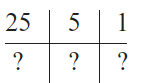
- Answer
-
3115
Convert the number 341 into base 5
- Answer
-
23315
You can use base blocks to model this situation, but you may also want to consider a more systematic method can be used to convert 341 to its base five numeral. First, find the highest power of 5 that will divide into 341 (the "how many" approach); that is, which is the greatest among 1, 5, 25, 125, 625, 3125, and so on, that will divide into 341? The answer in this case is 125. The rest of that procedure uses long division, each time dividing the remainder by the next smaller place value.

Remainder Approach:
🔁 Step 1: Divide 341 by 5
341 ÷ 5 = 68 with a remainder of 1
Write down the remainder.
🔁 Step 2: Divide 68 by 5
68 ÷ 5 = 13 with a remainder of 3
Write down the remainder.
🔁 Step 3: Divide 13 by 5
13 ÷ 5 = 2 with a remainder of 3
Write down the remainder.
🔁 Step 4: Divide 2 by 5
2 ÷ 5 = 0 with a remainder of 2
Write down the remainder.
📌 Step 5: Read the remainders from bottom to top
From last to first: 2 3 3 1
So, 341 in base 5 is: 2331
🧠Let's Listen to Learn❤️
Other Bases
Base-10 and Base-5 are not the only systems that can represent numbers. The base-2 system, also known as the binary system, is a number system that uses only two digits: 0 and 1. Unlike our familiar base-10 (decimal) system, where each place value represents a power of 10, the binary system is based on powers of 2. The binary system is fundamental to computing and digital electronics because modern computers and electronic devices operate using electrical circuits that have two states:
- ON (1)
- OFF (0)
Since binary numbers correspond directly to these two states, they are the most efficient way for computers to store, process, and transmit data.
When you see a Base Two numeral like \(11011_{\text{two}}\), you need to understand what each place value stands for. In all bases, the rightmost place value is the units or 1's place. Next, the number name "two" to the right of the numeral tells you this is a Base Two numeral, which means each place value as you move left increases by a multiple of 2. Below is a chart showing the first eight place values in Base Two. They are written in Base Ten.
| 128 | 64 | 32 | 16 | 8 | 4 | 2 | 1 |
To check that the Base Two numeral \(11011_{\text{two}}\) really is \(27_{\text{ten}}\), put it into a chart with just five place values showing (since it's a five-digit numeral) and check the total value of the numeral. Look at the numeral written to the right. The place value for each digit is written below each digit of the numeral. The numeral is written in bold so it does not get confused with the place values. You check this exactly the way you did for the Mayan numerals:
\[\begin{align*} \text{(1 group of 16)} + \text{(1 group of 8)} + \text{(0 groups of 4)} + \text{(1 group of 2)} + \text{(1 group of 1)} &= (\mathbf{1} \times 16) + (\mathbf{1} \times 8) + (\mathbf{0} \times 4) + (\mathbf{1} \times 2) + (\mathbf{1} \times 1) \\[4pt] &= 16 + 8 + 2 + 1 \\[4pt] &= \mathbf{27}.\end{align*} \nonumber \]
All right! It really works! In fact, it's really easy to check the arithmetic for a Base Two numeral because for each place value containing a 1, that place value gets added to the total, whereas those place values containing a zero do not get added to the total. There's no multiplication you have to do –you can skip directly to the addition: 16 + 8 + 2 + 1 = 27.
\[\boxed{\frac{\mathbf{1}}{16} \frac{\mathbf{1}}{8} \frac{\mathbf{0}}{4} \frac{\mathbf{1}}{2} \frac{\mathbf{0}}{1} \ \mathbf{ two}}\nonumber \]
Let's convert \(\mathbf{10 \ 011 \ 010}_{\mathbf{two}}\) to Base Ten. Again, we'll write it with the place values shown under each digit and add up the place values containing a 1. This numeral converts to 128 + 16 + 8 + 2 = 154.
\[\boxed{\frac{\mathbf{1}}{128} \frac{\mathbf{0}}{64} \frac{\mathbf{0}}{32} \frac{\mathbf{1}}{16} \frac{\mathbf{1}}{8} \frac{\mathbf{0}}{4} \frac{\mathbf{1}}{2} \frac{\mathbf{0}}{1} \ \mathbf{ two}}\nonumber \]
Convert each Base Two numeral to Base Ten.
| a) \(10 \ 011_{\text{two}}\) | b) \(1 \ 000 \ 001_{\text{two}}\) | c) \(111 \ 111_{\text{two}}\) |
- Answer
-
a) = (1×2⁴ + 0×2³ + 0×2² + 1×2¹ + 1×2⁰) = (16 + 0 + 0 + 2 + 1) = 19
b) = (1×2⁶ + 0×2⁵ + 0×2⁴ + 0×2³ + 0×2² + 0×2¹ + 1×2⁰) = (64 + 0 + 0 + 0 + 0 + 0 + 1) = 65
c) = (1×2⁵ + 1×2⁴ + 1×2³ + 1×2² + 1×2¹ + 1×2⁰) = (32 + 16 + 8 + 4 + 2 + 1) = 63
Wonder, Play, Grow
Convert the following numerals to Base Ten. Work with your peers to figure it out.
- 1023 = ____
- 10234 = ____
- You make up a number in base-6 and have a peer convert it to base-10.
DID YOU KNOW: In Base Eleven, you need eleven different symbols (or digits) for possible placeholders. The problem we encounter is that we only have these ten recognizable digits –0,1,2,3,4,5,6,7,8 and 9. Remember that 10 is made up of two separate digits –it isn't a single symbol!! So we need to introduce a new symbol to represent ten in Base Eleven and higher. The convention is to use the letter "T". Similarly, we use the letter "E" to represent the number eleven in Base Twelve and higher and the letter "W" to represent the number twelve in Base Thirteen and higher. Since the second place value from the right represents the base you are working in, you never need a separate symbol to represent the value of the base or any number higher than the base. That's why there are only 0's and 1's and no 2's in Base Two and why there are only 0's, 1's, 2's, 3's and 4's and no 5's in Base Five, etc.
Let's convert the numeral \(TE5_{\text{twelve}}\) to Base Ten. To remember the place values, we might want to draw a Base Twelve place value chart for three digits as shown to the right.
Then, \(TE5_{\text{twelve}} = 10 \times 144 + 11 \times 12 + 5 \times 1 = 1440 + 132 + 5 = \mathbf{1577}\).
Pay close attention to the difference between \(2T9_{\text{eleven}}\) and \(2109_{\text{eleven}}\).
Convert each of the following to a Base Ten numeral. Show work
| a. \(110_{\text{two}}\) = | e. \(110_{\text{six}}\) = |
| b. \(110_{\text{three}}\) = | f. \(110_{\text{seven}}\) = |
| c. \(110_{\text{four}}\) = | g. \(110_{\text{eight}}\) = |
| d. \(110_{\text{five}}\) = | h. \(110_{\text{nine}}\) = |
- Answer
-
TO convert each of the numbers
110from different bases into Base Ten (Decimal). We'll use this formula:110base=1×base2+1×base1+0×base0
a) 6 b) 12 c) 20 d) 30 e) 42 f) 56 g) 72 h) 90
Let's see what Dr. Howie Hua has to say about this.