

3.2.1: Written Retrieval and Problem Solving Practice
- Page ID
- 181695
\( \newcommand{\vecs}[1]{\overset { \scriptstyle \rightharpoonup} {\mathbf{#1}} } \)
\( \newcommand{\vecd}[1]{\overset{-\!-\!\rightharpoonup}{\vphantom{a}\smash {#1}}} \)
\( \newcommand{\dsum}{\displaystyle\sum\limits} \)
\( \newcommand{\dint}{\displaystyle\int\limits} \)
\( \newcommand{\dlim}{\displaystyle\lim\limits} \)
\( \newcommand{\id}{\mathrm{id}}\) \( \newcommand{\Span}{\mathrm{span}}\)
( \newcommand{\kernel}{\mathrm{null}\,}\) \( \newcommand{\range}{\mathrm{range}\,}\)
\( \newcommand{\RealPart}{\mathrm{Re}}\) \( \newcommand{\ImaginaryPart}{\mathrm{Im}}\)
\( \newcommand{\Argument}{\mathrm{Arg}}\) \( \newcommand{\norm}[1]{\| #1 \|}\)
\( \newcommand{\inner}[2]{\langle #1, #2 \rangle}\)
\( \newcommand{\Span}{\mathrm{span}}\)
\( \newcommand{\id}{\mathrm{id}}\)
\( \newcommand{\Span}{\mathrm{span}}\)
\( \newcommand{\kernel}{\mathrm{null}\,}\)
\( \newcommand{\range}{\mathrm{range}\,}\)
\( \newcommand{\RealPart}{\mathrm{Re}}\)
\( \newcommand{\ImaginaryPart}{\mathrm{Im}}\)
\( \newcommand{\Argument}{\mathrm{Arg}}\)
\( \newcommand{\norm}[1]{\| #1 \|}\)
\( \newcommand{\inner}[2]{\langle #1, #2 \rangle}\)
\( \newcommand{\Span}{\mathrm{span}}\) \( \newcommand{\AA}{\unicode[.8,0]{x212B}}\)
\( \newcommand{\vectorA}[1]{\vec{#1}} % arrow\)
\( \newcommand{\vectorAt}[1]{\vec{\text{#1}}} % arrow\)
\( \newcommand{\vectorB}[1]{\overset { \scriptstyle \rightharpoonup} {\mathbf{#1}} } \)
\( \newcommand{\vectorC}[1]{\textbf{#1}} \)
\( \newcommand{\vectorD}[1]{\overrightarrow{#1}} \)
\( \newcommand{\vectorDt}[1]{\overrightarrow{\text{#1}}} \)
\( \newcommand{\vectE}[1]{\overset{-\!-\!\rightharpoonup}{\vphantom{a}\smash{\mathbf {#1}}}} \)
\( \newcommand{\vecs}[1]{\overset { \scriptstyle \rightharpoonup} {\mathbf{#1}} } \)
\(\newcommand{\longvect}{\overrightarrow}\)
\( \newcommand{\vecd}[1]{\overset{-\!-\!\rightharpoonup}{\vphantom{a}\smash {#1}}} \)
\(\newcommand{\ket}[1]{\left| #1 \right>}\)
\(\newcommand{\bra}[1]{\left< #1 \right|}\)
\(\newcommand{\braket}[2]{\left< #1 \vphantom{#2} \right| \left. #2 \vphantom{#1} \right>}\)
\(\newcommand{\braopket}[3]{\left< #1 \vphantom{#2}\vphantom{#3} \right| #2 \vphantom{#1}\vphantom{#3} \left| #3 \vphantom{#1}\vphantom{#2} \right>}\)
\(\newcommand{\qmvec}[1]{\mathbf{\vec{#1}}}\)
\(\newcommand{\op}[1]{\hat{\mathbf{#1}}}\)
\(\newcommand{\expect}[1]{\langle #1 \rangle}\)
\(\newcommand{\dfn}[1]{\emph{\textbf{#1}}}\)
Student Learning Objectives
SLO 3.1 Students will demonstrate a comprehensive understanding of whole number operations, including addition, subtraction, multiplication, and division, by modeling each operation with set and measurement models and analyzing their properties.
SLO 3.2 Students will apply strategies for mental computation in addition, subtraction, and multiplication across different bases and demonstrate mastery of basic facts using commutativity, associativity, and distributive properties.
The mild assignment 🌶️ is a shorter and less challenging assignment. The medium assignment🌶️🌶️ is right in the middle in terms of length and level of difficulty. Finally, the spicy assignment 🌶️🌶️🌶️ is a longer assignment that is the most challenging.
(Spicy 🌶️🌶️🌶️ Problems are OPTIONAL, but go for it when you have the time to challenge yourself)
🌶️
What multiplication problems and which models are suggested by the following diagrams? Then determine which approach is being modeled.
i) Cartesian product approach
ii) Set model; rectangular array approach
iii) Set model; repeated-addition approach
iv) Measurement model; rectangular array approach
v) Measurement model; repeated-addition approach
a) 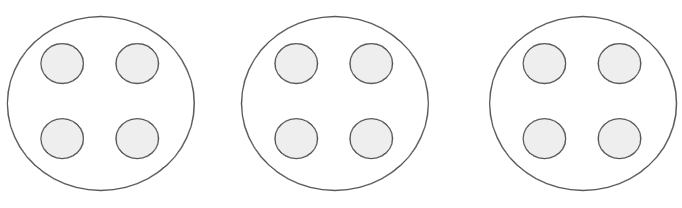 |
b) {(a, 1) , (a, 2) , (a, 3) , (b, 1), (b, 2) , (b, 3)} |
|
c)
|
d)
|
e)  |


- Answer
-
a) 3 x 4, Set model; repeated-addition approach
b) {a, b} x {1, 2, 3} OR 2 x 3 = 6, Cartesian product approach
c) 2 x 5, Measurement model; rectangular array approach
d) 3 x 2, Set model; rectangular array approach
e) 6 x 5, Measurement model; repeated-addition approach
🌶️
Illustrate 4 x 5 using each of the following models.
(a) Measurement model; rectangular array approach
(b) Set model; repeated-addition approach
- Answer
-
a)

b)

🌶️🌶️
Which of the following sets are closed under multiplication? Why or why not?
a) (2, 4}
b) {0, 2, 4, 6, 8, ...}
c) { 3, 5, 7, 9, 11, ...}
d) {21, 22, 23, 24, ...}
- Answer
-
a) NO, a counter example, 2x4 = 8
b) YES, the product of any two even numbers is always even.
c) YES, the product of any two odd numbers is always odd.
d) YES, the product of any powers of 2 is always a power of 2
🌶️
What properties of whole number multiplication justify these equations?
(a) 4 x 9 = 9 x 4
(b) 4 x (6 + 2) = 4 x 6 + 4 x 2
(c) 0 x 12 = 0
(d) 5 x (9 x 11) = (5 x 9) x 11
(e) 7 x 3 + 7 x 8 = 7 x (3 + 8).
- Answer
-
a) commutative b) distributive c) multiplication property of zero d) associative e) distributive
🌶️
Rewrite each of the following expressions using the distributive property for multiplication over addition or subtraction. Your answer should contain no parentheses.
(a) 4 (60 + 37)
(b) 3 x (29 + 30 + 6)
(c) a(7 − b + z).
- Answer
-
a) 4(60) + 4(37)
b) 3(29) + 3(30) + 3(6)
c) 7a - ab + az
🌶️🌶️
The distributive property of multiplication over addition can be used to perform some calculations mentally. For example, to find 13 x 12, you can think
13 x 12 = 13 x (10 + 2) = 13 x 10 + 13 x 2 = 130 + 26 = 156
How could each of the following products be rewritten using the distributive property so that it is more easily computed mentally?
a) 49(11) b) 35(101) c) 23(21) d) 35(99)
- Answer
-
a) 49 (10 + 1) = 490 + 49 = 539
b) 35 (100 + 1) = 3500 + 35 = 3535
c) 23 (20 + 1) = 460 + 23 = 483
d) 35 (100 - 1) = 3500 - 35 = 3465
🌶️🌶️
a) Write a sharing division problem that would have the equation 18 \(\div \) 6 as part of its solution.
b) Write a measurement division problem that would have the equation 28 \(\div \) 4 as part of its solution.
- Answer
-
a) "A teacher has 18 markers and wants to divide them equally among 6 students. How many markers does each student get?"
b) "A baker has 28 cookies and wants to pack them into boxes, with 4 cookies in each box. How many boxes can the baker fill?"
🌶️🌶️
Rewrite each of the following division problems as a multiply problem.
a) 50 \(\div \) 5 = 10
b) 100 \(\div \) x = 25
c) x \(\div \) 6 = 20
- Answer
-
a) 50 = (5)(10) b) 100 = (x)(25) c) x = (6)(20)
🌶️🌶️
Find the quotient and reminder for the following. [Try repeated subtraction]
a) 43 \(\div \) 8
b) 62 \(\div \) 15
c) 8 \(\div \) 12
- Answer
-
a) q=5 r = 3 b) q=4 r = 2 c) q=0 r = 8
🌶️🌶️🌶️
Which of the following properties hold for division of whole numbers?
a. Closure
b. Commutativity
c. Associativity
d. Identity
- Answer
-
a) Division is NOT Closed
b) Division is NOT commutative.
c) Division is NOT associative.
d) Division has an identity element, which is 1.
🌶️🌶️🌶️
Complete the following multiplication table in base five.

- Answer
-

Problem Solving Practice
🌶️🌶️🌶️
How many possible remainders (including zero) are there when dividing by the following numbers? How many possible quotients are there?
a. 2 b. 12 c. 23
- Answer
-
a) Dividing by 2, Possible remainders: 0,1 → 2 possible remainders Possible quotients: Any nonnegative integer → Infinite possible quotients
b) Dividing by 12 Possible remainders: 0,1,2,…,11 → 12 possible remainders Possible quotients: Any nonnegative integer → Infinite possible quotients
c) Dividing by 23 Possible remainders: 0,1,2,…,22→ 23 possible remainders Possible quotients: Any nonnegative integer → Infinite possible quotients
Wonder, SHARE, Grow
Task 1: View each of the videos from Math Educator Howie Hua.
|
A great multiplication strategy to have: doubling and halving |
A quick way to multiply by 11 |
|
A neat way of multiplying by 5 |
How can rectangles help us with multiplication? |
Task 2: Pick one of the methods from the videos and teach someone in your life how to do it.
Task 3: Be prepared to share in class what happened and how the person reacted.