3.3: Ordering Whole Numbers and Exponents
- Page ID
- 181697
\( \newcommand{\vecs}[1]{\overset { \scriptstyle \rightharpoonup} {\mathbf{#1}} } \)
\( \newcommand{\vecd}[1]{\overset{-\!-\!\rightharpoonup}{\vphantom{a}\smash {#1}}} \)
\( \newcommand{\dsum}{\displaystyle\sum\limits} \)
\( \newcommand{\dint}{\displaystyle\int\limits} \)
\( \newcommand{\dlim}{\displaystyle\lim\limits} \)
\( \newcommand{\id}{\mathrm{id}}\) \( \newcommand{\Span}{\mathrm{span}}\)
( \newcommand{\kernel}{\mathrm{null}\,}\) \( \newcommand{\range}{\mathrm{range}\,}\)
\( \newcommand{\RealPart}{\mathrm{Re}}\) \( \newcommand{\ImaginaryPart}{\mathrm{Im}}\)
\( \newcommand{\Argument}{\mathrm{Arg}}\) \( \newcommand{\norm}[1]{\| #1 \|}\)
\( \newcommand{\inner}[2]{\langle #1, #2 \rangle}\)
\( \newcommand{\Span}{\mathrm{span}}\)
\( \newcommand{\id}{\mathrm{id}}\)
\( \newcommand{\Span}{\mathrm{span}}\)
\( \newcommand{\kernel}{\mathrm{null}\,}\)
\( \newcommand{\range}{\mathrm{range}\,}\)
\( \newcommand{\RealPart}{\mathrm{Re}}\)
\( \newcommand{\ImaginaryPart}{\mathrm{Im}}\)
\( \newcommand{\Argument}{\mathrm{Arg}}\)
\( \newcommand{\norm}[1]{\| #1 \|}\)
\( \newcommand{\inner}[2]{\langle #1, #2 \rangle}\)
\( \newcommand{\Span}{\mathrm{span}}\) \( \newcommand{\AA}{\unicode[.8,0]{x212B}}\)
\( \newcommand{\vectorA}[1]{\vec{#1}} % arrow\)
\( \newcommand{\vectorAt}[1]{\vec{\text{#1}}} % arrow\)
\( \newcommand{\vectorB}[1]{\overset { \scriptstyle \rightharpoonup} {\mathbf{#1}} } \)
\( \newcommand{\vectorC}[1]{\textbf{#1}} \)
\( \newcommand{\vectorD}[1]{\overrightarrow{#1}} \)
\( \newcommand{\vectorDt}[1]{\overrightarrow{\text{#1}}} \)
\( \newcommand{\vectE}[1]{\overset{-\!-\!\rightharpoonup}{\vphantom{a}\smash{\mathbf {#1}}}} \)
\( \newcommand{\vecs}[1]{\overset { \scriptstyle \rightharpoonup} {\mathbf{#1}} } \)
\(\newcommand{\longvect}{\overrightarrow}\)
\( \newcommand{\vecd}[1]{\overset{-\!-\!\rightharpoonup}{\vphantom{a}\smash {#1}}} \)
\(\newcommand{\ket}[1]{\left| #1 \right>}\)
\(\newcommand{\bra}[1]{\left< #1 \right|}\)
\(\newcommand{\braket}[2]{\left< #1 \vphantom{#2} \right| \left. #2 \vphantom{#1} \right>}\)
\(\newcommand{\braopket}[3]{\left< #1 \vphantom{#2}\vphantom{#3} \right| #2 \vphantom{#1}\vphantom{#3} \left| #3 \vphantom{#1}\vphantom{#2} \right>}\)
\(\newcommand{\qmvec}[1]{\mathbf{\vec{#1}}}\)
\(\newcommand{\op}[1]{\hat{\mathbf{#1}}}\)
\(\newcommand{\expect}[1]{\langle #1 \rangle}\)
\(\newcommand{\dfn}[1]{\emph{\textbf{#1}}}\)
Ordering and Inequality
Before introducing the formal definition of "less than" for whole numbers, students should develop an intuitive understanding of ordering through familiar experiences with counting and comparing sets. The counting chant provides a natural foundation—children recognize that "two" comes before "five," establishing an inherent sense of numerical order. Kindergartners engage with ordering by comparing groups of objects, using one-to-one matching to determine which set has more or fewer items. Visual tools such as number lines further reinforce the relative size of numbers. Additionally, set comparisons help illustrate that if one set is a proper subset of another, its corresponding number is smaller. These early experiences with counting, matching, and set relationships create a strong conceptual base before introducing formal symbolic definitions of comparison (CDE, 2013; Finnan, 2006).
🧠Let's Listen to Learn❤️
The whole number m is greater than the whole number n if there is a whole number k such that m = n + k.
In mathematics, the symbol used to denote "is greater than" is: " > ". Therefore, " 7 > 5 " is read "Seven is greater than five".
The whole number r is less than the whole number s if there is a whole number k such that r + k = s.
In mathematics, the symbol used to denote "is less than" is: " < ". Therefore, " 4 < 9 " is read "Four is less than nine".
Verify each of the following (I've done part a for you):
| a. 9 > 3 because \(\underline{9 = 3 + 6}\) | b. 30 > 22 because ____ |
| c. 156 > 96 because ____ | d. 19 < 30 because ____ |
- Answer
-
b) 30 = 22 + 8
c) 156 = 96 + 60
d) 19 + 11 = 30
Task 1: Think about how the definitions for > and < can be restated in the most simplest ways so that you are able to explain what they mean to someone else.
Task 2: Now consider the following: "Less than" and "Greater than" can be used to order numbers on a number line. Fill in each blank with right or left.
| a. If m < n, then m is to the _____________ of n on the number line |
| b. If m > n, then m is to the _____________ of n on the number line. |
Task 3: How is "Chant Counting" related to what you discussed and learned in Task 2?
Task 4: Discuss with your peers if this statement is true or false. "If a and b are whole numbers, then exactly one of the following is true: a = b or a < b or a > b."
Transitive Property of “Less Than” for Whole Numbers: For all whole numbers a, b, and c, if a < b and b < c, then a < c.
Less Than and Addition Property for Whole Numbers: If a < b, then a + c < b + c.

Less Than and Multiplication Property for Whole Numbers: If a < b and c ≠ 0, then ac < bc.
Note: This property will have to be modified when we include negative numbers.
Exponential Notation
Just as multiplication can be defined as repeated addition and division may be viewed as repeated subtraction, the concept of exponent can be used to simplify situations involving repeated multiplication.
🧠Let's Listen to Learn❤️
Factors
In multiplication, the numbers being multiplied together are called factors. In repeated multiplication, all the factors are the same. In nonrepeated multiplication, none of the factors are the same.
\(18 \cdot 18 \cdot 18 \cdot 18\) Repeated Multiplication of 18. All four factors, 18 are the same.
\(x \cdot x \cdot x \cdot x \cdot x\) Repeated multiplication of \(x\). All five factors, \(x\), are the same.
\(3 \cdot 7 \cdot a\) Nonrepeated multiplication. None of the factors are the same.
Exponential Notation If \(a\) is any whole number and \(n\) is a whole number n ≠ 0, then
\(a^{n}=\underbrace{a \cdot a \cdot a \cdot \ldots \cdot a}_{n \text { factors of } a}\)
An exponent records the number of identical factors in multiplication.
Note that the definition for exponential notation only has meaning for whole number exponents. We will extend this notation to include other numbers as exponents later.
The number "n" is called the exponent or power of "a", and "a" is called the base. The number an is read "a to the nth power" or "a to the power of n".
The symbol \(x^2\) is often read as "\(x\) squared," and \(x^3\) is often read as "\(x\) cubed." A natural question is "Why are geometric terms appearing in the exponent expression?" The answer for \(x^3\) is this: \(x^3\) means \(x \cdot x \cdot x\). In geometry, the volume of a rectangular box is found by multiplying the length by the width by the depth. A cube has the same length on each side. If we represent this length by the letter \(x\) then the volume of the cube is \(x \cdot x \cdot x\), which, of course, is described by \(x^3\). (Can you think of why \(x^2\) is read as \(x\) squared?)
Take a look at these completed problems - what questions do you have?
a) \(7 \cdot 7 \cdot 7 \cdot 7 \cdot 7 \cdot 7 = 7^6\)
The repeated factor is 7. The exponent 6 records the fact that 7 appears 6 times in the multiplication.
b) \((2y)(2y)(2y) = (2y)^3\)
The repeated factor is \(2y\). The exponent 3 records the fact that the factor \(2y\) appears 3 times in the multiplication.
c) \(2yyy = 2y^3\)
The repeated factor is \(y\). The exponent 3 records the fact that the factor \(y\) appears 3 times in the multiplication.
d)\((a + b)(a + b)(a - b)(a - b)(a - b) = (a + b)^2(a - b)^3\)
The repeated factors are \((a + b)\) and \((a - b)\), \((a + b)\) appearing 2 times and \((a - b)\) appearing 3 times.
Below are a set of rules that students often just memorize without understanding. The rules of exponents for whole numbers are not just a set of procedures to be memorized, but rather a logical extension of the definition of multiplication that allows for efficient representation and manipulation of repeated multiplication. Understanding these rules is part of making sense of mathematical patterns and connections, and the notation and rules themselves contribute to the understanding of mathematics as a precise and powerful language for expressing mathematical ideas and relationships.
The Product Rule for Exponents
The first rule we wish to develop is the rule for multiplying two exponential quantities having the same base and whole number exponents.
If \(a\) is a whole number and \(n\) and \(m\) are whole numbers not equal to 0, then
\(a^na^m = a^{n+m}\)
To multiply two exponential quantities having the same base, add the exponents. Keep in mind that the exponential quantities being multiplied must have the same base for this rule to apply.
- Proof
-
\( a^m \cdot a^n = \underbrace{(a \cdot a \cdots a)}_{m \text{ factors}} \cdot \underbrace{(a \cdot a \cdots a)}_{n \text{ factors}} = \underbrace{a \cdot a \cdots a}_{m+n \text{ factors}} = a^{m+n} \)
The Quotient Rule for Exponents
The second rule we wish to develop is the rule for dividing two exponential quantities having the same base and whole number exponents.
If \(a\) is a whole number and \(n\) and \(m\) are whole numbers not equal to 0,
\(\dfrac{a^n}{a^m} = a^{n-m}, x \not = 0.\)
- Proof
-
\(\dfrac{a^n}{a^m} = c\) ff and only if \( a^m = a^n \cdot c \). Since \( a^n \cdot a^{m-n} = a^{n+(m-n)} = a^m \), we have \( c = a^{m-n} \). Therefore \( a^m \div a^n = a^{m-n}. \)
These next rules are all related to powers.
The Power Rules
If \(a\) is a whole number and \(n\) and \(m\) are whole numbers not equal to 0,
\((a^n)^m = a^{n \cdot m}\)
To raise a power to a power, multiply the exponents.
If \(a\) and \(b\) are whole numbers are \(n\) is a whole number not equal to 0,
\((ab)^n = a^nb^n\)
To raise a product to a power, apply the exponent rule to each and every factor.
If \(a\) and \(b\) are whole numbers and \(n\) is a whole number not equal to 0,
\((\dfrac{a}{b})^n = \dfrac{a^n}{b^n}, y \not = 0\)
To raise a quotient to a power, distribute the exponent to both the numerator and denominator.
Rewrite each of the following expressions using a single exponent.
| a) 23·25 | b) 37·39 | c) Tricky One: 23·53 |
| d) (53)4 | e) (78)3 | f) 57÷ 52 |
| g) \(\dfrac{7^7}{7^4}\) | h) \(\dfrac{5^7}{4^7}\) | i) 37÷ 37 |
- Answer
-
a) 28 b) 316 c) 103 d) 512 e) 724 f) 55 g) 73 h) (5/4)7 i) 30 or 1 (hmm?)
Zero as an Exponent
For the Quotient Rule let’s study the case when the exponents are the same. When the exponents are the same, say \(n\), the subtraction \(n-n\) produces \(0\). Thus, by the quotient rule of exponents, \(\dfrac{x^n}{x^n} = x^{n-n} = x^0\)
But what number, if any, does \(x^0\) represent? Let's think for a moment about our experience with division in arithmetic. We know that any nonzero number divided by itself is one.
\(\dfrac{8}{8} = 1\), \(\dfrac{43}{43} = 1\), \(\dfrac{258}{258} = 1\)
Since the letter \(x\) can represent some nonzero whole number divided by itself. Then \(\dfrac{x^n}{x^n} = 1\).
But we have also established that if \(x \not = 0\), \(\dfrac{x^n}{x^n} = x^0\). We now have that \(\dfrac{x^n}{x^n} = x^0\) and \(\dfrac{x^n}{x^n} = 1\). This implies that \(x^0 = 1\), \(x \not = 0\).
Exponents can now be zero.
\(a^0 = 1\) for all whole number \(a \not = 0\)
- Video Explanation Why a0=1
Any number, other than \(0\), raised to the power of \(0\), is \(1\). \(0^0\) has no meaning (it does not represent a number). Notice that 00 is not defined. To see why, consider the following two patterns.
| Pattern 1 | Pattern 2 |
|
30=1 20=1 10=1 00=? |
03=0 02=0 01=0 00=? |
Pattern 1 suggests that 00 should be 1 and pattern 2 suggests that 00 should be 0. Thus to avoid such an inconsistency, 00 is undefined.
Orders of Operation
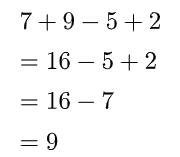
The order of operations fits into the broader essential questions of elementary mathematics by supporting students in developing foundational number sense, problem-solving skills, and mathematical reasoning. While young learners do not typically engage with formalized order of operations rules (like PEMDAS) early on, they build an understanding of operations through activities involving grouping, patterns, and number relationships.
The Simple Reason a Viral Math Equation Broke the Internet

The order in which we evaluate expressions can be ambiguous. Take, for example, the expression \(4-2 \cdot 8\). If we perform the subtraction first, then we get \(16\) as a result (the question mark over the equal sign indicates that the result is questionable).
\[\begin{align*} 4-2 \cdot 8 &\overset{?}{=} 2 \cdot 8\\ &\overset{?}{=}16 \end{align*} \nonumber \]
On the other hand, if we perform the multiplication first, then we get \(-12\) as a result.
\[\begin{align*} 4-2 \cdot 8 &\overset{?}{=} 4 - 16\\ &\overset{?}{=}-12 \end{align*} \nonumber \]
So, what are we to do?
Rules Guiding Order of Operations
When evaluating expressions, proceed in the following order.
- Evaluate all exponents that appear in the expression.
- Perform all additions and subtractions in the order that they appear in the expression, moving left to right.
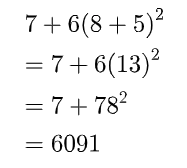
PEMDAS - mathematicians have agreed that the proper order of operations shall be Parentheses, Exponents, Multiplication and Division, Addition and Subtraction (PEMDAS). Although multiplication is listed before division, these operations are done left to right in order of appearance. Similarly, addition and subtraction are done left to right in order of appearance. The pneumonic device Please Excuse My Dear Aunt Sally is often used to remember this order.
Use the proper order of operations to simplify the following expressions.
a) 53 - 4(1 + 2)2
b) 11 - 4 ÷ 2(5) + 3
- Answer
-
a) = 53 - 4(3)2
= 125 - 4(9)
= 125 - 36
= 89
b) = 11 - 2(5) + 3
= 11 - 10 + 3
=4
Wonder, Play, Grow
Work with your peers to go through each of the parts of the table. By the end you should be able to complete the last problem.
|
Find the Error
Error Identified
Fix the Error
|
Find the Error
Error Identified
Fix the Error |
Your Turn - Use the proper order of operations to simplify the following expression after you Find the Error.
|