

4.3: Embracing Diversity of Algorithms for Multiplication and Division
- Page ID
- 183515
\( \newcommand{\vecs}[1]{\overset { \scriptstyle \rightharpoonup} {\mathbf{#1}} } \)
\( \newcommand{\vecd}[1]{\overset{-\!-\!\rightharpoonup}{\vphantom{a}\smash {#1}}} \)
\( \newcommand{\dsum}{\displaystyle\sum\limits} \)
\( \newcommand{\dint}{\displaystyle\int\limits} \)
\( \newcommand{\dlim}{\displaystyle\lim\limits} \)
\( \newcommand{\id}{\mathrm{id}}\) \( \newcommand{\Span}{\mathrm{span}}\)
( \newcommand{\kernel}{\mathrm{null}\,}\) \( \newcommand{\range}{\mathrm{range}\,}\)
\( \newcommand{\RealPart}{\mathrm{Re}}\) \( \newcommand{\ImaginaryPart}{\mathrm{Im}}\)
\( \newcommand{\Argument}{\mathrm{Arg}}\) \( \newcommand{\norm}[1]{\| #1 \|}\)
\( \newcommand{\inner}[2]{\langle #1, #2 \rangle}\)
\( \newcommand{\Span}{\mathrm{span}}\)
\( \newcommand{\id}{\mathrm{id}}\)
\( \newcommand{\Span}{\mathrm{span}}\)
\( \newcommand{\kernel}{\mathrm{null}\,}\)
\( \newcommand{\range}{\mathrm{range}\,}\)
\( \newcommand{\RealPart}{\mathrm{Re}}\)
\( \newcommand{\ImaginaryPart}{\mathrm{Im}}\)
\( \newcommand{\Argument}{\mathrm{Arg}}\)
\( \newcommand{\norm}[1]{\| #1 \|}\)
\( \newcommand{\inner}[2]{\langle #1, #2 \rangle}\)
\( \newcommand{\Span}{\mathrm{span}}\) \( \newcommand{\AA}{\unicode[.8,0]{x212B}}\)
\( \newcommand{\vectorA}[1]{\vec{#1}} % arrow\)
\( \newcommand{\vectorAt}[1]{\vec{\text{#1}}} % arrow\)
\( \newcommand{\vectorB}[1]{\overset { \scriptstyle \rightharpoonup} {\mathbf{#1}} } \)
\( \newcommand{\vectorC}[1]{\textbf{#1}} \)
\( \newcommand{\vectorD}[1]{\overrightarrow{#1}} \)
\( \newcommand{\vectorDt}[1]{\overrightarrow{\text{#1}}} \)
\( \newcommand{\vectE}[1]{\overset{-\!-\!\rightharpoonup}{\vphantom{a}\smash{\mathbf {#1}}}} \)
\( \newcommand{\vecs}[1]{\overset { \scriptstyle \rightharpoonup} {\mathbf{#1}} } \)
\(\newcommand{\longvect}{\overrightarrow}\)
\( \newcommand{\vecd}[1]{\overset{-\!-\!\rightharpoonup}{\vphantom{a}\smash {#1}}} \)
\(\newcommand{\ket}[1]{\left| #1 \right>}\)
\(\newcommand{\bra}[1]{\left< #1 \right|}\)
\(\newcommand{\braket}[2]{\left< #1 \vphantom{#2} \right| \left. #2 \vphantom{#1} \right>}\)
\(\newcommand{\braopket}[3]{\left< #1 \vphantom{#2}\vphantom{#3} \right| #2 \vphantom{#1}\vphantom{#3} \left| #3 \vphantom{#1}\vphantom{#2} \right>}\)
\(\newcommand{\qmvec}[1]{\mathbf{\vec{#1}}}\)
\(\newcommand{\op}[1]{\hat{\mathbf{#1}}}\)
\(\newcommand{\expect}[1]{\langle #1 \rangle}\)
\(\newcommand{\dfn}[1]{\emph{\textbf{#1}}}\)
Multiplication
The standard multiplication algorithm is efficient but relies heavily on place value, multiplication facts, and the distributive property. While it streamlines complex calculations, it often hides the underlying math concepts, making it hard for students to make sense of what they're doing. This lack of conceptual understanding can lead to errors and "buggy" algorithms when students forget a step or misalign place values. Without meaning behind the steps, students struggle to check if their answers are reasonable. In contrast, students can create their own multiplication strategies or use alternative thinking strategies, which tend to be more intuitive and flexible. These alternative methods, like repeated addition or doubling, often evolve into more efficient algorithms as their understanding deepens.
Many people use repeated addition all the time to multiply. Consider the multiplication problem 26 times 17. Basically, this means add 26 seventeens added together. This could be done by adding them together one at a time. That would take a long time. Another approach would be to add 10 seventeens together first to get 170, then add 10 more seventeens together to get 170 again, then add 5 more seventeens together which is 85, and then add one more seventeen. Adding 10 seventeens (170), 10 seventeens (170), 5 seventeens (85) and 1 seventeen (17) gives 170 + 170 + 85 + 17 = 442, which is exactly the answer to 26 times 17. That should be no surprise since we added 26 (10+10+5+1) seventeens together. Someone else might add 10 seventeens (170), 10 seventeens (170), 3 seventeens (51) and 3 more seventeens (51) to get 170 + 170 + 51 + 51 = 340 + 102 =442. Figure 4.3.1
🧠Let's Listen to Learn❤️

Figure \(\PageIndex{1}\)
One reason it's advantageous to do multiplication using repeated addition is that many problems can be done in your head this way. But, of course, every new method takes practice and getting used to, and it's common for people to revert back to using their old, familiar methods even if it takes longer and requires paper. That's okay, too. It is, however, very important that a teacher knows several ways so that he or she can provide more opportunities for students. What seems obvious to one student is foreign to another, so you give alternatives and present different ways of looking at things.
Use some form of repeated addition to compute the following multiplication problems. Show how you did each one.
a. \(23 \times 13\)
b. \(14 \times 14\)
- Answer
-
a) (10 x 23) + (3 x 23) = 230 + 69 = 299
b) (10 x 14) + (2 x 14) + (2 x 14) = 140 + 28 + 28 = 196
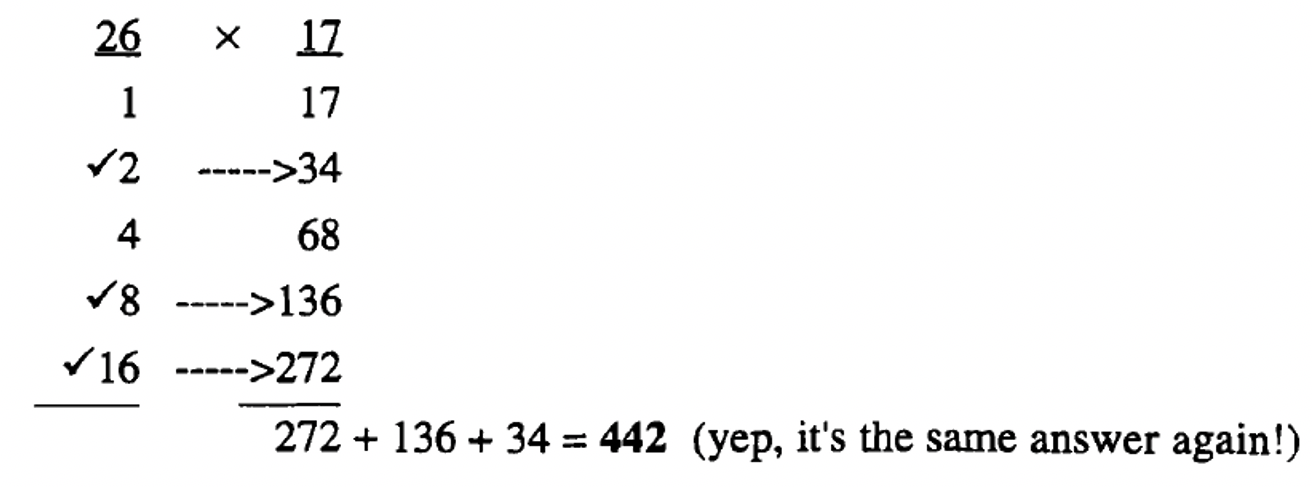
One new algorithm (for most of you reading this) is called Duplation (Egyptian Multiplication). This is actually a very old algorithm used in ancient times by the Egyptians. It also uses the principle that multiplication is simply repeated addition. It is called duplation because it uses the idea of doubling numbers to get the answer. Let's look again at the first multiplication we did in this section. It was \(26 \times 17\). Since 26 seventeens must be added together, the number 26 is broken down into powers of two. It's easy to get powers of two: simply start with 1, then double it to get 2, then double it to get 4, then double it to get 8, then double it to get 16, etc. To figure out how far you have to go in the doubling process, stop if doubling gives a number bigger than the number you are trying to break down (26, in this case). Now, all this sounds more complicated than it really is. Before explaining too much more, notice how you'll write it. Write 26 at the top and underline it. Underneath, start with 1, then, double continuously, stopping at 16 since if you doubled another time, you'd get a number bigger than 26. To the right of 26, write the number 17 and underline it.
Underneath it, first write 17, then double 17 to get 34, then double 34 to get 68, double 68 to get 136, etc., until you have the same amount of numbers under the 17 as you do under the 26.
\(\begin{aligned} &\begin{matrix}\underline{26} && \times & \underline{17} \\ 1 && 17 \\ 2 && 34 \\ 4 && 68 \\ 8 && 136 \\ 16 && 272 \end{matrix} \\ &\begin{matrix} \cdots \cdots && \cdots \cdots \end{matrix} \end{aligned}\)
Do you see the corresponding numbers? 1 corresponds with 17, because 17 is \(1 \times 17\), 2 corresponds with 34, because 34 is \(2 \times 17\), 4 corresponds with 68, because 68 is \(4 \times 17\), 8 corresponds with 136, because 136 is \(8 \times 17\), and 16 corresponds with 272, because 272 is \(8 \times 17\). Now, you may need to think about this for a few minutes. The left side keeps track of how many of some number you are adding together. So, the \(1 \times 17\) should be clear. So, \(2 \times 17\) is simply 17 doubled. Now if \(2 \times 17\) is 34, then \(4 \times 17\) is twice as many as \(2 \times 17\), so double 34 to get 68. This continues on and on. So, if \(8 \times 17\) is 136, then if we double 136, we should have \(16 \times 17\). Isn't it neat how we know that \(16 \times 17 = 272\) and we just double a few numbers to get there?
Okay, now we only need to add 26 seventeens together. Simply start at the bottom of the first column, and check off numbers that add up to 26 (this is like doing it in base two). After you check off the numbers in the left column, circle or point to their corresponding numbers in the right column. It's those numbers in the right column that you add together to get the answer. Watch how the rest of the problem is done:
If that all sounds complicated, maybe math educator Dr. Howie Hua can better explain in this video.
https://youtu.be/whnAk43GGM0?si=4wYzcnRozBcGGih
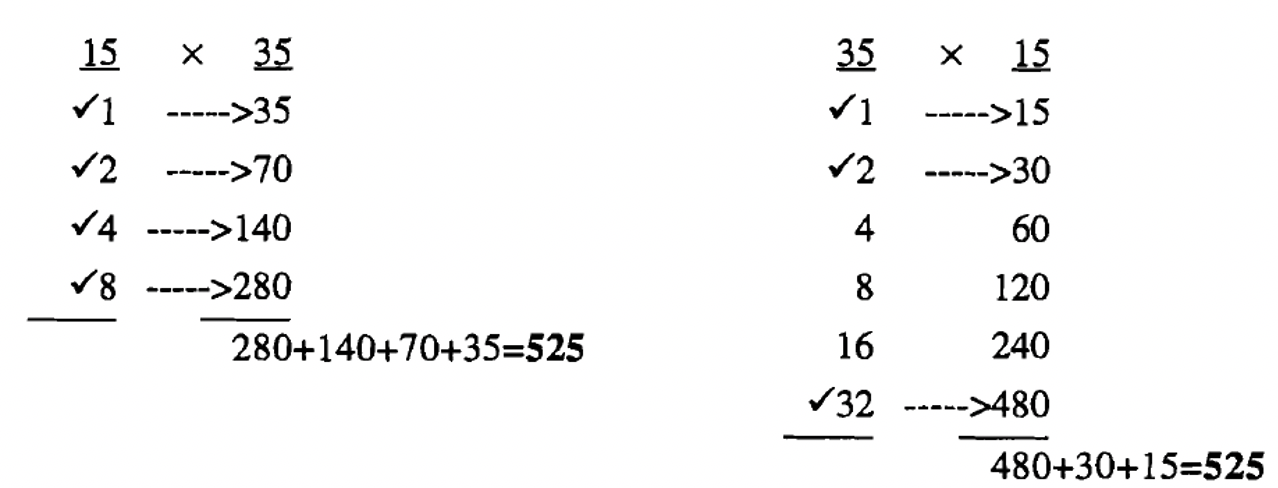
Here are two more examples for you to study. I'll do \(15 \times 35\) and \(35 \times 15\).
Multiply \(13 \times 29\) using duplation (Egyptian Multiplication). Show all of your work. Make it clear what is added together for each problem.
- Answer
-
\(\begin{aligned} &\begin{matrix}\underline{13} && \times & \underline{29} \\ *1 && 29 \\ 2 && 58 \\ *4 && 116 \\ *8 && 232 \end{matrix} \\ &\begin{matrix} \cdots \cdots && \cdots \cdots \end{matrix} \end{aligned}\)
13 x 29 = 232 + 116 + 29 = 377
The method you are now going to learn is called the LATTICE METHOD and it could be used for multiplying 2 digit or 3 digit or even bigger numbers together. The example we'll do is \(47 \times 32\).
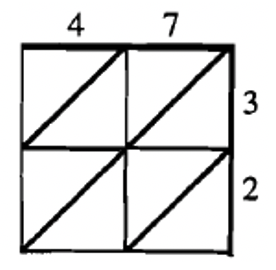
STEP 1: To begin, put one of the numbers at the top (47) of a rectangle (that has a space for each digit in the number) and the other number along the side (32) of the same rectangle (that has a space for each digit). In this case, we need a rectangle that has two spaces across the top and 2 spaces along the side. Then, you make diagonals. Look to the right.
STEP 2: Multiply each of the digits on the top by each of the digits along the side, and put the answer where they would meet. For instance, look where the 12 goes when you multiply 4 times 3.
STEP 3: There are three other multiplications to do: 7 times 3, 4 times 2 and 7 times 2. Do you see how all the answers are filled in? It doesn’t matter which ones you multiply and put in first.
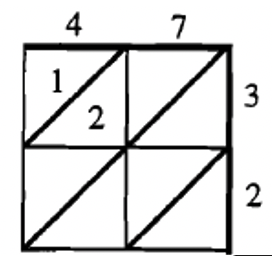
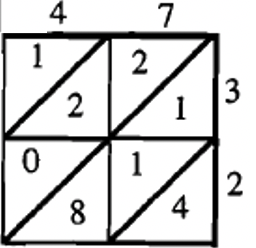
STEP 4: There are four diagonals (made up of little triangles) slanting to the right inside the rectangle. Starting with the one in the right bottom corner, add the digits inside each diagonal and fill put the sum in the “cup” under its diagonal. In the first diagonal is 4, so 4 is put in the “cup” under its diagonal (bottom right of rectangle). In the next diagonal are three digits a 1, 1 and 8 which adds up to 10, so put a 0 in the cup under that diagonal (at the bottom to the left) and a 1 (for the carry) in one of the triangles to the left. The next diagonal has a 2, 2, 0 and 1, which adds up to 5, and goes in the “cup” under its diagonal (left, bottom). In the last diagonal, there is just a 1, so a 1 is put in the “cup”under its diagonal (left, top). Look at how I filled in the numbers one at a time.
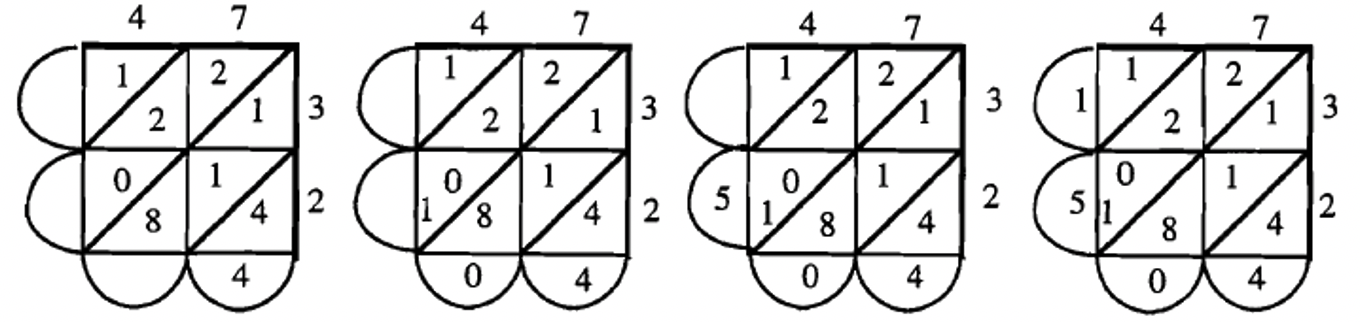
STEP 5: The numbers you filled in under each diagonal in the “cups” (outside the rectangle) form the answer. It is read by starting at the left top and reading down and then across the bottom. In this case, the answer is 1504. Isn’t that cool? That’s all there is to it!
Most of my students love this very old Lattice method of multiplying. It works as easily for small numbers as it does for large numbers. First, you simply do a series of simple single digit multiplications, and then you add, with carrying. Actually you could use the left to right (with underlining for carrying) method of addition for the last step. The main disadvantage is that you have to draw a lattice, which is a small price to pay to make multiplication easier and less complicated. Most likely, it takes less time than using the standard algorithm with carrying, because there's less chance of error and confusion with all that multiplying and carrying, etc. I propose all students learn multiplication this way first, and let them stay with it if they like it. Who needs to shorten it up and make it more complicated than it really is? Ah, well, I take it you get my point.
Use the lattices provided in a) and b) to multiply the given numbers. Then write the answer in the space provided. For c, draw your own lattice to compute the multiplication. By the way, you don't have to draw the little cups.
|
a. \(63 \times 57\) = ____ 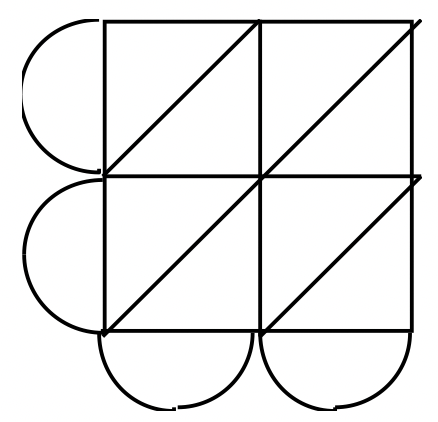 |
b. \(342 \times 85\) = ____ 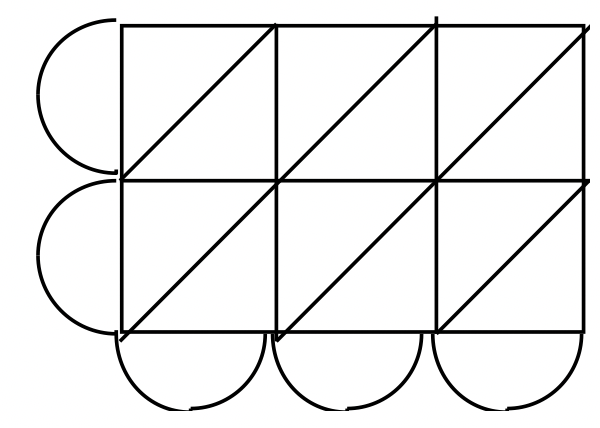 |
| c. \(58 \times 67\) = ____ Draw your own lattice. |
- Answer
-
a)
 b)
 c) 3886
Standard Algorithm for Multiplication
Before we take a look at the standard algorithm for multiplication, Figure 4.3.3 shows different conceptual ways to see multiplication. The concrete model is a way of seeing repeated addition using base-10 blocks, while the Place Value Representation uses expanded forms and distributive property to calculate the product.

Figure \(\PageIndex{3}\)
Finally, you could use the standard multiplication algorithm to compute products. This is the shortest algorithm in terms of space on the paper, but you have to be fairly adept at mental calculations. However, before we do what we learned in elementary school , we can use the Intermediate Algorithm (Partial Products Algorithm) to compute multiplication problems - See Figure 4.3.3.
Consider 346 x 70. Doing the intermediate algorithm or partial products algorithm is similar to how we used the distributive property to multiply. For instance, to multiply, rewrite the problem like this:
\(\begin{aligned} & 346 \times 72 = (300 + 40 + 6) \times (70 + 2) \\ &= (300 + 40 + 6) \times 70 + (300 + 40 + 6) \times 2 \\ &= 300 \times 70 + 40 \times 70 + 6 \times 70 + 300 \times 2 + 40 \times 2 + 6 \times 2 \\ &= 21000 + 2800 + 420 + 600 + 80 + 12 \\ &= 24912 \end{aligned}\)
The partial products are shown in the third line in the example above. They are:
\(300 \times 70, 40 \times 70, 6 \times 70, 300 \times 2, 40 \times 2 \text{ and } 6 \times 2\)
It's easier to write this in a vertical format. I'll show this problem two ways. It doesn't matter which partial products you multiply first. The second way it is shown is more similar to our standard algorithm, where we start with the unit's value of the bottom number and eventually work up to the larger place values.
| \(\begin{aligned} 346 \\ \times \underline{ 72} \\ 21000 && (300 \times 70) \\ 2800 && (40 \times 70) \\ 420 && (6 \times 70) \\ 600 && (300 \times 2) \\ 80 && (40 \times 2) \\ \underline{12} && (6 \times 2) \\ 24912 \end{aligned}\) | \(\begin{aligned} 346 \\ \times \underline{ 72} \\ 12 && (2 \times 6) \\ 80 && (2 \times 40) \\ 600 && (2 \times 300) \\ 420 && (70 \times 6) \\ 2800 && (70 \times 40) \\ \underline{21000} && (70 \times 300) \\ 24912 \end{aligned}\) |
On the left the first three partial products are \(346 \times 70\) and the second three partial products are \(346 \times 2\). On the right, the first three partial products are \(2 \times 346\) and the second three partial products are \(70 \times 346\).
Our standard algorithm is simply a shortening up of the partial products algorithm. We don't write all the zeroes and we doing the carrying involved with adding more than one partial product at a time in our head. Sure, it's shorter, but it is easier to make mistakes.
\(\begin{aligned} 346 \\ \times \underline{ 72} \\ 692 && (2 \times 346) \\ \underline{24220} && (70 \times 346) \\ 24912 \end{aligned}\)
Usually we just move over one place to the left to account for the zero in the one's place and don't write the zero in 24220. We "think" 7 times 346.
For each problem, write out the partial products in a vertical format to multiply the numbers together. Show your work, identifying the multiplication for each partial product. Check your answer using the standard algorithm.
a) \(\begin{aligned} 27 \\ \times \underline{91} \end{aligned}\)
b) \(\begin{aligned} 538 \\ \times \underline{34} \end{aligned}\)
- Answer
-
a) \(\begin{aligned} 27\\ \times \underline{ 91} \\ 7 && (1 \times 7) \\ 20 && (1 \times 20) \\ 630 && (90 \times 7) \\ \underline{1800} && (90 \times 20) \\ 2457 \end{aligned}\)
b)
\(\begin{aligned} 538 \\ \times \underline{ 34} \\ 2000 && (4 \times 500) \\ 120 && (4 \times 30) \\ 32 && (4 \times 8) \\ 240 && (30 \times 8) \\ 900 && (30 \times 30) \\ \underline{15000} && (30 \times 500) \\ 2457 \end{aligned}\)
Wonder, Play, Grow
Task 1: Considering the diverse sets of algorithms we learned to multiply, how would you do the following base-5 and base-2 problems? Try the first two independently, make sure to make an effortful attempt even if you are not sure. Try something.
i) \(34_{\text{five}} \times 2_{\text{five}}\)
ii) \(101_{\text{two}} \times 10_{\text{two}}\)
Task 2: Now share with others what you did. Decide together what is the best way to proceed to complete these problems.
Task 3: Compute the following.
iii) \(34_{\text{five}} \times 12_{\text{five}}\)
iv) \(134_{\text{five}} \times 32_{\text{five}}\)
iV) \(1011_{\text{two}} \times 110_{\text{two}}\)
Division
While calculators can now do much of this work for us, understanding long division—especially with one- or two-digit divisors—is still useful and helps us think mathematically. To make this clearer, we'll use base ten blocks and repeated subtraction to build a strong visual and conceptual foundation before moving into the standard algorithm. Remember, division isn’t just one way of doing things—there are many strategies, and we’ll look at several so you can choose the one that makes the most sense to you.
Let's recall the division algorithm (it states that if a and b are any whole numbers with b ≠ 0, there exist unique whole numbers q and r such that a = bq + r, where 0 ≤ r < b). Remember its just a way of expressing division using a simple idea: if you have two whole numbers, like 17 and 5, you can figure out how many times 5 fits into 17 and what's left over. In math language, we say that 17 = 5 × 3 + 2. That means 5 fits into 17 three times with 2 left over. This idea is behind the long division standard algorithm, a method you may have seen before. The following Figure 4.3.1 illustrates the sharing division using base ten blocks and the standard algorithm. Find the quotient and remainder of 343 divided by 3, 343 = 3 x 114 + 1

343
 Three equal groups with one remaining - Sharing Division
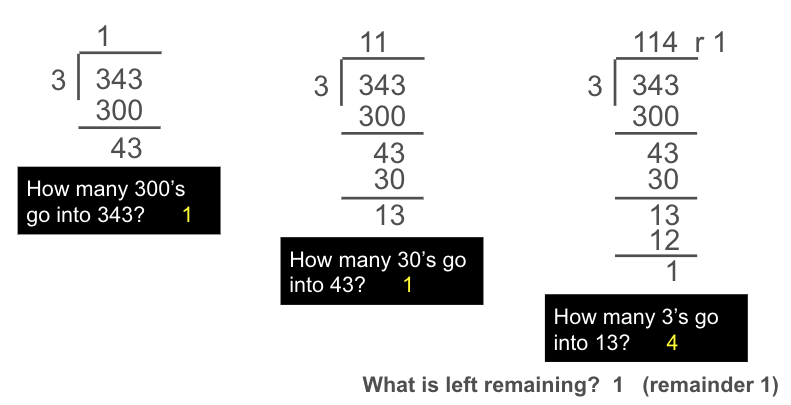 Standard Algorithm of Division
There are other ways of performing division. Let's start with a division algorithm that is "between" repeated subtraction of the divisor and long division.
Scaffold Division
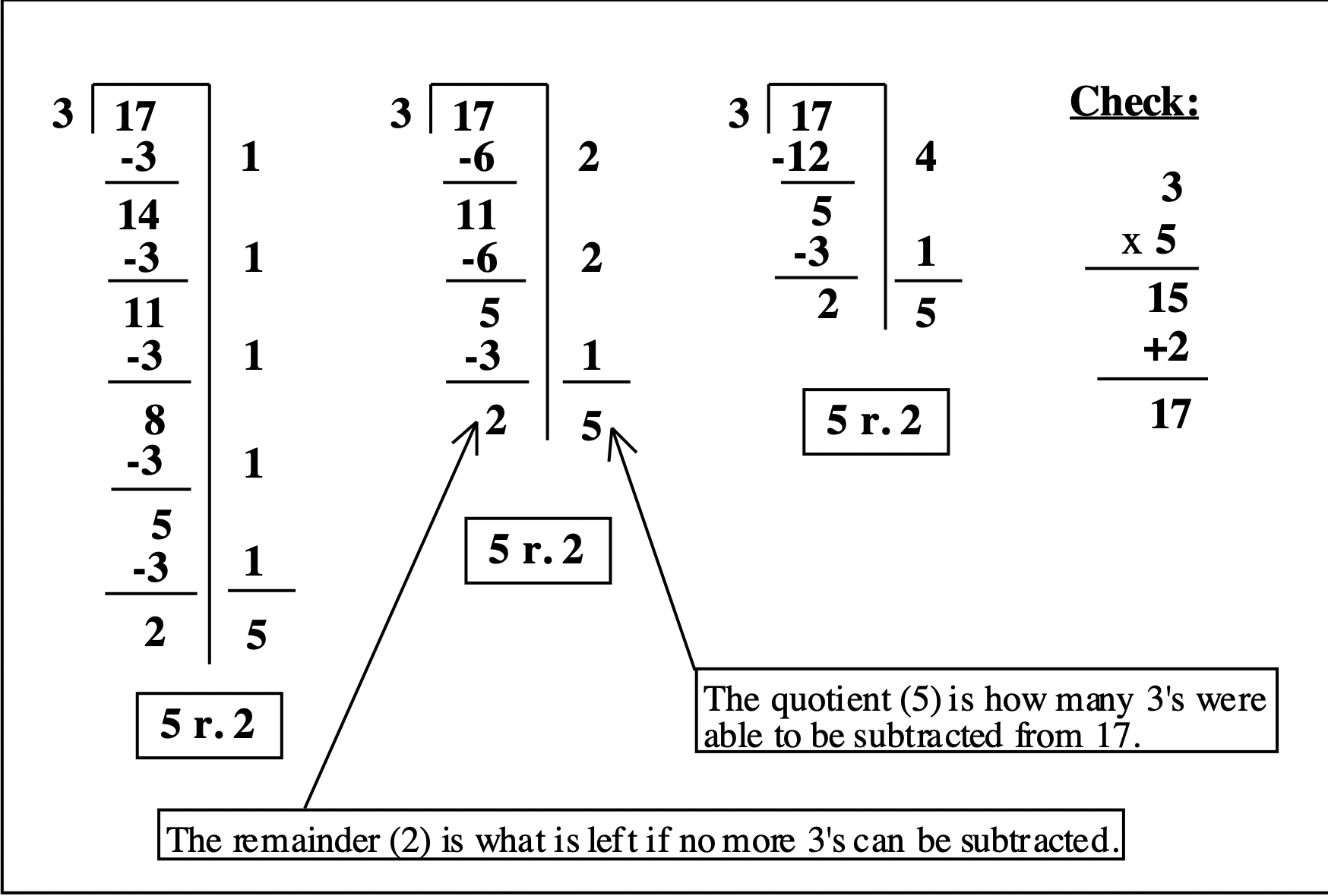
Let's consider \(\frac{17}{3}\). We will do this three different ways using what's called a scaffold. To make a scaffold, write the dividend, then draw a line starting to the left of the dividend and going up and around to the right of the dividend, extending as far downward as needed (it will not be clear how far this is until we are finished, so start short and simply extend downward as you continue through the problem). Write the divisor to the left of the part of the scaffold that goes around the dividend. See below.
In the first example below, we subtract 3 repeatedly (no short cuts!). We keep track of how many threes we subtract at each step to the right of the scaffold. Since 3 is subtracted one at a time, and a total of five 3's are subtracted before we get to 2 (any more and we would get a negative value as a result, so we stop), we have 5 ones to the right of the scaffold.
In the second one, first 2 threes are subtracted at once, then 2 more, and then 1 more. Notice that the numbers 2, 2, and 1 are written to the right of the scaffold. We stop because the last difference is 2, which means we cannot take away another 3. That means, again, we subtracted a total of 5 threes.
In the third one, first 4 threes are subtracted at once (and 4 is written to the right of the scaffold), and then only 1 more (and 1 is written to the right of the scaffold). Again, we stop because the difference is 2. And again this means we subtracted a total of 5 threes.
In each case, we got that \(17 \div 3 = 5\) with a remainder of 2.
🧠Let's Listen to Learn❤️
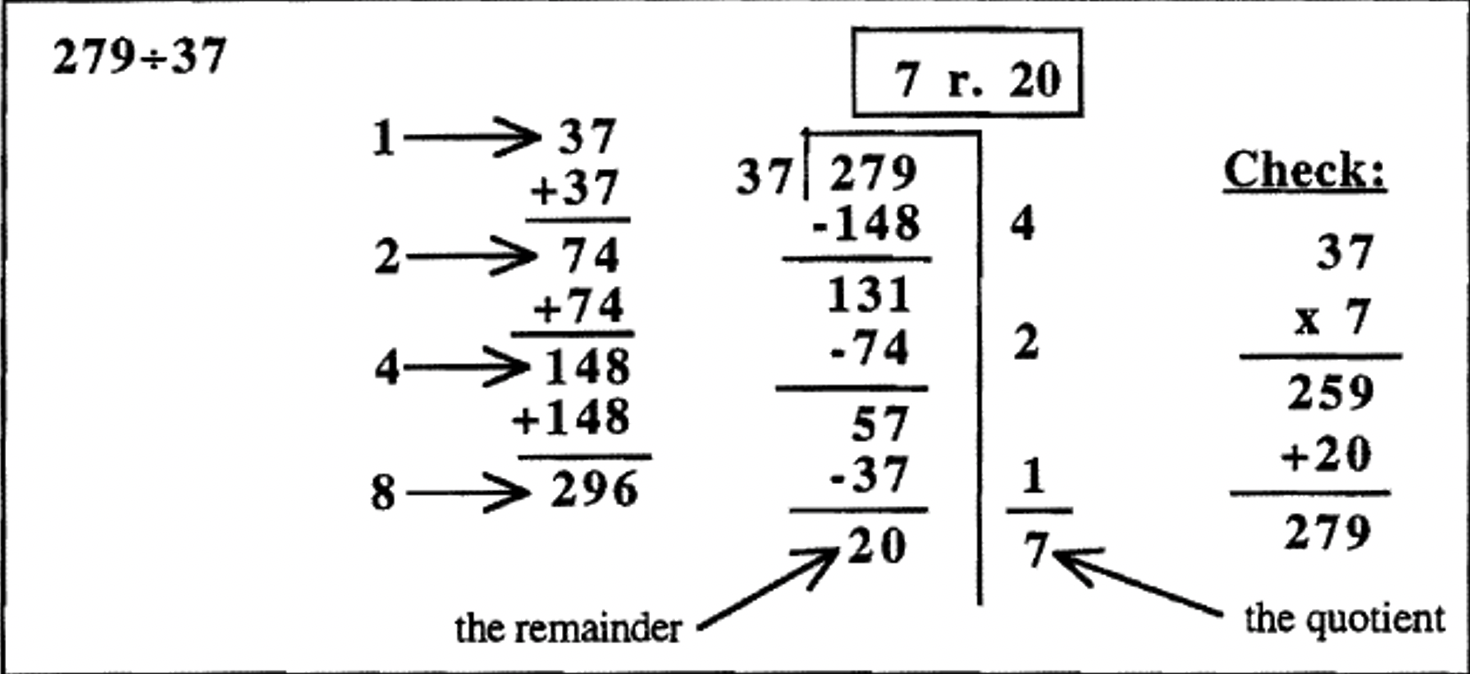
Long division with large numbers is often difficult because you have to multiply in your head or use a lot of space for scratch work to find the largest possible factor for each multiplication step. It's easy to make mistakes! But, by using scaffold division, you can keep the scratch work organized, and you do not have to find the largest number times one number "goes into" another number.
Divide \(\frac{279}{37}\) using a scaffold.
Wonder, Play, Grow
Task 1: Try the following problem on your own using scaffold division: \(361 \div 53\).
Now that you have tried it, let's do it together. The way we will do this might look different than what you did, but that does not mean your work is incorrect! Scaffold division lets the user choose what works best for them.
Task 2: Analyze this work done by a young student. Identify which division problem they are completing and check if their work is correct. Discuss with your peers what you see.


- Answer
-
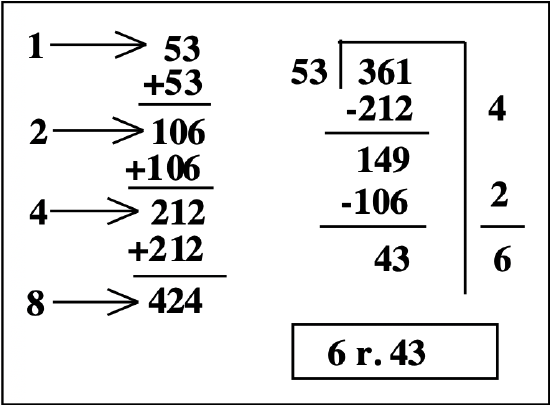
To check, multiply \(53 \times 6\) and add 43. You should have gotten 361.
Divide \(\frac{8871}{231}\) using the scaffold and the standard long division algorithm.
- Answer
-
Scaffold

Long Division
