

6.2: Fraction Addition and Subtraction
- Page ID
- 186355
\( \newcommand{\vecs}[1]{\overset { \scriptstyle \rightharpoonup} {\mathbf{#1}} } \)
\( \newcommand{\vecd}[1]{\overset{-\!-\!\rightharpoonup}{\vphantom{a}\smash {#1}}} \)
\( \newcommand{\dsum}{\displaystyle\sum\limits} \)
\( \newcommand{\dint}{\displaystyle\int\limits} \)
\( \newcommand{\dlim}{\displaystyle\lim\limits} \)
\( \newcommand{\id}{\mathrm{id}}\) \( \newcommand{\Span}{\mathrm{span}}\)
( \newcommand{\kernel}{\mathrm{null}\,}\) \( \newcommand{\range}{\mathrm{range}\,}\)
\( \newcommand{\RealPart}{\mathrm{Re}}\) \( \newcommand{\ImaginaryPart}{\mathrm{Im}}\)
\( \newcommand{\Argument}{\mathrm{Arg}}\) \( \newcommand{\norm}[1]{\| #1 \|}\)
\( \newcommand{\inner}[2]{\langle #1, #2 \rangle}\)
\( \newcommand{\Span}{\mathrm{span}}\)
\( \newcommand{\id}{\mathrm{id}}\)
\( \newcommand{\Span}{\mathrm{span}}\)
\( \newcommand{\kernel}{\mathrm{null}\,}\)
\( \newcommand{\range}{\mathrm{range}\,}\)
\( \newcommand{\RealPart}{\mathrm{Re}}\)
\( \newcommand{\ImaginaryPart}{\mathrm{Im}}\)
\( \newcommand{\Argument}{\mathrm{Arg}}\)
\( \newcommand{\norm}[1]{\| #1 \|}\)
\( \newcommand{\inner}[2]{\langle #1, #2 \rangle}\)
\( \newcommand{\Span}{\mathrm{span}}\) \( \newcommand{\AA}{\unicode[.8,0]{x212B}}\)
\( \newcommand{\vectorA}[1]{\vec{#1}} % arrow\)
\( \newcommand{\vectorAt}[1]{\vec{\text{#1}}} % arrow\)
\( \newcommand{\vectorB}[1]{\overset { \scriptstyle \rightharpoonup} {\mathbf{#1}} } \)
\( \newcommand{\vectorC}[1]{\textbf{#1}} \)
\( \newcommand{\vectorD}[1]{\overrightarrow{#1}} \)
\( \newcommand{\vectorDt}[1]{\overrightarrow{\text{#1}}} \)
\( \newcommand{\vectE}[1]{\overset{-\!-\!\rightharpoonup}{\vphantom{a}\smash{\mathbf {#1}}}} \)
\( \newcommand{\vecs}[1]{\overset { \scriptstyle \rightharpoonup} {\mathbf{#1}} } \)
\(\newcommand{\longvect}{\overrightarrow}\)
\( \newcommand{\vecd}[1]{\overset{-\!-\!\rightharpoonup}{\vphantom{a}\smash {#1}}} \)
\(\newcommand{\ket}[1]{\left| #1 \right>}\)
\(\newcommand{\bra}[1]{\left< #1 \right|}\)
\(\newcommand{\braket}[2]{\left< #1 \vphantom{#2} \right| \left. #2 \vphantom{#1} \right>}\)
\(\newcommand{\braopket}[3]{\left< #1 \vphantom{#2}\vphantom{#3} \right| #2 \vphantom{#1}\vphantom{#3} \left| #3 \vphantom{#1}\vphantom{#2} \right>}\)
\(\newcommand{\qmvec}[1]{\mathbf{\vec{#1}}}\)
\(\newcommand{\op}[1]{\hat{\mathbf{#1}}}\)
\(\newcommand{\expect}[1]{\langle #1 \rangle}\)
\(\newcommand{\dfn}[1]{\emph{\textbf{#1}}}\)
Adding and subtracting fractions is a foundational yet often challenging concept for elementary students. Many struggle to see fractions as single quantities, instead interpreting them as two separate whole numbers—leading to common errors like adding numerators and denominators directly (e.g., thinking 1/3 + 1/2 = 2/5). These misconceptions are compounded by confusion around the need for common denominators, which stems from a lack of understanding that fractions must represent parts of the same whole. Procedural instruction without conceptual grounding further exacerbates the issue, leaving students overwhelmed and prone to mistakes. To address this, future teachers must emphasize conceptual understanding through visual models, real-world contexts, and a clear focus on the meaning behind operations, fostering a more accurate and intuitive grasp of fraction addition and subtraction (NCTM, 2020).
When first learning fraction operations, students view the addition of fractions as adding the numerators and adding the denominators: \(\large\frac{3}{4}\) + \(\large\frac{1}{2}\) = \(\large\frac{4}{6}\). Using this example, think about why such a method for addition is unreasonable. You may want to use fractions strips to help with your understanding. Be prepared to discuss your ideas with your peers.

Model Fraction Addition
How many quarters are pictured, if you even know what these are (😆)? One quarter plus \(2\) quarters equals \(3\) quarters.

Figure \(\PageIndex{1}\)
Remember, quarters are really fractions of a dollar. Quarters are another way to say fourths. So the picture of the coins shows that
\[\begin{split} \dfrac{1}{4} \qquad \qquad \qquad \dfrac{2}{4} \qquad & \qquad \qquad \dfrac{3}{4} \\ one \; quarter + two \; quarters &= three\; quarters \end{split} \nonumber \]
So again, we see that
\[\dfrac{1}{4} + \dfrac{2}{4} = \dfrac{3}{4} \nonumber \]
Addition of fractions is an extension of whole-number addition and can be motivated using models. To find the sum of \(\large\frac{3}{5}\) + \(\large\frac{1}{5}\), consider the following models Figure 6.2.1: region, fraction strip, number-line model.

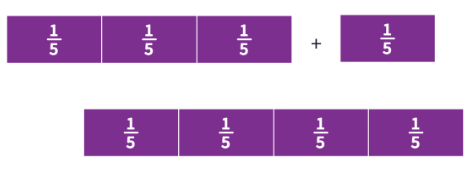

We see from those models that
\[\dfrac{3}{5} + \dfrac{1}{5} = \dfrac{4}{5} \nonumber \]
If \(a\), \(b\), and \(c\) are numbers where \(c ≠ 0\), then
\[\dfrac{a}{c} + \dfrac{b}{c} = \dfrac{a + b}{c}\]
To add fractions with a common denominator, add the numerators and place the sum over the common denominator.
Use a model to find the sum. Show a diagram to illustrate your model. \[\dfrac{1}{8} + \dfrac{4}{8} \nonumber \]
- Answer
-
\(\dfrac{5}{8}\)

How about ⅔ + ¼? Use fractions strips to build a model for this sum. Be prepared to discuss your ideas with your peers.
- MODEL
-

🧠Let's Listen to Learn❤️
Addition of Fractions with Unlike Denominators
Let \(\large\frac{a}{b}\) and \(\large\frac{c}{d}\) be any fractions. Then \(\large\frac{a}{b}\) + \(\large\frac{c}{d}\) = \(\large\frac{ad+bc}{bd}\)
- PROOF
-
\(\large\frac{a}{b}\) + \(\large\frac{c}{d}\) = \(\large\frac{ad}{bd} \) + \(\large\frac{bc}{bd}\) = \(\large\frac{ad + bc}{bd}\)
In words, to add fractions with unlike denominators, find equivalent fractions with common denominators. Then the sum will be represented by the sum of the numerators over the common denominator
Find the following sums and simplify.
a) \(\large\frac{5}{9}\text{+}\large\frac{3}{4}\)
b) \(\large\frac{17}{15}\text{+}\large\frac{5}{12}\)
c) \(\large\frac{3}{5}\text{ + (}\large\frac{4}{7}\text{ + }\large\frac{2}{5}\text{)}\)
- Answer
-
a) 20/36 + 27/36 = 47/36
b) Do not cross multiply, it may be easier to first find a common denominator. 68/60 + 25/60 = 93/60. 93/60 simplifies to 31/20.
c) (3/5 + 2/5) + 4/7 = 1 + 4/7 = 1\(\large\frac{4}{7}\) or 1+4/7 = 7/7 + 4/7 = 11/7
Use the Desmos Scientific Calclator to check your work.
Improper Fractions and Mixed Numbers
As we saw in the previous example, the number 1 + 4/7 can be expressed as the mixed number and as an improper fraction. For example, 2\(\large\frac{1}{2}\), can be seen as 2 + 1/2, which can be represented as 4/2 + 1/2 = 5/2. Any mixed number can be changed to an improper fraction, and vice versa.
a) Express 3\(\large\frac{2}{5}\) as an improper fraction.
b) Express 36/7 as a mixed number.
- Answer
-
a) 3 + 2/5 = 15/5 + 2/5 = 17/5. Do you know a shortcut?
b) 36/7 = 35/7 + 1/7 = 5 + 1/7 = 5\(\large\frac{1}{7}\). Do you know another way to do this?
Divide the numerator by the denominator.
- The quotient is the whole number part of the mixed number.
- The remainder becomes the new numerator.
Keep the same denominator from the original fraction.
When converting a mixed number to an improper fraction, why do we multiply the whole number times the denominator of the fractional part, add this product to the numerator of the fractional part, and write the result over the denominator of the fractional part?
1.Multiply the whole number by the denominator.
2.Add the numerator to this product.
3. Write this new sum over the original denominator.
IMPORTANT: Children may know the rule for converting a mixed number to an improper fraction, but they often do not understand why they do this. Make sure you do before moving on.
Fraction Subtraction
Subtraction of fractions can be viewed in two ways as we did with whole-number subtraction—either as (1) take-away or (2) using the missing-addend approach. The same rules follow as fraction addition.
If \(a\), \(b\), and \(c\) are numbers where \(c ≠ 0\), then
\[\dfrac{a}{c} - \dfrac{b}{c} = \dfrac{a-b}{c}\]
To subtract fractions with a common denominator, we subtract the numerators and place the difference over the common denominator.
\(\dfrac{4}{5} − \dfrac{1}{5}\) = \(\dfrac{4-1}{5}\) = \(\dfrac{3}{5}\).

Subtraction of Fractions with Unlike Denominators
Let \(\large\frac{a}{b}\) and \(\large\frac{c}{d}\) be any fractions. Then \(\large\frac{a}{b}\) - \(\large\frac{c}{d}\) = \(\large\frac{ad-bc}{bd}\)
NOTE: In this case we have \(\large\frac{a}{b}\) ≥ \(\large\frac{c}{d}\).
Find the following differences.
a) \(\dfrac{4}{7} − \dfrac{3}{8}\).
b) \(\dfrac{25}{12} − \dfrac{7}{18}\).
- Answer
-
a) \(\dfrac{4}{7} − \dfrac{3}{8}\) = \(\dfrac{4•8}{7•8} − \dfrac{3•7}{8•7}\) = \(\dfrac{32-21}{56}\) = 11/56
b) NOTE: LCM(12, 18)=36
\(\dfrac{25}{12} − \dfrac{7}{18}\)=\(\dfrac{25•3}{12•3} − \dfrac{7•2}{18•2}\) = \(\dfrac{75-14}{36}\) = 61/36
Mental Math and Estimation
Mental Math and Estimation for Addition and Subtraction Mental math and estimation techniques similar to those used with whole numbers can be used with fractions.
Estimate using the indicated techniques or your own techniques that come to mind.
a) 3\(\large\frac{3}{7}\) + 6\(\large\frac{2}{5}\) using range estimation.
b) 15\(\large\frac{1}{4}\) - 7\(\large\frac{3}{5}\) using front-end with adjustment.
c) 3\(\large\frac{5}{6}\) + 5\(\large\frac{1}{8}\) + 8\(\large\frac{3}{8}\) using rounding to the nearest 1/2 or whole.
- Answer
-
a) 3\(\large\frac{3}{7}\) + 6\(\large\frac{2}{5}\) is between 3 + 6 = 9 and 4 + 7 = 11.
b) 15\(\large\frac{1}{4}\) - 7\(\large\frac{3}{5}\) ≈ 7\(\large\frac{1}{2}\) since 15-7 = 8 and \(\large\frac{3}{5}\) ≈ \(\large\frac{1}{2}\).
c) 3\(\large\frac{5}{6}\) + 5\(\large\frac{1}{8}\) + 8\(\large\frac{3}{8}\) ≈ 4 + 5 + 8\(\large\frac{1}{2}\) = 17\(\large\frac{1}{2}\)
Which is larger? \(\large\frac{3}{8}\) or \(\large\frac{2}{3}\) ?
Think of a way to figure that out without a calculator and then be prepared to discuss this with your peers.
Using Benchmark Fractions
Expected of fifth grade students is the ability to use benchmark fractions and number sense of fractions to estimate mentally and assess the reasonableness of answers (CDE, 2013). One way to estimate the size of a fraction is to compare it to common benchmarks like 0, \(\frac{1}{2}\), and 1. For example, to compare \(\frac{5}{6}\) and \(\frac{5}{9}\), you might reason that \(\frac{5}{6}\) is very close to 1, while \(\frac{5}{9}\) is a little more than \(\frac{1}{2}\) (since \(\frac{4.5}{9}\))= \(\frac{1}{2}\). Therefore, you can estimate that \(\frac{5}{6}\) is larger than \(\frac{5}{9}\). You can also focus on the size of the unit fraction (the fraction with a numerator of 1). For example, when comparing \(\frac{1}{8}\) and \(\frac{1}{3}\), you can reason that thirds are larger parts than eighths (if the whole is the same), so \(\frac{1}{3}\) is larger.
Wonder, Play, Grow
Work collaboratively to share your thinking about the following questions. Keep in mind everything you have learned and that there will multiple ways to respond.
i) Which is larger, 5/6 or 5/9?
ii) Which is smaller, 2/11 or 1/9?
It's important to note that estimation skills develop slowly and require a strong conceptual understanding of fractions. Encouraging children to think about the meaning of fractions and use visual models can support the development of these estimation abilities (Feike et al., 2018).