

7.1: Decimals
- Page ID
- 186587
\( \newcommand{\vecs}[1]{\overset { \scriptstyle \rightharpoonup} {\mathbf{#1}} } \)
\( \newcommand{\vecd}[1]{\overset{-\!-\!\rightharpoonup}{\vphantom{a}\smash {#1}}} \)
\( \newcommand{\dsum}{\displaystyle\sum\limits} \)
\( \newcommand{\dint}{\displaystyle\int\limits} \)
\( \newcommand{\dlim}{\displaystyle\lim\limits} \)
\( \newcommand{\id}{\mathrm{id}}\) \( \newcommand{\Span}{\mathrm{span}}\)
( \newcommand{\kernel}{\mathrm{null}\,}\) \( \newcommand{\range}{\mathrm{range}\,}\)
\( \newcommand{\RealPart}{\mathrm{Re}}\) \( \newcommand{\ImaginaryPart}{\mathrm{Im}}\)
\( \newcommand{\Argument}{\mathrm{Arg}}\) \( \newcommand{\norm}[1]{\| #1 \|}\)
\( \newcommand{\inner}[2]{\langle #1, #2 \rangle}\)
\( \newcommand{\Span}{\mathrm{span}}\)
\( \newcommand{\id}{\mathrm{id}}\)
\( \newcommand{\Span}{\mathrm{span}}\)
\( \newcommand{\kernel}{\mathrm{null}\,}\)
\( \newcommand{\range}{\mathrm{range}\,}\)
\( \newcommand{\RealPart}{\mathrm{Re}}\)
\( \newcommand{\ImaginaryPart}{\mathrm{Im}}\)
\( \newcommand{\Argument}{\mathrm{Arg}}\)
\( \newcommand{\norm}[1]{\| #1 \|}\)
\( \newcommand{\inner}[2]{\langle #1, #2 \rangle}\)
\( \newcommand{\Span}{\mathrm{span}}\) \( \newcommand{\AA}{\unicode[.8,0]{x212B}}\)
\( \newcommand{\vectorA}[1]{\vec{#1}} % arrow\)
\( \newcommand{\vectorAt}[1]{\vec{\text{#1}}} % arrow\)
\( \newcommand{\vectorB}[1]{\overset { \scriptstyle \rightharpoonup} {\mathbf{#1}} } \)
\( \newcommand{\vectorC}[1]{\textbf{#1}} \)
\( \newcommand{\vectorD}[1]{\overrightarrow{#1}} \)
\( \newcommand{\vectorDt}[1]{\overrightarrow{\text{#1}}} \)
\( \newcommand{\vectE}[1]{\overset{-\!-\!\rightharpoonup}{\vphantom{a}\smash{\mathbf {#1}}}} \)
\( \newcommand{\vecs}[1]{\overset { \scriptstyle \rightharpoonup} {\mathbf{#1}} } \)
\(\newcommand{\longvect}{\overrightarrow}\)
\( \newcommand{\vecd}[1]{\overset{-\!-\!\rightharpoonup}{\vphantom{a}\smash {#1}}} \)
\(\newcommand{\ket}[1]{\left| #1 \right>}\)
\(\newcommand{\bra}[1]{\left< #1 \right|}\)
\(\newcommand{\braket}[2]{\left< #1 \vphantom{#2} \right| \left. #2 \vphantom{#1} \right>}\)
\(\newcommand{\braopket}[3]{\left< #1 \vphantom{#2}\vphantom{#3} \right| #2 \vphantom{#1}\vphantom{#3} \left| #3 \vphantom{#1}\vphantom{#2} \right>}\)
\(\newcommand{\qmvec}[1]{\mathbf{\vec{#1}}}\)
\(\newcommand{\op}[1]{\hat{\mathbf{#1}}}\)
\(\newcommand{\expect}[1]{\langle #1 \rangle}\)
\(\newcommand{\dfn}[1]{\emph{\textbf{#1}}}\)
The study of decimals is introduced after students have begun developing an understanding of fractions. Specifically, children begin studying decimals in the fourth grade. In this grade, instructional time focuses on developing an understanding of decimals, including the connections between fractions and decimals. One thing to keep in mind is that representing a number using a decimal system is just another way to represent a fraction. As we will see, the number 1\(\frac{3}{10}\) is the same value as 1.3, or that 0.75 is just another way to represent ¾. You may be thinking, why do we need to have different ways to represent the same values? That is an excellent question. We will explore these ideas in this section.
Name and Write Decimals
The word decimal comes from the Latin "decem", meaning ”ten”. Decimals fit naturally into our base-10 place value system, making them easier for most people to understand and manipulate, especially since this is the same system we use for whole numbers. As mentioned, decimals are another way of writing fractions whose denominators are powers of 10.
\[\begin{array} {ll} {0.1 = \frac { 1 } { 10 }} &{0.1 \text { is "one tenth" }} \\ {0.01 = \frac { 1 } { 100 }} &{0.01 \text { is "one hundredth }} \\ {0.001 = \frac { 1 } { 1,000 }} &{0.001 \text { is "one thousandth }} \\ {0.0001 = \frac { 1 } { 10,000 }} &{0.0001 \text { is "one ten-thousandth" }} \end{array}\]
Notice that “ten thousand” is a number larger than one, but “one ten-thousandth” is a number smaller than one. The “th” at the end of the name tells you that the number is smaller than one.
When we name a whole number, the name corresponds to the place value based on the powers of ten. We read 10,000 as “ten thousand” and 10,000,000 as “ten million.” Likewise, the names of the decimal places correspond to their fraction values. Figure \(\PageIndex{1}\) shows the names of the place values to the left and right of the decimal point.
Referring to Figure 7.1.1, the number 543.21 shows that the decimal point is placed between the ones column and the tenths column to show where the whole-number portion ends and where the decimal (or fractional) portion begins. Decimals are read as if they were written as fractions and the decimal point is read “and.” The number 543.21 is written in its expanded form as 5(100) + 4(10) + 3(1) + 2(1/10) + 1(1/100).
We see that 543.21 = 543 \(\frac{21}{100}\) is read “five hundred forty three and twenty one hundredths “. Note that the word "and" should only be used to indicate where the decimal point is located.
a) Write as a decimal: thirteen and sixty-eight thousandths.
b) Write as a decimal: five and ninety-four ten-thousandths.
c) Write 0.234 as a fraction.
d) Write 0.24 as a fraction.
- Answer
-
a) 13.068 b) 5.0094 c) \(\dfrac{234}{1000}\) = \(\dfrac{117}{500}\) d) \(\dfrac{24}{100}\) = \(\dfrac{6}{25}\)
Figure 7.1.2 shows how a hundreds square can be used to represent tenths and hundredths. Notice that the large square represents 1, one vertical strip represents 0.1, and each one of the smallest squares represents 0.01. A number line can also be used to picture decimals. The number line in Figure 7.1.3 shows the location of various decimals between 0 and 1.

Figure \(\PageIndex{2}\): Hundred Squares/Grids

Figure \(\PageIndex{3}\): A horizontal number line ranging from 0 to 1 is shown, divided into ten equal parts.
Rewrite each of these numbers in decimal form, and state the decimal name.
a) \(\dfrac{7}{100}\)
b) \(\dfrac{123}{10000}\)
c) \(1\frac{7}{8} \)
- Answer
-
a) 0.07, "seven hundredths"
b) \(
\frac{123}{10{,}000} = \frac{100}{10{,}000} + \frac{20}{10{,}000} + \frac{3}{10{,}000} = \frac{1}{100} + \frac{2}{1{,}000} + \frac{3}{10{,}000} = 0.0123,
\)c) \(
1\frac{7}{8} = 1 + \frac{7}{8} = 1 + \frac{7 \cdot 5 \cdot 5 \cdot 5}{2 \cdot 2 \cdot 2 \cdot 5 \cdot 5 \cdot 5} = 1 + \frac{875}{1000} = 1 + \frac{800}{1000} + \frac{70}{1000} + \frac{5}{1000} = 1 + \frac{8}{10} + \frac{7}{100} + \frac{5}{1000}
\) = 1.875NOTE: All of the fractions in this example have denominators whose only prime factors are 2 or 5. Such fractions can always be expressed in decimal form, since they have equivalent fractional forms whose denominators are powers of 10.
Wonder, Play, Grow
Use whatever method you would like to find the decimal representations of the following numbers.
\[
\frac{1}{3},\ \frac{3}{8},\ \frac{2}{7},\ \frac{4}{5},\ \frac{9}{36},\ \frac{25}{30},\ \frac{7}{15},\ \frac{27}{40} \nonumber
\]
Work with your peers to identify a rule that allows you to tell whether a fraction's decimal form will terminate just by examining the fraction.
🧠Let's Listen to Learn❤️
Fractions with Terminating Decimal Representations
Let a/b be a fraction in simplest form. Then a/b has a terminating decimal representation if and only if b contains only 2s and/or 5s in its prime factorization (since b can be expanded to a power of 10).
Well, what do you think? Can \(\frac{63}{72}\) be written as a terminating decimal? ________ Explain why or why not.
- Answer
-
The reason \(\frac{63}{72}\) can be written as a terminating decimal is because in its simplified form, it only has 2’s and/or 5’s as its prime factors. Here is how to finish this problem by simplifying first, and then multiplying by any needed factors of 2 or 5 to get the same number of each:
\(\frac{63}{72} = \frac{3 \cdot 3 \cdot 7}{2 \cdot 2 \cdot 2 \cdot 3 \cdot 3} = \frac{7}{2 \cdot 2 \cdot 2} \cdot \frac{5\cdot 5 \cdot 5}{5 \cdot 5 \cdot 5} = \frac{875}{1000} = 0.875\)
Ordering Decimals
Zeroes, which are behind a decimal's last non-zero digit, can be added or removed without changing the value of the decimal. If you look at some equivalent fraction, you'll see why this should be true. For example,
\[\dfrac{14}{100} = \dfrac{140}{1000} = \dfrac{1400}{10000} = \dfrac{14000}{100000}. \nonumber \]
These are all equivalent to \(\frac{14}{100}\) because the numerator and denominator was multiplied by some power of 10 (10, 100 or 1000) to get one of the other equivalent fractions. If we replace each of the four fractions above with their decimal equivalents, we get 0.14 = 0.140 = 0.1400 = 0.14000. Let's call any zeroes at the end of a decimal's last non-zero digit "trailing zeroes". Then, we could conclude that any number starting with .14 that has trailing zeroes is also equivalent, like 0.1400000.
Two decimals are equal only if one can be made to look identical to the other by adding or removing trailing zeroes. You can also determine if they are equivalent by removing any excess trailing zeroes from each to see if they are identical.
Case 1: To compare two or more decimals that are not equal, but have the same number of digits after the decimal point, you can write each as a fraction with the same denominator and then compare the numerator. For instance 0.14 is less than 0.21 since fourteen hundredths is less than twenty-one hundredths. Basically, in this case, it's just like comparing whole numbers. You'll be able to determine which is larger by comparing each number as if there was no decimal point. But, keep in mind this only makes sense if the numbers you are looking at have the same number of digits after the decimal point.
Case 2: To compare two or more decimals that are not equal that do not all have the same number of digits after the decimal point, first write each decimal with the same number of digits after the decimal point (by adding trailing zeroes to one or more if necessary). By doing that, you are comparing tenths with tenths, or hundredths with hundredth, etc., as you did in exercise 5.
Compare each of the following decimals using <, = or >.
a) 3.5 and 0.9
b) 35.06 and 35.0600
c) 0.8900 and 0.098
d) 0.08933 and 0.0894
- Answer
-
a) 3.5 > 0.9
b) 35.06 = 35.0600
c) 0.8900 > 0.098
d) 0.08933 < 0.0894
NOTE: In addition to looking at each digit from left to right - just like whole numbers - you can also compare terminating decimals by using a hundredths chart, a number line, and turning them into fractions.
Mental Math and Estimation, and Rounding
Before learning how to add, subtract, multiply, or divide decimals, you’ll first build your skills with mental math and estimation—just like you did with whole numbers and fractions—to help you feel confident working with decimal problems.
Use compatible (decimal) numbers, properties, and/or compensation to calculate the following mentally.
a) 1.7 + (3.2 + 4.3)
b) (0.5 x 6.7) x 4
c) 6 x 8.5
d) 3.76 + 1.98
e) 7.32 − 4.94
- Answer
-
a) 1.7 + (3.2 + 4.3) = (1.7 + 4.3) + 3.2 = 6 + 3.2 = 9.2. Here 1.7 and 4.3 are compatible numbers with respect to addition, since their sum is 6.
b) (0.5 x 6.7) x 4 = 6.7 x (0.5 x 4) = 6.7 x 2 = 13.4.
c) Using distributivity, 6 x 8.5 = 6(8 + 0.5) = 6 x 8 + 6 x 0.5 = 48 + 3 = 51.
d) 3.76 + 1.98 = 3.74 + 2 = 5.74 using additive compensation.
e) 7.32 − 4.94 = 7.38 − 5 = 2.38 by equal additions.

Find these products using fraction equivalents.
a) 68 x 0.5
b) 0.25 x 48
c) 0.2 x 375
d) 0.05 x 280
- Answer
-
a) 68 x 1/2 = 34
b) 1/4 x 48 = 12
c) 1/5 x 375 = 75
d) 1/20 x 280 = 14
You can multiply or divide decimals by powers of 10 using mental math, just like you would with whole numbers.
Find the following products and quotients by converting to fractions.
a) 3.14 x 1000
b) 27.018 x 100000
c) 123.4 ÷ 100
d) 0.89 ÷ 10000
- Answer
-
a) \(\frac{314}{100} \times \frac{1000}{1}\)= 3140
b) \(\frac{27018}{1000} \times \frac{100000}{1}\) = 2701800
c) \(\frac{1234}{10} \div \frac{100}{1}\) = \(\frac{1234}{10} \times \frac{1}{100}\) = 1.234
d) \(\frac{89}{100} \div \frac{10000}{1}\) = \(\frac{89}{100} \times \frac{1}{10000}\) = 0.000089
This mental mathematics leads to the
Multiplying/Dividing Decimals by Powers of 10
Let n be any decimal number and m represent any nonzero whole number. Multiplying a number n by 10m is equivalent to forming a new number by moving the decimal point of n to the right m places. Dividing a number n by 10m is equivalent to forming a new number by moving the decimal point of n to the left m places.
Using the theorem, we can rewrite Example 7.1.6 in the following way:
a) 3.14 x 10³
b) 27.018 x 10⁵
c) 123.4 ÷ 102
d) 0.89 ÷ 104
Round Decimals
Rounding decimals is very much like rounding whole numbers. We will round decimals with a method based on the one we used to round whole numbers. Overall, rounding decimals helps students understand the structure of the decimal system through place value and provides a valuable tool for estimating, checking computations, and simplifying numbers in both mathematical exercises and real-world contexts
We summarize the steps for rounding a decimal here.
- Locate the given place value and mark it with an arrow.
- Underline the digit to the right of the place value.
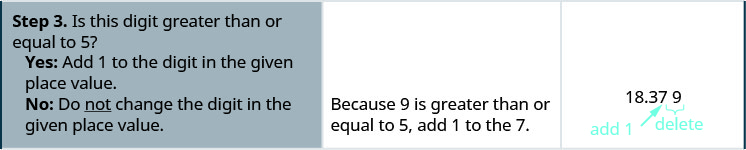
- Is this digit greater than or equal to 5?
- Yes—add 1 to the digit in the given place value.
- No—do not change the digit in the given place value.
- Rewrite the number, deleting all digits to the right of the rounding digit.
a) Round 18.379 to the nearest hundredth.
b) Round 1.047 to the nearest hundredth.
c) Round 29.512 to the nearest whole number.
- Answer
-
a)



b) 1.05
c) 30
One of the most effective techniques for estimating with decimals is rounding them to values that produce compatible whole numbers or fractions.
Estimate.
a) 203.4 × 47.8
b) 31 ÷ 1.93
c) 75 × 0.24
d) 124 ÷ 0.74
- Answer
-
a) 203.4 × 47.8 ≈ 200 × 50 = 10,000
b) 31 ÷ 1.93 ≈ 30 ÷ 2 = 15
c) 75 × 0.24 = 75 × ¼ × 0.96 ≈ 76 × ¼ = 19
d) 124 ÷ 0.74 ≈ 124 ÷ ¾ = 124 × 4⁄3 ≈ 123 × 4⁄3 = 164