

7.2: Understanding Decimal Operations
- Page ID
- 186588
\( \newcommand{\vecs}[1]{\overset { \scriptstyle \rightharpoonup} {\mathbf{#1}} } \)
\( \newcommand{\vecd}[1]{\overset{-\!-\!\rightharpoonup}{\vphantom{a}\smash {#1}}} \)
\( \newcommand{\dsum}{\displaystyle\sum\limits} \)
\( \newcommand{\dint}{\displaystyle\int\limits} \)
\( \newcommand{\dlim}{\displaystyle\lim\limits} \)
\( \newcommand{\id}{\mathrm{id}}\) \( \newcommand{\Span}{\mathrm{span}}\)
( \newcommand{\kernel}{\mathrm{null}\,}\) \( \newcommand{\range}{\mathrm{range}\,}\)
\( \newcommand{\RealPart}{\mathrm{Re}}\) \( \newcommand{\ImaginaryPart}{\mathrm{Im}}\)
\( \newcommand{\Argument}{\mathrm{Arg}}\) \( \newcommand{\norm}[1]{\| #1 \|}\)
\( \newcommand{\inner}[2]{\langle #1, #2 \rangle}\)
\( \newcommand{\Span}{\mathrm{span}}\)
\( \newcommand{\id}{\mathrm{id}}\)
\( \newcommand{\Span}{\mathrm{span}}\)
\( \newcommand{\kernel}{\mathrm{null}\,}\)
\( \newcommand{\range}{\mathrm{range}\,}\)
\( \newcommand{\RealPart}{\mathrm{Re}}\)
\( \newcommand{\ImaginaryPart}{\mathrm{Im}}\)
\( \newcommand{\Argument}{\mathrm{Arg}}\)
\( \newcommand{\norm}[1]{\| #1 \|}\)
\( \newcommand{\inner}[2]{\langle #1, #2 \rangle}\)
\( \newcommand{\Span}{\mathrm{span}}\) \( \newcommand{\AA}{\unicode[.8,0]{x212B}}\)
\( \newcommand{\vectorA}[1]{\vec{#1}} % arrow\)
\( \newcommand{\vectorAt}[1]{\vec{\text{#1}}} % arrow\)
\( \newcommand{\vectorB}[1]{\overset { \scriptstyle \rightharpoonup} {\mathbf{#1}} } \)
\( \newcommand{\vectorC}[1]{\textbf{#1}} \)
\( \newcommand{\vectorD}[1]{\overrightarrow{#1}} \)
\( \newcommand{\vectorDt}[1]{\overrightarrow{\text{#1}}} \)
\( \newcommand{\vectE}[1]{\overset{-\!-\!\rightharpoonup}{\vphantom{a}\smash{\mathbf {#1}}}} \)
\( \newcommand{\vecs}[1]{\overset { \scriptstyle \rightharpoonup} {\mathbf{#1}} } \)
\(\newcommand{\longvect}{\overrightarrow}\)
\( \newcommand{\vecd}[1]{\overset{-\!-\!\rightharpoonup}{\vphantom{a}\smash {#1}}} \)
\(\newcommand{\ket}[1]{\left| #1 \right>}\)
\(\newcommand{\bra}[1]{\left< #1 \right|}\)
\(\newcommand{\braket}[2]{\left< #1 \vphantom{#2} \right| \left. #2 \vphantom{#1} \right>}\)
\(\newcommand{\braopket}[3]{\left< #1 \vphantom{#2}\vphantom{#3} \right| #2 \vphantom{#1}\vphantom{#3} \left| #3 \vphantom{#1}\vphantom{#2} \right>}\)
\(\newcommand{\qmvec}[1]{\mathbf{\vec{#1}}}\)
\(\newcommand{\op}[1]{\hat{\mathbf{#1}}}\)
\(\newcommand{\expect}[1]{\langle #1 \rangle}\)
\(\newcommand{\dfn}[1]{\emph{\textbf{#1}}}\)
Operations with Decimals
The algorithms for adding, subtracting, multiplying, and dividing decimals are straightforward extensions of the methods used with whole numbers. In essence, while decimal algorithms provide efficient methods for computation, the arithmetic of fractions serves as a conceptual foundation and a tool for explaining and justifying why those decimal algorithms work (Musser et al., 2014).
Perform the following computations:
- 3.8 + 4.37
- 3.8 × 4.37
For each computation, discuss with your peers:
a) How the decimal point is positioned when setting up the problem and how it appears in the final answer.
b) Why this method for placing the decimal point makes sense and leads to a correct solution.
🧠Let's Listen to Learn❤️
Addition
Addition of decimal numbers is quite similar to addition of whole numbers. For example, suppose that we are asked to add 2.34 and 5.25. We could change these decimal numbers to mixed fractions and add.
\[ \begin{aligned} 2.34 + 5.25 & = 2 \frac{34}{100} + 5 \frac{25}{100} \\ & = 7 \frac{59}{100} \end{aligned}\nonumber \]
However, we can also line the decimal numbers on their decimal points and add vertically, as follows.
\[ \begin{array}{r} 2.34 \\ + 5.25 \\ \hline 7.59 \end{array}\nonumber \]
Note that this alignment procedure produces the same result, “seven and fifty nine hundredths.” The lining up of the decimals is like we are finding a common denominator. This motivates the following procedure for adding decimal numbers.
To add decimal numbers, proceed as follows:
- Place the numbers to be added in vertical format, aligning the decimal points.
- Add the numbers as if they were whole numbers.
- Place the decimal point in the answer in the same column as the decimal points above it.
Add using fractions and the decimal addition algorithm.
a) 2.56 + 8.95
b) 0.0084 + 70.183
- Answer
-
a) \( \quad 2.56 + 8.95 = \frac{256}{100} + \frac{895}{100} = \frac{256 + 895}{100} = \frac{1151}{100} = 11.51 \) b) \( \quad 0.0084 + 70.183 = \frac{84}{10000} + \frac{70183}{1000} = \frac{84}{10000} + \frac{701830}{10000} = \frac{701914}{10000} = 70.1914 \)
a) 2.56 + 8.95
   2.56
+  8.95
-------
  11.51
- Line up the decimal points:
b) 0.0084 + 70.183
   0.0084
+ 70.1830
---------
  70.1914
- Pad with zeros to match decimal places:
Before looking at another example, let’s recall an important observation.
Adding zeros to the end of the fractional part of a decimal number does not change its value. Similarly, deleting trailing zeros from the end of a decimal number does not change its value.
For example, we could add two zeros to the end of the fractional part of 7.25 to obtain 7.2500. The numbers 7.25 and 7.2500 are identical as the following argument shows:
\[ \begin{aligned} 7.2500 & = 7 \frac{2500}{10000} \\ & = 7 \frac{25}{100} \\ & = 7.25 \end{aligned}\nonumber \]
Subtraction
Subtraction of decimal numbers proceeds in much the same way as addition of decimal numbers.
To subtract decimal numbers, proceed as follows:
- Place the numbers to be subtracted in vertical format, aligning the decimal points.
- Subtract the numbers as if they were whole numbers.
- Place the decimal point in the answer in the same column as the decimal points above it.
a) Subtract 12.23 from 33.57.
b) Find the difference: 13.3 − 8.572.
- Answer
-
a) \(
\frac{3357}{100} - \frac{1223}{100} = \frac{3357 - 1223}{100} = \frac{2134}{100} = 21.34
\)Arrange the numbers in vertical format, aligning their decimal points in a column, then subtract. Note that we subtract 12.23 from 33.57.
\[ \begin{array}{r} 33.57 \\ -12.23 \\ \hline 21.34 \end{array}\nonumber \]
Hence, 33.57 − 12.23 = 21.34.
b) \(
\frac{133}{10} - \frac{8572}{1000} = \frac{13300}{1000} - \frac{8572}{1000} = \frac{13300 - 8572}{1000} = \frac{4728}{1000} = \frac{1182}{250}
\)Arrange the numbers in vertical format, aligning their decimal points in a column. Note that we add trailing zeros to the fractional part of 13.3 to improve columnar alignment.
\[ \begin{array}{r} 13.300 \\ -8.572 \\ \hline 4.728 \end{array}\nonumber \]
Hence, 13.3 − 8.572 = 4.728.
Multiplication
Let's look at multiplying decimals. Keep in mind the common student misconception that "multiplication always makes things bigger." While this idea holds when multiplying by whole numbers greater than one, it does not hold true for fractions or decimal numbers less than one (Feike et al., 2018). This misunderstanding highlights the importance of building conceptual understanding of multiplication beyond whole-number contexts.
Multiplying decimal numbers involves two steps: (1) multiplying the numbers as whole numbers, ignoring the decimal point, and (2) placing the decimal point in the correct position in the product or answer.
For example, consider (0.7)(0.08), which asks us to find the product of “seven tenths” and “eight hundredths.” We multiply 7 with 8, and move the decimal three places to the left. The product is 0.056, or “fifty six thousandths,” which as a fraction is 56/1000.
We could change these decimal numbers to fractions, then multiply.
\[ \begin{aligned} (0.7)(0.08) & = \frac{7}{10} \cdot \frac{8}{100} \\ & = \frac{56}{1000} \\ & = 0.056 \end{aligned}\nonumber \]
Multiply by changing to fractions first, (2.34)(1.2).
- Answer
-
Change the decimal numbers “two and thirty four hundredths” and “one and two tenths” to fractions, then multiply.
\[
\begin{aligned}
(2.34)(1.2) &= 2 \frac{34}{100} \cdot 1 \frac{2}{10} && \textcolor{red}{\text{Change decimals to mixed fractions.}} \\
&= \frac{234}{100} \cdot \frac{12}{10} && \textcolor{red}{\text{Change mixed to improper fractions.}} \\
&= \frac{234 \cdot 12}{100 \cdot 10} = \frac{2808}{1000} && \textcolor{red}{\text{Multiply numerators and denominators.}} \\
&= 2 \frac{808}{1000} && \textcolor{red}{\text{Change to mixed fraction.}} \\
&= 2.808 && \textcolor{red}{\text{Change back to decimal form.}}
\end{aligned}
\]
To multiply two decimal numbers, perform the following steps:
- Ignore the decimal points in the factors and multiply the two factors as if they were whole numbers.
- Count the number of digits to the right of the decimal point in each factor. Sum these two numbers.
- Place the decimal point in the product so that the number of digits to the right of the decimal point equals the sum found in step 2.
Use the steps outlined in Multiplying Decimal Numbers to find the product in Example 7.2.3.
- Answer
-
1. The first step is to multiply the factors 2.34 and 1.2 as whole numbers, ignoring the decimal points.
\[ \begin{array}{r} 234 \\ \times 12 \\ \hline 468 \\ 234 \\ \hline 2808 \end{array}\nonumber \]
2. The second step is to find the sum of the number of digits to the right of the decimal points in each factor. Note that 2.34 has two digits to the right of the decimal point, while 1.2 has one digit to the right of the decimal point. Thus, we have a total of three digits to the right of the decimal points in the factors.
3. The third and final step is to place the decimal point in the product or answer so that there are a total of three digits to the right of the decimal point. Thus,
(2.34)(1.2) = 2.808.
Note that this is precisely the same solution found in Example 1.
What follows is a convenient way to arrange your work in vertical format.
\[ \begin{array}{r} 2.34 \\ \times 1.2 \\ \hline 468 \\ 2 ~ 34 \\ \hline 2.808 \end{array}\nonumber \]
Division
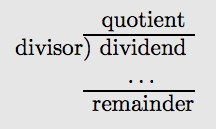
In this and following sections we make use of the terms divisor, dividend, quotient, and remainder.
This schematic reminds readers of the position of these terms in the division process.
Now that these terms are defined, we begin the discussion of division of decimal numbers. Suppose that we wish to divide 637 by 100. We could do this in fraction form, change the result to a mixed fraction, then the mixed fraction to decimal form.
\[\frac{637}{100} = 6 \frac{37}{100} = 6.37\nonumber \]
We can also arrange the division much as we would the division of two whole numbers.
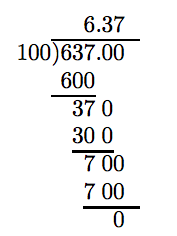
Note that adding two zeros after the decimal point in the dividend does not change the value of 637. Further, note that we proceed as if we are dividing two whole numbers, placing the decimal point in the quotient directly above the decimal point in the dividend.
These observations lead to the following algorithm.
To divide a decimal number by a whole number, proceed as follows:
- Set up the long division as you would the division of two whole numbers.
- Perform the division as if the numbers were both whole numbers, adding zeros to the right of the decimal point in the dividend as necessary to complete the division.
- Place the decimal point in the quotient immediately above the decimal point in the dividend.
Although the algorithm above is what we will use to divide decimals, it is important to know the relationship between the decimal placement and the fraction process of dividing decimals, see the example below to reinforce this idea.
\[
154.63 \div 4.7 = \left(\frac{15463}{100}\right) \div \left(\frac{47}{10}\right)
= \frac{15463 \times 10}{100 \times 47}
= \frac{154630}{470}
= 32.9
\]
Usually, one does not immediately see how many zeros to the right of the decimal point in the dividend are needed. These zeros are usually added at each step of the division, until the division is completed or the user is willing to terminate the process and accept only an estimate of the quotient.
Divide: 155.2 ÷ 25.
- Answer
-
Arrange as if using long division to divide whole numbers, and begin.
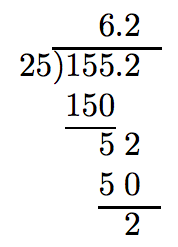
However, if we add one more additional zero, the division completes with a zero remainder.
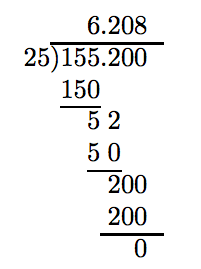
Thus, 155.2 divided by 25 is 6.208.
-
Decimal Divisors When the divisor contains a decimal point, we have a little work to do before we begin the division process. Suppose that we wish to divide 1.25 by 2.5. In fraction form, we could start with
\[ \frac{1.25}{2.5},\nonumber \]
then clear the decimals from the denominator by multiplying both numerator and denominator by 10. Note: Recall that multiplying by 10 moves the decimal point one place to the right.
\[ \begin{aligned} \frac{1.25}{2.5} = \frac{1.25 \cdot 10}{2.5 \cdot 10} \\ = \frac{12.5}{25} \end{aligned}\nonumber \]
Thus, dividing 1.25 by 2.5 is equivalent to dividing 12.5 by 25. This we know how to do.
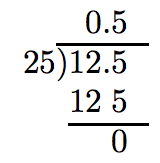
Thus, 1.25 divided by 2.5 is 0.5.
Instead of working in fraction form, we can take care of positioning the decimal point in the long division framework. Start with:
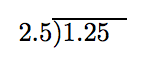
Move the decimal point in the divisor to the end of the divisor, then move the decimal point in the dividend an equal number of places.
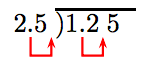
Thus, the division becomes
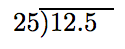
and we proceed as above to find the quotient. This discussion motivates the following algorithm.
If the divisor contains a decimal, proceed as follows:
- Move the decimal to the end of the divisor.
- Move the decimal in the dividend an equal number of places.
We can then complete the division using the rules for dividing a decimal by a whole number.
Classifying Repeating Decimals
If a fraction is written with a power of ten in the denominator, it's basic to write the same number in decimal form. You did that in Exercise 2. Any fraction that is written with a power of 10 in the denominator can be written as a terminal decimal. This means that it's possible to write the number with trailing zeroes. But what if the fraction doesn't have a power of 10 (like 10, 100, 1000, etc.) in the denominator? Sometimes those can be tricky!
If a fraction WITHOUT a power of ten in the denominator CAN be written as an equivalent fraction WITH a power of ten in the denominator, then it can be written as a terminating decimal.
For instance, \(\frac{1}{2}\) can be written as \(\frac{5}{10}\) (by multiplying the numerator and denominator by 5)
Therefore, \(\frac{1}{2}\) = \(\frac{5}{10}\) = 0.5 (remember to read this as five-tenths)
Well, that one wasn't too hard, but what about \(\frac{7}{80}\)? The question is whether you can multiply the denominator, 80, by something to get 10, 100, 1000, 10000, etc. There is no whole number you can multiply 80 by to get 10, 100 or 1000. But, if you multiply 80 times 125, it equals 100000. So, by multiplying both 7 and 80 by 125, we get the equivalent fraction \(\frac{875}{10000}\) for \(\frac{7}{80}\) which can now be written as the decimal 0.0875.
How about writing \(\frac{5}{6}\) as a terminating decimal? Well, there is nothing you can multiply 6 by to get 10 or 100 or 1000 or 10000. Is there maybe some number we could multiply 6 by to get some higher power of ten? Well, that's a good question! Actually, there isn't, but how could you be sure? You certainly can't try every power of ten since there are an infinite number of them to try.
It would be nice if there was an easy way to determine if any given fraction could be written as a terminating decimal. The key is to consider the factors of the denominator of a fraction that can be written as a terminating decimal. If a fraction can be written as a terminating decimal, then there is some equivalent fraction where the denominator must be a power of ten: 10 or 100 or 1000, etc. Powers of ten only have 2s and 5s as its prime factors and nothing else.
1) What is the decimal representation for \(\frac{5}{6}\)? Discuss with others how to find it. Be prepared to share with the class.
2) How about \(\frac{63}{72}\)? If we prime factor the denominator, we get 2 \(\cdot\) 2 \(\cdot\) 2 \(\cdot\) 3 \(\cdot\) 3. Can \(\frac{63}{72}\) be written as a terminating decimal? ________ Explain why or why not.
Fractions with Repeating, Nonterminating Decimal Representations
Let \(\frac{a}{b}\) be a fraction written in simplest form. Then \(\frac{a}{b}\) has a repeating decimal representation that does not terminate if and only if b has a prime factor other than 2 or 5.
Which of the following fractions have repeating, nonterminating decimal representations?
a) \(\frac{3}{4}\)
b) \(\frac{9}{20}\)
c) \(\frac{7}{40}\)
d) \(\frac{18}{25}\)
e) \(\frac{6}{28}\)
Then, check your answer with a calculator by taking the original fraction and dividing the numerator by the denominator.
- Answer
-
a) Terminates
b) Terminates
c) Terminates
d) Terminates
e) Non-Terminating, Repeating
Let's take a look at what happens when you do long division to compute \(\frac{4}{11}\) and \(\frac{2}{7}\). In both of these cases, eventually, you get a remainder that you got previously, so the computation repeats itself.
 |
 |
Rational Numbers are defined to be numbers which can be expressed as the ratio of two integers. Fractions as we usually refer to them (without decimal points or square roots, etc. in the numerator or denominator) are rational numbers. Since all fractions can be written as terminating or nonterminating (infinite, repeating) decimals, then all terminating and repeating decimals are also rational numbers. In our work, we wrote some terminating decimals as fractions. Since all nonterminating decimals came from a fraction, now we want to be able to go the other way around and write a repeating decimal as a fraction. We've got a nifty trick for doing just that!
Let's say we wanted to write \(0.\overline{72}\) or 0.727272727272... as a fraction.
First, notice this is a very different number from 0.72, since 0.72 is seventy-two hundredths, or \(\frac{72}{100}\). This simplifies to \(\frac{18}{25}\). So,0 .72 and \(\frac{18}{25}\) are the same number. You can check to make sure \(\frac{18}{25}\) is the correct fraction by using a calculator and dividing 18 by 25. The calculator should read 0.72, which is where we started.
Okay, so how do we write \(0.\overline{72}\) as a fraction? Since this is a repeating decimal that has infinitely many digits, there is no single power of ten we can put in the denominator. The trick is to use algebra to write a number in a way that eliminates the infinitely repeating part of the decimal. First, let's write out \(0.\overline{72}\) the long way:
\(0.\overline{72}\) = .727272727272... and call it the number x. So x = 0.727272727272...
Remember that if you multiply a decimal by 10, the decimal point moves one place to the right, and when you multiply a decimal by 100, the decimal point moves two places to the right, etc.
Express \(0.\overline{72}\) in fractional form.
- Answer
-
Okay, let's work with x = 0.727272727272... and 100x = 72.727272727272...
a. In algebra, what is 100x - x? _________ (Hint: Subtract coefficients.) 99x
b. Compute 100x - x another way: Line up the decimal points and subtract 0.727272727272... from 72.727272727272... Notice that if the decimals are lined up, the "tails" at the end of both repeating decimals are exactly the same so it should be easy to subtract. Show the work below.
72.727272727272... - 0.727272727272... = 72
c. Write an equation so that the answer to part a equals the answer to part b. Then use algebra to solve for x. Show work.
99x = 72
d. Simplify the fraction you got for x in part c. Show work.
x = 72/99
e. Use a calculator to rewrite the fraction you got in part c as a decimal:
Is it equal to \(0.\overline{72}\)? YES - 72/99 = \(0.\overline{72}\).
If so, you must have written \(0.\overline{72}\) as the correct fraction!
Here's the trick for changing repeating decimals to simplified fractions:
Call the number you are trying to write as a decimal a variable, like \(n\) or x.
If there is one repeating digit, compute 10x; if there are two repeating digits, compute 100x; if there are three repeating digits, compute 1000x, etc. This aligns the repeating decimals up with each other so that the tail of x and the other number (10x, 100x, 1000x, etc.) is the same.
Then subtract x from the other number (10x, 100x, 1000x, etc.) The tails of both numbers will come off and you should have an algebraic problem to solve at this point. Make sure you write your answer as a reduced fraction with only integers in the numerator and denominator.
Here are two examples. If you write the number in decimal form without the bar over the number, remember to put the ellipses (three dots) at the end!
|
Write \(0.\bar{2}\) as a simplified fraction. Let x = \(0.\bar{2}\) = .222222... Since only one digit is repeating, multiply x by 10. Then 10x = 2.222222... \[\begin{aligned} 10x = & 2.22222.... \\ - x = & .2222..... \\ \hline 9x = & 2 \end{aligned} \nonumber \] \[x = \frac{2}{9}\nonumber \] Use a calculator to check that \(\frac{2}{9} = 0.\bar{2}\) |
Write \(0.\overline{54}\) as a simplified fraction. Let x = \(0.\overline{54}\) = .545454... Since two digits are repeating, multiply x by 100. Then 100x = 54.545454... \[\begin{aligned} 100x = & 54.545454... \\ - x = & .545454... \\ \hline 99x = & 54 \end{aligned} \nonumber \] \[x = \frac{54}{99} = \frac{6}{11}\nonumber \] Use a calculator to check that \(\frac{6}{11} = 0.\overline{54}\) |

A repetend is the digit or group of digits that repeats indefinitely in the decimal representation of a rational number
Important Note: (Figure 7.2.1) Every fraction has a repeating decimal representation, and every repeating decimal has a fractional representation.
The rationals make up a very small part of the real numbers. To complete the real number system, we have to talk about the irrational numbers. Every real number is either rational or irrational. Those numbers which cannot be written as the ratio of two relatively prime integers is irrational. Those decimal numbers which neither terminate nor repeat are irrational. So, what do they look like?
One of the most commonly known irrational numbers is \(\pi\). It is the number that is the ratio of the circumference of a circle to its diameter. Sounds like it's a ratio of two integers, but it's not! \(\pi\) can only be approximated. The most common approximation is 3.14 or 22/7. Neither of these is equal to \(\pi\) because both of these are rational numbers, and \(\pi\) is not!
Other irrational numbers are square roots of numbers that are not perfect squares, or cube roots of numbers that are not perfect cubes, etc.
For instance, these numbers are irrational: \( \sqrt{5}, \sqrt{3}, \sqrt{12}, \sqrt{20}, \sqrt[3]{35}, \sqrt[4]{72}\)
Scientific Notation
Multiplying and dividing large numbers can sometimes be assisted by first expressing them in scientific notation. Numbers are said to be in scientific notation when written in the form a × 10ⁿ, where 1 ≤ a < 10.
| Scientific Notation | Standard Notation |
|---|---|
| 1.43 × 10⁸ meters | 143,800,000 meters |
| 1.2 × 10²⁴ kilograms | 1,200,000,000,000,000,000,000,000 kilograms |
| 5.88 × 10⁸ meters | 588,000,000 meters |
Once large numbers are expressed in scientific notation, they can be multiplied and divided more easily, as shown below.
Compute the following using scientific notation:
a) 54,500,000,000 × 346,000,000
b) 1,200,000,000,000 ÷ 62,500,000
- Answer
-
\(
\begin{aligned}
\text{a) } 54{,}500{,}000{,}000 \times 346{,}000{,}000
&= (5.45 \times 10^{10}) \times (3.46 \times 10^8) \\
&= (5.45 \times 3.46) \times 10^{10 + 8} \\
&= 18.857 \times 10^{18} \\
&= 1.8857 \times 10^{19}
\end{aligned}
\)\(
\begin{aligned}
\text{b) } 1{,}200{,}000{,}000{,}000 \div 62{,}500{,}000
&= (1.2 \times 10^{12}) \div (6.25 \times 10^7) \\
&= (1.2 / 6.25) \times 10^{12 - 7} \\
&= 0.192 \times 10^5 \\
&= 1.92 \times 10^4
\end{aligned}
\)