

8.2: Multiplying and Dividing
- Page ID
- 188595
\( \newcommand{\vecs}[1]{\overset { \scriptstyle \rightharpoonup} {\mathbf{#1}} } \)
\( \newcommand{\vecd}[1]{\overset{-\!-\!\rightharpoonup}{\vphantom{a}\smash {#1}}} \)
\( \newcommand{\dsum}{\displaystyle\sum\limits} \)
\( \newcommand{\dint}{\displaystyle\int\limits} \)
\( \newcommand{\dlim}{\displaystyle\lim\limits} \)
\( \newcommand{\id}{\mathrm{id}}\) \( \newcommand{\Span}{\mathrm{span}}\)
( \newcommand{\kernel}{\mathrm{null}\,}\) \( \newcommand{\range}{\mathrm{range}\,}\)
\( \newcommand{\RealPart}{\mathrm{Re}}\) \( \newcommand{\ImaginaryPart}{\mathrm{Im}}\)
\( \newcommand{\Argument}{\mathrm{Arg}}\) \( \newcommand{\norm}[1]{\| #1 \|}\)
\( \newcommand{\inner}[2]{\langle #1, #2 \rangle}\)
\( \newcommand{\Span}{\mathrm{span}}\)
\( \newcommand{\id}{\mathrm{id}}\)
\( \newcommand{\Span}{\mathrm{span}}\)
\( \newcommand{\kernel}{\mathrm{null}\,}\)
\( \newcommand{\range}{\mathrm{range}\,}\)
\( \newcommand{\RealPart}{\mathrm{Re}}\)
\( \newcommand{\ImaginaryPart}{\mathrm{Im}}\)
\( \newcommand{\Argument}{\mathrm{Arg}}\)
\( \newcommand{\norm}[1]{\| #1 \|}\)
\( \newcommand{\inner}[2]{\langle #1, #2 \rangle}\)
\( \newcommand{\Span}{\mathrm{span}}\) \( \newcommand{\AA}{\unicode[.8,0]{x212B}}\)
\( \newcommand{\vectorA}[1]{\vec{#1}} % arrow\)
\( \newcommand{\vectorAt}[1]{\vec{\text{#1}}} % arrow\)
\( \newcommand{\vectorB}[1]{\overset { \scriptstyle \rightharpoonup} {\mathbf{#1}} } \)
\( \newcommand{\vectorC}[1]{\textbf{#1}} \)
\( \newcommand{\vectorD}[1]{\overrightarrow{#1}} \)
\( \newcommand{\vectorDt}[1]{\overrightarrow{\text{#1}}} \)
\( \newcommand{\vectE}[1]{\overset{-\!-\!\rightharpoonup}{\vphantom{a}\smash{\mathbf {#1}}}} \)
\( \newcommand{\vecs}[1]{\overset { \scriptstyle \rightharpoonup} {\mathbf{#1}} } \)
\(\newcommand{\longvect}{\overrightarrow}\)
\( \newcommand{\vecd}[1]{\overset{-\!-\!\rightharpoonup}{\vphantom{a}\smash {#1}}} \)
\(\newcommand{\ket}[1]{\left| #1 \right>}\)
\(\newcommand{\bra}[1]{\left< #1 \right|}\)
\(\newcommand{\braket}[2]{\left< #1 \vphantom{#2} \right| \left. #2 \vphantom{#1} \right>}\)
\(\newcommand{\braopket}[3]{\left< #1 \vphantom{#2}\vphantom{#3} \right| #2 \vphantom{#1}\vphantom{#3} \left| #3 \vphantom{#1}\vphantom{#2} \right>}\)
\(\newcommand{\qmvec}[1]{\mathbf{\vec{#1}}}\)
\(\newcommand{\op}[1]{\hat{\mathbf{#1}}}\)
\(\newcommand{\expect}[1]{\langle #1 \rangle}\)
\(\newcommand{\dfn}[1]{\emph{\textbf{#1}}}\)
Multiply Integers
Since multiplication is mathematical shorthand for repeated addition, our counter model can easily be applied to show multiplication of integers. Let’s look at this concrete model to see what patterns we notice. We will use the same examples that we used for addition and subtraction.
We remember that 5 x 3

What about (-5) x 3? In this case the first number −5 is negative, which indicates that we should “take away 5 groups of 3 blue” rather than combine. When the first number is positive, the groups are combined into a new set, Figure 8.2.1. When the first number is negative, the groups are taken away from a set that has a value of 0. In order to take something away from a set with a value of 0, we must add some chips with a value of 0 to the set Figure 8.2.2. This is done by adding an equal number of red and blue chips to the set. After taking away 5 groups of 3 blue chips Figure 8.2.3, the resulting set has 15 red chips or a value of −15, Figure 8.2.4.


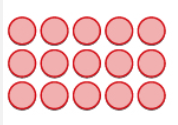
What about (-5) x (-3)? We can do the same thing with the chips, see Figure 8.2.2, but this time take away 5 groups of 3 red chips, the resulting set has a value of 15. Another way to view this, and the bigger question often asked, how come a negative times a negative is a positive, we can also use a pattern (inductive reasoning) to respond.

This pattern (values decreasing by 2, left column Figure 8.2.5) extended suggests that 2 x (−1) = −2, 2 x (−2) = −4, 2 x (−3) = −6, and so on. A similar pattern can be used to suggest what the product of two negative integers should be, as follows. This pattern (values increase by 2, right column Figure 8.2.5) suggests that (−2)(−1) = 2, (−2)(−2) = 4, (−2)(−3) = 6, and so on.
Here is another way to think about why it makes sense that a negative times a negative is a positive - Thank you Dr. Howie Hua.
Notice that for multiplication of two signed numbers, when the signs are the same, the product is positive, and when the signs are different, the product is negative.
Multiplication of Signed Numbers
The sign of the product of two numbers depends on their signs.
| Same signs | Product |
|---|---|
| •Two positives •Two negatives |
Positive Positive |
| Different signs | Product |
|---|---|
| •Positive • negative •Negative • positive |
Negative Negative |
The number-line model, the patterns, and the chips model all lead to the following definition.
Let a and b be integers.
1. Multiplying by zero: a x 0 = 0 = 0 x a.
2. Multiplying two positives: If a and b are positive, they are multiplied as whole numbers.
3. Multiplying a positive and a negative: If a is positive and b is positive (thus −b is negative), then a(−b) = − (ab), where ab is the whole-number product of a and b. That is, the product of a positive and a negative is negative.
4. Multiplying two negatives: If a and b are positive, then(−a)(−b) = ab, where ab is the whole-number product of a and b. That is, the product of two negatives is positive.
Multiply each of the following, but keep in mind the definition to deepen your understanding.
a) (4)(0) b) 5(-5) c) (-4)(-4) d) (-4)(5)(-6) e) (-a)(-b)(-c)
- Answer
-
a) 0 b) -25 c) 16 d) 120 e) -abc
NOTES: a) Multiply by 0 rule b) -(5x5)=-25 c) (-4)(-4) = (4x4)=16 d) -(4x5)(-6) = (-20)(-6) = 120 e) ab(-c)=-(abc)=-abc
When we multiply a number by the result is the same number. What happens when we multiply a number by -1 Let’s multiply a positive number and then a negative number by to see what we get.
Each time we multiply a number by we get its opposite.
Multiplying a number by gives its opposite.
Multiply each of the following.
a) -1(9) b) -1(-6) c) -1(-1)(3)
- Answer
-
a) opposite of 9, -9 b) opposite of -6, 6 c) opposite of -1, 1. Then 1(3)=3
Although students can memorize the rules of integer multiplication, it is important for future teachers to understand that these rules are foundational for algebra and algebraic reasoning. More than just procedural fluency, a deep conceptual understanding of why multiplying a negative by a negative yields a positive, or why the sign rules behave as they do, supports students' ability to generalize patterns, construct arguments, and make sense of symbolic expressions. This conceptual grounding becomes essential as students transition from arithmetic to algebra, where they manipulate variables and solve equations involving signed numbers.
Let a, b, and c be any integers.
- Closure Property for Integer Multiplication: ab is an integer.
- Commutative Property for Integer Multiplication: ab = ba
- Associative Property for Integer Multiplication: (ab)c = a(bc)
- Identity Property for Integer Multiplication: 1 is the unique integer such that a x 1 = a = 1 x a for all a.
- Distributivity of Multiplication over Addition of Integers: a(b + c) = ab + ac.
- Multiplicative Cancellation Property: Let a, b, c be any integers with c ≠ 0. If ac = bc, then a = b.
- Zero Divisors Property: Then ab = 0 if and only if a = 0 or b = 0 or a and b both equal zero.
Algebraic Reasoning: This property makes it possible to solve equations such as (x − 2)(x + 3) = 0. Because of this property, it is known that either x − 2 = 0 or x + 3 = 0.
Divide Integers
Division of Signed Numbers
The sign of the quotient of two numbers depends on their signs.
| Same signs | Quotient |
|---|---|
| •Two positives •Two negatives |
Positive Positive |
| Different signs | Quotient |
|---|---|
| •Positive & negative •Negative & positive |
Negative Negative |
Remember, you can always check the answer to a division problem by multiplying. This is demonstrated with the following definition.
Let a and b be any integers, where b ≠ 0. Then a ÷ b = c if and only if a = b \(\cdot\) c for a unique integer c.
Divide each of the following, if possible:
a) 12 ÷ (−3) b) (−15) ÷ (−5) c) (−8) ÷ 2 d) 7 ÷ (−2) e) 0 ÷ (-2)
- Answer
-
a) 12 ÷ (−3) = c if and only if 12 = (−3) c. From multiplication, 12 = (−3)(−4). Since (−3) \(\cdot\) c = (−3)(−4), by multiplicative cancellation, c = −4.
b) (−15) ÷ (−5) = c if and only if −15 = (−5) \(\cdot\) c. From multiplication, −15 = (−5) \(\cdot\) 3. Since (−5) \(\cdot\) c = (−5) \(\cdot\) 3, by multiplicative cancellation, c = 3.
c) (−8) ÷ 2 = c if and only if (−8) = 2 \(\cdot\) c. Thus c = −4, since 2(−4) = −8.
d) 7 ÷ (−2) = c if and only if 7 = (−2) \(\cdot\) c. There is no such integer c. Therefore, 7 ÷ (−2) is undefined in the integers.e) Division into zero, 0 ÷ (-2) = 0
Just as we saw with multiplication, when we divide a number by the result is the same number. What happens when we divide a number by Let’s divide a positive number and then a negative number by to see what we get.
When we divide a number by, we get its opposite.
Division by
Dividing a number by gives its opposite.
Now that we have finalized our work with the operations of integers, we can take a look at the properties of Ordering Integers
Let a, b, and c be any integers, p a positive integer, and n a negative integer.
- Transitive Property for Less Than: If a < b and b < c, then a < c.
- Property of Less Than and Addition: If a < b, then a + c < b + c.
- Property of Less Than and Multiplication by a Positive: If a < b, then ap < bp.
- Property of Less Than and Multiplication by a Negative: If a < b, then an > bn.
Negative Exponents and Scientific Notation
Recall that for whole-number exponents, the following properties hold:
\[
5^4 = 5 \cdot 5 \cdot 5 \cdot 5 \qquad
5^0 = 1 \qquad
\frac{5^5}{5^3} = 5^{5 - 3} = 5^2 \qquad
5^5 \cdot 5^3 = 5^{5 + 3} = 5^8
\]
It is important that the properties of negative exponents are consistent with the properties of exponents above.
- If the properties were consistent, what would 5-2 be equal to?
- Justify your conclusion with your peers.
- After you have your discussion, use the interactive below to check your thinking. Then explore other bases to solidify your thinking.
In our earlier study of whole numbers, we encountered exponents as a shorthand for repeated multiplication. Building on this understanding, we now explore how the concept of exponents extends to include integer values.
\[
\begin{array}{rlcl}
a^3 &= a \cdot a \cdot a \\
a^2 &= a \cdot a \\
a^1 &= a \\
a^0 &= 1 \\
a^{-1} &= \dfrac{1}{a} \\
a^{-2} &= \dfrac{1}{a^2}\\
a^{-3} &= \dfrac{1}{a^3} \\
\vdots \\
\text{etc.}
\end{array}
\]
Let a be any nonzero number and n be a positive integer. Then a-n = \(\dfrac{1}{n}\).
We care about negative exponents because they are essential for understanding and working with mathematical concepts that go beyond whole number operations, especially in areas like algebra, science, and real-world applications. Further, negative exponents are a necessary development to make the rules of exponents consistent across all integers, provide a compact and convenient notation, and are crucial for representing numbers in scientific notation and building the system of rational and real exponents.
Algebraic Reasoning: Negative integer exponents give students a way to see that \(\dfrac{1}{7^3} \cdot 7^3\)=1. Because \(\dfrac{1}{7^3}\)=7-3, \(\dfrac{1}{7^3} \cdot 7^3\)=7-3\(\cdot\)73=7-3+3=70=1. Knowing this is a way for solving algebraic equations.
Scientific Notation
We previously used scientific notation that was introduced in terms of very large numbers and positive exponents. With the introduction of negative exponents, we can now use scientific notation to represent very small numbers. Some examples are below.
| What? | How much? | Scientific Notation |
|---|---|---|
| Distance from Earth to Sun | 150,000,000,000 meters | 1.5 × 10¹¹ |
| Mass of average human cell | 0.000000000001 kilograms | 1 × 10-12 |
| Diameter of the moon | 3,474,000 meters | 3.474 × 10⁶ |
| Time for light to travel 1 mm |
|
3.33 × 10⁻⁹ |
| Estimated # of cells in human body | 100,000,000,000,000 cells | 1 × 10¹⁴ |
When a number is written in scientific notation, the exponent tells you if the term is a large or a small number. A positive exponent indicates a large number and a negative exponent indicates a small number that is between 0 and 1. Since we already studied big numbers, we will only focus on small numbers in this section.
To write a small number (between 0 and 1) in scientific notation, you move the decimal to the right and the exponent will have to be negative, as in the following example.
\(\begin{array}{r}\underset{\longrightarrow}{0.00004}=00.0004\times10^{-1}\\000.004\times10^{-2}\\0000.04\times10^{-3}\\00000.4\times10^{-4}\\000004.\times10^{-5}\\0.00004=4\times10^{-5}\end{array}\)
You may notice that the decimal point was moved five places to the right until you got to the number 4, which is between 1 and 10. The exponent is \(−5\).
Write the following numbers in scientific notation.
a) \(0.0000000000035\)
b) \(0.0000000102\)
c) \(0.00000000000000793\)
- Answer
-
a) \(\underset{\longrightarrow}{0.0000000000035}=3.5\times10^{-12}\), we moved the decimal 12 times to get to a number between 1 and 10
b) \(\underset{\longrightarrow}{0.0000000102}=1.02\times10^{-8}\)
c) \(\underset{\longrightarrow}{0.00000000000000793}=7.93\times10^{-15}\)
Multiplying and Dividing Numbers Expressed in Scientific Notation
Numbers that are written in scientific notation can be multiplied and divided rather simply by taking advantage of the properties of numbers and the rules of exponents that you may recall. To multiply numbers in scientific notation, first multiply the numbers that aren’t powers of 10 (the a in \(a\times10^{n}\)). Then multiply the powers of ten by adding the exponents.
This will produce a new number times a different power of 10. All you have to do is check to make sure this new value is in scientific notation. If it isn’t, you convert it.
Let’s look at some examples.
Example
\(\left(3\times10^{8}\right)\left(6.8\times10^{-13}\right)\)
Regroup using the commutative and associative properties.
\(\left(3\times6.8\right)\left(10^{8}\times10^{-13}\right)\)
Multiply the coefficients.
\(\left(20.4\right)\left(10^{8}\times10^{-13}\right)\)
Multiply the powers of 10 using the Product Rule. Add the exponents.
\(20.4\times10^{-5}\)
Convert 20.4 into scientific notation by moving the decimal point one place to the left and multiplying by \(10^{1}\).
\(\left(2.04\times10^{1}\right)\times10^{-5}\)
Group the powers of 10 using the associative property of multiplication.
\(2.04\times\left(10^{1}\times10^{-5}\right)\)
Multiply using the Product Rule—add the exponents.
\(2.04\times10^{1+\left(-5\right)}\)
\(\left(3\times10^{8}\right)\left(6.8\times10^{-13}\right)=2.04\times10^{-4}\)
Using what you learned for the problem above, discuss with your peers how we would solve \(\dfrac{2.4 \times 10^7}{4.8 \times 10^5}\). Use the video below to check your answer.