

4.9: Hyperbolic Functions
- Page ID
- 525
\( \newcommand{\vecs}[1]{\overset { \scriptstyle \rightharpoonup} {\mathbf{#1}} } \)
\( \newcommand{\vecd}[1]{\overset{-\!-\!\rightharpoonup}{\vphantom{a}\smash {#1}}} \)
\( \newcommand{\dsum}{\displaystyle\sum\limits} \)
\( \newcommand{\dint}{\displaystyle\int\limits} \)
\( \newcommand{\dlim}{\displaystyle\lim\limits} \)
\( \newcommand{\id}{\mathrm{id}}\) \( \newcommand{\Span}{\mathrm{span}}\)
( \newcommand{\kernel}{\mathrm{null}\,}\) \( \newcommand{\range}{\mathrm{range}\,}\)
\( \newcommand{\RealPart}{\mathrm{Re}}\) \( \newcommand{\ImaginaryPart}{\mathrm{Im}}\)
\( \newcommand{\Argument}{\mathrm{Arg}}\) \( \newcommand{\norm}[1]{\| #1 \|}\)
\( \newcommand{\inner}[2]{\langle #1, #2 \rangle}\)
\( \newcommand{\Span}{\mathrm{span}}\)
\( \newcommand{\id}{\mathrm{id}}\)
\( \newcommand{\Span}{\mathrm{span}}\)
\( \newcommand{\kernel}{\mathrm{null}\,}\)
\( \newcommand{\range}{\mathrm{range}\,}\)
\( \newcommand{\RealPart}{\mathrm{Re}}\)
\( \newcommand{\ImaginaryPart}{\mathrm{Im}}\)
\( \newcommand{\Argument}{\mathrm{Arg}}\)
\( \newcommand{\norm}[1]{\| #1 \|}\)
\( \newcommand{\inner}[2]{\langle #1, #2 \rangle}\)
\( \newcommand{\Span}{\mathrm{span}}\) \( \newcommand{\AA}{\unicode[.8,0]{x212B}}\)
\( \newcommand{\vectorA}[1]{\vec{#1}} % arrow\)
\( \newcommand{\vectorAt}[1]{\vec{\text{#1}}} % arrow\)
\( \newcommand{\vectorB}[1]{\overset { \scriptstyle \rightharpoonup} {\mathbf{#1}} } \)
\( \newcommand{\vectorC}[1]{\textbf{#1}} \)
\( \newcommand{\vectorD}[1]{\overrightarrow{#1}} \)
\( \newcommand{\vectorDt}[1]{\overrightarrow{\text{#1}}} \)
\( \newcommand{\vectE}[1]{\overset{-\!-\!\rightharpoonup}{\vphantom{a}\smash{\mathbf {#1}}}} \)
\( \newcommand{\vecs}[1]{\overset { \scriptstyle \rightharpoonup} {\mathbf{#1}} } \)
\(\newcommand{\longvect}{\overrightarrow}\)
\( \newcommand{\vecd}[1]{\overset{-\!-\!\rightharpoonup}{\vphantom{a}\smash {#1}}} \)
\(\newcommand{\ket}[1]{\left| #1 \right>}\)
\(\newcommand{\bra}[1]{\left< #1 \right|}\)
\(\newcommand{\braket}[2]{\left< #1 \vphantom{#2} \right| \left. #2 \vphantom{#1} \right>}\)
\(\newcommand{\braopket}[3]{\left< #1 \vphantom{#2}\vphantom{#3} \right| #2 \vphantom{#1}\vphantom{#3} \left| #3 \vphantom{#1}\vphantom{#2} \right>}\)
\(\newcommand{\qmvec}[1]{\mathbf{\vec{#1}}}\)
\(\newcommand{\op}[1]{\hat{\mathbf{#1}}}\)
\(\newcommand{\expect}[1]{\langle #1 \rangle}\)
\(\newcommand{\dfn}[1]{\emph{\textbf{#1}}}\)
Definition of the Hyperbolic Functions
We define the hyperbolic functions as follows:
\[ \sinh x = \dfrac{e^x - e^{-x}}{2}, \nonumber \]
\[ \cosh x = \dfrac{e^x + e^{-x}}{2}, \nonumber \]
\[ \tanh x = \dfrac{\sinh x}{\cosh x}. \nonumber \]
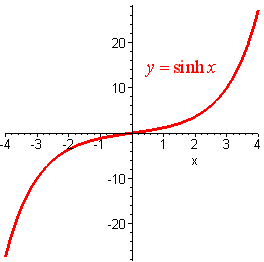
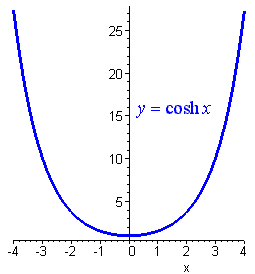
- \( \cosh^2 x - \sinh^2 x = 1 \),
- \( \dfrac{d}{dx} \sinh x = \cosh x\),
- \(\dfrac{d}{dx} \cosh x = \sinh x\).
We find
\[\begin{align*} \cosh^2 x - \sinh^2 x &= \left( \dfrac{e^x+e^{-x}}{2} \right)^2 - \left( \dfrac{e^x-e^{-x}}{2} \right)^2 \\[4pt] &= \dfrac{e^{2x}+2+e^{-2x}}{4} - \dfrac{e^{2x}-2+e^{-2x}}{4} \\[4pt] &= \dfrac{4}{4} =1. \end{align*} \nonumber \]
\(\square\)
The Derivative of the Inverse Hyperbolic Trig Functions
\[ \dfrac{d}{dx} \sinh^{-1} x = \dfrac{1}{\sqrt{1+x^2}}, \nonumber \]
\[ \dfrac{d}{dx} \cosh^{-1} x = \dfrac{1}{\sqrt{x^2-1}}, \nonumber \]
\[ \dfrac{d}{dx} \tanh^{-1} x = \dfrac{d}{dx} \coth^{-1} x = \dfrac{1}{1-x^2}, \nonumber \]
\[ \dfrac{d}{dx} \text{sech}^{-1} x = \dfrac{1}{x\sqrt{1-x^2}}, \nonumber \]
\[ \dfrac{d}{dx} \text{csch}^{-1} x = \dfrac{1}{x\sqrt{1+x^2}}. \nonumber \]
We have
\[ \tanh (\tanh^{-1} x) = x. \nonumber \]
Taking derivatives implicitly, we have
\[ \dfrac{d}{dx} \text{sech}^2 (\tanh^{-1} x = \tanh^{-1} x = 1. \nonumber \]
Dividing gives
\[ \dfrac{d}{dx} \tanh^{-1} x = \dfrac{1}{\text{sech}^2 (\tan^{-1} x)}. \nonumber \]
Since
\[ \cosh^2(x) - \sinh^2(x) = 1, \nonumber \]
dividing by \(\cosh^2(x)\), we get
\[1 - \tanh^2(x) = \text{sech}^2(x) \nonumber \]
so that
\[\begin{align*} \dfrac{d}{dx} \tan^{-1} x &= \dfrac{1}{1-\tanh^2 (\tanh^{-1} x)} \\[4pt] &= \dfrac{1}{1-x^2}. \end{align*}
\(\square\)
For the derivative of the \(\text{sech}^{-1} (x)\) click here.
Integration and Hyperbolic Functions
Now we are ready to use the arc hyperbolic functions for integration.
Evaluate
\[ \int \dfrac{dx}{4-x^2} \nonumber \]
Solution
\[ \int \dfrac{dx}{4-x^2} = \int \dfrac{1}{4} \int \dfrac{dx}{1-(2/3)^2}\nonumber \]
let \( u = \dfrac{x}{2}\), then \(du = \dfrac{1}{2}dx\)
\[ \dfrac{1}{2} \int \dfrac{du}{1-u^2}= \dfrac{1}{2}\tanh^{-1} u +C = \dfrac{1}{2} \tanh^{-1} \left(\dfrac{x}{2}\right) + C.\nonumber \]
Evaluate
\[ \int \dfrac{x}{1-x^4} dx. \nonumber \]
Solution
Although this is not directly a derivative of a hyperbolic trig function, we can use the substitution \( u = x^2 \) and \(du = 2x\, dx\).
To change the integral to
\[\begin{align*} \dfrac{1}{2} \int \dfrac{du}{1-u^2} &= \dfrac{1}{2} \tanh^{-1} u + C \\[4pt] &= \dfrac{1}{2} \tanh^{-1} (x^2) + C. \end{align*} \]
Contributors and Attributions
- Larry Green (Lake Tahoe Community College)
Integrated by Justin Marshall.