

3.1E: Exercises
- Page ID
- 168424

\( \newcommand{\vecs}[1]{\overset { \scriptstyle \rightharpoonup} {\mathbf{#1}} } \)
\( \newcommand{\vecd}[1]{\overset{-\!-\!\rightharpoonup}{\vphantom{a}\smash {#1}}} \)
\( \newcommand{\dsum}{\displaystyle\sum\limits} \)
\( \newcommand{\dint}{\displaystyle\int\limits} \)
\( \newcommand{\dlim}{\displaystyle\lim\limits} \)
\( \newcommand{\id}{\mathrm{id}}\) \( \newcommand{\Span}{\mathrm{span}}\)
( \newcommand{\kernel}{\mathrm{null}\,}\) \( \newcommand{\range}{\mathrm{range}\,}\)
\( \newcommand{\RealPart}{\mathrm{Re}}\) \( \newcommand{\ImaginaryPart}{\mathrm{Im}}\)
\( \newcommand{\Argument}{\mathrm{Arg}}\) \( \newcommand{\norm}[1]{\| #1 \|}\)
\( \newcommand{\inner}[2]{\langle #1, #2 \rangle}\)
\( \newcommand{\Span}{\mathrm{span}}\)
\( \newcommand{\id}{\mathrm{id}}\)
\( \newcommand{\Span}{\mathrm{span}}\)
\( \newcommand{\kernel}{\mathrm{null}\,}\)
\( \newcommand{\range}{\mathrm{range}\,}\)
\( \newcommand{\RealPart}{\mathrm{Re}}\)
\( \newcommand{\ImaginaryPart}{\mathrm{Im}}\)
\( \newcommand{\Argument}{\mathrm{Arg}}\)
\( \newcommand{\norm}[1]{\| #1 \|}\)
\( \newcommand{\inner}[2]{\langle #1, #2 \rangle}\)
\( \newcommand{\Span}{\mathrm{span}}\) \( \newcommand{\AA}{\unicode[.8,0]{x212B}}\)
\( \newcommand{\vectorA}[1]{\vec{#1}} % arrow\)
\( \newcommand{\vectorAt}[1]{\vec{\text{#1}}} % arrow\)
\( \newcommand{\vectorB}[1]{\overset { \scriptstyle \rightharpoonup} {\mathbf{#1}} } \)
\( \newcommand{\vectorC}[1]{\textbf{#1}} \)
\( \newcommand{\vectorD}[1]{\overrightarrow{#1}} \)
\( \newcommand{\vectorDt}[1]{\overrightarrow{\text{#1}}} \)
\( \newcommand{\vectE}[1]{\overset{-\!-\!\rightharpoonup}{\vphantom{a}\smash{\mathbf {#1}}}} \)
\( \newcommand{\vecs}[1]{\overset { \scriptstyle \rightharpoonup} {\mathbf{#1}} } \)
\(\newcommand{\longvect}{\overrightarrow}\)
\( \newcommand{\vecd}[1]{\overset{-\!-\!\rightharpoonup}{\vphantom{a}\smash {#1}}} \)
\(\newcommand{\avec}{\mathbf a}\) \(\newcommand{\bvec}{\mathbf b}\) \(\newcommand{\cvec}{\mathbf c}\) \(\newcommand{\dvec}{\mathbf d}\) \(\newcommand{\dtil}{\widetilde{\mathbf d}}\) \(\newcommand{\evec}{\mathbf e}\) \(\newcommand{\fvec}{\mathbf f}\) \(\newcommand{\nvec}{\mathbf n}\) \(\newcommand{\pvec}{\mathbf p}\) \(\newcommand{\qvec}{\mathbf q}\) \(\newcommand{\svec}{\mathbf s}\) \(\newcommand{\tvec}{\mathbf t}\) \(\newcommand{\uvec}{\mathbf u}\) \(\newcommand{\vvec}{\mathbf v}\) \(\newcommand{\wvec}{\mathbf w}\) \(\newcommand{\xvec}{\mathbf x}\) \(\newcommand{\yvec}{\mathbf y}\) \(\newcommand{\zvec}{\mathbf z}\) \(\newcommand{\rvec}{\mathbf r}\) \(\newcommand{\mvec}{\mathbf m}\) \(\newcommand{\zerovec}{\mathbf 0}\) \(\newcommand{\onevec}{\mathbf 1}\) \(\newcommand{\real}{\mathbb R}\) \(\newcommand{\twovec}[2]{\left[\begin{array}{r}#1 \\ #2 \end{array}\right]}\) \(\newcommand{\ctwovec}[2]{\left[\begin{array}{c}#1 \\ #2 \end{array}\right]}\) \(\newcommand{\threevec}[3]{\left[\begin{array}{r}#1 \\ #2 \\ #3 \end{array}\right]}\) \(\newcommand{\cthreevec}[3]{\left[\begin{array}{c}#1 \\ #2 \\ #3 \end{array}\right]}\) \(\newcommand{\fourvec}[4]{\left[\begin{array}{r}#1 \\ #2 \\ #3 \\ #4 \end{array}\right]}\) \(\newcommand{\cfourvec}[4]{\left[\begin{array}{c}#1 \\ #2 \\ #3 \\ #4 \end{array}\right]}\) \(\newcommand{\fivevec}[5]{\left[\begin{array}{r}#1 \\ #2 \\ #3 \\ #4 \\ #5 \\ \end{array}\right]}\) \(\newcommand{\cfivevec}[5]{\left[\begin{array}{c}#1 \\ #2 \\ #3 \\ #4 \\ #5 \\ \end{array}\right]}\) \(\newcommand{\mattwo}[4]{\left[\begin{array}{rr}#1 \amp #2 \\ #3 \amp #4 \\ \end{array}\right]}\) \(\newcommand{\laspan}[1]{\text{Span}\{#1\}}\) \(\newcommand{\bcal}{\cal B}\) \(\newcommand{\ccal}{\cal C}\) \(\newcommand{\scal}{\cal S}\) \(\newcommand{\wcal}{\cal W}\) \(\newcommand{\ecal}{\cal E}\) \(\newcommand{\coords}[2]{\left\{#1\right\}_{#2}}\) \(\newcommand{\gray}[1]{\color{gray}{#1}}\) \(\newcommand{\lgray}[1]{\color{lightgray}{#1}}\) \(\newcommand{\rank}{\operatorname{rank}}\) \(\newcommand{\row}{\text{Row}}\) \(\newcommand{\col}{\text{Col}}\) \(\renewcommand{\row}{\text{Row}}\) \(\newcommand{\nul}{\text{Nul}}\) \(\newcommand{\var}{\text{Var}}\) \(\newcommand{\corr}{\text{corr}}\) \(\newcommand{\len}[1]{\left|#1\right|}\) \(\newcommand{\bbar}{\overline{\bvec}}\) \(\newcommand{\bhat}{\widehat{\bvec}}\) \(\newcommand{\bperp}{\bvec^\perp}\) \(\newcommand{\xhat}{\widehat{\xvec}}\) \(\newcommand{\vhat}{\widehat{\vvec}}\) \(\newcommand{\uhat}{\widehat{\uvec}}\) \(\newcommand{\what}{\widehat{\wvec}}\) \(\newcommand{\Sighat}{\widehat{\Sigma}}\) \(\newcommand{\lt}{<}\) \(\newcommand{\gt}{>}\) \(\newcommand{\amp}{&}\) \(\definecolor{fillinmathshade}{gray}{0.9}\)Reading Questions
- The formula for Integration by Parts is derived from which rule in differential calculus?
- What is the formula for Integration by Parts for indefinite integrals?
- When choosing which part of the integrand will be \(u\) and which will be \(dv\), what is the most important characteristic of the expression chosen for \(dv\)?
- What does the mnemonic LIATE stand for, and how is it used as a guideline for choosing \(u\)?
- What is a "self-relating integral," and how do you solve it once the original integral reappears in your work?
- If you need to apply Integration by Parts more than once to solve an integral, why is it important to be consistent with your choices of function types for \(u\)?
- What is the purpose of a reduction formula?
In using the technique of Integration by Parts, you must carefully choose which expression is \(u\). For each of the following problems, use the guidelines in this section to choose \(u\). Do not evaluate the integrals.
1) \( \displaystyle \int x^3e^{2x}\,dx\)
- Answer
- \( u=x^3\)
2) \( \displaystyle \int x^3\ln(x)\,dx\)
3) \( \displaystyle \int y^3\cos y\,dy\)
- Answer
- \(u=y^3\)
4) \( \displaystyle \int x^2\arctan x\,dx\)
5) \( \displaystyle \int e^{3x}\sin(2x)\,dx\)
- Answer
- \(u=\sin(2x)\)
In exercises 6 - 40, find the integral by using the simplest method. Not all problems require Integration by Parts.
6) \( \displaystyle \int v\sin v\,dv\)
7) \( \displaystyle \int \ln x\,dx\) (Hint: \( \displaystyle \int \ln x\,dx\) is equivalent to \( \displaystyle \int 1 \cdot \ln(x)\,dx.)\)
- Answer
- \( \displaystyle \int \ln x\,dx \quad = \quad−x+x\ln x+C\)
8) \( \displaystyle \int x\cos x\,dx\)
9) \( \displaystyle \int \tan^{−1}x\,dx\)
- Answer
- \( \displaystyle \int \tan^{−1}x\,dx\quad = \quad x\tan^{−1}x−\tfrac{1}{2}\ln(1+x^2)+C\)
10) \( \displaystyle \int x^2e^x\,dx\)
11) \( \displaystyle \int x\sin(2x)\,dx\)
- Answer
- \( \displaystyle \int x\sin(2x)\,dx \quad = \quad −\tfrac{1}{2}x\cos(2x)+\tfrac{1}{4}\sin(2x)+C\)
12) \( \displaystyle \int xe^{4x}\,dx\)
13) \( \displaystyle \int xe^{−x}\,dx\)
- Answer
- \( \displaystyle \int xe^{−x}\,dx \quad = \quad e^{−x}(−1−x)+C\)
14) \( \displaystyle \int x\cos 3x\,dx\)
15) \( \displaystyle \int x^2\cos x\,dx\)
- Answer
- \( \displaystyle \int x^2\cos x\,dx \quad = \quad 2x\cos x+(−2+x^2)\sin x+C\)
16) \( \displaystyle \int x\ln x\,dx\)
17) \(\displaystyle \int \sqrt{x^2+9}\,dx\)
- Answer
- \(\displaystyle \int \sqrt{x^2+9}\,dx \quad = \quad 9\left[\frac{x\sqrt{x^2+9}}{18}+\tfrac{1}{2}\ln\left|\frac{\sqrt{x^2+9}}{3}+\frac{x}{3}\right|\right]+C\)
18) \( \displaystyle \int \ln(2x+1)\,dx\)
- Answer
- \( \displaystyle \int \ln(2x+1)\,dx \quad = \quad \tfrac{1}{2}(1+2x)(−1+\ln(1+2x))+C\)
19) \( \displaystyle \int x^2e^{4x}\,dx\)
20) \( \displaystyle \int e^x\sin x\,dx\)
- Answer
- \( \displaystyle \int e^x\sin x\,dx \quad = \quad \tfrac{1}{2}e^x(−\cos x+\sin x)+C\)
21) \( \displaystyle \int e^x\cos x\,dx\)
22) \( \displaystyle \int xe^{−x^2}\,dx\)
- Answer
- \( \displaystyle \int xe^{−x^2}\,dx \quad = \quad −\frac{e^{−x^2}}{2}+C\)
23) \( \displaystyle \int x^2e^{−x}\,dx\)
24) \( \displaystyle \int \sin(\ln(2x))\,dx\)
- Answer
- \( \displaystyle \int \sin(\ln(2x))\,dx \quad = \quad −\tfrac{1}{2}x\cos[\ln(2x)]+\tfrac{1}{2}x\sin[\ln(2x)]+C\)
25) \( \displaystyle \int \cos(\ln x)\,dx\)
26) \( \displaystyle \int (\ln x)^2\,dx\)
- Answer
- \( \displaystyle \int (\ln x)^2\,dx \quad = \quad 2x−2x\ln x+x(\ln x)^2+C\)
27) \( \displaystyle \int \ln(x^2)\,dx\)
28) \(\displaystyle \int \frac{x^2}{\sqrt{1+x^2}}\,dx\)
29) \( \displaystyle \int x^2\ln x\,dx\)
- Answer
- \( \displaystyle \int x^2\ln x\,dx \quad = \quad −\frac{x^3}{9}+\tfrac{1}{3}x^3\ln x+C\)
30) \( \displaystyle \int \sin^{−1}x\,dx\)
31) \( \displaystyle \int \cos^{−1}(2x)\,dx\)
- Answer
- \( \displaystyle \int \cos^{−1}(2x)\,dx \quad = \quad −\tfrac{1}{2}\sqrt{1−4x^2}+x\cos^{−1}(2x)+C\)
32) \( \displaystyle \int x\arctan x\,dx\)
33) \( \displaystyle \int x^2\sin x\,dx\)
- Answer
- \( \displaystyle \int x^2\sin x\,dx \quad = \quad −(−2+x^2)\cos x+2x\sin x+C\)
34) \( \displaystyle \int x^3\cos x\,dx\)
35) \( \displaystyle \int x^3\sin x\,dx\)
- Answer
- \( \displaystyle \int x^3\sin x\,dx \quad = \quad −x(−6+x^2)\cos x+3(−2+x^2)\sin x+C\)
36) \( \displaystyle \int x^3e^x\,dx\)
37) \( \displaystyle \int x\sec^{−1}x\,dx\)
- Answer
- \( \displaystyle \int x\sec^{−1}x\,dx \quad = \quad \tfrac{1}{2}x\left(−\sqrt{1−\frac{1}{x^2}}+x \cdot \sec^{−1}x\right)+C\)
38) \( \displaystyle \int x\sec^2x\,dx\)
39) \( \displaystyle \int x\cosh x\,dx\)
- Answer
- \( \displaystyle \int x\cosh x\,dx \quad = \quad −\cosh x+x\sinh x+C\)
40) \(\displaystyle \int \tan^2x\sec x\,dx\)
- Answer
- \(\displaystyle \int \tan^2x\sec x\,dx \quad = \quad \tfrac{1}{2}\sec x\tan x−\tfrac{1}{2}\ln(\sec x+\tan x)+C\)
In exercises 41 - 50, compute the definite integrals. Use a graphing utility to confirm your answers.
41) \( \displaystyle \int ^1_{1/e}\ln x\,dx\)
42) \( \displaystyle \int ^1_0xe^{−2x}\,dx\) (Express the answer in exact form.)
- Answer
- \( \displaystyle \int ^1_0xe^{−2x}\,dx \quad = \quad \frac{1}{4}−\frac{3}{4e^2}\)
43) \( \displaystyle \int ^1_0e^{\sqrt{x}}\,dx \quad (\text{let}\, u=\sqrt{x})\)
44) \( \displaystyle \int ^e_1\ln(x^2)\,dx\)
- Answer
- \( \displaystyle \int ^e_1\ln(x^2)\,dx \quad = \quad 2\)
45) \( \displaystyle \int ^ \pi _0x\cos x\,dx\)
46) \( \displaystyle \int ^ \pi _{− \pi }x\sin x\,dx\) (Express the answer in exact form.)
- Answer
- \( \displaystyle \int ^ \pi _{− \pi }x\sin x\,dx \quad = \quad 2\pi\)
47) \( \displaystyle \int ^3_0\ln(x^2+1)\,dx\) (Express the answer in exact form.)
48) \( \displaystyle \int ^{ \pi /2}_0x^2\sin x\,dx\) (Express the answer in exact form.)
- Answer
- \( \displaystyle \int ^{ \pi /2}_0x^2\sin x\,dx \quad = \quad −2+ \pi \)
49) \( \displaystyle \int ^1_0x5^x\,dx\) (Express the answer using five significant digits.)
50) Evaluate \( \displaystyle \int \cos x\ln(\sin x)\,dx\)
- Answer
- \( \displaystyle \int \cos x\ln(\sin x)\,dx \quad = \quad −\sin(x)+\ln[\sin(x)]\sin x+C\)
In exercises 51 - 53, derive the following formulas using the technique of Integration by Parts. Assume that \(n\) is a positive integer. These formulas are called reduction formulas because the exponent in the \(x\) term has been reduced by one in each case. The second integral is simpler than the original integral.
51) \( \displaystyle \int x^ne^x\,dx=x^ne^x−n \int x^{n−1}e^x\,dx\)
52) \( \displaystyle \int x^n\cos x\,dx=x^n\sin x−n \int x^{n−1}\sin x\,dx\)
- Answer
- Answers vary
53) \( \displaystyle \int x^n\sin x\,dx=\)______
54) Integrate \( \displaystyle \int 2x\sqrt{2x−3}\,dx\) using two methods:
a. Using Integration by Parts, letting \(dv=\sqrt{2x−3}\,dx\)
b. Substitution Method, letting \(u=2x−3\)
- Answer
- a. \( \displaystyle \int 2x\sqrt{2x−3}\,dx \quad = \quad \tfrac{2}{5}(1+x)(−3+2x)^{3/2}+C\)
b. \( \displaystyle \int 2x\sqrt{2x−3}\,dx \quad = \quad \tfrac{2}{5}(1+x)(−3+2x)^{3/2}+C\)
In exercises 55 - 60, state whether you would use Integration by Parts to evaluate the integral. If so, identify \(u\) and \(dv\). If not, describe the technique used to perform the integration without actually doing the problem.
55) \( \displaystyle \int x\ln x\,dx\)
56) \( \displaystyle \int \frac{\ln^2x}{x}\,dx\)
- Answer
- Do not use Integration by Parts. Choose \(u\) to be \(\ln x\), and the integral is of the form \( \int u^2\,du.\)
57) \( \displaystyle \int xe^x\,dx\)
58) \( \displaystyle \int xe^{x^2−3}\,dx\)
- Answer
- Do not use Integration by Parts. Let \(u=x^2−3\), and the integral can be put into the form \( \int e^u\,du\).
59) \( \displaystyle \int x^2\sin x\,dx\)
60) \( \displaystyle \int x^2\sin(3x^3+2)\,dx\)
- Answer
- Do not use Integration by Parts. Choose \(u\) to be \(u=3x^3+2\) and the integral can be put into the form \( \int \sin(u)\,du.\)
In exercises 61 - 62, sketch the region bounded above by the curve, the \(x\)-axis, and \(x=1\), and find the area of the region. Provide the exact form or round answers to the number of places indicated.
61) \(y=2xe^{−x}\) (Approximate answer to four decimal places.)
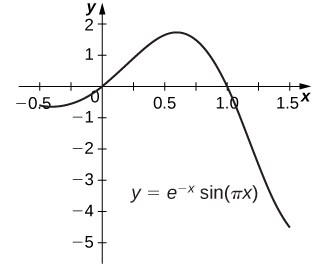
62) \(y=e^{−x}\sin( \pi x)\) (Approximate answer to five decimal places.)
- Answer
- The area under graph is \(0.39535 \, \text{units}^2.\)
In exercises 63 - 64, find the volume generated by rotating the region bounded by the given curves about the specified line. Express the answers in exact form or approximate to the number of decimal places indicated.
63) \(y=\sin x,\,y=0,\,x=2 \pi ,\,x=3 \pi ;\) about the \(y\)-axis (Express the answer in exact form.)
64) \(y=e^{−x}, \,y=0,\,x=−1, \, x=0;\) about \(x=1\) (Express the answer in exact form.)
- Answer
- \(V = 2 \pi e \, \text{units}^3\)
65) A particle moving along a straight line has a velocity of \(v(t)=t^2e^{−t}\) after \(t\) sec. How far does it travel in the first 2 sec? (Assume the units are in feet and express the answer in exact form.)
66) Find the area under the graph of \(y=\sec^3x\) from \(x=0\) to \(x=1\). (Round the answer to two significant digits.)
- Answer
- \(A= 2.05 \, \text{units}^2\)
67) Find the area between \(y=(x−2)e^x\) and the \(x\)-axis from \(x=2\) to \(x=5\). (Express the answer in exact form.)
68) Find the area of the region enclosed by the curve \(y=x\cos x\) and the \(x\)-axis for \(\frac{11 \pi }{2} \leq x \leq \frac{13 \pi }{2}.\) (Express the answer in exact form.)
- Answer
- \(A = 12 \pi \, \text{units}^2\)
69) Find the volume of the solid generated by revolving the region bounded by the curve \(y=\ln x\), the \(x\)-axis, and the vertical line \(x=e^2\) about the \(x\)-axis. (Express the answer in exact form.)
70) Find the volume of the solid generated by revolving the region bounded by the curve \(y=4\cos x\) and the \(x\)-axis, \(\frac{ \pi }{2} \leq x \leq \frac{3 \pi }{2},\) about the \(x\)-axis. (Express the answer in exact form.)
- Answer
- \(V = 8 \pi ^2 \, \text{units}^3\)
71) Find the volume of the solid generated by revolving the region in the first quadrant bounded by \(y=e^x\) and the \(x\)-axis, from \(x=0\) to \(x=\ln(7)\), about the \(y\)-axis. (Express the answer in exact form.)
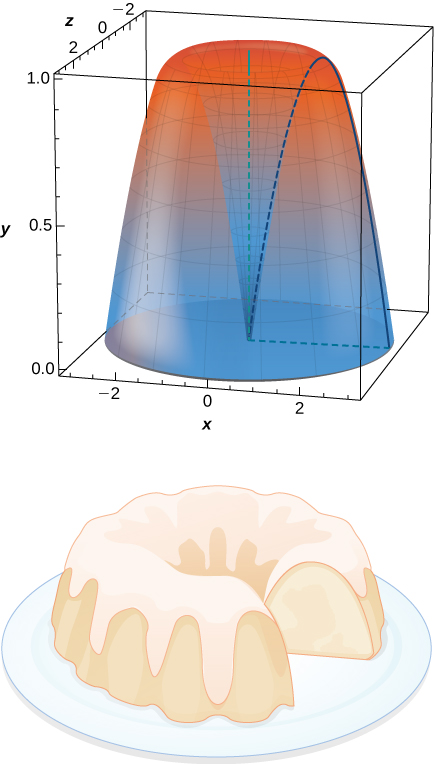
72) What is the volume of the Bundt cake that comes from rotating \( y=\sin x\) around the \(y\)-axis from \( x=0\) to \( x= \pi \)?
- Answer
- \(V = 2 \pi ^2\) units3
73) Find the weight of a ruler that is \(12\) in. long (starting at \( x=5\)) and has a weight density function of \( \gamma(x)=\ln(x)+(1/2)x^2\) oz/in. You should assume the ruler is a one-dimensional object.
In exercises 74 - 75, find the weight of the two-dimensional object that is centered at the origin.
74) A plate of radius \( 10\) in. with radial weight density function \( \gamma(x)=1+\cos(\pi x)\) \( \text{lb}/\text{in}^2 \)
- Answer
- \( 100\pi \) lbs.
75) A jar lid of radius \( 3\) in. with radial weight density function \(\gamma(x)=\ln(x+1)\) \( \text{oz}/\text{in}^2 \)
For each pair of integrals in exercises 76 - 77, determine which one is more difficult to evaluate. Explain your reasoning.
76) \(\displaystyle \int \sin^{456}x\cos x\,dx\) or \(\displaystyle \int \sin^2x\cos^2x\,dx\)
77) \(\displaystyle \int \tan^{350}x\sec^2x\,dx\) or \(\displaystyle \int \tan^{350}x\sec x\,dx\)
- Answer
- The second integral is more difficult because the first integral is simply a \(u\)-substitution type.