

Section 4.4: Solve Applications with Systems of Equations
- Page ID
- 188877

\( \newcommand{\vecs}[1]{\overset { \scriptstyle \rightharpoonup} {\mathbf{#1}} } \)
\( \newcommand{\vecd}[1]{\overset{-\!-\!\rightharpoonup}{\vphantom{a}\smash {#1}}} \)
\( \newcommand{\dsum}{\displaystyle\sum\limits} \)
\( \newcommand{\dint}{\displaystyle\int\limits} \)
\( \newcommand{\dlim}{\displaystyle\lim\limits} \)
\( \newcommand{\id}{\mathrm{id}}\) \( \newcommand{\Span}{\mathrm{span}}\)
( \newcommand{\kernel}{\mathrm{null}\,}\) \( \newcommand{\range}{\mathrm{range}\,}\)
\( \newcommand{\RealPart}{\mathrm{Re}}\) \( \newcommand{\ImaginaryPart}{\mathrm{Im}}\)
\( \newcommand{\Argument}{\mathrm{Arg}}\) \( \newcommand{\norm}[1]{\| #1 \|}\)
\( \newcommand{\inner}[2]{\langle #1, #2 \rangle}\)
\( \newcommand{\Span}{\mathrm{span}}\)
\( \newcommand{\id}{\mathrm{id}}\)
\( \newcommand{\Span}{\mathrm{span}}\)
\( \newcommand{\kernel}{\mathrm{null}\,}\)
\( \newcommand{\range}{\mathrm{range}\,}\)
\( \newcommand{\RealPart}{\mathrm{Re}}\)
\( \newcommand{\ImaginaryPart}{\mathrm{Im}}\)
\( \newcommand{\Argument}{\mathrm{Arg}}\)
\( \newcommand{\norm}[1]{\| #1 \|}\)
\( \newcommand{\inner}[2]{\langle #1, #2 \rangle}\)
\( \newcommand{\Span}{\mathrm{span}}\) \( \newcommand{\AA}{\unicode[.8,0]{x212B}}\)
\( \newcommand{\vectorA}[1]{\vec{#1}} % arrow\)
\( \newcommand{\vectorAt}[1]{\vec{\text{#1}}} % arrow\)
\( \newcommand{\vectorB}[1]{\overset { \scriptstyle \rightharpoonup} {\mathbf{#1}} } \)
\( \newcommand{\vectorC}[1]{\textbf{#1}} \)
\( \newcommand{\vectorD}[1]{\overrightarrow{#1}} \)
\( \newcommand{\vectorDt}[1]{\overrightarrow{\text{#1}}} \)
\( \newcommand{\vectE}[1]{\overset{-\!-\!\rightharpoonup}{\vphantom{a}\smash{\mathbf {#1}}}} \)
\( \newcommand{\vecs}[1]{\overset { \scriptstyle \rightharpoonup} {\mathbf{#1}} } \)
\(\newcommand{\longvect}{\overrightarrow}\)
\( \newcommand{\vecd}[1]{\overset{-\!-\!\rightharpoonup}{\vphantom{a}\smash {#1}}} \)
\(\newcommand{\avec}{\mathbf a}\) \(\newcommand{\bvec}{\mathbf b}\) \(\newcommand{\cvec}{\mathbf c}\) \(\newcommand{\dvec}{\mathbf d}\) \(\newcommand{\dtil}{\widetilde{\mathbf d}}\) \(\newcommand{\evec}{\mathbf e}\) \(\newcommand{\fvec}{\mathbf f}\) \(\newcommand{\nvec}{\mathbf n}\) \(\newcommand{\pvec}{\mathbf p}\) \(\newcommand{\qvec}{\mathbf q}\) \(\newcommand{\svec}{\mathbf s}\) \(\newcommand{\tvec}{\mathbf t}\) \(\newcommand{\uvec}{\mathbf u}\) \(\newcommand{\vvec}{\mathbf v}\) \(\newcommand{\wvec}{\mathbf w}\) \(\newcommand{\xvec}{\mathbf x}\) \(\newcommand{\yvec}{\mathbf y}\) \(\newcommand{\zvec}{\mathbf z}\) \(\newcommand{\rvec}{\mathbf r}\) \(\newcommand{\mvec}{\mathbf m}\) \(\newcommand{\zerovec}{\mathbf 0}\) \(\newcommand{\onevec}{\mathbf 1}\) \(\newcommand{\real}{\mathbb R}\) \(\newcommand{\twovec}[2]{\left[\begin{array}{r}#1 \\ #2 \end{array}\right]}\) \(\newcommand{\ctwovec}[2]{\left[\begin{array}{c}#1 \\ #2 \end{array}\right]}\) \(\newcommand{\threevec}[3]{\left[\begin{array}{r}#1 \\ #2 \\ #3 \end{array}\right]}\) \(\newcommand{\cthreevec}[3]{\left[\begin{array}{c}#1 \\ #2 \\ #3 \end{array}\right]}\) \(\newcommand{\fourvec}[4]{\left[\begin{array}{r}#1 \\ #2 \\ #3 \\ #4 \end{array}\right]}\) \(\newcommand{\cfourvec}[4]{\left[\begin{array}{c}#1 \\ #2 \\ #3 \\ #4 \end{array}\right]}\) \(\newcommand{\fivevec}[5]{\left[\begin{array}{r}#1 \\ #2 \\ #3 \\ #4 \\ #5 \\ \end{array}\right]}\) \(\newcommand{\cfivevec}[5]{\left[\begin{array}{c}#1 \\ #2 \\ #3 \\ #4 \\ #5 \\ \end{array}\right]}\) \(\newcommand{\mattwo}[4]{\left[\begin{array}{rr}#1 \amp #2 \\ #3 \amp #4 \\ \end{array}\right]}\) \(\newcommand{\laspan}[1]{\text{Span}\{#1\}}\) \(\newcommand{\bcal}{\cal B}\) \(\newcommand{\ccal}{\cal C}\) \(\newcommand{\scal}{\cal S}\) \(\newcommand{\wcal}{\cal W}\) \(\newcommand{\ecal}{\cal E}\) \(\newcommand{\coords}[2]{\left\{#1\right\}_{#2}}\) \(\newcommand{\gray}[1]{\color{gray}{#1}}\) \(\newcommand{\lgray}[1]{\color{lightgray}{#1}}\) \(\newcommand{\rank}{\operatorname{rank}}\) \(\newcommand{\row}{\text{Row}}\) \(\newcommand{\col}{\text{Col}}\) \(\renewcommand{\row}{\text{Row}}\) \(\newcommand{\nul}{\text{Nul}}\) \(\newcommand{\var}{\text{Var}}\) \(\newcommand{\corr}{\text{corr}}\) \(\newcommand{\len}[1]{\left|#1\right|}\) \(\newcommand{\bbar}{\overline{\bvec}}\) \(\newcommand{\bhat}{\widehat{\bvec}}\) \(\newcommand{\bperp}{\bvec^\perp}\) \(\newcommand{\xhat}{\widehat{\xvec}}\) \(\newcommand{\vhat}{\widehat{\vvec}}\) \(\newcommand{\uhat}{\widehat{\uvec}}\) \(\newcommand{\what}{\widehat{\wvec}}\) \(\newcommand{\Sighat}{\widehat{\Sigma}}\) \(\newcommand{\lt}{<}\) \(\newcommand{\gt}{>}\) \(\newcommand{\amp}{&}\) \(\definecolor{fillinmathshade}{gray}{0.9}\)We will rely heavily on these skills throughout this section.
- Two times a number and nine is thirty-one. What is the number?
- How far does someone who rides a bike \(3\frac{1}{2}\) hours at a rate of 10 miles per hour go?
- Simplify \(4.025(1,562)+254.1\)
Motivating Problem
You’re creating a custom trail mix with peanuts and dried fruit. One is $4 per pound, and the other is $6 per pound. You want 2 pounds of mix, which costs $5 per pound, total. How much of each do you need?
When two ingredients, speeds, or prices are blended together, systems of equations let you find the exact combo that works.
Fun Fact
Apothecaries in medieval Europe used systems of equations to blend herbs and tinctures at precise ratios for potions—chemistry and medicine have always had a mathematical component.
The Goal
In this section, we will apply systems of equations to solve real-world problems involving mixtures, motion, pricing, and comparisons. This is where algebra becomes a tool for decision-making!
In a previous section, we solved several applications with systems of linear equations. In this section, we’ll examine specific types of applications that relate two quantities. We’ll translate the words into linear equations, determine which method is most convenient to use, and then solve them.
Seven-Step Strategy For Solving Systems of Linear Equations:
- Read the problem. Ensure that all words and ideas are understood.
- Identify what we are looking for.
- Name what we are looking for. Choose variables to represent those quantities.
- Translate into a system of equations.
- Solve the system of equations using good algebra techniques.
- Verify the answer to the problem and ensure it is logical.
- Answer the question with a complete sentence.
Translate to a System of Equations
Let's look at an example where we stop after finding the system of equations.
Translate to a system of equations:
A married couple together earns $110,000 a year. The wife earns $16,000 less than twice what her husband earns. What does the husband earn?
Solution
\(\begin{array}{ll}{\text {We are looking for the amount that }} & {\text {Let } h=\text { the amount the husband earns. }} \\ {\text {the husband and wife each earn. }} & { w=\text { the amount the wife earns }} \\ {\text{Translate.}} & {\text{A married couple together earns \$110,000.} }\\ {} & {w+h=110000} \\ & \text{The wife earns \$16,000 less than twice what} \\ & \text{husband earns.} \\ & w=2h−16,000 \\ \text{The system of equations is:} & \left\{\begin{array}{l}{w+h=110,000} \\ {w=2 h-16,000}\end{array}\right.\end{array}\)
Translate to a system of equations:
A senior employee makes $5 less than twice what a new employee makes per hour. Together they make $43 per hour. How much does each employee make per hour?
- Answer
-
\(\left\{\begin{array}{l}{s=2 n-5} \\ {s+n=43}\end{array}\right.\)
Solve Direct Translation Applications
In the previous example, we set up but did not solve the systems of equations. Now, we’ll translate a situation into a system of equations and then solve it.
Translate to a system of equations and then solve:
Devon is 26 years older than his son Cooper. The sum of their ages is 50. Find their ages.
Solution
| Step 1. Read the problem. | |
| Step 2. Identify what we are looking for. | We are looking for the ages of Devon and Cooper. |
| Step 3. Name what we are looking for. | Let \(d\) be Devon’s age and \(c\) Cooper’s age. |
| Step 4. Translate into a system of equations. | Devon is 26 years older than Cooper:\[d=c+26\nonumber\] |
| The sum of their ages is 50: \[d+c=50\nonumber\] | |
| Then, the system is: \[\begin{cases} d=c+26,\\ d+c=50 \end{cases}\nonumber\] |
|
| Step 5. Solve the system of equations using substitution. |
Substitute \(c+26\) into the second equation for \(d\): \[ |
|
Solve for \(c\): \[ |
|
|
Substitute \(c=12\) into the first equation and solve for \(d\): \[ |
|
| Step 6. Check the answer in the problem. | Is Devon’s age 26 more than Cooper’s? Yes, 38 is 26 more than 12. Is the sum of their ages 50? Yes, 38 plus 12 is 50. |
| Step 7. Answer the question. | Devon is 38, and Cooper is 12. |
Translate to a system of equations and then solve:
Ali is 12 years older than his youngest sister, Jameela. The sum of their ages is 40. Find their ages.
- Answer
-
Ali is 26 and Jameela is 14.
Translate to a system of equations and then solve:
When Jenna spent 10 minutes on the elliptical trainer and then completed a 20-minute circuit training session, her fitness app indicated that she had burned 278 calories. When she spent 20 minutes on the elliptical trainer and 30 minutes circuit training, she burned 473 calories. How many calories does she burn each minute on the elliptical trainer? How many calories does she burn for each minute of circuit training?
Solution
| Step 1. Read the problem. | |
| Step 2. Identify what we are looking for. | We are looking for the number of calories burned each minute on the elliptical trainer and each minute of circuit training. |
| Step 3. Name what we are looking for. | Let \(e\) be the number of calories burned per minute on the elliptical trainer and \(c\) the number of calories burned per minute while circuit training. |
| Step 4. Translate into a system of equations. | 10 minutes on the elliptical and circuit training for 20 minutes, burned 278 calories |
 |
|
| 20 minutes on the elliptical and 30 minutes of circuit training burned 473 calories |
|
 |
|
| The system is: |  |
| Step 5. Solve the system of equations. | |
| Multiply the first equation by −2 to get opposite coefficients of e. |  |
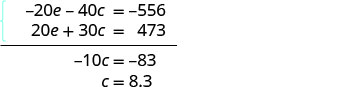
| Simplify and add the equations. Solve for c. |
 |
| Substitute c = 8.3 into one of the original equations to solve for e. |  |
 |
|
 |
|
 |
|
 |
|
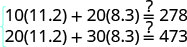
| Step 6. Check the answer in the problem. | Check the math on your own. |
 |
|
| Step 7. Answer the question. | Jenna burns 8.3 calories per minute circuit training and 11.2 calories per minute while on the elliptical trainer. |
Translate to a system of equations and then solve:
Erin spent 30 minutes on the rowing machine and 20 minutes lifting weights at the gym, burning a total of 430 calories. During her next visit to the gym, she spent 50 minutes on the rowing machine and 10 minutes lifting weights, burning a total of 600 calories. How many calories did she burn for each minute on the rowing machine? How many calories did she burn for each minute of weight lifting?
- Answer
-
Erin burned 11 calories for each minute on the rowing machine and 5 calories for each minute of weight lifting.
Many real-world problems involve relationships between quantities, like length and width, that can be described using variables and equations. By translating these situations into algebraic expressions, we can build and solve equations—or even systems of equations—to find unknown values that make sense in context.
Translate to a system of equations and then solve:
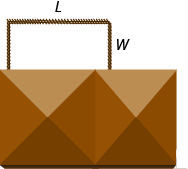
Randall has 125 feet of fencing to enclose the rectangular part of his backyard adjacent to his house. He will only need to fence around three sides, because the fourth side will be the wall of the house. He wants the length of the fenced yard (parallel to the house wall) to be 5 feet more than four times the width. Find the length and the width.
Solution
| Step 1. Read the problem. | |
| Step 2. Identify what you are looking for. | We are looking for the length and width. |
 |
|
| Step 3. Name what we are looking for. | Let \(L\) be the length of the fenced yard and \(W\) the width of the fenced yard. |
| Step 4. Translate into a system of equations. | One length and two widths equal 125. |
 |
|
| The length will be 5 feet more than four times the width. | |
 |
|
| The system is: Step 5. Solve the system of equations by substitution. |
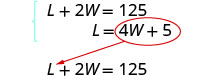 |
| Substitute \(L=4W+5\) into the first equation, then solve for \(W\). |
 |
 |
|
 |
|
| Substitute 20 for \(W\) in the second equation, then solve for \(L\). |
 |
 |
|
 |
|
 |
|
| Step 6. Check the answer in the problem. \(\begin{array}{rll} 20+85+20&=&125\checkmark \\ 85 &=&4\cdot 20 + 5\checkmark\end{array}\) |
|
| Step 7. Answer the equation. | The length is 85 feet and the width is 20 feet. |
Translate to a system of equations and then solve:
Alexis wants to build a rectangular dog run in her yard adjacent to her neighbor’s fence. She will use 136 feet of fencing to completely enclose the rectangular dog run. The length of the dog run along the neighbor’s fence will be 16 feet less than twice the width. Find the length and width of the dog run.
- Answer
-
The length is 60 feet and the width is 38 feet.
Many real-world applications of uniform motion arise because of the effects of currents—of water or air—on a vehicle's actual speed. Cross-country airplane flights in the United States generally take longer to travel west than to travel east due to the prevailing wind currents.
Let’s consider a boat traveling on a river. Depending on the direction the boat is traveling, the water current either slows it down or speeds it up.
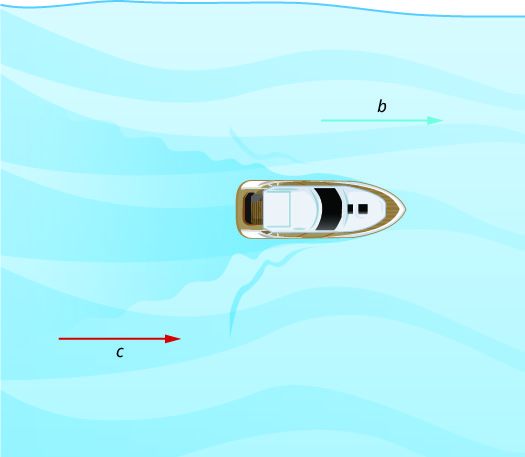
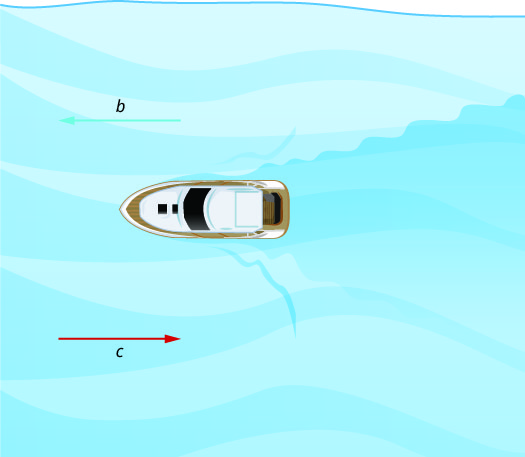
The figures below show how a river current affects a boat's actual speed. We’ll call the speed of the boat in still water \(b\) and the speed of the river current \(c\).
In the first figure, the boat is going downstream, in the same direction as the river current. The current helps push the boat, so its actual speed is faster than its speed in still water. The actual speed at which the boat is moving is \(b+c\).
In the second figure, the boat travels upstream against the river's current. The current is going against the boat, so its actual speed is slower than its speed in still water. The actual speed of the boat is \(b-c\).
We’ll put some numbers to this situation in the next example.
Translate to a system of equations and then solve:
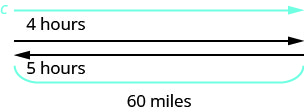
A river cruise ship sailed 60 miles downstream for 4 hours and then took 5 hours sailing upstream to return to the dock. Find the speed of the ship in still water and the speed of the river current.
Solution
Read the problem.
This is a uniform motion problem, and a picture will help us visualize the situation.
| Identify what we are looking for. | We are looking for the speed of the ship in still water and the speed of the current. |
| Name what we are looking for. | Let \(s\) be the rate of the ship in still water and \(c\) the rate of the current. |
| A chart will help us organize the information. The ship goes downstream and then upstream. Going downstream, the current helps the ship; therefore, the ship’s actual rate is \(s+c\). Going upstream, the current slows the ship; therefore, the actual rate is \(s-c\). |
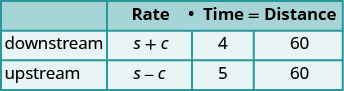 |
| Downstream it takes 4 hours. Upstream it takes 5 hours. Each way, the distance is 60 miles. |
|
| Translate into a system of equations. Since rate times time is distance, we can write the system of equations. |
 |
| Solve the system of equations. Distribute to put both equations in standard form, then solve by elimination. |
 |
| Multiply the top equation by 5 and the bottom equation by 4. Add the equations, then solve for \(s\). |
 |
| Substitute \(s=13.5\) into one of the original equations. |  |
 |
|
 |
|
 |
|
|
|
|
| Check the answer in the problem. The downstream rate would be 13.5 + 1.5 = 15 mph. In 4 hours, the ship would travel 15 · 4 = 60 miles. The upstream rate would be 13.5 − 1.5 = 12 mph. In 5 hours, the ship would travel 12 · 5 = 60 miles. |
|
| Answer the question. | The rate of the ship is 13.5 mph, and the rate of the current is 1.5 mph. |

Translate to a system of equations and then solve: Jason paddled his canoe 24 miles upstream for 4 hours. It took him 3 hours to paddle back. Find the speed of the canoe in still water and the speed of the river current.
- Answer
-
The canoe's speed is 7 mph, and the speed of the current is 1 mph.
When we solved mixture applications with coins and tickets earlier, we began by creating a table to organize the information. For a coin example with nickels and dimes, the table looked like this:
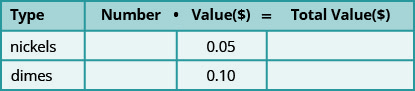
Using one variable meant that we had to relate the number of nickels to the number of dimes. We had to decide whether to let n be the number of nickels and then express the number of dimes in terms of n, or let d be the number of dimes and express the number of nickels in terms of d.
Now that we know how to solve systems of equations with two variables, we’ll just let n be the number of nickels and d be the number of dimes. We’ll write one equation based on the total value column, like we did before, and the other equation will come from the number column.
For the first example, we’ll solve a ticket problem with ticket prices in whole dollars, so we won’t need to use decimals just yet.
Translate to a system of equations and solve:
The box office at a movie theater sold 147 tickets for the evening show, and receipts totaled $1,302. How many $11 adult tickets and how many $8 child tickets were sold?
Solution
| Step 1. Read the problem. | We will create a table to organize the information. |
| Step 2. Identify what we are looking for. | We are looking for the number of adult tickets and the number of child tickets sold. |
| Step 3. Name what we are looking for. | Let \(a\) be the number of adult tickets and \(c\) the number of child tickets. |
| A table will help us organize the data. We have two types of tickets: adult and child. |
Write \(a\) and \(c\) for the number of tickets. |
| Write the total number of tickets sold at the bottom of the Number column. |
Altogether 147 were sold. |
| Write the value of each type of ticket in the Value column. |
The value of each adult ticket is $11. The value of each child tickets is $8. |
| The number times the value gives the total value, so the total value of adult tickets is \(a\cdot 11=11a\), and the total value of child tickets is \(c\cdot 8=8c\). |
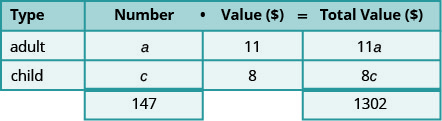 |
| Altogether the total value of the tickets was $1,302. |
Fill in the Total Value column. |
| Step 4. Translate into a system of equations. | |
| The Number column and the Total Value column give us the system of equations. We will use the elimination method to solve this system. |
 |
| Multiply the first equation by −8. |  |
| Simplify and add, then solve for \(a\). |
|
 |
|
| Substitute \(a=42\) into the first equation, then solve for \(c\). |
 |
 |
|
| Step 5. Check the answer in the problem. 42 adult tickets at $11 per ticket makes $462 105 child tickets at $8 per ticket makes $840. The total receipts are $1,302.✓ |
|
| Step 6. Answer the question. | The movie theater sold 42 adult tickets and 105 child tickets. |

Translate to a system of equations and solve:
The zoo's ticket office sold 553 tickets in one day, totaling $3,936. How many $9 adult tickets and how many $6 child tickets were sold?
- Answer
-
A total of 206 adult tickets and 347 children's tickets were sold.
Some mixture applications involve combining foods or drinks. Example situations might include combining raisins and nuts to make a trail mix or using two types of coffee beans to make a blend.
Translate to a system of equations and solve:
Carson wants to make 20 pounds of trail mix using nuts and chocolate chips. His budget requires that the trail mix cost him $7.60 per pound. Nuts cost $9.00 per pound, and chocolate chips cost $2.00 per pound. How many pounds of nuts and how many pounds of chocolate chips should he use?
Solution
| Step 1. Read the problem. | We will create a table to organize the information. |
| Step 2. Identify what we are looking for. | We are looking for the number of pounds of nuts and the number of pounds of chocolate chips. |
| Step 3. Name what we are looking for. | Let \(n\) be the number of pounds of nuts and \(c\) the number of pounds of chips. |
| Carson will mix nuts and chocolate chips to get trail mix. Write in \(n\) and \(c\) for the number of pounds of nuts and chocolate chips. There will be 20 pounds of trail mix. Put the price per pound of each item in the Value column. Fill in the last column using |
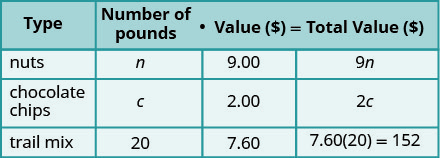 |
| Number · Value = Total Value | |
| Step 4. Translate into a system of equations. We get the equations from the Number and Total Value columns. |
 |
| Step 5. Solve the system of equations We will use elimination to solve the system. |
|
| Multiply the first equation by −2 to eliminate \(c\). |  |
| Simplify and add. Solve for /(n/). |  |
 |
|
| To find the number of pounds of chocolate chips, substitute \(n=16\) into the first equation, then solve for \(c\). |
  |
| \(c=4\) | |
| Step 6. Check the answer in the problem. \(\begin{aligned} 16+4 &=20 \checkmark \\ 9 \cdot 16+2 \cdot 4 &=152 \checkmark \end{aligned}\) |
|
| Step 7. Answer the question. | Carson should mix 16 pounds of nuts with 4 pounds of chocolate chips to create the trail mix. |
Translate to a system of equations and solve:
Sammy has most of the ingredients he needs to make a large batch of chili. The only items he lacks are beans and ground beef. He needs a total of 20 pounds of beans and ground beef, and he has a budget of $3 per pound. The price of beans is $1 per pound, and the price of ground beef is $5 per pound. How many pounds of beans and how many pounds of ground beef should he purchase?
- Answer
-
Sammy should purchase 10 pounds of beans and 10 pounds of ground beef.
Another application of mixture problems relates to concentrated cleaning supplies, other chemicals, and mixed drinks. The concentration is given as a percent. For example, a 20% concentrated household cleanser means that 20% of the total amount is cleanser, and the rest is water. To make 35 ounces of a 20% concentration, you mix 7 ounces (20% of 35) of the cleanser with 28 ounces of water.
For these kinds of mixture problems, we’ll use percent instead of value for one of the columns in our table.
Translate to a system of equations and solve:
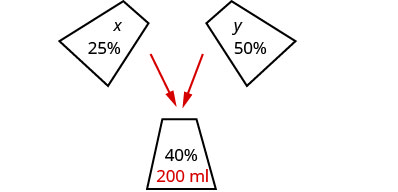
Sasheena is a lab assistant at her community college. She needs to make 200 milliliters of a 40% solution of sulfuric acid for a lab experiment. The lab has only 25% and 50% solutions in the storeroom. How much of the 25% and the 50% solutions should she mix to make the 40% solution?
Solution
| Step 1. Read the problem. | A figure may help us visualize the situation, then we will create a table to organize the information. |
| Sasheena must mix some of the 25% solution and some of the 50% solution together to get 200 mL of the 40% solution. |
 |
| Step 2. Identify what we are looking for. | We are looking for how much of each solution she needs. |
| Step 3. Name what we are looking for. | Let \(x\) be mL of 25% solution and \(y\) mL of 50% solution. |
| A table will help us organize the data. She will mix \(x\) mL of 25% with \(y\) mL of 50% to get 200 mL of 40% solution. We write the percents as decimals in the chart. We multiply the number of units times the concentration to get the total amount of sulfuric acid in each solution. |
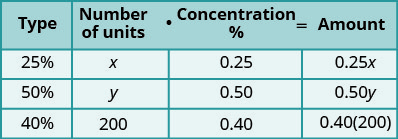 |
| Step 4. Translate into a system of equations. We get the equations from the Number column and the Amount column. |
|
| Now we have the system. |  |
| Step 5. Solve the system of equations. We will solve the system using the elimination method. Multiply the first equation by −0.5 to eliminate \(y\). |
 |
| Simplify and add to solve for x. | 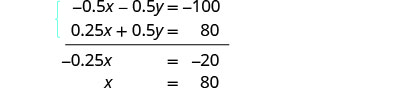 |
| To solve for y, substitute x = 80 into the first equation. |
 |
 |
|
 |
|
| Step 6. Check the answer in the problem. \(\begin{array}{rll} 80+120 &=&120 \checkmark\\ 0.25(80)+0.50(120) &=&80 \checkmark \\ &&\text{Yes!} \end{array}\) |
|
| Step 7. Answer the question. | Sasheena should mix 80 mL of the 25% solution with 120 mL of the 50% solution to get the 200 ml of the 40% solution. |
Translate to a system of equations and solve:
Anatole needs to make 250 milliliters of a 25% solution of hydrochloric acid for a lab experiment. The lab only has 10% and 40% solutions in the storeroom. How much of the 10% and how much of the 40% solutions should he mix to make the 25% solution?
- Answer
-
Anatole should mix 125 mL of the 10% solution with 125 mL of the 40% solution.