

2.1E: Exponential Growth and Decay (Exercises)
- Page ID
- 99709
\( \newcommand{\vecs}[1]{\overset { \scriptstyle \rightharpoonup} {\mathbf{#1}} } \)
\( \newcommand{\vecd}[1]{\overset{-\!-\!\rightharpoonup}{\vphantom{a}\smash {#1}}} \)
\( \newcommand{\dsum}{\displaystyle\sum\limits} \)
\( \newcommand{\dint}{\displaystyle\int\limits} \)
\( \newcommand{\dlim}{\displaystyle\lim\limits} \)
\( \newcommand{\id}{\mathrm{id}}\) \( \newcommand{\Span}{\mathrm{span}}\)
( \newcommand{\kernel}{\mathrm{null}\,}\) \( \newcommand{\range}{\mathrm{range}\,}\)
\( \newcommand{\RealPart}{\mathrm{Re}}\) \( \newcommand{\ImaginaryPart}{\mathrm{Im}}\)
\( \newcommand{\Argument}{\mathrm{Arg}}\) \( \newcommand{\norm}[1]{\| #1 \|}\)
\( \newcommand{\inner}[2]{\langle #1, #2 \rangle}\)
\( \newcommand{\Span}{\mathrm{span}}\)
\( \newcommand{\id}{\mathrm{id}}\)
\( \newcommand{\Span}{\mathrm{span}}\)
\( \newcommand{\kernel}{\mathrm{null}\,}\)
\( \newcommand{\range}{\mathrm{range}\,}\)
\( \newcommand{\RealPart}{\mathrm{Re}}\)
\( \newcommand{\ImaginaryPart}{\mathrm{Im}}\)
\( \newcommand{\Argument}{\mathrm{Arg}}\)
\( \newcommand{\norm}[1]{\| #1 \|}\)
\( \newcommand{\inner}[2]{\langle #1, #2 \rangle}\)
\( \newcommand{\Span}{\mathrm{span}}\) \( \newcommand{\AA}{\unicode[.8,0]{x212B}}\)
\( \newcommand{\vectorA}[1]{\vec{#1}} % arrow\)
\( \newcommand{\vectorAt}[1]{\vec{\text{#1}}} % arrow\)
\( \newcommand{\vectorB}[1]{\overset { \scriptstyle \rightharpoonup} {\mathbf{#1}} } \)
\( \newcommand{\vectorC}[1]{\textbf{#1}} \)
\( \newcommand{\vectorD}[1]{\overrightarrow{#1}} \)
\( \newcommand{\vectorDt}[1]{\overrightarrow{\text{#1}}} \)
\( \newcommand{\vectE}[1]{\overset{-\!-\!\rightharpoonup}{\vphantom{a}\smash{\mathbf {#1}}}} \)
\( \newcommand{\vecs}[1]{\overset { \scriptstyle \rightharpoonup} {\mathbf{#1}} } \)
\(\newcommand{\longvect}{\overrightarrow}\)
\( \newcommand{\vecd}[1]{\overset{-\!-\!\rightharpoonup}{\vphantom{a}\smash {#1}}} \)
\(\newcommand{\avec}{\mathbf a}\) \(\newcommand{\bvec}{\mathbf b}\) \(\newcommand{\cvec}{\mathbf c}\) \(\newcommand{\dvec}{\mathbf d}\) \(\newcommand{\dtil}{\widetilde{\mathbf d}}\) \(\newcommand{\evec}{\mathbf e}\) \(\newcommand{\fvec}{\mathbf f}\) \(\newcommand{\nvec}{\mathbf n}\) \(\newcommand{\pvec}{\mathbf p}\) \(\newcommand{\qvec}{\mathbf q}\) \(\newcommand{\svec}{\mathbf s}\) \(\newcommand{\tvec}{\mathbf t}\) \(\newcommand{\uvec}{\mathbf u}\) \(\newcommand{\vvec}{\mathbf v}\) \(\newcommand{\wvec}{\mathbf w}\) \(\newcommand{\xvec}{\mathbf x}\) \(\newcommand{\yvec}{\mathbf y}\) \(\newcommand{\zvec}{\mathbf z}\) \(\newcommand{\rvec}{\mathbf r}\) \(\newcommand{\mvec}{\mathbf m}\) \(\newcommand{\zerovec}{\mathbf 0}\) \(\newcommand{\onevec}{\mathbf 1}\) \(\newcommand{\real}{\mathbb R}\) \(\newcommand{\twovec}[2]{\left[\begin{array}{r}#1 \\ #2 \end{array}\right]}\) \(\newcommand{\ctwovec}[2]{\left[\begin{array}{c}#1 \\ #2 \end{array}\right]}\) \(\newcommand{\threevec}[3]{\left[\begin{array}{r}#1 \\ #2 \\ #3 \end{array}\right]}\) \(\newcommand{\cthreevec}[3]{\left[\begin{array}{c}#1 \\ #2 \\ #3 \end{array}\right]}\) \(\newcommand{\fourvec}[4]{\left[\begin{array}{r}#1 \\ #2 \\ #3 \\ #4 \end{array}\right]}\) \(\newcommand{\cfourvec}[4]{\left[\begin{array}{c}#1 \\ #2 \\ #3 \\ #4 \end{array}\right]}\) \(\newcommand{\fivevec}[5]{\left[\begin{array}{r}#1 \\ #2 \\ #3 \\ #4 \\ #5 \\ \end{array}\right]}\) \(\newcommand{\cfivevec}[5]{\left[\begin{array}{c}#1 \\ #2 \\ #3 \\ #4 \\ #5 \\ \end{array}\right]}\) \(\newcommand{\mattwo}[4]{\left[\begin{array}{rr}#1 \amp #2 \\ #3 \amp #4 \\ \end{array}\right]}\) \(\newcommand{\laspan}[1]{\text{Span}\{#1\}}\) \(\newcommand{\bcal}{\cal B}\) \(\newcommand{\ccal}{\cal C}\) \(\newcommand{\scal}{\cal S}\) \(\newcommand{\wcal}{\cal W}\) \(\newcommand{\ecal}{\cal E}\) \(\newcommand{\coords}[2]{\left\{#1\right\}_{#2}}\) \(\newcommand{\gray}[1]{\color{gray}{#1}}\) \(\newcommand{\lgray}[1]{\color{lightgray}{#1}}\) \(\newcommand{\rank}{\operatorname{rank}}\) \(\newcommand{\row}{\text{Row}}\) \(\newcommand{\col}{\text{Col}}\) \(\renewcommand{\row}{\text{Row}}\) \(\newcommand{\nul}{\text{Nul}}\) \(\newcommand{\var}{\text{Var}}\) \(\newcommand{\corr}{\text{corr}}\) \(\newcommand{\len}[1]{\left|#1\right|}\) \(\newcommand{\bbar}{\overline{\bvec}}\) \(\newcommand{\bhat}{\widehat{\bvec}}\) \(\newcommand{\bperp}{\bvec^\perp}\) \(\newcommand{\xhat}{\widehat{\xvec}}\) \(\newcommand{\vhat}{\widehat{\vvec}}\) \(\newcommand{\uhat}{\widehat{\uvec}}\) \(\newcommand{\what}{\widehat{\wvec}}\) \(\newcommand{\Sighat}{\widehat{\Sigma}}\) \(\newcommand{\lt}{<}\) \(\newcommand{\gt}{>}\) \(\newcommand{\amp}{&}\) \(\definecolor{fillinmathshade}{gray}{0.9}\)Part 1: Exponential growth
1. For each table below, determine if the table represents a function that is linear, exponential, or neither? If the function is exponential, find a formula.
a.
| x | 0 | 1 | 2 | 3 |
| \(f(x)\) | 5 | 10 | 20 | 40 |
b.
| x | 0 | 1 | 2 | 3 |
| \(g(x)\) | 7 | 12 | 17 | 22 |
c.
| x | 0 | 1 | 2 | 3 |
| \(h(x)\) | 36 | 12 | 4 | \(\frac{4}{3} \) |
d.
| x | 1 | 2 | 3 | 5 |
| \(k(x)\) | 50 | 42 | 34 | 26 |
e.
| x | 1 | 2 | 3 | 4 |
| \(m(x)\) | 90 | 81 | 72.9 | 65.61 |
f.
| x | 2 | 3 | 4 | 5 |
| \(n(x)\) | 3 | 1 | 3 | 7 |
Part 2: Graphs of exponential functions
2. Sketch a graph of the function \(y=2(3)^{x} \) using a table of values with \(x = -2,-1,0,1,2,3,4 \). Label the y-intercept.
3. Match each function with one of the graphs below.
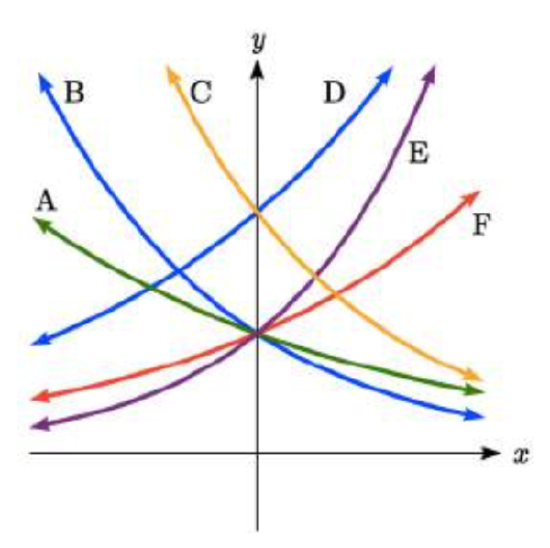
a. \(f\left(x\right)=2\left(0.69\right)^{x}\)
b. \(f\left(x\right)=2\left(1.28\right)^{x}\)
c. \(f\left(x\right)=2\left(0.81\right)^{x}\)
d. \(f\left(x\right)=4\left(1.28\right)^{x}\)
e. \(f\left(x\right)=2\left(1.59\right)^{x}\)
f. \(f\left(x\right)=4\left(0.69\right)^{x}\)
4. If all the graphs to the right have equations with form \(f\left(x\right)=ab^{x}\),
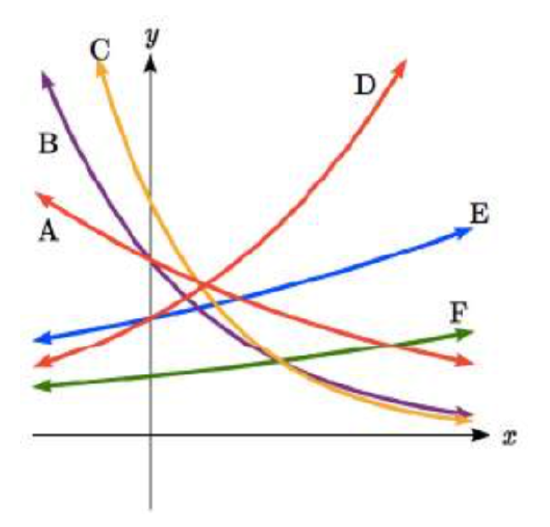
a. Which graph has the largest value for \(b\)?
b. Which graph has the smallest value for \(b\)?
c. Which graph has the largest value for \(a\)?
d. Which graph has the smallest value for \(a\)?
e. Which of the two graphs has the larger value for \(b\), graph E or F?
f. Which of the two graphs has the smaller value for \(b\), graph A or B?
g. Which of the graphs have a value for the growth factor \(b\) where \(b> 1\)?
h. Which of the graphs have a value for the growth factor \(b\) where \(0<b< 1\)?
5. Which of the functions graphed below could be exponential? If so, does the growth factor, \(b\), satisfy \(b> 1\) or \(0<b< 1\)?

6. Without graphing with a graphing calculator or other graphing technology, determine which of the graphs of the two functions will cross in the first quadrant? Explain your reasoning.
a. \(f(x)=8(1.15)^{x} \) and \(f(x)=3(1.20)^{x} \)
b. \(f(x)=8(1.15)^{x} \) and \(f(x)=10(1.20)^{x} \)
c. \(f(x)=8(1.15)^{x} \) and \(f(x)=3(1.12)^{x} \)
d. \(f(x)=6(0.85)^{x} \) and \(f(x)=3(0.90)^{x} \)
e. \(f(x)=6(0.85)^{x} \) and \(f(x)=7(0.90)^{x} \)
f. \(f(x)=6(0.85)^{x} \) and \(f(x)=7(0.83)^{x} \)
Answers to selected exercises:
Part 1:
1. a. Exponential, \(f(x)=5(2)^{x} \)
b. Linear
f. Neither
Part 2:
3. a. Graph B, b. Graph F, c. Graph A, d. Graph D, e. Graph E, f. Graph C
5. The functions y = \(g(x)\) and y = \(k(x)\) are graphs of exponential functions. For y = \(g(x)\), b > 1 since the function is increasing. For y = \(k(x)\), we have 0 < b < 1 since the function is decreasing.