

1.1: The Language of Algebra
- Page ID
- 173446

\( \newcommand{\vecs}[1]{\overset { \scriptstyle \rightharpoonup} {\mathbf{#1}} } \)
\( \newcommand{\vecd}[1]{\overset{-\!-\!\rightharpoonup}{\vphantom{a}\smash {#1}}} \)
\( \newcommand{\dsum}{\displaystyle\sum\limits} \)
\( \newcommand{\dint}{\displaystyle\int\limits} \)
\( \newcommand{\dlim}{\displaystyle\lim\limits} \)
\( \newcommand{\id}{\mathrm{id}}\) \( \newcommand{\Span}{\mathrm{span}}\)
( \newcommand{\kernel}{\mathrm{null}\,}\) \( \newcommand{\range}{\mathrm{range}\,}\)
\( \newcommand{\RealPart}{\mathrm{Re}}\) \( \newcommand{\ImaginaryPart}{\mathrm{Im}}\)
\( \newcommand{\Argument}{\mathrm{Arg}}\) \( \newcommand{\norm}[1]{\| #1 \|}\)
\( \newcommand{\inner}[2]{\langle #1, #2 \rangle}\)
\( \newcommand{\Span}{\mathrm{span}}\)
\( \newcommand{\id}{\mathrm{id}}\)
\( \newcommand{\Span}{\mathrm{span}}\)
\( \newcommand{\kernel}{\mathrm{null}\,}\)
\( \newcommand{\range}{\mathrm{range}\,}\)
\( \newcommand{\RealPart}{\mathrm{Re}}\)
\( \newcommand{\ImaginaryPart}{\mathrm{Im}}\)
\( \newcommand{\Argument}{\mathrm{Arg}}\)
\( \newcommand{\norm}[1]{\| #1 \|}\)
\( \newcommand{\inner}[2]{\langle #1, #2 \rangle}\)
\( \newcommand{\Span}{\mathrm{span}}\) \( \newcommand{\AA}{\unicode[.8,0]{x212B}}\)
\( \newcommand{\vectorA}[1]{\vec{#1}} % arrow\)
\( \newcommand{\vectorAt}[1]{\vec{\text{#1}}} % arrow\)
\( \newcommand{\vectorB}[1]{\overset { \scriptstyle \rightharpoonup} {\mathbf{#1}} } \)
\( \newcommand{\vectorC}[1]{\textbf{#1}} \)
\( \newcommand{\vectorD}[1]{\overrightarrow{#1}} \)
\( \newcommand{\vectorDt}[1]{\overrightarrow{\text{#1}}} \)
\( \newcommand{\vectE}[1]{\overset{-\!-\!\rightharpoonup}{\vphantom{a}\smash{\mathbf {#1}}}} \)
\( \newcommand{\vecs}[1]{\overset { \scriptstyle \rightharpoonup} {\mathbf{#1}} } \)
\(\newcommand{\longvect}{\overrightarrow}\)
\( \newcommand{\vecd}[1]{\overset{-\!-\!\rightharpoonup}{\vphantom{a}\smash {#1}}} \)
\(\newcommand{\avec}{\mathbf a}\) \(\newcommand{\bvec}{\mathbf b}\) \(\newcommand{\cvec}{\mathbf c}\) \(\newcommand{\dvec}{\mathbf d}\) \(\newcommand{\dtil}{\widetilde{\mathbf d}}\) \(\newcommand{\evec}{\mathbf e}\) \(\newcommand{\fvec}{\mathbf f}\) \(\newcommand{\nvec}{\mathbf n}\) \(\newcommand{\pvec}{\mathbf p}\) \(\newcommand{\qvec}{\mathbf q}\) \(\newcommand{\svec}{\mathbf s}\) \(\newcommand{\tvec}{\mathbf t}\) \(\newcommand{\uvec}{\mathbf u}\) \(\newcommand{\vvec}{\mathbf v}\) \(\newcommand{\wvec}{\mathbf w}\) \(\newcommand{\xvec}{\mathbf x}\) \(\newcommand{\yvec}{\mathbf y}\) \(\newcommand{\zvec}{\mathbf z}\) \(\newcommand{\rvec}{\mathbf r}\) \(\newcommand{\mvec}{\mathbf m}\) \(\newcommand{\zerovec}{\mathbf 0}\) \(\newcommand{\onevec}{\mathbf 1}\) \(\newcommand{\real}{\mathbb R}\) \(\newcommand{\twovec}[2]{\left[\begin{array}{r}#1 \\ #2 \end{array}\right]}\) \(\newcommand{\ctwovec}[2]{\left[\begin{array}{c}#1 \\ #2 \end{array}\right]}\) \(\newcommand{\threevec}[3]{\left[\begin{array}{r}#1 \\ #2 \\ #3 \end{array}\right]}\) \(\newcommand{\cthreevec}[3]{\left[\begin{array}{c}#1 \\ #2 \\ #3 \end{array}\right]}\) \(\newcommand{\fourvec}[4]{\left[\begin{array}{r}#1 \\ #2 \\ #3 \\ #4 \end{array}\right]}\) \(\newcommand{\cfourvec}[4]{\left[\begin{array}{c}#1 \\ #2 \\ #3 \\ #4 \end{array}\right]}\) \(\newcommand{\fivevec}[5]{\left[\begin{array}{r}#1 \\ #2 \\ #3 \\ #4 \\ #5 \\ \end{array}\right]}\) \(\newcommand{\cfivevec}[5]{\left[\begin{array}{c}#1 \\ #2 \\ #3 \\ #4 \\ #5 \\ \end{array}\right]}\) \(\newcommand{\mattwo}[4]{\left[\begin{array}{rr}#1 \amp #2 \\ #3 \amp #4 \\ \end{array}\right]}\) \(\newcommand{\laspan}[1]{\text{Span}\{#1\}}\) \(\newcommand{\bcal}{\cal B}\) \(\newcommand{\ccal}{\cal C}\) \(\newcommand{\scal}{\cal S}\) \(\newcommand{\wcal}{\cal W}\) \(\newcommand{\ecal}{\cal E}\) \(\newcommand{\coords}[2]{\left\{#1\right\}_{#2}}\) \(\newcommand{\gray}[1]{\color{gray}{#1}}\) \(\newcommand{\lgray}[1]{\color{lightgray}{#1}}\) \(\newcommand{\rank}{\operatorname{rank}}\) \(\newcommand{\row}{\text{Row}}\) \(\newcommand{\col}{\text{Col}}\) \(\renewcommand{\row}{\text{Row}}\) \(\newcommand{\nul}{\text{Nul}}\) \(\newcommand{\var}{\text{Var}}\) \(\newcommand{\corr}{\text{corr}}\) \(\newcommand{\len}[1]{\left|#1\right|}\) \(\newcommand{\bbar}{\overline{\bvec}}\) \(\newcommand{\bhat}{\widehat{\bvec}}\) \(\newcommand{\bperp}{\bvec^\perp}\) \(\newcommand{\xhat}{\widehat{\xvec}}\) \(\newcommand{\vhat}{\widehat{\vvec}}\) \(\newcommand{\uhat}{\widehat{\uvec}}\) \(\newcommand{\what}{\widehat{\wvec}}\) \(\newcommand{\Sighat}{\widehat{\Sigma}}\) \(\newcommand{\lt}{<}\) \(\newcommand{\gt}{>}\) \(\newcommand{\amp}{&}\) \(\definecolor{fillinmathshade}{gray}{0.9}\)
Hawk A.I. Section-Specific Tutor
To access the Hawk A.I. Tutor, you will need to be logged into your campus Gmail account.
Definitions and Theorems
A variable, typically represented by a letter or other symbol, is a quantity whose value may change.
A constant is a quantity whose value always stays the same.
A parameter is a variable that influences the behavior or output of a mathematical object (like a function or equation) but is held constant within a specific context or scenario. It's a quantity that helps define or constrain a system, function, or dataset.
An operation is a predefined action that takes one or more inputs (called operands) and produces an output. It's a process that combines numbers or other mathematical objects to produce a result.
The operation of addition between two numbers \( a \) and \( b \), denoted \( a + b \) and read as "\( a \) plus \( b \)," is the sum of \( a \) and \( b \). In this operation, both \( a \) and \( b \) are called addends.
The operation of subtraction between two numbers \( a \) and \( b \), denoted \( a - b \) and read as "\( a \) minus \( b \)," is the difference of \( a \) and \( b \). \( a \) is called the minuend and \( b \) is called the subtrahend.
The operation of multiplication between two numbers \( a \) and \( b \), denoted \( ab \), \( a \cdot b \), \( (a)b \), \( a(b) \), \( (a)(b) \), or \( a \times b \) and read as "\( a \) times \( b \)," is the product of \( a \) and \( b \). \( a \) is called the multiplier and \( b \) is called the multiplicand.
The operation of division between two numbers \( a \) and \( b \) (where \( b \neq 0 \)), denoted \( a \div b \), \( a/b \), or \( \frac{a}{b} \) and read as "\( a \) divided by \( b \)," is the quotient of \( a \) and \( b \). \( a \) is called the dividend and \( b \) is called the divisor.
An algebraic expression is a well-formed mathematical phrase that combines numbers, variables, and mathematical operations. It does not include an equals sign.
To evaluate an algebraic expression means to substitute a specific value for the variable or variables involved.
Two algebraic expressions are called equivalent if they have the same value for all allowable variable values.
A statement that the values of two mathematical expressions are equal is called an equation. Equations must include an equals sign.
An equation that is true only for certain variable values (and, therefore, is false for others) is called a conditional equation.
An equation that is true for all allowable variable values is called an identity.
Examples
\(a=b\) is read "\(a\) is equal to \(b\)."
The symbol “\(=\)” is called the equal sign.
On the number line, the numbers get larger as they go from left to right. The number line can be used to explain the symbols “\(<\)” and “\(>\)”.
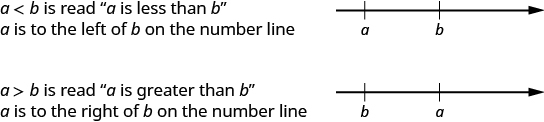
The expressions \(a<b\) or \(a>b\) can be read from left to right or right to left, though in English we usually read from left to right. In general,
\[a<b \text{ is equivalent to }b>a. \text{For example, } 7<11 \text{ is equivalent to }11>7.\]
\[a>b \text{ is equivalent to }b<a. \text{For example, } 17>4 \text{ is equivalent to }4<17.\]
| Inequality Symbols | Words |
|---|---|
| \(a\neq b\) | \(a\) is not equal to \(b\). |
| \(a<b\) | \(a\) is less than \(b\). |
| \(a\leq b\) | \(a\) is less than or equal to \(b\). |
| \(a>b\) | \(a\) is greater than \(b\). |
| \(a\geq b\) | \(a\) is greater than or equal to \(b\). |
Grouping symbols in algebra are much like the commas, colons, and other punctuation marks in English. They help identify an expression, which can be made up of number, a variable, or a combination of numbers and variables using operation symbols. We will introduce three types of grouping symbols now.
\[\begin{array}{lc} \text{Parentheses} & \mathrm{()} \\ \text{Brackets} & \mathrm{[]} \\ \text{Braces} & \mathrm{ \{ \} } \end{array}\]
Here are some examples of expressions that include grouping symbols. We will simplify expressions like these later in this section.
\[8(14−8) \qquad 21−3[2+4(9−8)] \qquad 24÷ \{13−2[1(6−5)+4]\}\]
What is the difference in English between a phrase and a sentence? A phrase expresses a single thought that is incomplete by itself, but a sentence makes a complete statement. A sentence has a subject and a verb. In algebra, we have expressions and equations.
An expression is a number, a variable, or a combination of numbers and variables using operation symbols.
\[\begin{array}{lll} \textbf{Expression} & \textbf{Words} & \textbf{English Phrase} \\ \mathrm{3+5} & \text{3 plus 5} & \text{the sum of three and five} \\ \mathrm{n−1} & n\text{ minus one} & \text{the difference of } n \text{ and one} \\ \mathrm{6·7} & \text{6 times 7} & \text{the product of six and seven} \\ \frac{x}{y} & x \text{ divided by }y & \text{the quotient of }x \text{ and }y \end{array} \]
Notice that the English phrases do not form a complete sentence because the phrase does not have a verb.
An equation is two expressions linked by an equal sign. When you read the words the symbols represent in an equation, you have a complete sentence in English. The equal sign gives the verb.
An equation is two expressions connected by an equal sign.
\[\begin{array}{ll} \textbf{Equation} & \textbf{English Sentence} \\ 3+5=8 & \text{The sum of three and five is equal to eight.} \\ n−1=14 & n \text{ minus one equals fourteen.} \\ 6·7=42 & \text{The product of six and seven is equal to forty-two.} \\ x=53 & x \text{ is equal to fifty-three.} \\ y+9=2y−3 & y \text{ plus nine is equal to two } y \text{ minus three.} \end{array}\]
Suppose we need to multiply 2 nine times. We could write this as \(2·2·2·2·2·2·2·2·2\). This is tedious and it can be hard to keep track of all those 2s, so we use exponents. We write \(2·2·2\) as \(\mathrm{2^3}\) and \(2·2·2·2·2·2·2·2·2\) as \(2^9\). In expressions such as \(2^3\), the 2 is called the base and the 3 is called the exponent. The exponent tells us how many times we need to multiply the base.

We say \(2^3\) is in exponential notation and \(2·2·2\) is in expanded notation.
\(a^n\) means multiply \(n\) factors of the number \(a\).
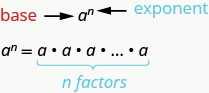
The expression \(a^n\) is read \(a\) to the \(n^{th}\) power.
While we read \(a^n\) as \(“a\) to the \(n^{th}\) power”, we usually read:
\[\begin{array}{cc} a^2 & “a \text{ squared}” \\ a^3 & “a \text{ cubed}” \end{array}\]
We’ll see later why \(a^2\) and \(a^3\) have special names.
Table shows how we read some expressions with exponents.
| Expression | In Words | |
|---|---|---|
| 72 | 7 to the second power or | 7 squared |
| 53 | 5 to the third power or | 5 cubed |
| 94 | 9 to the fourth power | |
| 125 | 12 to the fifth power |
Evaluate an Expression
In the last few examples, we simplified expressions using the order of operations. Now we’ll evaluate some expressions—again following the order of operations. To evaluate an expression means to find the value of the expression when the variable is replaced by a given number.
To evaluate an expression means to find the value of the expression when the variable is replaced by a given number.
To evaluate an expression, substitute that number for the variable in the expression and then simplify the expression.
Evaluate when \(x=4\): a. \(x^2\) b. \(3^x\) c. \(2x^2+3x+8\).
- Answer
-
a.
b.


Use definition of exponent. 
Simplify. 
c.


Use definition of exponent. 
Simplify. 



Follow the order of operations. .jpg?revision=1&size=bestfit&width=117&height=16)


Evaluate when \(x=3\), a. \(x^2\) b. \(4^x\) c. \(3x^2+4x+1\).
- Answer
-
a. 9
b. 64
c. 40
Evaluate when \(x=6\), a. \(x^3\) b. \(2^x\) c. \(6x^2−4x−7\).
- Answer
-
a. 216
b. 64
c. 185
Identify and Combine Like Terms
Algebraic expressions are made up of terms. A term is a constant, or the product of a constant and one or more variables.
A term is a constant or the product of a constant and one or more variables.
Examples of terms are \(7,\,y,\,5x^2,\,9a,\) and \(b^5\).
The constant that multiplies the variable is called the coefficient.
The coefficient of a term is the constant that multiplies the variable in a term.
Think of the coefficient as the number in front of the variable. The coefficient of the term \(3x\) is 3. When we write \(x\), the coefficient is 1, since \(x=1⋅x\).
Some terms share common traits. When two terms are constants or have the same variable and exponent, we say they are like terms.
Look at the following 6 terms. Which ones seem to have traits in common?
\[5x \quad 7 \quad n^2 \quad 4 \quad 3x \quad 9n^2\]
We say,
\(7\) and \(4\) are like terms.
\(5x\) and \(3x\) are like terms.
\(n^2\) and \(9n^2\) are like terms.
Terms that are either constants or have the same variables raised to the same powers are called like terms.
If there are like terms in an expression, you can simplify the expression by combining the like terms. We add the coefficients and keep the same variable.
\[\begin{array}{lc} \text{Simplify.} & 4x+7x+x \\ \text{Add the coefficients.} & 12x \end{array}\]
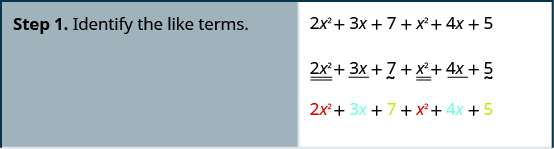
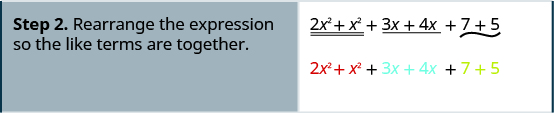
Simplify: \(2x^2+3x+7+x^2+4x+5\).
- Answer
-

Simplify: \(3x^2+7x+9+7x^2+9x+8\).
- Answer
-
\(10x^2+16x+17\)
Simplify: \(4y^2+5y+2+8y^2+4y+5.\)
- Answer
-
\(12y^2+9y+7\)
- Identify like terms.
- Rearrange the expression so like terms are together.
- Add or subtract the coefficients and keep the same variable for each group of like terms.
Translate an English Phrase to an Algebraic Expression
We listed many operation symbols that are used in algebra. Now, we will use them to translate English phrases into algebraic expressions. The symbols and variables we’ve talked about will help us do that. Table summarizes them.
| Operation | Phrase | Expression |
|---|---|---|
| Addition | \(a\) plus \(b\)
the sum of \(a\) and \(b\) \(a\) increased by \(b\) \(b\) more than \(a\) the total of \(a\) and \(b\) \(b\) added to \(a\) |
\(a+b\) |
| Subtraction | \(a\) minus \(b\)
the difference of \(a\) and \(b\) \(a\) decreased by \(b\) \(b\) less than \(a\) \(b\) subtracted from \(a\) |
\(a−b\) |
| Multiplication | \(a\) times \(b\)
the product of \(a\) and \(b\) twice \(a\) |
\(a·b,\,ab,\,a(b),\,(a)(b)\)
\(2a\) |
| Division | \(a\) divided by \(b\)
the quotient of \(a\) and \(b\) the ratio of \(a\) and \(b\) \(b\) divided into \(a\) |
\(a÷b,\,a/b,\,\frac{a}{b},\,b \overline{\smash{)}a}\) |
Look closely at these phrases using the four operations:
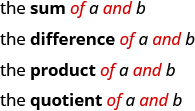
Each phrase tells us to operate on two numbers. Look for the words of and and to find the numbers.
Each phrase tells us to operate on two numbers. Look for the words of and and to find the numbers.
Translate each English phrase into an algebraic expression:
a. the difference of \(14x\) and \(9\)
b. the quotient of \(8y^2\) and \(3\)c. twelve more than \(y\)
d. seven less than \(49x^2\)
- Answer
-
a. The key word is difference, which tells us the operation is subtraction. Look for the words of and and to find the numbers to subtract.
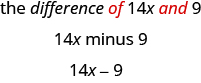
b. The key word is quotient, which tells us the operation is division.
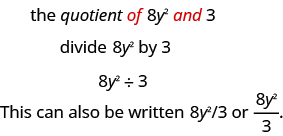
c. The key words are more than. They tell us the operation is addition. More than means “added to.”
\[\text{twelve more than }y \\ \text{twelve added to }y \\ y+12\]
d. The key words are less than. They tell us to subtract. Less than means “subtracted from.”
\[\text{seven less than }49x^2 \\ \text{seven subtracted from }49x^2 \\ 49x^2−7\]
Translate the English phrase into an algebraic expression:
a. the difference of \(14x^2\) and \(13\)
b. the quotient of \(12x\) and \(2\)
c. \(13\) more than \(z\)
d. \(18\) less than \(8x\)
- Answer
-
a. \(14x^2−13\) b. \(12x÷2\)
c. \(z+13\) d. \(8x−18\)
Translate the English phrase into an algebraic expression:
a. the sum of \(17y^2\) and \(19\)
b. the product of \(7\) and \(y\)
c. Eleven more than \(x\)
d. Fourteen less than \(11a\)
- Answer
-
a. \(17y^2+19\) b. \(7y\)
c. \(x+11\) d. \(11a−14\)
We look carefully at the words to help us distinguish between multiplying a sum and adding a product.
Translate the English phrase into an algebraic expression:
a. eight times the sum of \(x\) and \(y\)
b. the sum of eight times \(x\) and \(y\)
- Answer
-
There are two operation words—times tells us to multiply and sum tells us to add.
a. Because we are multiplying \(8\) times the sum, we need parentheses around the sum of \(x\) and \(y\), \((x+y)\). This forces us to determine the sum first. (Remember the order of operations.)
\[\text{eight times the sum of }x \text{ and }y \\ 8(x+y)\]
b. To take a sum, we look for the words of and and to see what is being added. Here we are taking the sum of eight times \(x\) and \(y\).
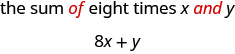
Translate the English phrase into an algebraic expression:
a. four times the sum of \(p\) and \(q\)
b. the sum of four times \(p\) and \(q\)
- Answer
-
a. \(4(p+q)\) b. \(4p+q\)
Translate the English phrase into an algebraic expression:
a. the difference of two times \(x\) and \(8\)
b. two times the difference of \(x\) and \(8\)
- Answer
-
a. \(2x−8\) b. \(2(x−8)\)
Later in this course, we’ll apply our skills in algebra to solving applications. The first step will be to translate an English phrase to an algebraic expression. We’ll see how to do this in the next two examples.
The length of a rectangle is 14 less than the width. Let \(w\) represent the width of the rectangle. Write an expression for the length of the rectangle.
- Answer
-
\[\begin{array}{lc} \text{Write a phrase about the length of the rectangle.} & \text{14 less than the width} \\ \text{Substitute }w \text{ for “the width.”} & w \\ \text{Rewrite less than as subtracted from.} & \text{14 subtracted from } w \\ \text{Translate the phrase into algebra.} & w−14 \end{array}\]
The length of a rectangle is 7 less than the width. Let \(w\) represent the width of the rectangle. Write an expression for the length of the rectangle.
- Answer
-
\(w−7\)
The width of a rectangle is \(6\) less than the length. Let \(l\) represent the length of the rectangle. Write an expression for the width of the rectangle.
- Answer
-
\(l−6\)
The expressions in the next example will be used in the typical coin mixture problems we will see soon.
June has dimes and quarters in her purse. The number of dimes is seven less than four times the number of quarters. Let \(q\) represent the number of quarters. Write an expression for the number of dimes.
- Answer
-
\[\begin{array}{lc} \text{Write a phrase about the number of dimes.} & \text{7 less than 4 times }q \\ \text{Translate 4 times }q. & \text{7 less than 4}q \\ \text{Translate the phrase into algebra.} & 4q−7 \end{array}\]
Geoffrey has dimes and quarters in his pocket. The number of dimes is eight less than four times the number of quarters. Let \(q\) represent the number of quarters. Write an expression for the number of dimes.
- Answer
-
\(4q−8\)
Lauren has dimes and nickels in her purse. The number of dimes is three more than seven times the number of nickels. Let \(n\) represent the number of nickels. Write an expression for the number of dimes.
- Answer
-
\(7n+3\)
Classify Equations
Whether or not an equation is true depends on the value of the variable. The equation \(7x+8=−13\) is true when we replace the variable, x, with the value \(−3\), but not true when we replace x with any other value. An equation like this is called a conditional equation. All the equations we have solved so far are conditional equations.
An equation that is true for one or more values of the variable and false for all other values of the variable is a conditional equation.
Now let’s consider the equation \(7y+14=7(y+2)\). Do you recognize that the left side and the right side are equivalent? Let’s see what happens when we solve for y.
Solve:
| \(7 y+14=7(y+2)\) | |
| Distribute. | \(7 y+14=7 y+14\) |
| Subtract \(7y\) to each side to get the \(y’\)s to one side. | \(7 y \color{red}-7 y \color{black} +14=7 y \color{red} -7 y \color{black}+14\) |
| Simplify—the \(y\)'s are eliminated. | \(14=14\) |
| But \(14=14\) is true. |
This means that the equation \(7y+14=7(y+2)\) is true for any value of \(y\). We say the solution to the equation is all of the real numbers. An equation that is true for any value of the variable is called an identity.
An equation that is true for any value of the variable is called an identity.
The solution of an identity is valid for all real numbers.
What happens when we solve the equation \(−8z=−8z+9?\)
Solve:
| \(-8 z=-8 z+9\) | |
| Add \(8z\) to both sides to leave the constant alone on the right. | \(-8 z \color{red} +8 z \color{black}=-8 z \color{red}+8 z \color{black} +9\) |
| Simplify—the \(z\)'s are eliminated. | \(0 \neq 9\) |
| But \(0≠9\). |
Solving the equation \(−8z=−8z+9\) led to the false statement \(0=9\). The equation \(−8z=−8z+9\) will not be true for any value of \(z\). It has no solution. An equation that has no solution, or that is false for all values of the variable, is called a contradiction.
An equation that is false for all values of the variable is called a contradiction.
A contradiction has no solution.
The next few examples will ask us to classify an equation as conditional, an identity, or as a contradiction.
Classify the equation as a conditional equation, an identity, or a contradiction and then state the solution: \(6(2n−1)+3=2n−8+5(2n+1)\).
- Answer
-
\(6(2 n-1)+3=2 n-8+5(2 n+1)\) Distribute. \(12 n-6+3=2 n-8+10 n+5\) Combine like terms. \(12 n-3=12 n-3\) Subtract \(12n\) from each side to get the \(n\)'s to one side. 
Simplify. \(-3=-3\) This is a true statement. The equation is an identity. The solution is all real numbers.
Classify the equation as a conditional equation, an identity, or a contradiction and then state the solution: \(4+9(3x−7)=−42x−13+23(3x−2).\)
- Answer
-
identity; all real numbers
Classify the equation as a conditional equation, an identity, or a contradiction and then state the solution: \(8(1−3x)+15(2x+7)=2(x+50)+4(x+3)+1.\)
- Answer
-
identity; all real numbers
Classify the equation as a conditional equation, an identity, or a contradiction and then state the solution: \(8+3(a−4)=0\).
- Answer
-
\(8+3(a-4)=0\) Distribute. \(8+3 a-12=0\) Combine like terms. \(3 a-4=0\) Add \(4\) to both sides. \(3 a-4 \color{red}+4 \color{black}=0 \color{red}+4\) Simplify. \(3 a=4\) Divide. \(\frac{3 a}{\color{red}3} \color{black}=\frac{4}{\color{red}3}\) Simplify. \(a=\frac{4}{3}\) The equation is true when \(a=\frac{4}{3}\). This is a conditional equation. The solution is \(a=\frac{4}{3}\).
Classify the equation as a conditional equation, an identity, or a contradiction and then state the solution: \(11(q+3)−5=19\).
- Answer
-
conditional equation; \(q=−\frac{9}{11}\)
Classify the equation as a conditional equation, an identity, or a contradiction and then state the solution: \(6+14(k−8)=95\).
- Answer
-
conditional equation; \(k=\frac{201}{14}\)
Classify the equation as a conditional equation, an identity, or a contradiction and then state the solution: \(5m+3(9+3m)=2(7m−11)\).
- Answer
-
\(5 m+3(9+3 m)=2(7 m-11)\) Distribute. \(5 m+27+9 m=14 m-22\) Combine like terms. \(14 m+27=14 m-22\) Subtract \(14m\) from both sides. \(14 m+27 \color{red}-14 m \color{black}=14 m-22 \color{red}-14 m\) Simplify. \(27 \neq-22\) But \(27≠−22\). The equation is a contradiction. It has no solution.
Classify the equation as a conditional equation, an identity, or a contradiction and then state the solution: \(12c+5(5+3c)=3(9c−4)\).
- Answer
-
contradiction; no solution
Classify the equation as a conditional equation, an identity, or a contradiction and then state the solution:\(4(7d+18)=13(3d−2)−11d\).
- Answer
-
contradiction; no solution
We summarize the methods for classifying equations in the table.
| Type of equation | What happens when you solve it? | Solution |
|---|---|---|
| Conditional Equation | True for one or more values of the variables and false for all other values | One or more values |
| Identity | True for any value of the variable | All real numbers |
| Contradiction | False for all values of the variable | No solution |