

4.3: Factoring Trinomials
- Page ID
- 173472

\( \newcommand{\vecs}[1]{\overset { \scriptstyle \rightharpoonup} {\mathbf{#1}} } \)
\( \newcommand{\vecd}[1]{\overset{-\!-\!\rightharpoonup}{\vphantom{a}\smash {#1}}} \)
\( \newcommand{\dsum}{\displaystyle\sum\limits} \)
\( \newcommand{\dint}{\displaystyle\int\limits} \)
\( \newcommand{\dlim}{\displaystyle\lim\limits} \)
\( \newcommand{\id}{\mathrm{id}}\) \( \newcommand{\Span}{\mathrm{span}}\)
( \newcommand{\kernel}{\mathrm{null}\,}\) \( \newcommand{\range}{\mathrm{range}\,}\)
\( \newcommand{\RealPart}{\mathrm{Re}}\) \( \newcommand{\ImaginaryPart}{\mathrm{Im}}\)
\( \newcommand{\Argument}{\mathrm{Arg}}\) \( \newcommand{\norm}[1]{\| #1 \|}\)
\( \newcommand{\inner}[2]{\langle #1, #2 \rangle}\)
\( \newcommand{\Span}{\mathrm{span}}\)
\( \newcommand{\id}{\mathrm{id}}\)
\( \newcommand{\Span}{\mathrm{span}}\)
\( \newcommand{\kernel}{\mathrm{null}\,}\)
\( \newcommand{\range}{\mathrm{range}\,}\)
\( \newcommand{\RealPart}{\mathrm{Re}}\)
\( \newcommand{\ImaginaryPart}{\mathrm{Im}}\)
\( \newcommand{\Argument}{\mathrm{Arg}}\)
\( \newcommand{\norm}[1]{\| #1 \|}\)
\( \newcommand{\inner}[2]{\langle #1, #2 \rangle}\)
\( \newcommand{\Span}{\mathrm{span}}\) \( \newcommand{\AA}{\unicode[.8,0]{x212B}}\)
\( \newcommand{\vectorA}[1]{\vec{#1}} % arrow\)
\( \newcommand{\vectorAt}[1]{\vec{\text{#1}}} % arrow\)
\( \newcommand{\vectorB}[1]{\overset { \scriptstyle \rightharpoonup} {\mathbf{#1}} } \)
\( \newcommand{\vectorC}[1]{\textbf{#1}} \)
\( \newcommand{\vectorD}[1]{\overrightarrow{#1}} \)
\( \newcommand{\vectorDt}[1]{\overrightarrow{\text{#1}}} \)
\( \newcommand{\vectE}[1]{\overset{-\!-\!\rightharpoonup}{\vphantom{a}\smash{\mathbf {#1}}}} \)
\( \newcommand{\vecs}[1]{\overset { \scriptstyle \rightharpoonup} {\mathbf{#1}} } \)
\(\newcommand{\longvect}{\overrightarrow}\)
\( \newcommand{\vecd}[1]{\overset{-\!-\!\rightharpoonup}{\vphantom{a}\smash {#1}}} \)
\(\newcommand{\avec}{\mathbf a}\) \(\newcommand{\bvec}{\mathbf b}\) \(\newcommand{\cvec}{\mathbf c}\) \(\newcommand{\dvec}{\mathbf d}\) \(\newcommand{\dtil}{\widetilde{\mathbf d}}\) \(\newcommand{\evec}{\mathbf e}\) \(\newcommand{\fvec}{\mathbf f}\) \(\newcommand{\nvec}{\mathbf n}\) \(\newcommand{\pvec}{\mathbf p}\) \(\newcommand{\qvec}{\mathbf q}\) \(\newcommand{\svec}{\mathbf s}\) \(\newcommand{\tvec}{\mathbf t}\) \(\newcommand{\uvec}{\mathbf u}\) \(\newcommand{\vvec}{\mathbf v}\) \(\newcommand{\wvec}{\mathbf w}\) \(\newcommand{\xvec}{\mathbf x}\) \(\newcommand{\yvec}{\mathbf y}\) \(\newcommand{\zvec}{\mathbf z}\) \(\newcommand{\rvec}{\mathbf r}\) \(\newcommand{\mvec}{\mathbf m}\) \(\newcommand{\zerovec}{\mathbf 0}\) \(\newcommand{\onevec}{\mathbf 1}\) \(\newcommand{\real}{\mathbb R}\) \(\newcommand{\twovec}[2]{\left[\begin{array}{r}#1 \\ #2 \end{array}\right]}\) \(\newcommand{\ctwovec}[2]{\left[\begin{array}{c}#1 \\ #2 \end{array}\right]}\) \(\newcommand{\threevec}[3]{\left[\begin{array}{r}#1 \\ #2 \\ #3 \end{array}\right]}\) \(\newcommand{\cthreevec}[3]{\left[\begin{array}{c}#1 \\ #2 \\ #3 \end{array}\right]}\) \(\newcommand{\fourvec}[4]{\left[\begin{array}{r}#1 \\ #2 \\ #3 \\ #4 \end{array}\right]}\) \(\newcommand{\cfourvec}[4]{\left[\begin{array}{c}#1 \\ #2 \\ #3 \\ #4 \end{array}\right]}\) \(\newcommand{\fivevec}[5]{\left[\begin{array}{r}#1 \\ #2 \\ #3 \\ #4 \\ #5 \\ \end{array}\right]}\) \(\newcommand{\cfivevec}[5]{\left[\begin{array}{c}#1 \\ #2 \\ #3 \\ #4 \\ #5 \\ \end{array}\right]}\) \(\newcommand{\mattwo}[4]{\left[\begin{array}{rr}#1 \amp #2 \\ #3 \amp #4 \\ \end{array}\right]}\) \(\newcommand{\laspan}[1]{\text{Span}\{#1\}}\) \(\newcommand{\bcal}{\cal B}\) \(\newcommand{\ccal}{\cal C}\) \(\newcommand{\scal}{\cal S}\) \(\newcommand{\wcal}{\cal W}\) \(\newcommand{\ecal}{\cal E}\) \(\newcommand{\coords}[2]{\left\{#1\right\}_{#2}}\) \(\newcommand{\gray}[1]{\color{gray}{#1}}\) \(\newcommand{\lgray}[1]{\color{lightgray}{#1}}\) \(\newcommand{\rank}{\operatorname{rank}}\) \(\newcommand{\row}{\text{Row}}\) \(\newcommand{\col}{\text{Col}}\) \(\renewcommand{\row}{\text{Row}}\) \(\newcommand{\nul}{\text{Nul}}\) \(\newcommand{\var}{\text{Var}}\) \(\newcommand{\corr}{\text{corr}}\) \(\newcommand{\len}[1]{\left|#1\right|}\) \(\newcommand{\bbar}{\overline{\bvec}}\) \(\newcommand{\bhat}{\widehat{\bvec}}\) \(\newcommand{\bperp}{\bvec^\perp}\) \(\newcommand{\xhat}{\widehat{\xvec}}\) \(\newcommand{\vhat}{\widehat{\vvec}}\) \(\newcommand{\uhat}{\widehat{\uvec}}\) \(\newcommand{\what}{\widehat{\wvec}}\) \(\newcommand{\Sighat}{\widehat{\Sigma}}\) \(\newcommand{\lt}{<}\) \(\newcommand{\gt}{>}\) \(\newcommand{\amp}{&}\) \(\definecolor{fillinmathshade}{gray}{0.9}\)Media
| Title | Level of Approach | Type | Length |
|---|---|---|---|
| A Review of Factoring Methods for Polynomials | Elementary Algebra | Review | 53:07 |
| Factoring Trinomials with Non-Unit Lead Coefficients Using the "Guess and Check" Method | Elementary Algebra | Review | 18:38 |
Factor Trinomials of the Form \(x^2+bx+c\)
You have already learned how to multiply binomials using distribution. Now you'll need to "undo" this multiplication. To factor the trinomial means to start with the product, and end with the factors.
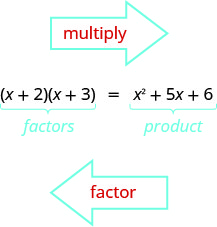
To figure out how we would factor a trinomial of the form \(x^2+bx+c\), such as \(x^2+5x+6\) and factor it to \((x+2)(x+3)\), let's start with two general binomials of the form \((x+m)\) and \((x+n)\).\[ \begin{array}{rclcl}
(x+m)(x+n) & = & x^{2}+m x+n x+m n & \quad & \left( \text{distributing} \right) \\[6pt]
& = & x^{2}+(m+n) x+m n & \quad & \left( \text{factoring the GCF from the middle two terms} \right) \\[6pt]
& = & \overbrace{x^{2}+(m+n) x+m n}^{\color{blue}x^{2}+b x+c} & \quad & \left( \text{the form is }x^2 + bx + c \right) \\[6pt]
\end{array} \nonumber \]This tells us that to factor a trinomial of the form \(x^2+bx+c\), we need two factors \((x+m)\) and \((x+n)\) where the two numbers \(m\) and \(n\) multiply to \(c\) and add to \(b\).
Factor: \(x^2+11x+24\).
- Solution
- We need to find two numbers \( m \) and \( n \) so that \( m \cdot n = 24 \) and \( m + n = 11 \). Our goal is\[ x^2 + 11x + 24 = (x + m)(x + n). \nonumber \]\[ \begin{array}{rc|c}
& \textbf{Factors of 24} & \textbf{Sum of Factors} \\[6pt]
\hline \color{red}{\times} & 1 \quad 24 & 25 \\[6pt]
\color{red}{\times} & 2 \quad 12 & 14 \\[6pt]
\color{green}{\checkmark} & 3 \quad 8 & 11 \\[6pt]
\end{array} \nonumber \]Hence,\[ x^2 + 11x + 24 = (x + 3)(x + 8). \nonumber \]We can check our work my multiplying out \( (x + 3)(x + 8) \).\[ (x + 3)(x + 8) = x^2 + 8x + 3x + 24 = x^2 + 11x + 24. \nonumber \]
Factor: \(q^2+10q+24\).
- Answer
-
\((q+4)(q+6)\)
Let's summarize the steps we used to find the factors.
- Write the factors as two binomials with first terms \( x \).\[ x^2+bx+c = (x\quad)(x\quad) \nonumber \]
- Find two numbers \(m\) and \(n\) that
- multiply to \(c\), \(m \cdot n=c\)
- add to \(b\), \(m+n=b\)
- Use \(m\) and \(n\) as the last terms of the factors.\[ x^2+bx+c = (x + m)(x + n) \nonumber \]
- Check by multiplying the factors.
In the first example, all terms in the trinomial were positive. What happens when there are negative terms? Well, it depends which term is negative. Let's look first at trinomials with only the middle term negative.
How do you get a positive product and a negative sum? We use two negative numbers.
Factor: \(y^2−11y+28\).
- Solution
-
Again, with the positive last term, \(28\), and the negative middle term, \(−11y\), we need two negative factors. Find two numbers, \( m \) and \( n \), that multiply \(28\) and add to \(−11\). Our goal is\[ y^2 - 11y + 28 = (y + m)(y + n). \nonumber \]\[ \begin{array}{rc|c}
& \textbf{Factors of 28} & \textbf{Sum of Factors} \\[6pt]
\hline \color{red}{\times} & -1 \quad -28 & -29 \\[6pt]
\color{red}{\times} & -2 \quad -14 & -16 \\[6pt]
\color{green}{\checkmark} & -4 \quad -7 & -11 \\[6pt]
\end{array} \nonumber \]Hence,\[ y^2 - 11y + 28 = (y - 4)(y - 7). \nonumber \]We leave it to the reader to distribute those binomials to check our work.
Factor: \(u^2−9u+18\).
- Answer
-
\((u−3)(u−6)\)
Now, what if the last term in the trinomial is negative? Think about distribution, the last term is the product of the last terms in the two binomials. A negative product results from multiplying two numbers with opposite signs. You have to be very careful to choose factors to make sure you get the correct sign for the middle term, too.
How do you get a negative product and a positive sum? We use one positive and one negative number.
Factor: \(2x+x^2−48\).
- Solution
-
When we factor trinomials, we must have the terms written in descending order - in order from highest degree to lowest degree. Therefore, we start by rewriting this trinomial as\[ x^2 + 2x - 48. \nonumber \]We need two factors of \( -48 \) that add to \( 2 \). The best approach is to list out factors of positive \( 48 \) and then see if a difference of those can become \( 2 \).\[ \begin{array}{rc|c}
& \textbf{Factors of 48} & \textbf{Difference of Factors} \\[6pt]
\hline \color{red}{\times} & 1 \quad 48 & \text{either } -47 \text{ or } 47 \\[6pt]
\color{red}{\times} & 2 \quad 24 & \text{either } -22 \text{ or } 22 \\[6pt]
\color{red}{\times} & 3 \quad 16 & \text{either } -13 \text{ or } 13 \\[6pt]
\color{red}{\times} & 4 \quad 12 & \text{either } -8 \text{ or } 8 \\[6pt]
\color{green}{\checkmark} & 6 \quad 8 & \text{either } -2 \text{ or } 2 \\[6pt]
\end{array} \nonumber \]To get the sum of factors to be \( 2 \), we choose \( 8 \) and \( -6 \). Hence,\[ x^2 + 2x - 48 = (x + 8)(x - 6). \nonumber \]Again, we leave it to the reader to check our work.
Factor: \(9m+m^2+18\).
- Solution
-
\((m+3)(m+6)\)
Sometimes you'll need to factor trinomials of the form \(x^2+bxy+cy^2\) with two variables, such as \(x^2+12xy+36y^2\). The first term, \(x^2\), is the product of the first terms of the binomial factors, \(x \cdot x\). The \(y^2\) in the last term means that the second terms of the binomial factors must each contain \(y\). To get the coefficients \(b\) and \(c\), you use the same process summarized above.
Factor: \(r^2−8rs−9s^2\).
- Solution
-
We need \(r\) in the first term of each binomial and \(s\) in the second term. The last term of the trinomial is negative, so the factors must have opposite signs. We begin by listing out factors of positive \( 9 \) and then see if a difference of those can become \( -8 \).\[ \begin{array}{rc|c}
& \textbf{Factors of 9} & \textbf{Difference of Factors} \\[6pt]
\hline \color{green}{\checkmark} & 1 \quad 9 & \text{either } -8 \text{ or } 8 \\[6pt]
\end{array} \nonumber \]We got lucky by finding the right combination on the first try! To get the sum of factors to be \( -8 \), we choose \( 1 \) and \( -9 \). Hence,\[ r^2−8rs−9s^2 = (r + 1s)(r - 9s) = (r + s)(r - 9s). \nonumber \]
Factor: \(a^2−11ab+10b^2\).
- Answer
-
\((a−b)(a−10b)\)
Just like numbers, polynomials can be prime. The only way to be certain a trinomial is prime is to list all the possibilities and show that none of them work.
Factor: \(u^2−9uv−12v^2\).
- Solution
-
We need two factors of \( -12 \) that add to \( -9 \). Therefore, we start by looking at factors of positive \( 12 \) and then see if a difference of those can become \( -9 \).\[ \begin{array}{rc|c}
& \textbf{Factors of 12} & \textbf{Difference of Factors} \\[6pt]
\hline \color{red}{\times} & 1 \quad 12 & \text{either } -11 \text{ or } 11 \\[6pt]
\color{red}{\times} & 2 \quad 6 & \text{either } -4 \text{ or } 4 \\[6pt]
\color{red}{\times} & 3 \quad 4 & \text{either } -1 \text{ or } 1 \\[6pt]
\end{array} \nonumber \]Note there are no factor pairs that give us \(−9\) as a sum. The trinomial is prime.
Factor: \(x^2−7xy−10y^2\).
- Answer
-
prime
Factor Trinomials of the Form \( ax^2 + bx + c \)
Our next step is to factor trinomials whose leading coefficient is not 1 - trinomials of the form \(ax^2+bx+c\). Remember to always check for a GCF first! Sometimes, after you factor the GCF, the leading coefficient of the trinomial becomes \(1\) and you can factor it by the methods we've used so far. Let's do an example to see how this works.
Factor completely: \(4x^3+16x^2−20x\).
- Solution
-
There is a GCF, so let's factor that out.\[ 4x^3+16x^2−20x = 4x (x^2 + 4x - 5) = 4x (x + 5)(x - 1). \nonumber \]Notice that I didn't show my factoring steps once I got to the trinomial. This is because we mastered that concept in the subsection above.
Factor completely: \(5x^3+15x^2−20x\).
- Answer
-
\(5x(x−1)(x+4)\)
What happens when the leading coefficient is not \(1\) and there is no GCF? There are several methods that can be used to factor these trinomials. First we will use the Trial and Error method.
Trial and Error Method (a.k.a., Guess and Check)
Let's factor the trinomial \(3x^2+5x+2\). From our earlier work, we expect this will factor into two binomials. We know the first terms of the binomial factors will multiply to give us \(3x^2\). The only factors of \(3x^2\) are \(1x\) and \(3x\). We can place them in the binomials.
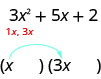
Check: Does \(1x \cdot 3x=3x^2\)?
We know the last terms of the binomials will multiply to \(2\). Since this trinomial has all positive terms, we only need to consider positive factors. The only factors of \(2\) are \(1\) and \(2\). But we now have two cases to consider as it will make a difference if we write \(1\), \(2\) or \(2\), \(1\).
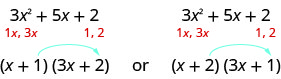
Which factors are correct? To decide that, we multiply the inner and outer terms.
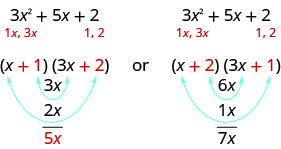
Since the middle term of the trinomial is \(5x\), the factors in the first case will work. Let's distribute to check.\[(x+1)(3x+2) = 3x^2+2x+3x+2 = 3x^2 + 5x + 2 \quad \color{green}{\checkmark} \nonumber\]Our result of the factoring is:\[3x^2+5x+2 = (x+1)(3x+2).\nonumber\]
- Write the trinomial in descending order of degrees as needed.
- Factor any GCF.
- Find all the factor pairs of the first term.
- Find all the factor pairs of the third term.
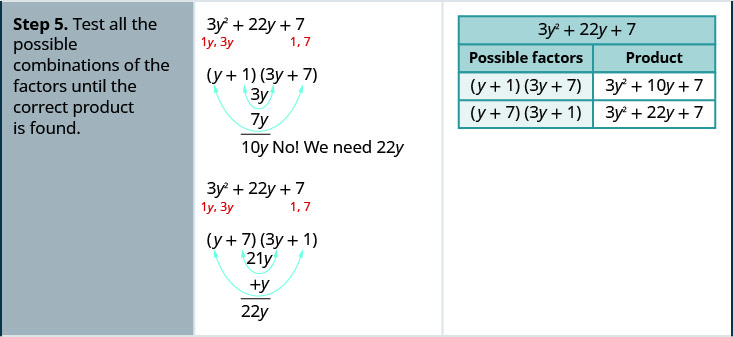
- Test all the possible combinations of the factors until the correct product is found.
- Check by multiplying.
Factor completely using trial and error: \(3y^2+22y+7\).
- Solution
- Since the trinomial is already written in descending order, we look for a GCF. However, there isn't a GCF, so we move on to finding the factors of \( 3 \) (the lead coefficient) and \( 7 \) (the constant term).\[ \begin{array}{c|c}
\textbf{Factors of 3} & \textbf{Factors of 7} \\[6pt]
\hline 1 \text{ and } 3 & 1 \text{ and } 7 \\[6pt]
\end{array} \nonumber \]When testing different combinations, it's best to "lock" the order of the factors of \( 3y^2 \) and adjust the order of the factors of the constant term. That is, we need to check if either of the following products results in our original trinomial:\[ \begin{array}{lcrclcr}
\left(y \right. & \quad & \left. ? \right) & \cdot & \left( 3y \right. & \quad & \left. ? \right) \\[6pt]
& & & \downarrow & & & \\[6pt]
\left( y \right. & + & \left. 1 \right) & \cdot & \left( 3y \right. & + & \left. 3 \right) \\[6pt]
& & & \text{or} & & & \\[6pt]
\left( y \right. & + & \left. 3 \right) & \cdot & \left( 3y \right. & + & \left. 1 \right) \\[6pt]
\end{array} \nonumber \] -





Factor completely using trial and error: \(2a^2+5a+3\).
- Solution
-
\((a+1)(2a+3)\)
Remember, when the middle term is negative and the last term is positive, the signs in the binomials must both be negative.
Factor completely using trial and error: \(6b^2−13b+5\).
- Solution
-
The trinomial is already in descending order. 
Find the factors of the first term. 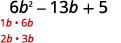
Find the factors of the last term. Consider the signs.
Since the last term, \(5\), is positive its factors must both be
positive or both be negative. The coefficient of the
middle term is negative, so we use the negative factors.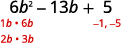
Consider all the combinations of factors.
\((b−1)(6b−5)\) \(6b^2−11b+5\) \((b−5)(6b−1)\) \(6b^2−31b+5\) \((2b−1)(3b−5)\) \(6b^2−13b+5^∗\) \((2b−5)(3b−1)\) \(6b^2−17b+5\) \(6b^2−13b+5\) Possible factors Product \(\begin{array} {ll} \text{The correct factors are those whose product} & \\[6pt] \text{is the original trinomial.} &(2b−1)(3b−5) \\[6pt] \text{Check by multiplying:} & \\[6pt] \hspace{50mm} (2b−1)(3b−5) & \\[6pt] \hspace{47mm} 6b^2−10b−3b+5 & \\[6pt] \hspace{50mm} 6b^2−13b+5\checkmark & \end{array} \)
Factor completely using trial and error: \(8x^2−14x+3\).
- Solution
-
\((2x−3)(4x−1)\)
When we factor an expression, we always look for a greatest common factor first. If the expression does not have a greatest common factor, there cannot be one in its factors either. This may help us eliminate some of the possible factor combinations.
Factor completely using trial and error: \(18x^2−37xy+15y^2\).
- Solution
-
The trinomial is already in descending order. 
Find the factors of the first term. 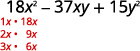
Find the factors of the last term. Consider the signs.
Since 15 is positive and the coefficient of the middle
term is negative, we use the negative factors.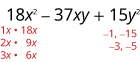
Consider all the combinations of factors.
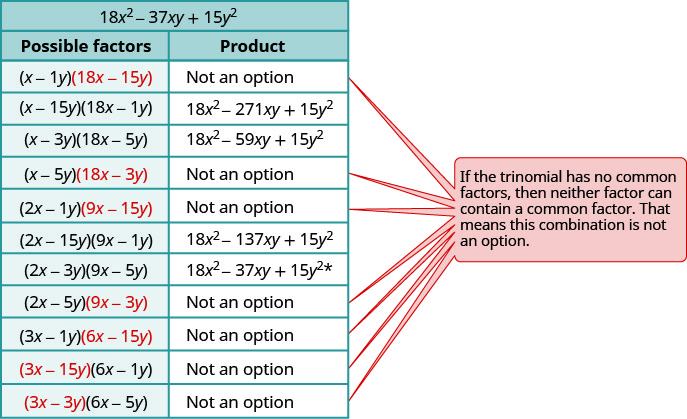
\(\begin{array} {ll} \text{The correct factors are those whose product is} & \\[6pt] \text{the original trinomial.} &(2x−3y)(9x−5y) \\[6pt] \text{Check by multiplying:} & \\[6pt] & \\[6pt] & \\[6pt] & \\[6pt] \hspace{50mm} (2x−3y)(9x−5y) & \\[6pt] \hspace{45mm}18x^2−10xy−27xy+15y^2 & \\[6pt] \hspace{47mm}18x^2−37xy+15y^2\checkmark & \end{array} \)
Factor completely using trial and error \(18x^2−3xy−10y^2\).
- Solution
-
\((3x+2y)(6x−5y)\)
Don't forget to look for a GCF first and remember if the leading coefficient is negative, so is the GCF.
Factor completely using trial and error: \(−10y^4−55y^3−60y^2\).
- Solution
-

Notice the greatest common factor, so factor it first. 
Factor the trinomial. 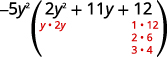
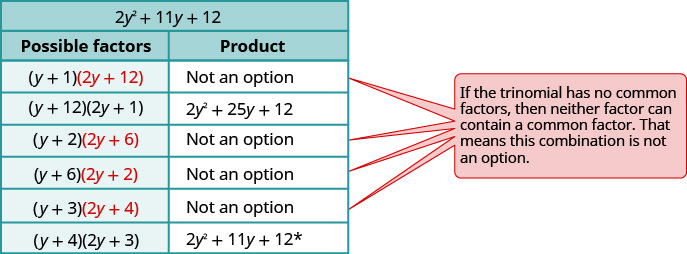
Consider all the combinations.
-
\(\begin{array} {ll} \text{The correct factors are those whose product} & \\[6pt] \text{is the original trinomial. Remember to include} & \\[6pt] \text{the factor }−5^y2. &−5y^2(y+4)(2y+3) \\[6pt] \text{Check by multiplying:} & \\[6pt] \hspace{50mm} −5y^2(y+4)(2y+3) & \\[6pt] \hspace{45mm} −5y^2(2y^2+8y+3y+12) & \\[6pt] \hspace{47mm}−10y^4−55y^3−60y^2\checkmark & \end{array} \)
Factor completely using trial and error: \(15n^3−85n^2+100n\).
- Solution
-
\(5n(n−4)(3n−5)\)
The "\(ac\)" Method (a.k.a., the Box or Diamond Method)
Another way to factor trinomials of the form \(ax^2+bx+c\) is the "\(ac\)" method. (The "\(ac\)" method is sometimes called the grouping method.) The "\(ac\)" method is actually an extension of the methods you used in the last section to factor trinomials with leading coefficient one. This method is very structured (that is step-by-step), and it always works!
Factor using the "\(ac\)" method: \(6x^2+7x+2\).
- Solution
-


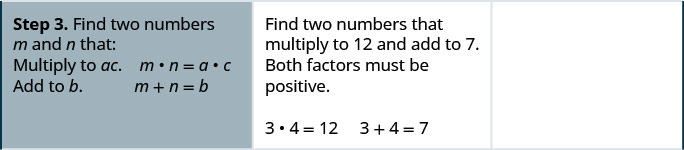
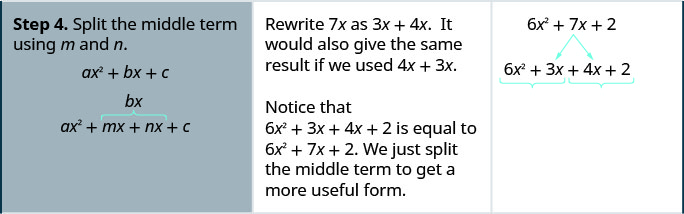


Factor using the "\(ac\)" method: \(6x^2+13x+2\).
- Solution
-
\((x+2)(6x+1)\)
The "\(ac\)" method is summarized here.
- Factor any GCF.
- Find the product \(ac\).
- Find two numbers \(m\) and \(n\) that:
\(\begin{array} {ll} \text{Multiply to }ac &m \cdot n=a \cdot c \\[6pt] \text{Add to }b &m+n=b \\[6pt] &ax^2+bx+c \end{array} \) - Split the middle term using \(m\) and \(n\). \(ax^2+mx+nx+c\)
- Factor by grouping.
- Check by multiplying the factors.
Don't forget to look for a common factor!
Factor using the ‘"\(ac\)" method: \(10y^2−55y+70\).
- Solution
-
Is there a greatest common factor? Yes. The GCF is \(5\). 
Factor it. 
The trinomial inside the parentheses has a
leading coefficient that is not \(1\).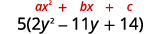
Find the product \(ac\). \(ac=28\) Find two numbers that multiply to \(ac\) \((−4)(−7)=28\) and add to \(b\). \(−4(−7)=−11\) Split the middle term. 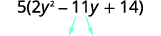

Factor the trinomial by grouping. 

Check by multiplying all three factors.
\(\hspace{50mm} 5(y−2)(2y−7)\)\(\hspace{45mm} 5(2y^2−7y−4y+14)\)
\(\hspace{48mm} 5(2y^2−11y+14)\)
\(\hspace{49mm} 10y^2−55y+70\checkmark\)
Factor using the "\(ac\)" method: \(16x^2−32x+12\).
- Solution
-
\(4(2x−3)(2x−1)\)