8.2.2: Homework
- Page ID
- 197155

\( \newcommand{\vecs}[1]{\overset { \scriptstyle \rightharpoonup} {\mathbf{#1}} } \)
\( \newcommand{\vecd}[1]{\overset{-\!-\!\rightharpoonup}{\vphantom{a}\smash {#1}}} \)
\( \newcommand{\dsum}{\displaystyle\sum\limits} \)
\( \newcommand{\dint}{\displaystyle\int\limits} \)
\( \newcommand{\dlim}{\displaystyle\lim\limits} \)
\( \newcommand{\id}{\mathrm{id}}\) \( \newcommand{\Span}{\mathrm{span}}\)
( \newcommand{\kernel}{\mathrm{null}\,}\) \( \newcommand{\range}{\mathrm{range}\,}\)
\( \newcommand{\RealPart}{\mathrm{Re}}\) \( \newcommand{\ImaginaryPart}{\mathrm{Im}}\)
\( \newcommand{\Argument}{\mathrm{Arg}}\) \( \newcommand{\norm}[1]{\| #1 \|}\)
\( \newcommand{\inner}[2]{\langle #1, #2 \rangle}\)
\( \newcommand{\Span}{\mathrm{span}}\)
\( \newcommand{\id}{\mathrm{id}}\)
\( \newcommand{\Span}{\mathrm{span}}\)
\( \newcommand{\kernel}{\mathrm{null}\,}\)
\( \newcommand{\range}{\mathrm{range}\,}\)
\( \newcommand{\RealPart}{\mathrm{Re}}\)
\( \newcommand{\ImaginaryPart}{\mathrm{Im}}\)
\( \newcommand{\Argument}{\mathrm{Arg}}\)
\( \newcommand{\norm}[1]{\| #1 \|}\)
\( \newcommand{\inner}[2]{\langle #1, #2 \rangle}\)
\( \newcommand{\Span}{\mathrm{span}}\) \( \newcommand{\AA}{\unicode[.8,0]{x212B}}\)
\( \newcommand{\vectorA}[1]{\vec{#1}} % arrow\)
\( \newcommand{\vectorAt}[1]{\vec{\text{#1}}} % arrow\)
\( \newcommand{\vectorB}[1]{\overset { \scriptstyle \rightharpoonup} {\mathbf{#1}} } \)
\( \newcommand{\vectorC}[1]{\textbf{#1}} \)
\( \newcommand{\vectorD}[1]{\overrightarrow{#1}} \)
\( \newcommand{\vectorDt}[1]{\overrightarrow{\text{#1}}} \)
\( \newcommand{\vectE}[1]{\overset{-\!-\!\rightharpoonup}{\vphantom{a}\smash{\mathbf {#1}}}} \)
\( \newcommand{\vecs}[1]{\overset { \scriptstyle \rightharpoonup} {\mathbf{#1}} } \)
\(\newcommand{\longvect}{\overrightarrow}\)
\( \newcommand{\vecd}[1]{\overset{-\!-\!\rightharpoonup}{\vphantom{a}\smash {#1}}} \)
\(\newcommand{\avec}{\mathbf a}\) \(\newcommand{\bvec}{\mathbf b}\) \(\newcommand{\cvec}{\mathbf c}\) \(\newcommand{\dvec}{\mathbf d}\) \(\newcommand{\dtil}{\widetilde{\mathbf d}}\) \(\newcommand{\evec}{\mathbf e}\) \(\newcommand{\fvec}{\mathbf f}\) \(\newcommand{\nvec}{\mathbf n}\) \(\newcommand{\pvec}{\mathbf p}\) \(\newcommand{\qvec}{\mathbf q}\) \(\newcommand{\svec}{\mathbf s}\) \(\newcommand{\tvec}{\mathbf t}\) \(\newcommand{\uvec}{\mathbf u}\) \(\newcommand{\vvec}{\mathbf v}\) \(\newcommand{\wvec}{\mathbf w}\) \(\newcommand{\xvec}{\mathbf x}\) \(\newcommand{\yvec}{\mathbf y}\) \(\newcommand{\zvec}{\mathbf z}\) \(\newcommand{\rvec}{\mathbf r}\) \(\newcommand{\mvec}{\mathbf m}\) \(\newcommand{\zerovec}{\mathbf 0}\) \(\newcommand{\onevec}{\mathbf 1}\) \(\newcommand{\real}{\mathbb R}\) \(\newcommand{\twovec}[2]{\left[\begin{array}{r}#1 \\ #2 \end{array}\right]}\) \(\newcommand{\ctwovec}[2]{\left[\begin{array}{c}#1 \\ #2 \end{array}\right]}\) \(\newcommand{\threevec}[3]{\left[\begin{array}{r}#1 \\ #2 \\ #3 \end{array}\right]}\) \(\newcommand{\cthreevec}[3]{\left[\begin{array}{c}#1 \\ #2 \\ #3 \end{array}\right]}\) \(\newcommand{\fourvec}[4]{\left[\begin{array}{r}#1 \\ #2 \\ #3 \\ #4 \end{array}\right]}\) \(\newcommand{\cfourvec}[4]{\left[\begin{array}{c}#1 \\ #2 \\ #3 \\ #4 \end{array}\right]}\) \(\newcommand{\fivevec}[5]{\left[\begin{array}{r}#1 \\ #2 \\ #3 \\ #4 \\ #5 \\ \end{array}\right]}\) \(\newcommand{\cfivevec}[5]{\left[\begin{array}{c}#1 \\ #2 \\ #3 \\ #4 \\ #5 \\ \end{array}\right]}\) \(\newcommand{\mattwo}[4]{\left[\begin{array}{rr}#1 \amp #2 \\ #3 \amp #4 \\ \end{array}\right]}\) \(\newcommand{\laspan}[1]{\text{Span}\{#1\}}\) \(\newcommand{\bcal}{\cal B}\) \(\newcommand{\ccal}{\cal C}\) \(\newcommand{\scal}{\cal S}\) \(\newcommand{\wcal}{\cal W}\) \(\newcommand{\ecal}{\cal E}\) \(\newcommand{\coords}[2]{\left\{#1\right\}_{#2}}\) \(\newcommand{\gray}[1]{\color{gray}{#1}}\) \(\newcommand{\lgray}[1]{\color{lightgray}{#1}}\) \(\newcommand{\rank}{\operatorname{rank}}\) \(\newcommand{\row}{\text{Row}}\) \(\newcommand{\col}{\text{Col}}\) \(\renewcommand{\row}{\text{Row}}\) \(\newcommand{\nul}{\text{Nul}}\) \(\newcommand{\var}{\text{Var}}\) \(\newcommand{\corr}{\text{corr}}\) \(\newcommand{\len}[1]{\left|#1\right|}\) \(\newcommand{\bbar}{\overline{\bvec}}\) \(\newcommand{\bhat}{\widehat{\bvec}}\) \(\newcommand{\bperp}{\bvec^\perp}\) \(\newcommand{\xhat}{\widehat{\xvec}}\) \(\newcommand{\vhat}{\widehat{\vvec}}\) \(\newcommand{\uhat}{\widehat{\uvec}}\) \(\newcommand{\what}{\widehat{\wvec}}\) \(\newcommand{\Sighat}{\widehat{\Sigma}}\) \(\newcommand{\lt}{<}\) \(\newcommand{\gt}{>}\) \(\newcommand{\amp}{&}\) \(\definecolor{fillinmathshade}{gray}{0.9}\)Reading Questions
- What is the difference between a rigid and a non-rigid transformation?
- In the function \(y = A\sin(Bx)\), what effect does the parameter \(A\) have on the graph? What happens if \(A\) is negative?
- In the function \(y = A\cos(Bx)\), what effect does the parameter \(B\) have on the graph?
- What is the amplitude of the function \(y = -5\cos(x)\)?
- What is the period of the function \(y = \sin(3x)\)?
- What is the period of the function \(y = \tan(2x)\)?
- What are the five "key numbers" used to sketch one cycle of a trigonometric graph?
- How do you calculate the "step size" for a graph?
- When graphing \(y = \cos(-2x)\), what property of the cosine function allows you to rewrite it first?
- Why does the tangent function not have an amplitude?
Homework
Vocabulary Check
-
To ___ the graph of a function, we mean to stretch or compress the graph horizontally or vertically.
-
A ___ transformation keeps the function's original scale and orientation but changes its position.
-
A ___ transformation keeps the function's original central position but changes its scale or orientation.
-
If a graph is symmetric about the \( y \)-axis, we say it is an ___ function.
-
An___ function is one whose graph is symmetric about the origin.
-
If \( A \gt 1 \), then the graph of \( y = A \sin\left( B x \right) \) is ___ vertically by a factor of ___.
-
If \( 0 \lt A \lt 1 \), then the graph of \( y = A \tan\left( B x \right) \) is ___ vertically by a factor of ___.
Concept Check
-
What is the range of \( f(x) = A \sin\left( Bx \right) \)?
-
What is the effect of \( A \lt 0 \) on the graph of the function \( g(x) = A \tan\left( B x \right) \)?
-
What is the period of \( h(x) = A \cos\left( B x \right) \)?
-
What is the period of \( k(x) = A \tan\left( B x \right) \)?
-
When graphing \( y = \cos\left( -B x \right) \), we first rewrite the function as \( y = \) ___ because cosine is an ___ function.
-
When graphing \( y = \tan\left( -B x \right) \), we first rewrite the function as \( y = \) ___ because tangent is an ___ function.
-
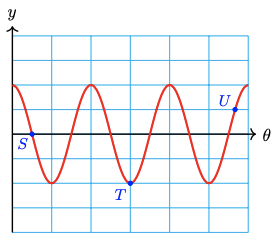
One of these graphs is \(y=A \sin k \theta\), and the other is \(y=A \cos k \theta\). Explain how you know which is which.
-


True or False? For the following exercises, determine if the statement is true or false. If true, cite the definition or theorem stated in the text supporting your claim. If false, explain why it is false and, if possible, correct the statement.
-
The natural period of the cosine function is \( 2\pi \).
-
The natural period of the tangent function is \( 2\pi \).
-
Dividing the period by 4 gives us the step size.
-
Dividing the period of the function by 4 partitions a single cycle of the trigonometric function into four subintervals.
-
There are four key numbers.
Basic Skills
-
Write an equation for a sine function with amplitude \( 6 \).
-
Write an equation for a cosine function with amplitude \(\frac{1}{2}\).
-
Write an equation for a sine function with period \(\frac{\pi}{2}\).
-
Write an equation for a cosine function with period \(4\pi\).
For the following exercises, state the amplitude (if applicable) and period of the graph.
-
\(y=-\cos \left(4 x\right)\)
-
\(y=-\sin \left(3 x\right)\)
-
\(y=-5 \sin \left(\dfrac{x}{3}\right)\)
-
\(y=6 \cos \left(\dfrac{x}{2}\right)\)
-
\(y=\tan \left(2 x\right)\)
-
\(y=\tan \left(4 x\right)\)
For the following exercises,
(i) Graph the function.
(ii) State the amplitude and period of the function.
-
\(y = 3\cos \left(\theta\right)\)
-
\(y=4\sin \left(\theta\right)\)
-
\(y = \cos \left(3\theta\right)\)
-
\(y = \sin \left(2\theta\right)\)
For the following exercises, sketch one cycle of each graph by hand and label scales on the axes.
-
-
\(y=\cos x\)
-
\(y=\cos 4 x\)
-
\(y=-\cos x\)
-
-
-
\(y=\sin x\)
-
\(y=\sin 3 x\)
-
\(y=-\sin 3 x\)
-
-
-
\(y=\sin x\)
-
\(y=\sin \dfrac{x}{3}\)
-
\(y=-5 \sin \dfrac{x}{3}\)
-
-
-
\(y=\cos x\)
-
\(y=\cos \dfrac{x}{2}\)
-
\(y=6 \cos \dfrac{x}{2}\)
-
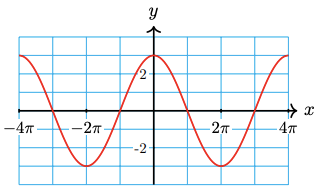
For the following exercises, write an equation for the graph using sine or cosine.
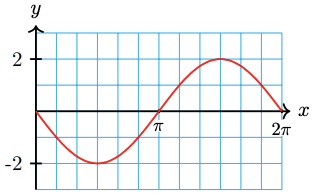
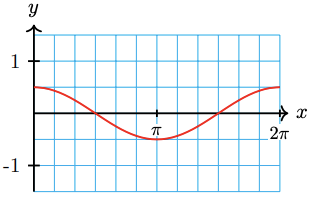
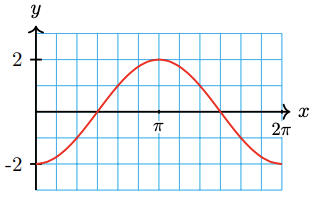
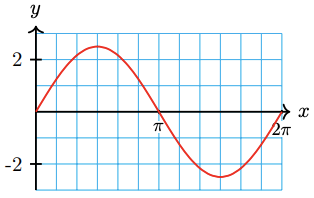
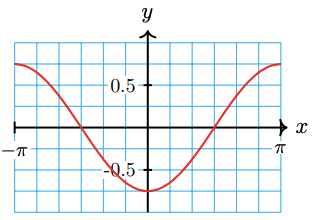
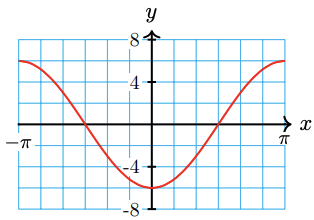
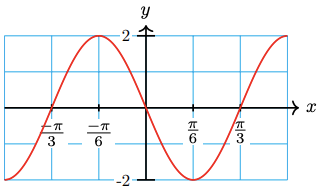
For the following exercises,
(i) State the graph's amplitude and period.
(ii) Write an equation for the graph using sine or cosine.
Synthesis Questions
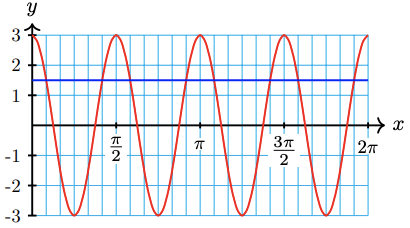
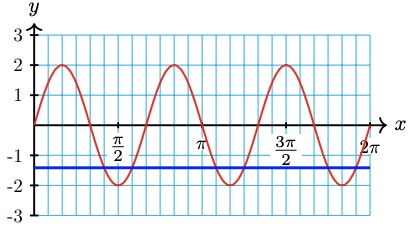
For the following exercises, use the graph to find all solutions between \( 0 \) and \(2 \pi\).
-
\(3 \cos \left(4 x\right)=1.5\)
-
\(2 \sin \left(3 x\right)=-\sqrt{2}\)
For the following exercises,
(i) Use technology to graph the function for \(0 \leq x \leq 2 \pi\).
(ii) Use the graph from part (i) to approximate all solutions between \( 0 \) and \(2 \pi\). Round your answers to hundredths.
-
-
\(f(x)=3 \sin \left(2 x\right)\)
-
\(3 \sin \left(2 x\right)=-1.5\)
-
-
-
\(g(x)=-2 \cos \left(3 x\right)\)
-
\(-2 \cos \left(3 x\right)=1\)
-
Applications
-
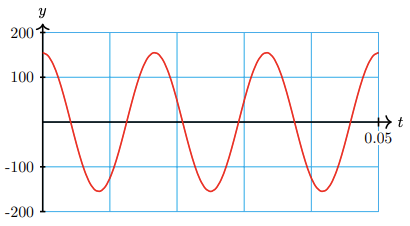
Electric Current. The following graph illustrates that the voltage used in U.S. electrical current changes from 155V to -155V and back 60 times each second. Write an equation for this graph.
-
Electric Current. If \( I \) represents the intensity of the current in an alternating circuit and \( t \) represents time, then\[ I\left( t \right) = 50 \sin\left( 120\pi t \right),\nonumber \]where \( I \) is measured in amperes and \( t \) is measured in seconds. Find the maximum value of \( I \) and the time it takes for \( I \) to go through one complete cycle.
-
Sound Waves. The oscillations in air pressure representing the sound wave for a tone at the standard pitch of C can be modeled by the equation\[ S(t) = 0.05 \sin\left( 524 \pi \right), \nonumber \]where \( S \) is the sound pressure in pascals after \( t \) seconds. Sketch a single cycle of the graph of this function.
Challenge Problems
For the following exercises, give the coordinates of the points on the graph.
-
\(f(\theta) = -3\cos \left(\theta\right)\)

-
\(f(\theta) = 4\sin \left(\theta\right)\)

-
\(f(\theta) = \sin \left(4\theta\right)\)

-
\(f(\theta) = \cos \left(3\theta\right)\)