

2.5: An Interlude - Hyperbolic Functions
- Page ID
- 116876

\( \newcommand{\vecs}[1]{\overset { \scriptstyle \rightharpoonup} {\mathbf{#1}} } \)
\( \newcommand{\vecd}[1]{\overset{-\!-\!\rightharpoonup}{\vphantom{a}\smash {#1}}} \)
\( \newcommand{\dsum}{\displaystyle\sum\limits} \)
\( \newcommand{\dint}{\displaystyle\int\limits} \)
\( \newcommand{\dlim}{\displaystyle\lim\limits} \)
\( \newcommand{\id}{\mathrm{id}}\) \( \newcommand{\Span}{\mathrm{span}}\)
( \newcommand{\kernel}{\mathrm{null}\,}\) \( \newcommand{\range}{\mathrm{range}\,}\)
\( \newcommand{\RealPart}{\mathrm{Re}}\) \( \newcommand{\ImaginaryPart}{\mathrm{Im}}\)
\( \newcommand{\Argument}{\mathrm{Arg}}\) \( \newcommand{\norm}[1]{\| #1 \|}\)
\( \newcommand{\inner}[2]{\langle #1, #2 \rangle}\)
\( \newcommand{\Span}{\mathrm{span}}\)
\( \newcommand{\id}{\mathrm{id}}\)
\( \newcommand{\Span}{\mathrm{span}}\)
\( \newcommand{\kernel}{\mathrm{null}\,}\)
\( \newcommand{\range}{\mathrm{range}\,}\)
\( \newcommand{\RealPart}{\mathrm{Re}}\)
\( \newcommand{\ImaginaryPart}{\mathrm{Im}}\)
\( \newcommand{\Argument}{\mathrm{Arg}}\)
\( \newcommand{\norm}[1]{\| #1 \|}\)
\( \newcommand{\inner}[2]{\langle #1, #2 \rangle}\)
\( \newcommand{\Span}{\mathrm{span}}\) \( \newcommand{\AA}{\unicode[.8,0]{x212B}}\)
\( \newcommand{\vectorA}[1]{\vec{#1}} % arrow\)
\( \newcommand{\vectorAt}[1]{\vec{\text{#1}}} % arrow\)
\( \newcommand{\vectorB}[1]{\overset { \scriptstyle \rightharpoonup} {\mathbf{#1}} } \)
\( \newcommand{\vectorC}[1]{\textbf{#1}} \)
\( \newcommand{\vectorD}[1]{\overrightarrow{#1}} \)
\( \newcommand{\vectorDt}[1]{\overrightarrow{\text{#1}}} \)
\( \newcommand{\vectE}[1]{\overset{-\!-\!\rightharpoonup}{\vphantom{a}\smash{\mathbf {#1}}}} \)
\( \newcommand{\vecs}[1]{\overset { \scriptstyle \rightharpoonup} {\mathbf{#1}} } \)
\(\newcommand{\longvect}{\overrightarrow}\)
\( \newcommand{\vecd}[1]{\overset{-\!-\!\rightharpoonup}{\vphantom{a}\smash {#1}}} \)
\(\newcommand{\avec}{\mathbf a}\) \(\newcommand{\bvec}{\mathbf b}\) \(\newcommand{\cvec}{\mathbf c}\) \(\newcommand{\dvec}{\mathbf d}\) \(\newcommand{\dtil}{\widetilde{\mathbf d}}\) \(\newcommand{\evec}{\mathbf e}\) \(\newcommand{\fvec}{\mathbf f}\) \(\newcommand{\nvec}{\mathbf n}\) \(\newcommand{\pvec}{\mathbf p}\) \(\newcommand{\qvec}{\mathbf q}\) \(\newcommand{\svec}{\mathbf s}\) \(\newcommand{\tvec}{\mathbf t}\) \(\newcommand{\uvec}{\mathbf u}\) \(\newcommand{\vvec}{\mathbf v}\) \(\newcommand{\wvec}{\mathbf w}\) \(\newcommand{\xvec}{\mathbf x}\) \(\newcommand{\yvec}{\mathbf y}\) \(\newcommand{\zvec}{\mathbf z}\) \(\newcommand{\rvec}{\mathbf r}\) \(\newcommand{\mvec}{\mathbf m}\) \(\newcommand{\zerovec}{\mathbf 0}\) \(\newcommand{\onevec}{\mathbf 1}\) \(\newcommand{\real}{\mathbb R}\) \(\newcommand{\twovec}[2]{\left[\begin{array}{r}#1 \\ #2 \end{array}\right]}\) \(\newcommand{\ctwovec}[2]{\left[\begin{array}{c}#1 \\ #2 \end{array}\right]}\) \(\newcommand{\threevec}[3]{\left[\begin{array}{r}#1 \\ #2 \\ #3 \end{array}\right]}\) \(\newcommand{\cthreevec}[3]{\left[\begin{array}{c}#1 \\ #2 \\ #3 \end{array}\right]}\) \(\newcommand{\fourvec}[4]{\left[\begin{array}{r}#1 \\ #2 \\ #3 \\ #4 \end{array}\right]}\) \(\newcommand{\cfourvec}[4]{\left[\begin{array}{c}#1 \\ #2 \\ #3 \\ #4 \end{array}\right]}\) \(\newcommand{\fivevec}[5]{\left[\begin{array}{r}#1 \\ #2 \\ #3 \\ #4 \\ #5 \\ \end{array}\right]}\) \(\newcommand{\cfivevec}[5]{\left[\begin{array}{c}#1 \\ #2 \\ #3 \\ #4 \\ #5 \\ \end{array}\right]}\) \(\newcommand{\mattwo}[4]{\left[\begin{array}{rr}#1 \amp #2 \\ #3 \amp #4 \\ \end{array}\right]}\) \(\newcommand{\laspan}[1]{\text{Span}\{#1\}}\) \(\newcommand{\bcal}{\cal B}\) \(\newcommand{\ccal}{\cal C}\) \(\newcommand{\scal}{\cal S}\) \(\newcommand{\wcal}{\cal W}\) \(\newcommand{\ecal}{\cal E}\) \(\newcommand{\coords}[2]{\left\{#1\right\}_{#2}}\) \(\newcommand{\gray}[1]{\color{gray}{#1}}\) \(\newcommand{\lgray}[1]{\color{lightgray}{#1}}\) \(\newcommand{\rank}{\operatorname{rank}}\) \(\newcommand{\row}{\text{Row}}\) \(\newcommand{\col}{\text{Col}}\) \(\renewcommand{\row}{\text{Row}}\) \(\newcommand{\nul}{\text{Nul}}\) \(\newcommand{\var}{\text{Var}}\) \(\newcommand{\corr}{\text{corr}}\) \(\newcommand{\len}[1]{\left|#1\right|}\) \(\newcommand{\bbar}{\overline{\bvec}}\) \(\newcommand{\bhat}{\widehat{\bvec}}\) \(\newcommand{\bperp}{\bvec^\perp}\) \(\newcommand{\xhat}{\widehat{\xvec}}\) \(\newcommand{\vhat}{\widehat{\vvec}}\) \(\newcommand{\uhat}{\widehat{\uvec}}\) \(\newcommand{\what}{\widehat{\wvec}}\) \(\newcommand{\Sighat}{\widehat{\Sigma}}\) \(\newcommand{\lt}{<}\) \(\newcommand{\gt}{>}\) \(\newcommand{\amp}{&}\) \(\definecolor{fillinmathshade}{gray}{0.9}\)
|
|


Hanging cables form a curve called a catenary. These curves are modeled using a new (to you) family of functions called the hyperbolic functions.
Unlike all the functions encountered in Calculus up to this point, the functions in this section should be unfamiliar to you. Here we define hyperbolic and inverse hyperbolic functions, which involve combinations of exponential and logarithmic functions. These provide a unique bridge between two groups of transcendental functions - exponential and trigonometric.
From Circular to Hyperbolic Functions
Before introducing the hyperbolic functions, it is worthwhile to review a particular feature of the trigonometric functions.
Most people refer to the sine, cosine, tangent, and their reciprocals as trigonometric functions; however, they are also known as circular functions. This is because their entire definition is based on the unit circle. Recall that the unit circle is defined by the relation\[ x^2 + y^2 = 1. \nonumber \]The graph of this relation can be seen in Figure \( \PageIndex{1} \) below.

Figure \( \PageIndex{1} \): The unit circle.
During our journey through Trigonometry, we discovered that the length of the arc on the unit circle subtended by an angle \( \theta \) (in radians) is \( s = \theta \). Moreover, we derived the area of a sector formula to be\[ A = \dfrac{1}{2} r^2 \theta. \nonumber \]Since the radius of the unit circle is \( r=1 \) and \( \theta = s \), we arrived at the fact that the area seen in Figure \( \PageIndex{2} \) is\[ A = \dfrac{s}{2}. \nonumber \]
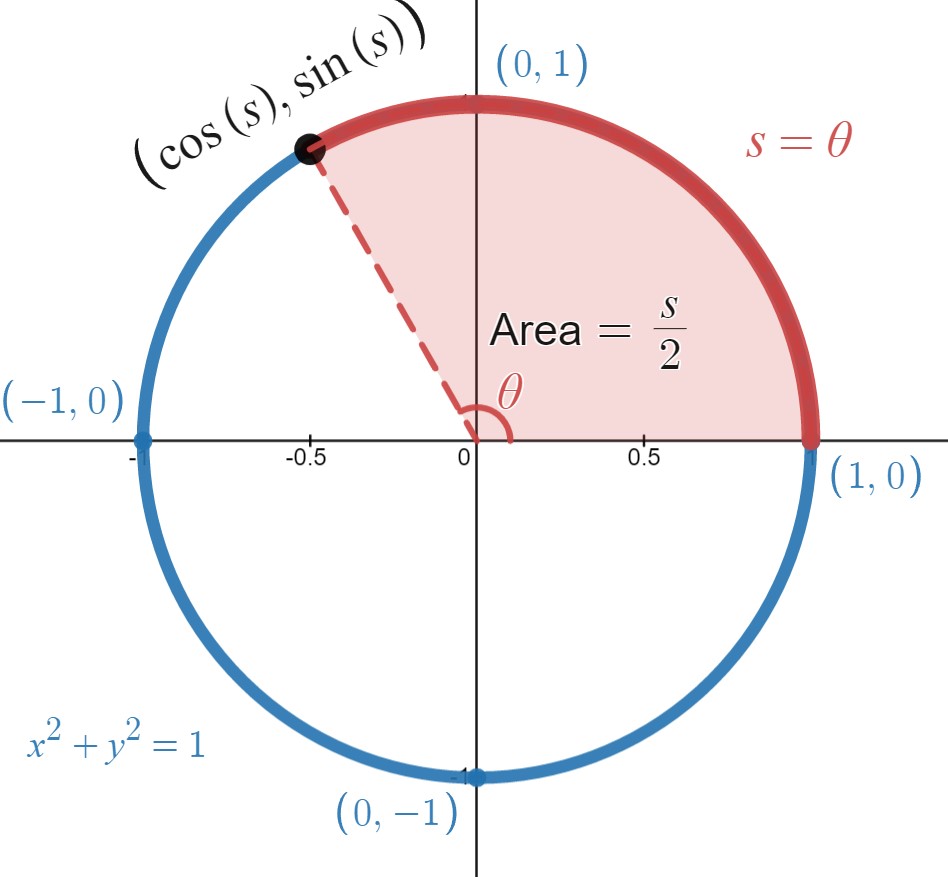
Figure \( \PageIndex{2} \): The area of the sector of the unit circle having arc length \( s \) is \( \frac{s}{2} \).
Stated clearly, the area of the region bounded by the positive \( x \)-axis, the unit circle, and the line segment connecting the origin to the point \( (\cos{(s)}, \sin{(s)}) \) is \( s/2 \).
In this section, we ask the following question:
Could we develop a set of functions, let's call them \( \cosh{(s)} \) and \( \sinh{(s)} \), such that the area of the region bounded by the positive \( x \)-axis, the unit hyperbola, and the line segment connecting the origin to the point \( (\cosh{(s)} , \sinh{(s)}) \) is \( s/2 \)?
Before we can answer this question, we need to define the unit hyperbola. For our purposes, the unit hyperbola will be defined by the relation\[ x^2 - y^2 = 1. \nonumber \]Furthermore, we restrict our work to the right branch of this hyperbola (see Figure \( \PageIndex{3} \)).

Figure \( \PageIndex{3} \): The unit hyperbola (right branch only).
We plot a point \( (x,y) = (\cosh{(s)} , \sinh{(s)})\) on this branch, highlight the arc length along the unit hyperbola to this point, draw a line segment connecting the origin to this point, and shade the bounded region (see Figure \( \PageIndex{4} \)).

Figure \( \PageIndex{4} \): We desire \( \cosh{(s)} \) and \( \sinh{(s)} \) so that the shaded region is \( s/2 \).
We want to define these new functions, \( \cosh{(s)} \) and \( \sinh{(s)} \), so that the shaded region is \( s/2 \).
It is critical to point out here that the highlighted arc length will not be \( s \). In fact, the angle between the positive \( x \)-axis and the line segment connecting the origin to the point \( (\cosh{(s)}, \sinh{(s)}) \) will also not be \( s \). Our goal with this discussion is not to find the arc length nor to find the angle, but instead to create functions, \( \cosh{(s)} \) and \( \sinh{(s)} \), so that the area of the bounded region is \( s/2 \).
As you can see in Figure \( \PageIndex{4} \), we define the hyperbolic cosine to be the \( x \)-value of this terminal point, and the hyperbolic sine as the \( y \)-value. We denote these functions as \( \cosh{(s)} \) and \( \sinh{(s)} \), respectively.
Hyperbolic Functions
The previous discussion considered the hyperbolic cosine and hyperbolic sine as functions of \( s \); however, most textbooks work exclusively with these as functions of \( t \). Since \( s \) is a "dummy variable," we can replace it easily with \( t \) for the remainder of this section.
It turns out (and can be proven in Calculus II) that the hyperbolic cosine and the hyperbolic sine can be written in terms of specific combinations of \(e^t\) and \(e^{−t}\). These functions arise naturally in various engineering and physics applications, including the study of water waves and vibrations of elastic membranes. Another common use, at least for the hyperbolic cosine, is the representation of a hanging chain or cable, also known as a catenary (Figure \(\PageIndex{5}\)). If we introduce a coordinate system so that the low point of the chain lies along the \(y\)-axis, we can describe the height of the chain in terms of the hyperbolic cosine.

Figure \(\PageIndex{5}\): The shape of a strand of silk in a spider’s web can be described in terms of a hyperbolic function. The same shape applies to a chain or cable hanging from two supports with only its own weight. (credit: “Mtpaley”, Wikimedia Commons)
Let \( \frac{t}{2} \) be the area of the region bounded by the arc along the right branch of the unit hyperbola \( x^2 - y^2 = 1 \) whose initial point is \( \left( 1,0 \right) \) and terminal point is \( \left( x,y \right) \), the \( x \)-axis, and the line segment connecting the origin to \( \left( x, y \right) \). Then, the hyperbolic functions in terms of twice this bounded area, are defined (and derived) as follows:1
Hyperbolic cosine\[x = \cosh{(t)} = \dfrac{e^t+e^{−t}}{2}\nonumber \]
Hyperbolic sine\[y = \sinh{(t)} = \dfrac{e^t−e^{−t}}{2}\nonumber \]
Hyperbolic tangent\[\tanh{(t)} = \dfrac{\sinh{(t)}}{\cosh{(t)}} = \dfrac{e^t−e^{−t}}{e^t+e^{−t}}\nonumber \]
Hyperbolic cosecant\[\operatorname{csch}{(t)} = \dfrac{1}{\sinh{(t)}} = \dfrac{2}{e^t−e^{−t}}\nonumber \]
Hyperbolic secant\[\operatorname{sech}{(t)} = \dfrac{1}{\cosh{(t)}} = \dfrac{2}{e^t+e^{−t}}\nonumber \]
Hyperbolic cotangent\[\coth{(t)} = \dfrac{\cosh{(t)}}{\sinh{(t)}} = \dfrac{e^t+e^{−t}}{e^t−e^{−t}}\nonumber \]
Despite writing this as a theorem, we have not proven that the hyperbolic functions are equal to these exponential forms. The reality is that you need Integral Calculus (Calculus II) to prove these relationships.
The name \(\cosh\) rhymes with "gosh," whereas the name \(\sinh\) is pronounced "sinch." \(\operatorname{Tanh}, \,\operatorname{sech}, \, \operatorname{csch},\) and \(\coth\) are pronounced "tanch," "seech," "coseech," and "cotanch," respectively.
Simplify \(\sinh{ \left( 5\ln{(x)} \right) } \).
- Solution
-
Using the definition of the \(\sinh\) function, we get\[ \begin{array}{rclcr}
\sinh{ \left( 5\ln{(x)} \right) } & = & \dfrac{e^{5\ln{(x)}} − e^{−5\ln{(x)}}}{2} & & \left( \text{definition of Hyperbolic Functions} \right) \\
\\
& = & \dfrac{e^{\ln{(x^5)}} − e^{\ln{(x^{-5})}}}{2} & & \left( \text{Laws of Logarithms} \right) \\
\\
& = & \dfrac{x^5 − x^{-5}}{2} & & \left( \text{inverse property of exponential and logarithmic functions} \right) \\
\end{array} \nonumber \]
Simplify \(\cosh(2\ln x)\).
- Hint
-
Use the definition of the \(\cosh\) function and the power property of logarithm functions.
- Answer
-
\((x^2+x^{−2})/2\)
Graphs of Hyperbolic Functions
To investigate the graphs of the hyperbolic functions, we need to start with a discussion related to Calculus - what happens to \( e^{-x} \) as \( x \to \infty \)? Drawing on our work with limits, we know that \( e^{-x} \to 0 \) as \( x \to \infty \) and \( e^x \to 0 \) as \( x \to -\infty \). Therefore,\[ \sinh{(x)} = \dfrac{e^x - e^{-x}}{2} \to \dfrac{e^x}{2}, \text{ as }x \to \infty, \text{ and } \cosh{(x)} = \dfrac{e^x + e^{-x}}{2} \to \dfrac{e^x}{2}, \text{ as }x \to \infty. \nonumber \]We purposefully did not write these using true limit notation because we are trying to discover the end behavior of the graphs of these functions. As similar analysis shows that,\[ \sinh{(x)} = \dfrac{e^x - e^{-x}}{2} \to \dfrac{-e^{-x}}{2}, \text{ as }x \to -\infty, \text{ and } \cosh{(x)} = \dfrac{e^x + e^{-x}}{2} \to \dfrac{e^{-x}}{2}, \text{ as }x \to -\infty. \nonumber \]Hence, using the graphs of \(\frac{1}{2}e^x\), \(\frac{1}{2}e^{−x}\), and \(−\frac{1}{2}e^{−x}\) as guides, we can graph \(\cosh(x)\) and \(\sinh(x)\) (see Figure \( \PageIndex{ 6 } \) below).
To graph \(\tanh(x)\), we recognize the fact that \(\tanh(0)=0\). Moreover,\[ \begin{array}{rclcl}
\displaystyle \lim_{x \to \infty} \tanh(x) & = & \displaystyle \lim_{x \to \infty} \dfrac{e^{x} - e^{-x}}{e^{x} + e^{-x}} & & \\[6pt]
& = & \displaystyle \lim_{x \to \infty} \dfrac{e^{x} - e^{-x}}{e^{x} + e^{-x}} \cdot \dfrac{e^{-x}}{e^{-x}} & \quad & \left( \text{multiplying numerator and denominator by }\dfrac{e^{-x}}{e^{-x}} \right) \\[6pt]
& = & \displaystyle \lim_{x \to \infty} \dfrac{1 - e^{-2x}}{1 + e^{-2x}} & \quad & \left( \text{simplifying} \right)\\[6pt]
& = & \dfrac{1 - \displaystyle \lim_{x \to \infty} e^{-2x}}{1 + \displaystyle \lim_{x \to \infty} e^{-2x}} & \quad & \left( \text{Limit Laws} \right)\\[6pt]
& = & \dfrac{1 - 0}{1 + 0} & \quad & \left( \displaystyle \lim_{x \to \infty} e^{-x} = 0 \right)\\[6pt]
& = & 1 & &
\end{array} \nonumber \]A similar argument shows \( \displaystyle \lim_{x \to -\infty} \tanh(x) = -1 \).
The graphs of the other three hyperbolic functions can be sketched using the graphs of \(\cosh(x)\), \(\sinh(x)\), and \(\tanh(x)\) (Figure \(\PageIndex{6}\)).2

Figure \(\PageIndex{6}\): The hyperbolic functions involve combinations of \(e^x\) and \(e^{−x}\).
Hyperbolic Identities
Once you grasp that the hyperbolic functions are based on the unit hyperbola, \( x^2 - y^2 = 1 \), you immediately arrive at the first of many hyperbolic identities.
\[ \cosh^2{(t)} - \sinh^2{(t)} = 1 \nonumber \]
- Proof
- Since \( x = \cosh{(t)} \) and \( y = \sinh{(t)} \) on the unit hyperbola \( x^2 - y^2 = 1 \), we substitute to arrive at \( \cosh^2{(t)} - \sinh^2{(t)} = 1\).
It is also important to note that this can be proved using the exponential form of the hyperbolic functions.
The Fundamental Hyperbolic Identity is one of many identities involving the hyperbolic functions, some of which are listed next.3 The first four properties follow quickly from the definitions of hyperbolic sine and hyperbolic cosine. Except for some differences in signs, most of these properties are analogous to identities for trigonometric functions.
- \(\cosh(−t)=\cosh(t)\)
- \(\sinh(−t)=−\sinh(t)\)
- \(\cosh(t)+\sinh(t) = e^t\)
- \(\cosh(t) −\sinh(t) = e^{−t}\)
- \(1−\tanh^2(t) = \operatorname{sech}^2(t)\)
- \(\coth^2(t) −1=\operatorname{csch}^2(t) \)
- \(\sinh(t \pm v)=\sinh(t) \cosh(v) \pm \cosh(t) \sinh(v)\)
- \(\cosh(t \pm v)=\cosh(t) \cosh(v) \pm \sinh(t) \sinh(v)\)
If \(\sinh{(t)} = 3/4\), find the values of the remaining five hyperbolic functions.
- Solution
-
Using the identity \(\cosh^2{(t)} − \sinh^2{(t)} = 1\),we see that\[ \cosh^2{(t)} = 1 + \left(\frac{3}{4}\right)^2 = \dfrac{25}{16}. \nonumber \]Since \(\cosh x \geq 1\) for all \(x\), we must have \(\cosh x=5/4\). Then, using the definitions for the other hyperbolic functions, we conclude that \(\tanh x=3/5,\operatorname{csch}x=4/3,\operatorname{sech}x=4/5\), and \(\coth x=5/3\).
Without using \(\cosh(t \pm v)=\cosh(t) \cosh(v) \pm \sinh(t) \sinh(v)\), prove\[ \cosh{(2t)} = \sinh^2{(t)} + \cosh^2{(t)}. \nonumber \]
- Solution
- \[ \begin{array}{rclcr}
\cosh^2{(t)} + \sinh^2{(t)} & = & \left( \dfrac{e^{t} + e^{-t}}{2} \right)^2 + \left( \dfrac{e^{t} - e^{-t}}{2} \right)^2 & \quad & \left( \text{exponential form of hyperbolic functions} \right) \\[6pt]
& = & \dfrac{e^{2t} + 2 + e^{-2t}}{4} + \dfrac{e^{2t} - 2 + e^{-2t}}{4} & \quad & \left( \text{distributing and Laws of Exponents} \right) \\[6pt]
& = & \dfrac{2 e^{2t} + 2 e^{-2t}}{4} & \quad & \left( \text{combining like terms} \right) \\[6pt]
& = & \dfrac{\cancel{2} \left(e^{2t} + e^{-2t}\right)}{\cancel{2} \cdot 2} & \quad & \left( \text{factoring out the GCF and canceling like factors} \right) \\[6pt]
& = & \dfrac{e^{2t} + e^{-2t}}{2} & \quad & \left( \text{canceling like factors} \right) \\[6pt]
& = & \cosh{(2t)} & \quad & \left( \text{exponential form of hyperbolic functions} \right) \\[6pt]
\end{array} \nonumber \]
Inverse Hyperbolic Functions
From the graphs of the hyperbolic functions, we see that all of them are one-to-one except \(\cosh x\) and \(\operatorname{sech}x\). If we restrict the domains of these two functions to the interval \([0,\infty),\) then all the hyperbolic functions are one-to-one, and we can define the inverse hyperbolic functions. Since the hyperbolic functions themselves involve exponential functions, it should make sense to the reader that the inverse hyperbolic functions involve logarithmic functions.
\[\begin{align*} &\sinh^{−1}x =\operatorname{arcsinh}x=\ln \left(x+\sqrt{x^2+1}\right) & & \cosh^{−1}x =\operatorname{arccosh}x=\ln \left(x+\sqrt{x^2−1}\right)\\[4pt]
&\tanh^{−1}x=\operatorname{arctanh}x=\dfrac{1}{2}\ln \left(\dfrac{1+x}{1−x}\right) & & \coth^{−1}x =\operatorname{arccot}x=\frac{1}{2}\ln \left(\dfrac{x+1}{x−1}\right)\\[4pt]
&\operatorname{sech}^{−1}x=\operatorname{arcsech}x=\ln \left(\dfrac{1+\sqrt{1−x^2}}{x}\right) & & \operatorname{csch}^{−1}x=\operatorname{arccsch}x=\ln \left(\dfrac{1}{x}+\dfrac{\sqrt{1+x^2}}{|x|}\right) \end{align*}\]
- Proof that \( \sinh^{−1}x =\ln \left(x+\sqrt{x^2+1}\right) \)
-
Suppose \(y=\sinh^{−1}x\). Then, \(x=\sinh y\) and, by the definition of the hyperbolic sine function, \(x=\dfrac{e^y−e^{−y}}{2}\). Therefore,
\(e^y−2x−e^{−y}=0.\)
Multiplying this equation by \(e^y\), we obtain
\(e^{2y}−2xe^y−1=0\).
This can be solved like a quadratic equation, with the solution
\(e^y=\dfrac{2x \pm \sqrt{4x^2+4}}{2}=x \pm \sqrt{x^2+1}\).
Since \(e^y>0\),the only solution is the one with the positive sign. Applying the natural logarithm to both sides of the equation, we conclude that
\(y=\ln (x+\sqrt{x^2+1}).\)
Q.E.D.
The independent variable \( x \) in the previous theorem is a dummy variable. It is not the \( x \)-coordinate of the terminal point of the arc of length \( t \) along the unit hyperbola.
Evaluate each of the following expressions.\[\sinh^{−1}(2) \quad \text{and} \quad \tanh^{−1}(1/4)\nonumber \]
- Solution
-
\[\sinh^{−1}(2)=\ln (2+\sqrt{2^2+1})=\ln (2+\sqrt{5}) \approx 1.4436\nonumber \]
\[\tanh^{−1}(1/4)=\frac{1}{2}\ln \left(\dfrac{1+1/4}{1−1/4}\right)=\frac{1}{2}\ln \left(\dfrac{5/4}{3/4}\right)=\frac{1}{2}\ln \left(\dfrac{5}{3}\right) \approx 0.2554\nonumber \]
Evaluate \(\tanh^{−1}(1/2)\).
- Hint
-
Use the definition of \(\tanh^{−1}x\) and simplify.
- Answer
-
\(\dfrac{1}{2}\ln (3) \approx 0.5493\).
Footnotes
1 The \( x \)-value of the terminal point along the unit hyperbola is defined to be \( \cosh{(t)} \) and the \( y \)-value is defined to be \( \sinh{(t)} \). The exponential forms, \[ \cosh{(t)} = \dfrac{e^t+e^{−t}}{2} \text{ and } \sinh{(t)} = \dfrac{e^t−e^{−t}}{2} \nonumber \]are derived using techniques in Calculus II. The remaining hyperbolic functions are defined as ratios of the \( \sinh{(t)} \) and \( \cosh{(t)} \).
2 While you will be expected to know the basic shapes of the graphs of \( \cosh{(x)} \) and \( \sinh{(x)} \). The graphs of the remaining four hyperbolic functions are rarely used in practice.
3 As with identities encountered in Trigonometry, the number of identities involving hyperbolic functions is too numerous to contain within a single table.