

1.3: Converting to Different Base Systems
- Page ID
- 182661

\( \newcommand{\vecs}[1]{\overset { \scriptstyle \rightharpoonup} {\mathbf{#1}} } \)
\( \newcommand{\vecd}[1]{\overset{-\!-\!\rightharpoonup}{\vphantom{a}\smash {#1}}} \)
\( \newcommand{\dsum}{\displaystyle\sum\limits} \)
\( \newcommand{\dint}{\displaystyle\int\limits} \)
\( \newcommand{\dlim}{\displaystyle\lim\limits} \)
\( \newcommand{\id}{\mathrm{id}}\) \( \newcommand{\Span}{\mathrm{span}}\)
( \newcommand{\kernel}{\mathrm{null}\,}\) \( \newcommand{\range}{\mathrm{range}\,}\)
\( \newcommand{\RealPart}{\mathrm{Re}}\) \( \newcommand{\ImaginaryPart}{\mathrm{Im}}\)
\( \newcommand{\Argument}{\mathrm{Arg}}\) \( \newcommand{\norm}[1]{\| #1 \|}\)
\( \newcommand{\inner}[2]{\langle #1, #2 \rangle}\)
\( \newcommand{\Span}{\mathrm{span}}\)
\( \newcommand{\id}{\mathrm{id}}\)
\( \newcommand{\Span}{\mathrm{span}}\)
\( \newcommand{\kernel}{\mathrm{null}\,}\)
\( \newcommand{\range}{\mathrm{range}\,}\)
\( \newcommand{\RealPart}{\mathrm{Re}}\)
\( \newcommand{\ImaginaryPart}{\mathrm{Im}}\)
\( \newcommand{\Argument}{\mathrm{Arg}}\)
\( \newcommand{\norm}[1]{\| #1 \|}\)
\( \newcommand{\inner}[2]{\langle #1, #2 \rangle}\)
\( \newcommand{\Span}{\mathrm{span}}\) \( \newcommand{\AA}{\unicode[.8,0]{x212B}}\)
\( \newcommand{\vectorA}[1]{\vec{#1}} % arrow\)
\( \newcommand{\vectorAt}[1]{\vec{\text{#1}}} % arrow\)
\( \newcommand{\vectorB}[1]{\overset { \scriptstyle \rightharpoonup} {\mathbf{#1}} } \)
\( \newcommand{\vectorC}[1]{\textbf{#1}} \)
\( \newcommand{\vectorD}[1]{\overrightarrow{#1}} \)
\( \newcommand{\vectorDt}[1]{\overrightarrow{\text{#1}}} \)
\( \newcommand{\vectE}[1]{\overset{-\!-\!\rightharpoonup}{\vphantom{a}\smash{\mathbf {#1}}}} \)
\( \newcommand{\vecs}[1]{\overset { \scriptstyle \rightharpoonup} {\mathbf{#1}} } \)
\(\newcommand{\longvect}{\overrightarrow}\)
\( \newcommand{\vecd}[1]{\overset{-\!-\!\rightharpoonup}{\vphantom{a}\smash {#1}}} \)
\(\newcommand{\avec}{\mathbf a}\) \(\newcommand{\bvec}{\mathbf b}\) \(\newcommand{\cvec}{\mathbf c}\) \(\newcommand{\dvec}{\mathbf d}\) \(\newcommand{\dtil}{\widetilde{\mathbf d}}\) \(\newcommand{\evec}{\mathbf e}\) \(\newcommand{\fvec}{\mathbf f}\) \(\newcommand{\nvec}{\mathbf n}\) \(\newcommand{\pvec}{\mathbf p}\) \(\newcommand{\qvec}{\mathbf q}\) \(\newcommand{\svec}{\mathbf s}\) \(\newcommand{\tvec}{\mathbf t}\) \(\newcommand{\uvec}{\mathbf u}\) \(\newcommand{\vvec}{\mathbf v}\) \(\newcommand{\wvec}{\mathbf w}\) \(\newcommand{\xvec}{\mathbf x}\) \(\newcommand{\yvec}{\mathbf y}\) \(\newcommand{\zvec}{\mathbf z}\) \(\newcommand{\rvec}{\mathbf r}\) \(\newcommand{\mvec}{\mathbf m}\) \(\newcommand{\zerovec}{\mathbf 0}\) \(\newcommand{\onevec}{\mathbf 1}\) \(\newcommand{\real}{\mathbb R}\) \(\newcommand{\twovec}[2]{\left[\begin{array}{r}#1 \\ #2 \end{array}\right]}\) \(\newcommand{\ctwovec}[2]{\left[\begin{array}{c}#1 \\ #2 \end{array}\right]}\) \(\newcommand{\threevec}[3]{\left[\begin{array}{r}#1 \\ #2 \\ #3 \end{array}\right]}\) \(\newcommand{\cthreevec}[3]{\left[\begin{array}{c}#1 \\ #2 \\ #3 \end{array}\right]}\) \(\newcommand{\fourvec}[4]{\left[\begin{array}{r}#1 \\ #2 \\ #3 \\ #4 \end{array}\right]}\) \(\newcommand{\cfourvec}[4]{\left[\begin{array}{c}#1 \\ #2 \\ #3 \\ #4 \end{array}\right]}\) \(\newcommand{\fivevec}[5]{\left[\begin{array}{r}#1 \\ #2 \\ #3 \\ #4 \\ #5 \\ \end{array}\right]}\) \(\newcommand{\cfivevec}[5]{\left[\begin{array}{c}#1 \\ #2 \\ #3 \\ #4 \\ #5 \\ \end{array}\right]}\) \(\newcommand{\mattwo}[4]{\left[\begin{array}{rr}#1 \amp #2 \\ #3 \amp #4 \\ \end{array}\right]}\) \(\newcommand{\laspan}[1]{\text{Span}\{#1\}}\) \(\newcommand{\bcal}{\cal B}\) \(\newcommand{\ccal}{\cal C}\) \(\newcommand{\scal}{\cal S}\) \(\newcommand{\wcal}{\cal W}\) \(\newcommand{\ecal}{\cal E}\) \(\newcommand{\coords}[2]{\left\{#1\right\}_{#2}}\) \(\newcommand{\gray}[1]{\color{gray}{#1}}\) \(\newcommand{\lgray}[1]{\color{lightgray}{#1}}\) \(\newcommand{\rank}{\operatorname{rank}}\) \(\newcommand{\row}{\text{Row}}\) \(\newcommand{\col}{\text{Col}}\) \(\renewcommand{\row}{\text{Row}}\) \(\newcommand{\nul}{\text{Nul}}\) \(\newcommand{\var}{\text{Var}}\) \(\newcommand{\corr}{\text{corr}}\) \(\newcommand{\len}[1]{\left|#1\right|}\) \(\newcommand{\bbar}{\overline{\bvec}}\) \(\newcommand{\bhat}{\widehat{\bvec}}\) \(\newcommand{\bperp}{\bvec^\perp}\) \(\newcommand{\xhat}{\widehat{\xvec}}\) \(\newcommand{\vhat}{\widehat{\vvec}}\) \(\newcommand{\uhat}{\widehat{\uvec}}\) \(\newcommand{\what}{\widehat{\wvec}}\) \(\newcommand{\Sighat}{\widehat{\Sigma}}\) \(\newcommand{\lt}{<}\) \(\newcommand{\gt}{>}\) \(\newcommand{\amp}{&}\) \(\definecolor{fillinmathshade}{gray}{0.9}\)↵
- Convert base ten to different bases.
- Convert different bases to base ten.
Introduction and Basic
During the previous discussions, we have been referring to positional base systems. In this chapter, we will explore exactly what a base system is and what it means if a system is “positional.” We will do so by first examining our familiar base-ten system and then expanding our exploration by considering other possible base systems.
A base system is a structure within which we count. The easiest way to describe a base system is to think about our own base-ten system. The base-ten system, which we call the “decimal” system, requires a total of ten different symbols/digits to write any number. They are, of course, \(0, 1, 2, ….. 9.\)
The decimal system is also an example of a positional base system, which means that the position of a digit gives its place value. Not all civilizations had a positional system, even though they did have a base with which they worked.
In our base-ten system, a number like \(5,783,216\) has meaning to us because we are familiar with the system and its places. As we know, there are six ones since there is a \(6\) in the ones' place. Likewise, there are seven hundred thousand since the \(7\) reside in that place. Each digit has a value explicitly determined by its position within the number. We distinguish between a digit, a symbol such as \(5,\) and a number, which comprises one or more digits. We can take this number and assign each of its digits a value. One way to do this is with a table, which follows:
\(\begin{array}{|l|l|l|l|}
\hline 5,000,000 & =5 \times 1,000,000 & =5 \times 10^{6} & \text { Five million } \\
\hline+700,000 & =7 \times 100,000 & =7 \times 10^{5} & \text { Seven hundred thousand } \\
\hline+80,000 & =8 \times 10,000 & =8 \times 10^{4} & \text { Eighty thousand } \\
\hline+3,000 & =3 \times 1000 & =3 \times 10^{3} & \text { Three thousand } \\
\hline+200 & =2 \times 100 & =2 \times 10^{2} & \text { Two hundred } \\
\hline+10 & =1 \times 10 & =1 \times 10^{1} & \text { Ten } \\
\hline+6 & =6 \times 1 & =6 \times 10^{0} & \text { Six } \\
\hline 5,783,216 & \text { Five million, seven hundred eighty-three thousand, two hundred sixteen } \\
\hline
\end{array}\)
The third column in the table shows that each place is simply a multiple of ten. Of course, this makes sense, given that our base is ten. The digits that are multiplying each place tell us how many of that place we have. We are restricted to having at most \(9\) in any one place before we have to “carry” over to the next place. We cannot, for example, have \(11\) in the hundreds place. Instead, we would carry \(1\) to the thousands place and retain \(1\) in the hundreds place. This comes as no surprise to us since we readily see that \(11\) hundreds is the same as one thousand, one hundred. Carrying is a pretty typical occurrence in a base system.
However, base ten is not the only option we have. Practically any positive integer greater than or equal to \(2\) can be used as a base for a number system. Such systems can work just like the decimal system, except the number of symbols will differ, and each position will depend on the base itself.
Other Bases
For example, let’s suppose we adopt a base-five system. The only modern digits we would need for this system are \(0, 1, 2, 3,\) and \(4.\) What are the place values in such a system? To answer that, we start with the ones place, as most base systems do. However, if we were to count in this system, we could only get to four (\(4\)) before we had to jump up to the next place. Our base is \(5,\) after all! What is the next place that we would jump to? It would not be tens since we are no longer in base ten. We’re in a different numerical world. As the base-ten system progresses from 100 to 101, so the base-five system moves from \(5^{0}\) to \(5^{1}=5.\) Thus, we move from the ones to the fives.
After the fives, we would move to the \(5^2\) place, or the twenty-fives. Note that in base-ten, we would have gone from the tens to the hundreds, which is, of course, \(10^2.\)
Let’s take an example and build a table. Consider the number \(30412\) in base five. We will write this as \(30412_{5},\) where the subscript \(5\) is not part of the number but indicates the base we’re using. First off, note that this is NOT the number “thirty thousand, four hundred twelve.” We must be careful not to impose the base-ten system on this number.
You must read \(30412_{5}\) as "three-zero-four-one-two" in base 5". Do not read as thirty thousand four hundred and twelve.
Place Value and Digits Used in Other Bases
The digits used in any base, \(b,\) can not reach \(b.\) For example, the digits used in the base \(b\) are \(0,1,2,...,b-1.\) And the place values in base \(b\) are the power of \(b.\). Note that \(b^0=1\)
\[...,b^4,b^3,b^2,b^1,1\nonumber\]
| Base | Digit symbols | Place Value |
|---|---|---|
| \(2\) | \(0,1\) | \(...,2^3,2^2,2^1,1\) |
| \(3\) | \(0,1,2\) | \(...,3^3,3^2,3^1,1\) |
| \(4\) | \(0,1,2,3\) | \(...,4^3,4^2,4^1,1\) |
| \(5\) | \(0, 1,2,3,4\) | \(...,5^3,5^2,5^1,1\) |
| \(6\) | \(0,1,2,3,4,5\) | \(...,6^3,6^2,6^1,1\) |
| \(7\) | \(0,1,2,3,4,5,6\) | \( ...,7^3,7^2,7^1,1\) |
| \(8\) | \(0,1,2,3,4,5,6,7\) | \( ...,8^3,8^2,8^1,1\) |
| \(9\) | \(0,1,2,3,4,5,6,7,8\) | \( ...,9^3,9^2,9^1,1\) |
| \(10\) | \(0,1,2,3,4,5,6,7,8,9\) | \( ...,10^3,10^2,10^1,1\) |
It's important to use only the allowed digits for a given base. For example, in a base \(6\) system, we can only use the symbols \(0, 1, 2, 3, 4,\) and \(5.\) Therefore, we cannot write \(23570_{6}\), because the digit \(7\) is not valid in base \(6.\)
Also, you do not need to specify the base for the base \(10\) number. For example, \(21048_{10}=21048.\)
Example \(\PageIndex{1}\): Idenfity the place value of a digit in other bases
What is the place value of the digit \(2\) in each number below?
- \(17526_{8}\)
- \(203_{5}\)
- \(2110_{9}\)
- \(3012_{4}\)
- Answer
-
- The digit \(2\) is in the \(8^1\) = \(8\) ’s place
- The digit \(2\) is in the \(5^2\) = \(25\) ’s place
- The digit \(2\) is in the \(9^3\) = \(729\) ’s place
- The digit \(2\) is in the \(4^0\) = \(1\) ’s place
Converting Other Bases to Base 10
To convert a number from any base to base \(10,\) you need to understand how numbers are represented in different bases. In base \(b \ \) each digit has a place value as a power of \(b.\). The step to convert to base \(10\) from other bases is summarized below.
-
Identify the place value of each digit in the given base.
-
Multiply each digit by its corresponding place value.
-
Add (sum) the results from Step 2 to obtain the number in base 10.
The following diagram illustrates the given diagram.

Example \(\PageIndex{2}\): Convert Other Bases to Base Ten
- Convert \(6234_{7}\) to a base \(10\) number.
- Convert the base-seven number \(6234_{9}\) to base \(10.\)
- Answer 1
-
We first note that we are given a base-\(7\) number that we are to convert. Thus, our places will start at the ones (\(7^{0},\) and then move up to the \(7^{\prime} s, 49^{\prime} s\left(7^{2}\right),\) etc. Here's the breakdown:
\[\begin{array}{|l|l|l|l|}\hline & \text { Base 7 } & \text { Convert } & \text { Base 10 } \\
\hline & =6 \times 7^{3} & =6 \times 343 & =2058 \\
\hline+ & =2 \times 7^{2} & =2 \times 49 & =98 \\
\hline+ & =3 \times 7 & =3 \times 7 & =21 \\
\hline+ & =4 \times 1 & =4 \times 1 & =4 \\
\hline & & \text { Total } & 2181 \\\hline\end{array} \nonumber \]
Thus \(6234_{7}=2181_{10}\). - Answer 2
-
The following is a slightly different way to do the conversion. The place values in base \(9\) are the powers of \(9\)
Place value of \(4\) is \(9^{0}=1\), so multiply \(4\) by \(1\).
Place value of \(3\) is \(9^{1}=9\), so multiply \(3\) by \(9\).
Place value of \(2\) is \(9^{2}=81\), so multiply \(2\) by \(81\).
Place value of \(6\) is \(9^{3}=729\), so multiply \(6\) by \(729\).
Add them together as shown below.
\[6234_{9}=(6 \times 729)+(2 \times 81)+(3\times 9)+(4 \times 1)=4567_{10} \nonumber \]
Thus \(6234_{9}=4567_{10}.\)
-
Example \(\PageIndex{3}\): Convert Other Bases to Base Ten
- Convert Convert \(110011_2\) to a base \(10\) number.
- Convert \(30412_5\) to base \(10.\)
- Answer 1
-
You can also make a table similar to what we did in example \(\PageIndex{2}\). The following is a slightly different way to do the conversion. Here, we identify the place value of each digit in base \(2,\) multiply those digits by their place value, and then ADD the product.

Figure \(\PageIndex{1}\): Convert Base \(2\) to base \(10\). - Answer 2
-
Let's make a table to do the conversion.
\(\begin{array}{|l|l|l|l|}
\hline & \text { Base 5 } & \text { This column coverts to base-ten } & \text { In Base-Ten } \\
\hline & 3 \times 5^{4} & =3 \times 625 & =1875 \\
\hline+ & 0 \times 5^{3} & =0 \times 125 & =0 \\
\hline+ & 4 \times 5^{2} & =4 \times 25 & =100 \\
\hline+ & 1 \times 5^{1} & =1 \times 5 & =5 \\
\hline+ & 2 \times 5^{0} & =2 \times 1 & =2 \\
\hline & & \text { Total } & 1982 \\
\hline
\end{array}\)As you can see, the number \(30412_{5}\) is equivalent to \(1,982\) in base-ten. We will say \(30412_{5}=1982_{10}.\)
Converting Base Ten to Other Bases
Converting from an unfamiliar base to a familiar decimal system is not that difficult once you get the hang of it. It’s only a matter of identifying each place and multiplying each digit by the appropriate power. However, going the other direction can be a little trickier. Suppose you have a base-ten number and want to convert it to base-five. Let’s start with some simple examples before we get to a more complicated one.
- Find the highest power of the base \(b\) that will divide into the given number at least once, and then divide.
- Write down the whole number part, then use the remainder from the division in the next step.
- Repeat step two, dividing by the next highest power of the base \(b \), writing down the whole number part (including \(0\)), and using the remainder in the next step.
- Continue until the remainder is smaller than the base. This last remainder will be in the “ones” place.
- Collect all your whole-number parts and the last remainder to get your number in base \(b\) notation.
Note: You do not need to use place value \(1\) in the division process. The above step is illustrated in the following diagram.

In the given chart, we see the base-\(5\) number equivalent to the base-\(10\) number.
For example: \(5_{10}=10_{5}\), \(6_{10}=11_{5}\), \(15_{10}=30_{5}\), \(19_{10}=34_{5}\), and so on.

Figure \(\PageIndex{1}\): Base \(5\) number chart
Example \(\PageIndex{4}\): Convert Base 10 to Other Bases
- Convert the base-ten number \(16\) to a base-five number.
- Convert the base-ten number \(2\) to a base-two number.
- Convert the base-ten number \(25\) to a base-nine number.
- Answer 1
-
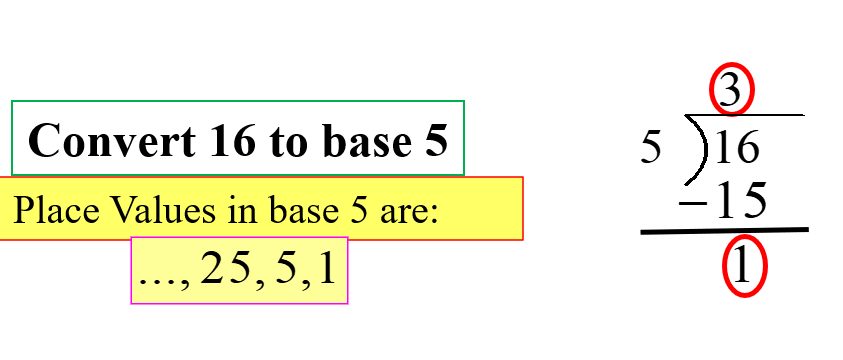
Place values in base five are \(...,25,5,1\)
The largest place value smaller than \(16\) that divides the given number \(16\) is \(5\).
\(\begin{array}{ll}
16 \div 5= & 3 \quad \mathrm{R} \quad 1 \\
\end{array}\)We'll say that \(16_{10}=31_{5}.\)
The above step is illustrated in the following diagram.
- Answer 2
-
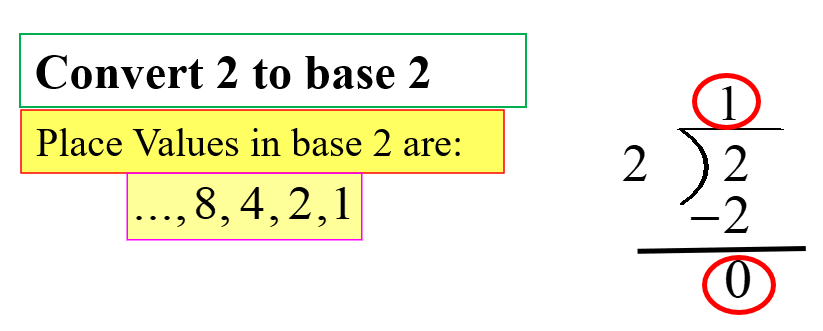
Place values in base two are \(..,4,2,1\)
The largest place value smaller than (or equal to) \(2\) that divides the given number \(2\) is \(2.\)
\(\begin{array}{ll}
2\div 2= & 1 \quad \mathrm{R} \quad 0\\
\end{array}\)We'll say that \(2_{10}=10_{2}.\)
- Answer 3
-
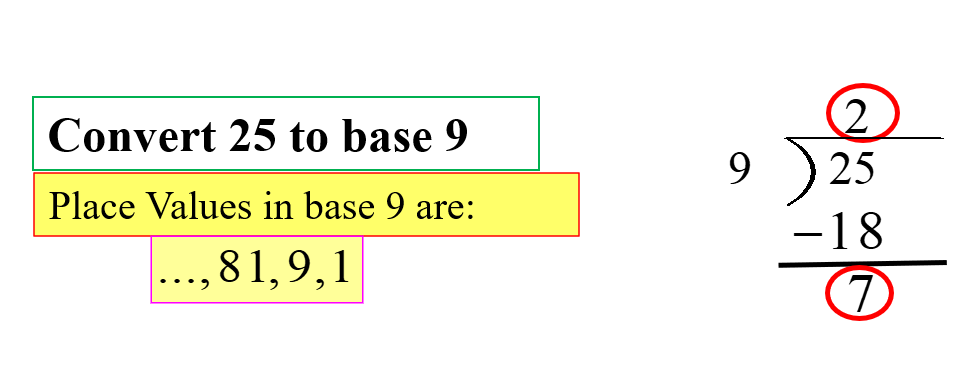
Place values in base nine are \(...,81,9,1\)
The largest place value smaller than \(25\) that divides the given number \(25\) is \(9.\)
\(\begin{array}{ll}
25 \div 9= & 2 \quad \mathrm{R} \quad 7 \\
\end{array}\)We'll say that \(25_{10}=27_{9}.\)
Example \(\PageIndex{5}\): Convert Base 10 to Other Bases
- Convert base \(10\) number \(23\) to a base four number.
- Convert base \(10\) number \(2763\) to a base five number.
- Answer 1
-
Place values in base four are \(...,16,4,1\)
The largest place value smaller than \(23\) that divides the given number \(23\) is \(16.\)
\(\begin{array}{ll}
23\div 16= & 1 \quad \mathrm{R} \quad 7 \\
7 \div 4= & 1 \quad \mathrm{R} \quad 3 \\
\end{array}\)We'll say that \(23_{10}=113_{4}\)
We can check our work by converting \(113_{4}\) to base ten.
\[(1 \times 16)+(1 \times 4)+(3\times 1)=23 \nonumber \]
Here, we have \(1\) sixteen, \(1\) four, and \(3\) ones. Hence, we have \(113\) in base four Thus, \(23_{10}=113_4.\). The above step is illustrated in the following diagram.

- Answer 2
-
Note: In general, when converting from base-ten to some other base, it is often helpful to determine the highest power of the base that will divide into the given number at least once. In the last example, \(4^{2}=16\) is the largest power of five that is present in \(23,\) so that was our starting point. If we had moved to \(4^{3}=64,\) then \(64)\) would not divide into \(23\) at least once.
Place values in base five are \(...,3125,625,125,25,5,1\)
The largest place value smaller than \(2763\) that divides the given number \(2763\) is \(625.\)
\(\begin{array}{ll}
2763 \div 625= & 4 \quad \mathrm{R} \quad 263 \\
263 \div 125 = & 2 \quad \mathrm{R} \quad 13\\
13 \div 25= & 0 \quad \mathrm{R} \quad 13 \\
13 \div 5= & 2\quad \mathrm{R} \quad 3 \\
\end{array}\)Putting all of this together means that \(2763_{10}=42023_{5}.\) The above step is illustrated in the following diagram.

Figure \(\PageIndex{2}\): Convert \(2763\) to base \(5\). This diagram shows the long division step to converst base ten number 2763 to base five number.
Working on the Bases Higher Than Ten.
As mentioned in the text, working in base \(10\) is mathematically awkward. Ten has only two natural number divisors: \(2\) and \(5.\) This means dividing into groups is not easy. However, \(12,\) or a dozen, has more divisors: \(2, 3, 4,\) and \(6.\) The Dozenal Society recognizes this more mathematically pleasant detail. It advocates for a switch to using base \(12\) for numbers. Their argument is based on the divisibility of the number \(12.\) But has there ever been a society that used such a system? The answer is yes. A dialect of the Gwandara language in Nigeria uses the base \(12\) system. It is unlikely, though, that the Dozenal Society will achieve their goal, as the base \(10\) system is so entrenched in our society.
A number base higher than ten and less than or equal to sixteen includes systems like base-\(9\) through base-\(16,\) which use additional symbols beyond the standard digits 0 to \(9.\) To represent values greater than \(9,\) these systems introduce letters from the alphabet, starting with A for \(10,\) B for \(11,\) C for \(12,\) D for \(13,\) E for \(14\) and F for \(15\) in base-\(16\) (hexadecimal). These bases are especially useful in fields like computer science and digital electronics. For example, hexadecimal (base-16) is commonly used to simplify binary code since each hex digit represents four binary digits (bits). These number systems allow for more compact and human-readable representations of data, making them practical for tasks such as memory addressing, color codes in web design, and machine-level programming.
| Bases | Digits Used | Place Values |
|---|---|---|
| \(11\) | \(0, 1,2,3,4,5,6,7,8,9, \text{A}\) | \(...,11^3,11^2,11^1,1\) |
| \(12\) | \(0,1,2,3,4,5,6,7,8,9, \text{A}, \text{B}\) | \(...,12^3,12^2,12^1,1\) |
| \(13\) | \(0,1,2,3,4,5,6,7,8,9, \text{A}, \text{B}, \text{C}\) | \( ...,13^3,13^2,13^1,1\) |
| \(14\) | \(0,1,2,3,4,5,6,7,8,9, \text{A}, \text{B}, \text{C}, \text{D}\) | \( ...,14^3,14^2,14^1,1\) |
| \(15\) | \(0,1,2,3,4,5,6,7,8,9, \text{A}, \text{B}, \text{C}, \text{D}, \text{E} \) | \( ...,15^3,15^2,15^1,1\) |
| \(16\) | \(0,1,2,3,4,5,6,7,8,9, \text{A}, \text{B}, \text{C}, \text{D}, \text{E},\text{F}\) | \( ...,16^3,16^2,16^1,1\) |
Example \(\PageIndex{6}\): Convert Base Sixteen to Base Ten
Convert \(FC52E_{16}\) into base \(10.\)
- Answer
-
The place values in ase \(16\) are powers of \(16:\)
\[\begin{array}{l}
16^{0}=1 \\
16^{1}=16 \\
16^{2}=256 \\
16^{3}=4096\\
16^{4}=65,536\\
\end{array} \nonumber\]Etc...
\[FC52E_{16}=(F(15) \times 65,536)+(12 \times 4096)+(5 \times 256)+(2 \times 16)+(E(14)\times 1)=1,033,518_{10} \nonumber \]
Thus \(FC52E_{16}=1,033,518_{10}.\)