

1.5: Truth Tables, Conditionals, and De Morgan’s Laws
- Page ID
- 207728
\( \newcommand{\vecs}[1]{\overset { \scriptstyle \rightharpoonup} {\mathbf{#1}} } \)
\( \newcommand{\vecd}[1]{\overset{-\!-\!\rightharpoonup}{\vphantom{a}\smash {#1}}} \)
\( \newcommand{\dsum}{\displaystyle\sum\limits} \)
\( \newcommand{\dint}{\displaystyle\int\limits} \)
\( \newcommand{\dlim}{\displaystyle\lim\limits} \)
\( \newcommand{\id}{\mathrm{id}}\) \( \newcommand{\Span}{\mathrm{span}}\)
( \newcommand{\kernel}{\mathrm{null}\,}\) \( \newcommand{\range}{\mathrm{range}\,}\)
\( \newcommand{\RealPart}{\mathrm{Re}}\) \( \newcommand{\ImaginaryPart}{\mathrm{Im}}\)
\( \newcommand{\Argument}{\mathrm{Arg}}\) \( \newcommand{\norm}[1]{\| #1 \|}\)
\( \newcommand{\inner}[2]{\langle #1, #2 \rangle}\)
\( \newcommand{\Span}{\mathrm{span}}\)
\( \newcommand{\id}{\mathrm{id}}\)
\( \newcommand{\Span}{\mathrm{span}}\)
\( \newcommand{\kernel}{\mathrm{null}\,}\)
\( \newcommand{\range}{\mathrm{range}\,}\)
\( \newcommand{\RealPart}{\mathrm{Re}}\)
\( \newcommand{\ImaginaryPart}{\mathrm{Im}}\)
\( \newcommand{\Argument}{\mathrm{Arg}}\)
\( \newcommand{\norm}[1]{\| #1 \|}\)
\( \newcommand{\inner}[2]{\langle #1, #2 \rangle}\)
\( \newcommand{\Span}{\mathrm{span}}\) \( \newcommand{\AA}{\unicode[.8,0]{x212B}}\)
\( \newcommand{\vectorA}[1]{\vec{#1}} % arrow\)
\( \newcommand{\vectorAt}[1]{\vec{\text{#1}}} % arrow\)
\( \newcommand{\vectorB}[1]{\overset { \scriptstyle \rightharpoonup} {\mathbf{#1}} } \)
\( \newcommand{\vectorC}[1]{\textbf{#1}} \)
\( \newcommand{\vectorD}[1]{\overrightarrow{#1}} \)
\( \newcommand{\vectorDt}[1]{\overrightarrow{\text{#1}}} \)
\( \newcommand{\vectE}[1]{\overset{-\!-\!\rightharpoonup}{\vphantom{a}\smash{\mathbf {#1}}}} \)
\( \newcommand{\vecs}[1]{\overset { \scriptstyle \rightharpoonup} {\mathbf{#1}} } \)
\(\newcommand{\longvect}{\overrightarrow}\)
\( \newcommand{\vecd}[1]{\overset{-\!-\!\rightharpoonup}{\vphantom{a}\smash {#1}}} \)
\(\newcommand{\avec}{\mathbf a}\) \(\newcommand{\bvec}{\mathbf b}\) \(\newcommand{\cvec}{\mathbf c}\) \(\newcommand{\dvec}{\mathbf d}\) \(\newcommand{\dtil}{\widetilde{\mathbf d}}\) \(\newcommand{\evec}{\mathbf e}\) \(\newcommand{\fvec}{\mathbf f}\) \(\newcommand{\nvec}{\mathbf n}\) \(\newcommand{\pvec}{\mathbf p}\) \(\newcommand{\qvec}{\mathbf q}\) \(\newcommand{\svec}{\mathbf s}\) \(\newcommand{\tvec}{\mathbf t}\) \(\newcommand{\uvec}{\mathbf u}\) \(\newcommand{\vvec}{\mathbf v}\) \(\newcommand{\wvec}{\mathbf w}\) \(\newcommand{\xvec}{\mathbf x}\) \(\newcommand{\yvec}{\mathbf y}\) \(\newcommand{\zvec}{\mathbf z}\) \(\newcommand{\rvec}{\mathbf r}\) \(\newcommand{\mvec}{\mathbf m}\) \(\newcommand{\zerovec}{\mathbf 0}\) \(\newcommand{\onevec}{\mathbf 1}\) \(\newcommand{\real}{\mathbb R}\) \(\newcommand{\twovec}[2]{\left[\begin{array}{r}#1 \\ #2 \end{array}\right]}\) \(\newcommand{\ctwovec}[2]{\left[\begin{array}{c}#1 \\ #2 \end{array}\right]}\) \(\newcommand{\threevec}[3]{\left[\begin{array}{r}#1 \\ #2 \\ #3 \end{array}\right]}\) \(\newcommand{\cthreevec}[3]{\left[\begin{array}{c}#1 \\ #2 \\ #3 \end{array}\right]}\) \(\newcommand{\fourvec}[4]{\left[\begin{array}{r}#1 \\ #2 \\ #3 \\ #4 \end{array}\right]}\) \(\newcommand{\cfourvec}[4]{\left[\begin{array}{c}#1 \\ #2 \\ #3 \\ #4 \end{array}\right]}\) \(\newcommand{\fivevec}[5]{\left[\begin{array}{r}#1 \\ #2 \\ #3 \\ #4 \\ #5 \\ \end{array}\right]}\) \(\newcommand{\cfivevec}[5]{\left[\begin{array}{c}#1 \\ #2 \\ #3 \\ #4 \\ #5 \\ \end{array}\right]}\) \(\newcommand{\mattwo}[4]{\left[\begin{array}{rr}#1 \amp #2 \\ #3 \amp #4 \\ \end{array}\right]}\) \(\newcommand{\laspan}[1]{\text{Span}\{#1\}}\) \(\newcommand{\bcal}{\cal B}\) \(\newcommand{\ccal}{\cal C}\) \(\newcommand{\scal}{\cal S}\) \(\newcommand{\wcal}{\cal W}\) \(\newcommand{\ecal}{\cal E}\) \(\newcommand{\coords}[2]{\left\{#1\right\}_{#2}}\) \(\newcommand{\gray}[1]{\color{gray}{#1}}\) \(\newcommand{\lgray}[1]{\color{lightgray}{#1}}\) \(\newcommand{\rank}{\operatorname{rank}}\) \(\newcommand{\row}{\text{Row}}\) \(\newcommand{\col}{\text{Col}}\) \(\renewcommand{\row}{\text{Row}}\) \(\newcommand{\nul}{\text{Nul}}\) \(\newcommand{\var}{\text{Var}}\) \(\newcommand{\corr}{\text{corr}}\) \(\newcommand{\len}[1]{\left|#1\right|}\) \(\newcommand{\bbar}{\overline{\bvec}}\) \(\newcommand{\bhat}{\widehat{\bvec}}\) \(\newcommand{\bperp}{\bvec^\perp}\) \(\newcommand{\xhat}{\widehat{\xvec}}\) \(\newcommand{\vhat}{\widehat{\vvec}}\) \(\newcommand{\uhat}{\widehat{\uvec}}\) \(\newcommand{\what}{\widehat{\wvec}}\) \(\newcommand{\Sighat}{\widehat{\Sigma}}\) \(\newcommand{\lt}{<}\) \(\newcommand{\gt}{>}\) \(\newcommand{\amp}{&}\) \(\definecolor{fillinmathshade}{gray}{0.9}\)Before we focus on truth tables, we’re going to recall the symbols that are commonly used for and, or, and not.
The symbol \(\wedge\) is used for and: \( p\) and \(\) is notated \(p \wedge q\): \(p \wedge q\) is called conjunction.
The symbol \(\vee\) is used for or: \(p\) or \(q\) is notated \(p \vee q\): \(p \vee q\) is call disjunction.
The symbol \(\sim\) is used for not: not \(p\) is notated \(\sim p\).
A Boolean statement is a statement that can be evaluated as either true or false, and only true or false. It’s the basis of logic, mathematics, and computer programming.
Compound Boolean statements can get tricky to think about. We can create a truth table to keep track of what truth values for the simple statements make the complex statement true and false.
A table showing what the resulting truth value of a compound statement is for all the possible truth values of the simple statements.
While working on truth value and truth table, we write T for "True" and F for "False".
Suppose you’re picking out a new couch, and your significant other says, “Get a sectional or something with a chaise”.
This is a complex statement made of two simpler conditions: “is a sectional”, and “has a chaise”. For simplicity, let’s use \(p\) to designate “is a sectional”, and \(q\) to designate “has a chaise”.
A truth table for this situation would look like this:
\[\begin{array}{|c|c|c|}
\hline p & q & p \text { or } q \\
\hline \mathrm{T} & \mathrm{T} & \mathrm{T} \\
\hline \mathrm{T} & \mathrm{F} & \mathrm{T} \\
\hline \mathrm{F} & \mathrm{T} & \mathrm{T} \\
\hline \mathrm{F} & \mathrm{F} & \mathrm{F} \\ \hline
\end{array}\nonumber\]
In the table, T is used for true, and F for false. In the first row, if p is true and q is also true, then the complex statement “p or q” is true. This sectional also features a chaise, which meets our desire. (Remember that or in logic is not exclusive; if the couch has both features, it meets the condition.)
In the previous example about the couch, the truth table was really just summarizing what we already know about how the or statement works. The truth tables for the basic and, or, and not statements are shown below.
Conjunction
\[\begin{array}{|c|c|c|}
\hline p & q & p \wedge q & \\
\hline \mathrm{T} & \mathrm{T} & \mathrm{T} & \mathrm{T\wedge T:~T}\\
\hline \mathrm{T} & \mathrm{F} & \mathrm{F}& \mathrm{T\wedge F:~F} \\
\hline \mathrm{F} & \mathrm{T} & \mathrm{F}& \mathrm{F\wedge T:~F} \\
\hline \mathrm{F} & \mathrm{F} & \mathrm{F}& \mathrm{F\wedge F:~F} \\
\hline
\end{array}\nonumber \]
So the conjunction \(p \wedge q\) is only true when both \(p\) and \(q\) are true. And the conjunction \(p \wedge q\) is false whenever at least one of the statements is false.
Disjunction
\[\begin{array}{|c|c|c|}
\hline p & q & p \vee q & \\
\hline \mathrm{T} & \mathrm{T} & \mathrm{T} & \mathrm{T\vee T:~T}\\
\hline \mathrm{T} & \mathrm{F} & \mathrm{T}& \mathrm{T\vee F:~T} \\
\hline \mathrm{F} & \mathrm{T} & \mathrm{T}& \mathrm{F\vee T:~T} \\
\hline \mathrm{F} & \mathrm{F} & \mathrm{F}& \mathrm{F\vee F:~F} \\
\hline
\end{array}\nonumber \]
So the disjunction \(p \vee q\) is true whenever at least one of the statements is true. And the disjunction \(p \vee q\) is only false if both statements are false.
Negation
\[\begin{array}{|c|c|}
\hline p & \sim p \\
\hline \mathrm{T} & \mathrm{F} \\
\hline \mathrm{F} & \mathrm{T} \\
\hline
\end{array}\nonumber \]
Truth tables really become useful when we analyze more complex Boolean statements.
Example \(\PageIndex{1}\): Truth Table for Disjunction
Create a truth table for the statement \(p \vee \sim q\)
- Answer
-
When we create the truth table, we need to list all the possible truth value combinations for \(p\) and \(q\). Notice how the first column contains \(2\) Ts followed by \(2 ~\mathrm{Fs}\), and the second column alternates \(\mathrm{T}, \mathrm{F}, \mathrm{T}\), F. This pattern ensures that all \(4\) combinations are considered.
After creating columns with those initial values, we create a third column for the expression \(\sim B\).
Next, we can find the truth values of \(p \vee \sim q,\) using the first and third columns.
\[\begin{array}{|c|c|c|c|}
\hline p & q & \sim q & p\vee \sim q \\
\hline \mathrm{T} & \mathrm{T} & \mathrm{F} & \mathrm{T} \\
\hline \mathrm{T} & \mathrm{F} & \mathrm{T} & \mathrm{T} \\
\hline \mathrm{F} & \mathrm{T} & \mathrm{F} & \mathrm{F} \\
\hline \mathrm{F} & \mathrm{F} & \mathrm{T} & \mathrm{T} \\
\hline
\end{array}\nonumber\]The truth table shows that \(p\vee \sim q\) is true in three cases and false in one case.
Example \(\PageIndex{2}\): Truth Table with Three Statements
Create a truth table for the statement \(p \wedge \sim(q \vee r)\).
- Answer
-
It helps to work from the inside out when creating a truth table and to create columns in the table for intermediate operations. We start by listing all the possible truth value combinations for \(p, q,\) and \(r .\) Notice how the first column contains 4 Ts followed by \(4 \mathrm{Fs}\), the second column contains \(2 \mathrm{Ts}, 2 \mathrm{Fs}\), then repeats, and the last column alternates \(\mathrm{T}, \mathrm{F}, \mathrm{T}, \mathrm{F} \ldots\) This pattern ensures that all 8 combinations are considered. After creating columns with those initial values, we create a fourth column for the innermost expression, \(q \vee r \). The fifth column would be for \(\sim(q\vee r)\) and the last sixth column for \(p \wedge \sim(q \vee r)\).
\[\begin{array}{|c|c|c|c|c|c|}
\hline p & q & r & q\vee r & \sim (q \vee r) & p \wedge \sim (q \vee r\text { ) } \\
\hline \text { T } & \text { T } & \text { T } & \text { T } & \text { F } & \text { F } \\
\hline \text { T } & \text { T } & \text { F } & \text { T } & \text { F } & \text { F } \\
\hline \text { T } & \text { F } & \text { T } & \text { T } & \text { F } & \text { F } \\
\hline \text { T } & \text { F } & \text { F } & \text { F } & \text { T } & \text { T } \\
\hline \text { F } & \text { T } & \text { T } & \text { T } & \text { F } & \text { F } \\
\hline \text { F } & \text { T } & \text { F } & \text { T } & \text { F } & \text { F } \\
\hline \text { F } & \text { F } & \text { T } & \text { T } & \text { F } & \text { F } \\
\hline \text { F } & \text { F } & \text { F } & \text { F } & \text { T } & \text { F } \\
\hline
\end{array}\nonumber\]
Conditional Statement and Truth Value
We discussed conditional statements earlier, in which we take an action based on the value of the condition. We are now going to examine another version of a conditional, sometimes referred to as an implication, which states that the second part must logically follow from the first. As we recall
A conditional is a logical compound statement in which a statement \(p\), called the antecedent, implies a statement \(q\), called the consequent.
A conditional is written as \(p \rightarrow q\) and is translated as "if \(p\), then \(q\)".
Implication
If P is true, then Q must also be true.
The conditional statement “If it is raining, then there are clouds in the sky” is an implication. It makes sense because if the antecedent “it is raining” is true, then the consequent “there are clouds in the sky” must also be true.
Notice that the statement tells us nothing of what to expect if it is not raining; there might be clouds in the sky, or there might not. If the antecedent is false, then the consequent becomes irrelevant.
In traditional logic, a conditional is considered true as long as there are no cases in which the antecedent is true and the consequent is false.
\[\begin{array}{|c|c|c|}
\hline p & q & p \rightarrow q &\\
\hline \mathrm{T} & \mathrm{T} & \mathrm{T}& \mathrm{T\rightarrow T:~T} \\
\hline \mathrm{T} & \mathrm{F} & \mathrm{F} & \mathrm{T\rightarrow F:~F}\\
\hline \mathrm{F} & \mathrm{T} & \mathrm{T} & \mathrm{F\rightarrow T:~T}\\
\hline \mathrm{F} & \mathrm{F} & \mathrm{T} &\mathrm{F\rightarrow F:~T}\\
\hline
\end{array}\nonumber\]
So the conditional statement \( p\rightarrow q\) is false only if the hypothesis is true and the conclusion is false. Otherwise, it is always true.
Again, if the antecedent \(p\) is false, we cannot prove that the statement is a lie, so the result of the third and fourth rows is true.
Example \(\PageIndex{4}\)
Suppose you order a team jersey online on Tuesday and want to receive it by Friday so you can wear it to Saturday’s game. The website says that if you pay for expedited shipping, you will receive the jersey by Friday. In what situation is the website telling a lie?
There are four possible outcomes:
1) You pay for expedited shipping and receive the jersey by Friday
2) You pay for expedited shipping and don’t receive the jersey by Friday
3) You don’t pay for expedited shipping and receive the jersey by Friday
4) You don’t pay for expedited shipping and don’t receive the jersey by Friday
- Answer
-
Only one of these outcomes proves that the website was lying: The second outcome in which you pay for expedited shipping but don’t receive the jersey by Friday.
The first outcome is exactly what was promised, so there’s no problem with that.
The third outcome is not a lie because the website never said what would happen if you didn’t pay for expedited shipping; maybe the jersey would arrive by Friday, whether you paid for expedited shipping or not.
The fourth outcome is not a lie because, again, the website didn’t make any promises about when the jersey would arrive if you didn’t pay for expedited shipping.
It may seem strange that the third outcome in the previous example, in which the first part is false but the second part is true, is not a lie. Remember, though, that if the antecedent is false, we cannot make any judgment about the consequent. The website never said that paying for expedited shipping was the only way to receive the jersey by Friday.
Example \(\PageIndex{5}\): Truth Table for Three Statements
Construct a truth table for the statement \((p \wedge \sim q) \rightarrow r\)
- Answer
-
We start by constructing a truth table with 8 rows to cover all possible scenarios.
\[\begin{array}{|c|c|c|c|c|c|c|}
\hline p & q & r & \sim q & p \wedge \sim q & r & (p \wedge \sim q) \rightarrow r \\
\hline \mathrm{T} & \mathrm{T} & \mathrm{T} & \mathrm{F} & \mathrm{F} & \mathrm{T} & \mathrm{T} \\
\hline \mathrm{T} & \mathrm{T} & \mathrm{F} & \mathrm{F} & \mathrm{F} & \mathrm{F} & \mathrm{T} \\
\hline \mathrm{T} & \mathrm{F} & \mathrm{T} & \mathrm{T} & \mathrm{T} & \mathrm{T} & \mathrm{T} \\
\hline \mathrm{T} & \mathrm{F} & \mathrm{F} & \mathrm{T} & \mathrm{T} & \mathrm{F} & \mathrm{F} \\
\hline \mathrm{F} & \mathrm{T} & \mathrm{T} & \mathrm{F} & \mathrm{F} & \mathrm{T} & \mathrm{T} \\
\hline \mathrm{F} & \mathrm{T} & \mathrm{F} & \mathrm{F} & \mathrm{F} & \mathrm{F} & \mathrm{T} \\
\hline \mathrm{F} & \mathrm{F} & \mathrm{T} & \mathrm{T} & \mathrm{F} & \mathrm{T} & \mathrm{T} \\
\hline \mathrm{F} & \mathrm{F} & \mathrm{F} & \mathrm{T} & \mathrm{F} & \mathrm{F} & \mathrm{T} \\
\hline
\end{array}\nonumber \]When \(p\) is true, \(q\) is false, and \(r\) is false- -the fourth row of the table-- then the antecedent \(p \wedge \sim q\) will be true but the consequent false, resulting in an invalid conditional; every other case gives a valid conditional.
If you want a real-life situation that could be modeled by \((p \wedge \sim q) \rightarrow r\), consider this: let \(p=\) we order meatballs, \(q=\) we order pasta, and \(r=\) Rob is happy. The statement \((p \wedge \sim q) \rightarrow r\) is "if we order meatballs and don't order pasta, then Rob is happy". If \(p\) is true (we order meatballs), \(q\) is false (we don't order pasta), and \(r\) is false (Rob is not happy), then the statement is false, because we satisfied the antecedent but Rob did not satisfy the consequent.
Converse, Inverse, and Contrapositive
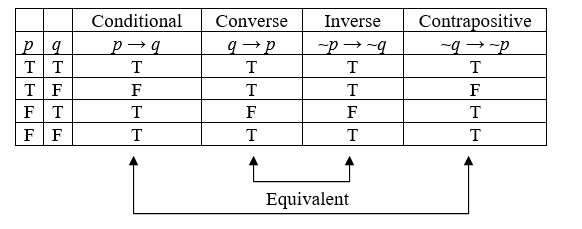
For any conditional, there are three related statements: the converse, the inverse, and the contrapositive.
| Statements | Symbolic forms | |
| conditionals | \[\begin{align*} \text{If } &p,~ \text{then}~ q \\ &p \longrightarrow q \end{align*}\nonumber\] |
\(p \longrightarrow q\) is equivalent to \(\sim q \longrightarrow \sim p\) AND \(q \longrightarrow p\) is equivalent to \(\sim p \longrightarrow \sim q\) In other words, the original statement and the contrapositive must agree with each other; they must both be true, or they must both be false. Similarly, the converse and the inverse must agree with each other; they must both be true, or they must both be false. |
| Converse | \[\begin{align*} \text{If } &q,~ \text{then}~ p \\ &q \longrightarrow p \end{align*}\] |
|
|
Inverse |
\[\begin{align*} \text{If not} & ~p,~ \text{then not}~ q \\ &\sim p \longrightarrow \sim q \end{align*}\] |
|
| Contrapositive | \[\begin{align*} \text{If not} & ~q,~ \text{then not}~ p \\ &\sim q \longrightarrow \sim p \end{align*}\] |
Looking at truth tables, we can see that the original conditional and the contrapositive are logically equivalent, and that the converse and inverse are logically equivalent.
Example \(\PageIndex{6}\): Equivalent Statements
Consider again the conditional “If it is raining, then there are clouds in the sky.” It seems reasonable to assume that this is true.
- Answer
-
The converse would be “If there are clouds in the sky, then it is raining.” This is not always true.
The inverse would be “If it is not raining, then there are no clouds in the sky.” Likewise, this is not always true.
The contrapositive would be “If there are no clouds in the sky, then it is not raining.” This statement is true and is equivalent to the original condition.
Be aware that symbolic logic cannot represent the English language perfectly. For example, we may need to change the verb tense to show that one thing occurred before another.
Example \(\PageIndex{7}\): Find Equivalent Statement
Suppose this statement is true: “If I eat this giant cookie, then I will feel sick.” Identify which of the following statements are the converse, inverse, and contrapositive. Which of the following statements must also be true?
- If I feel sick, then I ate that giant cookie.
- If I don’t eat this giant cookie, then I won’t feel sick.
- If I don’t feel sick, then I didn’t eat that giant cookie.
- Answer
-
First statement (a) is the converse, which is not necessarily true. I could feel sick for some other reason, such as drinking sour milk.
Second statement (b) is the inverse, which is not necessarily true. Again, I could feel sick for some other reason; avoiding the cookie doesn’t guarantee that I won’t feel sick.
Third statement (c) is the contrapositive, which is true, but we have to think somewhat backward to explain it. If I ate the cookie, I would feel sick, but since I don’t feel sick, I must not have eaten the cookie.
Notice again that the original statement and the contrapositive have the same truth value (both are true), and the converse and the inverse have the same truth value (both are false).
Consider the statement “If you park here, then you will get a ticket.” What set of conditions would prove this statement false?
- You don’t park here and you get a ticket.
- You don’t park here and you don’t get a ticket.
- You park here and you don’t get a ticket.
The first two statements are irrelevant because we don’t know what will happen if you park somewhere else. The third statement, however, contradicts the conditional statement “If you park here, then you will get a ticket” because you parked here but didn’t get a ticket. This example demonstrates a general rule; the negation of a conditional can be written as a conjunction: “It is not the case that if you park here, then you will get a ticket” is equivalent to “You park here and you do not get a ticket.”
The Negation of a Conditional Statement
The negation of a conditional statement is logically equivalent to a conjunction of the antecedent and the negation of the consequent.
\(\sim(p \rightarrow q)\) is equivalent to \(p \wedge \sim q\)
Example \(\PageIndex{8}\): Negation of Conditional
Which of the following statements is equivalent to the negation of “If you don’t grease the pan, then the food will stick to it”?
- I didn’t grease the pan and the food didn’t stick to it.
- I didn’t grease the pan and the food stuck to it.
- I greased the pan and the food didn’t stick to it.
- Answer
-
This is correct; it is the conjunction of the antecedent and the negation of the consequent. To disprove that not greasing the pan will cause the food to stick, I have to not grease the pan and have the food not stick. This is essentially the original statement with no negation; the “if…then” has been replaced by “and”. This essentially agrees with the original statement and cannot disprove it.
Biconditional Statement and Truth Value
In everyday life, we often have a stronger meaning in mind when we use a conditional statement. Consider “If you submit your hours today, then you will be paid next Friday.” What the payroll rep really means is “If you submit your hours today, then you will be paid next Friday, and if you don’t submit your hours today, then you won’t be paid next Friday.” The conditional statement if t, then p also includes the inverse of the statement: if not t, then not p. A more compact way to express this statement is “You will be paid next Friday if and only if you submit your timesheet today.” A statement of this form is called a biconditional.
Biconditional Statement
A biconditional is a logical conditional statement in which the antecedent and consequent are interchangeable.
A biconditional is written as \(p \leftrightarrow q\) and is translated as " \(p\) if and only if \(q^{\prime \prime}\).
Because a biconditional statement \(p \leftrightarrow q\) is equivalent to \((p \rightarrow q) \wedge(q \rightarrow p),\) we may think of it as a conditional statement combined with its converse: if \(p\), then \(q\) and if \(q\), then \(p\). The double-headed arrow shows that the conditional statement goes from left to right and from right to left. A biconditional is considered true as long as the antecedent and the consequent have the same truth value; that is, they are either both true or both false.
\[\begin{array}{|c|c|c|}
\hline p & q & p \leftrightarrow q &\\
\hline \mathrm{T} & \mathrm{T} & \mathrm{T}& \mathrm{T\leftrightarrow T:~T} \\
\hline \mathrm{T} & \mathrm{F} & \mathrm{F} & \mathrm{T\leftrightarrow F:~F}\\
\hline \mathrm{F} & \mathrm{T} & \mathrm{F} & \mathrm{F\leftrightarrow T:~F}\\
\hline \mathrm{F} & \mathrm{F} & \mathrm{T} &\mathrm{F\leftrightarrow F:~T}\\
\hline
\end{array}\nonumber\]
So the biconditional statement \( p\leftrightarrow q\) is true only if both statements have the same truth value.
Notice that the fourth row, where both components are false, is true; if you don’t submit your timesheet and you don’t get paid, the person from payroll told you the truth.
Example \(\PageIndex{9}\): Analyzing Biconditional Statement
Suppose this statement is true: “The garbage truck comes down my street if and only if it is Thursday morning.” Which of the following statements could be true?
- It is Thursday and the garbage truck did not come down my street this morning.
- It is Monday, and the garbage truck is coming down my street.
- It is Wednesday at 11:59PM, and the garbage truck did not come down my street today.
- Answer
-
- This cannot be true. This is like the second row of the truth table; it is true that I just experienced Thursday morning, but it is false that the garbage truck came.
- This cannot be true. This is like the third row of the truth table; it is false that it is Thursday, but it is true that the garbage truck came.
- This could be true. This is like the fourth row of the truth table; it is false that it is Thursday, but it is also false that the garbage truck came, so everything worked out like it should.
A contemporary of Boole’s, Augustus De Morgan, formalized two rules of logic that had previously been known informally. They allow us to rewrite the negation of a conjunction as a disjunction, and vice-versa.
For example, suppose you want to schedule a meeting with two colleagues at \(4: 30 ~\mathrm{PM}\) on Friday, and you need both of them to be available at that time. What situation would make it impossible to have the meeting? It is NOT the case that colleague \(a\) is available AND colleague \(b\) is available: \(\sim(a \wedge b)\). This situation is equivalent to either colleague \(a\) NOT being available OR colleague \(b\) NOT being available: \(\sim a \vee \sim b\)
The negation of a conjunction is equivalent to the disjunction of the negation of the statements making up the conjunction. To negate an “and” statement, negate each part and change the “and” to “or”.
\(\sim(p \wedge q)\) is equivalent to \(\sim p \vee \sim q\)
The negation of a disjunction is equivalent to the conjunction of the negation of the statements making up the disjunction. To negate an “or” statement, negate each part and change the “or” to “and”.
\(\sim(p \vee q)\) is equivalent to \(\sim p \wedge \sim q\)
Do you know what the following are equivalent to each other?
- \(\sim(\sim p \wedge \sim q)\equiv p \vee q\)
- \(\sim(p \vee \sim q)\equiv \sim p\wedge q\)
- \(\sim[p \rightarrow (q\wedge r) ]\equiv p \wedge \sim(q\wedge r)\equiv p\wedge(\sim q\vee\sim r)\)
Example \(\PageIndex{10}\): Using De Morgan Law
Write the negation of the following statement
"If Amy changes her major, then she will have to take summer school and won't graduate next year."
- Answer
-
Since this conditional statement's hypothesis has a conjunction, we use the negation of the conditional statement using
\(\sim(p \rightarrow q)\) is equivalent to \(p \wedge \sim q\), and then we use De Morgan Law in the second part of the previous negation (SEE NOTE 3 ABOVE).
Lets say: \(p\) = change her major, \(q\) = take summer school, and \(r\) = won't graduate
Note 3 above says: \(\sim[p \rightarrow (q\wedge r )]\equiv p\wedge(\sim q\vee\sim r)\). So negation would be
Amy changes his major, and she doesn't have to take summer school or she will graduate next year.
Example \(\PageIndex{11}\): Find Truth Value
Define the following statements:
\(p\) = "The Earth orbits the Sun."
\(q\) = "The chemical symbol for water is H₂O."
\(r\) = "A triangle has four sides."
Evaluate the truth value of the following compound statement:
\((p \vee \sim r)\leftrightarrow(\sim q \rightarrow r)\)
- Answer
- \(p\) is True, \(q\) is True, and \(r\) is False. \begin{aligned}
(T\vee \sim F)&\leftrightarrow(\sim T \rightarrow F)\\
(T\vee T)&\leftrightarrow(F \rightarrow F)\\
T&\leftrightarrow T\\
T
\end{aligned}
Example \(\PageIndex{12}\): Find the Truth Value of Compound Statement
Consider the following compound statements. Use appropriate entries from truth tables to determine whether each statement is true or false.
- If Mount Everest is the tallest mountain, then cats are mammals.
- If cows eat grass, then apples are blue.
- Tokyo is the largest city in Japan, and cats are amphibious.
- The Mona Lisa was painted by Leonardo da Vinci, or all odd numbers are divisible by 2.
- Answer
-
- \(T\rightarrow T\) : \(T\), so it is True.
- \(T\rightarrow F\) : \(F\), so it is False
- \(T\wedge F\) : \(F\), so it is False.
- \(T\vee F\) : \(T\), so it is True.