

8.2: Surface Area
- Page ID
- 186220

\( \newcommand{\vecs}[1]{\overset { \scriptstyle \rightharpoonup} {\mathbf{#1}} } \)
\( \newcommand{\vecd}[1]{\overset{-\!-\!\rightharpoonup}{\vphantom{a}\smash {#1}}} \)
\( \newcommand{\dsum}{\displaystyle\sum\limits} \)
\( \newcommand{\dint}{\displaystyle\int\limits} \)
\( \newcommand{\dlim}{\displaystyle\lim\limits} \)
\( \newcommand{\id}{\mathrm{id}}\) \( \newcommand{\Span}{\mathrm{span}}\)
( \newcommand{\kernel}{\mathrm{null}\,}\) \( \newcommand{\range}{\mathrm{range}\,}\)
\( \newcommand{\RealPart}{\mathrm{Re}}\) \( \newcommand{\ImaginaryPart}{\mathrm{Im}}\)
\( \newcommand{\Argument}{\mathrm{Arg}}\) \( \newcommand{\norm}[1]{\| #1 \|}\)
\( \newcommand{\inner}[2]{\langle #1, #2 \rangle}\)
\( \newcommand{\Span}{\mathrm{span}}\)
\( \newcommand{\id}{\mathrm{id}}\)
\( \newcommand{\Span}{\mathrm{span}}\)
\( \newcommand{\kernel}{\mathrm{null}\,}\)
\( \newcommand{\range}{\mathrm{range}\,}\)
\( \newcommand{\RealPart}{\mathrm{Re}}\)
\( \newcommand{\ImaginaryPart}{\mathrm{Im}}\)
\( \newcommand{\Argument}{\mathrm{Arg}}\)
\( \newcommand{\norm}[1]{\| #1 \|}\)
\( \newcommand{\inner}[2]{\langle #1, #2 \rangle}\)
\( \newcommand{\Span}{\mathrm{span}}\) \( \newcommand{\AA}{\unicode[.8,0]{x212B}}\)
\( \newcommand{\vectorA}[1]{\vec{#1}} % arrow\)
\( \newcommand{\vectorAt}[1]{\vec{\text{#1}}} % arrow\)
\( \newcommand{\vectorB}[1]{\overset { \scriptstyle \rightharpoonup} {\mathbf{#1}} } \)
\( \newcommand{\vectorC}[1]{\textbf{#1}} \)
\( \newcommand{\vectorD}[1]{\overrightarrow{#1}} \)
\( \newcommand{\vectorDt}[1]{\overrightarrow{\text{#1}}} \)
\( \newcommand{\vectE}[1]{\overset{-\!-\!\rightharpoonup}{\vphantom{a}\smash{\mathbf {#1}}}} \)
\( \newcommand{\vecs}[1]{\overset { \scriptstyle \rightharpoonup} {\mathbf{#1}} } \)
\(\newcommand{\longvect}{\overrightarrow}\)
\( \newcommand{\vecd}[1]{\overset{-\!-\!\rightharpoonup}{\vphantom{a}\smash {#1}}} \)
\(\newcommand{\avec}{\mathbf a}\) \(\newcommand{\bvec}{\mathbf b}\) \(\newcommand{\cvec}{\mathbf c}\) \(\newcommand{\dvec}{\mathbf d}\) \(\newcommand{\dtil}{\widetilde{\mathbf d}}\) \(\newcommand{\evec}{\mathbf e}\) \(\newcommand{\fvec}{\mathbf f}\) \(\newcommand{\nvec}{\mathbf n}\) \(\newcommand{\pvec}{\mathbf p}\) \(\newcommand{\qvec}{\mathbf q}\) \(\newcommand{\svec}{\mathbf s}\) \(\newcommand{\tvec}{\mathbf t}\) \(\newcommand{\uvec}{\mathbf u}\) \(\newcommand{\vvec}{\mathbf v}\) \(\newcommand{\wvec}{\mathbf w}\) \(\newcommand{\xvec}{\mathbf x}\) \(\newcommand{\yvec}{\mathbf y}\) \(\newcommand{\zvec}{\mathbf z}\) \(\newcommand{\rvec}{\mathbf r}\) \(\newcommand{\mvec}{\mathbf m}\) \(\newcommand{\zerovec}{\mathbf 0}\) \(\newcommand{\onevec}{\mathbf 1}\) \(\newcommand{\real}{\mathbb R}\) \(\newcommand{\twovec}[2]{\left[\begin{array}{r}#1 \\ #2 \end{array}\right]}\) \(\newcommand{\ctwovec}[2]{\left[\begin{array}{c}#1 \\ #2 \end{array}\right]}\) \(\newcommand{\threevec}[3]{\left[\begin{array}{r}#1 \\ #2 \\ #3 \end{array}\right]}\) \(\newcommand{\cthreevec}[3]{\left[\begin{array}{c}#1 \\ #2 \\ #3 \end{array}\right]}\) \(\newcommand{\fourvec}[4]{\left[\begin{array}{r}#1 \\ #2 \\ #3 \\ #4 \end{array}\right]}\) \(\newcommand{\cfourvec}[4]{\left[\begin{array}{c}#1 \\ #2 \\ #3 \\ #4 \end{array}\right]}\) \(\newcommand{\fivevec}[5]{\left[\begin{array}{r}#1 \\ #2 \\ #3 \\ #4 \\ #5 \\ \end{array}\right]}\) \(\newcommand{\cfivevec}[5]{\left[\begin{array}{c}#1 \\ #2 \\ #3 \\ #4 \\ #5 \\ \end{array}\right]}\) \(\newcommand{\mattwo}[4]{\left[\begin{array}{rr}#1 \amp #2 \\ #3 \amp #4 \\ \end{array}\right]}\) \(\newcommand{\laspan}[1]{\text{Span}\{#1\}}\) \(\newcommand{\bcal}{\cal B}\) \(\newcommand{\ccal}{\cal C}\) \(\newcommand{\scal}{\cal S}\) \(\newcommand{\wcal}{\cal W}\) \(\newcommand{\ecal}{\cal E}\) \(\newcommand{\coords}[2]{\left\{#1\right\}_{#2}}\) \(\newcommand{\gray}[1]{\color{gray}{#1}}\) \(\newcommand{\lgray}[1]{\color{lightgray}{#1}}\) \(\newcommand{\rank}{\operatorname{rank}}\) \(\newcommand{\row}{\text{Row}}\) \(\newcommand{\col}{\text{Col}}\) \(\renewcommand{\row}{\text{Row}}\) \(\newcommand{\nul}{\text{Nul}}\) \(\newcommand{\var}{\text{Var}}\) \(\newcommand{\corr}{\text{corr}}\) \(\newcommand{\len}[1]{\left|#1\right|}\) \(\newcommand{\bbar}{\overline{\bvec}}\) \(\newcommand{\bhat}{\widehat{\bvec}}\) \(\newcommand{\bperp}{\bvec^\perp}\) \(\newcommand{\xhat}{\widehat{\xvec}}\) \(\newcommand{\vhat}{\widehat{\vvec}}\) \(\newcommand{\uhat}{\widehat{\uvec}}\) \(\newcommand{\what}{\widehat{\wvec}}\) \(\newcommand{\Sighat}{\widehat{\Sigma}}\) \(\newcommand{\lt}{<}\) \(\newcommand{\gt}{>}\) \(\newcommand{\amp}{&}\) \(\definecolor{fillinmathshade}{gray}{0.9}\)Another geometric question that arises naturally is: "What is the surface area of a volume?'' For example, what is the surface area of a sphere? More advanced techniques are required to approach this question in general, but we can compute the areas of some volumes generated by revolution.
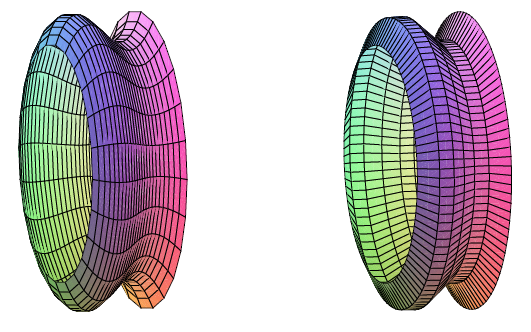
As usual, the question is: how might we approximate the surface area? For a surface obtained by rotating a curve around an axis, we can take a polygonal approximation to the curve, as in the last section, and rotate it around the same axis. This gives a surface composed of many "truncated cones;'' a truncated cone is called a frustum of a cone. Figure \(\PageIndex{1}\) illustrates this approximation.
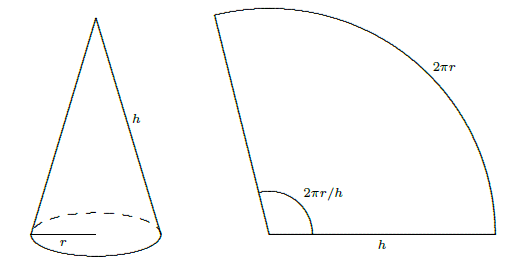
So we need to be able to compute the area of a frustum of a cone. Since the frustum can be formed by removing a small cone from the top of a larger one, we can compute the desired area if we know the surface area of a cone. Suppose a right circular cone has base radius \(r\) and slant height \(h\). If we cut the cone from the vertex to the base circle and flatten it out, we obtain a sector of a circle with radius \(h\) and arc length \(2\pi r\), as in Figure \(\PageIndex{2}\). The angle at the center, in radians, is then \(\dfrac{2\pi r}{h}\), and the area of the cone is equal to the area of the sector of the circle. Let \(A\) be the area of the sector; since the area of the entire circle is \(\pi h^2\), we have
\[\dfrac{A}{\pi h^2} =\dfrac{\frac{2\pi r}{h}}{ 2\pi} \implies A = \pi r h \nonumber \]
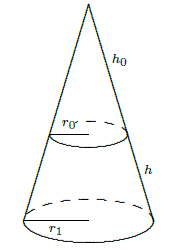
Now suppose we have a frustum of a cone with slant height \(h\) and radii \(r_0\) and \(r_1\), as in Figure \(\PageIndex{3}\). The area of the entire cone is \(\pi r_1(h_0+h)\), and the area of the small cone is \(\pi r_0 h_0\); thus, the area of the frustum is \(\pi r_1(h_0+h)-\pi r_0 h_0=\pi((r_1-r_0)h_0+r_1h)\). By similar triangles,
\[{h_0\over r_0}={h_0+h\over r_1} \implies (r_1-r_0)h_0=r_0h\nonumber \]
Substitution into the area gives
\[\pi((r_1-r_0)h_0+r_1h)=\pi(r_0h+r_1h)=\pi h(r_0+r_1)=2\pi \dfrac{r_0+r_1}{2} h = 2\pi r h \nonumber \]
The final form is particularly easy to remember, with \(r\) equal to the average of \(r_0\) and \(r_1\), as it is also the formula for the area of a cylinder. (Think of a cylinder of radius \(r\) and height \(h\) as the frustum of a cone of infinite height.)
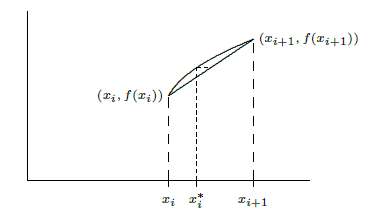
Now we are ready to approximate the area of a surface of revolution. On one subinterval, the situation is as shown in Figure \(\PageIndex{4}\). When the line joining two points on the curve is rotated around the \(x\)-axis, it forms a frustum of a cone. The area is
\[ 2\pi r h= 2\pi \dfrac{f(x_i)+f(x_{i+1}}{2} \sqrt{1+\left(f'(t_i)\right)^2}\,\Delta x \nonumber \]
Here \(\sqrt{1+\left(f'(t_i)\right)^2}\,\Delta x\) is the length of the line segment, as we found in the previous section. Assuming \(f\) is a continuous function, there must be some \(x_i^*\) in \( [x_i,x_{i+1}]\) such that \(\dfrac{f(x_i)+f(x_{i+1})}{2} = f(x_i^*)\), so the approximation for the surface area is
\[\sum_{i=0}^{n-1} 2\pi f(x_i^*)\sqrt{1+\left(f'(t_i)\right)^2}\,\Delta x \nonumber \]
This is not quite the sort of sum we have seen before, as it contains two different values in the interval \([x_i,x_{i+1}]\), namely \(x_i^*\) and \(t_i\). Nevertheless, using more advanced techniques than we have available here, it turns out that
\[\lim_{n\to\infty} \sum_{i=0}^{n-1} 2\pi f(x_i^*)\sqrt{1+\left(f'(t_i)\right)^2}\,\Delta x= \int_a^b 2\pi f(x)\sqrt{1+\left(f'(x)\right)^2}\,dx \nonumber \]
is the surface area we seek. (Roughly speaking, this is because while \(x_i^*\) and \(t_i\) are distinct values in \([x_i,x_{i+1}]\), they get closer and closer to each other as the length of the interval shrinks.)
If the curve \(y=f(x)\) for \(a\le x\le b\) is rotated around the \(x\)-axis, the surface area of the resulting object is
\[\int_a^b 2\pi f(x)\sqrt{1+\left(f'(x)\right)^2}\,dx \nonumber \]
If the curve \(y=f(x)\) for \(a\le x\le b\) is rotated around the \(y\)-axis, the surface area of the resulting object is
\[ \int_a^b 2\pi x\sqrt{1+\left(f'(x)\right)^2}\,dx \nonumber \]
Let \(f(x)\) be the straight line connecting \((0,3)\) to \((4,0)\). Find the surface area of the cone formed when \(y=f(x)\) is rotated around (a) the \(x\)-axis and (b) the \(y\)-axis
First, we find the equation of the described line by find the slope \(m=\dfrac{0-3}{4-0}=-\dfrac{3}{4}\).
Using point-slope form of a line, we can easily find that the line is therefore \(y=-\dfrac{3}{4}x+3\).
Each of these surface areas of revolutions will require us to solve an integral containing \(\sqrt{1+\left(f'(x)\right)^2}\), so we evaluate this expression for \(f(x)=-\dfrac{3}{4}x+3\):
\[ f'(x)=-\dfrac{3}{4} \implies \sqrt{1+\left(f'(x)\right)^2}=\sqrt{1+\left(-\dfrac{3}{4}\right)^2}=\sqrt{\dfrac{25}{16}}=\dfrac{5}{4} \nonumber \]
(a) The surface area when this line is rotated around the \(x\)-axis is given by:
\[\begin{align*} \text{Surface Area} &=\int_a^b 2\pi f(x)\sqrt{1+\left(f'(x)\right)^2}\,dx \\[4pt]
&= \int_0^4 2\pi \left( -\dfrac{3}{4}x+3\right) \cdot \dfrac{5}{4} \,dx \\[4pt]
&=\dfrac{5pi}{2} \int_0^4 \left( -\dfrac{3}{4}x+3\right) \,dx \\[4pt]
&= \dfrac{5\pi}{2} \left( -\dfrac{3}{8}x^2+3x\right)\bigg|_0^4 \\[4pt]
&=\dfrac{5\pi}{2}\left[ (-6+12)-(-0+0)\right] \\[4pt]
&= 15\pi \text{ units}^2 \end{align*} \]
(b) The surface area when this line is rotated around the \(y\)-axis is given by:
\[\begin{align*} \text{Surface Area} &=\int_a^b 2\pi x\sqrt{1+\left(f'(x)\right)^2}\,dx \\[4pt]
&= \int_0^4 2\pi x \cdot \dfrac{5}{4} \,dx \\[4pt]
&=\dfrac{5\pi}{2} \int_0^4 x\,dx \\[4pt]
&= \dfrac{5\pi}{4} x^2\bigg|_0^4 \\[4pt]
&= 20\pi \text{ units}^2 \end{align*} \]
Note that each of these answers can be checked using the surface area of a cone formula from above. The hypotenuse \(h\) is of length \(5\) in each case. When rotating around the \(x\)-axis, the radius \(r\) is \(3\), giving \(A=\pi r h = \pi\cdot 3 \cdot 5=15\pi \). When rotating around the \(y\)-axis, the radius \(r\) is 4, giving \(A=\pi r h = \pi \cdot 4\cdot 5=20\pi\)
Let \(f(x)=x^3+\dfrac{1}{12x}\) for \(1\le x\le 2\). Find the surface area of the object formed when \(y=f(x)\) is rotated around
(a) the \(x\)-axis
(b) the \(y\)-axis
Solution
First, we find the derivative of \(f(x)=x^3+\dfrac{1}{12x}\):
\[ f'(x)=3x^2-\dfrac{1}{12x^2} \nonumber \]
Next, we compute \(\sqrt{1+\left(f'(x)\right)^2}\):
\[ \left(f'(x)\right)^2 =\left(3x^2-\dfrac{1}{12x^2}\right)^2 =9x^4-\dfrac{1}{2}+\dfrac{1}{144x^4} \nonumber \]
We see that adding \(1\) to this keeps it a perfect square:
\[ 1+\left(f'(x)\right)^2 =9x^4+\dfrac{1}{2}+\dfrac{1}{144x^4} =\left(3x^2+\dfrac{1}{12x^2}\right)^2 \nonumber \]
Therefore, inside of each integral we will use
\[ \sqrt{1+\left(f'(x)\right)^2} =3x^2+\dfrac{1}{12x^2} \nonumber \]
(a) The surface area when this curve is rotated around the \(x\)-axis is given by:
\[\begin{align*} \text{Surface Area} &=\int_a^b 2\pi f(x)\sqrt{1+\left(f'(x)\right)^2}\,dx \\[4pt]
&=\int_1^2 2\pi \left(x^3+\dfrac{1}{12x}\right)\left(3x^2+\dfrac{1}{12x^2}\right) dx \\[4pt]
&=2\pi\int_1^2 \left(3x^5+\dfrac{x}{3}+\dfrac{1}{144x^3}\right) dx \\[4pt]
&=2\pi\left[\dfrac{x^6}{2}+\dfrac{x^2}{6}-\dfrac{1}{288x^2}\right]_1^2 \\[4pt]
&=2\pi\left[\left(32+\dfrac{2}{3}-\dfrac{1}{1152}\right)-\left(\dfrac{1}{2}+\dfrac{1}{6}-\dfrac{1}{288}\right)\right] \\[4pt]
&=2\pi\left(32+\dfrac{1}{384}\right) \\[4pt]
&=\boxed{64\pi+\dfrac{\pi}{192}\text{ units}^2} \end{align*}\]
(b) The surface area when this curve is rotated around the \(y\)-axis is given by:
\[ \begin{align*} \text{Surface Area} &=\int_a^b 2\pi x\sqrt{1+\left(f'(x)\right)^2}\,dx \\[4pt]
&=\int_1^2 2\pi x\left(3x^2+\dfrac{1}{12x^2}\right) dx \\[4pt]
&=2\pi\int_1^2 \left(3x^3+\dfrac{1}{12x}\right) dx \\[4pt]
&=2\pi\left[\dfrac{3x^4}{4}+\dfrac{1}{12}\ln (x)\right]_1^2 \\[4pt]
&=2\pi\left[\left(12+\dfrac{1}{12}\ln 2\right)-\left(\dfrac{3}{4}+0\right)\right] \\[4pt]
&=2\pi\left(\dfrac{45}{4}+\dfrac{1}{12}\ln (2)\right) \\[4pt]
&=\boxed{\dfrac{45\pi}{2}+\dfrac{\pi}{6}\ln (2)\text{ units}^2} \end{align*} \]
Find the surface area of the object formed when \(y=\dfrac{1}{8}x^2-\ln(x)\) for \(1\le x\le 4\) is rotated around the \(y\)-axis
- Answer
-
\(\dfrac{33\pi}{2}\)
Not all revolutions are done around an axis. Just like for volumes, if we wish to rotate a curve around a vertical or horizontal line, we can add or subtract the difference in our radius term.
If the curve \(y=f(x)\) for \(a\le x\le b\) is rotated around the line \(y=k\), the surface area of the resulting object is
\[\int_a^b 2\pi \left|f(x)-k\right| \sqrt{1+\left(f'(x)\right)^2}\,dx \nonumber \]
If the curve \(y=f(x)\) for \(a\le x\le b\) is rotated around the line \(x=k\), the surface area of the resulting object is
\[ \int_a^b 2\pi |x-k|\sqrt{1+\left(f'(x)\right)^2}\,dx \nonumber \]
Find the surface area of the object formed when the curve \(y=\sqrt{1-x^2}\) for \(0\le x\le 1\) is rotated around the line \(x=1\)
Solution
Let \(y = f(x) = \sqrt{1 - x^2}\) has \( f'(x) = \dfrac{-x}{\sqrt{1 - x^2}}\), so we see:
\[ \sqrt{1 + \left(f'(x)\right)^2} = \sqrt{1 + \frac{x^2}{1 - x^2}} = \sqrt{ \dfrac{1}{1 - x^2}}=\dfrac{1}{\sqrt{1-x^2}} \nonumber \]
The radius when rotating around \(x = 1\) is \(|x - 1|\). Since \(0 \le x \le 1\), we have \(x - 1 \le 0\), so \(|x - 1| = 1 - x\).
The surface area of revolution around \(x=1\) is given by
\[ \begin{align*} \text{Surface Area} & = \int_a^b 2\pi |x-1| \, \sqrt{1 + \left(f'(x)\right)^2} \, dx \\[4pt]
& = \int_0^1 2\pi\cdot (1-x)\cdot \dfrac{1}{\sqrt{1-x^2}}\,dx \\[4pt]
&= \lim_{t\to 1^-} 2\pi \int_0^t \dfrac{1-x}{\sqrt{1-x^2}}\,dx \\[4pt]
&= \lim_{t\to 1^-} 2\pi \int_0^t \left(\dfrac{1}{\sqrt{1-x^2}} - \dfrac{x}{\sqrt{1-x^2}}\right)\,dx \\[4pt]
&= \lim_{t\to 1^-} 2\pi \left( \sin^{-1}(x)+\sqrt{1-x^2} \right)\bigg|_0^t \\[4pt]
&= \lim_{t\to 1^-} 2\pi \left[ \left( \sin^{-1}(t)+\sqrt{1-t^2} \right)-\left( 0+\sqrt{1}\right)\right] \\[4pt]
&= 2\pi \left[ \dfrac{\pi}{2}-1\right] \\[4pt]
&= \boxed{\pi^2 - 2\pi \text{ units}^2} \end{align*} \]
Find the surface area of the object formed when the curve \(y=\dfrac{1}{18}x^3+4\) for \(0\le x\le 2\sqrt{2}\) is rotated around the line \(y=4\)
Solution
Let \(f(x)=\dfrac{1}{18}x^3+k\) so that \(f'(x)=\dfrac{1}{6}x^2\).
Then
\[ 1+\left(f'(x)\right)^2 = 1+\left(\dfrac{x^2}{6}\right)^2 = 1+\frac{x^4}{36} \nonumber \]
Notice that since \(x\ge 0\) we have \(f(x)\ge 4\) so \(\left|f(x)-4\right|=f(x)-4=\dfrac{1}{18}x^3\).
The surface area when the curve is rotated around \(y=4\) is given by
\[ \text{Surface Area} = \int_a^b 2\pi\left| f(x)-4\right| \sqrt{1+\left(f'(x)\right)^2}\,dx =\int_0^{2\sqrt{2}} 2\pi\cdot \dfrac{1}{18}x^3 \sqrt{1+\dfrac{x^4}{36}}\,dx \nonumber \]
This integral can be solved via substitution, using \(u=1+\dfrac{x^4}{36}\):
\[ \int_0^{2\sqrt{2}} 2\pi\cdot \dfrac{1}{18}x^3 \sqrt{1+\dfrac{x^4}{36}}\,dx =\pi \int_1^{\frac{25}{9}} \sqrt{u}\,du = \dfrac{2\pi}{3}u^{\frac{3}{2}}\bigg|_1^{\frac{25}{9}}=\dfrac{2\pi}{3}\left(\left(\frac{25}{9}\right)^{\frac{3}{2}}-1\right)=\boxed{\dfrac{196\pi}{81}\text{ units}^2} \nonumber \]
Find the surface area of the object formed when the curve \(y=\dfrac{1}{2}e^x+\dfrac{1}{2}e^{-x}\) for \(0\le x\le \ln(2) \) is rotated around the line \(y=-1\)
- Answer
-
\( \dfrac{15\pi}{8}+2\pi\ln(2)\)
Key Equations
- Surface Area of Revolution for \(y=f(x)\) around \(x\)-axis
\(\displaystyle A=∫^b_a 2\pi f(x)\sqrt{1+\left(f'(x)\right)^2}\,dx\)
- Surface Area of Revolution for \(y=f(x)\) around \(y\)-axis
\(\displaystyle A=∫^b_a 2\pi x\sqrt{1+\left(f'(x)\right)^2}\,dx\)