

1.1: Practice Set
- Page ID
- 192848

\( \newcommand{\vecs}[1]{\overset { \scriptstyle \rightharpoonup} {\mathbf{#1}} } \)
\( \newcommand{\vecd}[1]{\overset{-\!-\!\rightharpoonup}{\vphantom{a}\smash {#1}}} \)
\( \newcommand{\dsum}{\displaystyle\sum\limits} \)
\( \newcommand{\dint}{\displaystyle\int\limits} \)
\( \newcommand{\dlim}{\displaystyle\lim\limits} \)
\( \newcommand{\id}{\mathrm{id}}\) \( \newcommand{\Span}{\mathrm{span}}\)
( \newcommand{\kernel}{\mathrm{null}\,}\) \( \newcommand{\range}{\mathrm{range}\,}\)
\( \newcommand{\RealPart}{\mathrm{Re}}\) \( \newcommand{\ImaginaryPart}{\mathrm{Im}}\)
\( \newcommand{\Argument}{\mathrm{Arg}}\) \( \newcommand{\norm}[1]{\| #1 \|}\)
\( \newcommand{\inner}[2]{\langle #1, #2 \rangle}\)
\( \newcommand{\Span}{\mathrm{span}}\)
\( \newcommand{\id}{\mathrm{id}}\)
\( \newcommand{\Span}{\mathrm{span}}\)
\( \newcommand{\kernel}{\mathrm{null}\,}\)
\( \newcommand{\range}{\mathrm{range}\,}\)
\( \newcommand{\RealPart}{\mathrm{Re}}\)
\( \newcommand{\ImaginaryPart}{\mathrm{Im}}\)
\( \newcommand{\Argument}{\mathrm{Arg}}\)
\( \newcommand{\norm}[1]{\| #1 \|}\)
\( \newcommand{\inner}[2]{\langle #1, #2 \rangle}\)
\( \newcommand{\Span}{\mathrm{span}}\) \( \newcommand{\AA}{\unicode[.8,0]{x212B}}\)
\( \newcommand{\vectorA}[1]{\vec{#1}} % arrow\)
\( \newcommand{\vectorAt}[1]{\vec{\text{#1}}} % arrow\)
\( \newcommand{\vectorB}[1]{\overset { \scriptstyle \rightharpoonup} {\mathbf{#1}} } \)
\( \newcommand{\vectorC}[1]{\textbf{#1}} \)
\( \newcommand{\vectorD}[1]{\overrightarrow{#1}} \)
\( \newcommand{\vectorDt}[1]{\overrightarrow{\text{#1}}} \)
\( \newcommand{\vectE}[1]{\overset{-\!-\!\rightharpoonup}{\vphantom{a}\smash{\mathbf {#1}}}} \)
\( \newcommand{\vecs}[1]{\overset { \scriptstyle \rightharpoonup} {\mathbf{#1}} } \)
\(\newcommand{\longvect}{\overrightarrow}\)
\( \newcommand{\vecd}[1]{\overset{-\!-\!\rightharpoonup}{\vphantom{a}\smash {#1}}} \)
\(\newcommand{\avec}{\mathbf a}\) \(\newcommand{\bvec}{\mathbf b}\) \(\newcommand{\cvec}{\mathbf c}\) \(\newcommand{\dvec}{\mathbf d}\) \(\newcommand{\dtil}{\widetilde{\mathbf d}}\) \(\newcommand{\evec}{\mathbf e}\) \(\newcommand{\fvec}{\mathbf f}\) \(\newcommand{\nvec}{\mathbf n}\) \(\newcommand{\pvec}{\mathbf p}\) \(\newcommand{\qvec}{\mathbf q}\) \(\newcommand{\svec}{\mathbf s}\) \(\newcommand{\tvec}{\mathbf t}\) \(\newcommand{\uvec}{\mathbf u}\) \(\newcommand{\vvec}{\mathbf v}\) \(\newcommand{\wvec}{\mathbf w}\) \(\newcommand{\xvec}{\mathbf x}\) \(\newcommand{\yvec}{\mathbf y}\) \(\newcommand{\zvec}{\mathbf z}\) \(\newcommand{\rvec}{\mathbf r}\) \(\newcommand{\mvec}{\mathbf m}\) \(\newcommand{\zerovec}{\mathbf 0}\) \(\newcommand{\onevec}{\mathbf 1}\) \(\newcommand{\real}{\mathbb R}\) \(\newcommand{\twovec}[2]{\left[\begin{array}{r}#1 \\ #2 \end{array}\right]}\) \(\newcommand{\ctwovec}[2]{\left[\begin{array}{c}#1 \\ #2 \end{array}\right]}\) \(\newcommand{\threevec}[3]{\left[\begin{array}{r}#1 \\ #2 \\ #3 \end{array}\right]}\) \(\newcommand{\cthreevec}[3]{\left[\begin{array}{c}#1 \\ #2 \\ #3 \end{array}\right]}\) \(\newcommand{\fourvec}[4]{\left[\begin{array}{r}#1 \\ #2 \\ #3 \\ #4 \end{array}\right]}\) \(\newcommand{\cfourvec}[4]{\left[\begin{array}{c}#1 \\ #2 \\ #3 \\ #4 \end{array}\right]}\) \(\newcommand{\fivevec}[5]{\left[\begin{array}{r}#1 \\ #2 \\ #3 \\ #4 \\ #5 \\ \end{array}\right]}\) \(\newcommand{\cfivevec}[5]{\left[\begin{array}{c}#1 \\ #2 \\ #3 \\ #4 \\ #5 \\ \end{array}\right]}\) \(\newcommand{\mattwo}[4]{\left[\begin{array}{rr}#1 \amp #2 \\ #3 \amp #4 \\ \end{array}\right]}\) \(\newcommand{\laspan}[1]{\text{Span}\{#1\}}\) \(\newcommand{\bcal}{\cal B}\) \(\newcommand{\ccal}{\cal C}\) \(\newcommand{\scal}{\cal S}\) \(\newcommand{\wcal}{\cal W}\) \(\newcommand{\ecal}{\cal E}\) \(\newcommand{\coords}[2]{\left\{#1\right\}_{#2}}\) \(\newcommand{\gray}[1]{\color{gray}{#1}}\) \(\newcommand{\lgray}[1]{\color{lightgray}{#1}}\) \(\newcommand{\rank}{\operatorname{rank}}\) \(\newcommand{\row}{\text{Row}}\) \(\newcommand{\col}{\text{Col}}\) \(\renewcommand{\row}{\text{Row}}\) \(\newcommand{\nul}{\text{Nul}}\) \(\newcommand{\var}{\text{Var}}\) \(\newcommand{\corr}{\text{corr}}\) \(\newcommand{\len}[1]{\left|#1\right|}\) \(\newcommand{\bbar}{\overline{\bvec}}\) \(\newcommand{\bhat}{\widehat{\bvec}}\) \(\newcommand{\bperp}{\bvec^\perp}\) \(\newcommand{\xhat}{\widehat{\xvec}}\) \(\newcommand{\vhat}{\widehat{\vvec}}\) \(\newcommand{\uhat}{\widehat{\uvec}}\) \(\newcommand{\what}{\widehat{\wvec}}\) \(\newcommand{\Sighat}{\widehat{\Sigma}}\) \(\newcommand{\lt}{<}\) \(\newcommand{\gt}{>}\) \(\newcommand{\amp}{&}\) \(\definecolor{fillinmathshade}{gray}{0.9}\)Plot the following points in \(\mathbb{R}^3\):
(a) \((1,1,2)\)
(b) \((-1,0,1)\)
(c) \((0,-2,0)\)
(d) \((3,0,2)\)
- Answer
-

Find the distance between each of the following pairs of points:
(a) \((2,5)\) and \((-4,-3)\)
(b) \((1,2,4)\) and \((2,4,-1)\)
(c) \((-1,-1,2)\) and \((1,3,-2)\)
- Answer
-
(a) \(\text{dist}=\sqrt{(2-(-4))^2+(5-(-3))^2}=\sqrt{36+64}=\sqrt{100}=10\)
(b) \(\text{dist}=\sqrt{(1-2)^2+(2-4)^2+(4-(-1))^2}=\sqrt{1+4+25}=\sqrt{30}\)
(c) \(\text{dist}=\sqrt{(-1-1)^2+(-1-3)^2+(2-(-2))^2}=\sqrt{4+16+16}=\sqrt{36}=6\)
Find the distance from the origin to the point:
(a) \(\left( \dfrac{10}{13}, \dfrac{24}{13}\right)\)
(b) \((4\cos(2),4\sin(2))\)
(c) \(\left(100,-100,50\right)\)
(d) \(\left(3\cos\left(\dfrac{\pi}{5}\right)\sin\left(\dfrac{\pi}{7}\right),3\cos\left(\dfrac{\pi}{5}\right)\cos\left(\dfrac{\pi}{7}\right), 3\sin\left(\dfrac{\pi}{5}\right)\right)\)
- Answer
-
(a) \(\text{dist}=\sqrt{\left(\dfrac{10}{13}-0\right)^2+\left(\dfrac{24}{13}-0\right)^2}=\sqrt{\dfrac{100}{169}+\dfrac{576}{169}}=\sqrt{\dfrac{676}{169}}=\sqrt{4}=2\)
(b) \(\text{dist}=\sqrt{(4\cos(2)-0)^2+(4\sin(2)-0)^2}=\sqrt{16\cos^2(2)+16\sin^2(2)}=\sqrt{16}=4\)
(c) \(\text{dist}=\sqrt{(100-0)^2+(-100-0)^2+(50-0)^2}=\sqrt{10000+10000+2500}=\sqrt{22500}=150\)
\(\begin{align} \text{(d) dist}&=\sqrt{\left(3\cos\left(\dfrac{\pi}{5}\right)\sin\left(\dfrac{\pi}{7}\right)-0\right)^2+\left(3\cos\left(\dfrac{\pi}{5}\right)\cos\left(\dfrac{\pi}{7}\right)-0\right)^2+\left(3\sin\left(\dfrac{\pi}{5}\right)-0\right)^2} \nonumber \\ & =\sqrt{9\cos^2\left(\dfrac{\pi}{5}\right)\sin^2\left(\dfrac{\pi}{7}\right)+9\cos^2\left(\dfrac{\pi}{5}\right)\cos^2\left(\dfrac{\pi}{7}\right)+9\sin^2\left(\dfrac{\pi}{5}\right)} \nonumber \\ & =\sqrt{9\cos^2\left(\dfrac{\pi}{5}\right)\left[\sin^2\left(\dfrac{\pi}{7}\right)+\cos^2\left(\dfrac{\pi}{7}\right)\right]+9\sin^2\left(\dfrac{\pi}{5}\right)} \nonumber \\ & =\sqrt{9\cos^2\left(\dfrac{\pi}{5}\right)+9\sin^2\left(\dfrac{\pi}{5}\right)} \nonumber \\ & =\sqrt{9}=3 \nonumber \end{align} \)
What is the equation of the collection of points in \(\mathbb{R}^2\) which:
(a) are all exactly 10 units away from the point \((4,-3)\)
(b) are equidistant from the points \((2,1)\) and \((-4,-3)\)
(c) have the sum of the distance to \((-1,-1)\) and distance to \((1,1)\) total to \(4\)
- Answer
-
(a) \(d(x,y)=\sqrt{ (x-4)^2+(y-(-3))^2}=\sqrt{x^2-8x+y^2+6y+25}\)
Setting \(d=10\) gives the equation \[ \sqrt{x^2-8x+y^2+6y+25}=10 \nonumber \]
If we square both sides, this looks like \[x^2-8x+y^2+6y+25=100\nonumber \]
This simplifies to our final answer \(x^2-8x+y^2+6y=75\)
(This is more recognizable as a circle if we do not multiply out the perfect squares initially: \((x-4)^2+(y+3)^2=100\) )
(b) \(d_1(x,y)=\sqrt{(x-2)^2+(y-1)^2}=\sqrt{x^2-4x+y^2-2y+5}\) and \(d_2(x,y)=\sqrt{(x-(-4))^2+(y-(-3))^2}=\sqrt{x^2+8x+y^2+6y+25}\)
Setting these equal gives the equation \[ \sqrt{x^2-4x+y^2-2y+5}=\sqrt{x^2+8x+y^2+6y+25} \nonumber \]
If we square both sides, this becomes \[ x^2-4x+y^2-2y+5=x^2+8x+y^2+6y+25\nonumber \]
This simplifies to our final answer \(3x+2y=-5\), which is a line.
(c) \(d_1(x,y)=\sqrt{(x-(-1))^2+(y-(-1))^2}=\sqrt{x^2+2x+y^2+2y+2}\) and \(d_2(x,y)=\sqrt{(x-1)^2+(y-1)^2}=\sqrt{x^2-2x+y^2-2y+2}\)
Setting \(d_1+d_2=4\) this becomes: \[ \sqrt{x^2+2x+y^2+2y+2}+\sqrt{x^2-2x+y^2-2y+2}=4 \nonumber \]
Squaring both sides gives: \[ (x^2+2x+y^2+2y+2)+2\sqrt{(x^2+2x+y^2+2y+2)(x^2-2x+y^2-2y+2)}+(x^2-2x+y^2-2y+2)=16\nonumber \]
\[ 2\sqrt{ (x^2+y^2+2-(2x+2y))(x^2+y^2+2+(2x+2y))}=12-2x^2-2y^2\nonumber \]
Squaring both sides again: \[4\left( (x^2+y^2+2)^2-(2x+2y)^2\right)=(12-2x^2-2y^2)^2\nonumber \]
\[4x^4+8x^2y^2-32xy+4y^4+16=4x^4+8x^2y^2-48x^2+4y^4-48y^2+144\nonumber \]
\[48x^2+48y^2-32xy=128\nonumber \]
This simplifies to \(3x^2-2xy+3y^2=8\), which is a tilted ellipse (pictured below)

Let \(A=(-c,0)\) and \(B=(c,0)\) be fixed points for some \(c>0\). If \(d_A(x,y)\) and \(d_B(x,y)\) are the distance between \((x,y)\) and \(A\) and \(B\) respectively, find the equation for \((x,y)\) such that \(d_A-d_B=2D\) when:
(a) \(D=c\)
(b) \(0<D<c\)
- Answer
-
\(d_A(x,y)=\sqrt{(x-(-c))^2+(y-0)^2}=\sqrt{x^2+2cx+c^2+y^2}\) and \(d_B(x,y)=\sqrt{(x-c)^2+(y-0)^2}=\sqrt{x^2-2cx+c^2+y^2}\)
Setting \(|d_A-d_B|=2D\) is the same as saying \( (d_A-d_B)^2=4D^2\) which gives
\[ \left( \sqrt{x^2+2cx+c^2+y^2}- \sqrt{x^2-2cx+c^2+y^2}\right)^2=4D^2\nonumber\]
\[ (x^2+2cx+c^2+y^2) - 2\sqrt{(x^2+2cx+c^2+y^2)(x^2-2cx+c^2+y^2)}+(x^2-2cx+c^2+y^2)=4D^2\nonumber\]
\[ 2x^2+2c^2+2y^2 -4D^2= 2\sqrt{(x^2+2cx+c^2+y^2)(x^2-2cx+c^2+y^2)}\nonumber\]
Squaring both sides again gives:
\[ (2x^2+2c^2+2y^2 -4D^2)^2= 4\left((x^2+c^2+y^2)+2cx\right)\left((x^2+c^2+y^2)-2cx\right)\nonumber\]
\[ 4(x^2+c^2+y^2)^2 -16D^2(x^2+c^2+y^2)+16D^4= 4\left((x^2+c^2+y^2)^2-4c^2x^2\right)\nonumber\]
\[ -16D^2(x^2+c^2+y^2)+16D^4= -16c^2x^2\nonumber\]
\[ (16D^2-16c^2)x^2+16D^2y^2=16D^4-16D^2c^2\nonumber\]
(a) When \(D=c\) the coefficient of \(x^2\) and the right-hand side are zero so we get:
\(16c^2y^2=0\), which simplifies to the line \(y=0\).
(b) When \(0<D<c\) the right side is non-zero so we divide by it to get:
\[ \dfrac{(D^2-c^2)x^2}{D^2(D^2-c^2)}+\dfrac{D^2y^2}{D^2(D^2-c^2)}=1 \nonumber\]
Reducing gives our final answer: \( \dfrac{x^2}{D^2}-\dfrac{y^2}{c^2-D^2}=1\) which is a hyperbola.
What is the equation of the collection of points in \(\mathbb{R}^3\) which:
(a) are all exactly 6 units away from the point \((1,2,-3)\)
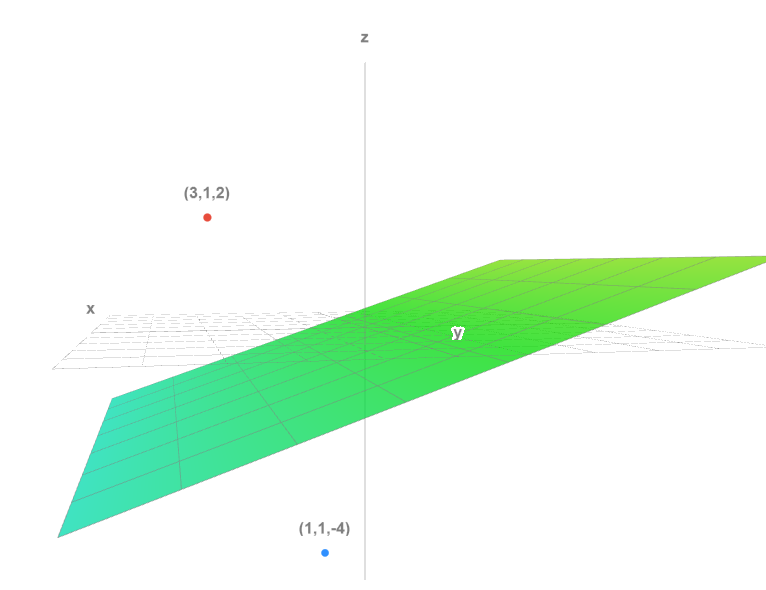
(b) are equidistant from the points \((1,1,-4)\) and \((3,1,2)\)
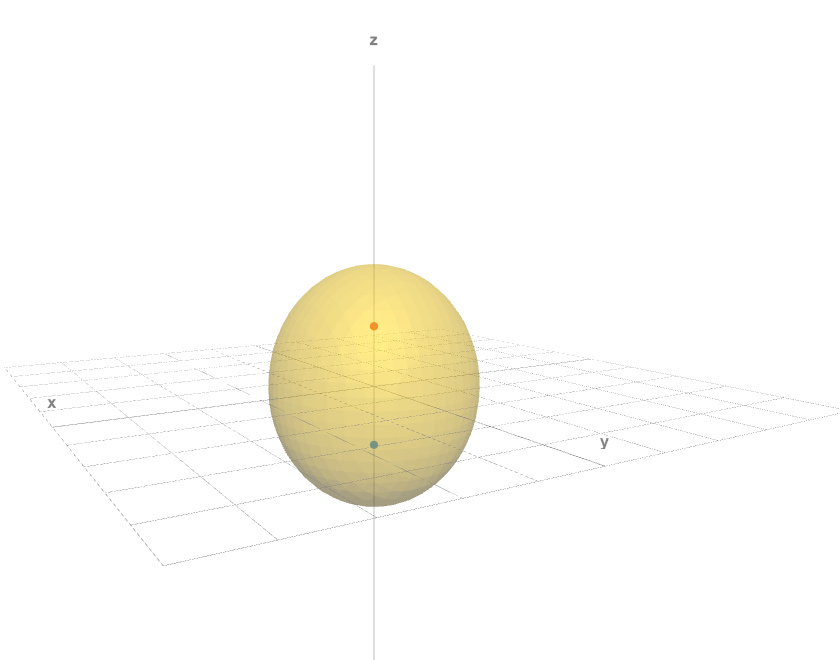
(c) have the sum of the distance to \((0,0,-1)\) and distance to \((0,0,1)\) total to \(4\)
- Answer
-
(a) \(d(x,y,z)=\sqrt{(x-1)^2+(y-2)^2+(z+3)^2}\)
Setting this equal to \(6\) and squaring both sides we immediately get \((x-1)^2+(y-2)^2+(z+3)^2=36\) which is a sphere.
(b) \(d_1(x,y,z)=\sqrt{(x-1)^2+(y-1)^2+(z-(-4))^2}=\sqrt{x^2-2x+y^2-2y+z^2+8z+18}\)
\(d_2(x,y,z)=\sqrt{(x-3)^2+(y-1)^2+(z-2)^2}=\sqrt{x^2-6x+y^2-2y+z^2-4z+14}\)
Setting these equal and squaring both sides we get:
\[ \left( \sqrt{x^2-2x+y^2-2y+z^2+8z+18}\right)^2=\left( \sqrt{x^2-6x+y^2-2y+z^2-4z+14}\right)^2 \nonumber \]
\[ x^2-2x+y^2-2y+z^2+8z+18=x^2-6x+y^2-2y+z^2-4z+14 \nonumber \]
\[4x +12z= -4 \nonumber \]
This simplifies down to \(x+3z=-1\), which is a plane (we will discuss these soon, but for now a picture is provided below)
(c) \(d_1(x,y,z)=\sqrt{(x-0)^2+(y-0)^2+(z-(-1))^2}=\sqrt{x^2+y^2+z^2+2z+1}\)
\(d_2(x,y,z)=\sqrt{(x-0)^2+(y-0)^2+(z-1)^2}=\sqrt{x^2+y^2+z^2-2z+1}\)
Setting \(d_1+d_2=4\) gives:
\[ \sqrt{x^2+y^2+z^2+2z+1}+\sqrt{x^2+y^2+z^2-2z+1}=4\nonumber \]
Square both sides:
\[ \left(\sqrt{x^2+y^2+z^2+2z+1}+\sqrt{x^2+y^2+z^2-2z+1}\right)^2=4^2\nonumber \]
\[ (x^2+y^2+z^2+2z+1)+2\sqrt{(x^2+y^2+z^2+2z+1)(x^2+y^2+z^2-2z+1)}+(x^2+y^2+z^2-2z+1)=16\nonumber \]
\[ 2\sqrt{(x^2+y^2+z^2+1+2z)(x^2+y^2+z^2+1-2z)}=16-2(x^2+y^2+z^2+1) \nonumber \]
\[ \sqrt{(x^2+y^2+z^2+1+2z)(x^2+y^2+z^2+1-2z)}=8-(x^2+y^2+z^2+1) \nonumber \]
Square both sides again:
\[ \left( \sqrt{(x^2+y^2+z^2+1+2z)(x^2+y^2+z^2+1-2z)}\right)^2=\left(8-(x^2+y^2+z^2+1)\right)^2 \nonumber \]
\[ (x^2+y^2+z^2+1)^2-(2z)^2=64-16(x^2+y^2+z^2+1)+(x^2+y^2+z^2+1)^2 \nonumber \]
\[ -4z^2=64-16(x^2+y^2+z^2+1) \nonumber \]
\[ 16x^2+16y^2+12z^2=48 \nonumber \]
Dividing everything by \(48\) makes this into its final form: \( \dfrac{x^2}{3}+\dfrac{y^2}{3}+\dfrac{z^2}{4}=1 \)
This shape is known as an ellipsoid, which we will also discuss soon and is pictured below.
Consider the vectors \(\vecs{v}=\langle 2 , -2 \rangle\) and \(\vecs{w}=\langle 1 , 3 \rangle \)
(a) Sketch \(\vecs{v}\)
(b) Sketch \(\vecs{w}\)
(c) Sketch \(\vecs{v}+\vecs{w}\)
(d) Sketch \(\vecs{v}-\vecs{w}\)
(e) Sketch \(\dfrac{1}{2}\vecs{v}\)
(f) Find \(\|\vecs{v}\|\)
(g) Find \(\|\vecs{w}\|\)
(h) Find a unit vector in the direction of \(\vecs{w}\)
- Answer
-
(a-e)
(f) \(\|\vecs{v}\|=\sqrt{2^2+(-2)^2}=\sqrt{8}=2\sqrt{2}\)
(g) \(\|\vecs{w}\|=\sqrt{1^2+3^2}=\sqrt{10}\)
(h) \(\dfrac{1}{\|\vecs{w}\|}\vecs{w}=\dfrac{1}{\sqrt{10}}\langle 1,3\rangle=\left\langle \dfrac{1}{\sqrt{10}},\dfrac{3}{\sqrt{10}}\right\rangle\)
Consider the vectors \(\vecs{a}=\langle 1, 2,0 \rangle \) and \(\vecs{b}=\langle 2 , 2 , 1 \rangle\)
(a) Sketch \(\vecs{a}\)
(b) Sketch \(\vecs{b}\)
(c) Sketch \(\vecs{a}+\vecs{b}\)
(d) Sketch \(2\vecs{a}-\vecs{b}\)
(e) Find \(\|\vecs{a}\|\)
(f) Find \(\|3\vecs{a}+4\vecs{b}\|\)
(g) Find a unit vector in the direction of \(\vecs{b}\)
- Answer
-
(a-d)
(e) \(\|\vecs{a}\|=\sqrt{1^2+2^2+0^2}=\sqrt{5}\)
(f) \(3\vecs{a}+4\vecs{b}=3\langle 1,2,0\rangle +4\langle 2,2,1\rangle = \langle 11,14,4\rangle\ \longrightarrow \|3\vecs{a}+4\vecs{b}\|=\|\langle 11,14,4\rangle \|=\sqrt{11^2+14^2+4^2}=\sqrt{333}=3\sqrt{37}\)
(g) \(\|\vecs{b}\|=\sqrt{2^2+2^2+1^2}=\sqrt{9}=3\) so \(\dfrac{1}{\|\vecs{b}\|}\vecs{b}=\dfrac{1}{3}\langle 2,2,1\rangle=\left\langle \dfrac{2}{3},\dfrac{2}{3},\dfrac{1}{3}\right\rangle\)
Consider the vectors \(\vecs{r}=\langle 1 , 1 , 1 \rangle, \vecs{s}=\langle 1 , -2 ,-1 \rangle\) and \(\vecs{t}=\langle 0 , 1 , 2 \rangle\):
(a) Evaluate \(10\vecs{r}\)
(b) Evaluate \(-\vecs{s}\)
(c) Evaluate \(3\vecs{r}-2\vecs{t}\)
(d) Evaluate \(2\vecs{r}+\vecs{s}+3\vecs{t}\)
(e) Evaluate \(\|\vecs{r}-\vecs{s}\|+\|\vecs{r}+\vecs{t}\|\)
(f) For what \(\alpha\) does \(\alpha \vecs{r}+3\vecs{s}+2\vecs{t}=\langle 7 , 0, 5 \rangle \)
(g) For what \(\beta\) does \(\beta \vecs{r}-\vecs{s}+4\vecs{t}=\langle 0 , 7 , 9 \rangle \)
(h) For what \(\gamma\) does \(\|\vecs{r}+\gamma\vecs{s}\|=3\)
- Answer
-
(a) \(10\vecs{r}=10\langle 1,1,1\rangle=\langle 10,10,10\rangle\)
(b) \(-\vecs{s}=-\langle 1,-2,-1\rangle=\langle -1,2,1\rangle\)
(c) \(3\vecs{r}-2\vecs{t}=3\langle 1,1,1\rangle-2\langle 0,1,2\rangle = \langle 3,1,-1\rangle\)
(d) \(2\vecs{r}+\vecs{s}+3\vecs{t}=2\langle 1,1,1\rangle + \langle 1,-2,-1\rangle +3\langle 0,1,2\rangle = \langle 3,3,7\rangle\)
(e) \(\vecs{r}-\vecs{s}=\langle 1,1,1\rangle -\langle 1,-2,-1\rangle = \langle 0,3,2\rangle \longrightarrow \|\vecs{r}-\vecs{s}\|=\|\langle 0,3,2\rangle\|=\sqrt{0^2+3^2+2^2}=\sqrt{13}\)
\(\vecs{r}+\vecs{t}=\langle 1,1,1\rangle+ \langle 0,1,2\rangle =\langle 1,2,3\rangle \longrightarrow \|\vecs{r}+\vecs{t}\|=\|\langle 1,2,3\rangle \|=\sqrt{1^2+2^2+3^2}=\sqrt{14}\)
Therefore \(\|\vecs{r}-\vecs{s}\|+\|\vecs{r}+\vecs{t}\|=\sqrt{13}+\sqrt{14}\)
(f) \(\alpha \vecs{r}+3\vecs{s}+2\vecs{t}=\alpha \langle 1,1,1\rangle+3\langle 1,-2,-1\rangle+2\langle 0,1,2\rangle=\langle \alpha+3,\alpha-4,\alpha+1\rangle\)
\(\langle \alpha+3,\alpha-4,\alpha+1\rangle=\langle 7 , 0, 5 \rangle \implies \left\{ \begin{array} {l} \alpha+3=7 \\ \alpha -4=0 \\ \alpha+1=5 \end{array} \right. \implies \alpha =4 \)
(g) \(\beta \vecs{r}-\vecs{s}+4\vecs{t}=\beta \langle 1,1,1\rangle-\langle 1,-2,-1\rangle+4\langle 0,1,2\rangle =\langle \beta-1, \beta+6,\beta +9\rangle\)
\(\langle \beta-1, \beta+6,\beta +9\rangle=\langle 0 , 7 , 9 \rangle \implies \left\{ \begin{array} {l} \beta-1=0 \\ \beta+6=7 \\ \beta+9=9 \end{array} \right. \) which cannot be satisfied by any \(\beta\)
(h) \(\vecs{r}+\gamma\vecs{s}= \langle 1,1,1\rangle +\gamma \langle 1,-2,-1\rangle = \langle \gamma+1, -2\gamma+1,-\gamma+1\rangle \)
\(\|\vecs{r}+\gamma\vecs{s}\|=\|\langle \gamma+1, -2\gamma+1,-\gamma+1\rangle\|=\sqrt{(\gamma+1)^2+(-2\gamma+1)^2+(-\gamma+1)^2}=\sqrt{ 6\gamma^2-4\gamma+3}\)
Setting this equal to three, we square both sides to get: \(6\gamma^2-4\gamma+3=9\longrightarrow 6\gamma^2-4\gamma-6=0\)
The quadratic formula gives us the solutions \(\gamma=\dfrac{1\pm\sqrt{10}}{3}\)
Prove the following Properties of Vector Operations for vectors in \(\mathbb{R}^2\):
(a) Associative property: \(\vecs{u}+(\vecs{v}+\vecs{w})=(\vecs{u}+\vecs{v})+\vecs{w}\)
(b) Additive Identity property: \(\vecs{u}+\vecs{0}=\vecs{u}\)
(c) Additive Inverse property: \(\vecs{u}+(-\vecs{u})=\vecs{0}\)
(d) Associativity of Scalar Multiplication: \((rs)\vecs{u}=r(s\vecs{u})\)
(e) Distributive Property: \((a+b)\vecs{u}=a\vecs{u}+b\vecs{u}\)
(f) Identity Property: \(1\vecs{u}=\vecs{u}\)
(g) Zero Property: \(0\vecs{u}=\vecs{0}\)
- Answer
-
(a) \[ \begin{align*} \vecs{u}+(\vecs{v}+\vecs{w})&= \langle u_1,u_2\rangle +\left( \langle v_1,v_2\rangle+\langle w_1,w_2\rangle\right) \\&=\langle u_1,u_2\rangle+\langle v_1+w_1,v_2+w_2\rangle \\ &= \langle u_1+(v_1+w_1),u_2+(v_2+w_2)\rangle \\ &=\langle (u_1+v_1)+w_1,(u_2+v_2)+w_2\rangle \\ &= \langle u_1+v_1,u_2+v_2\rangle + \langle w_1,w_2\rangle \\ &=\left(\langle u_1,u_2\rangle+\langle v_1,v_2\rangle\right)+\langle w_1,w_2\rangle \\ &= (\vecs{u}+\vecs{v})+\vecs{w} \end{align*} \]
(b) \[\begin{align*}\vecs{u}+\vecs{0} &= \langle u_1,u_2\rangle + \langle 0,0\rangle \\&=\langle u_1+0,u_2+0\rangle \\&=\langle u_1,u_2\rangle \\&=\vecs{u} \end{align*} \]
(c) \[\begin{align*}\vecs{u}+(-\vecs{u})&=\langle u_1,u_2\rangle +\langle -u_1,-u_2\rangle \\&=\langle u_1+(-u_1),u_2+(-u_2)\rangle \\&=\langle 0,0\rangle \\&=\vecs{0}\end{align*} \]
(d) \[\begin{align*}(rs)\vecs{u}&=(rs)\langle u_1,u_2\rangle \\&=\langle (rs)u_1,(rs)u_2\rangle \\&= \langle r(su_1),r(su_2)\rangle \\&=r\langle su_1,su_2\rangle \\&= r\left( s\langle u_1,u_2\rangle\right) \\&=r(s\vecs{u})\end{align*} \]
(e) \[\begin{align*} (a+b)\vecs{u}&=(a+b)\langle u_1,u_2\rangle \\&= \langle (a+b)u_1, (a+b)u_2\rangle \\&=\langle au_1+bu_1,au_2+bu_2\rangle \\&= \langle au_1,au_2\rangle+\langle bu_1,bu_2\rangle \\&= a\langle u_1,u_2\rangle +b \langle u_1,u_2\rangle \\&= a\vecs{u}+b\vecs{u}\end{align*} \]
(f) \[\begin{align*} 1\vecs{u} &=1 \langle u_1,u_2\rangle \\&=\langle 1u_1 ,1u_2 \rangle \\&=\langle u_1,u_2\rangle \\&=\vecs{u} \end{align*} \]
(g) \[\begin{align*} 0\vecs{u} &=0 \langle u_1,u_2\rangle \\&=\langle 0u_1 ,0u_2 \rangle \\&=\langle 0,0\rangle \\&=\vecs{0} \end{align*} \]