

1.5: Cylindrical and Spherical Coordinates
- Page ID
- 191871

\( \newcommand{\vecs}[1]{\overset { \scriptstyle \rightharpoonup} {\mathbf{#1}} } \)
\( \newcommand{\vecd}[1]{\overset{-\!-\!\rightharpoonup}{\vphantom{a}\smash {#1}}} \)
\( \newcommand{\dsum}{\displaystyle\sum\limits} \)
\( \newcommand{\dint}{\displaystyle\int\limits} \)
\( \newcommand{\dlim}{\displaystyle\lim\limits} \)
\( \newcommand{\id}{\mathrm{id}}\) \( \newcommand{\Span}{\mathrm{span}}\)
( \newcommand{\kernel}{\mathrm{null}\,}\) \( \newcommand{\range}{\mathrm{range}\,}\)
\( \newcommand{\RealPart}{\mathrm{Re}}\) \( \newcommand{\ImaginaryPart}{\mathrm{Im}}\)
\( \newcommand{\Argument}{\mathrm{Arg}}\) \( \newcommand{\norm}[1]{\| #1 \|}\)
\( \newcommand{\inner}[2]{\langle #1, #2 \rangle}\)
\( \newcommand{\Span}{\mathrm{span}}\)
\( \newcommand{\id}{\mathrm{id}}\)
\( \newcommand{\Span}{\mathrm{span}}\)
\( \newcommand{\kernel}{\mathrm{null}\,}\)
\( \newcommand{\range}{\mathrm{range}\,}\)
\( \newcommand{\RealPart}{\mathrm{Re}}\)
\( \newcommand{\ImaginaryPart}{\mathrm{Im}}\)
\( \newcommand{\Argument}{\mathrm{Arg}}\)
\( \newcommand{\norm}[1]{\| #1 \|}\)
\( \newcommand{\inner}[2]{\langle #1, #2 \rangle}\)
\( \newcommand{\Span}{\mathrm{span}}\) \( \newcommand{\AA}{\unicode[.8,0]{x212B}}\)
\( \newcommand{\vectorA}[1]{\vec{#1}} % arrow\)
\( \newcommand{\vectorAt}[1]{\vec{\text{#1}}} % arrow\)
\( \newcommand{\vectorB}[1]{\overset { \scriptstyle \rightharpoonup} {\mathbf{#1}} } \)
\( \newcommand{\vectorC}[1]{\textbf{#1}} \)
\( \newcommand{\vectorD}[1]{\overrightarrow{#1}} \)
\( \newcommand{\vectorDt}[1]{\overrightarrow{\text{#1}}} \)
\( \newcommand{\vectE}[1]{\overset{-\!-\!\rightharpoonup}{\vphantom{a}\smash{\mathbf {#1}}}} \)
\( \newcommand{\vecs}[1]{\overset { \scriptstyle \rightharpoonup} {\mathbf{#1}} } \)
\(\newcommand{\longvect}{\overrightarrow}\)
\( \newcommand{\vecd}[1]{\overset{-\!-\!\rightharpoonup}{\vphantom{a}\smash {#1}}} \)
\(\newcommand{\avec}{\mathbf a}\) \(\newcommand{\bvec}{\mathbf b}\) \(\newcommand{\cvec}{\mathbf c}\) \(\newcommand{\dvec}{\mathbf d}\) \(\newcommand{\dtil}{\widetilde{\mathbf d}}\) \(\newcommand{\evec}{\mathbf e}\) \(\newcommand{\fvec}{\mathbf f}\) \(\newcommand{\nvec}{\mathbf n}\) \(\newcommand{\pvec}{\mathbf p}\) \(\newcommand{\qvec}{\mathbf q}\) \(\newcommand{\svec}{\mathbf s}\) \(\newcommand{\tvec}{\mathbf t}\) \(\newcommand{\uvec}{\mathbf u}\) \(\newcommand{\vvec}{\mathbf v}\) \(\newcommand{\wvec}{\mathbf w}\) \(\newcommand{\xvec}{\mathbf x}\) \(\newcommand{\yvec}{\mathbf y}\) \(\newcommand{\zvec}{\mathbf z}\) \(\newcommand{\rvec}{\mathbf r}\) \(\newcommand{\mvec}{\mathbf m}\) \(\newcommand{\zerovec}{\mathbf 0}\) \(\newcommand{\onevec}{\mathbf 1}\) \(\newcommand{\real}{\mathbb R}\) \(\newcommand{\twovec}[2]{\left[\begin{array}{r}#1 \\ #2 \end{array}\right]}\) \(\newcommand{\ctwovec}[2]{\left[\begin{array}{c}#1 \\ #2 \end{array}\right]}\) \(\newcommand{\threevec}[3]{\left[\begin{array}{r}#1 \\ #2 \\ #3 \end{array}\right]}\) \(\newcommand{\cthreevec}[3]{\left[\begin{array}{c}#1 \\ #2 \\ #3 \end{array}\right]}\) \(\newcommand{\fourvec}[4]{\left[\begin{array}{r}#1 \\ #2 \\ #3 \\ #4 \end{array}\right]}\) \(\newcommand{\cfourvec}[4]{\left[\begin{array}{c}#1 \\ #2 \\ #3 \\ #4 \end{array}\right]}\) \(\newcommand{\fivevec}[5]{\left[\begin{array}{r}#1 \\ #2 \\ #3 \\ #4 \\ #5 \\ \end{array}\right]}\) \(\newcommand{\cfivevec}[5]{\left[\begin{array}{c}#1 \\ #2 \\ #3 \\ #4 \\ #5 \\ \end{array}\right]}\) \(\newcommand{\mattwo}[4]{\left[\begin{array}{rr}#1 \amp #2 \\ #3 \amp #4 \\ \end{array}\right]}\) \(\newcommand{\laspan}[1]{\text{Span}\{#1\}}\) \(\newcommand{\bcal}{\cal B}\) \(\newcommand{\ccal}{\cal C}\) \(\newcommand{\scal}{\cal S}\) \(\newcommand{\wcal}{\cal W}\) \(\newcommand{\ecal}{\cal E}\) \(\newcommand{\coords}[2]{\left\{#1\right\}_{#2}}\) \(\newcommand{\gray}[1]{\color{gray}{#1}}\) \(\newcommand{\lgray}[1]{\color{lightgray}{#1}}\) \(\newcommand{\rank}{\operatorname{rank}}\) \(\newcommand{\row}{\text{Row}}\) \(\newcommand{\col}{\text{Col}}\) \(\renewcommand{\row}{\text{Row}}\) \(\newcommand{\nul}{\text{Nul}}\) \(\newcommand{\var}{\text{Var}}\) \(\newcommand{\corr}{\text{corr}}\) \(\newcommand{\len}[1]{\left|#1\right|}\) \(\newcommand{\bbar}{\overline{\bvec}}\) \(\newcommand{\bhat}{\widehat{\bvec}}\) \(\newcommand{\bperp}{\bvec^\perp}\) \(\newcommand{\xhat}{\widehat{\xvec}}\) \(\newcommand{\vhat}{\widehat{\vvec}}\) \(\newcommand{\uhat}{\widehat{\uvec}}\) \(\newcommand{\what}{\widehat{\wvec}}\) \(\newcommand{\Sighat}{\widehat{\Sigma}}\) \(\newcommand{\lt}{<}\) \(\newcommand{\gt}{>}\) \(\newcommand{\amp}{&}\) \(\definecolor{fillinmathshade}{gray}{0.9}\)In two dimensions, we use the plane \(\mathbb{R}^2\) to graph relationships between \(x\) and \(y\). Some relationships involving circles (or curves related to circles) are difficult to describe using these two variables, and instead we describe the plane using polar coordinates. We translate each point \((x,y)\) into polar form and describe them as \((r,\theta)\) where \(r\) and \(\theta\) are defined as in the picture below.
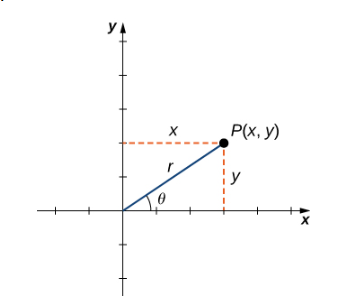
Figure \(\PageIndex{1}\): The relationship between polar and rectangular coordinates in two dimensions.
Switching between these two coordinate systems is generally easy for a single point, as the right triangle pictured above clearly gives:
\[ \begin{array} {l} x=r\cos(\theta) \\ y=r\sin(\theta) \end{array} \hspace{.3in} \text{ and } \hspace{.3in} \begin{array} {l} r^2=x^2+y^2 \\ \tan(\theta)=\dfrac{y}{x} \end{array} \nonumber \]
It is worth noting that the same point in rectangular coordinates can be written infinitely many different ways in polar coordinates. For example, the point \((x,y)=\left(1,\sqrt{3}\right)\) can be written as \((r,\theta)=\left( 2, \dfrac{\pi}{6}+2\pi k\right)\) or \((r,\theta)=\left( -2, \dfrac{7\pi}{6}+2\pi k\right)\) for any integer \(k\). For this reason, the "default" choice of values of \(r\) is positive, and of \(\theta\) is in \([0,2\pi)\), but these rules are not firm.
Relationships and equations that are complicated in rectangular form can often be simpler in polar form.
Write each equation below in polar form.
(a) \(x^2+y^2=100\)
(b) \((x-1)^2+(y-1)^2=2\)
(c) \( (x^2+y^2-2x)^2=4(x^2+y^2)\)
Solution
(a) We substitute \(x=r\cos(\theta)\) and \(y=r\sin(\theta)\) into the rectangular form and simplify:
\[\begin{align*} x^2+y^2=100 \\[4pt] (r\cos(\theta))^2+(r\sin(\theta))^2=100 \\[4pt] r^2(\cos^2(\theta)+\sin^2(\theta))=100 \\[4pt] r^2=100 \\[4pt] r=10 \end{align*} \nonumber \]
Therefore, the circle defined by \(x^2+y^2=100\) is represented in polar form as \(r=10\).
(b) We substitute \(x=r\cos(\theta)\) and \(y=r\sin(\theta)\) into the rectangular form and simplify:
\[\begin{align*} (x-1)^2+(y-1)^2=2 \\[4pt] (r\cos(\theta)-1)^2+(r\sin(\theta)-1)^2=2 \\[4pt] r^2\cos^2(\theta)-2r\cos(\theta)+r^2\sin^2(\theta)-2r\sin(\theta)+2=2 \\[4pt] r^2(\cos^2(\theta)+\sin^2(\theta))-2r(\cos(\theta)+\sin(\theta))=0 \\[4pt] r^2-2r(\cos(\theta)+\sin(\theta))=0 \\[4pt] r(r-2\cos(\theta)-2\sin(\theta))=0 \\[4pt] r=0 \text{ or } r=2\cos(\theta)+2\sin(\theta) \end{align*} \nonumber \]
Clearly \(r=0\) is just a single point, so the circle defined by \((x-1)^2+(y-1)^2=2\) is represented in polar form as \(r=2\cos(\theta)+2\sin(\theta) \).
(c) We substitute \(x=r\cos(\theta)\) and \(y=r\sin(\theta)\) into the rectangular form and simplify:
\[\begin{align*} (x^2+y^2-2x)^2=4(x^2+y^2) \\[4pt] (r^2\cos^2(\theta)+r^2\sin^2(\theta)-2r\cos(\theta))^2=4(r^2\cos^2(\theta)+r^2\sin^2(\theta)) \\[4pt] (r^2-2r\cos(\theta))^2=4r^2 \\[4pt] r^4-4r^3\cos(\theta)+4r^2\cos^2(\theta)=4r^2 \\[4pt] r^2(r^2-4r\cos(\theta)+4\cos^2(\theta)-4)=0 \\[4pt] r^2( (r-2\cos(\theta))^2-4)=0 \\[4pt] r=0 \text{ or } r=2+2\cos(\theta) \end{align*} \nonumber \]
Clearly \(r=0\) is just a single point, so the cardioid defined by \( (x^2+y^2-2x)^2=4(x^2+y^2)\) is represented in polar form as \(r=2+2\cos(\theta) \).

When we expanded the traditional Cartesian coordinate system from two dimensions to three, we simply added a new axis to model the third dimension. Starting with polar coordinates, we can follow this same process to create a new three-dimensional coordinate system, called the cylindrical coordinate system. In this way, cylindrical coordinates provide a natural extension of polar coordinates to three dimensions.
In the cylindrical coordinate system, a point in space is represented by the ordered triple \((r,θ,z)\), where
- \((r,θ)\) is the polar coordinates of the point’s projection in the \(xy\)-plane
- \(z\) is the usual \(z\)-coordinate in the Cartesian coordinate system
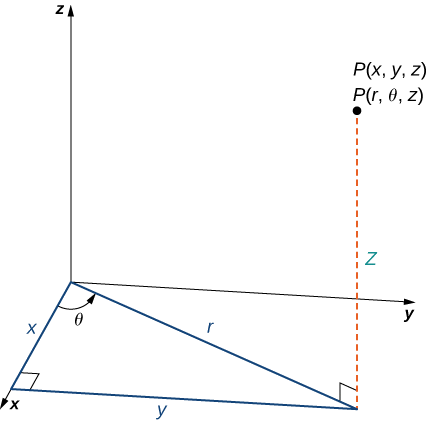
In the \(xy\)-plane, the right triangle shown above provides the key to the transformation between cylindrical and Cartesian, or rectangular, coordinates.
The rectangular coordinates \((x,y,z)\) and the cylindrical coordinates \((r,θ,z)\) of a point are related just like in polar form:
These equations are used to convert from cylindrical coordinates to rectangular coordinates.
- \(x=r\cos θ\)
- \(y=r\sin θ\)
- \(z=z\)
These equations are used to convert from rectangular coordinates to cylindrical coordinates
- \(r^2=x^2+y^2\)
- \(\tan θ=\dfrac{y}{x}\)
- \(z=z\)
As when we discussed conversion from rectangular coordinates to polar coordinates in two dimensions, it should be noted that the equation \(\tan( θ)=\dfrac{y}{x}\) has an infinite number of solutions. Again, if we restrict \(θ\) to values between \(0\) and \(2π\), then we can find a unique solution based on the quadrant of the \(xy\)-plane in which the original point \((x,y,z)\) is located. Note that if \(x=0\), then the value of \(θ\) is \(\dfrac{π}{2}\) when \(y>0\), or \(\dfrac{3π}{2}\) when \(y<0\), or is \(0\) when \(y=0\).
Let’s consider the differences between rectangular and cylindrical coordinates by looking at the surfaces generated when each of the coordinates is held constant. If \(c\) is a constant, then in rectangular coordinates, surfaces of the form \(x=c, y=c,\) or \(z=c\) are all planes. Planes of these forms are parallel to the \(yz\)-plane, the \(xz\)-plane, and the \(xy\)-plane, respectively. When we convert to cylindrical coordinates, the \(z\)-coordinate does not change.
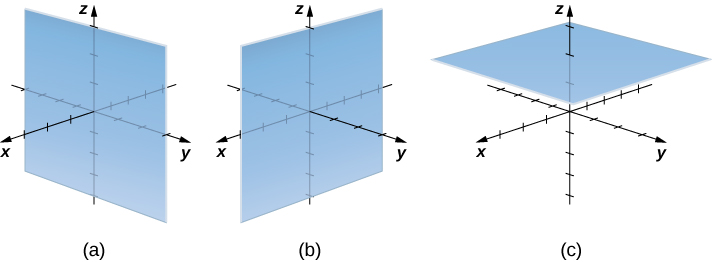
(a) surfaces of the form \(x=c\) are planes parallel to the \(yz\)-plane
(b) surfaces of the form \(y=c\) are planes parallel to the \(xz\)-plane
(c) surfaces of the form \(z=c\) are planes parallel to the \(xy\)-plane
Therefore, in cylindrical coordinates, surfaces of the form \(z=c\) are planes parallel to the \(xy\)-plane. Now, let’s think about surfaces of the form \(r=c\). The points on these surfaces are at a fixed distance from the \(z\)-axis. In other words, these surfaces are vertical circular cylinders. Last, what about \(θ=c\)? The points on a surface of the form \(θ=c\) are at a fixed angle from the \(x\)-axis, which gives us a half-plane that starts at the \(z\)-axis.
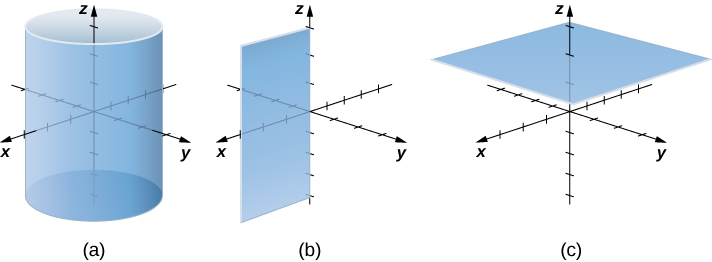
(a) surfaces of the form \(r=c\) are vertical cylinders of radius \(r\)
(b) surfaces of the form \(θ=c\) are half-planes at angle \(θ\) from the \(x\)-axis
(c) surfaces of the form \(z=c\) are planes parallel to the \(xy\)-plane.
Plot the points given in cylindrical coordinates and express its location in rectangular coordinates.
(a) \(\left(4,\dfrac{2π}{3},−2\right)\)
(b) \(\left(5,\dfrac{π}{6},4\right)\)
Solution
(a) Conversion from cylindrical to rectangular coordinates requires a simple application of the equations listed above:
\[\begin{align*} x &=r\cos θ=4\cos\dfrac{2π}{3}=−2 \\[4pt] y &=r\sin θ=4\sin \dfrac{2π}{3}=2\sqrt{3} \\[4pt] z &=−2 \end{align*} \nonumber \]
The point with cylindrical coordinates \(\left(4,\dfrac{2π}{3},−2\right)\) has rectangular coordinates \((−2,2\sqrt{3},−2)\).
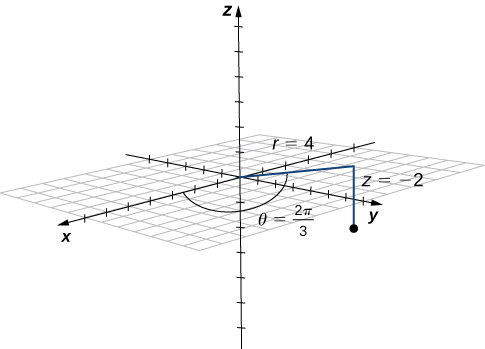
(b) Again, converting from cylindrical to rectangular coordinates:
\[\begin{align*} x &=r\cos θ=5\cos\dfrac{π}{6}=\dfrac{5\sqrt{3}}{2} \\[4pt] y &=r\sin θ=5\sin \dfrac{π}{6}=\dfrac{5}{2} \\[4pt] z &=4 \end{align*} \nonumber \]
The point with cylindrical coordinates \(\left(5,\dfrac{π}{6},4\right)\) has rectangular coordinates \(\left(\dfrac{5\sqrt{3}}{2},\dfrac{5}{2},4\right)\).
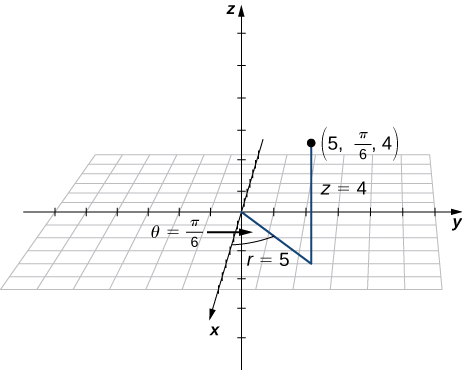
Convert the point given in rectangular coordinates to cylindrical coordinates.
(a) \((1,−3,5)\)
(b) \((−8,8,−7)\)
Solution
(a) Using the second set of equations above to translate from rectangular to cylindrical coordinates:
\[\begin{align*} r^2 &= x^2+y^2 \\[4pt] r &=±\sqrt{1^2+(−3)^2} \\[4pt] &= ±\sqrt{10} \end{align*}\]
We choose the positive square root, so \(r=\sqrt{10}\). Now, we apply the formula to find \(θ\). In this case, \(y\) is negative and \(x\) is positive, which means we must select the value of \(θ\) between \(\dfrac{3π}{2}\) and \(2π\):
\[\begin{align*} \tan (θ) =\dfrac{y}{x} =\dfrac{−3}{1}=-3 \\[4pt] θ =2\pi+\tan^{-1}(-3) \end{align*}\]
In this case, the z-coordinates are the same in both rectangular and cylindrical coordinates:
\[ z=5 \nonumber \]
The point with rectangular coordinates \((1,−3,5)\) has cylindrical coordinates equal to \((\sqrt{10},2\pi+\tan^{-1}(-3) ,5).\)
Note that it is often acceptable to write this answer as \((\sqrt{10},\tan^{-1}(-3) ,5)\), even though this places \(\theta\) outside of \([0,2\pi)\).
(b) Once again from rectangular to cylindrical coordinates:
\[\begin{align*} r^2 = x^2+y^2 \\[4pt] r =\sqrt{(-8)^2+8^2} = \sqrt{128}=8\sqrt{2} \end{align*}\]
So \(r=8\sqrt{2}\). Now, we apply the formula to find \(θ\). In this case, \(x\) is negative and \(y\) is positive, which means we must select the value of \(θ\) between \(\dfrac{π}{2}\) and \(π\):
\[\begin{align*} \tan (\theta) =\dfrac{y}{x} =\dfrac{8}{-8} =-1 \\[4pt] θ =\pi+\tan^{-1}(-1)=\dfrac{3\pi}{4} \end{align*}\]
Once more the z-coordinates are the same in both rectangular and cylindrical coordinates:
\[ z=-7 \nonumber \]
The point with rectangular coordinates \((-8,8,-7)\) has cylindrical coordinates equal to \(\left(8\sqrt{2},\dfrac{3π}{4},−7\right)\).
Please notice that this answer is not the same as the point \(\left(8\sqrt{2},\tan^{-1}(-1),−7\right)\)=\(\left(8\sqrt{2},-\dfrac{π}{4},−7\right)\).
The use of cylindrical coordinates is common in fields such as physics. Physicists studying electrical charges and the capacitors used to store these charges have discovered that these systems sometimes have a cylindrical symmetry. These systems have complicated modeling equations in the Cartesian coordinate system, which make them difficult to describe and analyze. The equations can often be expressed in more simple terms using cylindrical coordinates. For example, the cylinder described by equation \(x^2+y^2=25\) in the Cartesian system can be represented by cylindrical equation \(r=5\).
Describe the surfaces with the given cylindrical equations.
(a) \(θ=\dfrac{π}{4}\)
(b) \(r^2+z^2=9\)
(c) \(z^2=r^2\)
(d) \(r=6\)
Solution
(a) When the angle \(θ\) is held constant while \(r\) and \(z\) are allowed to vary, the result is a half-plane.
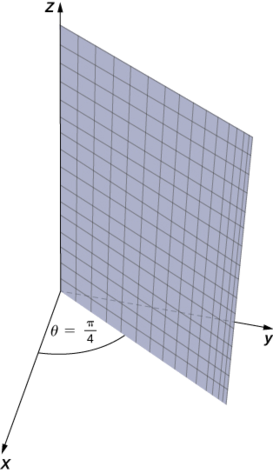
(b) Substitute \(r^2=x^2+y^2\) into equation \(r^2+z^2=9\) to express the rectangular form of the equation: \(x^2+y^2+z^2=9\).
This equation describes a sphere centered at the origin with radius 3.
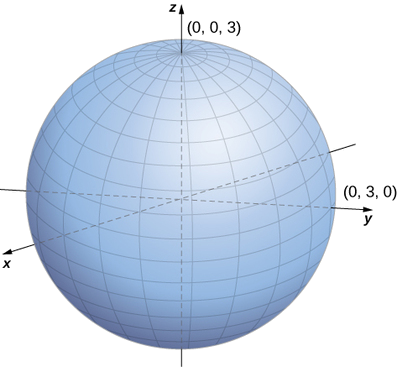
(c) To describe the surface defined by equation \(z^2=r^2\), it is useful to examine traces parallel to the \(xy\)-plane.
For example, the trace in plane \(z=1\) is circle \(r=1\), the trace in plane \(z=3\) is circle \(r=3\), and so on. Each trace is a circle.
As the value of \(|z|\) increases, the radius of the circle also increases. The resulting surface is a cone.
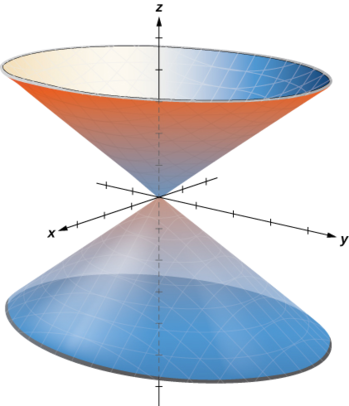
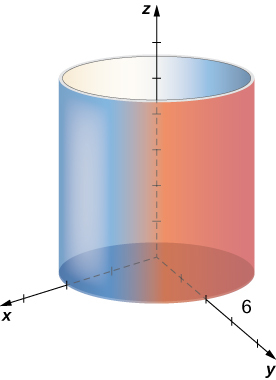
(d) To describe the surface defined by equation \(r=6\), notice that the value of \(z\) does not change the trace in any plane \(z=k\).
Each trace is a circle with radius \(6\). The resulting surface is a cylinder with radius \(6\).
In the Cartesian coordinate system, the location of a point in space is described using an ordered triple in which each coordinate represents a distance. In the cylindrical coordinate system, the location of a point in space is described using two distances \((r\) and \(z)\) and an angle measure \((θ)\). We can now define a third system, called the spherical coordinate system, in which we again use an ordered triple to describe the location of a point in space. In this new system, the triple describes one distance and two angles. Spherical coordinates make it simple to describe a sphere, just as cylindrical coordinates make it easy to describe a cylinder. Grid lines for spherical coordinates are based on angle measures, like those for polar coordinates.
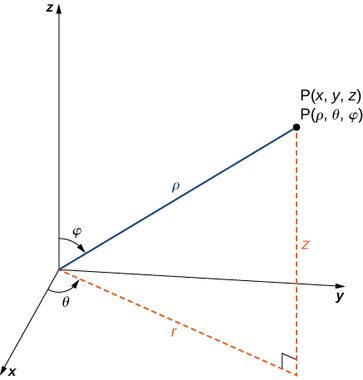
In the spherical coordinate system, a point \(P\) in space is represented by the ordered triple \((ρ,θ,\phi)\) where
- \(ρ\) (the Greek letter rho) is the distance between \(P\) and the origin \((ρ≠0);\)
- \(θ\) is the same angle used to describe the location in cylindrical coordinates;
- \(\phi\) (the Greek letter phi) is the angle formed by the positive \(z\)-axis and line segment \(\overline{OP}\), where \(O\) is the origin and \(0≤\phi≤π.\)
By convention, the origin is represented as \((0,0,0)\) in spherical coordinates.
The formulas to convert from spherical coordinates to rectangular coordinates may seem complex, but they are straightforward applications of trigonometry. Looking at the figure below, it is easy to see that \(r=ρ \sin φ\). Then, looking at the triangle in the \(xy\)-plane with \(r\) as its hypotenuse, we have \(x=r\cos (\theta)=ρ\sin(\phi) \cos (\theta)\). The derivation of the formula for \(y\) is similar. We also see that \(ρ^2=r^2+z^2=x^2+y^2+z^2\) and \(z=ρ\cos (\phi)\). Solving this last equation for \(φ\) and then substituting \(ρ=\sqrt{r^2+z^2}\) (from the first equation) yields \(\phi=\cos^{-1}\left(\dfrac{z}{\sqrt{r^2+z^2}}\right)\). Alternatively, taking cotangent of \(\phi\) yields \(\dfrac{z}{r}\), so we can write \(\phi=\cot^{-1}\left( \dfrac{z}{r}\right)\). Both of these inverse functions have a range of \([0,\pi]\), which is the default interval we use when solving for \(\phi\) in spherical coordinates. Unfortunately, as before, we must be careful when using the formula \(\tan (θ)=\dfrac{y}{x}\) to choose the correct value of \(θ\) since the range of the inverse tangent is not a perfect match for our default range of \([0,2\pi)\).
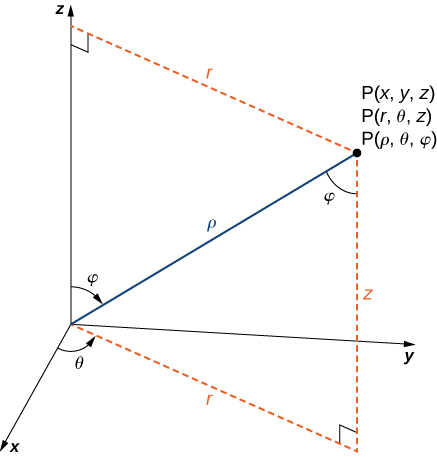
Rectangular coordinates \((x,y,z)\), cylindrical coordinates \((r,θ,z),\) and spherical coordinates \((ρ,θ,\phi)\) of a point are related as follows:
Convert from spherical coordinates to rectangular coordinates
These equations are used to convert from spherical coordinates to rectangular coordinates.
- \(x=ρ\sin (\phi) \cos (θ)\)
- \(y=ρ\sin (\phi) \sin (θ)\)
- \(z=ρ\cos (\phi) \)
Convert from rectangular coordinates to spherical coordinates
These equations are used to convert from rectangular coordinates to spherical coordinates.
- \(ρ^2=x^2+y^2+z^2\)
- \(\tan θ=\dfrac{y}{x}\)
- \(\phi=\cos^{-1}\left(\dfrac{z}{\sqrt{x^2+y^2+z^2}}\right)=\cot^{-1}\left(\dfrac{z}{\sqrt{x^2+y^2}}\right)\)
Convert from spherical coordinates to cylindrical coordinates
These equations are used to convert from spherical coordinates to cylindrical coordinates.
- \(r=ρ\sin (\phi)\)
- \(θ=θ\)
- \(z=ρ\cos (\phi)\)
Convert from cylindrical coordinates to spherical coordinates
These equations are used to convert from cylindrical coordinates to spherical coordinates.
- \(ρ=\sqrt{r^2+z^2}\)
- \(θ=θ\)
- \(\phi=\cos^{-1}\left(\dfrac{z}{\sqrt{r^2+z^2}}\right)=\cot^{-1}\left( \dfrac{z}{r}\right)\)
As we did with cylindrical coordinates, let’s consider the surfaces that are generated when each of the coordinates is held constant. Let \(c\) be a constant, and consider surfaces of the form \(ρ=c\). Points on these surfaces are at a fixed distance from the origin and form a sphere. The coordinate \(θ\) in the spherical coordinate system is the same as in the cylindrical coordinate system, so surfaces of the form \(θ=c\) are half-planes, as before. Last, consider surfaces of the form \(\phi=c\). The points on these surfaces are at a fixed angle from the \(z\)-axis and form a half-cone.
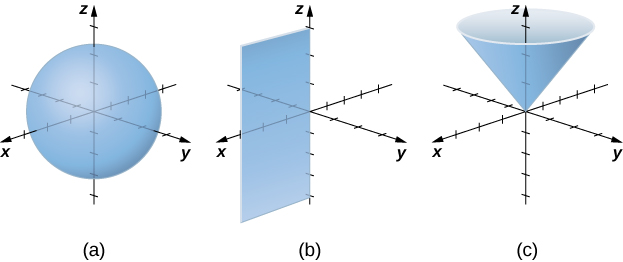
(a) surfaces of the form \(ρ=c\) are spheres of radius \(ρ\)
(b) surfaces of the form \(θ=c\) are half-planes at an angle \(θ\) from the \(x\)-axis
(c) surfaces of the form \(ϕ=c\) are half-cones at an angle \(ϕ\) from the \(z\)-axis
Plot the point given in spherical coordinates and describe its location in both rectangular and cylindrical coordinates.
(a) \(\left(8,\dfrac{π}{3},\dfrac{π}{6}\right)\)
(b) \(\left(2,−\dfrac{5π}{6},\dfrac{π}{6}\right)\)
Solution
(a)
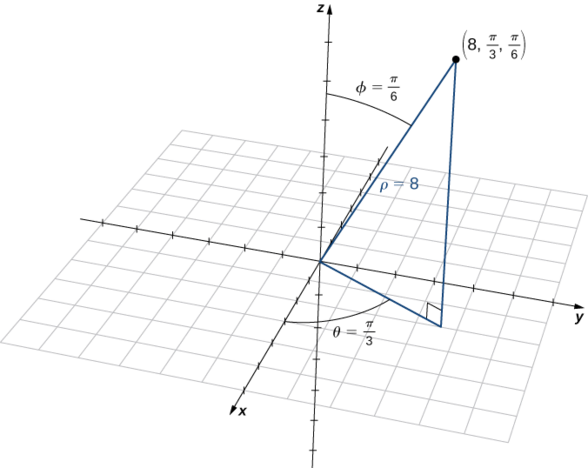
\[ \begin{align*} x =ρ\sin (\phi) \cos (\theta) =8 \sin\left(\dfrac{π}{6}\right) \cos\left(\dfrac{π}{3}\right) = 8\left(\dfrac{1}{2}\right)\dfrac{1}{2} =2 \\[4pt] y =ρ\sin (\phi)\sin (\theta) = 8\sin\left(\dfrac{π}{6}\right)\sin\left(\dfrac{π}{3}\right) = 8\left(\dfrac{1}{2}\right)\dfrac{\sqrt{3}}{2} = 2\sqrt{3} \\[4pt] z =ρ\cos (\phi) = 8\cos\left(\dfrac{π}{6}\right) = 8\left(\dfrac{\sqrt{3}}{2}\right) = 4\sqrt{3} \end{align*}\]
The point with spherical coordinates \(\left(8,\dfrac{π}{3},\dfrac{π}{6}\right)\) has rectangular coordinates \(\left(2,2\sqrt{3},4\sqrt{3}\right)\)
\[ \begin{align*} r=ρ \sin (\phi) = 8\sin \dfrac{π}{6} =4 \\[4pt] θ=θ \\[4pt] z=ρ\cos (\phi)= 8\cos\dfrac{π}{6} = 4\sqrt{3} \end{align*}\]
Thus, cylindrical coordinates for the point are \(\left(4,\dfrac{π}{3},4\sqrt{3}\right)\)
(b)
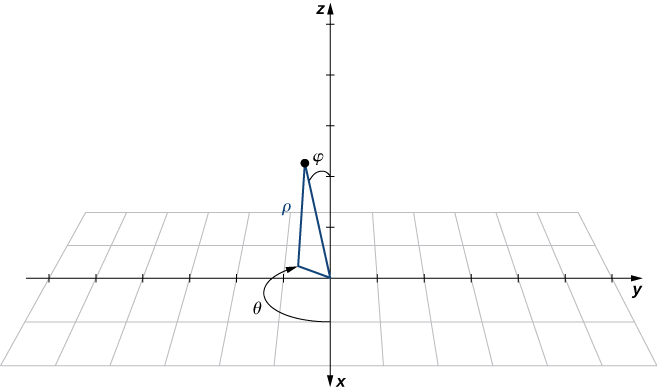
\[ \begin{align*} x =ρ\sin (\phi)\cos (\theta) =2 \sin\left(-\dfrac{5π}{6}\right) \cos\left(\dfrac{π}{6}\right) = 2\left(-\dfrac{1}{2}\right)\dfrac{\sqrt{3}}{2} =-\dfrac{\sqrt{3}}{2} \\[4pt] y =ρ\sin (\phi) \sin (\theta) = 2\sin\left(-\dfrac{5π}{6}\right)\sin\left(\dfrac{π}{6}\right) = 2\left(-\dfrac{1}{2}\right)\dfrac{1}{2} = -\dfrac{1}{2} \\[4pt] z =ρ\cos (\phi) = 2\cos\left(\dfrac{π}{6}\right) = 2\left(\dfrac{\sqrt{3}}{2}\right) = \sqrt{3} \end{align*}\]
The point with spherical coordinates \(\left(2,−\dfrac{5π}{6},\dfrac{π}{6}\right)\) has rectangular coordinates \(\left(−\dfrac{\sqrt{3}}{2},−\dfrac{1}{2},\sqrt{3}\right)\)
\[ \begin{align*} r=ρ \sin (\phi) =2\sin \dfrac{π}{6} =1 \\[4pt] θ=θ \\[4pt] z=ρ\cos (\phi)= 2\cos\dfrac{π}{6} = \sqrt{3} \end{align*}\]
Thus, cylindrical coordinates for the point are \(\left(1,−\dfrac{5π}{6},\sqrt{3}\right)\)
Convert the rectangular coordinates \((−1,1,\sqrt{6})\) to both spherical and cylindrical coordinates.
Solution
Start by converting from rectangular to spherical coordinates:
\[ ρ^2 =x^2+y^2+z^2=(−1)^2+1^2+(\sqrt{6})^2=8 \longrightarrow \rho=2\sqrt{2} \nonumber \]
\[ \tan θ =\dfrac{1}{−1}=-1 \text{ and } x<0,y>0 \longrightarrow θ=\dfrac{3π}{4} \nonumber\]
There are actually three equivalent methods to identify \(\phi\). We can use the equation \(\phi=\cos^{-1}\left(\dfrac{z}{\sqrt{x^2+y^2+z^2}}\right)\) or \(\phi=\cot^{-1}\left(\dfrac{z}{\sqrt{x^2+y^2}}\right)\). A more simple approach, however, is to use equation \(z=ρ\cos(\phi)\).
We know that \(z=\sqrt{6}\) and \(ρ=2\sqrt{2}\), so
\(\cos (\phi)=\dfrac{\sqrt{6}}{2\sqrt{2}}=\dfrac{\sqrt{3}}{2} \longrightarrow \phi=\dfrac{π}{6}\)
The spherical coordinates of the point are \(\left(2\sqrt{2},\dfrac{3π}{4},\dfrac{π}{6}\right)\)
To find the cylindrical coordinates for the point, we already know \(\theta\) and \(z\) so we need only to find \(r\):
\(r=\sqrt{x^2+y^2}=\sqrt{(-1)^2+1^2}=\sqrt{2}\)
The cylindrical coordinates for the point are \(\left(\sqrt{2},\dfrac{3π}{4},\sqrt{6}\right)\)
Describe the surfaces with the given spherical equations.
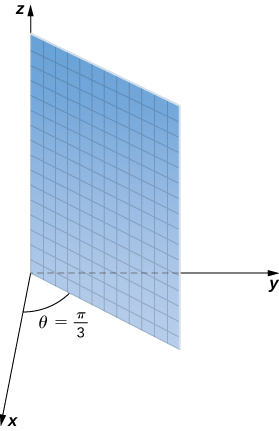
(a) \(θ=\dfrac{π}{3}\)
(b) \(\phi =\dfrac{π}{3}\)
(c) \(ρ=6\)
(d) \(ρ=\sin (\theta) \sin(\phi)\)
Solution
(a) The variable \(θ\) represents the measure of the same angle in both the cylindrical and spherical coordinate systems. Points with coordinates \(\left(ρ,\dfrac{π}{3}, \phi\right)\) lie on the plane that forms angle \(θ=\dfrac{π}{3}\) with the positive \(x\)-axis. Because \(ρ>0\), the surface described by equation \(θ=\dfrac{π}{3}\) is the half-plane shown below.
(b) Equation \(\phi=\dfrac{π}{3}\) describes all points in the spherical coordinate system that lie on a line from the origin forming an angle measuring \(\dfrac{π}{3}\) rad with the positive \(z\)-axis. These points form the half-cone pictured below. Because there is only one value for \(\phi\) that is measured from the positive \(z\)-axis, we do not get the full cone (with two pieces).

To find the equation in rectangular coordinates, use equation \(\phi=\cot^{-1}\left(\dfrac{z}{\sqrt{x^2+y^2}}\right)\):
\[ \begin{align*} \dfrac{π}{3} =\cot^{-1}\left(\dfrac{z}{\sqrt{x^2+y^2}}\right) \\[4pt] \cot\dfrac{π}{3}=\dfrac{z}{\sqrt{x^2+y^2}} \\[4pt] \dfrac{1}{\sqrt{3}}=\dfrac{z}{\sqrt{x^2+y^2}} \\[4pt] z=\dfrac{1}{\sqrt{3}}\sqrt{x^2+y^2} \\[4pt] z=\sqrt{\dfrac{x^2}{3}+\dfrac{y^2}{3}} \end{align*}\]
This is the equation of a cone centered on the \(z\)-axis.
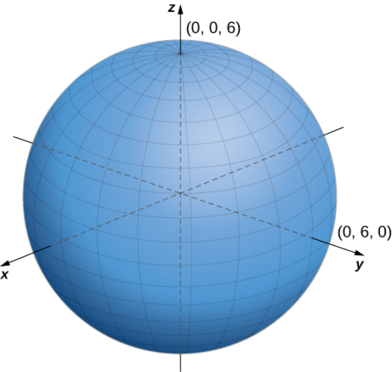
(c) Equation \(ρ=6\) describes the set of all points \(6\) units away from the origin — a sphere with radius \(6\)
(d) To identify this surface, convert the equation from spherical to rectangular coordinates \(ρ^2=x^2+y^2+z^2:\)
\[\begin{align*} ρ=\sin (\theta) \sin( \phi) & \xrightarrow{ \text{Multiply both sides of the equation by ρ}} ρ^2=ρ\sin (\theta)\sin (\phi) \\[4pt] & \xrightarrow{ \text{Substitute into terms of x, y, and z }} x^2+y^2+z^2=y \\[4pt] &\xrightarrow{ \text{Subtract y from both sides}} x^2+y^2-y+z^2=0 \\[4pt] & \xrightarrow{ \text{Complete the square}} x^2+y^2-y+\dfrac{1}{4}+z^2=\dfrac{1}{4} \\[4pt] & \xrightarrow{ \text{Rewrite as perfect squares }} x^2+\left(y-\dfrac{1}{2}\right)^2+z^2=\left(\dfrac{1}{2}\right)^2 \end{align*}\]
The equation describes a sphere centered at point \(\left(0,\dfrac{1}{2},0\right)\) with radius \(\dfrac{1}{2}\).
Spherical coordinates are useful in analyzing systems that have some degree of symmetry about a point, such as the volume of the space inside a domed stadium or wind speeds in a planet’s atmosphere. In geography, latitude and longitude are used to describe locations on Earth’s surface. Although the shape of Earth is not a perfect sphere, we use spherical coordinates to communicate the locations of points on Earth:

Figure \(\PageIndex{8}\): Navigating the Earth using spherical coordinates.
Let’s assume Earth has the shape of a sphere with radius \(4000\) mi. We express angle measures in degrees rather than radians because latitude and longitude are measured in degrees. Let the center of Earth be the center of the sphere, with the ray from the center through the North Pole representing the positive \(z\)-axis. The prime meridian represents the trace of the surface as it intersects the \(xz\)-plane. The equator is the trace of the sphere intersecting the \(xy\)-plane.
Points in \(\mathbb{R}^3\) can be described in many different ways, but the three most common are rectangular form, cylindrical form, and spherical form. Between these three, we generally have at least one way to describe a surface in a relatively simple way.