

4.7E: Exercises
- Page ID
- 13713
This page is a draft and is under active development.
\( \newcommand{\vecs}[1]{\overset { \scriptstyle \rightharpoonup} {\mathbf{#1}} } \)
\( \newcommand{\vecd}[1]{\overset{-\!-\!\rightharpoonup}{\vphantom{a}\smash {#1}}} \)
\( \newcommand{\dsum}{\displaystyle\sum\limits} \)
\( \newcommand{\dint}{\displaystyle\int\limits} \)
\( \newcommand{\dlim}{\displaystyle\lim\limits} \)
\( \newcommand{\id}{\mathrm{id}}\) \( \newcommand{\Span}{\mathrm{span}}\)
( \newcommand{\kernel}{\mathrm{null}\,}\) \( \newcommand{\range}{\mathrm{range}\,}\)
\( \newcommand{\RealPart}{\mathrm{Re}}\) \( \newcommand{\ImaginaryPart}{\mathrm{Im}}\)
\( \newcommand{\Argument}{\mathrm{Arg}}\) \( \newcommand{\norm}[1]{\| #1 \|}\)
\( \newcommand{\inner}[2]{\langle #1, #2 \rangle}\)
\( \newcommand{\Span}{\mathrm{span}}\)
\( \newcommand{\id}{\mathrm{id}}\)
\( \newcommand{\Span}{\mathrm{span}}\)
\( \newcommand{\kernel}{\mathrm{null}\,}\)
\( \newcommand{\range}{\mathrm{range}\,}\)
\( \newcommand{\RealPart}{\mathrm{Re}}\)
\( \newcommand{\ImaginaryPart}{\mathrm{Im}}\)
\( \newcommand{\Argument}{\mathrm{Arg}}\)
\( \newcommand{\norm}[1]{\| #1 \|}\)
\( \newcommand{\inner}[2]{\langle #1, #2 \rangle}\)
\( \newcommand{\Span}{\mathrm{span}}\) \( \newcommand{\AA}{\unicode[.8,0]{x212B}}\)
\( \newcommand{\vectorA}[1]{\vec{#1}} % arrow\)
\( \newcommand{\vectorAt}[1]{\vec{\text{#1}}} % arrow\)
\( \newcommand{\vectorB}[1]{\overset { \scriptstyle \rightharpoonup} {\mathbf{#1}} } \)
\( \newcommand{\vectorC}[1]{\textbf{#1}} \)
\( \newcommand{\vectorD}[1]{\overrightarrow{#1}} \)
\( \newcommand{\vectorDt}[1]{\overrightarrow{\text{#1}}} \)
\( \newcommand{\vectE}[1]{\overset{-\!-\!\rightharpoonup}{\vphantom{a}\smash{\mathbf {#1}}}} \)
\( \newcommand{\vecs}[1]{\overset { \scriptstyle \rightharpoonup} {\mathbf{#1}} } \)
\(\newcommand{\longvect}{\overrightarrow}\)
\( \newcommand{\vecd}[1]{\overset{-\!-\!\rightharpoonup}{\vphantom{a}\smash {#1}}} \)
\(\newcommand{\avec}{\mathbf a}\) \(\newcommand{\bvec}{\mathbf b}\) \(\newcommand{\cvec}{\mathbf c}\) \(\newcommand{\dvec}{\mathbf d}\) \(\newcommand{\dtil}{\widetilde{\mathbf d}}\) \(\newcommand{\evec}{\mathbf e}\) \(\newcommand{\fvec}{\mathbf f}\) \(\newcommand{\nvec}{\mathbf n}\) \(\newcommand{\pvec}{\mathbf p}\) \(\newcommand{\qvec}{\mathbf q}\) \(\newcommand{\svec}{\mathbf s}\) \(\newcommand{\tvec}{\mathbf t}\) \(\newcommand{\uvec}{\mathbf u}\) \(\newcommand{\vvec}{\mathbf v}\) \(\newcommand{\wvec}{\mathbf w}\) \(\newcommand{\xvec}{\mathbf x}\) \(\newcommand{\yvec}{\mathbf y}\) \(\newcommand{\zvec}{\mathbf z}\) \(\newcommand{\rvec}{\mathbf r}\) \(\newcommand{\mvec}{\mathbf m}\) \(\newcommand{\zerovec}{\mathbf 0}\) \(\newcommand{\onevec}{\mathbf 1}\) \(\newcommand{\real}{\mathbb R}\) \(\newcommand{\twovec}[2]{\left[\begin{array}{r}#1 \\ #2 \end{array}\right]}\) \(\newcommand{\ctwovec}[2]{\left[\begin{array}{c}#1 \\ #2 \end{array}\right]}\) \(\newcommand{\threevec}[3]{\left[\begin{array}{r}#1 \\ #2 \\ #3 \end{array}\right]}\) \(\newcommand{\cthreevec}[3]{\left[\begin{array}{c}#1 \\ #2 \\ #3 \end{array}\right]}\) \(\newcommand{\fourvec}[4]{\left[\begin{array}{r}#1 \\ #2 \\ #3 \\ #4 \end{array}\right]}\) \(\newcommand{\cfourvec}[4]{\left[\begin{array}{c}#1 \\ #2 \\ #3 \\ #4 \end{array}\right]}\) \(\newcommand{\fivevec}[5]{\left[\begin{array}{r}#1 \\ #2 \\ #3 \\ #4 \\ #5 \\ \end{array}\right]}\) \(\newcommand{\cfivevec}[5]{\left[\begin{array}{c}#1 \\ #2 \\ #3 \\ #4 \\ #5 \\ \end{array}\right]}\) \(\newcommand{\mattwo}[4]{\left[\begin{array}{rr}#1 \amp #2 \\ #3 \amp #4 \\ \end{array}\right]}\) \(\newcommand{\laspan}[1]{\text{Span}\{#1\}}\) \(\newcommand{\bcal}{\cal B}\) \(\newcommand{\ccal}{\cal C}\) \(\newcommand{\scal}{\cal S}\) \(\newcommand{\wcal}{\cal W}\) \(\newcommand{\ecal}{\cal E}\) \(\newcommand{\coords}[2]{\left\{#1\right\}_{#2}}\) \(\newcommand{\gray}[1]{\color{gray}{#1}}\) \(\newcommand{\lgray}[1]{\color{lightgray}{#1}}\) \(\newcommand{\rank}{\operatorname{rank}}\) \(\newcommand{\row}{\text{Row}}\) \(\newcommand{\col}{\text{Col}}\) \(\renewcommand{\row}{\text{Row}}\) \(\newcommand{\nul}{\text{Nul}}\) \(\newcommand{\var}{\text{Var}}\) \(\newcommand{\corr}{\text{corr}}\) \(\newcommand{\len}[1]{\left|#1\right|}\) \(\newcommand{\bbar}{\overline{\bvec}}\) \(\newcommand{\bhat}{\widehat{\bvec}}\) \(\newcommand{\bperp}{\bvec^\perp}\) \(\newcommand{\xhat}{\widehat{\xvec}}\) \(\newcommand{\vhat}{\widehat{\vvec}}\) \(\newcommand{\uhat}{\widehat{\uvec}}\) \(\newcommand{\what}{\widehat{\wvec}}\) \(\newcommand{\Sighat}{\widehat{\Sigma}}\) \(\newcommand{\lt}{<}\) \(\newcommand{\gt}{>}\) \(\newcommand{\amp}{&}\) \(\definecolor{fillinmathshade}{gray}{0.9}\)Exercise \(\PageIndex{1}\)
For the following exercises, answer by proof, counterexample, or explanation.
1) When you find the maximum for an optimization problem, why do you need to check the sign of the derivative around the critical points?
- Answer
-
The critical points can be the minima, maxima, or neither.
2) Why do you need to check the endpoints for optimization problems?
3) True or False. For every continuous nonlinear function, you can find the value xx that maximizes the function.
- Answer
-
False; \(y=−x^2\) has a minimum only
4) True or False. For every continuous nonconstant function on a closed, finite domain, there exists at least one xx that minimizes or maximizes the function
Exercise \(\PageIndex{2}\)
To carry a suitcase on an airplane, the length+width+height of the box must be less than or equal to 62in. Assuming the height is fixed, show that the maximum volume is \(V=h\left(31−\frac{1}{2}h\right)^2.\) What height allows you to have the largest volume?
- Answer
-
\(h=\frac{62}{3}\) in.
- Solution
-
Let \(l\), \(w\)and \(h\) be the length, width and height of the suitcase. Then \(l+w+h=62 \implies l=62-h-w.\) Now the volume \(V=lwh=(62-h-w)wh=62wh-wh^2-w^2h.\) Since \(V(w)\) is a continuous function over a closed, bounded interval, \([0, 62-h]\), it has a maximum and a minimum. Let’s begin by looking for any critical points of \(V\) over the interval \([0, 62-h].\) The derivative of \(V\), \(V'(w)= 62h-h^2-2wh.\) To find critical points set \(V'(w)=0\). Since \(h\) is fixed, \( 62h-h^2-2wh=0 \implies 62-h-2w=0 \implies w=\dfrac{62-h}{2}.\) To justify that the volume is maximized for this value of \(w\), we just need to check the values of \(V(w)\) at the endpoints \(w=0\) and \(w=62-h\), and compare them with the value of \(V(w)\) at the critical point \(w=\dfrac{62-h}{2}.\) \(V(0)=0\), \(V(62-h)=0\), and \(V(\dfrac{62-h}{2})=\left(62-h-\left(\dfrac{62-h}{2}\right)\right)\dfrac{62-h}{2}h=\left(\dfrac{62-h}{2}\right)^2h=h\left(31−\dfrac{1}{2}h\right)^2.\)
Now we maximize \(V=h\left(31−\dfrac{1}{2}h\right)^2,\) where \(0\leq h\leq 62\). Since \(V(h)\) is a continuous function over a closed, bounded interval, \([0, 62]\), it has a maximum and a minimum. Let’s begin by looking for any critical points of \(V\) over the interval \([0, 62].\) The derivative of \(V\),
\(V'(h)=\left(31−\frac{1}{2}h\right)^2+ 2h\left(31−\dfrac{1}{2}h\right)\dfrac{-1}{2}=\left(31−\frac{1}{2}h\right)^2-h\left(31−\dfrac{1}{2}h\right)=\left(31−\dfrac{1}{2}h\right) \left( \left(31−\dfrac{1}{2}h\right)-h \right)= \left(31−\dfrac{1}{2}h\right) \left(31−\dfrac{3}{2}h\right).\)
To find critical points set \(V'(h)=0\): \(\left(31−\dfrac{1}{2}h\right) =0, \left(31−\dfrac{3}{2}h\right)=0\).
Which implies, \(h=62, \dfrac{62}{3}.\) To justify that the volume is maximized for this value of \(h\), we just need to check the values of \(V(h)\) at the endpoints \(h=0\) and \(h=62\), and compare them with the value of \(V(h)\) at the critical point \(h=\dfrac{62}{3}.\) \(V(0)=0\), \(V(62)=0\), and \(V\left(\dfrac{62}{3}\right)=\left(\dfrac{62}{3}\right) \left(31−\dfrac{1}{2}\dfrac{62}{3}\right)^2=\left(\dfrac{62}{3}\right)^2\). Hence the volume is maximized when \(h=\dfrac{62}{3} in.\)
Exercise \(\PageIndex{3}\)
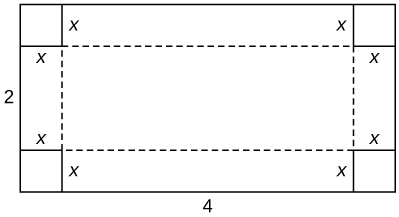
You are constructing a cardboard box with the dimensions 2m by 4m. You then cut equal-size squares from each corner so you may fold the edges. What are the dimensions of the box with the largest volume?
- Solution
-
The volume of the box \(
V(x) = (4 - 2x)(2 - 2x)x, x \in [0,1]
\)Expand:
\(
V = x( (4 - 2x)(2 - 2x) )=x(8 - 8x - 4x + 4x^2) = x(8 - 12x + 4x^2)=8x - 12x^2 + 4x^3.\)Now we maximize \(V(x) = (4 - 2x)(2 - 2x)x,\) where \(0 \leq x\leq 1\). Since \(V(x)\) is a continuous function over a closed, bounded interval, \([0, 1]\), it has a maximum and a minimum. Let’s begin by looking for any critical points of \(V\) over the interval \([0, 1].\) The derivative of \(V\),
\(
V'(x)=8 - 12(2x) + 4(3x^2)=4(3x^2-6x+2).\) To find critical points set \(V'(x)=0\): \(3x^2-6x+2=0 \implies x= \dfrac{-(-6) \pm\sqrt{(-6)^2-4(3)(2)}}{(2)(3)}=\dfrac{6 \pm \sqrt{6}\sqrt{6-4}}{6}=1\pm \sqrt{\dfrac{2}{6}}=1\pm \sqrt{\dfrac{1}{3}}.\) Since \(1+ \sqrt{\dfrac{1}{3}} >1,\) \(1- \sqrt{\dfrac{1}{3}}\) is only critical point in \([0,1]\).\(x\) \(V(x)=(4 - 2x)(2 - 2x)x\) \(0\) \(0\) \(1- \sqrt{\dfrac{1}{3}}\) \(\left( 4-2\left(1- \sqrt{\dfrac{1}{3}} \right)\right) \left( 2- 2 \left(1- \sqrt{\dfrac{1}{3}}\right) \right) \left(1- \sqrt{\dfrac{1}{3}} \right) =\left( 2-2 \sqrt{\dfrac{1}{3}} \right) \left( 2 \sqrt{\dfrac{1}{3}}\right) \left(1- \sqrt{\dfrac{1}{3}} \right) >0\) \(1\) \(0\) Hence, V is maximum when \(x=1- \sqrt{\dfrac{1}{3}}\). Thus, dimension of the box is \(\left( 2- 2\sqrt{\dfrac{1}{3}} \right) \, m \times \left( 2\sqrt{\dfrac{1}{3}}\right) \, m \times \left(1- \sqrt{\dfrac{1}{3}} \right)\, m\)
Exercise \(\PageIndex{4}\)
1) Find the positive integer that minimizes the sum of the number and its reciprocal.
- Answer
- \(1\)
2) Find two positive integers such that their sum is \(10\), and minimize and maximize the sum of their squares.
Exercise \(\PageIndex{5}\)
For the following exercises, consider the construction of a pen to enclose an area.
1) You have \(400\,\text{ft}\) of fencing to construct a rectangular pen for cattle. What are the dimensions of the pen that maximize the area?
- Answer
-
\(100\,\text{ft}\) by \(100\,\text{ft}\)
2) You have 800ft of fencing to make a pen for hogs. If you have a river on one side of your property, what is the dimension of the rectangular pen that maximizes the area?
3) You need to construct a fence around an area of 1600ft. 1600ft. What are the dimensions of the rectangular pen to minimize the amount of material needed?
- Answer
-
40ft x 40ft
Exercise \(\PageIndex{6}\)
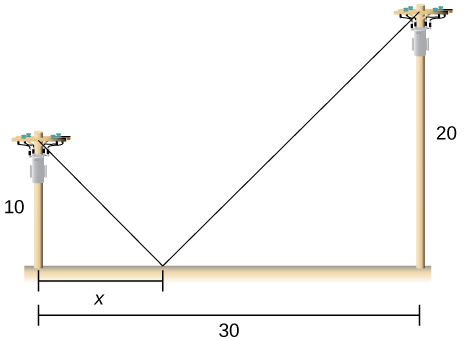
Two poles are connected by a wire that is also connected to the ground. The first pole is \(20\) ft tall, and the second pole is \(10\) ft tall. There is a distance of \(30\) ft between the two poles. Where should the wire be anchored to the ground to minimize the amount of wire needed?
- Solution
-
Minimize total length from heights 10 and 20 to a point x on the ground (0 ≤ x ≤ 30)
\(
L(x)=\sqrt{10^{2}+x^{2}}+\sqrt{20^{2}+(30-x)^{2}}, \qquad 0\le x\le 30.
\)Differentiate:
\(
L'(x)=\frac{x}{\sqrt{10^{2}+x^{2}}}+\frac{x-30}{\sqrt{20^{2}+(30-x)^{2}}}.
\)Critical points: Set \(L'(x)=0:\)
\(
\frac{x}{\sqrt{100+x^{2}}}=\frac{30-x}{\sqrt{400+(30-x)^{2}}}.
\)Square and simplify:
\(
\frac{x^{2}}{100+x^{2}}=\frac{(30-x)^{2}}{400+(30-x)^{2}}
\Longrightarrow
x^{2}\!\left(400+(30-x)^{2}\right)=(30-x)^{2}\!\left(100+x^{2}\right).
\)The common term \(x^{2}(30-x)^{2}\) cancels, giving
\(
400x^{2}=100(30-x)^{2}
\Longrightarrow
4x^{2}=(30-x)^{2}
\Longrightarrow
x=10.
\)\(x\) \(
L(x)=\sqrt{10^{2}+x^{2}}+\sqrt{20^{2}+(30-x)^{2}}
\)\(0\) \(
L(0)=\sqrt{10^{2}+0^{2}}+\sqrt{20^{2}+(30-0)^{2}}=10+10\sqrt{4+9}=10(1+\sqrt{13})
\)\(10\) \(
L(10)=\sqrt{10^{2}+10^{2}}+\sqrt{20^{2}+(30-10)^{2}}=10\sqrt{2}+20 \sqrt{2}=30\sqrt{2}
\)\(30\) \(
L(x)=\sqrt{10^{2}+30^{2}}+\sqrt{20^{2}+(30-30)^{2}}=10\sqrt{1+9}+20=10\sqrt{10}+20
\)Hence, L has the absolute minimum at \(x=10.\)
Thus, the minimizing point is \(x=10.\)
Exercise \(\PageIndex{7}\)
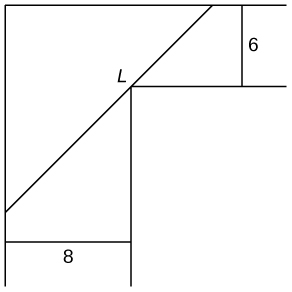
You are moving into a new apartment and notice there is a corner where the hallway narrows from \(8\) ft to \(6\) ft. What is the length of the longest item that can be carried horizontally around the corner?
- Answer
-
\(19.73\,\text{ft}\)
- Solution
-
Let \(\theta\) be the angle as seen in the figure. Then \(\sin(\theta)=\dfrac{6}{L_1}\) and \(\cos(\theta)=\dfrac{8}{L_2}\). Then the length
\(L=\dfrac{6}{\sin(\theta)}+\dfrac{8}{\cos(\theta)}=6 \csc(\theta)+8\sec(\theta)\), \(0 < \theta <\pi/2.\)
\(L'=-6 \csc(\theta)\cot(\theta)+8\sec(\theta)tan(\theta).\) Solve \(L'=0\) to find critical points: \(-6 \csc(\theta)\cot(\theta)=8\sec(\theta)tan(\theta)\)
\(3\dfrac{cos(\theta)}{sin^2(\theta)}= 4 \dfrac{sin(\theta)}{cos^2(\theta)} \implies 3cos^3(\theta) =4 sin^3(\theta) \implies \tan^3(\theta)=\frac{3}{4} \implies \tan(\theta)=\left(\dfrac{3}{4}\right)^{1/3}.\) Hence \(sin(\theta)=\dfrac{3^{1/3}}{3^{2/3}+4^{2/3}}\) and \(\cos(\theta)= \dfrac{4^{1/3}}{3^{2/3}+4^{2/3}}\). Now \(L= \dfrac{6}{\left(\dfrac{3^{1/3}}{3^{2/3}+4^{2/3}}\right)}+\dfrac{8}{\left(\dfrac{4^{1/3}}{3^{2/3}+4^{2/3}}\right)}= (3^{2/3}+4^{2/3}) \left(\dfrac{6}{3^{1/3}}+\dfrac{8}{4^{1/3}}\right)=19.73 \) ft
Exercise \(\PageIndex{8}\)
1) A patient’s pulse measures 70bpm,80bpm, then 120bpm. To determine an accurate measurement of pulse, the doctor wants to know what value minimizes the expression \((x−70)^2+(x−80)^2+(x−120)^2\)?
2) In the previous problem, assume the patient was nervous during the third measurement, so we only weight that value half as much as the others. What is the value that minimizes \((x−70)^2+(x−80)^2+12(x−120)^2\)?
- Answer
-
\(84 \,\text{bpm}\)
Exercise \(\PageIndex{9}\)
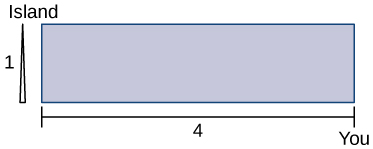
You can run at a speed of \(6\) mph and swim at a speed of \(3\) mph and are located on the shore, \(4\) miles east of an island that is \(1\) mile north of the shoreline. How far should you run west to minimize the time needed to reach the island?
- Answer
-
\(≈3.42 mi\)
- Solution
-

Figure \(\PageIndex{9}\): Swimming/running (Copyright; Pamini Thangarajah) Let \(x\) be the distance running and let \(y\) be the distance swimming (Figure \(\PageIndex{9}\)). Let \(T\) be the time it takes to get to the island. The problem is to minimize \(T\).
To find the time spent travelling from the cabin to the island, add the time spent running and swimming. Since Distance = Rate × Time \((D=(R)(T),\) the time spent running is
\(T_{running}=\dfrac{D_{running}}{R_{running}}=\dfrac{x}{6}\),
and the time spent swimming is
\(T_{swimming}=\dfrac{D_{swimming}}{R_{swimming}}=\dfrac{y}{3}\).
Therefore, the total time spent travelling is
\(T=\dfrac{x}{6}+\dfrac{y}{3}\).
From Figure \(\PageIndex{9}\), the line segment of \(y\) miles forms the hypotenuse of a right triangle with legs of length \(1\,mi\) and \(4−x\,mi\). Therefore, by the Pythagorean theorem, \(1^2+(4−x)^2=y^2\), and we obtain \(y=\sqrt{(4−x)^2+1}\). Thus, the total time spent travelling is given by the function
\(T(x)=\dfrac{x}{6}+\dfrac{\sqrt{(4−x)^2+1}}{3}\).
From Figure \(\PageIndex{5}\), we see that \(0≤x≤4\). Therefore, \([0,4]\) is the domain of consideration.
Since \(T(x)\) is a continuous function over a closed, bounded interval, it has a maximum and a minimum. Let’s begin by looking for any critical points of \(T\) over the interval \([0,4].\) The derivative is
\[\begin{align*} T′(x) &=\dfrac{1}{6}−\dfrac{1}{2}\dfrac{[(4−x)^2+1]^{−1/2}}{3}⋅2(4−x) \\[5pt] &=\dfrac{1}{8}−\dfrac{(4−x)}{3\sqrt{(4−x)^2+1}} \end{align*}\]
If \(T′(x)=0,\), then
\[\dfrac{1}{6}=\dfrac{4−x}{3\sqrt{(4−x)^2+1}} \nonumber\]
Therefore,
\[\sqrt{(4−x)^2+1}=2(4−x). \nonumber\]
Squaring both sides of this equation, we see that if \(x\) satisfies this equation, then \(x\) must satisfy
\[[(4−x)^2+1]=4(4−x)^2,\nonumber \]
which implies
\[3(4−x)^2=1. \nonumber\]
We conclude that if \(x\) is a critical point, then \(x\) satisfies
\[(x−4)^2=\dfrac{1}{3}. \nonumber\]
Therefore, the possibilities for critical points are
\[x=4±\dfrac{1}{\sqrt{3}}.\nonumber\]
Since \(x=4+\dfrac{1}{\sqrt{3}}\) is not in the domain, it is not a possibility for a critical point. On the other hand, \(x=4−\dfrac{1}{\sqrt{3}} \) is in the domain. Since we squared both sides of the Equation to arrive at the possible critical points, it remains to verify that \(x=4−\dfrac{1}{\sqrt{3}} \) satisfies the Equation. Since \(x=4−\dfrac{1}{\sqrt{3}}\) does satisfy that equation, we conclude that \(x=4−\dfrac{1}{\sqrt{3}}\) is a critical point, and it is the only one. To justify that the time is minimized for this value of x, we just need to check the values of \(T(x)\) at the endpoints \(x=0\) and \(x=4\), and compare them with the value of \(T(x)\) at the critical point \(x=4−\dfrac{1}{\sqrt{3}}\). We find that \(T(0)≈\dfrac{\sqrt{17}}{3}h=1.37 h\) and \(T(4)≈1 h\), whereas
\[T(4−1/\sqrt{3})≈.96h. \nonumber\]
Therefore, we conclude that \(T\) has an absolute minimum at \(x≈3.42 mi\).
Exercise \(\PageIndex{10}\)
For the following problems, consider a lifeguard at a circular pool with a diameter of \(40\)m. He must reach someone who is drowning on the exact opposite side of the pool, at position C. The lifeguard swims with a speed v and runs around the pool at speed \(w=3v.\)
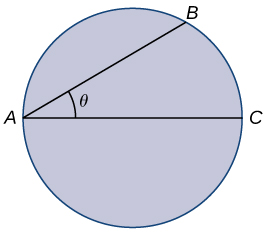
1) Find a function that measures the total amount of time it takes to reach the drowning person as a function of the swim angle, θ.
- Answer
- \(T(θ)=\dfrac{40θ}{3v}+\dfrac{40\cos θ}{v}\)
- Solution
-

Using properties of a circle (as seen in the figure), \(T(θ)=\dfrac{40θ}{3v}+\dfrac{40\cos θ}{v}\).

2) Find at what angle θ the lifeguard should swim to reach the drowning person in the least amount of time.
3) A truck uses gas as \(g(v)=av+\dfrac{b}{v}\), where \(v\) represents the speed of the truck and \(g\) represents the gallons of fuel per mile. At what speed is fuel consumption minimized?
- Answer
- \(v=\sqrt{\dfrac{b}{a}}\)
- Solution
- Given \(g(v)=av+\dfrac{b}{v}\) over the interval \((0, \infty).\) Let’s begin by looking for any critical points of \(g\) over the interval \((0, \infty).\) The derivative is \(g'(v)=a+\dfrac{-b}{v^2}=\dfrac{av^2-b}{v^2} \). If \(g'(v)=0\), then \(av^2-b=0 \implies v=\pm \sqrt{\dfrac{b}{a}}\). Hence the critical point is \(v=\sqrt{\dfrac{b}{a}}\) over the interval \((0, \infty).\) We need to show that \(g\) is minimum when \(v=\sqrt{\dfrac{b}{a}}\). Now we find the second derivative: \(g"(v)=\dfrac{2b}{v^3}\). Consider \(g"(\sqrt{\dfrac{b}{a}})=\dfrac{2b}{\left( \sqrt{\dfrac{b}{a}}\right)^3} >0\). Hence, by the second derivative test \(g\) has a local minimum when \(v=\sqrt{\dfrac{b}{a}}\). Since it is the only local extrema, \(g\) is th absolute minimum when \(v=\sqrt{\dfrac{b}{a}}\). Thus, when the speed is \(v=\sqrt{\dfrac{b}{a}}\), the fuel consumption minimized.
Exercise \(\PageIndex{11}\)
For the following exercises, consider a limousine that gets \(m(v)=(120−2v)5\,mi/gal \) at speed v, the chauffeur costs \(\$15/h\), and gas is \(\$3.5/gal\).
1) Find the cost per mile at speed \(v\).
2) Find the cheapest driving speed.
- Answer
-
approximately \(34.02\) mph
Exercise \(\PageIndex{12}\)
For the following exercises, consider a pizzeria that sells pizzas for a revenue of \(R(x)=ax\) and costs \(C(x)=b+cx+dx^2\), where x represents the number of pizzas.
1) Find the profit function for the number of pizzas. How many pizzas give the largest profit per pizza?
2) Assume that \(R(x)=10x\) and \(C(x)=2x+x^2\). How many pizzas should be sold to maximize the profit?
- Answer
-
Selling \(4\) pizzas will maximize the profit.
3) Assume that \(R(x)=15x\), and \(C(x)=60+3x+12x^2\). How many pizzas should be sold to maximize the profit?
Exercise \(\PageIndex{13}\)
Consider a wire \(4\) ft long, cut into two pieces. One piece forms a circle with radius \(r\) and the other forms a square of side \(x\).
1) Choose \(x\) to maximize the sum of their areas.
- Answer
- \(x = 0\)
2) Choose \(x\) to minimize the sum of their areas.
Exercise \(\PageIndex{14}\)
For the following exercises, consider two non-negative numbers x and y such that \(x+y=10\). Maximize and minimize the quantities.
1) \(xy\)
- Answer
-
Maximal: \(x=5,y=5\); minimal:\(x=0, y=10\) and \(y=0, x=10\)
2) \(x^2 y^2\)
3) \(y−1x\)
- Answer
-
Maximal: \(x=1,y=9\); minimal: none
4) \(x^2-y\)
Exercise \(\PageIndex{15}\)
For the following exercises, draw the given optimization problem and solve.
1) Find the volume of the largest right circular cylinder that fits in a sphere of radius \(1\).
- Answer
-
The largest volume is \(\dfrac{4 \pi}{3 \sqrt{3}}\).
- Solution
-

Figure \(\PageIndex{15}\): a right circular cylinder that fits in a sphere of radius \(1\). (Copyright; Pamini Thangarajah via Tikz library) Let \(r\) be the radius right circular cylinder that fits in a sphere of radius \(1\). Then the height of the right circular cylinder that fits in the sphere is \( 2 \sqrt{1-r^2}\). Hence the volume of the right circular cylinder \(V=2\pi r^2 \sqrt{1-r^2}.\)
From Figure \(\PageIndex{15}\), we see that \(0≤r≤1\). Therefore, \([0,1]\) is the domain of consideration.
Since \(V\) is a continuous function over a closed, bounded interval, it has a maximum and a minimum. Let’s begin by looking for any critical points of \(V\) over the interval \([0,1].\) The derivative is
\[\begin{align*} V'(r) &=4\pi r \sqrt{1-r^2}- 2\pi r^2 \dfrac {1}{\sqrt{1-r^2}}⋅2(−r) \\[5pt] &= 2\pi r \left(2\sqrt{1-r^2}−\dfrac {r^2}{\sqrt{1-r^2}} \right)\end{align*}\]
If \(V′(r)=0,\), then \(r=0\) or \[\begin{align*}2\sqrt{1-r^2} &=\dfrac {r^2}{\sqrt{1-r^2}} \\[5pt] 2(1-r^2)&=r^2 \\[5pt] 3r^2&=2\\[5pt] r&=\sqrt{\dfrac{2}{3}}. \end{align*}\] Now we need to check the values of \(V\) at the endpoints \(r=0\) and \(r=1\), and compare them with the value of \(V\) at the critical point \(r=\sqrt{\dfrac{2}{3}}.\) We find that \(V(0)=0, V(1)=0\) and
\[\begin{align*} V \left( \sqrt{\dfrac{2}{3}}\right) &= 2 \pi \left( \sqrt{\dfrac{2}{3}}\right)^2 \sqrt{1-\left( \sqrt{\dfrac{2}{3}}\right)^2}\\[5pt] &= \dfrac{4 \pi}{3}\sqrt{\dfrac{1}{3}}\\[5pt] &=\dfrac{4 \pi}{3 \sqrt{3}}.\end{align*}\]
Hence the largest volume is \(\dfrac{4 \pi}{3 \sqrt{3}}\).
2) Find the volume of the largest right cone that fits in a sphere of radius 11.
3) Find the area of the largest rectangle that fits into the triangle with sides
\(x=0,\,y=0\) and \(\dfrac{x}{4}+\dfrac{y}{6}=1.\)
- Answer
- \(A = 6\)
- Solution
-
Since \(\dfrac{x}{4}+\dfrac{y}{6}=1, 3x + 2y = 12.\)
We inscribe a rectangle with one corner at the origin and sides along the coordinate axes (see figure). Let the upper right corner of the rectangle be \((x,y)\).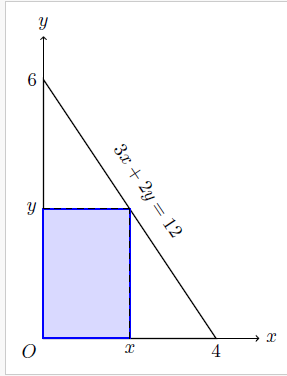
Since this point lies on the line \(3x + 2y = 12\),
\(3x + 2y = 12 \quad \Rightarrow \quad 2y = 12 - 3x \quad \Rightarrow \quad y = \dfrac{12 - 3x}{2}.\)The area \(A\) of the rectangle is
\(A(x) = x y = x \left(\dfrac{12 - 3x}{2}\right)
= \dfrac{12x - 3x^2}{2}
= 6x - \dfrac{3}{2}x^2.\)We wish to maximize \(A(x)\) for \(0 \le x \le 4\) (since the \(x\)-intercept of the line is at \(x=4\)). Differentiate \(A(x)\):
\(
A'(x) = 6 - 3x.
\)
Critical points:
\(
A'(x) = 0 \quad \Rightarrow \quad 6 - 3x = 0 \quad \Rightarrow \quad x = 2.
\)To check that this critical point gives a maximum,
\(x\) \(A(x)= = 6x - \frac{3}{2}x^2\) \(0\) \(0\) \(2\) \(6(2) - \frac{3}{2}2^2=6\) \(4\) \(6(4) - \frac{3}{2}4^2=0\)
From the table, \(A(x)\) has the absolute maximum at \(x = 2\). Now \(
y= \dfrac{12 - 3(2)}{2} = \dfrac{12 - 6}{2} = \dfrac{6}{2} = 3.
\)Therefore, the largest rectangle has a dimension
\(
x = 2,\quad y = 3,
\) and its maximum area is \(6.\)
4) Find the largest volume of a cylinder that fits into a cone that has base radius \(R\) and height \(h\).
5) Find the dimensions of the closed cylinder volume \(V=16 \pi \) that has the least amount of surface area.
- Answer
-
\(r=2, h=4\)
- Solution
-
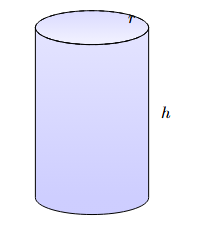
Let \(r\) be the radius of the cylinder and \(h\) be the height of the cylinder. The volume of the cylinder \(
V = \pi r^2 h = 16 \pi\). Then \(h= \dfrac{16}{r^2}.\)The surface area \(S = 2\pi r^2 + 2\pi r h \quad \text{(to minimize)}\)
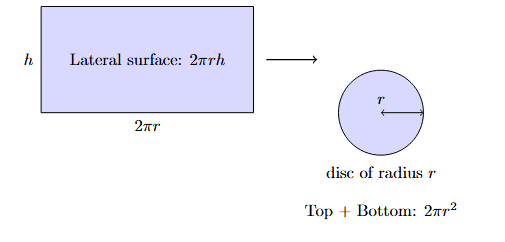
Substitute for \(h\):
\(h = \frac{16}{ r^2}\), Then,
\(
S = 2\pi r^2 + 2\pi r \left( \frac{16}{ r^2} \right)\\
= 2\pi r^2 + \frac{32 \pi}{r},
r \in (0, \infty) \quad \text{(open, infinite interval)}
\)Critical Points:
We start with the surface area function:
\(
S = 2\pi r^2 + \frac{32 \pi}{r}
\)Differentiate with respect to \( r \):
\(
S' = 4\pi r - 32 \pi r^{-2}
\)Simplify:
\(
S' = 4\pi r - \frac{32 \pi}{r^2}
\)
or equivalently,
\(
S' = \frac{4\pi r^3 - 32 \pi}{r^2}
\)Set \( S' = 0 \) to find critical points:
\(
4\pi r^3 - 32 \pi = 0 \implies
4\pi r^3 = 32 \pi \implies
r^3 = \frac{32 \pi}{4\pi} = 8.
\)Therefore,
\(
\boxed{r = \sqrt[3]{8}=2}
\) is a critical point.We need to show that \( S \) has a local minimum when
\(
r =2.
\)From before:
\(
S' =4\pi r - \frac{32 \pi}{r^2}
\)Differentiate again:
\(
S'' = 4\pi - 32 \pi(-2)r^{-3}
= 4\pi + \frac{64 \pi}{r^3}.
\)Now, evaluate \( S'' \) at the critical point:
\(
S''\left( 2 \right)
= 4\pi + \frac{64 \pi}{2^3}
= 4\pi + 8\pi
= 4\pi + 8\pi
= 12\pi > 0.
\)Therefore, by the second derivative test, \( S \) has a local minimum when \(
r = 2.
\) Since it is the only local minimum, \( S \) has the absolute minimum when \(
r = 2,\) and \(h=\frac{16}{ r^2}=\frac{16}{ 2^2}=4.\)
6) Find the dimensions of a right cone with surface area \(S=4 \pi\) that has the largest volume.
Exercise \(\PageIndex{16}\)
For the following exercises, consider the points on the given graphs. Use a calculator to graph the functions.
1) Where is the line \(y=5−2x\) closest to the origin?
- Answer
-
\((2,1)\)
2) Where is the line \(y=5−2x\) closest to the point \((1,1)\)?
3) Where is the parabola \(y=x^2\) closest to the point \((2,0)\)?
- Answer
-
\((0.8351,0.6974)\)
4) Where is the parabola \(y=x^2\) closest to the point \((0,3)\)?
Exercise \(\PageIndex{17}\)
For the following exercises, set up each optimization problem, but do not evaluate it.
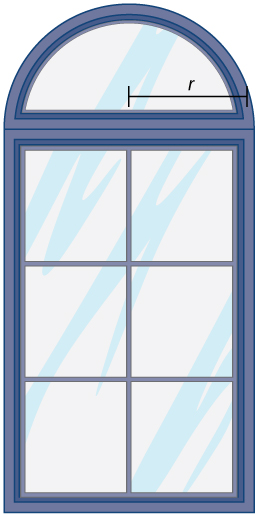
1) A window is composed of a semicircle placed on top of a rectangle. If you have \(20\)ft of window-framing materials for the outer frame, what is the maximum size of the window you can create? Use r to represent the radius of the semicircle.
- Answer
-
\(A=20r−2r^2−\dfrac{1}{2}\pi r^2\)
- Solution
-

The surface area of the window \(A= \dfrac{\pi}{2} r^2+\left(\frac{20-(\pi r-2r)}{2}\right) (2r)=20r−2r^2−\dfrac{1}{2}\pi r^2\).
2) You have a garden row of 20 watermelon plants that produce an average of 30 watermelons apiece. For any additional watermelon plants planted, the output per watermelon plant drops by one watermelon. How many extra watermelon plants should you plant?
3) You are constructing a box for your cat to sleep in. The plush material for the square bottom of the box costs \($5/ft^2\), and the material for the sides costs \($2/ft^2\). You need a box with volume \(4ft^3\). Find the dimensions of the box that minimize cost. Use x to represent the length of the side of the box.
- Answer
-
\(C(x)=5x^2+\dfrac{32}{x}\)
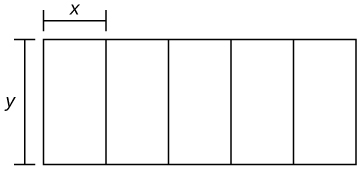
4) You are building five identical pens adjacent to each other with a total area of \(1000m^2\), as shown in the following figure. What dimensions should you use to minimize the amount of fencing?
5) You are the manager of an apartment complex with 50 units. When you set rent at $800/month, all apartments are rented. As you increase rent by $25/month, one fewer apartment is rented. Maintenance costs run $50/month for each occupied unit. What is the rent that maximizes the total amount of profit?
- Answer
-
\(P(x)=(50−x)(800+25x−50)\)
- Solution
-
Let \(x\) be the number of \(\$25\) rent increases. Since rent increased by \(\$25/\)month, one fewer apartment is rented, the rent is \( 800 + 25x\), and the occupied unit is \(50-x.\) Then the revenue is \((800 + 25x)(50-x)\) and the cost is \(50(50-x)\). Hence the profit is \(P(x) = (800 + 25x)(50 - x) - 50(50 - x)=(50−x)(800+25x−50)=(50−x)(750+25x)=37500 + 1250x - 750x - 25x^2=-25x^2 + 500x + 37500.\) Now, \(
P'(x) = -50x + 500.\)
Critical point(s):\(
P'(x) = -50x + 500=0 \implies x=10.
\) To check that this critical point gives a maximum,\(x\) \(P(x)=(50−x)(750+25x)\) \(0\) \((50)(750)=37500\) \(10\) \((40)(1000)=40000\) \(50\) \(0\) Hence, \(x = 10\) gives the absolute maximum. Thus, optimal rent is
\( 800 + 25(10) = 1050\) per month.