

3.4: Maxima and Minima
- Page ID
- 204105

\( \newcommand{\vecs}[1]{\overset { \scriptstyle \rightharpoonup} {\mathbf{#1}} } \)
\( \newcommand{\vecd}[1]{\overset{-\!-\!\rightharpoonup}{\vphantom{a}\smash {#1}}} \)
\( \newcommand{\dsum}{\displaystyle\sum\limits} \)
\( \newcommand{\dint}{\displaystyle\int\limits} \)
\( \newcommand{\dlim}{\displaystyle\lim\limits} \)
\( \newcommand{\id}{\mathrm{id}}\) \( \newcommand{\Span}{\mathrm{span}}\)
( \newcommand{\kernel}{\mathrm{null}\,}\) \( \newcommand{\range}{\mathrm{range}\,}\)
\( \newcommand{\RealPart}{\mathrm{Re}}\) \( \newcommand{\ImaginaryPart}{\mathrm{Im}}\)
\( \newcommand{\Argument}{\mathrm{Arg}}\) \( \newcommand{\norm}[1]{\| #1 \|}\)
\( \newcommand{\inner}[2]{\langle #1, #2 \rangle}\)
\( \newcommand{\Span}{\mathrm{span}}\)
\( \newcommand{\id}{\mathrm{id}}\)
\( \newcommand{\Span}{\mathrm{span}}\)
\( \newcommand{\kernel}{\mathrm{null}\,}\)
\( \newcommand{\range}{\mathrm{range}\,}\)
\( \newcommand{\RealPart}{\mathrm{Re}}\)
\( \newcommand{\ImaginaryPart}{\mathrm{Im}}\)
\( \newcommand{\Argument}{\mathrm{Arg}}\)
\( \newcommand{\norm}[1]{\| #1 \|}\)
\( \newcommand{\inner}[2]{\langle #1, #2 \rangle}\)
\( \newcommand{\Span}{\mathrm{span}}\) \( \newcommand{\AA}{\unicode[.8,0]{x212B}}\)
\( \newcommand{\vectorA}[1]{\vec{#1}} % arrow\)
\( \newcommand{\vectorAt}[1]{\vec{\text{#1}}} % arrow\)
\( \newcommand{\vectorB}[1]{\overset { \scriptstyle \rightharpoonup} {\mathbf{#1}} } \)
\( \newcommand{\vectorC}[1]{\textbf{#1}} \)
\( \newcommand{\vectorD}[1]{\overrightarrow{#1}} \)
\( \newcommand{\vectorDt}[1]{\overrightarrow{\text{#1}}} \)
\( \newcommand{\vectE}[1]{\overset{-\!-\!\rightharpoonup}{\vphantom{a}\smash{\mathbf {#1}}}} \)
\( \newcommand{\vecs}[1]{\overset { \scriptstyle \rightharpoonup} {\mathbf{#1}} } \)
\(\newcommand{\longvect}{\overrightarrow}\)
\( \newcommand{\vecd}[1]{\overset{-\!-\!\rightharpoonup}{\vphantom{a}\smash {#1}}} \)
\(\newcommand{\avec}{\mathbf a}\) \(\newcommand{\bvec}{\mathbf b}\) \(\newcommand{\cvec}{\mathbf c}\) \(\newcommand{\dvec}{\mathbf d}\) \(\newcommand{\dtil}{\widetilde{\mathbf d}}\) \(\newcommand{\evec}{\mathbf e}\) \(\newcommand{\fvec}{\mathbf f}\) \(\newcommand{\nvec}{\mathbf n}\) \(\newcommand{\pvec}{\mathbf p}\) \(\newcommand{\qvec}{\mathbf q}\) \(\newcommand{\svec}{\mathbf s}\) \(\newcommand{\tvec}{\mathbf t}\) \(\newcommand{\uvec}{\mathbf u}\) \(\newcommand{\vvec}{\mathbf v}\) \(\newcommand{\wvec}{\mathbf w}\) \(\newcommand{\xvec}{\mathbf x}\) \(\newcommand{\yvec}{\mathbf y}\) \(\newcommand{\zvec}{\mathbf z}\) \(\newcommand{\rvec}{\mathbf r}\) \(\newcommand{\mvec}{\mathbf m}\) \(\newcommand{\zerovec}{\mathbf 0}\) \(\newcommand{\onevec}{\mathbf 1}\) \(\newcommand{\real}{\mathbb R}\) \(\newcommand{\twovec}[2]{\left[\begin{array}{r}#1 \\ #2 \end{array}\right]}\) \(\newcommand{\ctwovec}[2]{\left[\begin{array}{c}#1 \\ #2 \end{array}\right]}\) \(\newcommand{\threevec}[3]{\left[\begin{array}{r}#1 \\ #2 \\ #3 \end{array}\right]}\) \(\newcommand{\cthreevec}[3]{\left[\begin{array}{c}#1 \\ #2 \\ #3 \end{array}\right]}\) \(\newcommand{\fourvec}[4]{\left[\begin{array}{r}#1 \\ #2 \\ #3 \\ #4 \end{array}\right]}\) \(\newcommand{\cfourvec}[4]{\left[\begin{array}{c}#1 \\ #2 \\ #3 \\ #4 \end{array}\right]}\) \(\newcommand{\fivevec}[5]{\left[\begin{array}{r}#1 \\ #2 \\ #3 \\ #4 \\ #5 \\ \end{array}\right]}\) \(\newcommand{\cfivevec}[5]{\left[\begin{array}{c}#1 \\ #2 \\ #3 \\ #4 \\ #5 \\ \end{array}\right]}\) \(\newcommand{\mattwo}[4]{\left[\begin{array}{rr}#1 \amp #2 \\ #3 \amp #4 \\ \end{array}\right]}\) \(\newcommand{\laspan}[1]{\text{Span}\{#1\}}\) \(\newcommand{\bcal}{\cal B}\) \(\newcommand{\ccal}{\cal C}\) \(\newcommand{\scal}{\cal S}\) \(\newcommand{\wcal}{\cal W}\) \(\newcommand{\ecal}{\cal E}\) \(\newcommand{\coords}[2]{\left\{#1\right\}_{#2}}\) \(\newcommand{\gray}[1]{\color{gray}{#1}}\) \(\newcommand{\lgray}[1]{\color{lightgray}{#1}}\) \(\newcommand{\rank}{\operatorname{rank}}\) \(\newcommand{\row}{\text{Row}}\) \(\newcommand{\col}{\text{Col}}\) \(\renewcommand{\row}{\text{Row}}\) \(\newcommand{\nul}{\text{Nul}}\) \(\newcommand{\var}{\text{Var}}\) \(\newcommand{\corr}{\text{corr}}\) \(\newcommand{\len}[1]{\left|#1\right|}\) \(\newcommand{\bbar}{\overline{\bvec}}\) \(\newcommand{\bhat}{\widehat{\bvec}}\) \(\newcommand{\bperp}{\bvec^\perp}\) \(\newcommand{\xhat}{\widehat{\xvec}}\) \(\newcommand{\vhat}{\widehat{\vvec}}\) \(\newcommand{\uhat}{\widehat{\uvec}}\) \(\newcommand{\what}{\widehat{\wvec}}\) \(\newcommand{\Sighat}{\widehat{\Sigma}}\) \(\newcommand{\lt}{<}\) \(\newcommand{\gt}{>}\) \(\newcommand{\amp}{&}\) \(\definecolor{fillinmathshade}{gray}{0.9}\)3.4 Maxima and Minima
- Explain the difference between absolute and local extrema, identifying how they relate to the global behavior and local behavior of a function.
- Determine the critical points of a function over a closed interval and use them, along with the endpoints of the interval, to identify absolute and local extreme values.
Let \( c \) be a number in the domain \( D \) of a function \( f \). Then:
- \( f(c) \) is the absolute maximum value of \( f \) on \( D \) if \( f(c) \geq f(x) \quad \text{for all } x \in D\)
- \( f(c) \) is the absolute minimum value of \( f \) on \( D \) if \( f(c) \leq f(x) \quad \text{for all } x \in D \)
![This figure has six parts a, b, c, d, e, and f. In figure a, the line f(x) = x^3 is shown, and it is noted that it has no absolute minimum and no absolute maximum. In figure b, the line f(x) = 1/(x^2 + 1) is shown, which is near 0 for most of its length and rises to a bump at (0, 1); it has no absolute minimum, but does have an absolute maximum of 1 at x = 0. In figure c, the line f(x) = cos x is shown, which has absolute minimums of −1 at ±π, ±3π, … and absolute maximums of 1 at 0, ±2π, ±4π, …. In figure d, the piecewise function f(x) = 2 – x^2 for 0 ≤ x < 2 and x – 3 for 2 ≤ x ≤ 4 is shown, with absolute maximum of 2 at x = 0 and no absolute minimum. In figure e, the function f(x) = (x – 2)2 is shown on [1, 4], which has absolute maximum of 4 at x = 4 and absolute minimum of 0 at x = 2. In figure f, the function f(x) = x/(2 − x) is shown on [0, 2), with absolute minimum of 0 at x = 0 and no absolute maximum.](https://math.libretexts.org/@api/deki/files/2406/CNX_Calc_Figure_04_03_010.jpeg?revision=1&size=bestfit&width=923&height=900)
Figure \(\PageIndex{4}\): Graphs showing several possibilities for absolute extrema for functions with a domain that is a bounded interval. From OpenStax Calculus Volume 1, licensed under CC-BY-NC-SA.
Use the graph of \( y = f(x) \) below to find the absolute minimum and maximum values (if any).

Figure \(\PageIndex{5}\). A function to find absolute maximum and minimum values
Suppose that \( f \) is continuous on the closed interval \( [a, b] \). Then \( f \) attains both an absolute maximum value \( f(c) \) and an absolute minimum value \( f(d) \) at some numbers \( c \) and \( d \) in \( [a, b] \).
Let \( c \) be a number in the domain \( D \) of a function \( f \). Then:
- \( f(c) \) is a local maximum value of \( f \) if \( f(c) \geq f(x) \quad \text{for all } x \text{ near } c\)
- \( f(c) \) is a local minimum value of \( f \) if \( f(c) \leq f(x) \quad \text{for all } x \text{ near } c\)
The maximum and minimum values of \( f \) are called local extreme values of \( f \).
Find local extreme values from the graph above (Figure 3.5)
A critical number of a function \( f \) is a number \( c \) in the domain of \( f \) such that either \( f'(c) = 0 \quad \text{or} \quad f'(c) \text{ does not exist.}\) The point \( (c, f(c)) \) is called a critical point of \( f \).
Suppose that \( f \) has a local maximum or minimum at \( c \). If \( f'(c) \) exists, then \( f'(c) = 0\)
If \( f \) has a local maximum or minimum at \( c \), then \( c \) is a critical number of \( f \).
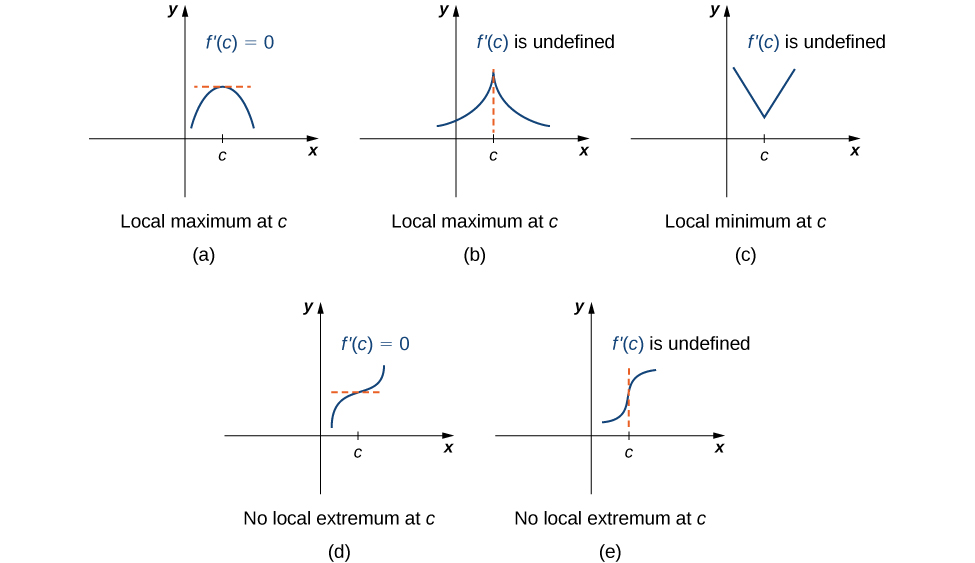
Figure \(\PageIndex{6}\): Functions illustrating possible local extreme values. From OpenStax Calculus Volume 1, licensed under CC-BY-NC-SA.
For the functions below, find all critical numbers.
- \( y= x^3 - 6x^2 + 9x + 5 \)
- \( y = 2(x^2 - 4)^3 \)
- \( y = (4x - 4)e^{-2x} \)
- \( y = \dfrac{x + 5}{x^2 - 9} \)
The Closed Interval Method:
If we want to find the absolute maximum and minimum values of a continuous function \( f \) on a closed interval \( [a, b] \), we can follow these steps:
- Find the critical numbers of \( f \) in the open interval \( (a, b) \).
- Evaluate \( f \) at each critical number found in Step 1.
- Evaluate \( f \) at the endpoints of the interval: \( x = a \) and \( x = b \).
- The largest of the values from Steps 2 and 3 is the absolute maximum value. The smallest of these values is the absolute minimum value.
For each of the following functions, find the absolute maximum and absolute minimum over the specified interval. State the values and where they occur.
- \( y = x^3 - 6x^2 + 9x + 5 \) over the interval \( [-1, 5] \)
- \( y = 2x - 4\sin x \) over the interval \( [0, \pi] \)
- \( y =13\ln x-14\sqrt{x}+10\) over the interval \([2, 9]\)