

4.7E: Exercises for Section 4.7
- Page ID
- 149910

\( \newcommand{\vecs}[1]{\overset { \scriptstyle \rightharpoonup} {\mathbf{#1}} } \)
\( \newcommand{\vecd}[1]{\overset{-\!-\!\rightharpoonup}{\vphantom{a}\smash {#1}}} \)
\( \newcommand{\dsum}{\displaystyle\sum\limits} \)
\( \newcommand{\dint}{\displaystyle\int\limits} \)
\( \newcommand{\dlim}{\displaystyle\lim\limits} \)
\( \newcommand{\id}{\mathrm{id}}\) \( \newcommand{\Span}{\mathrm{span}}\)
( \newcommand{\kernel}{\mathrm{null}\,}\) \( \newcommand{\range}{\mathrm{range}\,}\)
\( \newcommand{\RealPart}{\mathrm{Re}}\) \( \newcommand{\ImaginaryPart}{\mathrm{Im}}\)
\( \newcommand{\Argument}{\mathrm{Arg}}\) \( \newcommand{\norm}[1]{\| #1 \|}\)
\( \newcommand{\inner}[2]{\langle #1, #2 \rangle}\)
\( \newcommand{\Span}{\mathrm{span}}\)
\( \newcommand{\id}{\mathrm{id}}\)
\( \newcommand{\Span}{\mathrm{span}}\)
\( \newcommand{\kernel}{\mathrm{null}\,}\)
\( \newcommand{\range}{\mathrm{range}\,}\)
\( \newcommand{\RealPart}{\mathrm{Re}}\)
\( \newcommand{\ImaginaryPart}{\mathrm{Im}}\)
\( \newcommand{\Argument}{\mathrm{Arg}}\)
\( \newcommand{\norm}[1]{\| #1 \|}\)
\( \newcommand{\inner}[2]{\langle #1, #2 \rangle}\)
\( \newcommand{\Span}{\mathrm{span}}\) \( \newcommand{\AA}{\unicode[.8,0]{x212B}}\)
\( \newcommand{\vectorA}[1]{\vec{#1}} % arrow\)
\( \newcommand{\vectorAt}[1]{\vec{\text{#1}}} % arrow\)
\( \newcommand{\vectorB}[1]{\overset { \scriptstyle \rightharpoonup} {\mathbf{#1}} } \)
\( \newcommand{\vectorC}[1]{\textbf{#1}} \)
\( \newcommand{\vectorD}[1]{\overrightarrow{#1}} \)
\( \newcommand{\vectorDt}[1]{\overrightarrow{\text{#1}}} \)
\( \newcommand{\vectE}[1]{\overset{-\!-\!\rightharpoonup}{\vphantom{a}\smash{\mathbf {#1}}}} \)
\( \newcommand{\vecs}[1]{\overset { \scriptstyle \rightharpoonup} {\mathbf{#1}} } \)
\(\newcommand{\longvect}{\overrightarrow}\)
\( \newcommand{\vecd}[1]{\overset{-\!-\!\rightharpoonup}{\vphantom{a}\smash {#1}}} \)
\(\newcommand{\avec}{\mathbf a}\) \(\newcommand{\bvec}{\mathbf b}\) \(\newcommand{\cvec}{\mathbf c}\) \(\newcommand{\dvec}{\mathbf d}\) \(\newcommand{\dtil}{\widetilde{\mathbf d}}\) \(\newcommand{\evec}{\mathbf e}\) \(\newcommand{\fvec}{\mathbf f}\) \(\newcommand{\nvec}{\mathbf n}\) \(\newcommand{\pvec}{\mathbf p}\) \(\newcommand{\qvec}{\mathbf q}\) \(\newcommand{\svec}{\mathbf s}\) \(\newcommand{\tvec}{\mathbf t}\) \(\newcommand{\uvec}{\mathbf u}\) \(\newcommand{\vvec}{\mathbf v}\) \(\newcommand{\wvec}{\mathbf w}\) \(\newcommand{\xvec}{\mathbf x}\) \(\newcommand{\yvec}{\mathbf y}\) \(\newcommand{\zvec}{\mathbf z}\) \(\newcommand{\rvec}{\mathbf r}\) \(\newcommand{\mvec}{\mathbf m}\) \(\newcommand{\zerovec}{\mathbf 0}\) \(\newcommand{\onevec}{\mathbf 1}\) \(\newcommand{\real}{\mathbb R}\) \(\newcommand{\twovec}[2]{\left[\begin{array}{r}#1 \\ #2 \end{array}\right]}\) \(\newcommand{\ctwovec}[2]{\left[\begin{array}{c}#1 \\ #2 \end{array}\right]}\) \(\newcommand{\threevec}[3]{\left[\begin{array}{r}#1 \\ #2 \\ #3 \end{array}\right]}\) \(\newcommand{\cthreevec}[3]{\left[\begin{array}{c}#1 \\ #2 \\ #3 \end{array}\right]}\) \(\newcommand{\fourvec}[4]{\left[\begin{array}{r}#1 \\ #2 \\ #3 \\ #4 \end{array}\right]}\) \(\newcommand{\cfourvec}[4]{\left[\begin{array}{c}#1 \\ #2 \\ #3 \\ #4 \end{array}\right]}\) \(\newcommand{\fivevec}[5]{\left[\begin{array}{r}#1 \\ #2 \\ #3 \\ #4 \\ #5 \\ \end{array}\right]}\) \(\newcommand{\cfivevec}[5]{\left[\begin{array}{c}#1 \\ #2 \\ #3 \\ #4 \\ #5 \\ \end{array}\right]}\) \(\newcommand{\mattwo}[4]{\left[\begin{array}{rr}#1 \amp #2 \\ #3 \amp #4 \\ \end{array}\right]}\) \(\newcommand{\laspan}[1]{\text{Span}\{#1\}}\) \(\newcommand{\bcal}{\cal B}\) \(\newcommand{\ccal}{\cal C}\) \(\newcommand{\scal}{\cal S}\) \(\newcommand{\wcal}{\cal W}\) \(\newcommand{\ecal}{\cal E}\) \(\newcommand{\coords}[2]{\left\{#1\right\}_{#2}}\) \(\newcommand{\gray}[1]{\color{gray}{#1}}\) \(\newcommand{\lgray}[1]{\color{lightgray}{#1}}\) \(\newcommand{\rank}{\operatorname{rank}}\) \(\newcommand{\row}{\text{Row}}\) \(\newcommand{\col}{\text{Col}}\) \(\renewcommand{\row}{\text{Row}}\) \(\newcommand{\nul}{\text{Nul}}\) \(\newcommand{\var}{\text{Var}}\) \(\newcommand{\corr}{\text{corr}}\) \(\newcommand{\len}[1]{\left|#1\right|}\) \(\newcommand{\bbar}{\overline{\bvec}}\) \(\newcommand{\bhat}{\widehat{\bvec}}\) \(\newcommand{\bperp}{\bvec^\perp}\) \(\newcommand{\xhat}{\widehat{\xvec}}\) \(\newcommand{\vhat}{\widehat{\vvec}}\) \(\newcommand{\uhat}{\widehat{\uvec}}\) \(\newcommand{\what}{\widehat{\wvec}}\) \(\newcommand{\Sighat}{\widehat{\Sigma}}\) \(\newcommand{\lt}{<}\) \(\newcommand{\gt}{>}\) \(\newcommand{\amp}{&}\) \(\definecolor{fillinmathshade}{gray}{0.9}\)For exercises 1 - 2, determine the area of the region between the two curves in the given figure by integrating over the \(x\)-axis.
1) \(y=x^2−3\) and \(y=1\)
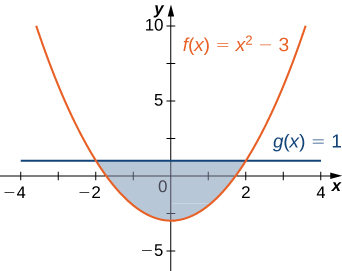
- Answer
- \(\dfrac{32}{3} \, \text{units}^2\)
2) \(y=x^2\) and \(y=3x+4\)
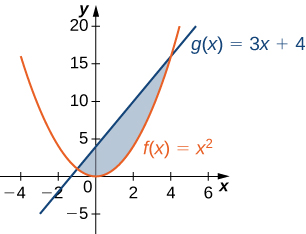
For exercise 3, split the region between the two curves into two smaller regions, then determine the area by integrating over the \(x\)-axis. Note that you will have two integrals to solve.
3) \(y=x^3\) and \( y=x^2+x\)
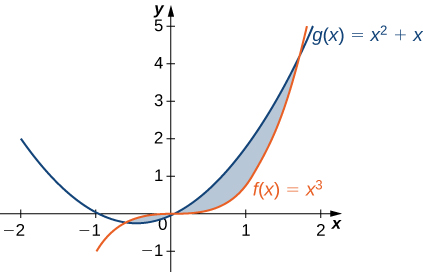
- Answer
- \(\dfrac{13}{12}\, \text{units}^2\)
For exercises 4-5, determine the area of the region between the two curves by integrating over the \(y\)-axis.
4) \(x=y^2\) and \(x=9\)
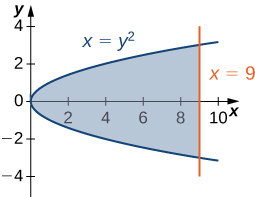
- Answer
- \(36 \, \text{units}^2\)
5) \(y=x\) and \( x=y^2\)
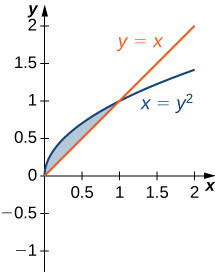
For exercises 6-12, graph the equations and shade the area of the region between the curves. Determine its area by integrating over the \(x\)-axis.
6) \(y=x^2\) and \(y=−x^2+18x\)
- Answer
-
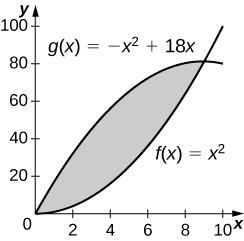
243 square units
7) \(y=\dfrac{1}{x}, \quad y=\dfrac{1}{x^2}\), and \(x=3\)
8) \(y=\sqrt{x}\) and \(y=x^2\)
- Answer
-

1/3 square units
9) \(y=e^x,\quad y=e^{2x−1}\), and \(x=0\)
10) \(y=e^x, \quad y=e^{−x}, \quad x=−1\) and \(x=1\)
- Answer
-
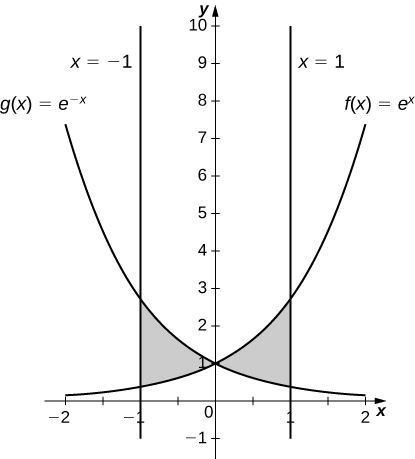
\(\dfrac{2(e−1)^2}{e}\, \text{units}^2\)
11) \( y=e, \quad y=e^x,\) and \(y=e^{−x}\)
12) \(y=|x|\) and \(y=x^2\)
- Answer
-
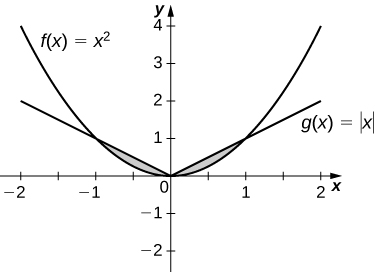
\(\dfrac{1}{3}\, \text{units}^2\)
For exercises 13-18, graph the equations and shade the area of the region between the curves. If necessary, break the region into sub-regions to determine its entire area.
13) \(y=8-2x,\quad y=x,\) and \(y=0\)
14) \(y=12−x,\quad y=\sqrt{x},\) and \(y=1\)
- Answer
-
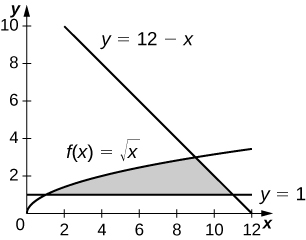
\(\dfrac{34}{3}\, \text{units}^2\)
15) \(y=x^2\) and \(y=\frac{8}{x}\) and \(y=1\)
16) \(y=x^3\) and \(y=x^2−2x\) over \(x \in [−1,1]\)
- Answer
-
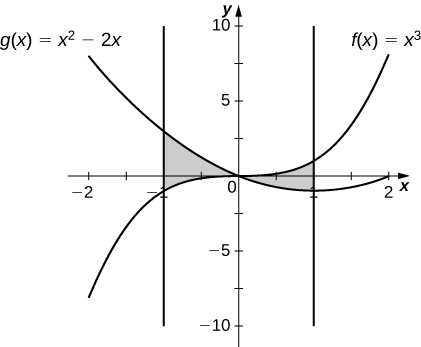
\(\dfrac{5}{2}\, \text{units}^2\)
17) \(y=x^2+9\) and \( y=10+2x\) over \(x \in [−1,3]\)
18) \(y=x^3+3x\) and \(y=4x\)
- Answer
-
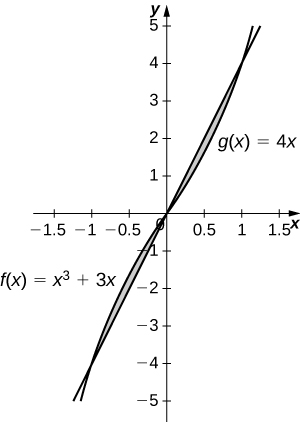
\(\dfrac{1}{2}\, \text{units}^2\)
For exercises 19-22, graph the equations and shade the area of the region between the curves. Determine its area by integrating over the \(y\)-axis.
19) \(x=y^3\) and \( x = 3y−2\)
20) \(x=y\) and \( x=y^3−y\)
- Answer
-
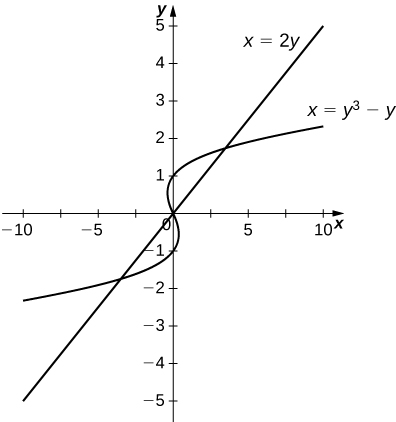
\(\dfrac{9}{2}\, \text{units}^2\)
21) \(x=−3+y^2\) and \( x=y−y^2\)
22) \(y^2=x\) and \(x=y+2\)
- Answer
-
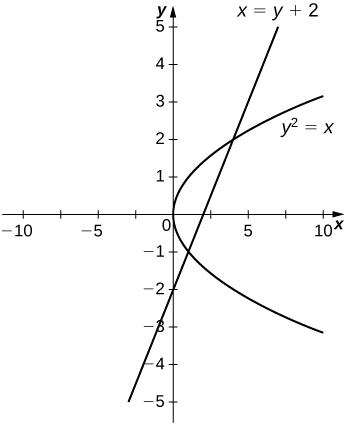
\(\dfrac{9}{2}\, \text{units}^2\)
For exercises 23-29, graph the equations and shade the area of the region between the curves. Determine its area by integrating over the \(x\)-axis or \(y\)-axis, whichever seems more convenient.
23) \(x=y^4\) and \(x=y^5\)
24) \(y=x^6\) and \(y=x^4\)
25) \(x=y^3+2y^2+1\) and \(x=−y^2+1\)
- Answer
-
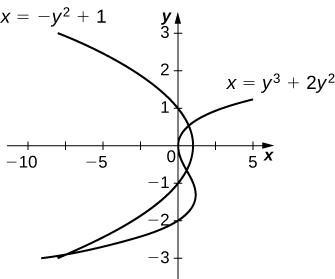
\(\dfrac{27}{4}\, \text{units}^2\)
26) \( y=|x|\) and \( y=x^2−1\)
27) \(y=4−3x\) and \(y=\dfrac{1}{x}\)
- Answer
-
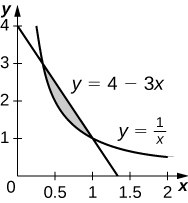
\(\left(\dfrac{4}{3}−\ln(3)\right)\, \text{units}^2\)
28) \(y=x^2−3x+2\) and \( y=x^3−2x^2−x+2\)
- Answer
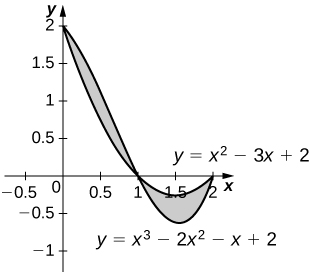
\(\dfrac{1}{2}\) square units
29) \(y+y^3=x\) and \(2y=x\)
- Answer
-
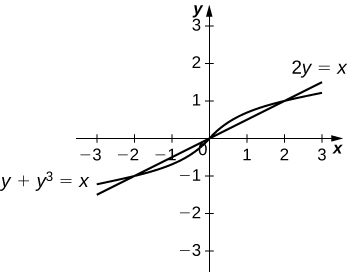
\(\dfrac{1}{2}\) square units
30) A factory selling cell phones has a marginal cost function \(C(x)=0.01x^2−3x+229\), where \(x\) represents the number of cell phones, and a marginal revenue function given by \(R(x)=429−2x.\) Find the area between the graphs of these curves and \(x=0.\) What does this area represent?
- Answer
- $33,333.33 total profit for 200 cell phones sold
31) An amusement park has a marginal cost function \(C(x)=1000e−x+5\), where \(x\) represents the number of tickets sold, and a marginal revenue function given by \(R(x)=60−0.1x\). Find the total profit generated when selling \(550\) tickets. Use a calculator to determine intersection points, if necessary, to two decimal places.
Contributors
Gilbert Strang (MIT) and Edwin “Jed” Herman (Harvey Mudd) with many contributing authors. This content by OpenStax is licensed with a CC-BY-SA-NC 4.0 license. Download for free at http://cnx.org.