

7.A: Answers
- Page ID
- 212068

\( \newcommand{\vecs}[1]{\overset { \scriptstyle \rightharpoonup} {\mathbf{#1}} } \)
\( \newcommand{\vecd}[1]{\overset{-\!-\!\rightharpoonup}{\vphantom{a}\smash {#1}}} \)
\( \newcommand{\dsum}{\displaystyle\sum\limits} \)
\( \newcommand{\dint}{\displaystyle\int\limits} \)
\( \newcommand{\dlim}{\displaystyle\lim\limits} \)
\( \newcommand{\id}{\mathrm{id}}\) \( \newcommand{\Span}{\mathrm{span}}\)
( \newcommand{\kernel}{\mathrm{null}\,}\) \( \newcommand{\range}{\mathrm{range}\,}\)
\( \newcommand{\RealPart}{\mathrm{Re}}\) \( \newcommand{\ImaginaryPart}{\mathrm{Im}}\)
\( \newcommand{\Argument}{\mathrm{Arg}}\) \( \newcommand{\norm}[1]{\| #1 \|}\)
\( \newcommand{\inner}[2]{\langle #1, #2 \rangle}\)
\( \newcommand{\Span}{\mathrm{span}}\)
\( \newcommand{\id}{\mathrm{id}}\)
\( \newcommand{\Span}{\mathrm{span}}\)
\( \newcommand{\kernel}{\mathrm{null}\,}\)
\( \newcommand{\range}{\mathrm{range}\,}\)
\( \newcommand{\RealPart}{\mathrm{Re}}\)
\( \newcommand{\ImaginaryPart}{\mathrm{Im}}\)
\( \newcommand{\Argument}{\mathrm{Arg}}\)
\( \newcommand{\norm}[1]{\| #1 \|}\)
\( \newcommand{\inner}[2]{\langle #1, #2 \rangle}\)
\( \newcommand{\Span}{\mathrm{span}}\) \( \newcommand{\AA}{\unicode[.8,0]{x212B}}\)
\( \newcommand{\vectorA}[1]{\vec{#1}} % arrow\)
\( \newcommand{\vectorAt}[1]{\vec{\text{#1}}} % arrow\)
\( \newcommand{\vectorB}[1]{\overset { \scriptstyle \rightharpoonup} {\mathbf{#1}} } \)
\( \newcommand{\vectorC}[1]{\textbf{#1}} \)
\( \newcommand{\vectorD}[1]{\overrightarrow{#1}} \)
\( \newcommand{\vectorDt}[1]{\overrightarrow{\text{#1}}} \)
\( \newcommand{\vectE}[1]{\overset{-\!-\!\rightharpoonup}{\vphantom{a}\smash{\mathbf {#1}}}} \)
\( \newcommand{\vecs}[1]{\overset { \scriptstyle \rightharpoonup} {\mathbf{#1}} } \)
\(\newcommand{\longvect}{\overrightarrow}\)
\( \newcommand{\vecd}[1]{\overset{-\!-\!\rightharpoonup}{\vphantom{a}\smash {#1}}} \)
\(\newcommand{\avec}{\mathbf a}\) \(\newcommand{\bvec}{\mathbf b}\) \(\newcommand{\cvec}{\mathbf c}\) \(\newcommand{\dvec}{\mathbf d}\) \(\newcommand{\dtil}{\widetilde{\mathbf d}}\) \(\newcommand{\evec}{\mathbf e}\) \(\newcommand{\fvec}{\mathbf f}\) \(\newcommand{\nvec}{\mathbf n}\) \(\newcommand{\pvec}{\mathbf p}\) \(\newcommand{\qvec}{\mathbf q}\) \(\newcommand{\svec}{\mathbf s}\) \(\newcommand{\tvec}{\mathbf t}\) \(\newcommand{\uvec}{\mathbf u}\) \(\newcommand{\vvec}{\mathbf v}\) \(\newcommand{\wvec}{\mathbf w}\) \(\newcommand{\xvec}{\mathbf x}\) \(\newcommand{\yvec}{\mathbf y}\) \(\newcommand{\zvec}{\mathbf z}\) \(\newcommand{\rvec}{\mathbf r}\) \(\newcommand{\mvec}{\mathbf m}\) \(\newcommand{\zerovec}{\mathbf 0}\) \(\newcommand{\onevec}{\mathbf 1}\) \(\newcommand{\real}{\mathbb R}\) \(\newcommand{\twovec}[2]{\left[\begin{array}{r}#1 \\ #2 \end{array}\right]}\) \(\newcommand{\ctwovec}[2]{\left[\begin{array}{c}#1 \\ #2 \end{array}\right]}\) \(\newcommand{\threevec}[3]{\left[\begin{array}{r}#1 \\ #2 \\ #3 \end{array}\right]}\) \(\newcommand{\cthreevec}[3]{\left[\begin{array}{c}#1 \\ #2 \\ #3 \end{array}\right]}\) \(\newcommand{\fourvec}[4]{\left[\begin{array}{r}#1 \\ #2 \\ #3 \\ #4 \end{array}\right]}\) \(\newcommand{\cfourvec}[4]{\left[\begin{array}{c}#1 \\ #2 \\ #3 \\ #4 \end{array}\right]}\) \(\newcommand{\fivevec}[5]{\left[\begin{array}{r}#1 \\ #2 \\ #3 \\ #4 \\ #5 \\ \end{array}\right]}\) \(\newcommand{\cfivevec}[5]{\left[\begin{array}{c}#1 \\ #2 \\ #3 \\ #4 \\ #5 \\ \end{array}\right]}\) \(\newcommand{\mattwo}[4]{\left[\begin{array}{rr}#1 \amp #2 \\ #3 \amp #4 \\ \end{array}\right]}\) \(\newcommand{\laspan}[1]{\text{Span}\{#1\}}\) \(\newcommand{\bcal}{\cal B}\) \(\newcommand{\ccal}{\cal C}\) \(\newcommand{\scal}{\cal S}\) \(\newcommand{\wcal}{\cal W}\) \(\newcommand{\ecal}{\cal E}\) \(\newcommand{\coords}[2]{\left\{#1\right\}_{#2}}\) \(\newcommand{\gray}[1]{\color{gray}{#1}}\) \(\newcommand{\lgray}[1]{\color{lightgray}{#1}}\) \(\newcommand{\rank}{\operatorname{rank}}\) \(\newcommand{\row}{\text{Row}}\) \(\newcommand{\col}{\text{Col}}\) \(\renewcommand{\row}{\text{Row}}\) \(\newcommand{\nul}{\text{Nul}}\) \(\newcommand{\var}{\text{Var}}\) \(\newcommand{\corr}{\text{corr}}\) \(\newcommand{\len}[1]{\left|#1\right|}\) \(\newcommand{\bbar}{\overline{\bvec}}\) \(\newcommand{\bhat}{\widehat{\bvec}}\) \(\newcommand{\bperp}{\bvec^\perp}\) \(\newcommand{\xhat}{\widehat{\xvec}}\) \(\newcommand{\vhat}{\widehat{\vvec}}\) \(\newcommand{\uhat}{\widehat{\uvec}}\) \(\newcommand{\what}{\widehat{\wvec}}\) \(\newcommand{\Sighat}{\widehat{\Sigma}}\) \(\newcommand{\lt}{<}\) \(\newcommand{\gt}{>}\) \(\newcommand{\amp}{&}\) \(\definecolor{fillinmathshade}{gray}{0.9}\)Section 7.1
- \(f(x)\) and \(y = 3-x\) are one-to-one because their graphs pass the horizontal line test (HLT); \(g(x)\) is not one-to-one because \(g(1) = g(4)\); \(h\) is not because its graph fails the HLT.
- The graph of \(f(x)\) fails the HLT; \(y = e^x-2\) is one-to-one because \(y' = e^x >0\) (see Problem 13); \(g(x)\) is one-to-one because the output values are all distinct; the graph of \(h\) passes the HLT.
- The relation is a function if the domain is all people with a Social Security number; ideally, it is a one-to-one function (but due to identity theft and other issues may not be so in practice).
- No two students received the same score.
- At most one.
-
- Yes (graph passes HLT).
- No, \(f(0) > f(1)\).
- No, \(f(0) < f(0.5)\).
- \(f'(x) = \frac{1}{x} > 0\) for all \(x > 0\). If \( 0 < a < b \) with \(f(a) = f(b)\), then Rolle’s Theorem guarantees a \(c\) with \( a < c < b \) and \( f'(c) = 0 \), which is impossible. Hence \( f(a) \neq f(b) \)for any \( a \neq b \) on \( (0,\infty) \), which proves that \(f(x)\) is one-to-one.
-
- Yes (each input has exactly one output).
- Yes (each input appears only once).
- cde
- Interchanging inputs and outputs:
a b c d e f f e b a d c - Interchanging inputs and outputs:
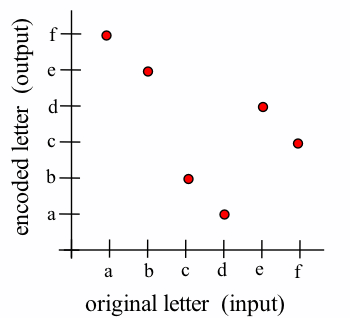
- They are reflections of each other.
-
- Yes (each output appears only once).
- Yes (each input appears only once).
- fda
- Interchanging inputs and outputs:
a b c d e f d c f e b a - Interchanging inputs and outputs:
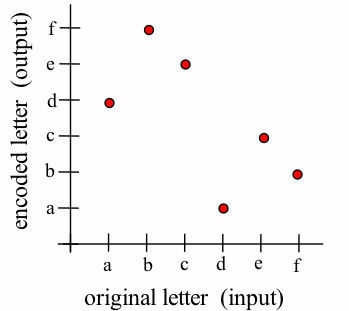
- It’s the same! (Function is its own inverse.)
Section 7.2
-
\(x\) \(f(x)\) \(f'(x)\) \(f^{-1}(x)\) \(\left(f^{-1}\right)'(x)\) \(1\) \(3\) \(-3\) \(2\) \(\frac12\) \(2\) \(1\) \(2\) \(3\) \(\frac13\) \(3\) \(2\) \(3\) \(1\) \(-\frac13\) -
\(x\) \(h(x)\) \(h'(x)\) \(h^{-1}(x)\) \(\left(h^{-1}\right)'(x)\) \(1\) \(2\) \(2\) \(3\) undefined \(2\) \(3\) \(-2\) \(1\) \(\frac12\) \(3\) \(1\) \(0\) \(2\) \(-\frac12\) - The graphs of \(f\) and \(f^{-1}\) appear below:

- \(a=b\)
- (1) Multiply by \(4\), (2) add \(5\) and (3) divide by \(7\): \(\displaystyle f^{-1}(x) = \frac{4x+5}{7}\)
- \(g^{-1}(x) = \frac{x-1}{2}\), hence \(g^{-1}\left(g(1)\right) = \frac{3-1}{2} = 1\) and \(g^{-1}\left(g(7)\right) = \frac{15-1}{2} = 7\).
- \(\displaystyle w^{-1}(x) = e^{x-5}\), so \(w^{-1}\left(w(1)\right) = e^{5-5} = 1\).
- The graph of \(f^{-1}\) goes through \((3,1)\) and \(\displaystyle \left(f^{-1}\right)'(3) = \frac{1}{f'(1)} > 0\).
- \(\displaystyle \left(f^{-1}\right)'(x) = \frac{1}{f'\left(f^{-1}(x)\right)} > 0\), so both \(f\) and \(f^{-1}\) are increasing functions.
- \(\displaystyle f(x) = x + 2 \Rightarrow f^{-1}(x) = x-2\) both have slope \(1\) (hence are parallel) but different \(y\)-intercepts.
- \(f'(x) = 3 + \cos(x) \geq 2 > 0\), so \(f(x)\) is increasing, hence one-to-one.
- \(\displaystyle x = \frac{ay+b}{cy-a} \Rightarrow cxy-ax = ay + b \Rightarrow (cx-a)y = ax+b \Rightarrow y = \frac{ax+b}{cx-a}\) so the function in (d) is its own inverse, and the functions in (a), (b) and (c) are all special cases of (d).
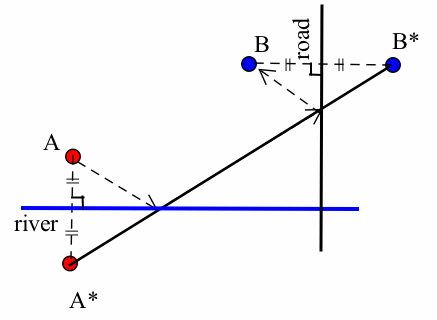
- Fold across the river to generate point \(A^*\) (see figure below) then unfold; fold across the road to generate the point \(B^*\), then unfold; connect \(A^*\) and \(B^*\) with a line; fold the line across the river and the road to get the shortest path:
- Fold across the wall:
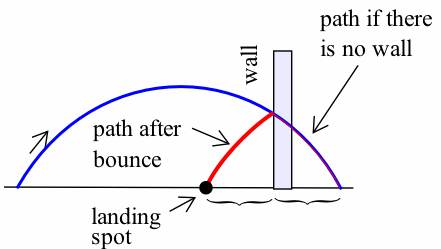
The distance from the wall to the landing spot is the same whether the ball bounces off the wall or passes through it.
Section 7.3
- \(\displaystyle \frac{\pi}{2}\), \(\displaystyle \frac{5\pi}{2}\), \(\displaystyle \frac{9\pi}{2}\)
-
- \(\arcsin(0.3)<1\) but \(\pi-\arcsin(0.3) \approx 2.837\) and \(\arcsin(0.3)+2\pi \approx 6.588\)
- \(\arcsin(-0.4)<1\) but \(\pi-\arcsin(-0.4) \approx 3.553\) and \(\arcsin(-0.4)+ 2\pi \approx 5.872\)
- \(\displaystyle \frac{5\pi}{6}\), \(\displaystyle \frac{13\pi}{6}\)
-
- \(\arctan(3.2) \approx 1.268\), \(\pi + 1.268 \approx 4.410\)
- \(\arctan(-0.2)+\pi \approx 2.944\), \(\pi + 2.944 \approx 6.086\)
-
- \(\displaystyle \frac45\)
- \(\displaystyle \frac43\)
- \(\displaystyle \frac53\)
- \(\displaystyle \frac35\)
-
- \(\displaystyle \frac{5}{13}\)
- \(\displaystyle \frac{5}{12}\)
- \(\displaystyle \frac{13}{12}\)
- \(\displaystyle \frac{12}{13}\)
- The triangle below should help:
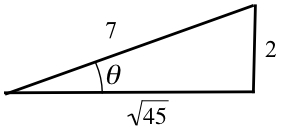
- \(\displaystyle \frac{2}{\sqrt{45}}\)
- \(\displaystyle \frac{\sqrt{45}}{7}\)
- \(\displaystyle \frac72\)
- \(\displaystyle \frac{\sqrt{45}}{2}\)
- The triangle below should help:

- \(\displaystyle \sqrt{24}\)
- \(\displaystyle \frac{\sqrt{24}}{5}\)
- \(\displaystyle \frac{5}{\sqrt{24}}\)
- \(\displaystyle \frac{1}{\sqrt{24}}\)
- The triangle below should help:

- \(\displaystyle \frac{a}{b}\)
- \(\displaystyle \frac{a}{\sqrt{a^2+b^2}}\)
- \(\displaystyle \frac{b}{\sqrt{a^2+b^2}}\)
- \(\displaystyle \frac{b}{a}\)
- For \(\displaystyle 0 < \theta < \frac{\pi}{2}\), \(\cos^2(\theta)+\sin^2(\theta) = 1 \Rightarrow \sin(\theta) = \sqrt{1-\cos^2(\theta)}\) and \(\cos(\theta) = \sqrt{1-\sin^2(\theta)}\) so:
- \(\displaystyle \sin(\arccos(x)) = \sqrt{1-x^2}\)
- \(\displaystyle \cos(\arcsin(x)) = \sqrt{1-x^2}\)
- \(\displaystyle \sec(\arccos(x)) = \frac{1}{x}\)
-
- No: \(2\arcsin(1) = 2\cdot\frac{\pi}{2} = \pi\), but \(\arcsin(2)\) is not defined.
- No: \(2\arccos(1) = 2\cdot0 = 0\), but \(\arccos(2)\) is not defined.
- Let \(\alpha\) represent the angle of declination from the viewer to the bottom of the whiteboard, and \(\beta\) the angle of elevation to the top:

- \(\displaystyle \alpha + \beta = \arctan\left(\frac{1}{15}\right) + \arctan\left(\frac{3}{15}\right) \approx 0.264\), or about \(15.12^{\circ}\).
- Replacing \(15\) with \(x\):\[\alpha + \beta = \arctan\left(\frac{1}{x}\right) + \arctan\left(\frac{3}{x}\right)\nonumber\]
- The graphs appear below:

- Differentiating implicitly, \(\displaystyle \frac{dh}{dt} = 20\cos(\theta)\cdot\frac{d\theta}{dt}\), so \(\displaystyle \frac{dh}{dt}\bigg|_{\theta=1.3} = 20\cos(1.3)\cdot 12 \approx 64.20\).
- Differentiating implicitly, \(\displaystyle -\sin(\theta)\cdot\frac{d\theta}{dt} = 3\cdot \frac{dh}{dt}\), so \(\displaystyle \frac{dh}{dt}\bigg|_{\theta=1.3} = -\frac13\sin(1.3)\cdot 12 \approx -3.85\).
- Differentiating implicitly, \(\displaystyle \cos(\theta)\cdot\frac{d\theta}{dt} = \frac{1}{38}\cdot \frac{dh}{dt}\), so \(\displaystyle \frac{d\theta}{dt}\bigg|_{\theta=1.3} = \frac{4}{38}\sec(1.3)\approx 0.394\).
- Differentiating implicitly, \(\displaystyle -\sin(\theta)\cdot\frac{d\theta}{dt} = 7\cdot \frac{dh}{dt}\), so \(\displaystyle \frac{d\theta}{dt}\bigg|_{\theta=1.3} = -28\csc(1.3)\cdot 12 \approx -29.059\).
- If \(h\) is the height of the rocket, then \(\displaystyle \tan(\theta) = \frac{h}{4000} \Rightarrow h = 4000\tan(\theta) \Rightarrow \frac{dh}{dt} = 4000\sec^2(\theta)\cdot\frac{d\theta}{dt}\), so \(\displaystyle \frac{dh}{dt}\bigg|_{\theta=\frac{\pi}{3}} = 4000\cdot 4 \cdot\frac{\pi}{12} \approx 4189\) ft/sec.
-
- \(\displaystyle \alpha = \arcsin\left(\frac{A}{C}\right)\)
- \(\displaystyle \beta = \arccos\left(\frac{A}{C}\right)\)
- \(\displaystyle \arcsin\left(\frac{A}{C}\right)+\arccos\left(\frac{A}{C}\right) = \alpha + \beta = \frac{\pi}{2}\)
-
- \(\displaystyle \alpha = \mbox{arcsec}\left(\frac{C}{B}\right)\)
- \(\displaystyle \beta = \mbox{arccsc}\left(\frac{C}{B}\right)\)
- \(\displaystyle \mbox{arcsec}\left(\frac{C}{B}\right)+\mbox{arccsc}\left(\frac{C}{B}\right) = \alpha + \beta = \frac{\pi}{2}\)
-
- \(\displaystyle \frac{5}{12}\)
- \(\displaystyle \frac{12}{5}\)
-
- \(\displaystyle \frac{12}{13}\)
- \(\displaystyle \frac{13}{12}\)
- \(1.231\)
- \(\pi\)
- \(\displaystyle \frac{2\pi}{3}\)
- \(\displaystyle \frac{\pi}{4}\)
- \(0.322\)
-
- \(\displaystyle \frac{7}{25}\)
- \(\displaystyle \frac{24}{25}\)
- \(\displaystyle \arcsin\left(\frac{7}{25}\right) = \arccos\left(\frac{24}{25}\right)\)
- If \(x\neq 0\) then:\[\sin\left(\mbox{arccsc}\left(x\right)\right) = \frac{1}{\csc\left(\mbox{arccsc}\left(x\right)\right)} = \frac{1}{x}\nonumber\]Applying \(\arcsin\) to each side yields the result.
- We know that \(\tan\left(\mbox{arcsec}(x)\right) = \sqrt{x^2-1}\) from Example 5, so \(\mbox{arcsec}(x) = \arctan\left(\sqrt{x^2-1}\right)\).
Section 7.4
- \(\displaystyle \frac{1}{\sqrt{1-\left(3x\right)^2}} \cdot 3 = \frac{3}{\sqrt{1-9x^2}}\)
- \(\displaystyle \frac{1}{1+\left(x+5\right)^2} = \frac{1}{x^2+10x+26}\)
- \(\displaystyle \frac{1}{1+\left(\sqrt{x}\right)^2} \cdot \frac{1}{2\sqrt{x}} = \frac{1}{2\sqrt{x}\left(1+x\right)}\)
- \(\displaystyle \frac{1}{\arctan(x)} \cdot \frac{1}{1+x^2}\)
- \(\displaystyle 3\left(\mbox{arcsec}(x)\right)^2 \cdot \frac{1}{\left|x\right|\sqrt{x^2-1}}\)
- \(\displaystyle \frac{1}{1+\left(\ln(x)\right)^2} \cdot \frac{1}{x}\)
- \(\displaystyle e^x \cdot \frac{2}{1+4x^2} + \arctan(2x)\cdot e^x\)
- \(\displaystyle \frac{1}{\sqrt{1-x^2}} - \frac{1}{\sqrt{1-x^2}} = 0\)
- \(\displaystyle \frac{1}{2\sqrt{\arcsin(x)}} \cdot \frac{1}{\sqrt{1-x^2}}\)
- \(\displaystyle \cos\left(3+\arctan(x)\right)\cdot \frac{1}{1+x^2}\)
- \(\displaystyle \arctan\left(\frac{1}{x}\right) - \frac{x}{x^2+1}\)
-
- Use the result of Section 7.3 Problem 21:\[\theta = \arctan\left(\frac{1}{x}\right) + \arctan\left(\frac{3}{x}\right)\nonumber\]
- Differentiating yields:\[\frac{d\theta}{dx} = \frac{-1}{x^2+1} - \frac{3}{x^2+9} = \frac{-4\left(x^2+3\right)}{(x^2+1)(x^2+9)} < 0\nonumber\]so there are no critical points. As \(x\to\infty\), \(\theta \to 0\) (a minimum), and as \(x\to 0\), \(\theta \to \pi\): the viewer's nose touches the whiteboard!
- With \(y = \arccos(x)\), \(\cos(y) = x\) so that:\[-\sin(y) \cdot \frac{dy}{dx} = 1 \Rightarrow \frac{dy}{dx} = \frac{-1}{\sin(y)}\nonumber\]The range of \(\arccos(y)\) is \(0 \leq y \leq \pi\), and on this interval \(\sin(y) \geq 0\), so:\[\cos^2(y) + \sin^2(y) = 1 \Rightarrow \sin(y) = \sqrt{1-\cos^2(y)} \Rightarrow \ \frac{dy}{dx} = \frac{-1}{\sqrt{1-\cos^2(y)}} = \frac{-1}{\sqrt{1-x^2}}\nonumber\]
- For \(\displaystyle 0 < x < \frac{\pi}{2}\): \(\displaystyle \arccos(x) +\arcsin(x) = \frac{\pi}{2}\)
Section 7.5
- \(\displaystyle 7\cdot \int \frac{1}{\sqrt{3^2-x^2}} \, dx = 7\arcsin\left(\frac{x}{3}\right)+C\)
- \(\displaystyle 3\cdot \int_0^1 \frac{1}{5^2+x^2} \, dx = \left[\frac35\arctan\left(\frac{x}{5}\right)\right]_0^1 =\frac35\arctan\left(\frac15\right) \approx 0.1184\)
- \(\displaystyle 9\cdot \int \frac{1}{\sqrt{7^2-x^2}} \, dx = 9\arcsin\left(\frac{x}{7}\right)+C\)
- \(\displaystyle 3\cdot \int_6^{10} \frac{1}{x\sqrt{x^2-5^2}} \, dx = \left[\frac35\mbox{arcsec}\left(\frac{x}{5}\right)\right]_6^{10} = \frac35\left[\mbox{arcsec}\left(2\right)-\mbox{arcsec}\left(\frac{6}{5}\right)\right] \approx 0.2769\)
- With \(u = x-1 \Rightarrow du = dx\) the integral becomes:\[\int \frac{1}{1+u^2}\, du = \arctan(u)+C = \arctan(x-1)+C\nonumber\]
- With \(u = e^x \Rightarrow du = e^x\, dx\) the integral becomes:\[\int_{e^{-1}}^{e} \frac{1}{1+u^2}\, du = \arctan(e)-\arctan\left(e^{-1}\right) \approx 0.8658\nonumber\]
- With \(u = \sin(\theta) \Rightarrow du = \cos(\theta)\, d\theta\) this becomes: \begin{align*}\int \frac{1}{\sqrt{3^2-u^2}}\, du &= \arcsin\left(\frac{u}{3}\right) + C \\ &= \arcsin\left(\frac{\sin(\theta)}{3}\right)+C\end{align*}
- With \(u = 9+x^2 \Rightarrow du = 2x\, dx\) this becomes:\[\frac32\int u^{-\frac12}\, du = 3\sqrt{u}+C = 3\sqrt{9+x^2}+C\nonumber\]
- With \(u = x^2 \Rightarrow du = 2x\, dx\) the integral becomes:\[3\int \frac{1}{3^2+u^2}\, du = \arctan\left(\frac{u}{3}\right)+C = \arctan\left(\frac{x^2}{3}\right)+C\nonumber\]
- With \(u = 2x \Rightarrow du = 2\, dx\) the integral becomes:\[\frac12\int\frac{1}{1+u^2}\, du = \frac12\arctan(u)+C = \frac12\arctan(2x)+C\nonumber\]
- This is an improper integral:\[\lim_{M\to\infty}\int_0^M \frac{1}{\left(\sqrt{3}\right)^2+x^2}\, dx = \lim_{M\to\infty} \left[\frac{1}{\sqrt{3}}\arctan\left(\frac{x}{\sqrt{3}}\right)\right]_0^M = \lim_{M\to\infty}\, \frac{1}{\sqrt{3}}\arctan\left(\frac{M}{\sqrt{3}}\right) = \frac{\pi}{2\sqrt{3}}\nonumber\]
- This is an improper integral:\[\lim_{b\to\sqrt{7}^{-}}\int_0^b \frac{1}{\sqrt{\left(\sqrt{7}\right)^2-x^2}}\, dx = \lim_{b\to\sqrt{7}^{-}}\left[\arcsin\left(\frac{x}{\sqrt{7}}\right)\right]_0^b =\lim_{b\to\sqrt{7}^{-}}\, \arcsin\left(\frac{b}{\sqrt{7}}\right) = \arcsin(1) = \frac{\pi}{2}\nonumber\]
- Separating variables:\[\int \frac{1}{y}\, dy = \int \frac{1}{\sqrt{1-x^2}}\, dx \Rightarrow \ln\left(\left|y\right|\right) = \arcsin(x)+C\nonumber\]Using \(y(0) = e\):\[\ln(e)=\arcsin(0)+ C \Rightarrow 1 = 0+C \Rightarrow C = 1\nonumber\]Solving for \(y\):\[\ln\left(\left|y\right|\right)=\arcsin(x)+1 \Rightarrow |y| = e^{\arcsin(x)+1}\nonumber\]so \(\displaystyle y = e^{\arcsin(x)+1}\) (because \(y(0)=e>0\)).
- Separating variables:\[\int \frac{1}{y^2}\, dy = \int \frac{1}{3^2+x^2}\, dx \Rightarrow -\frac{1}{y} = \frac13 \arctan\left(\frac{x}{3}\right)+C\nonumber\]Using \(y(1)=2\):\[-\frac12 = \frac13\arctan\left(\frac13\right)+C \Rightarrow C = -\frac12-\frac13\arctan\left(\frac13\right)\nonumber\]Solving for \(y\) yields:\[y = \frac{-1}{\frac13 \arctan\left(\frac{x}{3}\right) -\frac12 -\frac13\arctan\left(\frac13\right)}\nonumber\]
- Rewrite the integral as:\[\int \frac{4\cdot 2x}{3^2+x^2}\, dx + \int \frac{5}{3^2+x^2}\, dx\nonumber\]and integrate each term separately to get:\[4\ln\left(x^2+9\right)+\frac53\arctan\left(\frac{x}{3}\right)+C\nonumber\]
- Rewrite the integral as:\[\frac72 \int \frac{2x}{\left(\sqrt{10}\right)^2+x^2}\, dx + 3 \int \frac{1}{\left(\sqrt{10}\right)^2+x^2}\, dx\nonumber\]and integrate each term separately to get:\[\frac72\ln\left(x^2+10\right)+\frac{3}{\sqrt{10}}\arctan\left(\frac{x}{\sqrt{10}}\right)+C\nonumber\]
- Completing the square in the denominator, the integral becomes:\[8\int \frac{1}{1+(x+3)^2}\, dx = 8\arctan(x+3)+C\nonumber\]
- Rewrite the integral as:\[\int\frac{2(2x+6)}{x^2+6x+10}\, dx + \int \frac{8}{1+(x+3)^2}\, dx\nonumber\]and integrate each term separately to get:\[2\ln(x^2+6x+10)+8\arctan(x+3)+C\nonumber\]
- Use \(u = x^2+4x+5 \Rightarrow du = (2x+4)\, dx\):\[\int\frac{6(2x+4)}{x^2+4x+5}\, dx =6\int \frac{1}{u}\, du = 6\ln\left(\left|u\right|\right)+C\nonumber\]and resubstitute to get \(\displaystyle 6\ln(x^2+4x+5)+C\)
- Rewrite the integral as:\[\int\frac{3(2x+4)}{x^2+4x+20}\, dx + \int \frac{3}{4^2+(x+2)^2}\, dx\nonumber\]and integrate each term separately to get:\[3\ln(x^2+4x+20)+\frac34\arctan\left(\frac{x+2}{4}\right)+C\nonumber\]