

4.A: Answers
- Page ID
- 212041

\( \newcommand{\vecs}[1]{\overset { \scriptstyle \rightharpoonup} {\mathbf{#1}} } \)
\( \newcommand{\vecd}[1]{\overset{-\!-\!\rightharpoonup}{\vphantom{a}\smash {#1}}} \)
\( \newcommand{\dsum}{\displaystyle\sum\limits} \)
\( \newcommand{\dint}{\displaystyle\int\limits} \)
\( \newcommand{\dlim}{\displaystyle\lim\limits} \)
\( \newcommand{\id}{\mathrm{id}}\) \( \newcommand{\Span}{\mathrm{span}}\)
( \newcommand{\kernel}{\mathrm{null}\,}\) \( \newcommand{\range}{\mathrm{range}\,}\)
\( \newcommand{\RealPart}{\mathrm{Re}}\) \( \newcommand{\ImaginaryPart}{\mathrm{Im}}\)
\( \newcommand{\Argument}{\mathrm{Arg}}\) \( \newcommand{\norm}[1]{\| #1 \|}\)
\( \newcommand{\inner}[2]{\langle #1, #2 \rangle}\)
\( \newcommand{\Span}{\mathrm{span}}\)
\( \newcommand{\id}{\mathrm{id}}\)
\( \newcommand{\Span}{\mathrm{span}}\)
\( \newcommand{\kernel}{\mathrm{null}\,}\)
\( \newcommand{\range}{\mathrm{range}\,}\)
\( \newcommand{\RealPart}{\mathrm{Re}}\)
\( \newcommand{\ImaginaryPart}{\mathrm{Im}}\)
\( \newcommand{\Argument}{\mathrm{Arg}}\)
\( \newcommand{\norm}[1]{\| #1 \|}\)
\( \newcommand{\inner}[2]{\langle #1, #2 \rangle}\)
\( \newcommand{\Span}{\mathrm{span}}\) \( \newcommand{\AA}{\unicode[.8,0]{x212B}}\)
\( \newcommand{\vectorA}[1]{\vec{#1}} % arrow\)
\( \newcommand{\vectorAt}[1]{\vec{\text{#1}}} % arrow\)
\( \newcommand{\vectorB}[1]{\overset { \scriptstyle \rightharpoonup} {\mathbf{#1}} } \)
\( \newcommand{\vectorC}[1]{\textbf{#1}} \)
\( \newcommand{\vectorD}[1]{\overrightarrow{#1}} \)
\( \newcommand{\vectorDt}[1]{\overrightarrow{\text{#1}}} \)
\( \newcommand{\vectE}[1]{\overset{-\!-\!\rightharpoonup}{\vphantom{a}\smash{\mathbf {#1}}}} \)
\( \newcommand{\vecs}[1]{\overset { \scriptstyle \rightharpoonup} {\mathbf{#1}} } \)
\(\newcommand{\longvect}{\overrightarrow}\)
\( \newcommand{\vecd}[1]{\overset{-\!-\!\rightharpoonup}{\vphantom{a}\smash {#1}}} \)
\(\newcommand{\avec}{\mathbf a}\) \(\newcommand{\bvec}{\mathbf b}\) \(\newcommand{\cvec}{\mathbf c}\) \(\newcommand{\dvec}{\mathbf d}\) \(\newcommand{\dtil}{\widetilde{\mathbf d}}\) \(\newcommand{\evec}{\mathbf e}\) \(\newcommand{\fvec}{\mathbf f}\) \(\newcommand{\nvec}{\mathbf n}\) \(\newcommand{\pvec}{\mathbf p}\) \(\newcommand{\qvec}{\mathbf q}\) \(\newcommand{\svec}{\mathbf s}\) \(\newcommand{\tvec}{\mathbf t}\) \(\newcommand{\uvec}{\mathbf u}\) \(\newcommand{\vvec}{\mathbf v}\) \(\newcommand{\wvec}{\mathbf w}\) \(\newcommand{\xvec}{\mathbf x}\) \(\newcommand{\yvec}{\mathbf y}\) \(\newcommand{\zvec}{\mathbf z}\) \(\newcommand{\rvec}{\mathbf r}\) \(\newcommand{\mvec}{\mathbf m}\) \(\newcommand{\zerovec}{\mathbf 0}\) \(\newcommand{\onevec}{\mathbf 1}\) \(\newcommand{\real}{\mathbb R}\) \(\newcommand{\twovec}[2]{\left[\begin{array}{r}#1 \\ #2 \end{array}\right]}\) \(\newcommand{\ctwovec}[2]{\left[\begin{array}{c}#1 \\ #2 \end{array}\right]}\) \(\newcommand{\threevec}[3]{\left[\begin{array}{r}#1 \\ #2 \\ #3 \end{array}\right]}\) \(\newcommand{\cthreevec}[3]{\left[\begin{array}{c}#1 \\ #2 \\ #3 \end{array}\right]}\) \(\newcommand{\fourvec}[4]{\left[\begin{array}{r}#1 \\ #2 \\ #3 \\ #4 \end{array}\right]}\) \(\newcommand{\cfourvec}[4]{\left[\begin{array}{c}#1 \\ #2 \\ #3 \\ #4 \end{array}\right]}\) \(\newcommand{\fivevec}[5]{\left[\begin{array}{r}#1 \\ #2 \\ #3 \\ #4 \\ #5 \\ \end{array}\right]}\) \(\newcommand{\cfivevec}[5]{\left[\begin{array}{c}#1 \\ #2 \\ #3 \\ #4 \\ #5 \\ \end{array}\right]}\) \(\newcommand{\mattwo}[4]{\left[\begin{array}{rr}#1 \amp #2 \\ #3 \amp #4 \\ \end{array}\right]}\) \(\newcommand{\laspan}[1]{\text{Span}\{#1\}}\) \(\newcommand{\bcal}{\cal B}\) \(\newcommand{\ccal}{\cal C}\) \(\newcommand{\scal}{\cal S}\) \(\newcommand{\wcal}{\cal W}\) \(\newcommand{\ecal}{\cal E}\) \(\newcommand{\coords}[2]{\left\{#1\right\}_{#2}}\) \(\newcommand{\gray}[1]{\color{gray}{#1}}\) \(\newcommand{\lgray}[1]{\color{lightgray}{#1}}\) \(\newcommand{\rank}{\operatorname{rank}}\) \(\newcommand{\row}{\text{Row}}\) \(\newcommand{\col}{\text{Col}}\) \(\renewcommand{\row}{\text{Row}}\) \(\newcommand{\nul}{\text{Nul}}\) \(\newcommand{\var}{\text{Var}}\) \(\newcommand{\corr}{\text{corr}}\) \(\newcommand{\len}[1]{\left|#1\right|}\) \(\newcommand{\bbar}{\overline{\bvec}}\) \(\newcommand{\bhat}{\widehat{\bvec}}\) \(\newcommand{\bperp}{\bvec^\perp}\) \(\newcommand{\xhat}{\widehat{\xvec}}\) \(\newcommand{\vhat}{\widehat{\vvec}}\) \(\newcommand{\uhat}{\widehat{\uvec}}\) \(\newcommand{\what}{\widehat{\wvec}}\) \(\newcommand{\Sighat}{\widehat{\Sigma}}\) \(\newcommand{\lt}{<}\) \(\newcommand{\gt}{>}\) \(\newcommand{\amp}{&}\) \(\definecolor{fillinmathshade}{gray}{0.9}\)Section 4.0
-
- \((10)(12) + (8)(4) = 152\)
- \((10)(20) - (3)(8) = 176\)
- \(bh + \frac12 b(H - h) = bh + \frac12 bH - \frac12 bh = b\left(\frac{h + H}{2}\right)\)
-
- \(1\cdot 3 + 1\cdot 2 = 5\)
- area \(< 5\)
- Answers will vary from \(5\) to \(13\).
- \(A(1) = 1\), \(A(2) = 2.5\), \(A(3) = 4.5\), \(A(4) = 6\), \(A(5) = 7\)
- \(C(1) = 1.5\), \(C(2) = 4\), \(C(3) = 7.5\), \(C(x)\) is sum of rectangular and triangular areas:\[C(x) = x + \frac12 x\cdot x = x + \frac12 x^2\nonumber\]
- \((20)(30) + \frac12 (10)(30) = 600 + 150 = 750\) feet
-
- \(A\): 20 seconds to stop; \(B\): 40 seconds to stop
- \(A\): \(\frac12 (20)(80) = 800\) ft; \(B\): \(\frac12 (40)(40) = 800\) ft
- miles, $, ft\(^3\), kilowatt-hours, people, square meals
Section 4.1
- \(2^2 + 3^2 + 4^2 = 29\)
- \((1+1)^2 + (1+2)^2 + (1+3)^2 = 29\)
- \(\cos(0) + \cos(\pi) + \cos(2\pi) + \cos(3\pi) + \cos(4\pi) + \cos(5\pi) = 1 + (-1) + 1 + (-1) + 1 + (-1) = 0\)
- \(\displaystyle \sum_{k=3}^{94} k\)
- \(\displaystyle \sum_{k=3}^{12} k^2\)
- \(\displaystyle \sum_{k=1}^{7} k\cdot 2^k\)
-
- \((1+2) + (2+2) + (3+2) = 3 + 4 + 5 = 12\)
- \((1+2+3) + (2+2+2) = 12\)
-
- \(5\cdot 1 + 5\cdot 2 + 5\cdot 3 = 5 + 10 + 15 = 30\)
- \(5\cdot (1 + 2 + 3) = 5\cdot 6 = 30\)
-
- \(1^2 + 2^2 + 3^2 = 1 + 4 + 9 = 14\)
- \((1 + 2 + 3)^2 = 6^2 = 36\)
- \(f(0) + f(1) + f(2) + f(3) = 0^2 + 1^2 + 2^2 + 3^2 = 14\)
- \(2\cdot f(0) + 2\cdot f(1) + 2\cdot f(2) + 2\cdot f(3) = 2\cdot 0 + 2\cdot 1 + 2\cdot 4 + 2\cdot 9 = 28\)
- \(g(1) + g(2) + g(3) = 3 + 6 + 9 = 18\)
- \(g^2(1) + g^2(2) + g^2(3) = 3^2 + 6^2 + 9^2 = 126\)
- \(h(2) + h(3) + h(4) = \frac22 + \frac23 + \frac24 = \frac{13}{6}\)
- \(f(1)h(1) + f(2)h(2) + f(3)h(3) =(1)(2) + (4)(1) + (9)\left(\frac23\right) = 12\)
- \(\left(1^2 - 0^2\right) + \left(2^2 - 1^2\right) + \left(3^2 - 2^2\right) + \left(4^2 - 3^2\right) + \cdots + \left(7^2 - 6^2\right) = 7^2 - 0^2 = 49\)
- \(\left(\frac11-\frac12\right) + \left(\frac12-\frac13\right) + \left(\frac13-\frac14\right) + \left(\frac14-\frac15\right) + \left(\frac15-\frac16\right) = 1-\frac16 = \frac56\)
- \(\left(\sqrt{1} - \sqrt{0}\right) + \left(\sqrt{2} - \sqrt{1}\right) + \left(\sqrt{3} - \sqrt{2}\right) + \left(\sqrt{4} - \sqrt{3}\right) + \cdots + \left(\sqrt{9} - \sqrt{8}\right) = 3-0 = 3\)
-
- \([2, 3]\), \([3, 4.5]\), \([4.5, 6]\), \([6, 7]\)
- \(1\), \(1.5\), \(1.5\), \(1\)
- mesh \(= 1.5\)
- \(1 + 1.5 + 1.5 + 1 = 5\)
-
- \([-3, -1]\), \([-1, 0]\), \([0, 1.5]\), \([1.5, 2]\)
- \(2\), \(1\), \(1.5\), \(0.5\)
- mesh \(= 2\)
- \(2 + 1 + 1.5 + 0.5 = 5\)
-
- \([3, 3.8]\), \([3.8, 4.5]\), \([4.5, 5.2]\), \([5.2, 7]\)
- \(0.8\), \(0.7\), \(0.7\), \(1.8\)
- mesh \(= 1.8\)
- \(0.8+0.7+ 0.7+ 1.8 = 4\)
- \(\Delta x_1 + \Delta x_2 + \cdots + \Delta x_n = (x_1 - x_0) + (x_2 - x_1) + (x_3 - x_2) + \cdots + (x_n - x_{n-1}) = x_n - x_0\)
-

\(f(0)(1) + f(1)(0.5) + f(2)(0.5) = (4)(1) + (3)(0.5) + (0)(0.5) = 5.5\)- \(f(1)(1) + f(1.5)(0.5) + f(1.5)(0.5) = (3)(1) + (1.75)(0.5) + (1.75)(0.5) = 4.75\)
-

\(\left(\frac{\pi}{4}\right)(0) + \left(\frac{\pi}{4}\right)(\frac{1}{\sqrt{2}}) + \left(\frac{\pi}{2}\right)(1) \approx 2.13\)- \(\left(\frac{\pi}{4}\right)(\frac{1}{\sqrt{2}}) + \left(\frac{\pi}{4}\right)(1)+\left(\frac{\pi}{2}\right)(0) \approx 1.34\)
-
- \((2)(1) + (5)(2) + (17)(1) \leq \mbox{RS} \leq (5)(1) + (17)(2) + (26)(1) \ \Rightarrow \ 29 \leq \mbox{RS} \leq 65\)
- \((2)(1) + (5)(1) + (10)(1) + (17)(1) \leq \mbox{RS} \leq (5)(1) + (10)(1) + (17)(1) + (26)(1)\ \Rightarrow \ 34 \leq \mbox{RS} \leq 58\)
- \(2(0.5) + 3.25(0.5) + 5(1) + 10(1) + 17(1) \leq \mbox{RS} \leq 3.25(0.5) + 5(0.5) + 10(1) + 17(1) + 26(1) \Rightarrow 34.625 \leq \mbox{RS} \leq 57.125\)
-
- \((0)\left(\frac{\pi}{2}\right) + (0)\left(\frac{\pi}{2}\right) \leq \mbox{RS} \leq (1)\left(\frac{\pi}{2}\right) + (1)\left(\frac{\pi}{2}\right) \ \Rightarrow \ 0 \leq \mbox{RS} \leq \pi\)
- \(0\left(\frac{\pi}{4}\right) + \frac{1}{\sqrt{2}}\left(\frac{\pi}{4}\right) + 0\left(\frac{\pi}{2}\right) \leq \mbox{RS} \leq \frac{1}{\sqrt{2}}\left(\frac{\pi}{4}\right) + 1\left(\frac{\pi}{4}\right) + 1\left(\frac{\pi}{2}\right) \Rightarrow \ 0.56 \leq \mbox{RS} \leq 2.91\)
- \(0\left(\frac{\pi}{4}\right) + \frac{1}{\sqrt{2}}\left(\frac{\pi}{4}\right) + \frac{1}{\sqrt{2}}\left(\frac{\pi}{4}\right) + 0\left(\frac{\pi}{4}\right) \leq \mbox{RS} \leq \frac{1}{\sqrt{2}}\left(\frac{\pi}{2}\right) + 1\left(\frac{\pi}{4}\right) + 1\left(\frac{\pi}{4}\right)+ \frac{1}{\sqrt{2}}\left(\frac{\pi}{4}\right) \Rightarrow \ 1.11 \leq \mbox{RS} \leq 2.68\)
-
- \(\left| 7.402 - 7.362 \right| = 0.04\)
- \(\left| 7.390 - 7.372 \right| = 0.018\)
- \(\left|\mbox{error}\right| = (\mbox{base})(\mbox{height}) = \frac{4 - 2}{50}\left(65 - 9\right) = \frac{56}{25} = 2.24\)
-
- \(\frac{100(101)}{2} = 5050\)
-
so \(2S = \ 100(101) \ = \ 10100 \ \Rightarrow \ S = 5050\)\(S =\) \(1\) \(+\) \(2\) \(+\) \(3\) \(+\) \(\cdots\) \(+\) \(100\) \(+\ S =\) \(100\) \(+\) \(99\) \(+\) \(98\) \(+\) \(\cdots\) \(+\) \(1\) \(2S =\) \(101\) \(+\) \(101\) \(+\) \(101\) \(+\) \(\cdots\) \(+\) \(101\)
- \(10 + 11 + 12 + \cdots + 20 = (1+2+3 + \cdots + 20) - (1+2+3 + \cdots + 9) = \frac{20(21)}{2} - \frac{9(10)}{2} = 210 - 45 = 165\)
- \(\displaystyle \sum_{k=1}{10}\, (k^3 + k) = \sum_{k=1}{10}\, k^3 + \sum_{k=1}{10}\, k = \left[\frac{10(11)}{2}\right]^2 + \left[\frac{10(11)}{2}\right] = (55)^2 + 55 = 3080\)
Section 4.2
- \(\displaystyle \int_0^4 \left[2+3x\right]\, dx\)
- \(\displaystyle \int_2^5 \cos(5x) \, dx\)
- \(\displaystyle \int_1^5 x^3 \, dx\)
- \(\displaystyle \int_{0.5}^2 x\cdot \sin(x)\, dx\)
- \(\displaystyle \int_1^3 \ln(x) \, dx\)
- \(\displaystyle \int_1^3 2x \, dx = 8\)
- \(\displaystyle \int_{-1}^0 \left|x\right| \, dx = \frac12\)
- \(\displaystyle \int_0^4 \left[3-\frac{x}{2}\right]\, dx = 8\)
-
- \(3\)
- \(-1\)
- \(6\)
- \(8\)
- \(7\)
-
![A graph of a blue curve on a [0,10]X[-10,20] grid, with the horizontal axis labeled 'minutes' and the vertical axis labeled 'feet.' The curve begins as a straight line between the origin and (5,10) then bends upward in a U shape to (6,16), then transitions to an inverted-U shape, reaching a peak near (8,19).](https://math.libretexts.org/@api/deki/files/140728/ans402_19.png?revision=1&size=bestfit&width=214&height=126)
- 24 ft
- 24 feet from starting point
- meters
- ft\(^3\)
- gram-meters
- ft/sec
- \(\Delta x = \frac{2-0}{n} = \frac{2}{n}\), \(m_k = \frac{2}{n}(k - 1)\), \(M_k = \frac{2}{n}k\), so \(f(m_k) = \left[\frac{2}{n}(k-1)\right]^3\) and \(f(M_k) = \left[\frac{2}{n}k\right]^3\)
- \(\displaystyle \mbox{LS} = \sum_{k=1}^n f(m_k)\, \Delta x = \sum_{k=1}^n \, \left[\frac{2}{n}(k-1)\right]^3 \Delta x =\frac{2}{n}\cdot\frac{8}{n^3}\left[\sum_{k=1}^n \, k^3 - 3 \sum_{k=1}^n \, k^2 + 3 \sum_{k=1}^n \, k - \sum_{k=1}^n \, 1\right]\)
\(\displaystyle = \frac{16}{n^4} \left[\left(\frac14 n^4 + \frac12 n^3 + \frac{3}{12} n^2\right)-3\left(\frac13 n^3 + \frac12 n^2 + \frac{2}{12} n\right) + 3\left( \frac12 n^2 + \frac12 n\right)-n\right]\)
\(\displaystyle = \frac{16}{n^4}\left[\frac14 n^4 - \frac12 n^3 +\frac14 n^2\right] = 4 - \frac{8}{n} + \frac{4}{n^2} \longrightarrow 4\) - \(\displaystyle \mbox{US} = \sum_{k=1}^n f(M_k)\, \Delta x = \sum_{k=1}^n \, \left[\frac{2}{n}(k)\right]^3 \frac{2}{n} = \frac{16}{n^4}\left[\sum_{k=1}^n \, k^3\right] = \frac{16}{n^4}\left[\frac14 n^4 + \frac12 n^3 +\frac{3}{12} n^2\right] = 4 + \frac{8}{n} + \frac{4}{n^2} \longrightarrow 4\)
- \(\displaystyle \mbox{LS} = \sum_{k=1}^n f(m_k)\, \Delta x = \sum_{k=1}^n \, \left[\frac{2}{n}(k-1)\right]^3 \Delta x =\frac{2}{n}\cdot\frac{8}{n^3}\left[\sum_{k=1}^n \, k^3 - 3 \sum_{k=1}^n \, k^2 + 3 \sum_{k=1}^n \, k - \sum_{k=1}^n \, 1\right]\)
Section 4.3
- \(5\)
- \(0\)
- \(3\)
- \(0\)
- \(-5\)
- \(-5\)
- \(0\)
- \(4.5+5 = 9.5\)
- \(10+3 = 13\)
- \(5+2 = 7\)
- \(1\)
- \(-1\)
- \(2\)
- \(1\)
- \(1\)
-
- \(8\cdot 6 = 48\)
- \(24\)
-
- \(32\)
- \(8^2 = 64\)
- \(8\)
- \(2.5\)
- \(3\)
- \(7\)
-
- \(y = A(x) = \frac12 x^2\) (below left)
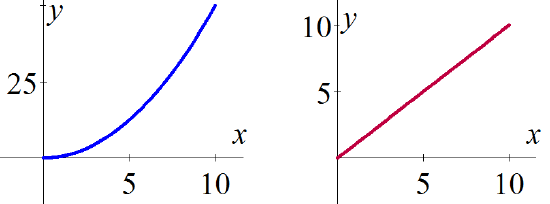
- \(y = A'(x) = x\) (above right)
- \(y = A(x) = \frac12 x^2\) (below left)
-
-
- \(f\) is continuous on \([1, 4]\)
- \(f\) is not differentiable on \([1,4]\) (not differentiable at \(x \approx 2.5\) and \(x \approx 3.3\))
- \(f\) is integrable on \([1,4]\)
-
- \(f\) is not continuous on \([1, 4]\) (not continuous at \(x=2\))
- \(f\) is not differentiable on \([1,4]\) (not differentiable at \(x=2\))
- \(f\) is integrable on \([1,4]\)
- \(\int_1^4 v(t)\, dt = \int_1^2 v(t)\, dt + \int_2^4 v(t)\, dt = 35 + 50 = 85\) miles
-
- The rectangle associated with the interval containing \(x=2\) has width \(w\) and height \(5\), so its area is \(5w\); all of the other rectangles have the same height (\(7\)) and the sum of their widths is \((4-1)-w = 3-w\), so their total area is \(7(3-w)\): \(\mbox{RS} = 5w + 7(3-w)\)
- Because \(0 < w \leq \left\|{\cal P}\right\|\), as \(\left\|{\cal P}\right\| \rightarrow 0 \Rightarrow w \rightarrow 0\) so \(\displaystyle \lim_{\left\|{\cal P}\right\| \to 0} \, \mbox{RS} = \lim_{w \to 0} \, \left[5w + 7(3-w)\right] = 21\)
- \(\int_1^4 g(x)\, dx =\) \(\displaystyle \lim_{\left\|{\cal P}\right\| \to 0} \mbox{RS} = 21\)
\(\int_1^4 7 \, dx = 7(4-1) = 7(3) = 21\) - A (very) similar argument shows that redefining any constant function \(f\) at a single point does not alter the value of \(\int_a^b f(x)\, dx\). A (somewhat) similar argument can extend this result to all integrable functions.


Section 4.4
-
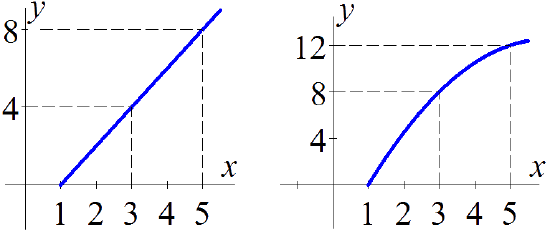
- See figure below left.
- \(A(1) = 0\), \(A(2) = 1.5\), \(A(3) = 4\), \(A(4) = 6.5\)
- \(A'(1) = 1\), \(A'(2) = 2\), \(A'(3) = 3\), \(A'(4) = 2\)

-
- See figure above right.
- \(A(1) = 0\), \(A(2) = 0.5\), \(A(3) = 0\), \(A(4) = -1\)
- \(A'(1) = 1\), \(A'(2) = 0\), \(A'(3) = -1\), \(A'(4) = -1\)
-
- See figure below left.
- \(A(1) = 0\), \(A(2) = 2\), \(A(3) = 4\), \(A(4) = 6\)
- \(A'(1) = 2\), \(A'(2) = 2\), \(A'(3) = 2\), \(A'(4) = 2\)
-
- See figure above right.
- \(A(1) = 0\), \(A(2) = 4.5\), \(A(3) = 8\), \(A(4) = 10.5\)
- \(A'(1) = 5\), \(A'(2) = 4\), \(A'(3) = 3\), \(A'(4) = 2\)
-
- \(\displaystyle x^2\Big|_0^3 = 9\)
- \(\displaystyle x^2\Big|_1^3 = 8\)
- \(\displaystyle x^2\Big|_0^1 = 1\)
-
- \(\displaystyle 2x^3\Big|_1^3 = 52\)
- \(\displaystyle 2x^3\Big|_1^2 = 14\)
- \(\displaystyle 2x^3\Big|_0^3 = 54\)
-
- \(\displaystyle x^4\Big|_0^3 = 81\)
- \(\displaystyle x^4\Big|_1^3 = 80\)
- \(\displaystyle x^4\Big|_0^1 = 1\)
-
- \(\displaystyle x^3\Big|_{-3}^3 = 54\)
- \(\displaystyle x^3\Big|_{-3}^0 = 27\)
- \(\displaystyle x^3\Big|_0^3 = 27\)
-
- \(\displaystyle x^3\Big|_0^2 = 8\)
- \(\displaystyle x^3\Big|_1^3 = 26\)
- \(\displaystyle x^3\Big|_3^1 = -26\)
-
- \(\displaystyle \int_0^{10} 2t\, dt = t^2\Big|_0^{10} = 100\) ft
- \(\displaystyle 50 = \int_0^{T} 2t\, dt = T^2 \Rightarrow T = \sqrt{50} \approx 7.07\) sec
-
- \(\displaystyle \int_0^{10} 4t^3\, dt = t^4\Big|_0^{10} = 10000\) ft
- \(\displaystyle 5000 = \int_0^{T} 4t^3\, dt = T^4 \Rightarrow T = %\sqrt[4]{5000} \approx 8.41\) sec
-
- \(75-3t^2=0 \Rightarrow t = 5\) sec
- \(\displaystyle \int_0^{5} \left[75-3t^2\right]\, dt = 75t-t^3\Big|_0^{5} = 250\) ft
- \(\displaystyle 125 = \int_0^{T} \left[75-3t^2\right]\, dt = 75T-T^3\), so use a graph of \(y = x^3-75x+125\) (or Newton’s method) to solve for \(T \approx 1.74\) sec
- The total area is \(\displaystyle \int_0^3 x^2\, dx = \frac13 x^3\Big|_0^3 = \frac13\cdot 27 = 9\).
- \(\displaystyle \frac12\cdot 9 = \frac13 x^3\Big|_0^T = \frac13 T^3 \Rightarrow T = \sqrt[3]{\frac{27}{2}} \approx 2.38\)
- \(\displaystyle \frac13\cdot 9 = \int_0^T x^2\, dx = \frac13 T^3 \Rightarrow T = \sqrt[3]{9} \approx 2.08\)
\(\displaystyle \frac23\cdot 9 = \int_0^T x^2\, dx = \frac13 T^3 \Rightarrow T = \sqrt[3]{18} \approx 2.62\)
Section 4.5
-
- \(A(x) = x^3 \Rightarrow A'(x) = 3x^2\) so \(A'(1) = 3\), \(A'(2) = 12\) and \(A'(3) = 27\)
- \(A'(x) = \mbox{D}\left[\int_0^x 3t^2\, dt \right] = 3x^2\) so \(A'(1) = 3\), \(A'(2) = 12\) and \(A'(3) = 27\)
- \(A'(x) = 2x\) so \(A'(1) = 2\), \(A'(2) = 4\), \(A'(3) = 6\)
- \(A'(x) = 2x\) so \(A'(1) = 2\), \(A'(2) = 4\), \(A'(3) = 6\)
- \(A'(1) \approx 0.84\), \(A'(2) \approx 0.91\), \(A'(3) \approx 0.14\)
- \(A'(x) = f(x)\), \(A'(1) = 2\), \(A'(2) = 1\), \(A'(3) = 2\)
- \(A'(x) = f(x)\), \(A'(1) = 1\), \(A'(2) = 2\), \(A'(3) = 2\)
- \(F(1) - F(0) = 6 - 5 = 1\)
- \(F(3) - F(1) = 9 - \frac13 = \frac{26}{3}\)
- \(F(5) - F(1) \approx 1.61 - 0 = 1.61\)
- \(F(3) - F\left(\frac12\right) \approx 1.10 - (-0.69) = 1.79\)
- \(F\left(\frac{\pi}{2}\right) - F(0) = 1 - 0 = 1\)
- \(F(1) - F(0) \approx 0.67 - 0 = 0.67\)
- \(F(7) - F(1) = \frac23(7)^{\frac32} - \frac23 \approx 11.68\)
- \(F(9) - F(1) = 3 - 1 = 2\)
- \(F(3) - F(-2) \approx 20.09 - 0.14 = 19.95\)
- \(F\left(\frac{\pi}{4}\right) - F(0) = 1 - 0 = 1\)
- \(F(3) - F(0) = \frac23 (10)^{\frac32} - \frac23 \approx 20.42\)
- \(F(x) = \frac13 x^3 \Rightarrow F(2) - F(-1) = \frac83 - \left( -\frac13\right) = 3\)
- \(F(x) = \ln(x) \Rightarrow F(e) - F(1) = 1 - 0 = 1\)
- \(F(x) = \frac23 x^{\frac32} \Rightarrow F(100) - F(25) = \frac{2000}{3} - \frac{250}{3} = \frac{1750}{3}\)
- \(F(x) = -\frac{1}{x} \Rightarrow F(10) - F(1) = - 0.1 - (-1) = 0.9\)
- \(F(x) = e^x \Rightarrow F(1) - F(0) = e - 1 \approx 1.718\)
- \(F(x) = \tan(x) \Rightarrow F\left(\frac{\pi}{4}\right) - F\left(\frac{\pi}{6}\right) = 1 - \frac{1}{\sqrt{3}} \approx 0.423\)
- \(\int_3^3 f(x)\, dx = 0\) for any integrable \(f\)
- \(\displaystyle \int_0^{\pi} \sin(x)\, dx = -\cos(x)\Big|_0^{\pi} = -(-1) - (-1) = 2\)
- \(\displaystyle \int_0^{3.5} \lfloor x \rfloor \, dx = 0 + 1 + 2 + \frac12 (3) = 4.5\)
- \(\displaystyle \int_0^3 (x-2)^2 \, dx = \int_0^3 (x^2-4x+4) \, dx = \frac13 x^3 - 2x^2 + 4x\Big|_0^3 =3\)
- \(\mbox{D}\left(A(3x)\right) = 3\tan(3x)\), \(\mbox{D}\left(A(x^2)\right) = 2x\tan(x^2)\), \(\mbox{D}\left(A(\sin(x)\right) = \cos(x)\tan(\sin(x))\)
- \(\sqrt{1 + 5x}(5)\)
- \(\sqrt{1 + \sin(x)} \cdot \cos(x)\)
- \(\left[3(1-2x)^2 + 2\right](-2)\)
- \(-\cos(3x)\)
- \(\tan(x^2)\cdot 2x - \tan(x)\)
- \(5\ln(x)\cos(3\ln(x))\cdot\frac{1}{x}\)
Section 4.6
- \(\displaystyle \frac14 x^4\Big|_1^2 = \frac{15}{4} \neq \frac72 = \left[\frac13 x^3\Big|_1^2\right]\left[\frac12 x^2\Big|_1^2\right]\)
- \(\displaystyle \frac14 \neq \frac13 \cdot \frac12\)
- \(\displaystyle \frac13\sin(3x) + C\)
- \(-\cos(2 + e^x) + C\)
- \(\tan(\sin(x)) + C\)
- \(\displaystyle \frac52\ln\left| 3 + 2x \right| + C\)
- \(\displaystyle -\frac13 \cos(1 + x^3) + C\)
- \(\displaystyle \frac14\sin(4x) + C\)
- \(\frac{1}{48}\left(5 + x^4\right)^{12} + C\)
- \(\ln\left| 2 + x^3\right| + C\)
- \(\displaystyle \frac12\left(\ln(x)\right)^2 + C\)
- \(\frac{1}{24}\left( 1 + 3x \right)^8 + C\)
- \(\sec\left(e^x\right) + C\)
- \(\displaystyle \frac13 \sin(3x) \Big|_0^{\frac{\pi}{2}} = -\frac13\)
- \(\displaystyle -\cos\left(2 + e^x\right)\Big|_0^1 \approx -0.996\)
- \(\displaystyle \frac{1}{18}\left(1 + x^3\right)^6\Big|_{-1}^1 = \frac{32}{9}\)
- \(\displaystyle \frac{5}{2}\ln\left|3 + 2x\right|\Big|_{0}^2 = \frac52\ln\left(\frac73\right)\)
- \(\displaystyle -\frac{1}{3}\left(1 - x^2\right)^{\frac32}\Big|_{0}^1 = \frac13\)
- \(\displaystyle \frac{2}{9}\left(1 +3x\right)^{\frac32}\Big|_{0}^1 = \frac{14}{9}\)
- \(\frac{1}{2}x - \frac{1}{20}\sin(10x)+ C\)
- \(\frac{1}{4}\sin(2x)+ C\)
- \(\frac{1}{2}x - \frac{1}{4}\sin(2x)\Big|_{0}^{\pi} = \frac{\pi}{2}\)
- \(\frac17 x^7 + \frac35 x^5 + x^3 + x + C\)}
- \(\frac12 e^{2x} + 2e^x + x + C\)
- \(\frac16 x^6 + \frac14 x^4 + \frac53 x^3 + 5x + C\)
- \(\frac12 e^{2x} + \frac14 e^{4x} + C\)
- \(\frac27 x^{\frac72} + \frac65 x^{\frac52} - \frac43 x^{\frac32} + C\)
- \(3x - 3\ln\left| x + 1 \right| + C\)
- \(\frac12 x^2 - x + C\)
- \(x^2 - 11x + 7\ln\left| x - 1 \right| + C\)
- \(x+3\ln\left| x - 1 \right| + C\)
- \(\frac23 x^{\frac32} + 8 x^{\frac12} + C\)
- \(\mbox{area of semicircle with radius 1} = \frac12 \pi(1)^2 = \frac{\pi}{2}\)
- \(\mbox{area of semicircle with radius 3} = \frac12 \pi(3)^2 = \frac{9\pi}{2}\)
- \((2)(2)+\frac12 \pi(1)^2 = 4+\frac{\pi}{2}\)
Section 4.7
- Answers will vary between \(11\) (using left endpoints) and \(6\) (using right endpoints).
- Between \(4\) (left endpoints) and \(6\) (right).
- Using left-hand widths:\[(40)\left[0+70+55+90+130+115\right] = 18400 \mbox{ ft}^2\nonumber\]Right-hand widths (\(70\), \(55\), … ) and average widths (\(\frac{70}{2}\), \(\frac{125}{2}\), … ) yield the same result.
- \(\displaystyle \int_{-1}^{2} \left[(x^2+3)-1\right]\, dx = 9\)
- \(\displaystyle \int_{0}^{1} \left[x-x^2\right]\, dx + \int_{1}^{2} \left[x^2-x\right]\, dx= 1\)
- \(\displaystyle \int_{1}^{e} \left[x-\frac{1}{x}\right]\, dx = \frac12 e^2 - \frac32\)
- \(\displaystyle \int_{0}^{\frac{\pi}{4}} \left[(x+1)-\cos(x)\right]\, dx = \frac{1}{32}{\pi}^2 + \frac14 \pi - \frac{\sqrt{2}}{2}\)
- \(\displaystyle \int_{0}^{2} \left[e^x-x\right]\, dx = e^2 - 3\)
- \(\displaystyle \int_{0}^{1} \left[3-\sqrt{1-x^2}\right]\, dx = 3 - \frac{\pi}{4}\)
- Using \({\cal P} = \left\{0.5, 1.5, 2.5, 3.5, 4.5\right\}\), so that \(\Delta x = 1\), and \(c_1 = 1\), \(c_2 = 2\), \(c_3 = 3\), \(c_4 = 4\):\[\frac{1}{4.5-0.5} \int_{0.5}^{4.5} f(x)\, dx \approx \frac14\left[6+6+4+3\right](1) = \frac{19}{4}\nonumber\]
- With \({\cal P} = \left\{1.5, 2.5, 3.5\right\}\), \(\Delta x = 1\), \(c_1 = 2\), \(c_2 = 3\):\[\frac{1}{3.5-1.5} \int_{0.5}^{3.5} f(x)\, dx \approx \frac12\left[6+4\right](1) = \frac{10}{2}=5\nonumber\]
- \(\displaystyle \frac{1}{2-0}\int_{0}^{2} f(x)\, dx = \frac22 = 1\)
- \(\displaystyle \frac{1}{6-1}\int_{1}^{6} f(x)\, dx = \frac{11}{5}\)
- \(\displaystyle \frac{1}{4-0}\int_{0}^{4} \left[2x+1\right]\, dx = 5\)
- \(\displaystyle \frac{1}{3-1}\int_{1}^{3} x^2\, dx = \frac{13}{3}\)
- \(\displaystyle \frac{1}{\pi -0}\int_{0}^{\pi} \sin(x)\, dx = \frac{2}{\pi}\)
- \(C = 1\): \(\overline{f} = \frac23\); \(C = 9\): \(\overline{f} = 2\); \(C = 81\): \(\overline{f} = 6\); \(C = 100\): \(\overline{f} = \frac{20}{3}\). In general, \(\overline{f} = \frac23 \sqrt{C}\).
-
- About 180 miles
- About 36 mph
-
- 1,950 foot-pounds
- 1,312.5 foot-pounds
-
- 1,200 ft-lbs
- 600 ft-lbs
- 400 foot-lbs
- 1,275 foot-pounds
Section 4.8
- \(\displaystyle \frac12 \arctan\left(\frac{x}{2}\right) + C\)
- \(\displaystyle x^2 + \frac25 \arctan\left(\frac{x}{5}\right) + C\)
- \(\displaystyle \frac13 \ln\left|\frac{x+3}{x-3}\right| + C\)
- \(\displaystyle \frac{1}{\sqrt{3}} \arctan\left(\frac{x}{\sqrt{3}}\right) + C\)
- \(\displaystyle e^x + \frac{7}{\sqrt{2}} \arctan\left(\frac{x}{\sqrt{2}}\right) + C\)
- \(\displaystyle 3\arcsin\left(\frac{x}{\sqrt{5}}\right) + C\)
- \(\displaystyle \frac{1}{10} \arctan\left(\frac{5x}{2}\right) + C\)
- \(\displaystyle \frac52 \arcsin\left(2x\right) + C\)
- \(\displaystyle \frac23\ln\left|3x+\sqrt{1+9x^2}\right| + C\)
- \(\displaystyle (x+1)\ln\left(x+1\right) - x+K\)
- \(\displaystyle \frac{3}{10}(5x^2+7)\left[\ln\left(5x^2+7\right) -1\right]+C\)
- \(\displaystyle \sin(x)\left[\ln\left| \sin(x)\right| - 1\right]+C\)
- \(\displaystyle \frac{x}{2}\sqrt{x^2+4}+2\ln\left|x+\sqrt{x^2+4}\right|+C\)
- \(\displaystyle \frac{x}{2}\sqrt{x^2+16}+8\ln\left|x+\sqrt{x^2+16}\right|+C\)
- \(\displaystyle 8 + \frac25\left[\arctan\left(\frac35\right)-\arctan\left(\frac15\right)\right]\)
- \(\displaystyle \frac{1}{\sqrt{3}}\arctan\left(\frac{x}{\sqrt{3}}\right)\Big|_{-1}^1 = \frac{\pi}{3\sqrt{3}}\)
- \(\displaystyle 3\left[\arcsin\left(\frac{2}{\sqrt{5}}\right)-\arcsin\left(\frac{1}{\sqrt{5}}\right)\right]\)
- \(\displaystyle \frac52 \arcsin\left(2x\right)\Big|_{0}^{0.1} = \frac52\arcsin(0.2)\)
- \(7\ln(7) - 6\)
- \(3\ln(3) - 2\ln(2) - 1\)
- \(\displaystyle 3\sqrt{18} + \frac92\ln\left(\frac{3 + \sqrt{18}}{-3 + \sqrt{18}}\right)\)
- \(\displaystyle -\frac13 \sin^2(x)\cos(x) -\frac23 \cos(x) + C\)
- \(\displaystyle \frac15 \cos^4(x)\sin(x) + \frac45 \int \cos^3(x)\, dx\)
- \(x^2\sin(x) + 2x\cos(x) - 2\sin(x) + C\)
- average of \(\sin(x) = \frac{2}{\pi} > \frac12 =\) average of \(\sin^2(x)\)
- \(C=e\): \(\frac{1}{e-1}\); \(C=10\): \(\frac19 \left[10\ln(10)-9\right]\); \(C= 100\): \(\frac{1}{99} \left[100\ln(100)-99\right]\); \(C= 1000\): \(\frac{1}{999} \left[1000\ln(1000)-999\right]\)
-
- \(e^2-e \approx 4.67\)
- \(e^2 \approx 7.39\)
- \(2e^2-e \approx 12.06\)
- \(2\arctan(C) \approx 1.57\), \(2.94\), \(3.04\), \(3.07\), \(3.09\)
Section 4.9
- \(T_4 = \frac12\left[2.1 + 2(3.8) + 2(0.3) + 2(-0.9) + 2.2\right] = 5.35\)
\(S_4 = \frac13 \left[2.1 + 4(3.8) + 2(0.3) + 4(-0.9) + 2.2\right] = 5.5\)} - \(T_8 = 7.35\), \(\displaystyle S_8 = \frac{22}{3} \approx 7.3333\)
-
- \(T_4 = 4\)
- \(S_4 = 4\)
- \(4\)
-
- \(T_4 = 0.75\)
- \(S_4 = \frac23 \approx 0.67\)
- \(\displaystyle \frac23\)
-
- \(T_4 = 1.896118898\)
- \(S_4 = 2.004559755\)
- \(2\)
-
- \(T_6 = 1.088534906\)
- \(S_6 = 1.090560447\)
-
- \(T_6 = 3.815780054\)
- \(S_6 = 3.826350295\)
-
- \(T_6 = 0.8159928163\)
- \(S_6 = 0.8120491229\)
-
- \(f(x) = x \Rightarrow f''(x) = 0 \Rightarrow B_2 = 0\), so the error bound is \(0\) (the Trapezoidal approximation is exact)
- \(f^{(4)}(x) = 0 \Rightarrow B_4 = 0\), so the error bound is \(0\) (the Simpson’s Rule approximation is exact)
- \(n = 1\)
- \(n = 2\) (must be an even integer)
-
- \(f(x) = x^3 \Rightarrow f''(x) = 6x\) so when \(\left|x\right|\leq 1\), \(\left|f''(x)\right| \leq 6\); taking \(B_2 = 6\), \(\left|\mbox{error}\right| \leq \frac{2^3\cdot 6}{12\cdot 4^2} = 0.25\)
- \(f^{(4)}(x) = 0 \Rightarrow B_4 = 0\), so error bound is \(0\)
- \(\frac{2^3\cdot 6}{12\cdot n^2} \leq 0.001 \Rightarrow n^2 \geq 4000 \Rightarrow n \geq 63.25\), so take \(n = 64\)
- \(n=2\)
-
- \(f''(x) = -\sin(x) \Rightarrow \left|f''(x)\right| \leq 1 \Rightarrow B_2 = 1\), so \(\left|\mbox{error}\right| \leq \frac{\pi^3\cdot 1}{12\cdot 4^2} \approx 0.1612\)
- \(f^{(4)}(x) = \sin(x) \Rightarrow\) \(\left|f^{(4)}(x)\right| \leq 1 = B_4\), so \(\left|\mbox{error}\right| \leq \frac{\pi^5\cdot 1}{180\cdot 4^4} \approx 0.0066\)
- \(\frac{\pi^3\cdot 1}{12\cdot n^2} \leq 0.001\) \(\Rightarrow n^2 \geq \frac{1000\pi^3}{12} \Rightarrow n \geq 50.83\), so take \(n = 51\)
- \(\frac{\pi^5\cdot 1}{180\cdot n^4} \leq 0.001 \Rightarrow n^4 \geq \frac{1000\pi^3}{180} \Rightarrow\) \(n \geq 6.42\), so take \(n = 8\)
- \(S_6 = \frac{30}{3}[50 + 4(62) + 2(92) + 4(86) + 2(74)\); \(+ 4(50) + 40] = 12140\) ft\)^2\)
- area: \(S_6 \approx 37166.7\) ft\(^2\); volume: \((37166.7)(22) =\) 817,667 ft\(^3\)
- distance \(\approx T_{10} =\) 4,010 ft
- On your own.
- On your own.
-
- \(L_4 = 3.5\)
- \(R_4 = 4.5\)
- \(M_4 = 4\)
- \(4\)
-
- \(L_4 = 0.75\)
- \(R_4 = 0.75\)
- \(M_4 = 0.625\)
- \(\frac23\)\
-
- \(1.8961\)
- \(1.8961\)
- \(2.0523\)
- \(2\)
- On your own.
- \(S_{10} = 6.12572\); \(S_{40} = 6.12573\)
- \(S_{10} = 22.1035\); \(S_{40} = 22.1035\)