

5.2: Disks and Washers
- Page ID
- 212045

\( \newcommand{\vecs}[1]{\overset { \scriptstyle \rightharpoonup} {\mathbf{#1}} } \)
\( \newcommand{\vecd}[1]{\overset{-\!-\!\rightharpoonup}{\vphantom{a}\smash {#1}}} \)
\( \newcommand{\dsum}{\displaystyle\sum\limits} \)
\( \newcommand{\dint}{\displaystyle\int\limits} \)
\( \newcommand{\dlim}{\displaystyle\lim\limits} \)
\( \newcommand{\id}{\mathrm{id}}\) \( \newcommand{\Span}{\mathrm{span}}\)
( \newcommand{\kernel}{\mathrm{null}\,}\) \( \newcommand{\range}{\mathrm{range}\,}\)
\( \newcommand{\RealPart}{\mathrm{Re}}\) \( \newcommand{\ImaginaryPart}{\mathrm{Im}}\)
\( \newcommand{\Argument}{\mathrm{Arg}}\) \( \newcommand{\norm}[1]{\| #1 \|}\)
\( \newcommand{\inner}[2]{\langle #1, #2 \rangle}\)
\( \newcommand{\Span}{\mathrm{span}}\)
\( \newcommand{\id}{\mathrm{id}}\)
\( \newcommand{\Span}{\mathrm{span}}\)
\( \newcommand{\kernel}{\mathrm{null}\,}\)
\( \newcommand{\range}{\mathrm{range}\,}\)
\( \newcommand{\RealPart}{\mathrm{Re}}\)
\( \newcommand{\ImaginaryPart}{\mathrm{Im}}\)
\( \newcommand{\Argument}{\mathrm{Arg}}\)
\( \newcommand{\norm}[1]{\| #1 \|}\)
\( \newcommand{\inner}[2]{\langle #1, #2 \rangle}\)
\( \newcommand{\Span}{\mathrm{span}}\) \( \newcommand{\AA}{\unicode[.8,0]{x212B}}\)
\( \newcommand{\vectorA}[1]{\vec{#1}} % arrow\)
\( \newcommand{\vectorAt}[1]{\vec{\text{#1}}} % arrow\)
\( \newcommand{\vectorB}[1]{\overset { \scriptstyle \rightharpoonup} {\mathbf{#1}} } \)
\( \newcommand{\vectorC}[1]{\textbf{#1}} \)
\( \newcommand{\vectorD}[1]{\overrightarrow{#1}} \)
\( \newcommand{\vectorDt}[1]{\overrightarrow{\text{#1}}} \)
\( \newcommand{\vectE}[1]{\overset{-\!-\!\rightharpoonup}{\vphantom{a}\smash{\mathbf {#1}}}} \)
\( \newcommand{\vecs}[1]{\overset { \scriptstyle \rightharpoonup} {\mathbf{#1}} } \)
\(\newcommand{\longvect}{\overrightarrow}\)
\( \newcommand{\vecd}[1]{\overset{-\!-\!\rightharpoonup}{\vphantom{a}\smash {#1}}} \)
\(\newcommand{\avec}{\mathbf a}\) \(\newcommand{\bvec}{\mathbf b}\) \(\newcommand{\cvec}{\mathbf c}\) \(\newcommand{\dvec}{\mathbf d}\) \(\newcommand{\dtil}{\widetilde{\mathbf d}}\) \(\newcommand{\evec}{\mathbf e}\) \(\newcommand{\fvec}{\mathbf f}\) \(\newcommand{\nvec}{\mathbf n}\) \(\newcommand{\pvec}{\mathbf p}\) \(\newcommand{\qvec}{\mathbf q}\) \(\newcommand{\svec}{\mathbf s}\) \(\newcommand{\tvec}{\mathbf t}\) \(\newcommand{\uvec}{\mathbf u}\) \(\newcommand{\vvec}{\mathbf v}\) \(\newcommand{\wvec}{\mathbf w}\) \(\newcommand{\xvec}{\mathbf x}\) \(\newcommand{\yvec}{\mathbf y}\) \(\newcommand{\zvec}{\mathbf z}\) \(\newcommand{\rvec}{\mathbf r}\) \(\newcommand{\mvec}{\mathbf m}\) \(\newcommand{\zerovec}{\mathbf 0}\) \(\newcommand{\onevec}{\mathbf 1}\) \(\newcommand{\real}{\mathbb R}\) \(\newcommand{\twovec}[2]{\left[\begin{array}{r}#1 \\ #2 \end{array}\right]}\) \(\newcommand{\ctwovec}[2]{\left[\begin{array}{c}#1 \\ #2 \end{array}\right]}\) \(\newcommand{\threevec}[3]{\left[\begin{array}{r}#1 \\ #2 \\ #3 \end{array}\right]}\) \(\newcommand{\cthreevec}[3]{\left[\begin{array}{c}#1 \\ #2 \\ #3 \end{array}\right]}\) \(\newcommand{\fourvec}[4]{\left[\begin{array}{r}#1 \\ #2 \\ #3 \\ #4 \end{array}\right]}\) \(\newcommand{\cfourvec}[4]{\left[\begin{array}{c}#1 \\ #2 \\ #3 \\ #4 \end{array}\right]}\) \(\newcommand{\fivevec}[5]{\left[\begin{array}{r}#1 \\ #2 \\ #3 \\ #4 \\ #5 \\ \end{array}\right]}\) \(\newcommand{\cfivevec}[5]{\left[\begin{array}{c}#1 \\ #2 \\ #3 \\ #4 \\ #5 \\ \end{array}\right]}\) \(\newcommand{\mattwo}[4]{\left[\begin{array}{rr}#1 \amp #2 \\ #3 \amp #4 \\ \end{array}\right]}\) \(\newcommand{\laspan}[1]{\text{Span}\{#1\}}\) \(\newcommand{\bcal}{\cal B}\) \(\newcommand{\ccal}{\cal C}\) \(\newcommand{\scal}{\cal S}\) \(\newcommand{\wcal}{\cal W}\) \(\newcommand{\ecal}{\cal E}\) \(\newcommand{\coords}[2]{\left\{#1\right\}_{#2}}\) \(\newcommand{\gray}[1]{\color{gray}{#1}}\) \(\newcommand{\lgray}[1]{\color{lightgray}{#1}}\) \(\newcommand{\rank}{\operatorname{rank}}\) \(\newcommand{\row}{\text{Row}}\) \(\newcommand{\col}{\text{Col}}\) \(\renewcommand{\row}{\text{Row}}\) \(\newcommand{\nul}{\text{Nul}}\) \(\newcommand{\var}{\text{Var}}\) \(\newcommand{\corr}{\text{corr}}\) \(\newcommand{\len}[1]{\left|#1\right|}\) \(\newcommand{\bbar}{\overline{\bvec}}\) \(\newcommand{\bhat}{\widehat{\bvec}}\) \(\newcommand{\bperp}{\bvec^\perp}\) \(\newcommand{\xhat}{\widehat{\xvec}}\) \(\newcommand{\vhat}{\widehat{\vvec}}\) \(\newcommand{\uhat}{\widehat{\uvec}}\) \(\newcommand{\what}{\widehat{\wvec}}\) \(\newcommand{\Sighat}{\widehat{\Sigma}}\) \(\newcommand{\lt}{<}\) \(\newcommand{\gt}{>}\) \(\newcommand{\amp}{&}\) \(\definecolor{fillinmathshade}{gray}{0.9}\)In the previous section, we computed volumes of solids for which we could determine the area of a cross-section or “slice.” In this section, we restrict our attention to a special case in which the solid is generated by rotating a region in the \(xy\)-plane about a horizontal or vertical line. We call a solid formed in this way a solid of revolution and we call the line an axis of rotation.
If the axis of rotation coincides with a boundary of the region:

then the cross-sections of the region perpendicular to the axis of rotation will be disks, making it relatively easy to find a formula for the area of a cross-section:\[A(x) = \mbox{area of a disk} = \pi (\mbox{radius})^2\nonumber\]The radius is often a function of \(x\), the location of the cross-section.
Find the volume of the solid formed by rotating the region in the first quadrant bounded by the curve \(\displaystyle y = \frac{\sqrt{x}}{2}\) and the line \(x = 4\) about the \(x\)-axis:

Solution
Any slice perpendicular to the \(x\)-axis (and to the \(xy\)-plane) will yield a circular cross-section with radius equal to the distance between the curve \(\displaystyle y = \frac{\sqrt{x}}{2}\) and the \(x\)-axis, so the volume of the region is given by:\[V = \int_0^4 \pi \left[\frac{\sqrt{x}}{2}\right]^2 \, dx = \int_0^4 \pi \cdot \frac{x}{4} \, dx = \frac{\pi}{8}x^2 \bigg|_0^4 = 2\pi\nonumber\]or about 6.28 cubic inches.
Sometimes the boundary curve intersects the axis of rotation.
The region between the graph of \(f(x) = x^2\) and the horizontal line \(y = 1\) for \(0 \leq x \leq 2\) is revolved about the horizontal line \(y=1\) to form a solid:

Compute the volume of the solid.
Solution
The margin figure shows cross-sections for several values of \(x\), all of them disks. If \(0 \leq x \leq 1\), then the radius of the disk is \(r(x) = 1-x^2\); if \(1\leq x\leq 2\), then \(r(x) = x^2 -1\). We could split up the volume computation into two separate integrals, using \(A(x) = \pi \left[r(x)\right]^2 = \pi\left[1-x^2\right]^2\) for \(0 \leq x \leq 1\) and \(A(x) = \pi \left[r(x)\right]^2 = \pi\left[x^2-1\right]^2\) for \(1\leq x\leq 2\), but:\[\pi\left[x^2-1\right]^2 = \pi\left[-(1-x^2)\right]^2 = \pi\left[1-x^2\right]^2\nonumber\]for all \(x\) so we can instead compute the volume with a single integral:
\begin{align*}V &= \int_0^2 \pi\left[x^2-1\right]^2 \, dx = \pi \int_0^2 \left[x^4 - 2x^2 + 1\right]\, dx \\
&= \pi\left[\frac15 x^5 -\frac23 x^3 + x\right]_0^2 = \pi\left[\frac{32}{5} - \frac{16}{3} + 2\right] = \frac{46\pi}{15}\end{align*}
or about \(9.63\).
Find the volume of the solid formed by revolving the region between \(f(x) = 3 - x\) and the horizontal line \(y = 2\) about the line \(y=2\) for \(0\leq x\leq 3\):

- Answer
-
\(\displaystyle \int_0^3 \pi \Big[\left|(3-x)-2)\right|\Big]^2 \, dx = \pi \int_0^3 (1-x)^2 \, dx = \pi \int_0^3 \left[1-2x+x^2\right]\, dx = \pi \left[x-x^2 +\frac13 x^3\right]_0^3 = 3\pi\)
If: the region constrained by the graph of \(y = f(x)\), the horizontal line \(y = L\) and the interval \([a, b]\) is revolved about the horizontal line \(y = L\)
then: then the volume of the resulting solid is:\[V = \int_a^b A(x)\, dx = \int_a^b \pi\left(\mbox{radius}\right)^2\, dx = \int_a^b \pi\left[f(x) - L\right]^2\ dx\nonumber\]
We often refer to this technique as the “disk” method because revolving a thin rectangular slice of the region (that we might use in a Riemann sum to approximate the area of the region) results in a disk. If the region between the graph of \(f\) and the \(x\)-axis (\(L=0\)) is revolved about the \(x\)-axis, then the previous formula reduces to:\[V = \int_a^b \pi \left[ f(x) \right]^2 \, dx\nonumber\]
Find the volume generated when the region between one arch of the sine curve (for \(0 \leq x \leq \pi\)) and
- the \(x\)-axis is revolved about the \(x\)-axis and
- the line \(\displaystyle y=\frac12\) is revolved about the line \(\displaystyle y= \frac12\).
Solution
- The radius of each circular slice:

is just the height of the function \(y = \sin(x)\): \begin{align*}V &= \int_0^{\pi} \pi \left[ \sin(x) \right]^2 \, dx = \pi \int_0^{\pi} \sin^2(x)\, dx = \pi \int_0^{\pi} \left[\frac12 - \frac12\cos(2x)\right]\, dx \\ &= \pi\left[\frac12 x - \frac14 \sin(2x)\right]_0^{\pi} = \pi\left[\frac{\pi}{2}-0\right]-\pi\left[0-0\right] = \frac{\pi^2}{2} \approx 4.93\end{align*} - Here we use the more general disk formula:

with \(\displaystyle L = \frac12\): \begin{align*}V &= \int_0^{\pi} \pi \left[ \sin(x) -\frac12 \right]^2 \, dx = \pi \int_0^{\pi} \left[\sin^2(x)-\sin(x)+\frac14\right]\, dx \\ &= \pi \int_0^{\pi} \left[\frac12 - \frac12\cos(2x) -\sin(x)+\frac14\right]\, dx \\ &= \pi\left[\frac34 x - \frac14 \sin(2x) +\cos(x)\right]_0^{\pi} \\ &= \pi\left[\frac{3\pi}{4}-0 - 1\right]-\pi\left[0-0+1\right] = \frac{3\pi^2}{4}-2\pi \end{align*} or approximately \(1.12\).
Find the volume generated when:
- the region between the parabola \(y = x^2\) (for \(0 \leq x \leq 2\)) and the \(x\)-axis is revolved about the \(x\)-axis and
- the region between the parabola \(y = x^2\) (for \(0 \leq x \leq 2\)) and the line \(y = 2\) is revolved about the line \(y= 2\).
- Answer
-
- Slicing the region vertically and rotating the slice about the \(x\)-axis results in disks, so the volume of the solid is:\[\int_0^2 \pi\left[x^2 \right]^2\, dx = \pi\int_0^2 x^4 \, dx = \pi\left[\frac15 x^5\right]_0^2 = \frac{32\pi}{5}\nonumber\]
- Here the slices extend from \(y=x^2\) to \(y = 2\) so the radius of each disk is \(2-x^2\) and the volume is:\[\int_0^2 \pi\left[2-x^2\right]^2\, dx = \pi\int_0^2 \left[4-4x^2+x^4\right]\, dx = \pi\left[4x - \frac43 x^3 + \frac15 x^5\right]_0^2 = \frac{56\pi}{15}\nonumber\]
Given that \(\displaystyle \int_1^5 f(x)\, dx = 4\) and \(\displaystyle \int_1^5 \left[f(x)\right]^2\, dx = 7\), represent the volume of each solid shown below:

as a definite integral, and evaluate those integrals.
Solution
- Here the axis of rotation is \(y = 0\) so:\[V = \int_1^5 \pi\left(\mbox{radius}\right)^2\, dx = \int_1^5 \pi \left[f(x)\right]^2\, dx = \pi \int_1^5 \left[f(x)\right]^2\, dx = 7\pi\nonumber\]
- Here the axis of rotation is \(y = -1\) so: \begin{align*}V &= \int_1^5 \pi\left(\mbox{radius}\right)^2\, dx = \int_1^5 \pi \left[f(x)-(-1)\right]^2\, dx \\ &= \pi \int_1^5 \left[f(x)+1\right]^2\, dx = \pi \int_1^5 \left[\left(f(x)\right)^2 + 2f(x) + 1\right]\, dx \\ &= \pi\left[\int_1^5 \left(f(x)\right)^2\, dx + 2\int_1^5 f(x) \, dx + \int_1^5 1\, dx \right] \\ &= \pi\left[7+2\cdot 4 +(5-1)\right] = 19\pi\end{align*}
- This is not a solid of revolution, even though the cross-sections are disks. Each disk has diameter equal to the function height, so the radius of each disk is half that height, and the volume is:\[V = \int_1^5 \pi\left[\frac{f(x)}{2}\right]^2 \, dx = \frac{\pi}{4} \int_1^5 \left[f(x)\right]^2 \, dx = \frac{\pi}{4} \cdot 7 = \frac{7\pi}{4}\nonumber\]
Set up and evaluate an integral to compute the volume of the solid shown below:

- Answer
-
\(\displaystyle \int_1^5 \pi\left[3-f(x)\right]^2 \, dx = \int_1^5 \pi\left[9-6f(x)+\left(f(x)\right)^2\right] = \pi\left[\int_1^5 9\, dx - 6\int_1^5 f(x)\, dx + \int_1^5 \left[f(x)\right]^2\, dx\right] = \pi\left[36-6\cdot 4 + 7\right] = 19\pi\)
Solids with Holes
Some solids have “holes”: for example, we might drill a cylindrical hole through a spherical solid (such as a ball bearing) to create a part for an engine. One approach involves using an integral (or using geometry) to compute the volume of the “outer” solid, then use another integral (or geometry) to compute the volume of the “hole” cut out of the original solid, and finally subtracting the second result from the first. You should be able to use this approach in the next problem.
Compute the volume of the solid shown below:

- Answer
-
The volume we want can be obtained by subtracting the volume of the “box” from the volume of the truncated cone generated by the rotated line segment. The volume of the truncated cone is:\[\int_0^2 \pi\left[x+2\right]^2 \, dx = \pi \int_0^2 \left[x^2+4x+4\right]\, dx =\pi\left[\frac13 x^3 + 2x^2 + 4x\right]_0^2 = \frac{56\pi}{3}\nonumber\]while the volume of the box is \(\displaystyle \left[\sqrt{2}\right]^2(2) = 4\) so the volume of the solid shown in the graph is \(\displaystyle \frac{56\pi}{3}-4 \approx 54.64\).
A special case of a solid with a hole results from rotating a region bounded by two curves around an axis that does not intersect the region.
Compute the volume of the solid shown below:

Solution
The face for a slice made at \(x\) has area:
\begin{align*}A(x) &= \left[\mbox{area of BIG circle}\right] - \left[\mbox{area of small circle}\right] \\
&= \pi \left[\mbox{BIG radius}\right]^2 - \pi \left[\mbox{small radius}\right]^2\end{align*}
Here the BIG radius is the distance from the line \(y = x+1\) to the \(x\)-axis, or \(R(x) = (x+1)-0 = x+1\); similarly, the small radius is the distance from the curve \(\displaystyle y = \frac{1}{x}\) to the \(x\)-axis, or \(\displaystyle r(x) = \frac{1}{x} - 0 = \frac{1}{x}\), hence the cross-sectional area is:\[A(x) = \pi\left[x+1\right]^2-\pi\left[\frac{1}{x}\right]^2 = \pi \left[ x^2 + 2x + 1 - \frac{1}{x^2}\right]\nonumber\]The curves intersect where:
\begin{align*}x+1 = \frac{1}{x} \ &\Rightarrow \ x^2 + x = 1 \ \Rightarrow x^2 + x - 1 = 0 \\
&\Rightarrow \ x = \frac{-1 \pm \sqrt{1-4(-1)}}{2} = -\frac12 \pm \frac{\sqrt{5}}{2}\end{align*}
Clearly we need \(x > 0\) for this region, so the left endpoint of integration must be \(x = \frac{-1 + \sqrt{5}}{2}\) while the right endpoint is \(x = 2\), so the volume of the solid is:
\begin{align*}V &= \int_{\frac{-1 + \sqrt{5}}{2}}^2 \pi \left[ x^2 + 2x + 1 - \frac{1}{x^2}\right] \, dx = \pi \left[ \frac13 x^3 + x^2 + x + \frac{1}{x}\right]_{\frac{-1 + \sqrt{5}}{2}}^2 \\
&= \pi\left[\frac{2^3}{3} + 2^2 + 2 + \frac12\right] - \pi\left[\frac13 \left(\frac{-1 + \sqrt{5}}{2}\right)^3 + \left(\frac{-1 + \sqrt{5}}{2}\right)^2 + \frac{-1 + \sqrt{5}}{2} + \frac{2}{-1 + \sqrt{5}}\right]\end{align*}
which simplifies to \(\displaystyle \frac{\pi}{6}\left[50 - 5\sqrt{5}\right] \approx 20.33\).
The previous Example extends the “disk” method to a more general technique often called the “washer” method because a big disk with a smaller disk cut out of the middle resembles a washer (a small flat ring used with nuts and bolts).
If: the region constrained by the graphs of \(y = f(x)\) and \(y = g(x)\) and the interval \([a, b]\) is revolved about a horizontal line
then: the volume of the resulting solid is:\[V = \int_a^b \left[\pi\left(R(x)\right)^2 - \pi\left(r(x)\right)^2\right]\, dx\nonumber\]where \(R(x)\) represents the distance from the axis of rotation to the farthest curve from that axis, and \(r(x)\) represents the distance from the axis to the closest curve.
If \(r(x) = 0\), the “washer” method becomes the “disk” method.
When applying the washer method, you should:
- graph the region
- draw a representative rectangular “slice” of that region
- check that revolving the slice about the axis of rotation results in a “washer”
- locate the limits of integration
- set up an integral
- evaluate the integral
If you are unable to find an antiderivative for the integrand of your integral, you can consult an integral table or use numerical methods to approximate the volume of the solid. You might also need to use numerical methods to locate where the boundary curves of the region intersect.
Find the volume of the solid generated by rotating the region between the curves \(y = 2x\) and \(y = x^2\) about the
- \(x\)-axis
- \(y\)-axis
- the line \(x = -1\)
- the line \(y=5\).
Solution
- The curves intersect where \(x^2 = 2x \Rightarrow x^2-2x=0 \Rightarrow x(x-2) = 0\), so the limits of integration should involve \(x=0\) and \(x=2\). Revolving a vertical slice of the region with width \(\Delta x\) about the \(x\)-axis:

yields a “washer” with big radius \(R(x) = 2x-0 = 2x\) (the line \(y = 2x\) is farthest from the \(x\)-axis) and small radius \(r(x) = x^2-0 = x^2\) (the parabola is closest to the \(x\)-axis when \(0 \leq x \leq 2\)). So the volume of the solid is: \begin{align*}V &= \int_0^2 \left[\pi (2x)^2- \pi(x^2)^2\right] \, dx = \pi \int_0^2 \left[4x^2 - x^4\right] \, dx \\ &= \pi\left[\frac43 x^3 - \frac15 x^5\right]_0^2 = \pi\left[\frac{32}{3}-\frac{32}{5}\right] - \pi\left[0-0\right] = \frac{64\pi}{15}\end{align*} - A vertical slice revolved around the \(y\)-axis does not result in a “washer” so instead we try slicing horizontally. A horizontal slice of thickness \(\Delta y\) revolved around the \(y\)-axis does result in a washer:

The big radius is the \(x\)-distance from the parabola (where \(x = \sqrt{y}\)) to the \(y\)-axis (where \(x = 0\)) so \(R(y) = \sqrt{y}\). Similarly, the small radius is the distance from the line (where \(x = \frac{y}{2}\)) to the \(y\)-axis (where \(x = 0\)), so \(r(y) = \frac{y}{2}\). Because the variable of integration is now \(y\), we need \(y\)-values for the limits of integration. At the lower intersection point of the two curves, \(x=0 \Rightarrow y = 0\); at the upper intersection point, \(x = 2 \Rightarrow y = x^2 = 2^2 = 4\). So the volume of the solid is: \begin{align*}V &= \int_{y=0}^{y=4} \left[\pi\left(\sqrt{y}\right)^2-\pi\left(\frac{y}{2}\right)^2\right] \, dy = \pi \int_0^4 \left[y - \frac14 y^2\right]\, dy \\ &= \pi\left[\frac12 y^2 - \frac{1}{12}y^3\right]_0^4 = \pi\left[8-\frac{16}{3}\right] = \frac{8\pi}{3}\end{align*} - This solid resembles the one from part (b) except now the radii are both bigger:

because the region (and the curves that form the boundary of the region) are farther away from the axis of rotation: \(R(x) = \sqrt{y}-(-1) = \sqrt{y}+1\) and \(r(x) = \frac{y}{2} - (-1) = \frac{y}{2} + 1\): \begin{align*}V &= \int_{y=0}^{y=4} \left[\pi\left(\sqrt{y} + 1\right)^2-\pi\left(\frac{y}{2} + 1\right)^2\right] \, dy \\ &= \pi \int_0^4 \left[\left(y + 2\sqrt{y} + 1\right) - \left(\frac14 y^2 + y + 1\right)\right]\, dy \\ &= \pi \int_0^4 \left[2y^{\frac12} - \frac14 y^2\right] \, dy = \pi\left[\frac43 y^{\frac32} - \frac{1}{12}y^3\right]_0^4 = \pi\left[\frac{32}3-\frac{16}{3}\right] = \frac{16\pi}{3}\end{align*} - For this solid, slicing the region vertically as in part (a) results in washers, but here the “near” and “far” roles of the curves are reversed: the parabola is farthest away from \(y = 5\) while the line is closest. The radii are \(R(x) = 5-x^2\) and \(r(x) = 5-2x\):\[V = \int_{x=0}^{x=2} \pi\left[(5-x^2)^2-(5-2x)^2\right]\, dx = \frac{136\pi}{15}\nonumber\]The details of evaluating this definite integral are left to you.
Find the volume of the solid generated by rotating the region between the curves \(y = 2x\) and \(y = x^2\) about the:
- the line \(x = 5\)
- the line \(y=-5\).
- Answer
-
- Slicing the region vertically and rotating the slice about the line \(x = 5\) results in something other than a washer, so we instead slice the region horizontally. The slice extends from \(\displaystyle x = \frac{y}{2}\) (farthest from the axis of rotation) to \(x = \sqrt{y}\) (closest), so the volume of the solid is:\[\int_0^4 \left[\pi\left(5-\frac{y}{2}\right)^2 - \pi\left(5-\sqrt{y}\right)^2\right]\, dy = \frac{32\pi}{3}\nonumber\]
- Slicing the region vertically and rotating the slice about the line \(y = -5\) results in washers, so the volume is:\[\int_0^2 \left[\pi\left(2x+5\right)^2-\pi\left(x^2+5\right)^2\right]\, dx = \frac{88\pi}{5}\nonumber\]
Problems
In Problems 1–12, find the volume of the solid generated when the region in the first quadrant bounded by the given curves is rotated about the \(x\)-axis.
- \(y = x\), \(x = 5\)
- \(y = \sin(x)\), \(x = \pi\)
- \(y = \cos(x)\), \(x = \frac{\pi}{3}\)
- \(y = 3-x\)
- \(y = \sqrt{7-x}\)
- \(y = \sqrt[4]{9-x}\)
- \(y = 5-x^2\)
- \(x = 9 - y^2\)
- \(x = 121-y^2\)
- \(x^2+y^2=4\)
- \(9x^2+25y^2=225\)
- \(3x^2+5y^2=15\)
In Problems 13–30, compute the volume of the solid formed when the region between the given curves is rotated about the specified axis.
- \(y = x\), \(y = x^4\) about the \(x\)-axis
- \(y = x\), \(y = x^4\) about the \(y\)-axis
- \(y = x^2\), \(y = x^4\) about the \(y\)-axis
- \(y = x^2\), \(y = x^4\) about the \(x\)-axis
- \(y = x^2\), \(y = x^3\) about the \(x\)-axis
- \(y = \sec(x)\), \(y = 2\cos(x)\), \(x= \frac{\pi}{3}\) about the \(x\)-axis
- \(y = \sec(x)\), \(y = \cos(x)\), \(x= \frac{\pi}{3}\) about the \(x\)-axis
- \(y = x\), \(y = x^4\) about \(y=3\)
- \(y = x\), \(y = x^4\) about \(y=-4\)
- \(y = x\), \(y = x^4\) about \(x=-4\)
- \(y = x\), \(y = x^4\) about \(x=3\)
- \(y = x\), \(y = x^4\) about \(x=1\)
- \(y = \sin(x)\), \(y = x\), \(x=1\) about \(y = 3\)
- \(y = \sin(x)\), \(y = x\), \(x=\frac{\pi}{2}\) about \(y = -2\)
- \(y = \sqrt{x}\), \(y = \sqrt[3]{x}\), about \(x = -2\)
- \(y = \sqrt{x}\), \(y = \sqrt[3]{x}\), about \(x = 4\)
- \(y = \sqrt{x}\), \(y = \sqrt[3]{x}\), about \(y = 2\)
- \(y = \sqrt{x}\), \(y = \sqrt[3]{x}\), about \(y = -\sqrt{3}\)
- Use calculus to compute the volume of a sphere of radius \(2\). (A sphere is formed when the region bounded by the \(x\)-axis and the top half of the circle \(x^2 + y^2 = 2^2\) is revolved about the \(x\)-axis.)
- Use calculus to determine the volume of a sphere of radius \(r\). (Revolve the region bounded by the \(x\)-axis and the top half of the circle \(x^2 + y^2 = r^2\) about the \(x\)-axis.)
- Compute the volume swept out when the top half of the elliptical region bounded by \(\displaystyle \frac{x^2}{5^2} + \frac{y^2}{3^2} = 1\) is revolved around the \(x\)-axis:

- Compute the volume swept out when the top half of the elliptical region bounded by \(\displaystyle \frac{x^2}{a^2} + \frac{y^2}{b^2} = 1\) is revolved around the \(x\)-axis.
- Compute the volume of the region shown below:

- Compute the volume of a sphere of radius \(5\) with a hole of radius \(3\) drilled through its center:

- Compute the volume of the region shown below:

- Determine the volume of the “doughnut” (called a “torus”):
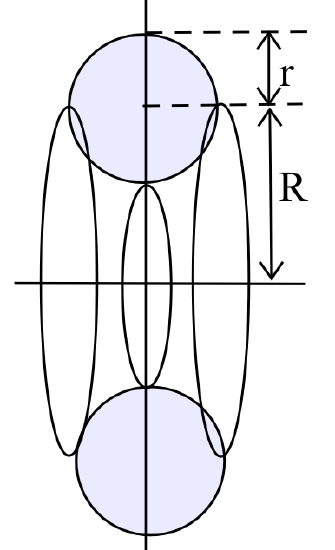
generated by rotating a disk of radius \(r\) with center \(R\) units away from the \(x\)-axis about the \(x\)-axis. -
- Find the area between \(\displaystyle f(x) = \frac{1}{x}\) and the \(x\)-axis for \(1\leq x \leq 10\), \(1\leq x \leq 100\) and \(1\leq x \leq M\). What is the limit of the area for \(1\leq x \leq M\) when \(M \rightarrow \infty\)?
- Find the volume swept out when the region in part (a) is revolved about the \(x\)-axis for \(1\leq x \leq 10\), \(1\leq x \leq 100\) and \(1\leq x \leq M\). What is the limit of the volume for \(1\leq x \leq M\) when \(M \rightarrow \infty\)?