

9.1: Introducing Ratios and Ratio Language
- Page ID
- 39920

\( \newcommand{\vecs}[1]{\overset { \scriptstyle \rightharpoonup} {\mathbf{#1}} } \)
\( \newcommand{\vecd}[1]{\overset{-\!-\!\rightharpoonup}{\vphantom{a}\smash {#1}}} \)
\( \newcommand{\dsum}{\displaystyle\sum\limits} \)
\( \newcommand{\dint}{\displaystyle\int\limits} \)
\( \newcommand{\dlim}{\displaystyle\lim\limits} \)
\( \newcommand{\id}{\mathrm{id}}\) \( \newcommand{\Span}{\mathrm{span}}\)
( \newcommand{\kernel}{\mathrm{null}\,}\) \( \newcommand{\range}{\mathrm{range}\,}\)
\( \newcommand{\RealPart}{\mathrm{Re}}\) \( \newcommand{\ImaginaryPart}{\mathrm{Im}}\)
\( \newcommand{\Argument}{\mathrm{Arg}}\) \( \newcommand{\norm}[1]{\| #1 \|}\)
\( \newcommand{\inner}[2]{\langle #1, #2 \rangle}\)
\( \newcommand{\Span}{\mathrm{span}}\)
\( \newcommand{\id}{\mathrm{id}}\)
\( \newcommand{\Span}{\mathrm{span}}\)
\( \newcommand{\kernel}{\mathrm{null}\,}\)
\( \newcommand{\range}{\mathrm{range}\,}\)
\( \newcommand{\RealPart}{\mathrm{Re}}\)
\( \newcommand{\ImaginaryPart}{\mathrm{Im}}\)
\( \newcommand{\Argument}{\mathrm{Arg}}\)
\( \newcommand{\norm}[1]{\| #1 \|}\)
\( \newcommand{\inner}[2]{\langle #1, #2 \rangle}\)
\( \newcommand{\Span}{\mathrm{span}}\) \( \newcommand{\AA}{\unicode[.8,0]{x212B}}\)
\( \newcommand{\vectorA}[1]{\vec{#1}} % arrow\)
\( \newcommand{\vectorAt}[1]{\vec{\text{#1}}} % arrow\)
\( \newcommand{\vectorB}[1]{\overset { \scriptstyle \rightharpoonup} {\mathbf{#1}} } \)
\( \newcommand{\vectorC}[1]{\textbf{#1}} \)
\( \newcommand{\vectorD}[1]{\overrightarrow{#1}} \)
\( \newcommand{\vectorDt}[1]{\overrightarrow{\text{#1}}} \)
\( \newcommand{\vectE}[1]{\overset{-\!-\!\rightharpoonup}{\vphantom{a}\smash{\mathbf {#1}}}} \)
\( \newcommand{\vecs}[1]{\overset { \scriptstyle \rightharpoonup} {\mathbf{#1}} } \)
\( \newcommand{\vecd}[1]{\overset{-\!-\!\rightharpoonup}{\vphantom{a}\smash {#1}}} \)
\(\newcommand{\avec}{\mathbf a}\) \(\newcommand{\bvec}{\mathbf b}\) \(\newcommand{\cvec}{\mathbf c}\) \(\newcommand{\dvec}{\mathbf d}\) \(\newcommand{\dtil}{\widetilde{\mathbf d}}\) \(\newcommand{\evec}{\mathbf e}\) \(\newcommand{\fvec}{\mathbf f}\) \(\newcommand{\nvec}{\mathbf n}\) \(\newcommand{\pvec}{\mathbf p}\) \(\newcommand{\qvec}{\mathbf q}\) \(\newcommand{\svec}{\mathbf s}\) \(\newcommand{\tvec}{\mathbf t}\) \(\newcommand{\uvec}{\mathbf u}\) \(\newcommand{\vvec}{\mathbf v}\) \(\newcommand{\wvec}{\mathbf w}\) \(\newcommand{\xvec}{\mathbf x}\) \(\newcommand{\yvec}{\mathbf y}\) \(\newcommand{\zvec}{\mathbf z}\) \(\newcommand{\rvec}{\mathbf r}\) \(\newcommand{\mvec}{\mathbf m}\) \(\newcommand{\zerovec}{\mathbf 0}\) \(\newcommand{\onevec}{\mathbf 1}\) \(\newcommand{\real}{\mathbb R}\) \(\newcommand{\twovec}[2]{\left[\begin{array}{r}#1 \\ #2 \end{array}\right]}\) \(\newcommand{\ctwovec}[2]{\left[\begin{array}{c}#1 \\ #2 \end{array}\right]}\) \(\newcommand{\threevec}[3]{\left[\begin{array}{r}#1 \\ #2 \\ #3 \end{array}\right]}\) \(\newcommand{\cthreevec}[3]{\left[\begin{array}{c}#1 \\ #2 \\ #3 \end{array}\right]}\) \(\newcommand{\fourvec}[4]{\left[\begin{array}{r}#1 \\ #2 \\ #3 \\ #4 \end{array}\right]}\) \(\newcommand{\cfourvec}[4]{\left[\begin{array}{c}#1 \\ #2 \\ #3 \\ #4 \end{array}\right]}\) \(\newcommand{\fivevec}[5]{\left[\begin{array}{r}#1 \\ #2 \\ #3 \\ #4 \\ #5 \\ \end{array}\right]}\) \(\newcommand{\cfivevec}[5]{\left[\begin{array}{c}#1 \\ #2 \\ #3 \\ #4 \\ #5 \\ \end{array}\right]}\) \(\newcommand{\mattwo}[4]{\left[\begin{array}{rr}#1 \amp #2 \\ #3 \amp #4 \\ \end{array}\right]}\) \(\newcommand{\laspan}[1]{\text{Span}\{#1\}}\) \(\newcommand{\bcal}{\cal B}\) \(\newcommand{\ccal}{\cal C}\) \(\newcommand{\scal}{\cal S}\) \(\newcommand{\wcal}{\cal W}\) \(\newcommand{\ecal}{\cal E}\) \(\newcommand{\coords}[2]{\left\{#1\right\}_{#2}}\) \(\newcommand{\gray}[1]{\color{gray}{#1}}\) \(\newcommand{\lgray}[1]{\color{lightgray}{#1}}\) \(\newcommand{\rank}{\operatorname{rank}}\) \(\newcommand{\row}{\text{Row}}\) \(\newcommand{\col}{\text{Col}}\) \(\renewcommand{\row}{\text{Row}}\) \(\newcommand{\nul}{\text{Nul}}\) \(\newcommand{\var}{\text{Var}}\) \(\newcommand{\corr}{\text{corr}}\) \(\newcommand{\len}[1]{\left|#1\right|}\) \(\newcommand{\bbar}{\overline{\bvec}}\) \(\newcommand{\bhat}{\widehat{\bvec}}\) \(\newcommand{\bperp}{\bvec^\perp}\) \(\newcommand{\xhat}{\widehat{\xvec}}\) \(\newcommand{\vhat}{\widehat{\vvec}}\) \(\newcommand{\uhat}{\widehat{\uvec}}\) \(\newcommand{\what}{\widehat{\wvec}}\) \(\newcommand{\Sighat}{\widehat{\Sigma}}\) \(\newcommand{\lt}{<}\) \(\newcommand{\gt}{>}\) \(\newcommand{\amp}{&}\) \(\definecolor{fillinmathshade}{gray}{0.9}\)Lesson
Let's describe two quantities at the same time.
Exercise \(\PageIndex{1}\): What Kind and How Many?
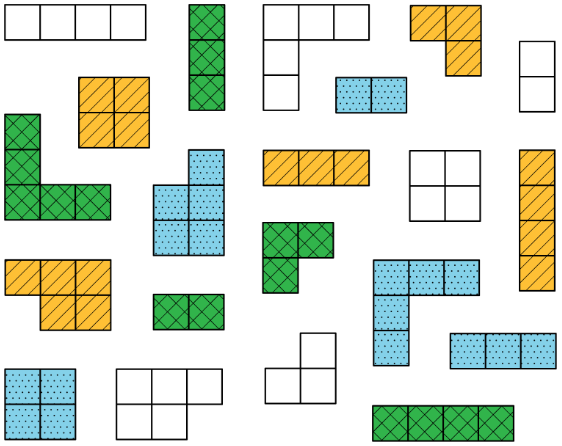
Think of different ways you could sort these figures. What categories could you use? How many groups would you have?
Exercise \(\PageIndex{2}\): The Teacher's Collection
- Think of a way to sort your teacher’s collection into two or three categories. Count the items in each category, and record the information in the table.
| category name | |||
|---|---|---|---|
| category amount |
Pause here so your teacher can review your work.
- Write at least two sentences that describe ratios in the collection. Remember, there are many ways to write a ratio:
- The ratio of one category to another category is ________ to ________.
- The ratio of one category to another category is ________ : ________.
- There are _______ of one category for every _______ of another category.
Exercise \(\PageIndex{3}\): The Student's Collection
- Sort your collection into three categories. You can experiment with different ways of arranging these categories. Then, count the items in each category, and record the information in the table.
| category name | |||
|---|---|---|---|
| category amount |
- Write at least two sentences that describe ratios in the collection. Remember, there are many ways to write a ratio:
- The ratio of one category to another category is ________ to ________.
- The ratio of one category to another category is ________ : ________.
- There are _______ of one category for every _______ of another category.
Pause here so your teacher can review your sentences.
- Make a visual display of your items that clearly shows one of your statements. Be prepared to share your display with the class.
Are you ready for more?
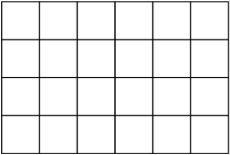
- Use two colors to shade the rectangle so there are 2 square units of one color for every 1 square unit of the other color.
- The rectangle you just colored has an area of 24 square units. Draw a different shape that does not have an area of 24 square units, but that can also be shaded with two colors in a \(2:1\) ratio. Shade your new shape using two colors.
Summary
A ratio is an association between two or more quantities. There are many ways to describe a situation in terms of ratios. For example, look at this collection:
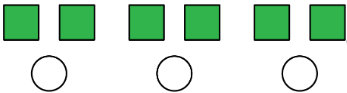
Here are some correct ways to describe the collection:
- The ratio of squares to circles is \(6:3\).
- The ratio of circles to squares is 3 to 6.
Notice that the shapes can be arranged in equal groups, which allow us to describe the shapes using other numbers.
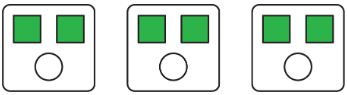
- There are 2 squares for every 1 circle.
- There is 1 circle for every 2 squares.
Glossary Entries
Definition: Ratio
A ratio is an association between two or more quantities.
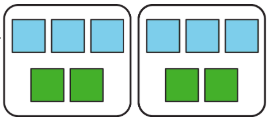
For example, the ratio \(3:2\) could describe a recipe that uses 3 cups of flour for every 2 eggs, or a boat that moves 3 meters every 2 seconds. One way to represent the ratio \(3:2\) is with a diagram that has 3 blue squares for every 2 green squares.
Practice
Exercise \(\PageIndex{4}\)
In a fruit basket there are 9 bananas, 4 apples, and 3 plums.
- The ratio of bananas to apples is ________ : ________.
- The ratio of plums to apples is ________ to ________.
- For every ________ apples, there are ________ plums.
- For every 3 bananas there is one ________.
Exercise \(\PageIndex{5}\)
Complete the sentences to describe this picture.

- The ratio of dogs to cats is ________.
- For every ________ dogs, there are ________ cats.
Exercise \(\PageIndex{6}\)
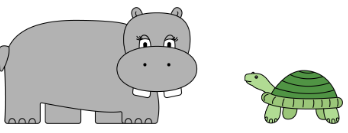
Write two different sentences that use ratios to describe the number of eyes and legs in this picture.
Exercise \(\PageIndex{7}\)
Choose an appropriate unit of measurement for each quantity.
- area of a rectangle
- volume of a prism
- side of a square
- area of a square
- volume of a cube
- cm
- cm3
- cm2
(From Unit 1.6.1)
Exercise \(\PageIndex{8}\)
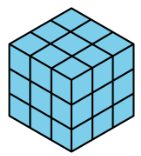
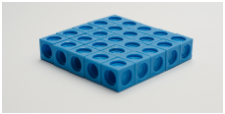
Find the volume and surface area of each prism.
- Prism A: 3 cm by 3 cm by 3 cm
- Prism B: 5 cm by 5 cm by 1 cm
- Compare the volumes of the prisms and then their surface areas. Does the prism with the greater volume also have the greater surface area?
(From Unit 1.5.5)
Exercise \(\PageIndex{9}\)
Which figure is a triangular prism? Select all that apply.
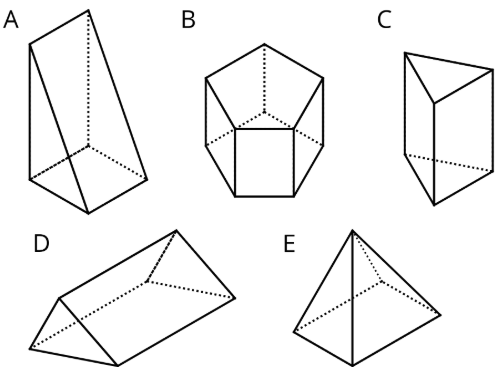
- A
- B
- C
- D
- E
(From Unit 1.5.2)


