

7.5: Modeling with Differential Equations


- Last updated
- Apr 4, 2022
- Save as PDF
( \newcommand{\kernel}{\mathrm{null}\,}\)
Learning Objectives
In this section, we strive to understand the ideas generated by the following important questions:
- How can we use differential equations to describe phenomena in the world around us?
- How can we use differential equations to better understand these phenomena?
In our work to date, we have seen several ways that differential equations arise in the natural world, from the growth of a population to the temperature of a cup of coffee. In this section, we will look more closely at how differential equations give us a natural way to describe various phenomena. As we’ll see, the key is to focus on understanding the different factors that cause a quantity to change.
Preview Activity
Any time that the rate of change of a quantity is related to the amount of a quantity, a differential equation naturally arises. In the following two problems, we see two such scenarios; for each, we want to develop a differential equation whose solution is the quantity of interest.
- Suppose you have a bank account in which money grows at an annual rate of 3%.
- If you have $10,000 in the account, at what rate is your money growing?
- Suppose that you are also withdrawing money from the account at $1,000 per year. What is the rate of change in the amount of money in the account? What are the units on this rate of change?
- Suppose that a water tank holds 100 gallons and that a salty solution, which contains 20 grams of salt in every gallon, enters the tank at 2 gallons per minute.
- How much salt enters the tank each minute?
- Suppose that initially there are 300 grams of salt in the tank. How much salt is in each gallon at this point in time?
- Finally, suppose that evenly mixed solution is pumped out of the tank at the rate of 2 gallons per minute. How much salt leaves the tank each minute?
- What is the total rate of change in the amount of salt in the tank?
Developing a Differential Equation
Preview activity
Example
In the Great Lakes region, rivers flowing into the lakes carry a great deal of pollution in the form of small pieces of plastic averaging 1 millimeter in diameter. In order to understand how the amount of plastic in Lake Michigan is changing, construct a model for how this type pollution has built up in the lake.
Solution
First, some basic facts about Lake Michigan.
- The volume of the lake is
- Water flows into the lake at a rate of
- Each cubic meter flowing into the lake contains roughly
Let’s denote the amount of pollution in the lake by
First, we will measure how
Second, we will measure how
Since
The total rate of change of
We have now found a differential equation that describes the rate at which the amount of pollution is changing. To better understand the behavior of
Since this is an autonomous differential equation, we can sketch
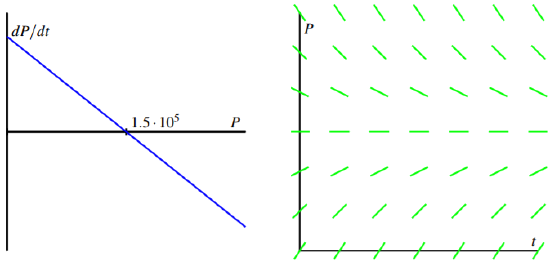
Figure
These plots both show that
Separating variables, we find that
Integrating with respect to
and thus changing variables on the left and antidifferentiating on both sides, we find that
Finally, multiplying both sides by −1 and using the definition of the logarithm, we find that
This is a good time to determine the constant
In other words,
Using this value of
Superimposing the graph of P on the slope field we saw in Figure
There are many important lessons to learn from Example
Of course, we can also explore what happens when certain aspects of the problem change. For instance, let’s suppose we are at a time when the plastic pollution entering
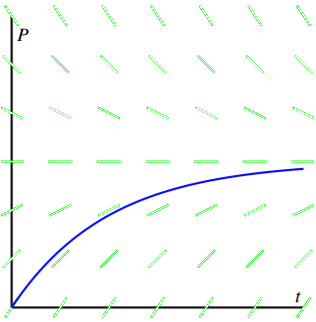
Figure
Lake Michigan has stabilized at
Restarting the problem at time
It is a straightforward and familiar exercise to find that the solution to this equation is
or
It follows that
In the upcoming activities, we explore some other natural settings in which differential equation model changing quantities.
Activity
Suppose you have a bank account that grows by 5% every year. Let
- What is the rate of change of
- Suppose that you are also withdrawing $10,000 per year. Write a differential equation that expresses the total rate of change of
- Sketch a slope field for this differential equation, find any equilibrium solutions, and identify them as either stable or unstable. Write a sentence or two that describes the significance of the stability of the equilibrium solution.
- Suppose that you initially deposit $100,000 into the account. How long does it take for you to deplete the account?
- What is the smallest amount of money you would need to have in the account to guarantee that you never deplete the money in the account?
- If your initial deposit is $300,000, how much could you withdraw every year without depleting the account?
Activity
A dose of morphine is absorbed from the bloodstream of a patient at a rate proportional to the amount in the bloodstream.
- Write a differential equation for
- Assuming that the initial dose of morphine is
- Suppose that a patient is given morphine intravenously at the rate of 3 milligrams per hour. Write a differential equation that combines the intravenous administration of morphine with the body’s natural absorption.
- Find any equilibrium solutions and determine their stability.
- Assuming that there is initially no morphine in the patient’s bloodstream, solve the initial value problem to determine
- To what rate should a doctor reduce the intravenous rate so that there is eventually 7 milligrams of morphine in the patient’s bloodstream?
Summary
In this section, we encountered the following important ideas:
- Differential equations arise in a situation when we understand how various factors cause a quantity to change.
- We may use the tools we have developed so far—slope fields, Euler’s methods, and our method for solving separable equations—to understand a quantity described by a differential equation.
