

17.3E: Exercises for Section 17.3
- Page ID
- 72451

\( \newcommand{\vecs}[1]{\overset { \scriptstyle \rightharpoonup} {\mathbf{#1}} } \)
\( \newcommand{\vecd}[1]{\overset{-\!-\!\rightharpoonup}{\vphantom{a}\smash {#1}}} \)
\( \newcommand{\dsum}{\displaystyle\sum\limits} \)
\( \newcommand{\dint}{\displaystyle\int\limits} \)
\( \newcommand{\dlim}{\displaystyle\lim\limits} \)
\( \newcommand{\id}{\mathrm{id}}\) \( \newcommand{\Span}{\mathrm{span}}\)
( \newcommand{\kernel}{\mathrm{null}\,}\) \( \newcommand{\range}{\mathrm{range}\,}\)
\( \newcommand{\RealPart}{\mathrm{Re}}\) \( \newcommand{\ImaginaryPart}{\mathrm{Im}}\)
\( \newcommand{\Argument}{\mathrm{Arg}}\) \( \newcommand{\norm}[1]{\| #1 \|}\)
\( \newcommand{\inner}[2]{\langle #1, #2 \rangle}\)
\( \newcommand{\Span}{\mathrm{span}}\)
\( \newcommand{\id}{\mathrm{id}}\)
\( \newcommand{\Span}{\mathrm{span}}\)
\( \newcommand{\kernel}{\mathrm{null}\,}\)
\( \newcommand{\range}{\mathrm{range}\,}\)
\( \newcommand{\RealPart}{\mathrm{Re}}\)
\( \newcommand{\ImaginaryPart}{\mathrm{Im}}\)
\( \newcommand{\Argument}{\mathrm{Arg}}\)
\( \newcommand{\norm}[1]{\| #1 \|}\)
\( \newcommand{\inner}[2]{\langle #1, #2 \rangle}\)
\( \newcommand{\Span}{\mathrm{span}}\) \( \newcommand{\AA}{\unicode[.8,0]{x212B}}\)
\( \newcommand{\vectorA}[1]{\vec{#1}} % arrow\)
\( \newcommand{\vectorAt}[1]{\vec{\text{#1}}} % arrow\)
\( \newcommand{\vectorB}[1]{\overset { \scriptstyle \rightharpoonup} {\mathbf{#1}} } \)
\( \newcommand{\vectorC}[1]{\textbf{#1}} \)
\( \newcommand{\vectorD}[1]{\overrightarrow{#1}} \)
\( \newcommand{\vectorDt}[1]{\overrightarrow{\text{#1}}} \)
\( \newcommand{\vectE}[1]{\overset{-\!-\!\rightharpoonup}{\vphantom{a}\smash{\mathbf {#1}}}} \)
\( \newcommand{\vecs}[1]{\overset { \scriptstyle \rightharpoonup} {\mathbf{#1}} } \)
\(\newcommand{\longvect}{\overrightarrow}\)
\( \newcommand{\vecd}[1]{\overset{-\!-\!\rightharpoonup}{\vphantom{a}\smash {#1}}} \)
\(\newcommand{\avec}{\mathbf a}\) \(\newcommand{\bvec}{\mathbf b}\) \(\newcommand{\cvec}{\mathbf c}\) \(\newcommand{\dvec}{\mathbf d}\) \(\newcommand{\dtil}{\widetilde{\mathbf d}}\) \(\newcommand{\evec}{\mathbf e}\) \(\newcommand{\fvec}{\mathbf f}\) \(\newcommand{\nvec}{\mathbf n}\) \(\newcommand{\pvec}{\mathbf p}\) \(\newcommand{\qvec}{\mathbf q}\) \(\newcommand{\svec}{\mathbf s}\) \(\newcommand{\tvec}{\mathbf t}\) \(\newcommand{\uvec}{\mathbf u}\) \(\newcommand{\vvec}{\mathbf v}\) \(\newcommand{\wvec}{\mathbf w}\) \(\newcommand{\xvec}{\mathbf x}\) \(\newcommand{\yvec}{\mathbf y}\) \(\newcommand{\zvec}{\mathbf z}\) \(\newcommand{\rvec}{\mathbf r}\) \(\newcommand{\mvec}{\mathbf m}\) \(\newcommand{\zerovec}{\mathbf 0}\) \(\newcommand{\onevec}{\mathbf 1}\) \(\newcommand{\real}{\mathbb R}\) \(\newcommand{\twovec}[2]{\left[\begin{array}{r}#1 \\ #2 \end{array}\right]}\) \(\newcommand{\ctwovec}[2]{\left[\begin{array}{c}#1 \\ #2 \end{array}\right]}\) \(\newcommand{\threevec}[3]{\left[\begin{array}{r}#1 \\ #2 \\ #3 \end{array}\right]}\) \(\newcommand{\cthreevec}[3]{\left[\begin{array}{c}#1 \\ #2 \\ #3 \end{array}\right]}\) \(\newcommand{\fourvec}[4]{\left[\begin{array}{r}#1 \\ #2 \\ #3 \\ #4 \end{array}\right]}\) \(\newcommand{\cfourvec}[4]{\left[\begin{array}{c}#1 \\ #2 \\ #3 \\ #4 \end{array}\right]}\) \(\newcommand{\fivevec}[5]{\left[\begin{array}{r}#1 \\ #2 \\ #3 \\ #4 \\ #5 \\ \end{array}\right]}\) \(\newcommand{\cfivevec}[5]{\left[\begin{array}{c}#1 \\ #2 \\ #3 \\ #4 \\ #5 \\ \end{array}\right]}\) \(\newcommand{\mattwo}[4]{\left[\begin{array}{rr}#1 \amp #2 \\ #3 \amp #4 \\ \end{array}\right]}\) \(\newcommand{\laspan}[1]{\text{Span}\{#1\}}\) \(\newcommand{\bcal}{\cal B}\) \(\newcommand{\ccal}{\cal C}\) \(\newcommand{\scal}{\cal S}\) \(\newcommand{\wcal}{\cal W}\) \(\newcommand{\ecal}{\cal E}\) \(\newcommand{\coords}[2]{\left\{#1\right\}_{#2}}\) \(\newcommand{\gray}[1]{\color{gray}{#1}}\) \(\newcommand{\lgray}[1]{\color{lightgray}{#1}}\) \(\newcommand{\rank}{\operatorname{rank}}\) \(\newcommand{\row}{\text{Row}}\) \(\newcommand{\col}{\text{Col}}\) \(\renewcommand{\row}{\text{Row}}\) \(\newcommand{\nul}{\text{Nul}}\) \(\newcommand{\var}{\text{Var}}\) \(\newcommand{\corr}{\text{corr}}\) \(\newcommand{\len}[1]{\left|#1\right|}\) \(\newcommand{\bbar}{\overline{\bvec}}\) \(\newcommand{\bhat}{\widehat{\bvec}}\) \(\newcommand{\bperp}{\bvec^\perp}\) \(\newcommand{\xhat}{\widehat{\xvec}}\) \(\newcommand{\vhat}{\widehat{\vvec}}\) \(\newcommand{\uhat}{\widehat{\uvec}}\) \(\newcommand{\what}{\widehat{\wvec}}\) \(\newcommand{\Sighat}{\widehat{\Sigma}}\) \(\newcommand{\lt}{<}\) \(\newcommand{\gt}{>}\) \(\newcommand{\amp}{&}\) \(\definecolor{fillinmathshade}{gray}{0.9}\)1. A mass weighing 4 lb stretches a spring 8 in. Find the equation of motion if the spring is released from the equilibrium position with a downward velocity of 12 ft/sec. What is the period and frequency of the motion?
2. A mass weighing 2 lb stretches a spring 2 ft. Find the equation of motion if the spring is released from 2 in. below the equilibrium position with an upward velocity of 8 ft/sec. What is the period and frequency of the motion?
- Answer
- differential equation: \(x″+16x=0,\)
equation of motion: \(x(t)=\frac{1}{6} \cos (4t)−2 \sin (4t),\)
period \(=\,\frac{π}{2} \text{ sec},\)
frequency \(=\,\frac{2}{π} \text{ Hz}\)
3. A 100-g mass stretches a spring 0.1 m. Find the equation of motion of the mass if it is released from rest from a position 20 cm below the equilibrium position. What is the frequency of this motion?
4. A 400-g mass stretches a spring 5 cm. Find the equation of motion of the mass if it is released from rest from a position 15 cm below the equilibrium position. What is the frequency of this motion?
- Answer
- differential equation: \(x″+196x=0,\)
equation of motion: \(x(t)=0.15 \cos (14t),\)
period \(=\,\frac{π}{7} \text{ sec},\)
frequency \(=\,\frac{7}{π} \text{ Hz}\)
5. A block has a mass of 9 kg and is attached to a vertical spring with a spring constant of 0.25 N/m. The block is stretched 0.75 m below its equilibrium position and released.
- Find the position function \(x(t)\) of the block.
- Find the period and frequency of the vibration.
- Sketch a graph of \(x(t)\).
- At what time does the block first pass through the equilibrium position?
6. A block has a mass of 5 kg and is attached to a vertical spring with a spring constant of 20 N/m. The block is released from the equilibrium position with a downward velocity of 10 m/sec.
- Find the position function \(x(t)\) of the block.
- Find the period and frequency of the vibration.
- Sketch a graph of \(x(t)\).
- At what time does the block first pass through the equilibrium position?
- Answer
-
a. \(x(t)=5 \sin (2t)\)
b. period \(=π \text{ sec},\)
frequency \(=\frac{1}{π} \text{ Hz}\)
c.
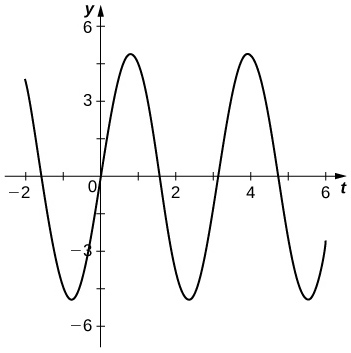
d. \(t=\frac{π}{2} \text{ sec}\)
7. A 1-kg mass is attached to a vertical spring with a spring constant of 21 N/m. The resistance in the spring-mass system is equal to 10 times the instantaneous velocity of the mass.
- Find the equation of motion if the mass is released from a position 2 m below its equilibrium position with a downward velocity of 2 m/sec.
- Graph the solution and determine whether the motion is overdamped, critically damped, or underdamped.
8. An 800-lb weight (25 slugs) is attached to a vertical spring with a spring constant of 226 lb/ft. The system is immersed in a medium that imparts a damping force equal to 10 times the instantaneous velocity of the mass.
- Find the equation of motion if it is released from a position 20 ft below its equilibrium position with a downward velocity of 41 ft/sec.
- Graph the solution and determine whether the motion is overdamped, critically damped, or underdamped.
- Answer
-
a. \(x(t)=e^{−t/5}(20 \cos (3t)+15 \sin(3t))\)
b. underdamped
9. A 9-kg mass is attached to a vertical spring with a spring constant of 16 N/m. The system is immersed in a medium that imparts a damping force equal to 24 times the instantaneous velocity of the mass.
- Find the equation of motion if it is released from its equilibrium position with an upward velocity of 4 m/sec.
- Graph the solution and determine whether the motion is overdamped, critically damped, or underdamped.
10. A 1-kg mass stretches a spring 6.25 cm. The resistance in the spring-mass system is equal to eight times the instantaneous velocity of the mass.
- Find the equation of motion if the mass is released from a position 5 m below its equilibrium position with an upward velocity of 10 m/sec.
- Determine whether the motion is overdamped, critically damped, or underdamped.
- Answer
-
a. \(x(t)=5e^{−4t}+10te^{−4t}\)
b. critically damped
11. A 32-lb weight (1 slug) stretches a vertical spring 4 in. The resistance in the spring-mass system is equal to four times the instantaneous velocity of the mass.
- Find the equation of motion if it is released from its equilibrium position with a downward velocity of 12 ft/sec.
- Determine whether the motion is overdamped, critically damped, or underdamped.
12. A 64-lb weight is attached to a vertical spring with a spring constant of 4.625 lb/ft. The resistance in the spring-mass system is equal to the instantaneous velocity. The weight is set in motion from a position 1 ft below its equilibrium position with an upward velocity of 2 ft/sec. Is the mass above or below the equation position at the end of \(π\) sec? By what distance?
- Answer
- \(x(π)=\frac{7e^{−π/4}}{6}\) ft below
13. A mass that weighs 8 lb stretches a spring 6 inches. The system is acted on by an external force of \(8 \sin 8t \)lb. If the mass is pulled down 3 inches and then released, determine the position of the mass at any time.
14. A mass that weighs 6 lb stretches a spring 3 in. The system is acted on by an external force of \(8 \sin (4t) \) lb. If the mass is pulled down 1 inch and then released, determine the position of the mass at any time.
- Answer
- \(x(t)=\frac{32}{9} \sin (4t)+ \cos (\sqrt{128}t)−\frac{16}{9\sqrt{2}} \sin (\sqrt{128}t)\)
15. Find the charge on the capacitor in an RLC series circuit where \(L=40\) H, \(R=30\,Ω\), \(C=1/200\) F, and \(E(t)=200\) V. Assume the initial charge on the capacitor is 7 C and the initial current is 0 A.
16. Find the charge on the capacitor in an RLC series circuit where \(L=2\) H, \(R=24\,Ω,\) \(C=0.005\) F, and \(E(t)=12 \sin 10t\) V. Assume the initial charge on the capacitor is 0.001 C and the initial current is 0 A.
- Answer
- \(q(t)=e^{−6t}(0.051 \cos (8t)+0.03825 \sin (8t))−\frac{1}{20} \cos (10t)\)
17. A series circuit consists of a device where\(L=1\) H, \(R=20\,Ω,\) \(C=0.002\) F, and \(E(t)=12\) V. If the initial charge and current are both zero, find the charge and current at time \(t.\)
18. A series circuit consists of a device where \(L=12\) H, \(R=10\,Ω\), \(C=\frac{1}{50}\) F, and \(E(t)=250\) V. If the initial charge on the capacitor is 0 C and the initial current is 18 A, find the charge and current at time \(t.\)
- Answer
- \(q(t)=e^{−10t}(−32t−5)+5,I(t)=2e^{−10t}(160t+9)\)