

3.2: Explicit Boundary Conditions


- Last updated
- Jul 4, 2022
- Save as PDF

( \newcommand{\kernel}{\mathrm{null}\,}\)
For the problems of interest here we shall only consider linear boundary conditions, which express a linear relation between the function and its partial derivatives, e.g.,
Dirichlet Boundary Condition
When we specify the value of
von Neumann Boundary Conditions
In multidimensional problems the derivative of a function w.r.t. to each of the variables forms a vector field (i.e., a function that takes a vector value at each point of space), usually called the gradient. For three variables this takes the form
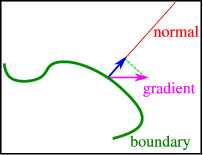
Typically we cannot specify the gradient at the boundary since that is too restrictive to allow for solutions. We can – and in physical problems often need to – specify the component normal to the boundary, see Figure
In the case of an insulated (infinitely thin) rod of length
Mixed (Robin’s) Boundary Conditions
We can of course mix Dirichlet and von Neumann boundary conditions. For the thin rod example given above we could require
