

8.1: Improper Integrals
- Page ID
- 175605

\( \newcommand{\vecs}[1]{\overset { \scriptstyle \rightharpoonup} {\mathbf{#1}} } \)
\( \newcommand{\vecd}[1]{\overset{-\!-\!\rightharpoonup}{\vphantom{a}\smash {#1}}} \)
\( \newcommand{\dsum}{\displaystyle\sum\limits} \)
\( \newcommand{\dint}{\displaystyle\int\limits} \)
\( \newcommand{\dlim}{\displaystyle\lim\limits} \)
\( \newcommand{\id}{\mathrm{id}}\) \( \newcommand{\Span}{\mathrm{span}}\)
( \newcommand{\kernel}{\mathrm{null}\,}\) \( \newcommand{\range}{\mathrm{range}\,}\)
\( \newcommand{\RealPart}{\mathrm{Re}}\) \( \newcommand{\ImaginaryPart}{\mathrm{Im}}\)
\( \newcommand{\Argument}{\mathrm{Arg}}\) \( \newcommand{\norm}[1]{\| #1 \|}\)
\( \newcommand{\inner}[2]{\langle #1, #2 \rangle}\)
\( \newcommand{\Span}{\mathrm{span}}\)
\( \newcommand{\id}{\mathrm{id}}\)
\( \newcommand{\Span}{\mathrm{span}}\)
\( \newcommand{\kernel}{\mathrm{null}\,}\)
\( \newcommand{\range}{\mathrm{range}\,}\)
\( \newcommand{\RealPart}{\mathrm{Re}}\)
\( \newcommand{\ImaginaryPart}{\mathrm{Im}}\)
\( \newcommand{\Argument}{\mathrm{Arg}}\)
\( \newcommand{\norm}[1]{\| #1 \|}\)
\( \newcommand{\inner}[2]{\langle #1, #2 \rangle}\)
\( \newcommand{\Span}{\mathrm{span}}\) \( \newcommand{\AA}{\unicode[.8,0]{x212B}}\)
\( \newcommand{\vectorA}[1]{\vec{#1}} % arrow\)
\( \newcommand{\vectorAt}[1]{\vec{\text{#1}}} % arrow\)
\( \newcommand{\vectorB}[1]{\overset { \scriptstyle \rightharpoonup} {\mathbf{#1}} } \)
\( \newcommand{\vectorC}[1]{\textbf{#1}} \)
\( \newcommand{\vectorD}[1]{\overrightarrow{#1}} \)
\( \newcommand{\vectorDt}[1]{\overrightarrow{\text{#1}}} \)
\( \newcommand{\vectE}[1]{\overset{-\!-\!\rightharpoonup}{\vphantom{a}\smash{\mathbf {#1}}}} \)
\( \newcommand{\vecs}[1]{\overset { \scriptstyle \rightharpoonup} {\mathbf{#1}} } \)
\(\newcommand{\longvect}{\overrightarrow}\)
\( \newcommand{\vecd}[1]{\overset{-\!-\!\rightharpoonup}{\vphantom{a}\smash {#1}}} \)
\(\newcommand{\avec}{\mathbf a}\) \(\newcommand{\bvec}{\mathbf b}\) \(\newcommand{\cvec}{\mathbf c}\) \(\newcommand{\dvec}{\mathbf d}\) \(\newcommand{\dtil}{\widetilde{\mathbf d}}\) \(\newcommand{\evec}{\mathbf e}\) \(\newcommand{\fvec}{\mathbf f}\) \(\newcommand{\nvec}{\mathbf n}\) \(\newcommand{\pvec}{\mathbf p}\) \(\newcommand{\qvec}{\mathbf q}\) \(\newcommand{\svec}{\mathbf s}\) \(\newcommand{\tvec}{\mathbf t}\) \(\newcommand{\uvec}{\mathbf u}\) \(\newcommand{\vvec}{\mathbf v}\) \(\newcommand{\wvec}{\mathbf w}\) \(\newcommand{\xvec}{\mathbf x}\) \(\newcommand{\yvec}{\mathbf y}\) \(\newcommand{\zvec}{\mathbf z}\) \(\newcommand{\rvec}{\mathbf r}\) \(\newcommand{\mvec}{\mathbf m}\) \(\newcommand{\zerovec}{\mathbf 0}\) \(\newcommand{\onevec}{\mathbf 1}\) \(\newcommand{\real}{\mathbb R}\) \(\newcommand{\twovec}[2]{\left[\begin{array}{r}#1 \\ #2 \end{array}\right]}\) \(\newcommand{\ctwovec}[2]{\left[\begin{array}{c}#1 \\ #2 \end{array}\right]}\) \(\newcommand{\threevec}[3]{\left[\begin{array}{r}#1 \\ #2 \\ #3 \end{array}\right]}\) \(\newcommand{\cthreevec}[3]{\left[\begin{array}{c}#1 \\ #2 \\ #3 \end{array}\right]}\) \(\newcommand{\fourvec}[4]{\left[\begin{array}{r}#1 \\ #2 \\ #3 \\ #4 \end{array}\right]}\) \(\newcommand{\cfourvec}[4]{\left[\begin{array}{c}#1 \\ #2 \\ #3 \\ #4 \end{array}\right]}\) \(\newcommand{\fivevec}[5]{\left[\begin{array}{r}#1 \\ #2 \\ #3 \\ #4 \\ #5 \\ \end{array}\right]}\) \(\newcommand{\cfivevec}[5]{\left[\begin{array}{c}#1 \\ #2 \\ #3 \\ #4 \\ #5 \\ \end{array}\right]}\) \(\newcommand{\mattwo}[4]{\left[\begin{array}{rr}#1 \amp #2 \\ #3 \amp #4 \\ \end{array}\right]}\) \(\newcommand{\laspan}[1]{\text{Span}\{#1\}}\) \(\newcommand{\bcal}{\cal B}\) \(\newcommand{\ccal}{\cal C}\) \(\newcommand{\scal}{\cal S}\) \(\newcommand{\wcal}{\cal W}\) \(\newcommand{\ecal}{\cal E}\) \(\newcommand{\coords}[2]{\left\{#1\right\}_{#2}}\) \(\newcommand{\gray}[1]{\color{gray}{#1}}\) \(\newcommand{\lgray}[1]{\color{lightgray}{#1}}\) \(\newcommand{\rank}{\operatorname{rank}}\) \(\newcommand{\row}{\text{Row}}\) \(\newcommand{\col}{\text{Col}}\) \(\renewcommand{\row}{\text{Row}}\) \(\newcommand{\nul}{\text{Nul}}\) \(\newcommand{\var}{\text{Var}}\) \(\newcommand{\corr}{\text{corr}}\) \(\newcommand{\len}[1]{\left|#1\right|}\) \(\newcommand{\bbar}{\overline{\bvec}}\) \(\newcommand{\bhat}{\widehat{\bvec}}\) \(\newcommand{\bperp}{\bvec^\perp}\) \(\newcommand{\xhat}{\widehat{\xvec}}\) \(\newcommand{\vhat}{\widehat{\vvec}}\) \(\newcommand{\uhat}{\widehat{\uvec}}\) \(\newcommand{\what}{\widehat{\wvec}}\) \(\newcommand{\Sighat}{\widehat{\Sigma}}\) \(\newcommand{\lt}{<}\) \(\newcommand{\gt}{>}\) \(\newcommand{\amp}{&}\) \(\definecolor{fillinmathshade}{gray}{0.9}\)- Evaluate an integral over an infinite interval.
- Evaluate an integral over a closed interval with an infinite discontinuity within the interval.
- Use the comparison theorem to determine whether a definite integral is convergent.
Before we dive too deeply into the focus of this chapter (sequences and series), we must investigate the concept of integrals with infinite upper and/or lower limits - this will significantly help us with the material for the rest of this chapter.
Is the area between the graph of \(f(x) = \frac{1}{x}\) and the \(x\)-axis over the interval \([1,\infty )\) finite or infinite? If this same region is revolved about the \(x\)-axis, is the volume finite or infinite? Surprisingly, the area of the region described is infinite, but the volume of the solid obtained by revolving this region about the \(x\)-axis is finite.
In this section, we define integrals over an infinite interval and integrals of functions containing a discontinuity on the interval. Integrals of these types are called improper integrals. We examine several techniques for evaluating improper integrals, all involving taking limits.
Integrating over an Infinite Interval
How should we go about defining an integral of the type \(\displaystyle \int ^{\infty }_a f(x)\, dx\)? We can integrate \(\displaystyle \int ^t_a f(x)\, dx\) for any value of \(t\), so it is reasonable to look at the behavior of this integral as we substitute larger values of \(t\). Figure \(\PageIndex{1}\) shows that \(\displaystyle \int ^t_a f(x)\,dx\) may be interpreted as area for various values of \(t\). In other words, we may define an improper integral as a limit, taken as one of the limits of integration increases or decreases without bound.

Figure \(\PageIndex{1}\): To integrate a function over an infinite interval, we consider the limit of the integral as the upper limit increases without bound.
- Let \(f(x)\) be continuous over an interval of the form \([a,\infty )\). Then \( \displaystyle \int_a^{\infty} f(x) \, dx \) is called an improper integral, and \[\int ^{\infty }_a f(x)\,dx \equiv \lim_{t \to \infty }\int ^t_a f(x)\,dx, \label{improper1} \]provided this limit exists.1,2
- Let \(f(x)\) be continuous over an interval of the form \((− \infty ,b]\). Then \( \displaystyle \int_{-\infty}^b f(x) \, dx \) is also called an improper integral, and \[\int ^b_{− \infty } f(x)\,dx \equiv \lim_{t \to − \infty }\int ^b_tf(x)\,dx, \label{improper2} \]provided this limit exists.
In each case, if the limit exists, then the improper integral is said to converge. If the limit does not exist, then the improper integral is said to diverge.
- Let \(f(x)\) be continuous over \((− \infty ,\infty )\). Then \( \displaystyle \int_{-\infty}^{\infty} f(x) \, dx \) is also called an improper integral, and \[\int ^{\infty }_{− \infty }f(x)\,dx \equiv \int ^a_{− \infty }f(x)\,dx+\int ^{\infty }_a f(x)\,dx \label{improper3} \]for any value of \( a \), provided that \(\displaystyle \int ^a_{− \infty }f(x)\,dx\) and \(\displaystyle \int ^{\infty }_a f(x)\,dx\) both converge.
If either of these two integrals diverge, then \(\displaystyle \int ^{\infty }_{− \infty }f(x)\,dx\) diverges.
In our first example, we return to the question we posed at the start of this section: Is the area between the graph of \(f(x)=\frac{1}{x}\) and the \(x\)-axis over the interval \([1,\infty )\) finite or infinite?
Determine whether the area between the graph of \(f(x)=\frac{1}{x}\) and the \(x\)-axis over the interval \([1,\infty )\) is finite or infinite.
- Solution
-
We first do a quick sketch of the region in question, as shown in Figure \(\PageIndex{2}\).

Figure \(\PageIndex{2}\): We can find the area between the curve \(f(x)=1/x\) and the \(x\)-axis on an infinite interval.We can see that the area of this region is given by\[A = \int^{\infty}_1 \dfrac{1}{x}\, dx. \nonumber \]which can be evaluated using Equation \ref{improper1}:\[ \begin{array}{rcl}
A & = & \displaystyle \int^{\infty} _1 \dfrac{1}{x}\,dx \\[16pt]
& = & \displaystyle \lim_{t \to \infty }\int^t_1 \dfrac{1}{x}\,dx \\[16pt]
& = & \displaystyle \lim_{t \to \infty } \ln |x| \bigg|^t_1 \\[16pt]
& = & \displaystyle \lim_{t \to \infty }(\ln |t|−\ln 1) \\[16pt]
& = & \infty . \\[16pt]
\end{array} \nonumber \]Since the limit tends to \(\infty\), it technically does not exist (as a finite number).2 Thus, the improper integral is divergent. In fact, it diverges to infinity, and so the area of the region is infinite.
A very lousy habit that some students get into is to evaluate an improper integral without using limit notation. To be clear:
To evaluate an improper integral, you must use limits!
That is, in Example \( \PageIndex{1} \), it would be incorrect to write\[ A = \int_1^{\infty} \dfrac{1}{x} \, dx = \ln|x| \bigg|_1^{\infty} = \ln|\infty| - \ln|1| = \infty - 0 = \infty. \nonumber \]This makes no sense mathematically since \( \infty \) is not a number and, as such, you cannot directly evaluate any function "at \( \infty \)." Hence, \( \ln|\infty| \) has no meaning. On the other hand, \( \displaystyle \lim_{t \to \infty} \ln|t| = \infty\) makes complete sense.
Find the volume of the solid obtained by revolving the region bounded by the graph of \(f(x)=\frac{1}{x}\) and the \(x\)-axis over the interval \([1,\infty )\) about the \(x\)-axis.
- Solution
-
The solid is shown in Figure \(\PageIndex{3}\). Using the Disk Method, we see that the volume \(V\) is\[V= \pi \int ^{\infty }_1\dfrac{1}{x^2}\,dx. \nonumber \]

Figure \(\PageIndex{3}\): The solid of revolution can be generated by rotating an infinite area about the \(x\)-axis.Then we have\[\begin{array}{rcl}
V & = & \pi \displaystyle \int ^{\infty }_1\dfrac{1}{x^2}\,dx \\[16pt]
& = & \pi \displaystyle \lim_{t \to \infty }\int ^t_1 \dfrac{1}{x^2}\,dx \\[16pt]
& = & \pi \displaystyle \lim_{t \to \infty }-\dfrac{1}{x}\bigg|^t_1 \\[16pt]
& = & \pi \displaystyle \lim_{t \to \infty }\left(-\dfrac{1}{t}+1\right) \\[16pt]
& = & \pi \displaystyle \lim_{t \to \infty }\left(-\cancelto{0}{\dfrac{1}{t}}+1\right) \\[16pt]
& = & \pi \\[16pt]
\end{array} \nonumber \]Since this limit exists, the improper integral converges. In fact, it converges to \( \pi \). Therefore, the volume of the solid of revolution is \( \pi \).
In conclusion, although the area of the region between the \(x\)-axis and the graph of \(f(x)= \frac{1}{x}\) over the interval \([1,\infty )\) is infinite, the volume of the solid generated by revolving this region about the \(x\)-axis is finite. The solid generated is known as Gabriel’s Horn.3
Suppose that at a busy intersection, traffic accidents occur at an average rate of one every three months. After residents complained, changes were made to the traffic lights at the intersection. It has been eight months since the changes were made, and no accidents have occurred. Were the changes effective, or is the 8-month interval without an accident a result of chance?

Figure \(\PageIndex{4}\): Modification of work by David McKelvey, Flickr.
Probability theory tells us that if the average time between events is \(k\), then the probability that the actual time between events is between \(a\) and \(b\) is given by\[P(a \leq X \leq b) = \int ^b_af(x)\,dx, \nonumber \]where\[f(x) = \begin{cases}
0, & \text{if }x \lt 0 \\[16pt]
ke^{−kx}, & \text{if }x \geq 0 \\[16pt]
\end{cases}. \nonumber \]Thus, if accidents are occurring at a rate of one every 3 months, then the probability that actual time between accidents is between \(a\) and \(b\) is given by\[P(a \leq X \leq b) = \int ^b_af(x)\, dx, \nonumber \]where\[f(x) = \begin{cases}
0, & \text{if }x \lt 0 \\[16pt]
3e^{−3x}, & \text{if }x \geq 0 \\[16pt]
\end{cases}. \nonumber \]To answer the question, we must ask ourselves, "What is the probability that the first accident in the intersection occurs after 8 months?" Hence, we need to compute \(\displaystyle P(X \geq 8) = \int ^{\infty }_8 3e^{−3x}\, dx\) and decide whether it is likely that 8 months could have passed without an accident if there had been no improvement in the traffic situation.
- Solution
-
We need to calculate the probability as an improper integral:\[ \begin{array}{rcl}
P(X \geq 8) & = & \displaystyle \int^{\infty }_8 3e^{−3x}\,dx \\[16pt]
& = & \displaystyle \lim_{t \to \infty }\int ^t_8 3e^{−3x}\,dx \\[16pt]
& = & \displaystyle \lim_{t \to \infty }−e^{−3x}\bigg|^t_8 \\[16pt]
& = & \displaystyle \lim_{t \to \infty }(−e^{−3t}+e^{−24}) \\[16pt]
& \approx & 3.8 \times 10^{−11}. \\[16pt]
\end{array} \nonumber \]The value \(3.8 \times 10^{−11}\) represents the probability of no accidents in 8 months under the initial conditions. Since this value is very small, concluding the changes were effective is reasonable.
Evaluate\[ \int ^0_{− \infty }\dfrac{1}{x^2+4}\,dx. \nonumber \]State whether the improper integral converges or diverges.
- Solution
-
Begin by rewriting \(\displaystyle \int ^0_{− \infty }\frac{1}{x^2+4}\,dx\) as a limit using Equation \ref{improper2} from the definition. Thus,\[\begin{array}{rcl}
\displaystyle \int ^0_{− \infty }\dfrac{1}{x^2+4}\,dx & = & \displaystyle \lim_{t \to − \infty }\int ^0_t\dfrac{1}{x^2+4}\,dx \\[16pt]
& = & \displaystyle \lim_{t \to − \infty }\dfrac{1}{2}\tan^{−1}\dfrac{x}{2} \bigg|^0_t \\[16pt]
& = & \displaystyle \lim_{t \to − \infty }\left(\dfrac{1}{2}\tan^{−1}0−\dfrac{1}{2}\tan^{−1}\dfrac{t}{2}\right) \\[16pt]
& = & \dfrac{ \pi }{4} \\[16pt]
\end{array} \nonumber \]Therefore, the improper integral converges to \(\frac{ \pi }{4}.\)
Evaluate\[ \int ^{\infty }_{− \infty }xe^x\,dx. \nonumber \]State whether the improper integral converges or diverges.
- Solution
-
Start by splitting up the integral:\[\int ^{\infty }_{− \infty }xe^x\,dx=\int ^0_{− \infty }xe^x\,dx+\int ^{\infty }_0xe^x\,dx. \nonumber \]If either \(\displaystyle \int ^0_{− \infty }xe^x\,dx\) or \(\displaystyle \int ^{\infty }_0xe^x\,dx\) diverges, then \(\displaystyle \int ^{\infty }_{− \infty }xe^x\,dx\) diverges.
For the first integral,\[ \begin{array}{rcl}
\displaystyle \int ^0_{− \infty }xe^x\,dx & = & \displaystyle \lim_{t \to − \infty }\int ^0_t xe^x\,dx \\[16pt]
& = & \displaystyle \lim_{t \to − \infty }(xe^x−e^x)\bigg|^0_t \\[16pt]
& = & \displaystyle \lim_{t \to − \infty }(−1−te^t+e^t) \\[16pt]
& = & −1. \\[16pt]
\end{array} \nonumber \]Note: \(\displaystyle \lim_{t \to − \infty }te^t\) is indeterminate of the form \(0 \cdot \infty \). Thus,\[ \lim_{t \to − \infty }te^t = \lim_{t \to − \infty }\dfrac{t}{e^{−t}} \overset{\text{l'H}}{=} \lim_{t \to − \infty }\dfrac{−1}{e^{−t}}=\lim_{t \to − \infty }−e^t=0 \nonumber \]by l’Hospital’s Rule. Hence, the first improper integral converges.For the second integral,\[\begin{array}{rcl}
\displaystyle \int ^{\infty }_0xe^x\,dx & = & \displaystyle \lim_{t \to \infty }\int ^t_0xe^x\,dx \\[16pt]
& = & \displaystyle \lim_{t \to \infty }(xe^x−e^x)\bigg|^t_0 \\[16pt]
& = & \displaystyle \lim_{t \to \infty }(te^t−e^t+1) \\[16pt]
& = & \displaystyle \lim_{t \to \infty }((t−1)e^t+1) \\[16pt]
& = & \infty . \\[16pt]
\end{array} \nonumber \]Thus, \(\displaystyle \int ^{\infty }_0xe^x\,dx\) diverges. Since this integral diverges, \(\displaystyle \int ^{\infty }_{− \infty }xe^x\,dx\) diverges as well.
Evaluate\[ \int ^{\infty }_{−3}e^{−x}\,dx.\nonumber \]State whether the improper integral converges or diverges.
- Answer
-
It converges to \(e^3.\)
Integrating a Discontinuous Integrand
Now, let's examine integrals of functions containing an infinite discontinuity in the interval over which the integration occurs. Consider an integral of the form \(\displaystyle \int ^b_af(x)\,dx,\) where \(f(x)\) is continuous over \([a,b)\) and discontinuous at \(b\). Since the function \(f(x)\) is continuous over \([a,t]\) for all values of \(t\) satisfying \(a \le t \lt b\), the integral \(\displaystyle \int ^t_a f(x)\,dx\) is defined for all such values of \(t\). Thus, it makes sense to consider the values of \(\displaystyle \int^t_a f(x)\,dx\) as \(t\) approaches \(b\) for \(a \le t \lt b\). That is, we define \(\displaystyle \int ^b_af(x)\,dx \equiv \lim_{t \to b^−}\int ^t_af(x)\,dx\), provided this limit exists. Figure \(\PageIndex{5}\) illustrates \(\displaystyle \int ^t_af(x)\,dx\) as areas of regions for values of \(t\) approaching \(b\).

Figure \(\PageIndex{5}\): As t approaches b from the left, the value of the area from a to t approaches the area from a to b.
We use a similar approach to define \(\displaystyle \int ^b_af(x)\,dx\), where \(f(x)\) is continuous over \((a,b]\) and discontinuous at \(a\). We now proceed with a formal definition.
- Let \(f(x)\) be continuous over \([a,b)\). Then, \[\int ^b_af(x)\,dx \equiv \lim_{t \to b^−}\int ^t_af(x)\,dx, \label{improperundefb} \]provided this limit exists.
- Let \(f(x)\) be continuous over \((a,b]\). Then, \[\int ^b_af(x)\,dx=\lim_{t \to a^+}\int ^b_tf(x)\,dx, \label{improperundefa} \]provided this limit exists.
- If \(f(x)\) is continuous over \([a,b]\) except at a point \(c\) in \((a,b)\), then \[\int ^b_af(x)\,dx \equiv \int ^c_af(x)\,dx+\int ^b_cf(x)\,dx,\label{improperundefc} \] provided both \(\displaystyle \int ^c_af(x)\,dx\) and \(\displaystyle \int ^b_cf(x)\,dx\) converge. If either of these integrals diverges, then \(\displaystyle \int ^b_af(x)\,dx\) diverges.
In each case, if the limit exists, then the improper integral is said to converge. If the limit does not exist, then the improper integral is said to diverge.
The following examples demonstrate the application of this definition.
Evaluate\[ \int ^4_0 \dfrac{1}{\sqrt{4−x}}\,dx, \nonumber \]if possible. State whether the integral converges or diverges.
- Solution
-
The function \(f(x)=\frac{1}{\sqrt{4−x}}\) is continuous over \([0,4)\) and discontinuous at 4. Using Equation \ref{improperundefb} from the definition, rewrite \(\displaystyle \int ^4_0\frac{1}{\sqrt{4−x}}\,dx\) as a limit:\[ \begin{array}{rcl}
\displaystyle \int^4_0\dfrac{1}{\sqrt{4−x}}\,dx & = & \displaystyle \lim_{t \to 4^−}\int^t_0\dfrac{1}{\sqrt{4−x}}\,dx \\[16pt]
& = & \displaystyle \lim_{t \to 4^−}(−2\sqrt{4−x})\bigg|^t_0 \\[16pt]
& = & \displaystyle \lim_{t \to 4^−}(−2\sqrt{4−t}+4) \\[16pt]
& = & 4. \\[16pt]
\end{array} \nonumber \]The improper integral converges (to 4).
Evaluate\[\int ^2_0x\ln x\,dx.\nonumber \]State whether the integral converges or diverges.
- Solution
-
Since \(f(x)=x\ln x\) is continuous over \((0,2]\) and is discontinuous at zero, we can rewrite the integral in limit form using Equation \ref{improperundefa}:\[ \begin{array}{rcl}
\displaystyle \int ^2_0x\ln x\,dx & = & \displaystyle \lim_{t \to 0^+}\int ^2_tx\ln x\,dx \\[16pt]
& = & \displaystyle \lim_{t \to 0^+}\left(\dfrac{1}{2}x^2\ln x−\dfrac{1}{4}x^2\right)\bigg|^2_t \\[16pt]
& = & \displaystyle \lim_{t \to 0^+}\left(2\ln 2−1−\dfrac{1}{2}t^2\ln t+\dfrac{1}{4}t^2\right) \\[16pt]
& = & 2\ln 2−1 \\[16pt]
\end{array}\nonumber \]Note that \( \displaystyle \lim_{t \to 0^+} t^2 \ln t \) is indeterminate of the form \( 0 \cdot \infty \). Therefore,\[ \begin{array}{rclcl}
\displaystyle \lim_{t \to 0^+} t^2 \ln t & = & \displaystyle \lim_{t \to 0^+} \dfrac{\ln t}{t^{-2}} & \quad & \left( \text{indeterminate of the form }\dfrac{\infty}{\infty} \right) \\[16pt]
& \overset{\text{l'H}}{=} & \displaystyle \lim_{t \to 0^+} \dfrac{t^{-1}}{-2t^{-3}} & & \\[16pt]
& = & \displaystyle \lim_{t \to 0^+} -\dfrac{t^2}{2} & & \\[16pt]
& = & 0 & & \\[16pt]
\end{array} \nonumber \]Thus, the improper integral converges to \( 2 \ln 2 - 1 \).
Evaluate\[\int ^1_{−1}\dfrac{1}{x^3}\,dx.\nonumber \]State whether the improper integral converges or diverges.
- Solution
-
Since \(f(x)= \frac{1}{x^3}\) is discontinuous at zero, using Equation \ref{improperundefc}, we can write\[\int^1_{−1}\dfrac{1}{x^3}\,dx = \int^0_{−1}\dfrac{1}{x^3}\,dx + \int ^1_0\dfrac{1}{x^3}\,dx.\nonumber \]If either of the two integrals diverges, the original integral diverges. Begin with \(\displaystyle \int ^0_{−1}\frac{1}{x^3}\,dx\):\[ \begin{array}{rcl}
\displaystyle \int^0_{−1}\dfrac{1}{x^3}\,dx & = & \displaystyle \lim_{t \to 0^−}\int ^t_{−1}\dfrac{1}{x^3}\,dx \\[16pt]
& = & \displaystyle \lim_{t \to 0^−}\left(−\dfrac{1}{2x^2}\right)\bigg|^t_{−1} \\[16pt]
& = & \displaystyle \lim_{t \to 0^−}\left(−\dfrac{1}{2t^2}+\dfrac{1}{2}\right) \\[16pt]
& = & \infty . \\[16pt]
\end{array} \nonumber \]Therefore, \(\displaystyle \int ^0_{−1}\frac{1}{x^3}\,dx\) diverges.Since \(\displaystyle \int ^0_{−1}\frac{1}{x^3}\,dx\) diverges, \(\displaystyle \int ^1_{−1}\frac{1}{x^3}\,dx\) also diverges.
Evaluate\[ \int ^2_0\dfrac{1}{x}\,dx. \nonumber \]State whether the integral converges or diverges.
- Answer
-
\(\infty \), It diverges.
The Comparison Test for Improper Integrals
It is not always easy, or even possible, to evaluate an improper integral directly; however, by comparing it with another carefully chosen integral, it may be possible to determine its convergence or divergence. To see this, consider two continuous functions \(f(x)\) and \(g(x)\) satisfying \(0 \leq f(x) \leq g(x)\) for \(x \geq a\) (Figure \(\PageIndex{6}\)). In this case, we may view integrals of these functions over intervals of the form \([a,t]\) as areas, so we have the relationship\[ 0 \leq \int ^t_af(x)\, dx \leq \int ^t_ag(x)\, dx \nonumber \]for \(t \geq a\).
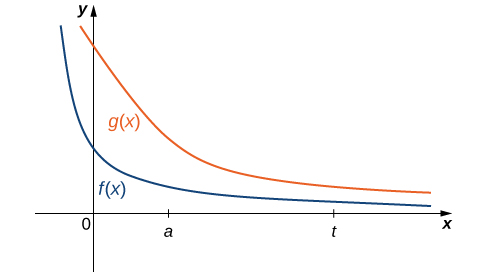
Figure \(\PageIndex{6}\): If \(0 \leq f(x) \leq g(x)\) for \(x \geq a\), then for \(t \geq a\), \(\displaystyle \int ^t_af(x)\,dx \leq \int ^t_ag(x)\,dx.\)
Thus, if\[\int ^{\infty }_af(x)\,dx=\lim_{t \to \infty }\int ^t_af(x)\,dx=\infty , \nonumber \]then\[\int ^{\infty }_ag(x)\,dx=\lim_{t \to \infty }\int ^t_ag(x)\,dx=\infty \nonumber \]as well. That is, if the area of the region between the graph of \(f(x)\) and the \(x\)-axis over \([a,\infty )\) is infinite, then the area of the region between the graph of \(g(x)\) and the \(x\)-axis over \([a,\infty )\) is infinite too.
On the other hand, if\[\int ^{\infty }_ag(x)\,dx=\lim_{t \to \infty }\int ^t_ag(x)\,dx=L \nonumber \]for some real number \(L\), then\[\int ^{\infty }_af(x)\,dx=\lim_{t \to \infty }\int ^t_af(x)\,dx \nonumber \]must converge to some value less than or equal to \(L\), since \(\displaystyle \int ^t_af(x)\,dx\) increases as \(t\) increases and \(\displaystyle \int ^t_af(x)\,dx \leq L\) for all \(t \geq a.\)
If the area of the region between the graph of \(g(x)\) and the \(x\)-axis over \([a,\infty )\) is finite, then the area of the region between the graph of \(f(x)\) and the \(x\)-axis over \([a,\infty )\) is also finite.
These conclusions are summarized in the following theorem.
Let \(f(x)\) and \(g(x)\) be continuous over \([a,\infty ).\) Assume that \(0 \leq f(x) \leq g(x)\) for \(x \geq a\).
- If \[\int ^{\infty }_af(x)\,dx=\lim_{t \to \infty }\int ^t_af(x)\,dx=\infty , \nonumber \]then \[\int ^{\infty }_ag(x)\,dx=\lim_{t \to \infty }\int ^t_ag(x)\,dx=\infty . \nonumber \]That is, if the area between \( f(x) \) and the \( x \)-axis is divergent (in this case, infinite), then so is the area between \( g(x) \) and the \( x \)-axis.
- If \[\int ^{\infty }_ag(x)\,dx=\lim_{t \to \infty }\int ^t_ag(x)\,dx=L, \nonumber \]where \(L\) is a real number, then \[\int ^{\infty }_af(x)\,dx=\lim_{t \to \infty }\int ^t_af(x)\,dx=M \nonumber \]for some real number \(M \leq L\). That is, if the area between \( g(x) \) and the \( x \)-axis is convergent (i.e., finite), then so is the area between \( f(x) \) and the \( x \)-axis.
Use the Comparison Test for Improper Integrals to show that\[\int^{\infty }_1\dfrac{1}{xe^x}\,dx \nonumber \]converges.
- Solution
-
We can see that \(0 \leq \frac{1}{xe^x} \leq \frac{1}{e^x}=e^{−x}\), so if \(\displaystyle \int ^{\infty }_1e^{−x}\,dx\) converges, then so does \(\displaystyle \int ^{\infty }_1\frac{1}{xe^x}\,dx\).
To evaluate \(\displaystyle \int ^{\infty }_1e^{−x}\,dx,\) first rewrite it as a limit:\[ \begin{array}{rcl}
\displaystyle \int ^{\infty }_1 e^{−x}\,dx & = & \displaystyle \lim_{t \to \infty }\int ^t_1e^{−x}\,dx \\[16pt]
& = & \displaystyle \lim_{t \to \infty }(−e^{−x})\bigg|^t_1 \\[16pt]
& = & \displaystyle \lim_{t \to \infty }(−e^{−t}+e^{-1}) \\[16pt]
& = & e^{-1}. \\[16pt]
\end{array} \nonumber \]Since \(\displaystyle \int ^{\infty }_1e^{−x}\,dx\) converges, so does \(\displaystyle \int ^{\infty }_1\frac{1}{xe^x}\,dx\). Note that we do not know the value the improper integral converges to, but we know it is less than or equal to \( e^{-1} \).
Finding a function to compare an integrand to is an art form. I always advise my students to look for a similar function that they can integrate. Be sure to set up the bounding behavior. That is, once you find a function to compare your integrand with, be sure to develop an inequality relating the two functions.
The Comparison Test for Improper Integrals gives us the following very useful theorem.
The improper integral\[ \int ^{\infty }_a \dfrac{1}{x^p}\,dx \nonumber \]where \( a \gt 0 \), converges for \( p \gt 1 \) and diverges otherwise.
- Proof
- Assuming for now that \( p \neq 1 \),\[ \begin{array}{rcl}
\displaystyle \int_a^{\infty} \dfrac{1}{x^p} \, dx & = & \displaystyle \lim_{t \to \infty} \int_a^t \dfrac{1}{x^p} \, dx \\[16pt]
& = & \displaystyle \lim_{t \to \infty} \left( \dfrac{x^{-p + 1}}{-p + 1} \right) \bigg|_a^t \\[16pt]
& = & \dfrac{1}{1 - p} \displaystyle \lim_{t \to \infty} \left( t^{1 - p} - a^{1 - p} \right) \\[16pt]
\end{array} \nonumber \]If \( p \gt 1 \), then \( 0 \gt 1 - p \) and so \( \displaystyle \lim_{t \to \infty} t^{1 - p} = 0 \). Hence, the improper integral converges (specifically, it converges to \( \frac{a^{1 - p}}{p - 1} \)).
On the other hand, if \( p \lt 1 \), then \( 0 \lt 1 - p \) and so \( \displaystyle \lim_{t \to \infty} t^{1 - p} = \infty \). Hence, the improper integral diverges.
Finally, if \( p = 1 \), then\[ \begin{array}{rcl}
\displaystyle \int_a^{\infty} \dfrac{1}{x^p} \, dx & = & \displaystyle \lim_{t \to \infty} \int_a^t \dfrac{1}{x} \, dx \\[16pt]
& = & \displaystyle \lim_{t \to \infty} \left( \ln(x) \right) \bigg|_a^t \\[16pt]
& = & \displaystyle \lim_{t \to \infty} \left( \ln(t) - \ln(a) \right) \\[16pt]
\end{array} \nonumber \]However, \( \displaystyle \lim_{t \to \infty} \ln(t) = \infty \). Hence, the improper integral diverges.
Therefore, \[ \int ^{\infty }_a \dfrac{1}{x^p}\,dx \nonumber \]where \( a \gt 0 \), converges for \( p \gt 1 \) and diverges otherwise.
Determine whether the improper integral is convergent or divergent.\[ \int ^{\infty }_3\dfrac{\sin^2(x)}{x^2 + x + 1}\,dx \nonumber \]
- Solution
-
For \( x \geq 3 \),\[ x^2 \leq x^2 + x + 1. \nonumber \]Therefore,\[ \dfrac{1}{x^2} \geq \dfrac{1}{x^2 + x + 1}. \nonumber \]Moreover, since \( 1 \geq \sin^2(x) \geq 0 \),\[ \dfrac{1}{x^2} \geq \dfrac{1}{x^2 + x + 1} \geq \dfrac{\sin^2(x)}{x^2 + x + 1} \geq 0. \nonumber \]Thus,\[ 0 \leq \dfrac{\sin^2(x)}{x^2 + x + 1} \leq \dfrac{1}{x^2}. \nonumber \]Since \( \displaystyle \int_3^{\infty} \frac{1}{x^2} \, dx \) converges by the \( p \)-Integral Test, the Comparison Test for Improper Integrals implies\[ \int ^{\infty }_3\dfrac{\sin^2(x)}{x^2 + x + 1}\, dx \nonumber \]converges as well.
Show that\[ \int ^{\infty }_e \dfrac{\ln x}{x}\,dx \nonumber \]diverges.
- Answer
-
Since \(\displaystyle \int ^{\infty }_e\frac{1}{x}\,dx=\infty ,\) \(\displaystyle \int ^{\infty }_e\frac{\ln x}{x}\,dx\) diverges.
In the last chapter, we have looked at several ways to use integration for solving real-world problems. For this next project, we will explore a more advanced application of integration: integral transforms. Specifically, we describe the Laplace transform and some of its properties.
The Laplace transform is used in engineering and physics to simplify the computations needed to solve some problems. It takes functions expressed in terms of time and transforms them to functions expressed in terms of frequency. In many cases, the computations needed to solve problems in the frequency domain are much simpler than those required in the time domain.
The Laplace transform is defined in terms of an integral as\[ {\mathscr L} \left(f(t)\right) = F(s) = \int^{\infty}_0 e^{−st}f(t)\,dt. \nonumber \]Note that the input to a Laplace transform is a function of time, \(f(t)\), and the output is a function of frequency, \(F(s)\). Although many real-world examples require the use of complex numbers (involving the imaginary number \(i=\sqrt{−1})\), in this project, we limit ourselves to functions of real numbers.
Let's start with a simple example. We calculate the Laplace transform of \(f(t)=t\). We have\[{\mathscr L}(t) = \int^{\infty} _0 te^{−st} \, dt. \nonumber \]This is an improper integral, so we express it in terms of a limit, which gives\[{\mathscr L}(t) = \int^{\infty}_0 te^{−st} \, dt = \lim_{z \to \infty }\int^z_0 te^{−st} \, dt. \nonumber \]We use Integration by Parts to evaluate the integral. Note that we are integrating with respect to \(t\), so we treat the variable \(s\) as a constant. We have\[\begin{array}{ll}
u = t & dv = e^{−st} \, dt \\[16pt]
du = dt & v =−\dfrac{1}{s}e^{−st} \\[16pt]
\end{array} \nonumber\]Then we obtain\[ \begin{array}{rcl}
\displaystyle \lim_{z \to \infty }\int ^z_0te^{−st} \, dt & = & \displaystyle \lim_{z \to \infty }\left[−\dfrac{t}{s}e^{−st} \bigg|^z_0 + \dfrac{1}{s} \displaystyle \int ^z_0 e^{−st} \, dt \right] \\[16pt]
& = & \displaystyle \lim_{z \to \infty}\left[\left(−\dfrac{z}{s}e^{−sz}+\dfrac{0}{s}e^{−0s}\right) + \dfrac{1}{s} \int ^z_0e^{−st} \, dt \right] \\[16pt]
& = & \displaystyle \lim_{z \to \infty }\left[\left(−\dfrac{z}{s}e^{−sz}+0\right) − \dfrac{1}{s}\left(\dfrac{e^{−st}}{s}\right)\bigg|^z_0\right] \\[16pt]
& = & \displaystyle \lim_{z \to \infty }\left[−\dfrac{z}{s}e^{−sz} − \dfrac{1}{s^2}\left(e^{−sz}−1\right)\right] \\[16pt]
& = & \displaystyle \lim_{z \to \infty }\left[−\dfrac{z}{se^{sz}}\right] − \displaystyle \lim_{z \to \infty }\dfrac{1}{s^2e^{sz}} + \displaystyle \lim_{z \to \infty }\dfrac{1}{s^2} \\[16pt]
& = & 0 − 0 + \dfrac{1}{s^2} \\[16pt]
& = & \dfrac{1}{s^2}. \\[16pt]
\end{array} \nonumber \]Note, \(\displaystyle \lim_{z \to \infty }\left[−\frac{z}{se^{sz}}\right]\) is indeterminate of the form \(-\frac{\infty}{\infty}\) and requires l'Hospital's Rule to evaluate. Using l'Hospital's Rule,\[ \lim_{z \to \infty }\left[−\dfrac{z}{se^{sz}}\right] = \lim_{z \to \infty }\left[−\dfrac{1}{s^2e^{sz}}\right] = 0.\nonumber\]Laplace transforms are often used to solve differential equations. While we saw some differential equations as homework problems in Differential Calculus, they are not covered in detail until later in this book; but, for now, let's look at the relationship between the Laplace transform of a function and the Laplace transform of its derivative.
Let's start with the definition of the Laplace transform. We have\[{\mathscr L}\big(f(t)\big)=\int ^ \infty _0e^{−st}f(t)\,dt=\lim_{z \to \infty }\int ^z_0e^{−st}f(t)\,dt. \nonumber \]Use Integration by Parts to evaluate \(\displaystyle \lim_{z \to \infty }\int ^z_0e^{−st}f(t)\,dt\). (Let \(u=f(t)\) and \(dv=e^{−st}dt\).)
After integrating by parts and evaluating the limit, you should see that\[{\mathscr L}\big(f(t)\big)=\dfrac{f(0)}{s}+\dfrac{1}{s}\big[{\mathscr L}\big(f^{\prime}(t)\big)\big]. \nonumber \]Then,\[{\mathscr L}\big(f^{\prime}(t)\big)=s{\mathscr L}\big(f(t)\big)−f(0). \nonumber \]Thus, differentiation in the time domain simplifies to multiplication by \(s\) in the frequency domain.
The final thing we look at in this project is how the Laplace transforms of \(f(t)\) and its antiderivative are related. Let \(\displaystyle g(t)=\int ^t_0f(u)\,du.\)
Then,\[{\mathscr L}\big(g(t)\big)=\int ^ \infty _0e^{−st}g(t)\,dt=\lim_{z \to \infty }\int ^z_0e^{−st}g(t)\,dt. \nonumber \]Use Integration by Parts to evaluate \(\displaystyle \lim_{z \to \infty }\int ^z_0e^{−st}g(t)\,dt.\) (Let \(u=g(t)\) and \(dv=e^{−st}dt\). Note, by the way that we have defined \(g(t), \, du=f(t)\,dt.\))
As you might expect, you should see that\[{\mathscr L}\big(g(t)\big)=\dfrac{1}{s} \cdot {\mathscr L}\big(f(t)\big). \nonumber \]Integration in the time domain simplifies to division by \(s\) in the frequency domain.
Now it's your turn.
- Calculate the Laplace transform of \(f(t)=1.\)
- Calculate the Laplace transform of \(f(t)=e^{−3t}.\)
- Calculate the Laplace transform of \(f(t)=t^2\). (Note: you will have to integrate by parts twice.)
Footnotes
1 Recall that the notation "\( \equiv \)" means "is equivalent to," and is often used in Mathematics to clearly state that an expression is defined to be some other expression. In this case, \( \displaystyle \int_a^{\infty} f(x) \, dx \) is defined to be \( \displaystyle \lim_{t \to \infty} \int_a^t f(x) \, dx \).
2 In your Differential Calculus class, your instructor should have been very clear that the words "provided this limit exists" means "provided this limit exists as a finite number." That is, if \( \displaystyle \lim_{t \to a} g(t) = \infty \), we would say that this limit does not exist (as a finite number). We still use the notation \( \displaystyle \lim_{t \to a} g(t) = \infty \) to describe the divergent behavior of the limit, but, in truth, the limit does not exist. This distinction will be critical when dealing with improper integrals.
3 Gabriel's horn (also called Torricelli's Trumpet) is a geometric figure which has infinite surface area, but finite volume. The name refers to the tradition identifying the Archangel Gabriel as the angel who blows the horn to announce Judgment Day, associating the divine, or infinite, with the finite. Italian physicist and mathematician Evangelista Torricelli first studied the properties of this figure in the 17th century.
Key Concepts
- Integrals of functions over infinite intervals are defined in terms of limits.
- Integrals of functions over an interval for which the function has a discontinuity at an endpoint may be defined in terms of limits.
- The convergence or divergence of an improper integral may be determined by comparing it with the value of an improper integral for which the convergence or divergence is known.
Key Equations
- Improper integrals
\(\displaystyle \int ^{+ \infty }_af(x)\,dx=\lim_{t \to + \infty }\int ^t_af(x)\,dx\)
\(\displaystyle \int ^b_{− \infty }f(x)\,dx=\lim_{t \to − \infty }\int ^b_tf(x)\,dx\)
\(\displaystyle \int ^{+ \infty }_{− \infty }f(x)\,dx=\int ^0_{− \infty }f(x)\,dx+\int ^{+ \infty }_0f(x)\,dx\)
Glossary
- improper integral
- an integral over an infinite interval or an integral of a function containing an infinite discontinuity on the interval; an improper integral is defined as a limit. The improper integral converges if this limit is a finite real number; otherwise, the improper integral diverges
Review Topics (from previous courses)
Algebra
- function
Differential Calculus
- continuous function
- definite integrals, properties of
- discontinuities, their types, and discontinuous functions
- indeterminate forms and l'Hospital's Rule
- limits (precise definition of infinite limits at infinity and finite limits at infinity)
- limit of integration