

3.4: Composition of Functions
- Page ID
- 170194

\( \newcommand{\vecs}[1]{\overset { \scriptstyle \rightharpoonup} {\mathbf{#1}} } \)
\( \newcommand{\vecd}[1]{\overset{-\!-\!\rightharpoonup}{\vphantom{a}\smash {#1}}} \)
\( \newcommand{\dsum}{\displaystyle\sum\limits} \)
\( \newcommand{\dint}{\displaystyle\int\limits} \)
\( \newcommand{\dlim}{\displaystyle\lim\limits} \)
\( \newcommand{\id}{\mathrm{id}}\) \( \newcommand{\Span}{\mathrm{span}}\)
( \newcommand{\kernel}{\mathrm{null}\,}\) \( \newcommand{\range}{\mathrm{range}\,}\)
\( \newcommand{\RealPart}{\mathrm{Re}}\) \( \newcommand{\ImaginaryPart}{\mathrm{Im}}\)
\( \newcommand{\Argument}{\mathrm{Arg}}\) \( \newcommand{\norm}[1]{\| #1 \|}\)
\( \newcommand{\inner}[2]{\langle #1, #2 \rangle}\)
\( \newcommand{\Span}{\mathrm{span}}\)
\( \newcommand{\id}{\mathrm{id}}\)
\( \newcommand{\Span}{\mathrm{span}}\)
\( \newcommand{\kernel}{\mathrm{null}\,}\)
\( \newcommand{\range}{\mathrm{range}\,}\)
\( \newcommand{\RealPart}{\mathrm{Re}}\)
\( \newcommand{\ImaginaryPart}{\mathrm{Im}}\)
\( \newcommand{\Argument}{\mathrm{Arg}}\)
\( \newcommand{\norm}[1]{\| #1 \|}\)
\( \newcommand{\inner}[2]{\langle #1, #2 \rangle}\)
\( \newcommand{\Span}{\mathrm{span}}\) \( \newcommand{\AA}{\unicode[.8,0]{x212B}}\)
\( \newcommand{\vectorA}[1]{\vec{#1}} % arrow\)
\( \newcommand{\vectorAt}[1]{\vec{\text{#1}}} % arrow\)
\( \newcommand{\vectorB}[1]{\overset { \scriptstyle \rightharpoonup} {\mathbf{#1}} } \)
\( \newcommand{\vectorC}[1]{\textbf{#1}} \)
\( \newcommand{\vectorD}[1]{\overrightarrow{#1}} \)
\( \newcommand{\vectorDt}[1]{\overrightarrow{\text{#1}}} \)
\( \newcommand{\vectE}[1]{\overset{-\!-\!\rightharpoonup}{\vphantom{a}\smash{\mathbf {#1}}}} \)
\( \newcommand{\vecs}[1]{\overset { \scriptstyle \rightharpoonup} {\mathbf{#1}} } \)
\(\newcommand{\longvect}{\overrightarrow}\)
\( \newcommand{\vecd}[1]{\overset{-\!-\!\rightharpoonup}{\vphantom{a}\smash {#1}}} \)
\(\newcommand{\avec}{\mathbf a}\) \(\newcommand{\bvec}{\mathbf b}\) \(\newcommand{\cvec}{\mathbf c}\) \(\newcommand{\dvec}{\mathbf d}\) \(\newcommand{\dtil}{\widetilde{\mathbf d}}\) \(\newcommand{\evec}{\mathbf e}\) \(\newcommand{\fvec}{\mathbf f}\) \(\newcommand{\nvec}{\mathbf n}\) \(\newcommand{\pvec}{\mathbf p}\) \(\newcommand{\qvec}{\mathbf q}\) \(\newcommand{\svec}{\mathbf s}\) \(\newcommand{\tvec}{\mathbf t}\) \(\newcommand{\uvec}{\mathbf u}\) \(\newcommand{\vvec}{\mathbf v}\) \(\newcommand{\wvec}{\mathbf w}\) \(\newcommand{\xvec}{\mathbf x}\) \(\newcommand{\yvec}{\mathbf y}\) \(\newcommand{\zvec}{\mathbf z}\) \(\newcommand{\rvec}{\mathbf r}\) \(\newcommand{\mvec}{\mathbf m}\) \(\newcommand{\zerovec}{\mathbf 0}\) \(\newcommand{\onevec}{\mathbf 1}\) \(\newcommand{\real}{\mathbb R}\) \(\newcommand{\twovec}[2]{\left[\begin{array}{r}#1 \\ #2 \end{array}\right]}\) \(\newcommand{\ctwovec}[2]{\left[\begin{array}{c}#1 \\ #2 \end{array}\right]}\) \(\newcommand{\threevec}[3]{\left[\begin{array}{r}#1 \\ #2 \\ #3 \end{array}\right]}\) \(\newcommand{\cthreevec}[3]{\left[\begin{array}{c}#1 \\ #2 \\ #3 \end{array}\right]}\) \(\newcommand{\fourvec}[4]{\left[\begin{array}{r}#1 \\ #2 \\ #3 \\ #4 \end{array}\right]}\) \(\newcommand{\cfourvec}[4]{\left[\begin{array}{c}#1 \\ #2 \\ #3 \\ #4 \end{array}\right]}\) \(\newcommand{\fivevec}[5]{\left[\begin{array}{r}#1 \\ #2 \\ #3 \\ #4 \\ #5 \\ \end{array}\right]}\) \(\newcommand{\cfivevec}[5]{\left[\begin{array}{c}#1 \\ #2 \\ #3 \\ #4 \\ #5 \\ \end{array}\right]}\) \(\newcommand{\mattwo}[4]{\left[\begin{array}{rr}#1 \amp #2 \\ #3 \amp #4 \\ \end{array}\right]}\) \(\newcommand{\laspan}[1]{\text{Span}\{#1\}}\) \(\newcommand{\bcal}{\cal B}\) \(\newcommand{\ccal}{\cal C}\) \(\newcommand{\scal}{\cal S}\) \(\newcommand{\wcal}{\cal W}\) \(\newcommand{\ecal}{\cal E}\) \(\newcommand{\coords}[2]{\left\{#1\right\}_{#2}}\) \(\newcommand{\gray}[1]{\color{gray}{#1}}\) \(\newcommand{\lgray}[1]{\color{lightgray}{#1}}\) \(\newcommand{\rank}{\operatorname{rank}}\) \(\newcommand{\row}{\text{Row}}\) \(\newcommand{\col}{\text{Col}}\) \(\renewcommand{\row}{\text{Row}}\) \(\newcommand{\nul}{\text{Nul}}\) \(\newcommand{\var}{\text{Var}}\) \(\newcommand{\corr}{\text{corr}}\) \(\newcommand{\len}[1]{\left|#1\right|}\) \(\newcommand{\bbar}{\overline{\bvec}}\) \(\newcommand{\bhat}{\widehat{\bvec}}\) \(\newcommand{\bperp}{\bvec^\perp}\) \(\newcommand{\xhat}{\widehat{\xvec}}\) \(\newcommand{\vhat}{\widehat{\vvec}}\) \(\newcommand{\uhat}{\widehat{\uvec}}\) \(\newcommand{\what}{\widehat{\wvec}}\) \(\newcommand{\Sighat}{\widehat{\Sigma}}\) \(\newcommand{\lt}{<}\) \(\newcommand{\gt}{>}\) \(\newcommand{\amp}{&}\) \(\definecolor{fillinmathshade}{gray}{0.9}\)Learning Objectives
- Create a new function by composition of functions.
- Evaluate composite functions.
- Find the domain of a composite function.
Create a Function by Composition of Functions
Performing algebraic operations on functions combines them into a new function, but we can also create functions by composing functions. When we wanted to compute a heating cost from a day of the year, we created a new function that takes a day as input and yields a cost as output. The process of combining functions so that the output of one function becomes the input of another is known as a composition of functions. The resulting function is known as a composite function. We represent this combination by the following notation:
\[f{\circ}g(x)=f(g(x))\]
We read the left-hand side as“\(f\) composed with \(g\) at \(x\),” and the right-hand side as“\(f\) of \(g\) of \(x\).”The two sides of the equation have the same mathematical meaning and are equal. The open circle symbol \(\circ\) is called the composition operator. We use this operator mainly when we wish to emphasize the relationship between the functions themselves without referring to any particular input value. Composition is a binary operation that takes two functions and forms a new function, much as addition or multiplication takes two numbers and gives a new number. However, it is important not to confuse function composition with multiplication because, as we learned above, in most cases \(f(g(x)){\neq}f(x)g(x)\).
It is also important to understand the order of operations in evaluating a composite function. We follow the usual convention with parentheses by starting with the innermost parentheses first, and then working to the outside. In the equation above, the function \(g\) takes the input \(x\) first and yields an output \(g(x)\). Then the function \(f\) takes \(g(x)\) as an input and yields an output \(f(g(x))\).
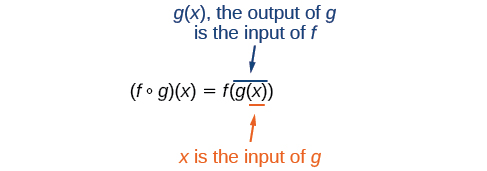
In general, \(f{\circ}g\) and \(g{\circ}f\) are different functions. In other words, in many cases \(f(g(x)){\neq}g(f(x))\) for all \(x\). We will also see that sometimes two functions can be composed only in one specific order.
For example, if \(f(x)=x^2\) and \(g(x)=x+2\), then
\[\begin{align*} f(g(x))&= f(x+2) \\[4pt]&=(x+2)^2 \\[4pt] &=x^2+4x+4 \end{align*}\]
but
\[\begin{align*} g(f(x))&= g(x^2) \\[4pt]&=x^2+2 \end{align*}\]
These expressions are not equal for all values of x, so the two functions are not equal. It is irrelevant that the expressions happen to be equal for the single input value \(x=−\frac{1}{2}\).
Note that the range of the inside function (the first function to be evaluated) needs to be within the domain of the outside function. Less formally, the composition has to make sense in terms of inputs and outputs.
When the output of one function is used as the input of another, we call the entire operation a composition of functions. For any input \(x\) and functions \(f\) and \(g\), this action defines a composite function, which we write as \(f{\circ}g\) such that
\[(f{\circ}g)(x)=f(g(x))\]
It is important to realize that the product of functions \(fg\) is not the same as the function composition \(f(g(x))\), because, in general, \(f(x)g(x){\neq}f(g(x))\).
Other Compositions
Similarly, we can form other types of compositions as follows:
\[(g {\circ}f)(x)=g(f(x))\]
\[(f{\circ}f)(x)=f(f(x))\]
\[(g {\circ}g)(x)=g(g(x))\]
Example \(\PageIndex{1}\): Determining whether Composition of Functions is Commutative
Using the functions provided, find \(f(g(x))\) and \(g(f(x))\). Determine whether the composition of the functions is commutative.
\[f(x)=2x+1 \;\;\;\; g(x)=3x - 4 \nonumber\]
Solution
Let’s begin by substituting \(g(x)\) into \(f(x)\).
\[\begin{align*} f(g(x))&= 2(3x -4)+1 \\[4pt] &=6x-12+1 \\[4pt] &=6x-11 \end{align*}\]
Now we can substitute \(f(x)\) into \(g(x)\).
\[\begin{align*} g(f(x))&= 3(2x+1) - 4\\[4pt]&=6x+3−4 \\[4pt] &=6x-1 \end{align*}\]
We find that \(g(f(x)){\neq}f(g(x))\), so the operation of function composition is not commutative.
Example \(\PageIndex{2}\): Finding Composite Functions
Given the functions \(f(x) = x^2 + 6x\) and \(g(x) = x+2\). Find the compositions and simplify the resulting expressions.
- \((f \circ g)(x)\)
- \((g \circ f)(x)\)
- \((f \circ f)(x)\)
- \((g \circ g)(x)\)
Solutions
By definition
1. \[\begin{align*} (f \circ g)(x) &= f(g(x)) \\[4pt]&= (x+2)^2 +6(x+2)\\[4pt] &=x^2 + 4x + 4 + 6x + 12 \\[4pt] &=x^2 + 10x + 16 \end{align*}\]
Therefore, \((f\circ g)(x) = x^2 + 10x + 16 \)
2. \[\begin{align*} (g \circ f)(x) &= g(f(x)) \\[4pt]&= (x^2 +6x) + 2)\\[4pt] &=x^2 + 6x + 2 \end{align*}\]
Therefore, \((g\circ f)(x) = x^2 + 6x + 2 \)
3. \[\begin{align*} (f \circ f)(x) &= f(f(x)) \\[4pt]&= (x^2 +6x)^2 + 6(x^2+6x)\\[4pt] &=x^2(x+ 6)^2 +6x^2 + 36x \\[4pt] &=x^2(x^2 + 12x + 36) +6x^2 + 36x \\[4pt] &=x^4 +12x^3 + 36x^2 + 6x^2 + 36x \\[4pt] &=x^4 +12x^3 + 42x^2 + 36x\end{align*}\]
Therefore, \((f\circ f)(x) = x^4 +12x^3 + 42x^2 + 36x \)
4. \[\begin{align*} (g \circ g)(x) &= g(g(x)) \\[4pt]&= (x + 2) + 2\\[4pt] &=x + 4 \end{align*}\]
Therefore, \((g\circ f)(x) = x + 4 \)
Example \(\PageIndex{3}\): Investigating the Order of a Composition by Evaluating
Suppose \(f(x) = x^2 + 6x\) and \(g(x) = x+2\), evaluate \((f \circ g)(1)\) and \((g \circ f)(1)\), discuss the results.
Solution
Since we already have the composite function \((f\circ g)(x)= x^2 + 10x + 16 \) obtained in the previous example, we can simply evaluate this function at \(x=1\)
\((f\circ g)(1) = (1)^2 + 10(1) + 16 = 27 \)
Next, to evaluate \((g \circ f)(1)\), we can use the definition
\((g \circ f)(1) = g(f(1))\)
First we evaluate \(f(1) = (1)^2 + 6(1) = 7\)
Next, we use the output of \(f\) as the input for \(g\) , so now we must evaluate \(g(7)\)
\[\begin{align*} g(x)&= x+2 \end{align*}\]
\[\begin{align*} g(7)&= (7)+2 \\[4pt]&= 9 \end{align*}\]
Therefore, \((g\circ f)(1) = 9\)
Discussion
Since \((f\circ g)(1) = 27\) and \((g\circ f)(1) = 9\), we have confirmed that composition is not commutative.
Question/Answer
Are there any situations where \(f(g(x))\) and \(g(f(x))\) would be equal?
Yes. There are several possible cases in which this happens.
1. When \(f(x) = g(x)\)
2. When BOTH functions are of the form \(y = x + b\)
3. When BOTH functions are of the form \(y = ax \)
4. When BOTH functions are of the form \(y = x^n \)
5. When \(f\) and \(g\) are inverses* of each other.
*Later in this chapter, we will discuss "inverse" functions. When these compositions are equal, then \(f\) and \(g\) have a special relationship to each other that we will learn more about...stay tuned.
Evaluating Composite Functions
Once we compose a new function from two existing functions, we need to be able to evaluate it for any input in its domain. We will do this with specific numerical inputs for functions expressed as tables, graphs, and formulas and with variables as inputs to functions expressed as formulas. In each case, we evaluate the inner function using the starting input and then use the inner function’s output as the input for the outer function.
While we can compose the functions for each individual input value, it is sometimes helpful to find a single formula that will calculate the result of a composition \(f(g(x))\). To do this, we will extend our idea of function evaluation. Recall that, when we evaluate a function like \(f(x)=x^2−x\), we substitute the value inside the parentheses into the formula wherever we see the input variable.
Example \(\PageIndex{6}\): Evaluating a Composition of Functions with a Numerical Input
Given \(f(x)=x^2−x\) and \(g(x)=3x+2\), evaluate \(f(g(1))\).
Solution
Because the inside expression is \(g(1)\), we start by evaluating \(g(x)\) at \(x=1\).
\[ \begin{align*} g(1)=3(1)+2 \\[4pt] g(1)&=5 \end{align*} \]
Then \(f(g(1))=f(5)\), so we evaluate \(f(x)\) at an input of 5.
\[ \begin{align*} f(g(1)) &=f(5) \\[5pt] f(g(1))&=5^2−5 \\[5pt] f(g(1))&=20 \end{align*} \]
Exercise \(\PageIndex{6}\)
Given \(f(x)=x^2−x\) and \(g(x)=3x+2\), evaluate
a. \(g(f(2))\)
b. \(g(f(−2))\)
- Answer a
-
8
- Answer b
-
20
Evaluating Composite Functions Using Tables
When working with functions given as tables, we read input and output values from the table entries and always work from the inside to the outside. We evaluate the inside function first and then use the output of the inside function as the input to the outside function.
Example \(\PageIndex{4}\): Using a Table to Evaluate a Composite Function
Using Table \(\PageIndex{1}\), evaluate \(f(g(3))\) and \(g(f(3))\).
| \(x\) | \(f(x)\) | \(g(x)\) |
|---|---|---|
| 1 | 6 | 3 |
| 2 | 8 | 5 |
| 3 | 3 | 2 |
| 4 | 1 | 7 |
Solution
To evaluate \(f(g(3))\), we start from the inside with the input value 3. We then evaluate the inside expression \(g(3)\) using the table that defines the function \(g: g(3)=2\). We can then use that result as the input to the function \(f\), so \(g(3)\) is replaced by 2 and we get \(f(2)\). Then, using the table that defines the function \(f\), we find that \(f(2)=8\).
\[g(3)=2 \nonumber\]
\[f(g(3))=f(2)=8 \nonumber\]
To evaluate \(g(f(3))\), we first evaluate the inside expression \(f(3)\) using the first table: \(f(3)=3\). Then, using the table for \(g\), we can evaluate
\[g(f(3))=g(3)=2 \nonumber\]
Table \(\PageIndex{2}\) shows the composite functions \(f{\circ}g\) and \(g{\circ}f\) as tables.
| \(x\) | \(g(x)\) | \(f(g(x))\) | \(f(x)\) | \(g(f(x))\) |
|---|---|---|---|---|
| 3 | 2 | 8 | 3 | 2 |
Exercise \(\PageIndex{4}\)
Using Table \(\PageIndex{1}\), evaluate \(f(g(1))\) and \(g(f(4))\).
- Answer
-
\(f(g(1))=f(3)=3\) and \(g(f(4))=g(1)=3\)
Evaluating Composite Functions Using Graphs
When we are given individual functions as graphs, the procedure for evaluating composite functions is similar to the process we use for evaluating tables. We read the input and output values, but this time, from the x- and y-axes of the graphs.
How To ...
Given a composite function and graphs of its individual functions, evaluate it using the information provided by the graphs.
- Locate the given input to the inner function on the x-axis of its graph.
- Read off the output of the inner function from the y-axis of its graph.
- Locate the inner function output on the x-axis of the graph of the outer function.
- Read the output of the outer function from the y-axis of its graph. This is the output of the composite function.
Example \(\PageIndex{5}\): Using a Graph to Evaluate a Composite Function
Using Figure \(\PageIndex{3}\), evaluate \(f(g(1))\).
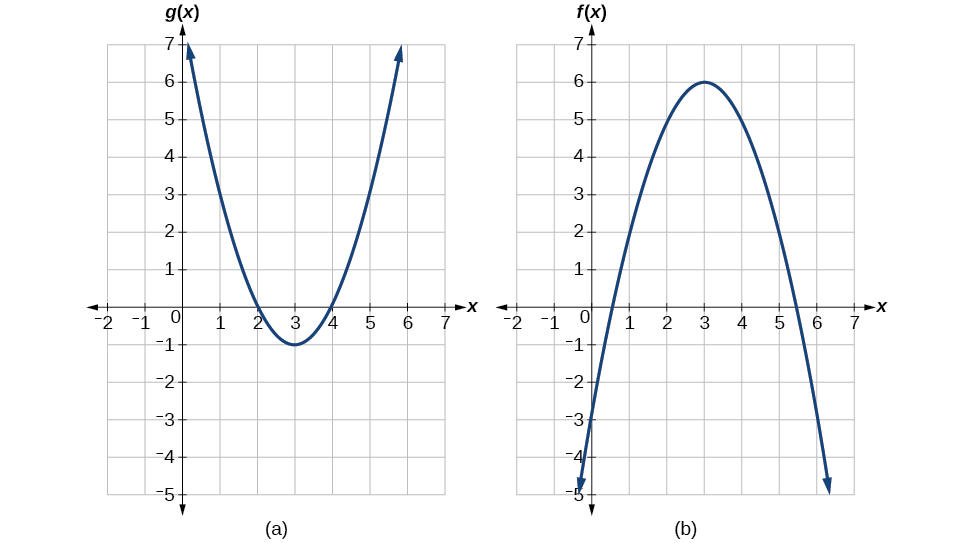
Solution
To evaluate \(f(g(1))\), we start with the inside evaluation. See Figure \(\PageIndex{4}\).
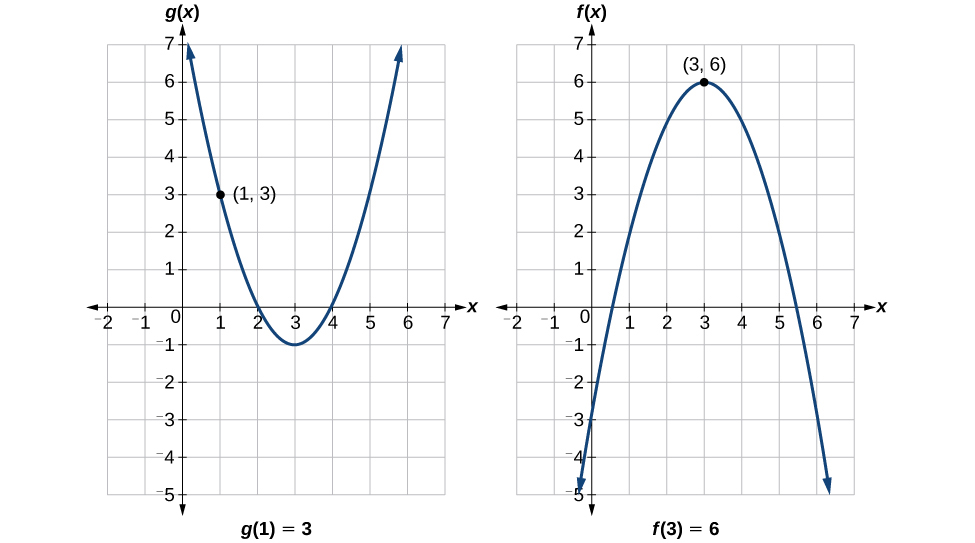
We evaluate \(g(1)\) using the graph of \(g(x)\), finding the input of 1 on the x-axis and finding the output value of the graph at that input. Here, \(g(1)=3\). We use this value as the input to the function \(f\).
\[f(g(1))=f(3) \nonumber\]
We can then evaluate the composite function by looking to the graph of \(f(x)\), finding the input of 3 on the x-axis and reading the output value of the graph at this input. Here, \(f(3)=6\), so \(f(g(1))=6\).
Analysis
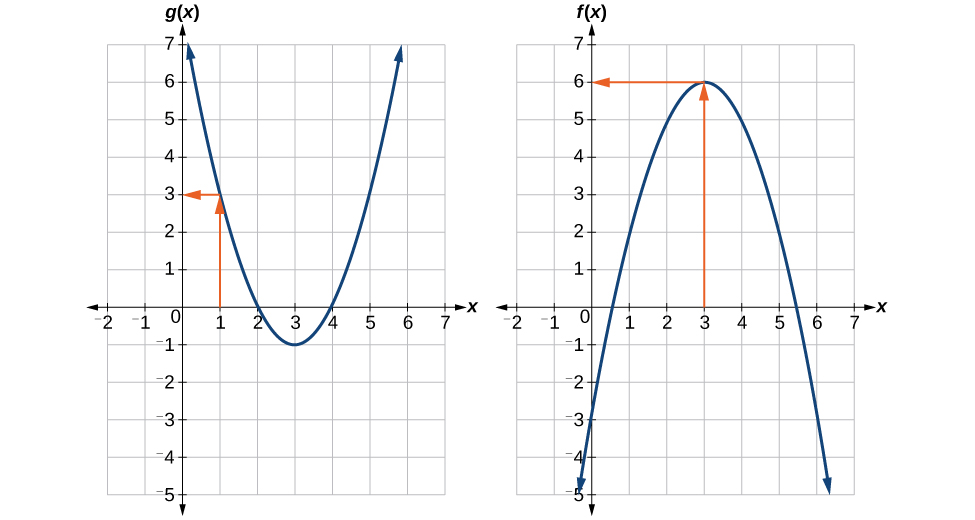
Figure \(\PageIndex{5}\) shows how we can mark the graphs with arrows to trace the path from the input value to the output value.
Exercise \(\PageIndex{5}\)
Using Figure \(\PageIndex{3}\), evaluate \(g(f(2))\).
- Answer
-
\(g(f(2))=g(5)=3\)
Finding the Domain of a Composite Function
As we discussed previously, the domain of a composite function such as \(f{\circ}g\) is dependent on the domain of \(g\) and the domain of \(f\). It is important to know when we can apply a composite function and when we cannot, that is, to know the domain of a function such as \(f{\circ}g\). Let us assume we know the domains of the functions \(f\) and \(g\) separately. If we write the composite function for an input \(x\) as \(f(g(x))\), we can see right away that \(x\) must be a member of the domain of g in order for the expression to be meaningful, because otherwise we cannot complete the inner function evaluation. However, we also see that \(g(x)\) must be a member of the domain of \(f\), otherwise the second function evaluation in \(f(g(x))\) cannot be completed, and the expression is still undefined. Thus the domain of \(f{\circ}g\) consists of only those inputs in the domain of \(g\) that produce outputs from \(g\) belonging to the domain of \(f\). Note that the domain of \(f\) composed with \(g\) is the set of all \(x\) such that \(x\) is in the domain of \(g\) and g(x)\) is in the domain of \(f\).
Definition: Domain of a Composite Function
The domain of a composite function \(f(g(x))\) is the set of those inputs \(x\) in the domain of \(g\) for which \(g(x)\) is in the domain of \(f\).
How To...
Given a function composition \(f(g(x))\), determine its domain.
- Find the domain of \(g\).
- Find the domain of \(f\).
- Find those inputs \(x\) in the domain of \(g\) for which \(g(x)\) is in the domain of \(f\). That is, exclude those inputs \(x\) from the domain of \(g\) for which \(g(x)\) is not in the domain of \(f\). The resulting set is the domain of \(f{\circ}g\).
Example \(\PageIndex{7}\): Finding the Domain of a Composite Function
Find the domain of
\[(f∘g)(x) \text{ where } f(x)=\dfrac{5}{x−1} \text{ and } g(x)=\dfrac{4}{3x−2} \nonumber\]
Solution
The domain of \(g(x)\) consists of all real numbers except \(x=\frac{2}{3}\), since that input value would cause us to divide by 0. Likewise, the domain of \(f\) consists of all real numbers except 1. So we need to exclude from the domain of \(g(x)\) that value of \(x\) for which \(g(x)=1\).
\[\begin{align*} \dfrac{4}{3x-2}&= 1 \\[4pt] 4 &=3x-2 \\[4pt] 6&=3x \\[4pt] x&= 2 \end{align*}\]
So the domain of \(f{\circ}g\) is the set of all real numbers except \(\frac{2}{3}\) and \(2\). This means that
\[x{\neq} \dfrac{2}{3} \text{ or } x\neq2 \nonumber\]
We can write this in interval notation as
\[\left(−\infty,\dfrac{2}{3}\right)\cup \left(\dfrac{2}{3},2 \right)\cup \left(2,\infty \right) \nonumber\]
Example \(\PageIndex{8}\): Finding the Domain of a Composite Function Involving Radicals
Find the domain of
\[(f{\circ}g)(x) \text{ where } f(x)=\sqrt{x+2} \text{ and } g(x)=\sqrt{3−x} \nonumber\]
Solution
Because we cannot take the square root of a negative number, the domain of \(g\) is \(\left(−\infty,3\right]\). Now we check the domain of the composite function
\[(f{\circ}g)(x)=\sqrt{\sqrt{3−x}+2} \nonumber\]
For \((f∘g)(x)=\sqrt{ \sqrt{3−x}+2},\sqrt{3−x}+2≥0,\) since the radicand of a square root must be positive. Since square roots are positive, \(\sqrt{3−x}≥0\),or, \(3−x≥0,\) which gives a domain of \((-∞,3]\).
Analysis
This example shows that knowledge of the range of functions (specifically the inner function) can also be helpful in finding the domain of a composite function. It also shows that the domain of \(f{\circ}g\) can contain values that are not in the domain of \(f\), though they must be in the domain of \(g\).
Exercise \(\PageIndex{8}\)
Find the domain of
\[(f{\circ}g)(x) \text{ where } f(x)=\dfrac{1}{x−2} \text{ and } g(x)=\sqrt{x+4} \nonumber\]
- Answer
-
\([−4,0)∪(0,∞)\)
Key Equation
- Composite function \((f{\circ}g)(x)=f(g(x))\)
Key Concepts
- We can perform algebraic operations on functions. See Example.
- When functions are combined, the output of the first (inner) function becomes the input of the second (outer) function.
- The function produced by combining two functions is a composite function. See Example and Example.
- The order of function composition must be considered when interpreting the meaning of composite functions. See Example.
- A composite function can be evaluated by evaluating the inner function using the given input value and then evaluating the outer function taking as its input the output of the inner function.
- A composite function can be evaluated from a table. See Example.
- A composite function can be evaluated from a graph. See Example.
- A composite function can be evaluated from a formula. See Example.
- The domain of a composite function consists of those inputs in the domain of the inner function that correspond to outputs of the inner function that are in the domain of the outer function. See Example and Example.
- Just as functions can be combined to form a composite function, composite functions can be decomposed into simpler functions.
- Functions can often be decomposed in more than one way. See Example.
Glossary
- composite function
-
the new function formed by function composition, when the output of one function is used as the input of another