

9.2: The Definition of a Function
- Page ID
- 173875
\( \newcommand{\vecs}[1]{\overset { \scriptstyle \rightharpoonup} {\mathbf{#1}} } \)
\( \newcommand{\vecd}[1]{\overset{-\!-\!\rightharpoonup}{\vphantom{a}\smash {#1}}} \)
\( \newcommand{\dsum}{\displaystyle\sum\limits} \)
\( \newcommand{\dint}{\displaystyle\int\limits} \)
\( \newcommand{\dlim}{\displaystyle\lim\limits} \)
\( \newcommand{\id}{\mathrm{id}}\) \( \newcommand{\Span}{\mathrm{span}}\)
( \newcommand{\kernel}{\mathrm{null}\,}\) \( \newcommand{\range}{\mathrm{range}\,}\)
\( \newcommand{\RealPart}{\mathrm{Re}}\) \( \newcommand{\ImaginaryPart}{\mathrm{Im}}\)
\( \newcommand{\Argument}{\mathrm{Arg}}\) \( \newcommand{\norm}[1]{\| #1 \|}\)
\( \newcommand{\inner}[2]{\langle #1, #2 \rangle}\)
\( \newcommand{\Span}{\mathrm{span}}\)
\( \newcommand{\id}{\mathrm{id}}\)
\( \newcommand{\Span}{\mathrm{span}}\)
\( \newcommand{\kernel}{\mathrm{null}\,}\)
\( \newcommand{\range}{\mathrm{range}\,}\)
\( \newcommand{\RealPart}{\mathrm{Re}}\)
\( \newcommand{\ImaginaryPart}{\mathrm{Im}}\)
\( \newcommand{\Argument}{\mathrm{Arg}}\)
\( \newcommand{\norm}[1]{\| #1 \|}\)
\( \newcommand{\inner}[2]{\langle #1, #2 \rangle}\)
\( \newcommand{\Span}{\mathrm{span}}\) \( \newcommand{\AA}{\unicode[.8,0]{x212B}}\)
\( \newcommand{\vectorA}[1]{\vec{#1}} % arrow\)
\( \newcommand{\vectorAt}[1]{\vec{\text{#1}}} % arrow\)
\( \newcommand{\vectorB}[1]{\overset { \scriptstyle \rightharpoonup} {\mathbf{#1}} } \)
\( \newcommand{\vectorC}[1]{\textbf{#1}} \)
\( \newcommand{\vectorD}[1]{\overrightarrow{#1}} \)
\( \newcommand{\vectorDt}[1]{\overrightarrow{\text{#1}}} \)
\( \newcommand{\vectE}[1]{\overset{-\!-\!\rightharpoonup}{\vphantom{a}\smash{\mathbf {#1}}}} \)
\( \newcommand{\vecs}[1]{\overset { \scriptstyle \rightharpoonup} {\mathbf{#1}} } \)
\(\newcommand{\longvect}{\overrightarrow}\)
\( \newcommand{\vecd}[1]{\overset{-\!-\!\rightharpoonup}{\vphantom{a}\smash {#1}}} \)
\(\newcommand{\avec}{\mathbf a}\) \(\newcommand{\bvec}{\mathbf b}\) \(\newcommand{\cvec}{\mathbf c}\) \(\newcommand{\dvec}{\mathbf d}\) \(\newcommand{\dtil}{\widetilde{\mathbf d}}\) \(\newcommand{\evec}{\mathbf e}\) \(\newcommand{\fvec}{\mathbf f}\) \(\newcommand{\nvec}{\mathbf n}\) \(\newcommand{\pvec}{\mathbf p}\) \(\newcommand{\qvec}{\mathbf q}\) \(\newcommand{\svec}{\mathbf s}\) \(\newcommand{\tvec}{\mathbf t}\) \(\newcommand{\uvec}{\mathbf u}\) \(\newcommand{\vvec}{\mathbf v}\) \(\newcommand{\wvec}{\mathbf w}\) \(\newcommand{\xvec}{\mathbf x}\) \(\newcommand{\yvec}{\mathbf y}\) \(\newcommand{\zvec}{\mathbf z}\) \(\newcommand{\rvec}{\mathbf r}\) \(\newcommand{\mvec}{\mathbf m}\) \(\newcommand{\zerovec}{\mathbf 0}\) \(\newcommand{\onevec}{\mathbf 1}\) \(\newcommand{\real}{\mathbb R}\) \(\newcommand{\twovec}[2]{\left[\begin{array}{r}#1 \\ #2 \end{array}\right]}\) \(\newcommand{\ctwovec}[2]{\left[\begin{array}{c}#1 \\ #2 \end{array}\right]}\) \(\newcommand{\threevec}[3]{\left[\begin{array}{r}#1 \\ #2 \\ #3 \end{array}\right]}\) \(\newcommand{\cthreevec}[3]{\left[\begin{array}{c}#1 \\ #2 \\ #3 \end{array}\right]}\) \(\newcommand{\fourvec}[4]{\left[\begin{array}{r}#1 \\ #2 \\ #3 \\ #4 \end{array}\right]}\) \(\newcommand{\cfourvec}[4]{\left[\begin{array}{c}#1 \\ #2 \\ #3 \\ #4 \end{array}\right]}\) \(\newcommand{\fivevec}[5]{\left[\begin{array}{r}#1 \\ #2 \\ #3 \\ #4 \\ #5 \\ \end{array}\right]}\) \(\newcommand{\cfivevec}[5]{\left[\begin{array}{c}#1 \\ #2 \\ #3 \\ #4 \\ #5 \\ \end{array}\right]}\) \(\newcommand{\mattwo}[4]{\left[\begin{array}{rr}#1 \amp #2 \\ #3 \amp #4 \\ \end{array}\right]}\) \(\newcommand{\laspan}[1]{\text{Span}\{#1\}}\) \(\newcommand{\bcal}{\cal B}\) \(\newcommand{\ccal}{\cal C}\) \(\newcommand{\scal}{\cal S}\) \(\newcommand{\wcal}{\cal W}\) \(\newcommand{\ecal}{\cal E}\) \(\newcommand{\coords}[2]{\left\{#1\right\}_{#2}}\) \(\newcommand{\gray}[1]{\color{gray}{#1}}\) \(\newcommand{\lgray}[1]{\color{lightgray}{#1}}\) \(\newcommand{\rank}{\operatorname{rank}}\) \(\newcommand{\row}{\text{Row}}\) \(\newcommand{\col}{\text{Col}}\) \(\renewcommand{\row}{\text{Row}}\) \(\newcommand{\nul}{\text{Nul}}\) \(\newcommand{\var}{\text{Var}}\) \(\newcommand{\corr}{\text{corr}}\) \(\newcommand{\len}[1]{\left|#1\right|}\) \(\newcommand{\bbar}{\overline{\bvec}}\) \(\newcommand{\bhat}{\widehat{\bvec}}\) \(\newcommand{\bperp}{\bvec^\perp}\) \(\newcommand{\xhat}{\widehat{\xvec}}\) \(\newcommand{\vhat}{\widehat{\vvec}}\) \(\newcommand{\uhat}{\widehat{\uvec}}\) \(\newcommand{\what}{\widehat{\wvec}}\) \(\newcommand{\Sighat}{\widehat{\Sigma}}\) \(\newcommand{\lt}{<}\) \(\newcommand{\gt}{>}\) \(\newcommand{\amp}{&}\) \(\definecolor{fillinmathshade}{gray}{0.9}\)Definitions and Theorems
A function is a relation in which each possible input value leads to exactly one output value. We say the output is a function of the input. The set of input values makes up the domain of the function, and the corresponding set of output values makes up the range of the function.
Examples
Use the set of ordered pairs to determine whether the relation is a function, and find the domain and range of the relation.
- \({\{(−3,27),(−2,8),(−1,1),(0,0),(1,1),(2,8),(3,27)}\}\)
- \({\{(9,−3),(4,−2),(1,−1),(0,0),(1,1),(4,2),(9,3)}\}\)
- Solutions
-
- \(\{(−3,27),(−2,8),(−1,1),(0,0),(1,1),(2,8),(3,27)\}\)
(i) Each \(x\)-value is matched with only one \(y\)-value. So this relation is a function.
(ii) The domain is the set of all \(x\)-values in the relation.
The domain is: \({\{−3,−2,−1,0,1,2,3}\}\).
(iii) The range is the set of all \(y\)-values in the relation. Notice we do not list range values twice.
The range is: \({\{27,8,1,0}\}\). - \(\{(9,−3),(4,−2),(1,−1),(0,0),(1,1),(4,2),(9,3)\}\)
(i) The \(x\)-value 9 is matched with two \(y\)-values, both 3 and \(−3\). So this relation is not a function.
(ii) The domain is the set of all \(x\)-values in the relation. Notice we do not list domain values twice.
The domain is: \({\{0,1,2,4,9}\}\).
(iii) The range is the set of all \(y\)-values in the relation.
The range is: \({\{−3,−2,−1,0,1,2,3}\}\).
- \(\{(−3,27),(−2,8),(−1,1),(0,0),(1,1),(2,8),(3,27)\}\)
Use the set of ordered pairs to determine whether the relation is a function, and find the domain and range of the relation.
- \({\{(−3,−6),(−2,−4),(−1,−2),(0,0),(1,2),(2,4),(3,6)}\}\)
- \({\{(8,−4),(4,−2),(2,−1),(0,0),(2,1),(4,2),(8,4)}\}\)
- \({\{(27,−3),(8,−2),(1,−1),(0,0),(1,1),(8,2),(27,3)}\}\)
- \({\{(7,−3),(−5,−4),(8,−0),(0,0),(−6,4),(−2,2),(−1,3)}\}\)
- Answers
-
(i) Yes
(ii) \(\{−3,−2,−1,0,1,2,3\}\)
(iii) \(\{−6,−4,−2,0,2,4,6\}\)
(i) No
(ii) \(\{0,2,4,8\}\)
(iii) \(\{−4,−2,−1,0,1,2,4\}\)
(i) No
(ii) \(\{0,1,8,27\}\)
(iii) \(\{−3,−2,−1,0,2,2,3\}\)
(i) Yes
(ii) \(\{7,−5,8,0,−6,−2,−1\}\)
(iii) \(\{−3,−4,0,4,2,3\}\)
The coffee shop menu, shown in the figure below, consists of items and their prices.
- Is price a function of the item?
- Is the item a function of the price?
- Solutions
-
- Let’s begin by considering the input as the items on the menu. The output values are then the prices. Each item on the menu has only one price, so the price is a function of the item.
- Two items on the menu have the same price. If we consider the prices to be the input values and the items to be the output, then the same input value could have more than one output associated with it (see the figure below).
In a particular math class, the overall percent grade corresponds to a grade point average. Is grade point average a function of the percent grade? Is the percent grade a function of the grade point average? The following table shows a possible rule for assigning grade points.
| Percent grade | 0–56 | 57–61 | 62–66 | 67–71 | 72–77 | 78–86 | 87–91 | 92–100 |
| Grade point average | 0.0 | 1.0 | 1.5 | 2.0 | 2.5 | 3.0 | 3.5 | 4.0 |
- Solution
-
For any percent grade earned, there is an associated grade point average, so the grade point average is a function of the percent grade. In other words, if we input the percent grade, the output is a specific grade point average.
In the grading system given, there is a range of percent grades that correspond to the same grade point average. For example, students who receive a grade point average of 3.0 could have a variety of percent grades ranging from 78 all the way to 86. Thus, percent grade is not a function of grade point average.
The following table lists the five greatest baseball players of all time in order of rank.
| Player | Rank |
|---|---|
| Babe Ruth | 1 |
| Willie Mays | 2 |
| Ty Cobb | 3 |
| Walter Johnson | 4 |
| Hank Aaron | 5 |
- Is the rank a function of the player name?
- Is the player name a function of the rank?
Use the mapping to determine whether the relation is a function, and find the domain and range of the relation.
| NAME | PHONE |
|---|---|
| Lydia | 321-549-3327 427-658-2314 |
| Eugene | 321-964-7324 |
| Janet | 684-358-7961 |
| Rick | |
| Marty | 684-369-7231 798-367-8541 |
- Solution
-
Both Lydia and Marty have two phone numbers. So each \(x\)-value is not matched with only one \(y\)-value. So this relation is not a function. The domain is the set of all \(x\)-values in the relation. The domain is: {Lydia, Eugene, Janet, Rick, Marty}. The range is the set of all \(y\)-values in the relation. The range is: \(\{321-549-3327, 427-658-2314, 321-964-7324, 684-358-7961, 684-369-7231, 798-367-8541\}\).
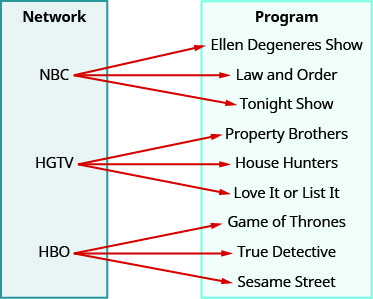
Use the mapping to determine whether the relation is a function, and find the domain and range of the relation.
- Answer
-
Not a function. The domain is {NBC, HGTV, HBO}. The range is {Ellen Degeneres Show, Law and Order, Tonight Show, Property Brothers, House Hunters, Love it or List it, Game of Thrones, True Detective, Sesame Street}.
Determine whether each equation is a function.
- \(2x+y=7\)
- \(y=x^2+1\)
- \(x+y^2=3\)
- Solutions
-
- For each value of \(x\), we multiply it by \(−2\) and then add 7 to get the \(y\)-value
We have that when \(x=3\), then \(y=1\). It would work similarly for any value of \(x\). Since each value of \(x\), corresponds to only one value of \(y\) the equation defines a function.
For example, if \(x=3\): 

- For each value of \(x\), we square it and then add 1 to get the \(y\)-value.
We have that when \(x=2\), then \(y=5\). It would work similarly for any value of \(x\). Since each value of \(x\), corresponds to only one value of \(y\) the equation defines a function.
For example, if \(x=2\): 

-
We have shown that when \(x=2\), then \(y=1\) and \(y=−1\). It would work similarly for any value of \(x\). Since each value of \(x\) does not corresponds to only one value of \(y\) the equation does not define a function.
Isolate the \(y\) term. 
Let’s substitute \(x=2\). 

This give us two values for \(y\). \(y=1\space y=−1\)
- For each value of \(x\), we multiply it by \(−2\) and then add 7 to get the \(y\)-value
Determine whether each equation is a function.
- \(4x+y=−3\)
- \(x+y^2=1\)
- \(y−x^2=2\)
- Answers
-
- yes
- no
- yes