

10.2: Symmetry
- Page ID
- 174354

\( \newcommand{\vecs}[1]{\overset { \scriptstyle \rightharpoonup} {\mathbf{#1}} } \)
\( \newcommand{\vecd}[1]{\overset{-\!-\!\rightharpoonup}{\vphantom{a}\smash {#1}}} \)
\( \newcommand{\dsum}{\displaystyle\sum\limits} \)
\( \newcommand{\dint}{\displaystyle\int\limits} \)
\( \newcommand{\dlim}{\displaystyle\lim\limits} \)
\( \newcommand{\id}{\mathrm{id}}\) \( \newcommand{\Span}{\mathrm{span}}\)
( \newcommand{\kernel}{\mathrm{null}\,}\) \( \newcommand{\range}{\mathrm{range}\,}\)
\( \newcommand{\RealPart}{\mathrm{Re}}\) \( \newcommand{\ImaginaryPart}{\mathrm{Im}}\)
\( \newcommand{\Argument}{\mathrm{Arg}}\) \( \newcommand{\norm}[1]{\| #1 \|}\)
\( \newcommand{\inner}[2]{\langle #1, #2 \rangle}\)
\( \newcommand{\Span}{\mathrm{span}}\)
\( \newcommand{\id}{\mathrm{id}}\)
\( \newcommand{\Span}{\mathrm{span}}\)
\( \newcommand{\kernel}{\mathrm{null}\,}\)
\( \newcommand{\range}{\mathrm{range}\,}\)
\( \newcommand{\RealPart}{\mathrm{Re}}\)
\( \newcommand{\ImaginaryPart}{\mathrm{Im}}\)
\( \newcommand{\Argument}{\mathrm{Arg}}\)
\( \newcommand{\norm}[1]{\| #1 \|}\)
\( \newcommand{\inner}[2]{\langle #1, #2 \rangle}\)
\( \newcommand{\Span}{\mathrm{span}}\) \( \newcommand{\AA}{\unicode[.8,0]{x212B}}\)
\( \newcommand{\vectorA}[1]{\vec{#1}} % arrow\)
\( \newcommand{\vectorAt}[1]{\vec{\text{#1}}} % arrow\)
\( \newcommand{\vectorB}[1]{\overset { \scriptstyle \rightharpoonup} {\mathbf{#1}} } \)
\( \newcommand{\vectorC}[1]{\textbf{#1}} \)
\( \newcommand{\vectorD}[1]{\overrightarrow{#1}} \)
\( \newcommand{\vectorDt}[1]{\overrightarrow{\text{#1}}} \)
\( \newcommand{\vectE}[1]{\overset{-\!-\!\rightharpoonup}{\vphantom{a}\smash{\mathbf {#1}}}} \)
\( \newcommand{\vecs}[1]{\overset { \scriptstyle \rightharpoonup} {\mathbf{#1}} } \)
\(\newcommand{\longvect}{\overrightarrow}\)
\( \newcommand{\vecd}[1]{\overset{-\!-\!\rightharpoonup}{\vphantom{a}\smash {#1}}} \)
\(\newcommand{\ket}[1]{\left| #1 \right>}\)
\(\newcommand{\bra}[1]{\left< #1 \right|}\)
\(\newcommand{\braket}[2]{\left< #1 \vphantom{#2} \right| \left. #2 \vphantom{#1} \right>}\)
\(\newcommand{\braopket}[3]{\left< #1 \vphantom{#2}\vphantom{#3} \right| #2 \vphantom{#1}\vphantom{#3} \left| #3 \vphantom{#1}\vphantom{#2} \right>}\)
\(\newcommand{\qmvec}[1]{\mathbf{\vec{#1}}}\)
\(\newcommand{\op}[1]{\hat{\mathbf{#1}}}\)
\(\newcommand{\expect}[1]{\langle #1 \rangle}\)
\(\newcommand{\dfn}[1]{\emph{\textbf{#1}}}\)
Videos
Review: Symmetry - Even and Odd Functions (level = college algebra)
Definitions and Theorems
Throughout this section, \(f\) denotes a real function whose domain is symmetric about the origin; that is, whenever \(x\) is in the domain, \(-x\) is also in the domain.
The function \( f \) is called an even function if for every input \( x \) in the domain of \( f \)\[f ( -x ) = f ( x ). \nonumber \]The function \( f \) is called an odd function if for every input \( x \) in the domain of \( f \)\[ f ( -x ) = − f ( x ). \nonumber \]
A function that fails to satisfy \(f(-x)=f(x)\) for at least one \(x\), and also fails to satisfy \(f(-x)=-f(x)\) for at least one \(x\), is said to be neither even nor odd. Most functions fall into this category.
Let \(f\) be a real function.
- \(f\) is even if and only if its graph is symmetric with respect to the \(y\)-axis; that is, the graph is unchanged under reflection across the \(y\)-axis.
- \(f\) is odd if and only if its graph is symmetric with respect to the origin; that is, the graph is unchanged under a \(180^{\circ}\) rotation about the origin.
Equivalently, \(f\) is even when the point \((-x,y)\) lies on the graph whenever \((x,y)\) does, and \(f\) is odd when the point \((-x,-y)\) lies on the graph whenever \((x,y)\) does.
Let \(f\) be a polynomial function. Then \(f\) is even if and only if every term has even degree, and \(f\) is odd if and only if every term has odd degree. A nonzero constant term is treated as having even degree.
The only function that is both even and odd is the function that equals \(0\) everywhere on its domain. Satisfying \(f(-x)=f(x)\) and \(f(-x)=-f(x)\) simultaneously forces \(f(x)=-f(x)\), hence \(f(x)=0\).
Examples
Classify \(f(x)=2x^4-x^2+5\) as even, odd, or neither.
- Solution
-
Replace \(x\) with \(-x\) and simplify, using the fact that an even power removes the sign:\[f(-x)=2(-x)^4-(-x)^2+5=2x^4-x^2+5.\nonumber\]This is identical to \(f(x)\), so \(f(-x)=f(x)\) and \(f\) is even. Its graph is symmetric about the \(y\)-axis. (Every term has even degree, which confirms the result.)
Classify \(f(x)=x^3-4x\) as even, odd, or neither.
- Solution
-
Compute \(f(-x)\), noting that an odd power keeps the sign:\[f(-x)=(-x)^3-4(-x)=-x^3+4x.\nonumber\]Factor out \(-1\) to compare with \(f(x)\):\[-x^3+4x=-\left(x^3-4x\right)=-f(x).\nonumber\]Since \(f(-x)=-f(x)\), the function is odd, and its graph is symmetric about the origin.
Classify \(f(x)=x^3+x^2\) as even, odd, or neither.
- Solution
-
Compute \(f(-x)\):\[f(-x)=(-x)^3+(-x)^2=-x^3+x^2.\nonumber\]Compare with \(f(x)=x^3+x^2\): the two are not identical, so \(f\) is not even. Compare with\[-f(x)=-x^3-x^2;\nonumber\]this does not match \(f(-x)=-x^3+x^2\) either, so \(f\) is not odd. The function is neither. (The mixed even and odd degrees signal this outcome directly.)
Classify \(f(x)=\dfrac{x}{x^2+1}\) as even, odd, or neither.
- Solution
-
Substitute \(-x\) and simplify each part. The numerator becomes \(-x\); the denominator is unchanged because \((-x)^2=x^2\):\[f(-x)=\dfrac{-x}{(-x)^2+1}=\dfrac{-x}{x^2+1}=-\dfrac{x}{x^2+1}=-f(x).\nonumber\]Since \(f(-x)=-f(x)\), the function is odd.
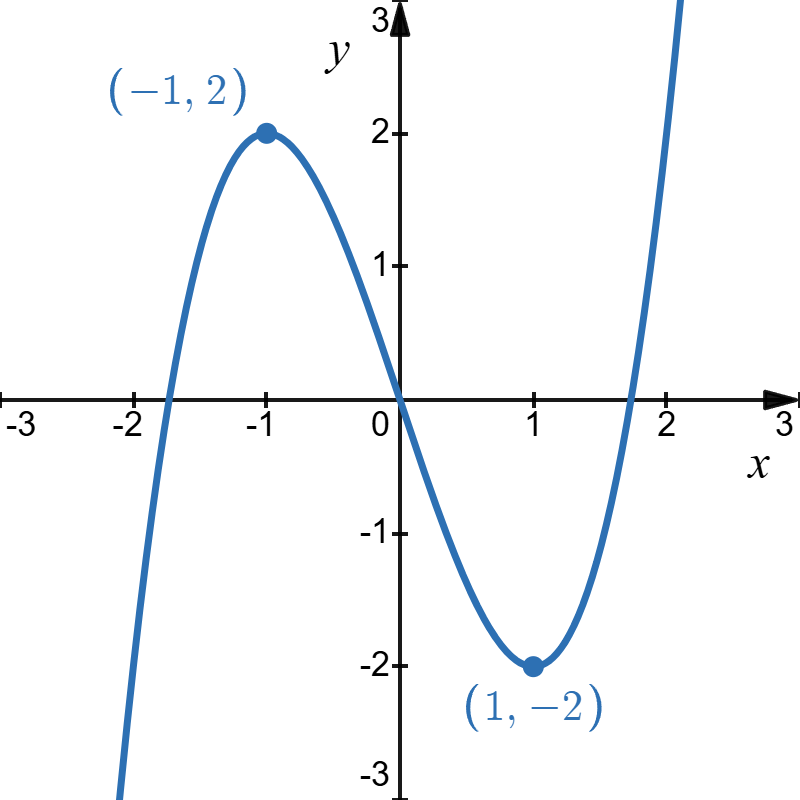
The graph of a function \(f\) is shown in Figure \(\PageIndex{1}\). Determine whether \(f\) is even, odd, or neither.
- Solution
-
Test the graph against the two symmetry conditions. A reflection across the \(y\)-axis does not return the same curve, so \(f\) is not even. However, rotating the graph \(180^{\circ}\) about the origin leaves it unchanged: for each plotted point \((x,y)\), the opposite point \((-x,-y)\) also lies on the curve. This is exactly the condition for symmetry about the origin, so \(f\) is odd.
Classify \(f(x)=x^2+\cos x\) as even, odd, or neither.
- Solution
-
Compute \(f(-x)\), using \((-x)^2=x^2\) and the fact that cosine is even, so \(\cos(-x)=\cos x\):\[f(-x)=(-x)^2+\cos(-x)=x^2+\cos x.\nonumber\]This equals \(f(x)\), so \(f\) is even. (The result also follows because a sum of two even functions is even, and both \(x^2\) and \(\cos x\) are even.)
MyOpenMath Practice
Sources
Several parts of this text use modifications from the following source:
- Wikipedia article: "Even and odd functions"
This source is released under the Creative Commons Attribution-Share-Alike License 4.0.