

7.2: Radian Measure, Arc Length, and Sector Area
- Page ID
- 197140

\( \newcommand{\vecs}[1]{\overset { \scriptstyle \rightharpoonup} {\mathbf{#1}} } \)
\( \newcommand{\vecd}[1]{\overset{-\!-\!\rightharpoonup}{\vphantom{a}\smash {#1}}} \)
\( \newcommand{\dsum}{\displaystyle\sum\limits} \)
\( \newcommand{\dint}{\displaystyle\int\limits} \)
\( \newcommand{\dlim}{\displaystyle\lim\limits} \)
\( \newcommand{\id}{\mathrm{id}}\) \( \newcommand{\Span}{\mathrm{span}}\)
( \newcommand{\kernel}{\mathrm{null}\,}\) \( \newcommand{\range}{\mathrm{range}\,}\)
\( \newcommand{\RealPart}{\mathrm{Re}}\) \( \newcommand{\ImaginaryPart}{\mathrm{Im}}\)
\( \newcommand{\Argument}{\mathrm{Arg}}\) \( \newcommand{\norm}[1]{\| #1 \|}\)
\( \newcommand{\inner}[2]{\langle #1, #2 \rangle}\)
\( \newcommand{\Span}{\mathrm{span}}\)
\( \newcommand{\id}{\mathrm{id}}\)
\( \newcommand{\Span}{\mathrm{span}}\)
\( \newcommand{\kernel}{\mathrm{null}\,}\)
\( \newcommand{\range}{\mathrm{range}\,}\)
\( \newcommand{\RealPart}{\mathrm{Re}}\)
\( \newcommand{\ImaginaryPart}{\mathrm{Im}}\)
\( \newcommand{\Argument}{\mathrm{Arg}}\)
\( \newcommand{\norm}[1]{\| #1 \|}\)
\( \newcommand{\inner}[2]{\langle #1, #2 \rangle}\)
\( \newcommand{\Span}{\mathrm{span}}\) \( \newcommand{\AA}{\unicode[.8,0]{x212B}}\)
\( \newcommand{\vectorA}[1]{\vec{#1}} % arrow\)
\( \newcommand{\vectorAt}[1]{\vec{\text{#1}}} % arrow\)
\( \newcommand{\vectorB}[1]{\overset { \scriptstyle \rightharpoonup} {\mathbf{#1}} } \)
\( \newcommand{\vectorC}[1]{\textbf{#1}} \)
\( \newcommand{\vectorD}[1]{\overrightarrow{#1}} \)
\( \newcommand{\vectorDt}[1]{\overrightarrow{\text{#1}}} \)
\( \newcommand{\vectE}[1]{\overset{-\!-\!\rightharpoonup}{\vphantom{a}\smash{\mathbf {#1}}}} \)
\( \newcommand{\vecs}[1]{\overset { \scriptstyle \rightharpoonup} {\mathbf{#1}} } \)
\(\newcommand{\longvect}{\overrightarrow}\)
\( \newcommand{\vecd}[1]{\overset{-\!-\!\rightharpoonup}{\vphantom{a}\smash {#1}}} \)
\(\newcommand{\avec}{\mathbf a}\) \(\newcommand{\bvec}{\mathbf b}\) \(\newcommand{\cvec}{\mathbf c}\) \(\newcommand{\dvec}{\mathbf d}\) \(\newcommand{\dtil}{\widetilde{\mathbf d}}\) \(\newcommand{\evec}{\mathbf e}\) \(\newcommand{\fvec}{\mathbf f}\) \(\newcommand{\nvec}{\mathbf n}\) \(\newcommand{\pvec}{\mathbf p}\) \(\newcommand{\qvec}{\mathbf q}\) \(\newcommand{\svec}{\mathbf s}\) \(\newcommand{\tvec}{\mathbf t}\) \(\newcommand{\uvec}{\mathbf u}\) \(\newcommand{\vvec}{\mathbf v}\) \(\newcommand{\wvec}{\mathbf w}\) \(\newcommand{\xvec}{\mathbf x}\) \(\newcommand{\yvec}{\mathbf y}\) \(\newcommand{\zvec}{\mathbf z}\) \(\newcommand{\rvec}{\mathbf r}\) \(\newcommand{\mvec}{\mathbf m}\) \(\newcommand{\zerovec}{\mathbf 0}\) \(\newcommand{\onevec}{\mathbf 1}\) \(\newcommand{\real}{\mathbb R}\) \(\newcommand{\twovec}[2]{\left[\begin{array}{r}#1 \\ #2 \end{array}\right]}\) \(\newcommand{\ctwovec}[2]{\left[\begin{array}{c}#1 \\ #2 \end{array}\right]}\) \(\newcommand{\threevec}[3]{\left[\begin{array}{r}#1 \\ #2 \\ #3 \end{array}\right]}\) \(\newcommand{\cthreevec}[3]{\left[\begin{array}{c}#1 \\ #2 \\ #3 \end{array}\right]}\) \(\newcommand{\fourvec}[4]{\left[\begin{array}{r}#1 \\ #2 \\ #3 \\ #4 \end{array}\right]}\) \(\newcommand{\cfourvec}[4]{\left[\begin{array}{c}#1 \\ #2 \\ #3 \\ #4 \end{array}\right]}\) \(\newcommand{\fivevec}[5]{\left[\begin{array}{r}#1 \\ #2 \\ #3 \\ #4 \\ #5 \\ \end{array}\right]}\) \(\newcommand{\cfivevec}[5]{\left[\begin{array}{c}#1 \\ #2 \\ #3 \\ #4 \\ #5 \\ \end{array}\right]}\) \(\newcommand{\mattwo}[4]{\left[\begin{array}{rr}#1 \amp #2 \\ #3 \amp #4 \\ \end{array}\right]}\) \(\newcommand{\laspan}[1]{\text{Span}\{#1\}}\) \(\newcommand{\bcal}{\cal B}\) \(\newcommand{\ccal}{\cal C}\) \(\newcommand{\scal}{\cal S}\) \(\newcommand{\wcal}{\cal W}\) \(\newcommand{\ecal}{\cal E}\) \(\newcommand{\coords}[2]{\left\{#1\right\}_{#2}}\) \(\newcommand{\gray}[1]{\color{gray}{#1}}\) \(\newcommand{\lgray}[1]{\color{lightgray}{#1}}\) \(\newcommand{\rank}{\operatorname{rank}}\) \(\newcommand{\row}{\text{Row}}\) \(\newcommand{\col}{\text{Col}}\) \(\renewcommand{\row}{\text{Row}}\) \(\newcommand{\nul}{\text{Nul}}\) \(\newcommand{\var}{\text{Var}}\) \(\newcommand{\corr}{\text{corr}}\) \(\newcommand{\len}[1]{\left|#1\right|}\) \(\newcommand{\bbar}{\overline{\bvec}}\) \(\newcommand{\bhat}{\widehat{\bvec}}\) \(\newcommand{\bperp}{\bvec^\perp}\) \(\newcommand{\xhat}{\widehat{\xvec}}\) \(\newcommand{\vhat}{\widehat{\vvec}}\) \(\newcommand{\uhat}{\widehat{\uvec}}\) \(\newcommand{\what}{\widehat{\wvec}}\) \(\newcommand{\Sighat}{\widehat{\Sigma}}\) \(\newcommand{\lt}{<}\) \(\newcommand{\gt}{>}\) \(\newcommand{\amp}{&}\) \(\definecolor{fillinmathshade}{gray}{0.9}\)
The following is a list of learning objectives for this section.
|
.png?revision=1) To access the Hawk A.I. Tutor, you will need to be logged into your campus Gmail account. |
Imagine riding on a Ferris wheel with a radius of 100 feet, where each rotation takes eight minutes. We can use angles in a standard position to describe your location as you travel around the wheel. Figure \( \PageIndex{ 1 } \) shows the locations indicated by \(\theta = 0^{\circ}\), \(90^{\circ}\), \(180^{\circ}\), and \(270^{\circ}\).
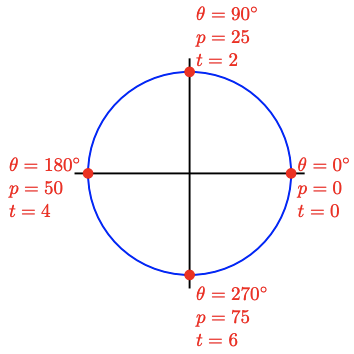
However, degrees are not the only way to specify a location on a circle. We could use a percent of one complete revolution1 and label the same locations by \(p = 0\), \(p = 25\), \(p = 50\), and \(p = 75\). Another option is to use the time elapsed so that, for this example, we would have \(t = 0\), \(t = 2\), \(t = 4\), and \(t = 6\) minutes (see Figure \( \PageIndex{ 1 } \)).
Another helpful method uses distance traveled, or arc length, along the circle. In Figure \( \PageIndex{ 1 } \), how far have you traveled around the Ferris wheel at each of the locations shown, assuming you hopped onto the ride at \( \theta = 0^{\circ} \)?
Before we consider that question, let's agree on some vocabulary. To help us understand the vocabulary, let's consider Figure \( \PageIndex{ 2 } \).

We begin by naming a portion of the edge of a circle.
In Figure \( \PageIndex{ 2 } \), the arc is in blue and its length, which we labeled as \( s \), is called the arc length.
It should be natural to think that any arc along the circumference of a circle is related to an angle "opening" at the center of the circle. This angle (which is labeled as \( \theta \) in Figure \( \PageIndex{ 2 } \)) gets its own name.
Thus, for the given arc in Figure \( \PageIndex{ 2 } \), the related central angle is \( \theta \). If the arc represents a distance traveled, we sometimes refer to such an angle as the angle of displacement.
Finally, we need to introduce the conventional language used throughout most of Mathematics when it comes to relating the central angle to the arc.
This definition means that the angle \( \theta \) in Figure \( \PageIndex{ 2 } \) subtends an arc of length \( s \).
Arc Length
Recall that the circumference of a circle is given by the formula\[C=2 \pi r. \label{circlecircumference} \]
Another way to say this is that the circumference of a circle is proportional to its radius - increasing the radius of the circle increases the circumference and vice versa.
According to Equation \( \ref{circlecircumference} \), if we walk around the entire circumference of a circle, the distance we travel is the product of \(2 \pi\) and the radius, or approximately \( 6.28 \) times the radius (by the way, just like \( \pi \), \( 2 \pi \) gets its own special name - the Greek letter tau. That is, we define \( \tau = 2 \pi \)). If we walk only part of the way around the circle, then the distance we travel depends also on the angle of displacement.
For example, an angle of \(45^{\circ}\) is \(\frac{1}{8}\) of a complete revolution, so the arc length, \(s\), from point \(A\) to point \(B\) in Figure \( \PageIndex{ 3 } \) is \(\frac{1}{8}\) of the circumference. Therefore,\[ s=\dfrac{1}{8}(2 \pi r)=\dfrac{\pi}{4} r. \nonumber \]

Similarly, the angle of displacement from point \(A\) to point \(C\) in Figure \( \PageIndex{ 4 } \) is \(\frac{3}{4}\) of a complete revolution, so the arc length along the circle from \(A\) to \(C\), shown below, is\[s=\dfrac{3}{4}(2 \pi r)=\dfrac{3\pi}{2} r.\nonumber \]

In general, the length of the arc spanned by an angle is proportional to the size of the angle for a given circle.
The Ferris wheel in the introduction has circumference\[C=2 \pi(100) \approx 628 \text { feet,}\nonumber \]so in half a revolution, you travel approximately 314 feet around the edge. In one-quarter revolution, you travel approximately 157 feet.
To indicate the same four locations from Figure \( \PageIndex{ 1 } \) on the wheel by distance traveled, we would use \(s=0\), \(s \approx 157\), \(s \approx 314\), and \(s \approx 471\), as shown below.

What length of arc is spanned by an angle of \(120^{\circ}\) on a circle of radius 12 centimeters?
- Solution
-
Because \(\frac{120^{\circ}}{360^{\circ}}=\frac{1}{3}\), an angle of \(120^{\circ}\) is \(\frac{1}{3}\) of a complete revolution, as shown below.
Figure \( \PageIndex{ 6 } \) 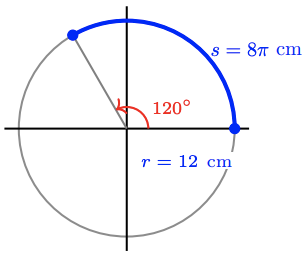
Using the arc length formula with \(r=12\), we find that\[s=\dfrac{1}{3}(2 \pi \cdot 12)=\dfrac{2 \pi}{3} \cdot 12=8 \pi \mathrm{ cm}\nonumber \]or about 25.1 cm.
How far have you traveled around the edge of a Ferris wheel of radius 100 feet when you have turned through an angle of \(150^{\circ}\)?
- Answer
-
Approximately 261.8 ft
Measuring Angles in Radians
If you think about measuring arc length, you will see that the degree measure of the spanning angle is not as important as the fraction of one revolution it covers. This observation suggests a new unit of measurement for angles, one that is better suited to calculations involving arc length. We'll make one change in our formula for arc length from \[ \textbf{arc length} = \left( \textbf{fraction of one revolution} \right) \cdot \left(2 \pi r\right) \nonumber \]to\[ \textbf{arc length} = \left( \textbf{fraction of one revolution} \cdot 2 \pi \right) \cdot r. \nonumber \]You might be asking yourself why we made such a silly change since these two formulas state the same thing (just with the parentheses in different spots).
The subtle difference between these two interpretations of arc length leads to an entirely new angular measurement system. We'll call the quantity in parentheses, (fraction of one revolution \(\times 2\pi\)), the radian measure of the angle that spans the arc.
For example, one complete revolution (\(360^{\circ}\)) is equal to \(2 \pi\) radians, and one-quarter revolution (\(90^{\circ}\)) is equal to \(\frac{1}{4}(2 \pi) = \frac{\pi}{2}\) radians. Figure \( \PageIndex{ 7 } \) shows the radian measure of the quadrantal angles.

Unlike degree measure, which depends on a human-created construct dependent on either the number of days for the Earth to rotate around the sun or the base-60 numbering system used by the Babylonians (depending on which historical viewpoint of the creation of the degree measurement system you believe), radian measure makes sense on any planet and within any numbering system. That is, if an alien species were to arrive on Earth, radian measures for angles are likely something we would both have in common.
What is the radian measure of an angle of \(120^{\circ}\)?
- Solution
-
An angle of \(120^{\circ}\) is \(\frac{120^{ \circ }}{360^{ \circ }} = \frac{1}{3}\) of a complete revolution, as we saw in the previous example. Thus, an angle of \(120^{\circ}\) has a radian measure of \(\frac{1}{3}(2 \pi)\), or \(\frac{2 \pi}{3}\).
What fraction of a revolution is \(\pi\) radians? How many degrees is that?
- Answer
-
Half a revolution, \(180^{\circ}\)
Radian measure does not have to be expressed in multiples of \(\pi\). Remember that \(\pi \approx 3.14\), so one complete revolution is approximately 6.28 radians, and one-quarter revolution is \(\frac{1}{4}(2 \pi)=\frac{\pi}{2}\), or about 1.57 radians. Figure \( \PageIndex{ 8 } \) shows decimal approximations for the quadrantal angles.

Table \( \PageIndex{ 1 } \): Quadrantal Angles in Both Degrees and Radians
| Degrees | Radians: Exact Values | Radians: Decimal Approximations |
|---|---|---|
| \(0^{\circ}\) | 0 | 0 |
| \(90^{\circ}\) | \(\dfrac{\pi}{2}\) | 1.57 |
| \(180^{\circ}\) | \(\pi\) | 3.14 |
| \(270^{\circ}\) | \(\dfrac{3\pi}{2}\) | 4.71 |
| \(360^{\circ}\) | \(2\pi\) | 6.28 |
Because they are "benchmarks" for comparing angles, you should memorize the exact values of the angles in the previous table in radians!
In which quadrant would you find an angle of 2 radians? An angle of 5 radians?
- Solution
-
Look at Figure \( \PageIndex{ 5 } \). The second quadrant includes angles between \(\frac{\pi}{2}\) and \(\pi\), or approximately 1.57 and 3.14 radians, so 2 radians lies in the second quadrant. An angle of 5 radians is between 4.71 and 6.28, or between \(\frac{3 \pi}{2}\) and \(2 \pi\) radians, so it lies in the fourth quadrant.
Draw a circle centered at the origin and sketch (in standard position) angles of approximately 3 radians, 4 radians, and 6 radians.
- Answer
-
Figure \( \PageIndex{ 9 } \) 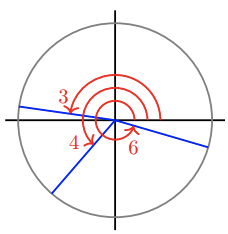
It turns out that measuring angles in radians is helpful for many applications besides calculating arc lengths, so we need to start thinking in radians. To help that process, we’ll first learn to convert between degrees and radians.
Converting Between Degrees and Radians
It is not difficult to convert the measure of an angle in degrees to its measure in radians or vice versa. One complete revolution is equal to \( 2 \pi \) radians or to \(360^{\circ}\), so\[2 \pi \text { radians }=360^{\circ}.\nonumber \]Dividing both sides of this equation by \(2 \pi\) radians or by \(360^{\circ}\) gives us an angle measure conversion theorem:
- Convert 3 radians to degrees.
- Convert 3 degrees to radians.
- Solutions
-
- \[\begin{array}{rcl}
3 \text{ radians} & = & 3 \text{ radians} \times (1) \\[6pt] & = & 3 \text{ }\cancel{\text{radians}} \times \left( \dfrac{180^{\circ}}{\pi \text{ }\cancel{\text{radians}}} \right) \\[6pt] & = & \dfrac{540^{\circ}}{\pi} \\[6pt] & \approx & 171.9^{\circ} \\[6pt] \end{array} \nonumber \] - \[\begin{array}{rcl}
3^{\circ} & = & 3^{ \circ } \times (1) \\[6pt] & = & 3^{\cancel{\circ}} \times\left(\dfrac{\pi \text{ radians}}{180^{\cancel{\circ} }}\right) \\[6pt] & = & \dfrac{\pi}{60} \text{ radians} \\[6pt] & \approx & 0.05 \text{ radians} \\[6pt] \end{array} \nonumber \]
- \[\begin{array}{rcl}
Technically speaking, a radian is what is known as a unitless measure. This is because, from the definition of radian measure, a radian is the product of a fraction of a revolution (no units) and \( 2 \pi \) (also, no units). Therefore, it is acceptable to answer Example \( \PageIndex{ 4b } \) with "approximately 0.05" instead of "approximately 0.05 radians." Moreover, there is no need to include the word "radian" when the context of the situation implies the constant is an angular measure (and the angular measure is not in degrees). For example, the solution to Example \( \PageIndex{ 4a } \) could have been written as\[\begin{array}{rcl}
3 & = & 3 \times (1) \\[6pt] & = & 3 \times \left( \dfrac{180^{\circ}}{\pi} \right) \\[6pt] & = & \dfrac{540^{\circ}}{\pi} \\[6pt] & \approx & 171.9^{\circ} \\[6pt] \end{array} \nonumber \]
- Convert \(60^{\circ}\) to radians. Give both an exact answer and an approximation to three decimal places.
- Convert \(\frac{3 \pi}{4}\) to degrees.
- Answers
-
- \(\dfrac{\pi}{3} \approx 1.047\)
- \(135^{\circ}\)
From our angle conversion theorem, we also learn that\[1 \text { radian }=\dfrac{180^{\circ}}{\pi} \approx 57.3^{\circ}.\nonumber \]

So while \(1^{\circ}\) is a relatively small angle, 1 radian is much larger (nearly \(60^{\circ}\), in fact). However, this is reasonable because there are only a little more than 6 radians in an entire revolution. An angle of 1 radian is shown above.
We'll soon see that, for many applications, it is easier to work entirely in radians. In fact, in the study of Calculus, you will find that radian measure must be used instead of degree measure.
For reference, Figure \( \PageIndex{ 11 } \) shows a radian protractor.

Quadrants and Reference Angles in Radians
Radian measure takes a bit to get used to, but you will soon find it easier to work with than degree measure. Understanding the acute special angles and quadrantal angles in radian measure, we now ask how to quickly determine in which quadrant an angle terminates. We also want to know the reference angle for a given angle in radian measure. We will focus on angles of the form \( \frac{n \pi}{d} \) for this discussion.2
A beneficial habit to get into when given an angle in radian measure of the form \( \frac{n \pi}{d} \) is to think in multiples of the denominator, \( d \). This is because \( \frac{d \pi}{d} = \pi \), \( \frac{2 d \pi}{d} = 2 \pi \), \( \frac{3 d \pi}{d} = 3 \pi \), and so on. If you sketch these angles, they terminate on either the positive or negative \( x \)-axis - this will be useful.
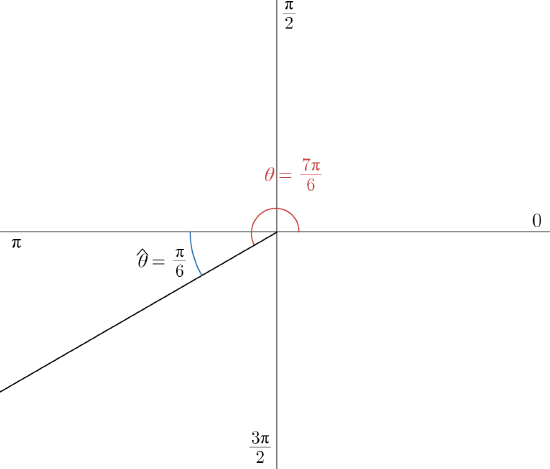
For example, if asked to find the quadrant in which \( \theta = \frac{7 \pi}{6} \) terminates, we consider that \( \theta \) is slightly more than \( \frac{6 \pi}{6} = \pi \) (which is equivalent to \( 180^{ \circ } \)). In fact, it is only \( \frac{1 \pi}{6} \) more than \( \frac{6 \pi}{6} = \pi \). Thus, to get to \( \theta \), we rotate past \( \pi \) and into quadrant three by the small amount of \( \frac{\pi}{6} \) radians. This small extra angle of rotation is the reference angle for \( \theta \). That is, the reference angle for \( \theta = \frac{7 \pi}{6} \) is \( \hat{\theta} = \frac{\pi}{6} \) (see Figure \( \PageIndex{ 12 } \)).
This concept of using multiples of the denominator need not be limited to positive angles. For example, if \( \theta = -\frac{9 \pi}{5} \), we imagine rotating in the negative direction to \( -\frac{5 \pi}{5} = -\pi \); however, this is nowhere near \( -\frac{9 \pi}{5} \). Therefore, we continue until we get to \( -\frac{10 \pi}{5} = -2 \pi \). At this point, we will have rotated back to the positive \( x \)-axis, but we will have rotated slightly too far. Therefore, we back off (in the positive direction) by \( \frac{1 \pi}{5} \) to arrive at \( -\frac{9 \pi}{5} \), which terminates in the first quadrant. Hence, \( \theta = -\frac{9 \pi}{5} \in \mathrm{QI} \) with reference angle \( \hat{\theta} = \frac{\pi}{5} \) (see Figure \( \PageIndex{ 13 } \)).

State the quadrant in which \( \beta = \frac{5 \pi}{3} \) terminates, state its reference angle and sketch.
- Solution
- \( \beta = \frac{5 \pi}{3} \) is almost all the way to \( \frac{6 \pi}{3} = 2\pi \), but we have to back off by \( \frac{\pi}{3} \). Hence, \( \frac{5\pi}{3} \in \mathrm{QIV} \) and \( \hat{\beta} = \frac{\pi}{3} \) (see Figure \( \PageIndex{ 14 } \)).
Figure \( \PageIndex{ 14 } \) 
State the quadrant in which \( \alpha = -\frac{17 \pi}{16} \) terminates, state its reference angle, and sketch.
- Answer
-
\( \alpha \in \mathrm{QII} \) and \( \hat{\alpha} = \frac{\pi}{16} \)
Arc Length Formula
We now return to our calculation of arc length and see the first instance in which measuring angles in radians is useful. To calculate an arc length, we need only multiply the circle's radius by the radian measure of the spanning angle, \(\theta\). Look again at our formula for arc length:\[\text{arc length } = \left( \text{fraction of one revolution } \times 2 \pi \right) \cdot r \nonumber \]The quantity in parentheses, "fraction of one revolution \(\times 2 \pi\)," is the measure of the spanning angle in radians. Thus, if \(\theta\) is measured in radians, we have the following formula for arc length, \(s\).
It is crucial to remember that the arc length formula, \( s = r \theta \), is only valid if \( \theta \) is in radians.
Thus, there is a special relationship between arc length and radians. An angle of 1 radian spans an arc on a circle equal to the radius of the circle, as shown in Figure \( \PageIndex{ 15 } \). Likewise, the length of any arc is just the product of the measure of its spanning angle in radians and the radius of the circle.
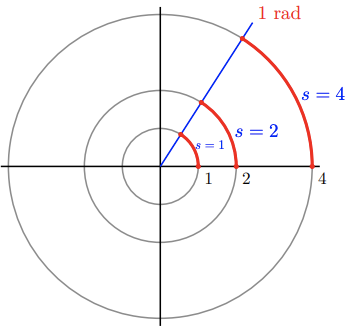
So, for instance, we can use the formula to find the arc length spanned by an angle of \(2.5\) radians on a circle of radius six inches:\[s = r \theta = \left(6 \, \text{inches}\right)(2.5) = 15 \text{ inches}.\nonumber \]Note that we didn't use the word "radians" when replacing \( \theta \) with \( 2.5 \). This is because, as we mentioned previously, radians is a unitless measure. Therefore, when performing unit analysis (which is the act of including units when performing computations to understand the meaning of the result of a series of computations), we leave the word "radians" off the angle.
We can also use the formula in the form \( \theta = \frac{s}{r} \) to find an angle that spans a given arc. For example, an arc length equal to one radius determines a central
angle of one radian, or approximately \( 57.3^{\circ} \).
In the following example, we use the arc length formula to compute a change in latitude on the Earth's surface.
The Earth's radius is roughly 3,960 miles. If you travel 500 miles due north, how many degrees of latitude will you traverse? (Latitude is measured in degrees north or south of the equator.)
- Solution
-
We think of the distance of 500 miles as an arc length on the surface of the Earth, as shown below. Substituting \(s=500\) and \(r=3960\) into the arc length formula gives\[\begin{array}{crcl}
& 500 \, \text{miles} & = & 3960 \, \text{miles} \times \theta \\[6pt] \implies & \dfrac{500 \, \cancel{\text{miles}}}{3960 \, \cancel{\text{miles}}} & = & \theta \\[6pt] \implies & \theta & \approx & 0.1263 \text { radians } \\[6pt] \end{array} \nonumber \]Figure \( \PageIndex{ 16 } \) 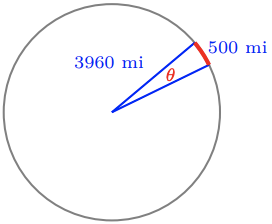
To convert the angle measure to degrees, we multiply by the conversion factor \(\frac{180^{\circ}}{\pi}\) to get\[0.1263\left(\dfrac{180^{\circ}}{\pi}\right) \approx 7.23^{\circ}\nonumber \]Your latitude has changed by about \(7.23^{\circ}\).
The distance around the face of a large clock from 2 to 3 is five feet. What is the radius of the clock?
- Answer
-
9.55 feet
The London Eye, located on the South Bank of the River Thames in London, is Europe's tallest Ferris wheel. In fact, when it first opened in 2000, it was the world's tallest Ferris wheel. It has a diameter of 120 meters. Interestingly, the London Eye rotates slowly enough that it never stops - riders easily step on and off at the wheel's bottom platform while the wheel is in motion.

Loi boards the London Eye to take in an elevated city view. If Loi has moved 80 meters along the circumference of the wheel, how many degrees has the London Eye rotated?
- Solution
- Parsing this question into language associated with our recent material, we have a circle of diameter 120 meters, which means the radius of the circle is 60 meters. Loi is moving through an arc of length 80 meters along the edge of this circle. Our task is to find the central angle that subtends this arc. In the formula\[ s = r \theta, \nonumber \]\( s = 80 \) meters and \( r = 60 \) meters. Therefore,\[ 80 \, \text{meters} = \left( 60 \, \text{meters} \right) \theta \implies \dfrac{80 \, \cancel{\text{meters}}}{60 \, \cancel{\text{meters}}} = \dfrac{4}{3} = \theta. \nonumber \]However, this angle is in radians. We must convert this to degrees.\[ \dfrac{4}{3} \times \dfrac{180^{ \circ }}{\pi} \approx 76.4^{ \circ }. \nonumber \]Hence, Loi moves through an approximate angle of \( 76.4^{ \circ } \).
A central angle in a circle of radius 6 cm cuts off an arc of length 24 cm. What is the radian measure of the angle? What is the degree measure?
- Answer
-
\( 4 \, \text{radians} \approx 229^{ \circ }\)
Trigonometric Functions of Angles in Radians
Measuring angles in radians has other applications besides calculating arc length. One such use is evaluating trigonometric functions of angles in radians. Many applications in Trigonometry (and beyond) use radians for input values rather than degrees. For this reason, it is crucial to know the trigonometric values for the special angles, which you learned in degrees previously, when the angles are given in radians. Fortunately, the value of a trigonometric function is the same whether the angle is measured in radians or degrees.
For example, \(\frac{\pi}{3}\) radians is the same as \(60^{\circ}\), because \(\frac{\pi}{3} \cdot \frac{180^{\circ}}{\pi}=60^{\circ}\), so\[\sin \left(\dfrac{\pi}{3}\right)=\sin \left(60^{\circ}\right)=\dfrac{\sqrt{3}}{2}\nonumber \]Table \( \PageIndex{ 2 } \) shows the radian measures for the special angles and the quadrantal angles, as well as the exact values of the sine, cosine, and tangent at these angles.
| \( \theta \) in Degrees | \( \theta \) in Radians | \( \sin\left( \theta \right) \) | \( \cos\left( \theta \right) \) | \( \tan\left( \theta \right) \) |
|---|---|---|---|---|
| \(0^{\circ}\) | \( 0 \) | \( 0 \) | \( 1 \) | \( 0 \) |
| \(30^{\circ}\) | \(\dfrac{\pi}{6}\) | \(\dfrac{1}{2}\) | \(\dfrac{\sqrt{3}}{2}\) | \(\dfrac{1}{\sqrt{3}}\) |
| \(45^{\circ}\) | \(\dfrac{\pi}{4}\) | \(\dfrac{1}{\sqrt{2}}\) | \(\dfrac{1}{\sqrt{2}}\) | \( 1 \) |
| \(60^{\circ}\) | \(\dfrac{\pi}{3}\) | \(\dfrac{\sqrt{3}}{2}\) | \(\dfrac{1}{2}\) | \(\sqrt{3}\) |
| \(90^{\circ}\) | \(\dfrac{\pi}{2}\) | \( 1 \) | \( 0 \) | undefined |
| \( 180^{ \circ } \) | \( \pi \) | \( 0 \) | \( -1 \) | \( 0 \) |
| \( 270^{ \circ } \) | \( \dfrac{3 \pi}{2} \) | \( -1 \) | \( 0 \) | undefined |
| \( 360^{ \circ } \) | \( 2\pi \) | \( 0 \) | \( 1 \) | \( 0 \) |
You should memorize these function values and be able to use them to find trigonometric values for the special angles in all four quadrants, as they will appear frequently throughout the rest of Trigonometry.
Compute the value of \( \csc\left( \frac{\pi}{3} \right) \).
- Solution
- Our identities still hold - working in radians does not change that fact. Therefore, by the Reciprocal Identities,\[ \csc\left( \frac{\pi}{3} \right) = \dfrac{1}{\sin\left( \frac{\pi}{3} \right)} = \dfrac{1}{\sqrt{3}/2} = \dfrac{2}{\sqrt{3}}. \nonumber \]
Compute the value of \( \cot\left( \frac{\pi}{4} \right) \).
- Answer
-
1
As before, we use reference angles to define the trigonometric functions for angles greater than \(90^{\circ}\).
Give exact values for the following.
- \(\tan \left(\dfrac{2 \pi}{3}\right)\)
- \(\cos \left(\dfrac{5 \pi}{4}\right)\)
- Solutions
-
- The reference angle for \(\theta = \frac{2 \pi}{3}\) is \(\hat{\theta} = \pi-\frac{2 \pi}{3}=\frac{\pi}{3}\), and the tangent is negative in the second quadrant. (See the figure below.) Thus, \(\tan \left(\frac{2 \pi}{3}\right)=-\tan \left(\frac{\pi}{3}\right)=-\sqrt{3}\).
Figure \( \PageIndex{ 18 } \) 
b The reference angle for \(\theta = \frac{5 \pi}{4}\) is \(\hat{\theta} = \frac{5 \pi}{4}-\pi=\frac{\pi}{4}\), and the cosine is negative in the third quadrant, so \(\cos \left(\frac{5 \pi}{4}\right)=-\cos \left(\frac{\pi}{4}\right)=-\frac{1}{\sqrt{2}}\).
Figure \( \PageIndex{ 19 } \) 
Give exact values for the following.
- \(\sin \left(\dfrac{5 \pi}{6}\right)\)
- \(\tan \left(\dfrac{7 \pi}{4}\right)\)
- Answers
-
- \(\dfrac{1}{2}\)
- \(-1\)
Areas of Sectors
Now that we have paired angles with real numbers via radian measure, a world of applications awaits us.
We recently discovered the relationship between the length, \( s \), of the arc subtended by an angle \( \theta \) (in radians) in a circle of radius \( r \) to be\[ s = r \theta. \nonumber \]We now investigate the area of the sector formed by this central angle \( \theta \).

To find the area of a sector, recall that the total area of a circle of radius \( r \) is \( \pi r^2 \); however, the shaded region in Figure \( \( \PageIndex{ 20 } \) \) is not the entire circle. In fact, it is a specific portion of this circle. In terms of angular measure, we have only shaded the region covered by an angle rotated through \( \theta \) out of \( 2\pi \) radians of a full circle. That is, the portion of the circle we have shaded is\[ A = \dfrac{\theta}{2\pi} \, \text{of the area of the full circle} = \dfrac{\theta}{2 \cancel{\pi}} \cdot \cancel{\pi} r^2 = \dfrac{1}{2} r^2 \theta. \nonumber \]This proves the following theorem.
Finding the areas of sectors becomes increasingly essential as you move into Calculus (specifically, Integral Calculus). Be sure to spend the time now to master this relatively straightforward concept.
Find the area of the sector subtended by a central angle of \( 120^{ \circ } \) in a circle of radius \( 4 \).
- Solution
- The most common mistake when using the formula for the area of a sector is not working in radian measure. Since \( 120^{ \circ } = \frac{2 \pi}{3} \), we find the area of the sector to be\[ A = \dfrac{1}{2}\cdot (4)^2 \left( \dfrac{2\pi}{3} \right) = \dfrac{16 \pi}{3}. \nonumber \]
If the area of a sector of a circle having radius \( 12 \) meters is \( 100 \) square meters, find the measure of the central angle (in radians).
- Answer
-
\( \frac{25}{18} \) radians
In certain parts of the world near the Arctic, such as Norway, the sun doesn't set during part of the summer. This phenomenon is known as the Midnight Sun. A golf course in Norway takes advantage of this by hosting a special event: The Midnight Sun Golf Challenge. During this event, golfers can play as many holes as they want throughout the night.
The golf course has a unique challenge on their signature par 3 hole, which features a circular green with a radius of 15 meters. If a golfer lands their ball within a particular marked sector of the green, where the central angle is 30 degrees, they win a prize. To determine the likelihood of winning, calculate the area of the sector where golfers must land their ball.
- Solution
- We are given \( \theta = 30^{ \circ } = \frac{\pi}{6} \) radians and \( r = 15 \) meters. Therefore, the area of the sector is\[ A = \dfrac{1}{2} \cdot (15)^2 \dfrac{\pi}{6} = \dfrac{225\pi}{12} \approx 59 \, \text{square meters} \nonumber \]As an aside, the probability that the golfer's ball would land in this sector (given the ball lands on the green and that all areas are equally likely for the ball to land in) would be the ratio of this sector area to the area of the entire green, which is\[ \dfrac{A_{\text{sector}}}{A_{\text{green}}} = \dfrac{225 \pi / 12}{\pi (15)^2} = \frac{1}{12} \approx 0.083 = 8.3\%. \nonumber \]This should make sense because \( 30^{ \circ } \) is one-twelfth of a full rotation of a circle.
A circular park has a sector fenced off for dogs. The sign posted by Sacramento County states that dogs can enjoy 6,000 square feet of play area; however, Paige finds this claim rather dubious. Unafraid about how foolish she might look, Paige takes a very large tape measure to the park and measures the radius of the park to be 120 feet. She then measures the length of fencing along the arc of the dog park area to be roughly 84 feet. Is the sign claiming that dogs have 6,000 square feet of play area correct?
- Answer
-
No. The given measurements yield a central angle of \( 0.7 \) radians. Thus, the area is actually\[ A = \dfrac{1}{2} (120)^2 (0.7) = 5,040 \, \text{square feet}. \nonumber \]
Footnotes
1 The word "revolution" will be used extensively from this point forward. Some texts use "rotation."
2 Angles in radians need not have a \( \pi \) attached to them, but it does help when determining the quadrant in which the angle terminates. Therefore, we restrict ourselves to angles of the form \( \frac{n \pi}{d} \) for this short discussion.