

2.8: Derivatives of Logarithms and Logarithmic Differentiation
- Page ID
- 116574

\( \newcommand{\vecs}[1]{\overset { \scriptstyle \rightharpoonup} {\mathbf{#1}} } \)
\( \newcommand{\vecd}[1]{\overset{-\!-\!\rightharpoonup}{\vphantom{a}\smash {#1}}} \)
\( \newcommand{\dsum}{\displaystyle\sum\limits} \)
\( \newcommand{\dint}{\displaystyle\int\limits} \)
\( \newcommand{\dlim}{\displaystyle\lim\limits} \)
\( \newcommand{\id}{\mathrm{id}}\) \( \newcommand{\Span}{\mathrm{span}}\)
( \newcommand{\kernel}{\mathrm{null}\,}\) \( \newcommand{\range}{\mathrm{range}\,}\)
\( \newcommand{\RealPart}{\mathrm{Re}}\) \( \newcommand{\ImaginaryPart}{\mathrm{Im}}\)
\( \newcommand{\Argument}{\mathrm{Arg}}\) \( \newcommand{\norm}[1]{\| #1 \|}\)
\( \newcommand{\inner}[2]{\langle #1, #2 \rangle}\)
\( \newcommand{\Span}{\mathrm{span}}\)
\( \newcommand{\id}{\mathrm{id}}\)
\( \newcommand{\Span}{\mathrm{span}}\)
\( \newcommand{\kernel}{\mathrm{null}\,}\)
\( \newcommand{\range}{\mathrm{range}\,}\)
\( \newcommand{\RealPart}{\mathrm{Re}}\)
\( \newcommand{\ImaginaryPart}{\mathrm{Im}}\)
\( \newcommand{\Argument}{\mathrm{Arg}}\)
\( \newcommand{\norm}[1]{\| #1 \|}\)
\( \newcommand{\inner}[2]{\langle #1, #2 \rangle}\)
\( \newcommand{\Span}{\mathrm{span}}\) \( \newcommand{\AA}{\unicode[.8,0]{x212B}}\)
\( \newcommand{\vectorA}[1]{\vec{#1}} % arrow\)
\( \newcommand{\vectorAt}[1]{\vec{\text{#1}}} % arrow\)
\( \newcommand{\vectorB}[1]{\overset { \scriptstyle \rightharpoonup} {\mathbf{#1}} } \)
\( \newcommand{\vectorC}[1]{\textbf{#1}} \)
\( \newcommand{\vectorD}[1]{\overrightarrow{#1}} \)
\( \newcommand{\vectorDt}[1]{\overrightarrow{\text{#1}}} \)
\( \newcommand{\vectE}[1]{\overset{-\!-\!\rightharpoonup}{\vphantom{a}\smash{\mathbf {#1}}}} \)
\( \newcommand{\vecs}[1]{\overset { \scriptstyle \rightharpoonup} {\mathbf{#1}} } \)
\(\newcommand{\longvect}{\overrightarrow}\)
\( \newcommand{\vecd}[1]{\overset{-\!-\!\rightharpoonup}{\vphantom{a}\smash {#1}}} \)
\(\newcommand{\avec}{\mathbf a}\) \(\newcommand{\bvec}{\mathbf b}\) \(\newcommand{\cvec}{\mathbf c}\) \(\newcommand{\dvec}{\mathbf d}\) \(\newcommand{\dtil}{\widetilde{\mathbf d}}\) \(\newcommand{\evec}{\mathbf e}\) \(\newcommand{\fvec}{\mathbf f}\) \(\newcommand{\nvec}{\mathbf n}\) \(\newcommand{\pvec}{\mathbf p}\) \(\newcommand{\qvec}{\mathbf q}\) \(\newcommand{\svec}{\mathbf s}\) \(\newcommand{\tvec}{\mathbf t}\) \(\newcommand{\uvec}{\mathbf u}\) \(\newcommand{\vvec}{\mathbf v}\) \(\newcommand{\wvec}{\mathbf w}\) \(\newcommand{\xvec}{\mathbf x}\) \(\newcommand{\yvec}{\mathbf y}\) \(\newcommand{\zvec}{\mathbf z}\) \(\newcommand{\rvec}{\mathbf r}\) \(\newcommand{\mvec}{\mathbf m}\) \(\newcommand{\zerovec}{\mathbf 0}\) \(\newcommand{\onevec}{\mathbf 1}\) \(\newcommand{\real}{\mathbb R}\) \(\newcommand{\twovec}[2]{\left[\begin{array}{r}#1 \\ #2 \end{array}\right]}\) \(\newcommand{\ctwovec}[2]{\left[\begin{array}{c}#1 \\ #2 \end{array}\right]}\) \(\newcommand{\threevec}[3]{\left[\begin{array}{r}#1 \\ #2 \\ #3 \end{array}\right]}\) \(\newcommand{\cthreevec}[3]{\left[\begin{array}{c}#1 \\ #2 \\ #3 \end{array}\right]}\) \(\newcommand{\fourvec}[4]{\left[\begin{array}{r}#1 \\ #2 \\ #3 \\ #4 \end{array}\right]}\) \(\newcommand{\cfourvec}[4]{\left[\begin{array}{c}#1 \\ #2 \\ #3 \\ #4 \end{array}\right]}\) \(\newcommand{\fivevec}[5]{\left[\begin{array}{r}#1 \\ #2 \\ #3 \\ #4 \\ #5 \\ \end{array}\right]}\) \(\newcommand{\cfivevec}[5]{\left[\begin{array}{c}#1 \\ #2 \\ #3 \\ #4 \\ #5 \\ \end{array}\right]}\) \(\newcommand{\mattwo}[4]{\left[\begin{array}{rr}#1 \amp #2 \\ #3 \amp #4 \\ \end{array}\right]}\) \(\newcommand{\laspan}[1]{\text{Span}\{#1\}}\) \(\newcommand{\bcal}{\cal B}\) \(\newcommand{\ccal}{\cal C}\) \(\newcommand{\scal}{\cal S}\) \(\newcommand{\wcal}{\cal W}\) \(\newcommand{\ecal}{\cal E}\) \(\newcommand{\coords}[2]{\left\{#1\right\}_{#2}}\) \(\newcommand{\gray}[1]{\color{gray}{#1}}\) \(\newcommand{\lgray}[1]{\color{lightgray}{#1}}\) \(\newcommand{\rank}{\operatorname{rank}}\) \(\newcommand{\row}{\text{Row}}\) \(\newcommand{\col}{\text{Col}}\) \(\renewcommand{\row}{\text{Row}}\) \(\newcommand{\nul}{\text{Nul}}\) \(\newcommand{\var}{\text{Var}}\) \(\newcommand{\corr}{\text{corr}}\) \(\newcommand{\len}[1]{\left|#1\right|}\) \(\newcommand{\bbar}{\overline{\bvec}}\) \(\newcommand{\bhat}{\widehat{\bvec}}\) \(\newcommand{\bperp}{\bvec^\perp}\) \(\newcommand{\xhat}{\widehat{\xvec}}\) \(\newcommand{\vhat}{\widehat{\vvec}}\) \(\newcommand{\uhat}{\widehat{\uvec}}\) \(\newcommand{\what}{\widehat{\wvec}}\) \(\newcommand{\Sighat}{\widehat{\Sigma}}\) \(\newcommand{\lt}{<}\) \(\newcommand{\gt}{>}\) \(\newcommand{\amp}{&}\) \(\definecolor{fillinmathshade}{gray}{0.9}\)
|
|

Now that we have the Chain Rule and implicit differentiation under our belts, we can explore the derivatives of logarithmic functions and the relationship between a function's derivative and its inverse's derivative. For functions whose derivatives we already know, we can use this relationship to find derivatives of inverses without using the limit definition of the derivative. In particular, we will apply the formula for derivatives of inverse functions to trigonometric functions. This formula may also be used to extend the Power Rule to rational exponents.
Derivative of the Logarithmic Function
Now that we have the derivative of the natural exponential function, we can use implicit differentiation to find the derivative of its inverse, the natural logarithmic function.
If \(y=\ln x\), then\[\dfrac{dy}{dx}=\dfrac{1}{x}. \nonumber \]
- Proof
-
If \(y=\ln x\), then \(e^y=x.\) Differentiating both sides of this equation results in the equation\[e^y\dfrac{dy}{dx}=1. \nonumber \]Solving for \(\frac{dy}{dx}\) yields\[\dfrac{dy}{dx}=\dfrac{1}{e^y}. \nonumber \]Finally, we substitute \(x=e^y\) to obtain\[\dfrac{dy}{dx}=\dfrac{1}{x}. \nonumber \]
Q.E.D.
The graph of \(y=\ln x\) and its derivative \(\frac{dy}{dx}=\frac{1}{x}\) are shown in Figure \(\PageIndex{1}\).
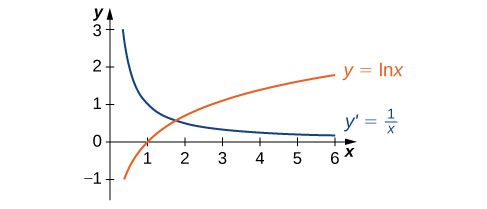
Figure \(\PageIndex{1}\): The function \(y=\ln x\) is increasing on \((0,+ \infty)\). Its derivative \(y^{\prime}=\frac{1}{x}\) is greater than zero on \((0,+ \infty)\)
Find the derivative of \(f(x)=\ln(x^3+3x−4)\).
- Solution
-
\[ \begin{array}{rclcl}
f^{\prime}(x) & = & \dfrac{1}{x^3+3x−4} \cdot \dfrac{d}{dx} \left(x^3 + 3x - 4\right) & \quad & \left(\text{Chain Rule}\right) \\[16pt]
& = & \dfrac{1}{x^3+3x−4} \cdot \left(3x^2 + 3\right) & & \\[16pt]
& = & \dfrac{3x^2 + 3}{x^3+3x−4} & & \\[16pt]
& = & \dfrac{3(x^2 + 1)}{x^3+3x−4} & & \\[16pt]
\end{array} \nonumber \]As an aside, cleaning up derivatives using our prerequisite Algebra is always a good idea. Sometimes, things clean up very nicely.
Find the derivative of \(f(x)=\ln\left(\frac{x^2\sin x}{2x+1}\right)\).
- Solution
-
At first glance, taking this derivative appears rather complicated. However, by using the properties of logarithms before finding the derivative, we can make the problem much simpler.\[f(x) = \ln\left(\dfrac{x^2\sin x}{2x+1}\right) = 2\ln x+\ln(\sin x)−\ln(2x+1)\nonumber\]Hence,\[\begin{array}{rclcl}
f^{\prime}(x) & = & \dfrac{2}{x} + \dfrac{1}{\sin x} \cdot \cos x − \dfrac{1}{2x+1} \cdot 2 & \quad & \left( \text{derivative of the natural log and the Chain Rule} \right) \\[16pt]
& = & \dfrac{2}{x} + \cot x − \dfrac{2}{2x+1} & & \\[16pt]
\end{array}\nonumber\]
Differentiate: \(f(x)=\ln(3x+2)^5\).
- Answer
-
\(f^{\prime}(x)=\frac{15}{3x+2}\)
Now that we can differentiate the natural logarithmic function, we can use this result to find the derivatives of \(y=\log_b x\) for \(b>0, \,b \neq 1\).
\[ \dfrac{d}{dx} \left( \log_{b}{(x)} \right) = \dfrac{1}{x \ln{(b)}} \nonumber \]
- Proof
-
If \(y=\log_b x,\) then \(b^y=x.\) It follows that \(\ln(b^y)=\ln x\). Thus \(y\ln b=\ln x\). Solving for \(y\), we have \(y=\frac{\ln x}{\ln b}\). Differentiating and keeping in mind that \(\ln b\) is a constant, we see that\[\dfrac{dy}{dx}=\dfrac{1}{x\ln b}. \nonumber \]
Q.E.D.
Find the slope of the line tangent to the graph of \(y=\log_2 (3x+1)\) at \(x=1\).
- Solution
-
To find the slope, we must evaluate \(\frac{dy}{dx}\) at \(x=1\).\[\dfrac{dy}{dx}=\dfrac{3}{(3x+1)\ln 2}. \nonumber \]By evaluating the derivative at \(x=1\), we see that the tangent line has slope\[\left. \dfrac{dy}{dx}\right|_{x=1}=\dfrac{3}{4\ln 2}=\dfrac{3}{\ln 16}. \nonumber \]
Aside: Revisiting the Generalized Power Rule
We now have enough "mathematical prowess" to continue our proof of the Generalized Power Rule from earlier in this chapter. This time, we add the ability to take the derivative of \(y = x^n\), where \(n\) is a rational number.
Let \(y = x^n\), where \(n\) is a rational number. Then \(n\) can be written as \(p/q\), for integers \(p\) and \(q\).\[ \begin{array}{rclcrcl}
y & = & x^n & \implies & y & = & x^{p/q} \\[16pt]
& & & \implies & y^q & = & x^p \\[16pt]
& & & \implies & \dfrac{d}{dx} \left( y^q \right) & = & \dfrac{d}{dx} \left( x^p \right) \\[16pt]
& & & \implies & q y^{q - 1} \dfrac{dy}{dx} & = & p x^{p - 1} \\[16pt]
& & & \implies & \dfrac{dy}{dx} & = & \dfrac{p x^{p - 1}}{q y^{q - 1}} \\[16pt]
& & & \implies & \dfrac{dy}{dx} & = & \dfrac{p}{q} \cdot \dfrac{x^{p - 1}}{y^{q - 1}} \\[16pt]
& & & \implies & \dfrac{dy}{dx} & = & \dfrac{p}{q} \cdot \dfrac{x^{p - 1}}{\left(x^{p/q}\right)^{q - 1}} \\[16pt]
& & & \implies & \dfrac{dy}{dx} & = & \dfrac{p}{q} \cdot \dfrac{x^{p - 1}}{x^{p - p/q}} \\[16pt]
& & & \implies & \dfrac{dy}{dx} & = & \dfrac{p}{q} \cdot x^{p/q - 1} \\[16pt]
& & & \implies & \dfrac{dy}{dx} & = & n x^{n - 1} \\[16pt]
\end{array} \nonumber \]
Q.E.D.
Logarithmic Differentiation
At this point, we can take derivatives of functions of the form \(y=(g(x))^n\) for certain values of \(n\), as well as functions of the form \(y=b^{g(x)}\), where \(b>0\) and \(b \neq 1\). Unfortunately, we still do not know the derivatives of functions such as \(y=x^x\) or \(y=x^{\sin{(x)}}\). These functions require a technique called logarithmic differentiation, which allows us to differentiate any function of the form \(h(x)=g(x)^{f(x)}\). It can also be used to convert a very complex differentiation problem into a simpler one, such as finding the derivative of \(y=\frac{x\sqrt{2x+1}}{e^x\sin^3 x}\).
Find the derivative of \(y=(2x^4+1)^{\tan x}\).
- Solution
-
Use logarithmic differentiation to find this derivative.\[ \begin{array}{rrclcl}
& \ln{(y)} & = & \ln{(2x^4+1)^{\tan{(x)}}} & \quad & \left( \text{taking the natural logarithm of both sides} \right) \\[16pt]
\implies & \ln{(y)} & = & \tan{(x)} \ln{(2x^4+1)} & \quad & \left( \text{Properties of Logarithms} \right) \\[16pt]
\implies & \dfrac{1}{y}\dfrac{dy}{dx} & = & \sec^2{(x)} \ln{(2x^4+1)} + \dfrac{8x^3}{2x^4+1} \cdot \tan{(x)} & \quad & \left( \text{implicitly differentiating} \right) \\[16pt]
\implies & \dfrac{dy}{dx} & = & y \cdot \left(\sec^2{(x)} \ln{(2x^4+1)} + \dfrac{8x^3}{2x^4+1} \cdot \tan{(x)} \right) & & \\[16pt]
\implies & \dfrac{dy}{dx} & = & (2x^4+1)^{\tan{(x)}} \left( \sec^2{(x)} \ln{(2x^4+1)} + \dfrac{8x^3}{2x^4+1} \cdot \tan{(x)} \right) & \quad & \left( \text{substituting }y=(2x^4+1)^{\tan{(x)}}. \right) \\[16pt]
\end{array} \nonumber \]
Find the derivative of \(y=\frac{x\sqrt{2x+1}}{e^x\sin^3 x}\).
- Solution
-
This problem uses the Properties of Logarithms and the differentiation rules introduced in this chapter.\[ \begin{array}{rrclcl}
& \ln y & = & \ln\dfrac{x\sqrt{2x+1}}{e^x\sin^3 x} & \quad & \left( \text{taking the natural logarithm of both sides} \right) \\[16pt]
\implies & \ln y & = & \ln x+\frac{1}{2}\ln(2x+1)−x\ln e−3\ln \sin x & \quad & \left( \text{Properties of Logarithms} \right) \\[16pt]
\implies & \dfrac{1}{y}\dfrac{dy}{dx} & = & \dfrac{1}{x}+\dfrac{1}{2x+1}−1−3\dfrac{\cos x}{\sin x} & \quad & \left( \text{implicitly differentiating} \right) \\[16pt]
\implies & \dfrac{dy}{dx} & = & y\left(\dfrac{1}{x}+\dfrac{1}{2x+1}−1−3\cot x\right) & & \\[16pt]
\implies & \dfrac{dy}{dx} & = & \dfrac{x\sqrt{2x+1}}{e^x\sin^3 x}\left(\dfrac{1}{x}+\dfrac{1}{2x+1}−1−3\cot x\right) & \quad & \left( \text{substituting }y=\dfrac{x\sqrt{2x+1}}{e^x\sin^3 x}. \right) \\[16pt]
\end{array} \nonumber \]
Use logarithmic differentiation to find the derivative of \(y=x^x\).
- Answer
-
Solution: \(\frac{dy}{dx}=x^x(1+\ln x)\)
Find the derivative of \(y=(\tan x)^ \pi \).
- Answer
-
\(y^{\prime}= \pi (\tan x)^{ \pi −1}\sec^2 x\)